Blog

  • Chairman Vows District 5 Fix

    WINNSBORO – When a bill passed by the State Legislature last month failed to fully correct the lines of District 5, State Sen. Creighton Coleman (D-17) said only County Council could undo the confusion wrought by the 2011 reapportionment. Council Chairman David Ferguson (District 5) said last month he would have done so in the first place had he received even a phone call from Coleman or State Rep. MaryGail Douglas (D-41), who introduced the legislation in their respective chambers, or from School Board member Bobby Cunningham, who was affected by the debacle.

    Last week, Coleman sent a letter to Interim County Administrator Milton Pope, asking Council to consider amending the district lines in order to make the School Board District 5 consistent with the County Council District 5. After Monday night’s County Council meeting, Ferguson said Council would indeed do just that.

    “Yes, we are going to address it,” Ferguson said. “It was kind of indicated that it was our fault that it was like that. That’s done in Columbia.”

    Cunningham was elected to the Fairfield County School Board in 2010. Following the 2010 census that showed a shift in racial demographics in areas of the county, County Council initiated a redistricting process, which it completed in 2011. At that time, Cunningham was inexplicably drawn out of District 5 and into District 6. Cunningham said he was not made aware of the change until he showed up to vote in the 2012 elections. The legislation was designed to place Cunningham, as well as five others, back into District 5 for both the School Board and County Council, whose lines have traditionally followed one another. After Gov. Nikki Haley signed the bill into law on March 4 and Cunningham received his new voter registration card, however, it became apparent that the bill had not fully achieved its goal.

    “I am in District 5 for the School Board,” Cunningham said two weeks ago, “and District 6 for County Council.”

    Ferguson was not explicit as to when Council would be taking the matter up, but said it would be addressed well before two months had passed.

  • Structure Vote Divides Council

    WINNSBORO – In a split decision Monday night, County Councilman David Brown’s motion to return to a seven-committee structure of government failed to carry. Councilwoman Mary Lynn Kinley (District 6) was absent from Monday’s regular meeting and Brown (District 7) saw his motion cut right down the middle, dying 3-3.

    Brown, Carolyn Robinson (District 2) and Dwayne Perry (District 1) voted in favor, while Kamau Marcharia (District 4), Mikel Trapp (District 3) and Chairman David Ferguson (District 5) voted against. Currently, Council operates with three standing committees as well as an ad hoc committee to take up miscellaneous issues.

    Prior to the vote, District 7 resident Billy Smith, speaking during the first public comment portion of the meeting, said three committees were not enough and encouraged Council to adopt the seven committee standard and improve upon its structure.

    “We can’t give you input if we don’t know what’s going on,” Smith said.

    District 2 resident Pat Williams also encouraged Council to adopt a seven-committee system and suggested an improved structure would be selection of committee members by majority vote of full Council, as opposed to appointment by the Chairman.

    As Robinson seconded Brown’s motion, Perry said he had served on committees under the old structure and felt they did not work as well as the three Council works with now. Perry asked Interim Administrator Milton Pope, who reestablished the committee system utilizing just three committees, for his opinion.

    “The point, as I understood, of reestablishing the committee process was to create a sense of transparency, so that items would be reviewed by a committee prior to that matter coming to County Council,” Pope said. “If that is the case, then I feel very comfortable in saying that the committee process that has been accepted by this Council, the three committees, I think that structure is fine.

    “If there’s a desire to create additional committees, then I guess that’s fine, but it’s nothing that the three could not handle,” Pope added.

    But when Brown asked Pope for a list of committees and their members, Pope and staff struggled to produce a definitive list. After some awkward hesitation, Pope said that Trapp, Robinson and Perry serve on the Administration & Finance Committee; Ferguson, Perry and Brown on the Economic Development Committee; and Robinson, Ferguson and Perry currently serve on the Ad Hoc Committee that is tasked with shepherding the County Courthouse through its upcoming relocation and renovation. The full list of members of the Development & Policy Committee was never disclosed, although Marcharia and Kinley were later counted among its membership.

    Brown then asked how personnel matters were being routed, if not through a personnel committee.

    “Not as far as who you hire,” Brown said, “but if the recreation commission or somebody needs a new employee, at one time the way we used to do that, we used to meet and look at the description of the position and it would go through the personnel committee and then it would go through the finance committee to see if we have the money to do it.”

    Pope said that under Fairfield County’s Council-Administrator form of government, the administrator had the authority over personnel. The administrator could not create new positions, which Pope said was the purview of Council, but could fill existing positions through the budgeting process. Council, he said, has only two employees – the administrator and the clerk to council.

    “I don’t want to hire,” Brown said. “I want to set policy to create and then let you do your job. I’ll go back to my motion: I truly believe our old committee structure was very detailed and covered every item that came up. In some cases it would have to go through more than one committee to let everybody know what’s going on.”

    Perry, however, said the old structure was flawed.

    “For the first seven years on Council I don’t think our committee structure was effective at all and we rarely if ever met at all about anything,” Perry said. “I think we’ve covered more meaningful information in the Finance Committee just this year alone than I ever covered in any committee meeting in the last seven years I had.”

    Robinson said that was because Council, until last summer, had an administrator who did not believe in committees.

    “When I first came on Council, we had a fabulous seven-committee (system) and we had an administrator that believed in putting everything into a committee,” Robinson said. “After he left, I’m sorry to say, every year it began to wane as to how much information the administrator fed to you. That’s the reason the committees did not meet for the first seven years you were here. . . . It works, if you put it in place and everybody buys into it and does their homework and works it.”

    After the motion failed, Smith, speaking during the second public comment portion, wanted to know why.

    “This is really an embarrassment that we can’t do things in a structure that allows for transparency,” Smith said. “It’s obvious that there are things that come to this floor and are voted on without any discussion prior to that, and it seems the citizenry does not know about and we are making an appeal to you that we want to know about things. We are not getting good representation when we don’t know what’s going on. Those of you who voted against this, I seriously want to know why.”
  • The Spirit of 76

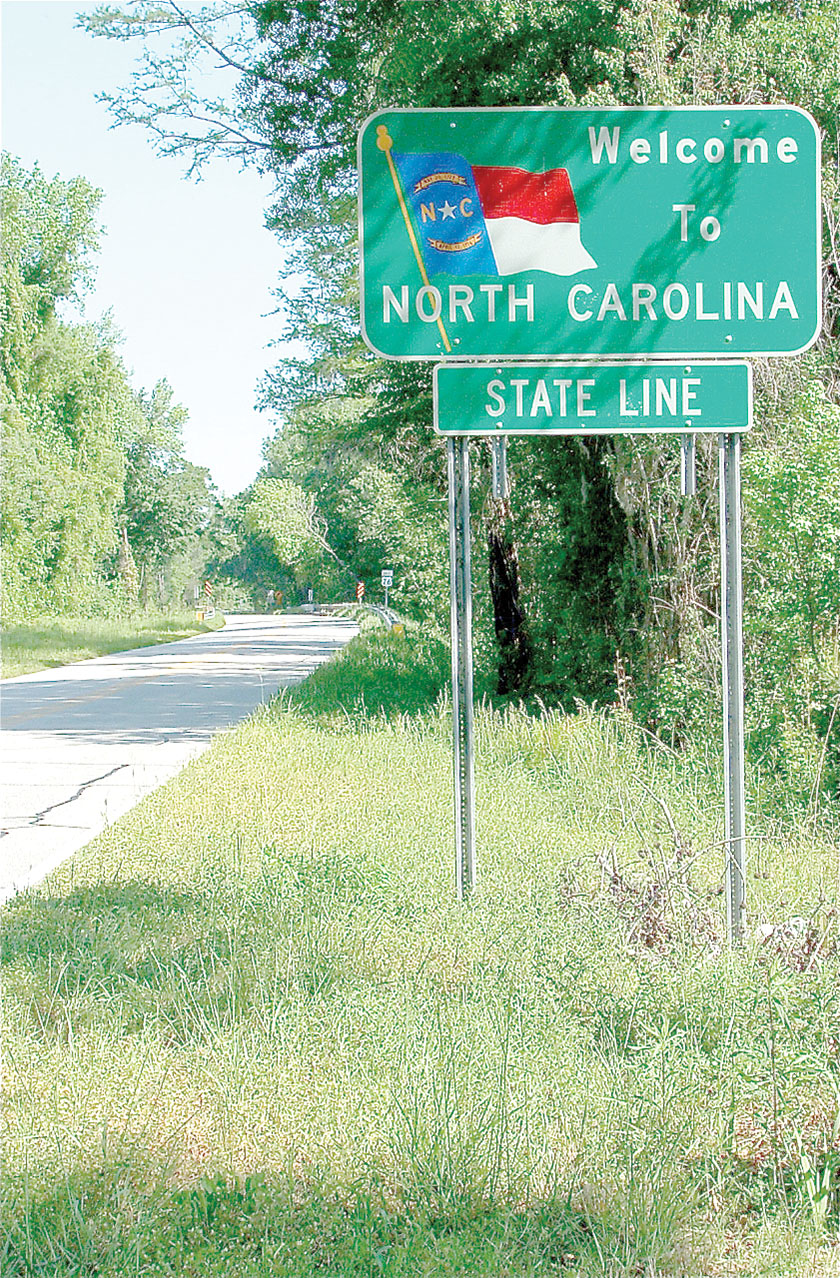
    Your starting point, the N.C. state line. Begin here and follow Highway 76 through rural South Carolina.

    A Summer Road Trip Across S.C.,

    Part One: From Spring Branch to Mayesville

    Summer means road trips. Here’s a guide to crossing South Carolina in three drives.

    Slung across the Palmetto State like a thin, low-hung belt and cosigning with 176, 378, 301, I-26, I-126, and other roads, 76 runs across the Palmetto State entire. In all, 76 runs 548 miles, east to west, from Wrightsville Beach, N.C., to Chattanooga, Tenn.

    And it runs through my mind, this asphalt river lost in time. For I have driven every inch of it, and I know that for those who live along its path and those who go to work on it, it flows as essential as ever. On three Sundays, I journeyed its length – past remnants of an old South Carolina and a shiny new South Carolina. My escort? The goddess Change.

    Highway 76 begins unceremoniously, easing into South Carolina from Tar Heel Land. No state sign welcomes me, just a sign heralding my arrival in the Horry County community of Spring Branch. Crossing the Little Pee Dee, I’m in vintage country. A tire swings from a tree near the Spring Branch Country Store. And then Nichols, all 1.4 square miles, arrives.

    From a weathered mansion’s column, a framed deer head stares at 76 passersby. Man’s oldest calling, hunting, thrives here. And fighting too. The town of Marion honors Francis Marion, Revolutionary War hero, and just beyond flows the Great Pee Dee, the river that missed renown in Stephen Foster’s “Old Folks at Home.” Spying the Suwannee River on a map, Foster preferred “Swanee’s” lyrical fit.

    Highway 76 can be surreal. A “Broken Arrow” incident, the first, happened at Mars Bluff. A B-47 bomber, No. 876, left Savannah’s Hunter Air Force Base for North Africa. At 4:19 in the afternoon of March 11, 1958, it accidentally dropped an unarmed nuclear bomb in the woods behind Bill Gregg’s home. The bomb slammed down in gummy loam and its high-explosive trigger dug a crater 50 feet wide and 35 feet deep. No one died.

    Not far away, a gunboat sleeps way down beneath the Pee Dee. The Confederate Mars Bluff Naval Shipyard built the C.S.S. Pee Dee upriver from the 76 Bridge. Because Sherman was coming, Confederates sank the Pee Dee March 15, 1865.

    Fields and forests fly by until I arrive in Florence, where the Drive-In Restaurant claims to have the Pee Dee’s greatest fried chicken. That would please those Chic-Fil-A bovines who take matters into their own hooves and their famous cousin who lived here. In 1925 Commerce Secretary Herbert Hoover visited Fred Young’s dairy farm whose Jersey, “Sensation’s Mikado’s Millie,” set a world-champion butter-fat record.

    In Timmonsville, “Cale Yarborough” says it all. NASCAR racing through my mind, I approach Cartersville and pass JB’s CB Shop, a reminder of the 1970s citizens band craze. Outside Mayesville, veins of tar run like rivers through 76, now a gravel reminder of Sumter County’s old days. From here came Mary McLeod-Bethune, civil rights leader, unofficial advisor to Franklin Roosevelt and founder of Bethune-Cookman College in Daytona Beach, which she opened for African-American girls in 1904.

    Next week: Part Two — From Sumter to Prosperity

    Learn more about Tom Poland, a Southern writer, and his work at www.tompoland.net. Email day-trip ideas to him at tompol@earthlink.net.

  • Major Coach of the Year

    Boo Major

    BLYTHEWOOD – South Carolina head coach Boo Major of Blythewood has been named SEC Equestrian Coach of the Year for the second straight season. Major’s selection was determined by a vote of the league’s four head coaches. Major, in her 17th season at the University of South Carolina, led the Gamecocks to the 2014 SEC Equestrian Championship, their second in a row, becoming the first team at South Carolina (in any sport) to win back-to-back SEC titles. This year, the Gamecocks have posted their best regular season in team history, going 11-2 overall and 4-2 in conference action.

    “I’m certainly honored to receive this award from an outstanding group of SEC coaches, but this is a reflection on our team and the riders,” Major said. “We have a terrific group of student-athletes who have committed themselves to succeeding in the classroom and in the competition arena. This year, we had 21 riders named to the NCEA Academic Honor Roll, seven of which were named to the Academic First Team, and that’s something we take a lot of pride in. I want to thank Athletics Director Ray Tanner and our University President Dr. Harris Pastides for their leadership and support of our program. I also want to thank everybody in the athletics department for their work and commitment to our team’s success, and certainly I want to recognize our assistant coaches Ruth Sorrel and Carol Gwin for what they’ve done.”

    Major has led the Gamecocks to two NCEA National Championships, in 2005 and 2007. South Carolina is currently the top-ranked equestrian team in the country in the National Collegiate Equestrian Association’s coaches’ poll.

    The Gamecocks are in Waco, Texas this week for the 2014 NCEA National Championships, which will run April 17-19.

  • Council Counts Doko Pennies

    BLYTHEWOOD – During a 5-hour work session on Tuesday, Blythewood Town Council presented an update on where the Town stands with construction costs associated with Doko Meadows (the park) and Doko Manor. The bottom line, Councilman Tom Utroska told Council members, is that there is still work to be completed on the Manor and the park, and at least $157,967 is still owed to the two construction companies (Condor Construction Company and Monroe Construction Company) for work both completed and yet to be completed.

    “The Blythewood Facilities Corporation (the BFC, which disperses construction payments for the park and manor) owes Monroe a total of $51,871.71, including $27,400 for work still to be completed on the two restrooms in the park and $24,471, which has been retained by the BFC as an incentive until all the work is completed,” Utroska said.

    Utroska said the BFC owes Condor a total of $106,095.45, including $67,066.10, most of which is for landscaping work yet to be completed by Pony Hill Nursery who Utroska said was subcontracted by Condor. That work includes sod and irrigation on the athletic field and grassing of the park and Town Hall, which is almost complete. Construction work yet to be completed by Condor includes the clock tower base and all dumpster enclosures. In addition, BFC is still holding $44,029.35 in retainage due Condor. The total owed both companies is $157,967.16.

    According to a report presented to Council by former Councilman Paul Moscati on Sept. 17, 2013, there should be a remaining funds balance of $18,754.96.

    “But the problem with this balance,” Utroska told Council, “is that there is a lot of money (from the original $5.5 million bond) that was spent not for construction but for things such as revised estimates, new plans drawn up by Land Plan South or the architect (Ralph Walden) that were not included in the construction contracts. So (Moscati’s) original construction fund numbers and the actual money spent will never match.

    “We’ve had to pay additional money out of the general fund for these things and I don’t know if we’re going to have to come up with more to pay for the $157,967.16 we still owe,” Utroska said. “I really don’t know what’s left in the BFC pot of money. Much of the $157,967.16 is for work that is actually still to be done under contract.”

    Plus, Utroska said, there are going to be additional costs including $2,412 for a security system for the Manor, the second layer of paving for the roads in the park, paving repair on the walking trail and a reserve fund.

    “We don’t have the funds for this,” Utroska said.

    “I think Paul (Moscati) did a good job keeping up with what had and had not been done on the overall project,” Utroska said, “but I don’t think it was managed well fiscally. We ended up spending a lot of money that wasn’t included in the budget. It wasn’t necessarily on construction, but it was money the Town had to spend on the park.”

    Reimbursing the General Fund

    Looking at the financial losses at the Manor, Councilman Bob Massa suggested establishing a formal payment plan to reimburse the general fund for a $162,000 deficit that ran up at the Manor during its first year of operation. He proposed making monthly reimbursements to the Doko Manor cash account only after the unrestricted part of the account (consisting of such items as deposits on rentals) exceeds $10,000.

    “At month end for balances from $10,000 – $19,999, 10 percent will be returned to the general fund cash account until the entire payable is reimbursed,” Massa said.

    For all month end balances in excess of $19,999, Massa suggested the general fund cash account be reimbursed $5,000 plus 10 percent of the remaining balance in excess of $10,000. He asked that Council pass a resolution for the payment plan at the April 28 Council meeting.

    Other Business

    Council also discussed goals for 2014-15 and it received a technology briefing from VC3 about their Cloud-based technology and other offerings that would facilitate the Town’s computer technology. Council discussed a Resolution in executive session pertaining to the Winnsboro water franchise agreement (see related story, page 1) and voted unanimously in favor of it.

    The next Town Council meeting is April 28 and another workshop is scheduled for May 13, from 8 a.m. until noon.

  • Surprise Resolution Could End Blythewood’s Cut of Water Deal

    WINNSBORO – Town Council was shocked to discover Tuesday night that Blythewood Town Council had, during their meeting earlier the same day, voted unanimously to pass a resolution to terminate the water franchise agreement between the two municipalities. Council said they were completely unaware that Blythewood had even been considering such a move, hearing about it for the first time, Council said, when questioned after Tuesday’s meeting by a reporter from The Voice.

    The resolution may, in fact, have been somewhat premature, Winnsboro officials noted, as the contract is binding for another six years – until 2020. And with Winnsboro still owning the existing infrastructure in place beneath the streets of Blythewood, any new provider of water would have to work out a deal with Winnsboro in order to pipe in the supply, or else make an enormous investment to put their own infrastructure in the ground. The one thing the resolution would do for certain, were it legally found to be able to sever the agreement prior to 2020, would be to end the payments made by the Town of Winnsboro to Blythewood for the use of Blythewood’s streets and right-of-ways necessary for Winnsboro to access, service and maintain its infrastructure.

    The resolution would not prevent Winnsboro from selling water to Blythewood customers in the future, according to John Fantry, Winnsboro’s legal counsel on water and utility issues. If the resolution was implemented and the agreement canceled, Fantry said Winnsboro could easily bypass the Blythewood right-of-ways to continue to serve customers.

    “I don’t know why they would want to cancel that,” Winnsboro Town Manager Don Wood said Tuesday night after learning of the passage of the resolution. “It’s for their benefit. That’s money we collect for them and we turn over to them.”

    Currently, Winnsboro has approximately 750 taps in and around Blythewood. Wood said Winnsboro collects 1.5 percent on each water bill and transfers that money to Blythewood annually. Blythewood Mayor J. Michael Ross, however, said the fee only amounted to around $13,000 a year, and the resolution was less about money and more about ensuring future development for Blythewood.

    “This is about an economic development issue – Doko Village – that came to us and was dead in the water because the developer went to Winnsboro and couldn’t get water,” Ross said. “We can’t grow, and there’s plenty of water available from Columbia. They’re supplying us already.”

    Blythewood is indeed supplied by the Capital City, thanks to a deal two summers ago between Winnsboro and Columbia that brought up to 400,000 gallons a day through Winnsboro’s meters and into Blythewood homes and businesses. The deal was revised last year to bring the amount up to as much as 1 million gallons a day. That revision was put in place largely to help supply Fairfield County’s new Commerce Center on Peach Road. The Doko Village project, Ross said, would have been a tremendous boon for Blythewood, bringing homes and businesses into the community.

    But as large a part as future growth played in Tuesday’s resolution, Ross said another factor instilled fear in Blythewood. When word leaked out earlier this month that a private corporation was interested in purchasing Winnsboro’s Blythewood infrastructure, Ross said Blythewood “hit the panic button.”

    “I think it sent up a red flag that that infrastructure could be sold out from under us,” Ross said. “It scares me a little when private enterprise gets involved with public utilities.”

    That private enterprise, Ni America, LLC, which owns Palmetto Utilities in Elgin, recently approached the Town of Winnsboro, according to a source close to the situation, and threw down an $800,000 offer. But Tuesday night, Winnsboro Mayor Roger Gaddy said the Town was not, in fact, in negotiations.

    “We’re not anywhere with it,” Gaddy said. “We haven’t set a price on anything. We’re not in the process of negotiating anything.”

    Councilman Stan Klaus agreed, and said after the meeting that Ni America had come to Winnsboro “to talk,” but that there were no negotiations to sell. The Voice’s source also said the rumored “negotiations” barely even qualified as “talks,” and that he felt it was very unlikely Winnsboro would be interested in selling.

    “That’s real easy to say,” Ross said. “We’re just trying to look out for the future of the Town of Blythewood.”

  • Commission OK’s Election Results

    RIDGEWAY – Although a number of his votes were whittled away by the Fairfield County Election Commission Friday morning, write-in candidate Heath Cookendorfer’s surprise victory in Ridgeway’s April 8 municipal election was upheld by a final tally of 43 votes to 41 over incumbent Town Councilwoman Belva Bush.

    The two-vote margin put Cookendorfer just beyond the mandatory recount threshold and the 42-year-old native of Alexandria, Ky. was sworn into office Friday evening.

    Debbie Stidham, Director of Fairfield County Voter Registration & Elections, said the Commission discounted some votes that did not clearly indicate voter intent, per state guidelines, such as ballots that simply read “Heath,” or incorrectly read “Heath M.”

    Other vote finals remained unchanged, with incumbent Charlene Herring easily beating out Bush for mayor, 91-27, and Councilman Russ Brown earning a second term with 98 votes. Herring and Brown also renewed their oaths Friday.

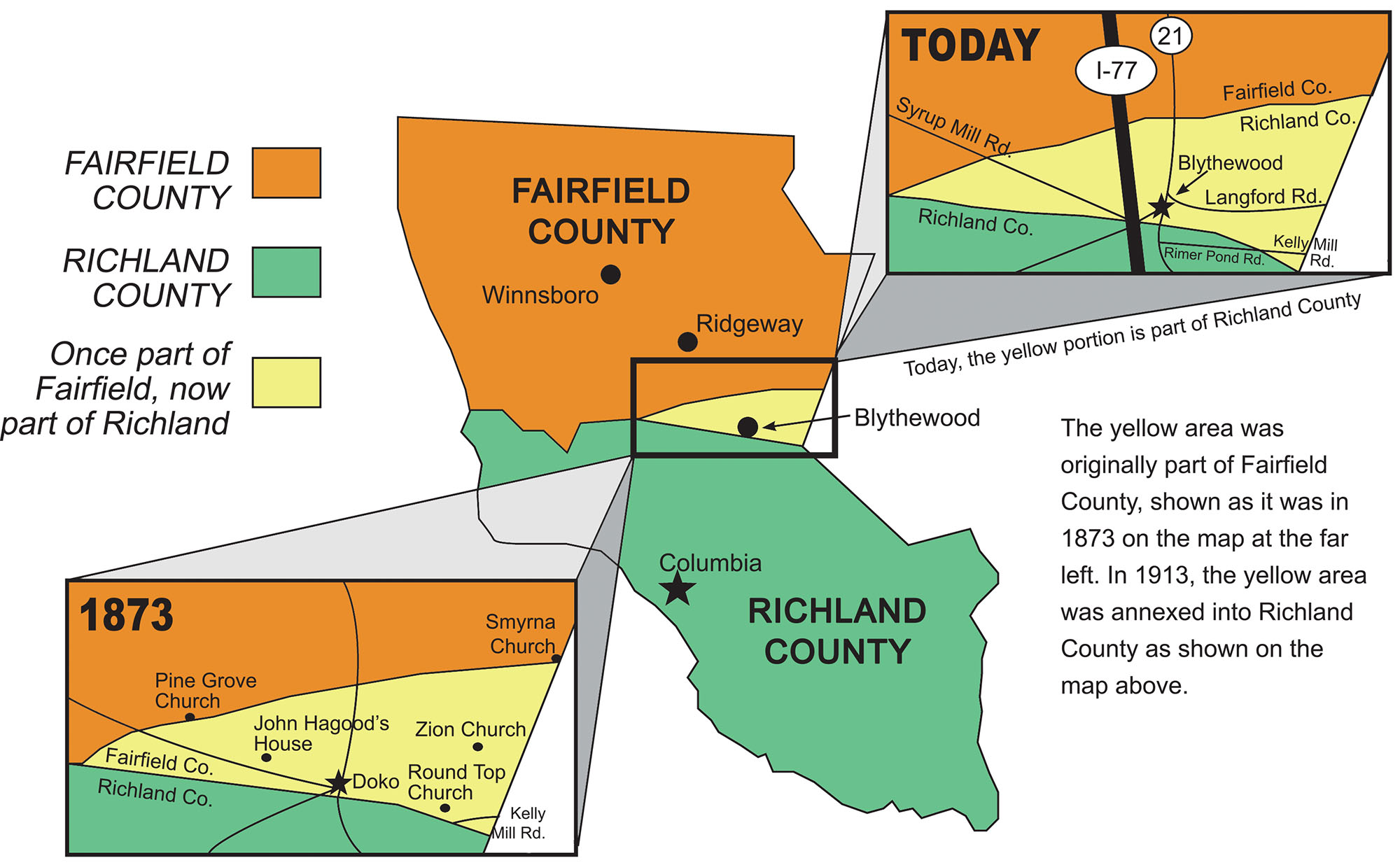
  • A County Divided: How — and Why — Blythewood Fled Fairfield

    On Nov. 16, 1910, a group of Fairfield County residents petitioned their state government for annexation into Richland County. Here is their story – which is also the story of How Doko of Fairfield County became Blythewood of Richland County . . .

    Blythewood in Fairfield County

    Until 1910, Blythewood was content to be in Fairfield County. But a great dissatisfaction arose with the treatment of the Blythewood section by the Fairfield County government. This inspired the Blythewood gentlemen to try something new. Under the terms of the 1895 Constitution, written to the specification of Sen. Benjamin R. ‘Pitchfork Ben’ Tillman, new counties could be created and sections of counties could be transferred from one county to another.

    There were several conditions: 1) a petition bearing the signatures of at least one-third of the registered voters in the affected area must be obtained; 2) no area could be taken from a county if the transfer would leave the old county with fewer than 15,000 inhabitants; 3) no old county could dip below 500 square miles; 4) the old county could not dip below $2,000,000 in taxable property; 5) the new county lines could be no closer than eight miles from the courthouse; 6) once these condition were met, an election could be held in the area proposed for transfer and at least two-thirds of the voters had to vote for the transfer and 7) if the question passed the election, the General Assembly then could, if it chose to, pass a bill to effect the annexation.

    Fairfield officials try to appease defectors

    In an apparent attempt to dissuade the petitioners from annexing into Richland County, the Fairfield County Board of Commissioners, on Sept. 12, 1910, passed a resolution regarding the complaints of the ‘Inhabitants of Lower Fairfield.’ It promised in a handbill distributed all around to make several concessions. First it would split the chain gang into two forces of equal numbers, one to work in the northern half of the county and one to work in the southern. The gang in the southern half was to be ‘put to work immediately under the supervision of Mr. Joseph B. Stewart…to improve and construct first class roads through Bear Creek and Blythewood sections.’ Second, the State Senators and Representatives pledged to give each section of the County a voice in the Democratic Party organization of the county. It would appear from this that a lack of fairness in road construction and upkeep as well as influence in Democratic Party circles was inspiring the movement to separate Blythewood from Fairfield and add it to Richland.

    The promises of Fairfield’s leaders must not have had much effect on the Blythewood citizens as on Nov. 16, 1910, they presented petitions to Gov. Martin Ansel asking to be annexed into Richland County. The petitions were sworn to by Furman E. Hood, B. P. Hoffman and Dr. Michael Langford. They contained 139 names, well beyond the one-third required to set the annexation machinery in motion. These petitions are a who’s who of early Blythewood.

    Gov. Ansel had Assistant Attorney General M.P. DeBruhl look over the petitions and on Nov. 16, 1910, he received the legal go-ahead to appoint commissioners to survey the area and arrange for a possible transfer. He appointed W.W. Cloud and Dr. Michael Langford of Blythewood, W.R. Brooker of Columbia and J.E. McDonald of Winnsboro as commissioners in this matter.

    Fairfield government tries to block annexation

    Then, on Nov. 20, 1910, R.A. Meares, a member of the Fairfield Delegation to the S.C. House of Representatives residing in Ridgeway, wrote to Gov. Ansel asking him to postpone further action in the matter as it was ‘a local matter of discord…in process of adjustment.’ The Governor replied that the Commission had already been appointed.

    In January 1911, Coleman L. Blease became Governor. The Blythewood annexation matter stewed along until March 15, 1911, when the Commissioners reported to the new Governor that all the statutory provisions regarding wealth, area and population were complied with and a survey of the area completed. The Commissioners asked that an election be held in early May 1911. Gov. Blease was generally opposed to any changes in county lines, and therefore sat on the Commissioners Report until June 8, 1911, when the Blythewood Commissioners again wrote asking him to speed things along and give them the election they felt entitled to.

    Blease wrote Sen. Dixon of Fairfield that he had held the matter up so far, but he was being pressed to act so he was inquiring of the Clerks of Court in Columbia and Winnsboro whether the required expenses for holding an election had been paid. He found the funds had not been deposited, which gave him and the Fairfield County political leaders an opportunity to further hold up the election.

    On Aug. 12, 1911, W.W. Cloud of Blythewood paid the Clerk of Court in Winnsboro $55 for the costs of holding an election. A new question then arose over the amount of money required. Were the petitioners required to pay for the election only (a relatively small sum) or for the election, survey and costs for the Commission? Rep. Meares used this argument in a letter to Blease asking him to further postpone the election, all the while assuring him that the work on the roads around Blythewood continued and would surely pacify the residents if enough time could be bought.

    Fairfield power structure runs out of time

    By December 1911, the Fairfield County power structure was running out of time. Assistant Attorney General DeBruhl gave an opinion that all requirements had been complied with, and the Governor was therefore free to order an election on the question. On Dec. 16, 1911, Blease ordered that an election be held on Jan. 11, 1912. The Clerk of Court of Fairfield County as well as J.M. McDonald (annexation commissioner from Fairfield) continued an exchange of letters with Gov. Blease, arguing that still not enough money had been deposited by the Blythewood men. At this point, Blease became annoyed and his letters took on a short, flippant style. He eventually told Mr. McDonald, “You will please have the election ordered or send me your resignation as Commissioner of Election, and I will appoint someone who will obey the mandates of the law.” McDonald replied that he would order the election, although he ‘hated to see them leave us, but if they will go, let them go, and may the Devil take the hindermost.”

    Writers Note: While I have been unable to locate the results of the election ordered for Jan. 22, 1912, the annexation into Richland County did pass. On Feb. 18, 1913, a bill passed the General Assembly that transferred 47.07 square miles from Fairfield County to Richland County. There were about 3,500 people in the area, with between 170-200 registered voters. This extremely low number of voters can be understood by remembering that only white men over the age of 21 could vote then. Gov. Blease did not sign the act, letting it become law without his signature. Because of the neglect of an unresponsive government, Blythewood left its former home in Fairfield County to join Richland County.

  • Green Questions State Spending Claims

    Many District Costs Down Since 2012

    WINNSBORO – Dr. Mick Zais, State Superintendent of Education, last week targeted nine S.C. school districts he said spent more on operations costs in 2011-2012 than on teacher salaries. Among those districts was the Fairfield County School District, which Zais said spent $2,384 per student on operations. Operations costs, according to Zais, include maintenance, data processing and business operations, as well as legal fees and district office staff salaries.

    “I am very disappointed to see that nearly 11 percent of districts in our state spent more money on district operations than on teacher salaries,” Zais said. “These data give taxpayers insight into where their money goes.”

    J.R. Green, Superintendent of Fairfield County Schools, said that since his tenure with the District began with the 2012-2013 school year, he was at a disadvantage when it comes to explaining Zais’ data. But, he said he found the release of two-year-old data both confusing and frustrating.

    “(Zais) often does this,” Green said, “throwing old data out there without telling you how he arrived at these figures. He’s trying to promote some type of agenda, it seems.”

    Zais’ data is based on a statewide average teacher salary of $47,376, with an average class size of 22 students. Green said Fairfield’s average class size was approximately 19 students and that teacher salaries were more or less consistent with the statewide average.

    Furthermore, Green said, even before he arrived in the District, reductions were being made in District office staff.

    “And we haven’t added any (District office staff), apart from the project manager (for the career center construction) since I’ve been here,” Green said.

    The greatest reduction in operation expenses during his tenure, Green said, has been in legal fees. During the 2011-2012 school year, from which Zais draws his data, the Fairfield County School District spent $351,403 in legal fees. The following year, that figure was down to $166,306. As of February of this year, Green said, the District had spent only 12 percent (approximately $34,000) of the $282,707 it had budgeted for legal fees.

    “That puts us on track to spend less than $100,000 (on legal fees) by the end of the year,” Green said, “so, we’ve taken huge steps in reducing that. Regardless of what method (Zais) used (to compile his data), if legal fees are a part of that, then we’re better off than we were two years ago.”

  • Write-In Pulls Election Night Upset

    Heath Cookendorfer

    RIDGEWAY – Although the results are still unofficial, the final numbers rolling in Tuesday night appear to have carried a surprise candidate to victory in Ridgeway’s municipal elections.

    Charlene Herring easily won her third term as mayor Tuesday night, besting challenger and sitting Councilwoman Belva Bush 91 votes to 27. Russ Brown also coasted to his second term on Town Council with 98 votes. The big shock, which will not be confirmed until 10 a.m. Friday by the Fairfield County Election Commission, came in the race for the second spot on Council, as write-in candidate Heath Cookendorfer appears to have ousted Bush from her Council seat, 47 votes to 41.

    Cookendorfer, 42, is originally from Alexandria, Ky., and has lived on N. Palmer Street in downtown Ridgeway for approximately 10 years. He made his intentions to run as a write-in known to the Fairfield County Elections Office on March 29, according to Debbie Stidham, Director of Fairfield County Voter Registration & Elections, in a phone call to the office. While all of Cookendorfer’s information was written down by office staff at that time, Stidham said, staff also informed him that a written declaration would also be necessary and asked him to send that declaration by email. After polls closed Tuesday night, the Elections Office was unable to locate Cookendorfer’s email containing the written declaration. Stidham said Cookendorfer sent the information via email late Tuesday as a precaution, but added that her office did have the information that was written down at the time of the March 29 phone call.

    The written declaration is necessary, Stidham said, in order to confirm spelling of a candidate’s name so that the Election Commission can verify voter intent when confirming results.

    “I decided at the 11th hour to put my candidacy in for Town Council,” Cookendorfer said Tuesday night. “I’ve always been interested in politics. It’s been a passion of mine since I was a little kid.”

    Cookendorfer said he had made two previous bids for Town Council, both with no success. When he saw that Bush was running for both the mayor’s seat and reelection to her Council seat, Cookendorfer said he saw an opportunity, especially if Bush won the mayor’s race.

    “I look forward to working with everyone on Council and serving the people of Ridgeway,” Cookendorfer said. “I think Charlene Herring has done a good job and I think Council has done a good job of putting Ridgeway on the map.”

    While results were still unofficial, Bush accepted the outcome graciously.

    “I am thankful for the time I’ve spent with the town,” Bush said, “but I’m also grateful for the rest. I thank all the people who supported me. I admire the work Charlene has done and I’m sure she will continue to do a good job. It was a pleasure to be the first African-American to run for mayor in Ridgeway.”

    Herring could not be reached for comment at press time.