Blog

  • Plantation Residents: Things Reek in LongCreek

    BLYTHEWOOD – Some residents of Blythewood’s LongCreek Plantation subdivision are accusing the Board of Directors of their Property Owner’s Association (POA) of turning a blind eye to a developer, Gateway LLC, who residents say is blatantly disregarding the neighborhood’s deed restrictions and covenants as it develops a new neighborhood within LongCreek Plantation. Sam Brick, an attorney and resident of the subdivision, but not a member of the POA, said there are, so far, no responses from either the POA or Richland County to Gateway’s actions.

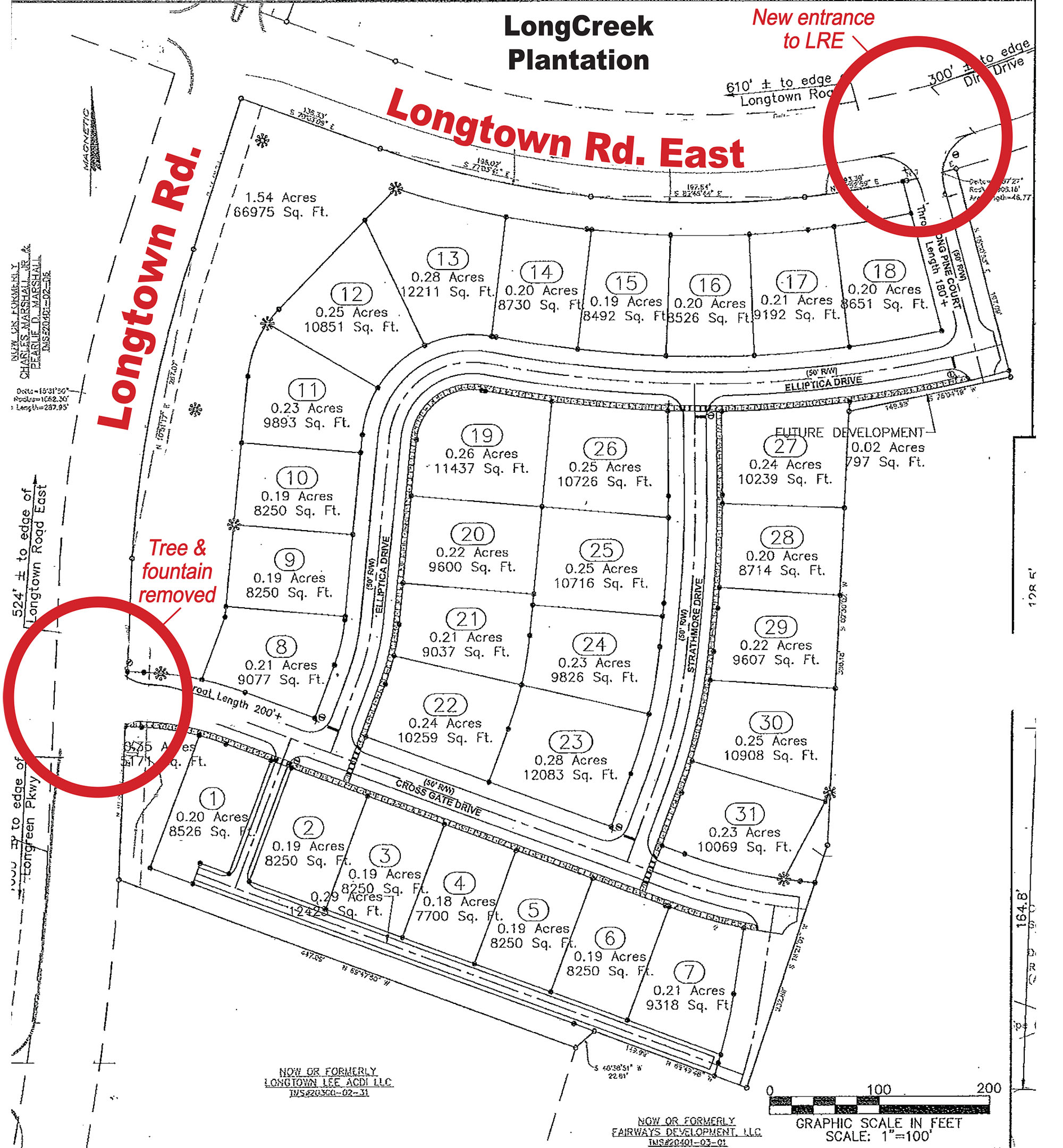
    Gateway purchased 10 acres at the southern entrance to LongCreek Plantation March 15, 2013. According to members of the POA and other residents of the subdivision who asked not to be identified, Gateway, earlier this year, proceeded to rip out a landmark giant oak tree and the subdivision’s substantial sign and fountain at that entrance on Longtown Road to make way for another smaller entrance (in the same location as the tree and sign) to serve a new neighborhood proposed on the 10 acres. Brick said the tree and sign were specifically protected in the property’s deed restrictions and should be addressed by the POA board.

    “When John Bakhaus, the developer of LongCreek Plantation, sold the 10 acres to a Presbyterian church about 14 years ago, it was specified in the deed that the tree and fountain must not be removed,” Brick said.

    When Gateway LLC purchased the property last year, the owners signed a deed that stated (section F of page 5 of the deed restrictions) that “Additionally, the LongCreek Plantation Sign and overhanging tree shall be left intact.”

    In addition to the ruckus over the destruction of the tree and sign, Brick said the zoning for the 10 acres is medium density with 8,500-square-foot minimum lot sizes.

    “Yet, the developers are not abiding by this in almost half the planned lots and the County is not honoring the zoning in its approvals of these site plans,” Brick said.

    Some residents also say flooding from recent thunderstorms (at the adjacent intersection of Longtown Road and Longtown Road East and West) is the result of Gateway’s failure to abide by the covenants, which, they say, state that no more than 40 percent of the area may be disrupted during construction of the roads, sewers, etc.

    Brick told The Voice that Gateway’s designs also call for a four-way traffic stop on Longtown Road East between the Windermere Club and the four-way stop at the entrance to LongCreek at Longtown Road.

    “The POA has standing on these issues but is doing nothing to protect us. It’s burying its head in the mud,” Brick said. “The POA is responsible for upholding covenants of title but have done nothing so far in this case.”

    The Voice received several email notices from residents that the POA had called for a meeting Wednesday evening (June 11) at the Columbia Country Club to discuss these issues. However, POA members received an email from the LongCreek POA on Tuesday, June 10, stating that the meeting was not for the residents, but a regular monthly POA Board of Directors meeting.

    “Any member of the POA is allowed to attend the meeting,” the email stated, “unless it is called into Executive Session. Non- members of the POA are not allowed to attend, unless specifically invited…”

    The Voice obtained a copy of the meeting agenda, which did not list any of the residents’ concerns regarding the Gateway development, but mundane items including: website update, a neighborhood yard sale and the LongTown nature trail. An executive session was listed but there was no explanation, as is required by the S.C. Freedom of Information Act, as to the purpose of the session.

    Brick said many of the residents of the subdivision are hoping the POA board will open the meeting to the residents and hear their concerns about the construction at the entrance.

    The Voice left email and voice messages for LongCreek Plantation developer John Bakhaus; the agent for Gateway LLC, Kenneth E. Ormand Jr. and the president of the LongCreek POA, Stephen Stackhouse, but had not received any responses at press time. Since the Wednesday meeting of the POA was held after The Voice went to press, that report will appear in the June 20 edition.


  • Douglas Prevails in Primary

    State Rep. MaryGail Douglas

    Dickerson Earns Bid for Senate Race

    WINNSBORO – In unofficial results reporting in late Tuesday night, incumbent State Rep. MaryGail Douglas (D-41) successfully held off a primary challenge from Chester City Councilman William “Budda” Killian, 1,696 votes to 968. Douglas swept away Killian in her home county of Fairfield 1,182 votes (72.96 percent) to 438 (27.04 percent). In the Richland County areas of District 41, Douglas also carried the day, 126 votes (82.89 percent) to 26 (17.11 percent). Killian carried his home county 504 votes (56.5 percent) to 388 (43.5 percent), but it wasn’t enough to overcome Douglas, who will be unchallenged in November.

    “I am elated and glad I made it through for another 730 days,” Douglas said. “I’m glad folks have that much confidence in me. I have enjoyed my first term and I am looking forward to serving again.”

    Douglas said that in her upcoming second term in the General Assembly, two key issues top her agenda – ethics reform and roads and bridges.

    “(Ethics reform) has got to be resolved,” Douglas said. “We have got to do a better job of reclaiming some semblance of integrity among ourselves. We have some good people there, but we are branded by people who think we’re all crooks.”

    Roads and bridges, Douglas said, “are the foundation of our state and we wouldn’t allow our houses that we live in to get into the shape that our roads and bridges are in. We have got to address that.”

    U.S. Senate

    With 43 of 46 counties reporting at press time, Richland County Councilwoman Joyce Dickerson (District 2) earned one of the two Democratic nominations in the race for U.S. Senate. Dickerson beat out Sidney Moore and Harry Pavilack with nearly 66 percent of the vote Tuesday. Dickerson carried Fairfield County with 843 votes (61.99 percent), and Richland County with 14,602 votes (82.66 percent). She will face Republican incumbent Tim Scott in November. Scott handily earned his party’s nomination with more than 90 percent of the vote over Randall Young.

    Orangeburg Democrat and S.C. State Sen. Brad Hutto (D-40) earned his party’s second nomination in the U.S. Senate race, besting Jay Stamper with 76.64 percent of the vote. Hutto will face Republican incumbent Lindsey Graham in November. Graham fought off a slew of challengers in the Republican primary with 56.49 percent of the vote. His closest rival, Greer conservative State Sen. Lee Bright (R-12), mustered just under 16 percent of the vote.

    Sixth Circuit Solicitor

    In the race for the Republican nomination for the Sixth Circuit Solicitor’s Office being vacated by retiring Doug Barfield, Randy Newman Jr. earned the bid, beating out Tom Holland 3,157 (55.02 percent) to 2,581 (44.98 percent). Holland carried Fairfield County, 452-385, but strong showings by Newman in Lancaster, where Newman won 2,393-1,840, and Chester, where he won 379-289, lifted Newman to victory. Newman will face Fairfield County public defender William Frick in November.

    Results from Tuesday’s primary remain unofficial until certified later this week.

  • Christ Central Cuts Ribbon on Mission Ridge

    The directors of Christ Central cut the ribbon during the grand opening ceremony Friday of the renovated Mission Ridge Golf and Leadership Center in Winnsboro. From left are mission directors Ted McGee, Barbara Franklin, CEO Jimmy Jones, Lee Kizer and Roger Floyd.

    WINNSBORO – About 100 community members and elected officials attended the ribbon cutting for Christ Central’s newly renovated and expanded Mission Ridge Golf and Leadership Center, formerly the Fairfield County Club. The facility, which includes a 9-hole golf course, will be used for leadership training for Christ Central missions as well as for local organizations and governments, according to Jimmy Jones, CEO and founder of Christ Central. Jones now has 90 facilities around the country that minister to the homeless by providing housing, education opportunities and jobs. Mission Ridge, with several furnished bedroom suites on the second floor, will also accommodate private social events including weddings, receptions and other celebratory events.

    Gov. Nikki Haley, who had been scheduled to speak at the grand opening ceremony, was unable to attend but her prepared message was read by a spokesperson.

    “You and your leadership team have truly set the example for neighbors helping neighbors,” Haley said in her message.

    The training center will focus on ways to serve the community and will serve as a retreat for mission directors. Jones explained how Christ Central began operations 17 years ago on a street corner in Columbia serving homeless people with meals and other services. Jones said that besides feeding the homeless, Christ Central housed them and prepared them to find jobs and get an education.

    Jimmy Burroughs, a lifelong resident of Fairfield County and Director of Christ Central in Winnsboro, told those attending the event, “This is a great facility for Fairfield County and now it’s a public facility for the entire area to use.”

  • Town Councilman: Pull Up Your Pants!

    Ordinance Aimed at Sagging Britches

    WINNSBORO – Town Council, on the suggestion of Councilman Clyde Sanders, instructed the Town’s attorneys Tuesday night to craft an ordinance that would impose a civil penalty for wearing pants that hang down below the wearer’s undergarments. The fashion statement has become so prevalent, Sanders said, that it has become an embarrassment for the entire community.

    “It’s embarrassing to me to go to Wal-Mart or walk down Main Street and have somebody holding their pants up just to take a step, and that’s what they’re doing,” Sanders said. “A couple of years ago it wasn’t quite as bad. They went down to just showing the top of their drawers. Today, it’s below the bottom of their underwear. . . . If a female, 18 to 40 years old, walked into Wal-Mart with their pants below their butt, she would probably be arrested for indecent exposure.”

    Councilman Danny Miller said he agreed, but questioned how such an ordinance would be enforced and by whom.

    “Who’s going to enforce it? Law enforcement? They’re going to be dealing with that all day long,” Miller said.

    Freddie Lorick, Chief of Public Safety, suggested that Council consider making the infraction a civil violation, and not criminal, so that officers could write tickets instead of carting violators off to jail.

    “One town is charging a $114 fine,” Sanders said. “I think that’s probably a little excessive. But if you go to Wal-Mart or somewhere and our police force sees somebody, ask them to pull their pants up and if they don’t, write them a ticket for $10. If you get very many $10 tickets, you’re going to get the point at some point and start wearing your pants like you’re supposed to.”

    Mayor Roger Gaddy agreed and asked the Town’s attorneys to come up with an ordinance.

    Water

    Sanders also requested a work session with Margaret Pope of the Pope Zeigler Law Firm in Columbia, the firm that counseled the Town during their failed attempt to form a water authority. Sanders said Pope may be able to help direct the Town in its efforts to find the funds to run a water line to Lake Monticello. Explorations into a potential bond to fund the estimated $8-12 million project have hit a bit of a snag, Town Manager Don Wood said.

    “We have conflicting information,” Wood said. “We have an ordinance, somewhere among our ordinances, that says a utility that benefits from a particular loan, the debt service has to be paid from the revenues produced by that utility, which would imply that if we got this $8-$12 million loan, the water rates would have to support the debt service with that, which would put them very high.”

    On the other hand, Wood said that Trish Comp, with the State Revolving Loan Fund, told the Town this week that if a town has a combined utility, the revenues from all utilities may be used to pay back the loan.

    “So that would be gas, electric, water and sewer, rather than just water by itself,” Wood said. “That would be the only way we could afford to repay that.”

    Last month, Blythewood resident Jim Landmeyer, a hydrologist with the U.S. Geological Survey (USGS), told Council that it may be possible to solve Winnsboro’s water issues with wells. A groundwater survey would be necessary first, Landmeyer said, noting that such a survey had never been done in Fairfield County.

    Tuesday night, Mayor Gaddy said Council had made no movements on Landmeyer’s suggestion.

    “We haven’t really talked with the County about that,” Gaddy said. “The cost of that was about $200,000 and a three-year study, so we took that under advisement and we have not done anything with that.”

  • B&E Suspect Eludes Capture

    WINNSBORO – The Fairfield County Sheriff’s Office is seeking a North Carolina man who slipped away from a deputy last week after a car chase from the scene of one of three local church break-ins.

    Investigators have identified the suspect as David Ezel Simpson, 63, whose last known place of residence was in Charlotte, and have linked Simpson to last week’s break-ins at Weeping Mary Baptist Church and New Independent Methodist Church, and suspect Simpson in an incident at Greater Mt. Zion Baptist Church. According to the S.C. State Law Enforcement Division (SLED), Simpson has a string of burglary convictions in S.C., dating as far back as 1984 when he was arrested and charged by the Cheraw Police Department. Simpson was also subsequently arrested in Clover and in Spartanburg County, and Fairfield County investigators said Simpson had only recently been released from prison prior to last week’s break-ins.

    Just before 5 a.m. on May 26, a Fairfield County deputy responded to an alarm call at Weeping Mary Baptist Church at 7109 Highway 321 N. in Winnsboro. As the deputy drove his patrol car around the right side of the church, he spotted a 2002 Kia SUV with its headlights off pulling out of the church parking lot. The Kia hit the accelerator and raced south down Highway 321 with the deputy in pursuit.

    Near Toatley Road, the Kia made a sweeping U-turn and headed back north on Highway 321 with the cruiser still on its tail. Back near the entrance to the Weeping Mary parking lot, the Kia hung a right on Patrick Road. At the Bull Run Road junction, the Kia attempted the hard right-hand curve to stay on Patrick Road. The speed of the Kia was too great, however, and the SUV swerved across Bull Run Road, struck a tree and overturned a few yards away from Patrick Road.

    The deputy, with his sidearm drawn, approached the wreckage and ordered the driver, later identified as Simpson, out of the vehicle at gunpoint. Momentarily trapped inside the SUV, Simpson managed to kick out the glass of the driver’s side door window and crawl from the mangled heap of metal.

    Simpson appeared to be unarmed, so the deputy holstered his sidearm and deployed his taser, zapping Simpson in the hip and upper back. Simpson immediately fell to the ground, but just as quickly jumped back up, yanking the taser prong from his hip and running down Bull Run Road. The deputy executed a leg-sweep, taking Simpson down again, but almost at once Simpson was back on his feet and running down Bull Run Road. A second leg-sweep from the deputy sent Simpson sprawling off the side of the road and into a barbwire fence. Determined to avoid capture, Simpson rapidly freed himself from the barbwire entanglement and fled into the nearby woods. By the time the bloodhound unit and a SLED helicopter arrived to scour the area, Simpson was nowhere to be found.

    The Kia was traced back to a Simpson family member, investigators said, and items inside the SUV were identified as those having been stolen from Weeping Mary as well as from New Independent Methodist Church at 371 Odyssey Drive in Blackstock. The stolen goods – a keyboard and other miscellaneous items, worth approximately $1,100 – were returned to the churches.

    The New Independent break-in occurred some time between 1 and 3 a.m. on May 26, but was not discovered until later that afternoon. The suspect, believed to be Simpson, cut the wires to the church’s alarm system and forced his way in through the front door.

    A third incident also believed to be attributed to Simpson was discovered the following afternoon at Greater Mt. Zion Baptist Church at 2508 Camp Welfare Road, Winnsboro. A church member there found the church bus missing from the parking lot at 12:04 p.m. on May 27. Investigators found that the church had been broken into through the front door, and that the door to the pastor’s office had also been forced open. The only thing missing were the keys to the bus, which had been kept in a desk drawer inside the pastor’s office. The bus, worth $30,000, was found a short time later parked on the side of the road with its emergency flashers on, approximately 7 miles from the church near Highway 21 N.

    The Sheriff’s Office said there was not yet any definitive evidence linking Simpson to the apparently aborted theft of the bus, but DNA swabs and other evidence were still being processed as of press time. Fairfield County investigators are working with SLED and N.C. law enforcement agencies in their search for Simpson, the Sheriff’s Office said. How Simpson came to target Fairfield County is also an unknown at this time, the Sheriff’s Office said, as the investigation has established no links between Simpson and any individuals or family members locally.

  • A Swamp Thing

    There are roads in Palmetto land that go nowhere near big cities. And that’s not bad. One road, Highway 64, leads to Walterboro where an ancient lane once cut a green leafy tunnel through a swamp. Just three minutes off I-95, a town, of all places, provides a tranquil setting to contemplate a Southern swamp. Had Joseph Conrad written a novel about Walterboro he might have titled it “Heart of Greenness,” for a shimmering 842-acre swamp lives within Walterboro’s city limits.

    Located in the ACE Basin, the East Coast’s largest estuarine preserve, the sanctuary may well provide the only braided creek swamp accessible to the public. The Ashepoo River’s headwaters (the A in the ACE Basin), originate in the sanctuary.

    The sanctuary offers many opportunities to observe wetland life. Stroll the boardwalk stretching over more than two miles of swamp. See the Old Charleston to Savannah Stagecoach Road where George Washington gazed out a stagecoach window “to acquire knowledge of the face of the country.” At best, he made 33 miles a day the spring of 1791, and you can bet he saw plenty of wildlife. Interested in history and archaeology? You can explore the Old Wagon/Stage Coach Road over which all overland traffic passed between Charleston and Savannah.

    As for the swamp, it consists of hardwood flats with interweaving streams. Natural wealth includes beaver, deer, fox, otter, mink, opossum, raccoons, squirrels, wildcats and wild turkey. Feathers aplenty here. Bird life includes a large, year-round, population of songbirds, wading birds, ducks and raptors. The area serves as an important resting area for transient and migrating birds.

    The Walterboro Wildlife Sanctuary brings history, culture, recreation, and education together in a unique setting. Overland trails and boardwalks offer a chance to get some exercise as does a bicycle path. Tying it all together is the Discovery Center, an interpretive exhibition hall that informs visitors about the important role swamps play in the Lowcountry ecosystem and the habitat they maintain for numerous flora and fauna.

    It’s a matter of mere steps from natural history to Walterboro’s main historic district. Consider an overnight stay in this unique place where a swamp sanctuary forms a town’s green heart, and remember that man needs swamps too. They serve to cleanse our water, remove toxins from the environment, and best of all remind us the tremendous losses we’ve suffered when it comes to swamps and wetlands, once believed to be a source of diseases thanks to the evil miasmas that emanated from them.

    If You Go …

    • 122 miles

    • Free Admission

    • Open from dawn to dusk

    • 399 Detreville Street

    Walterboro, S.C. 29488

    • 843-549-2545

    • www.walterborosc.org/walterboro-wildlife-sanctuary.aspx

    Learn more about Tom Poland, a Southern writer, and his work at www.tompoland.net. Email day-trip ideas to him at tompol@earthlink.net.

  • D-Day: Jumping into History

    Staff Sgt. Bruce Baker

    ‘Longest Day’ Turns into Long Haul for Father of Publisher

    BLYTHEWOOD – Shortly after my dad, Bruce Baker, enlisted in the Army on Oct. 6, 1942, to serve in World War II, he learned paratroopers were being paid $100 a month more than the regular infantry, so he opted for the higher pay and the 508th Parachute Infantry Regiment, which was attached to the 82nd Airborne Division. While he had never even flown in an airplane, much less jumped out of one, he saw parachuting as an easy way to earn extra money for his wife and their growing family back in Texas. In the predawn hours of June 6, 1944, he might have been rethinking that easy money as he scrambled to make his first combat jump out of a low-flying C-47 troop transport plane over Normandy, France under the most harrowing of conditions. The day was D-Day – and that jump was the last one he would ever make.

    The 10,000+ paratroopers of the 82nd Airborne Division were an integral part of the Western allies’ massive plan to liberate Europe from Nazi occupation and stop Hitler’s advance toward the west and, potentially, the world. The paratroopers were assigned what has been described by some as probably the most difficult task of the initial operation — a night jump behind the enemy lines five hours before the coastal landings. It was the greatest airborne assault in history at that time. After making landfall, the paratroopers were to destroy vital German supply bridges, capture causeways and prepare the way for thousands of allied ships, aircraft and infantrymen that would arrive on the heavily fortified beaches at dawn.

    While the first paratroopers were dropped largely on target, the planes carrying my dad and other paratroopers in the 508th were hindered by a dense cloud cover and increasing anti-aircraft fire, causing the troop carriers to break formation and stray off course. At the same time, the enemy began moving into the drop zones, delaying the pathfinder troops in marking those zones and causing the pilots of the troop carriers to overshoot the zones as they frantically searched for markers. My dad later told my mom how, when the green jump light flashed that morning, he and the other paratroopers on his plane dropped out of the open door of the aircraft into unimaginable chaos – dark skies, dense clouds, tracers everywhere and enemy fire. Plus, to avoid being hit by the enemy, the pilots of the troop carriers had to maneuver at greater speeds than would afford a good jump. My dad and many of the other paratroopers in the 508th landed widely scattered over the Normandy countryside, far from their jump zone and their well-planned assignments.

    On July 24, my mom received a telegram informing her that my dad had been reported missing in action on June 11. My brother was 2 years old and I was due to be born two months later. My dad later recalled how he and a buddy from Texas and several other soldiers had been dropped into an area virtually surrounded by German troops and were captured five days after their boots hit the ground. The Germans marched the captives for several days to a train depot where they were loaded into unmarked open-slatted railway cars that were strafed repeatedly by the Western allies as the prisoners were transported to Stalag 12D in Berlin, one of two prison camps where my dad would be held until being liberated by the Russian allies on Jan. 31, 1945.

    Of the 2,056 paratroopers in my dad’s 508th Parachute Infantry Regiment, 1,161 were either killed in action, injured or captured. While my dad survived the full blown, gut-wrenching glory that was D-Day and missed almost entirely the combat of the war, he did not escape the subsequent misery of starvation and other forms of deprivation and mistreatment he and his comrades endured as prisoners of war.

    Shortly before the war ended in Europe in May 1945, my dad was joyously welcomed home by his family and friends. My brother was 3 years old and I was 8 months old. It was the first time my dad had seen me.

    My dad never appeared to carry much emotional baggage from his experiences in the war and, for the most part, picked up where he left off before enlisting – hunting his wolf hounds and coon dogs by night and working in the oil fields by day. Some summers, he played baseball on a team with other men in our town. In 1982, he died in Young County, Texas where he had lived his entire life, and almost everyone in our town attended his funeral. While he never talked much outside his family about his experiences on D-Day or in the prison camp, I grew up with the vivid realization that my dad was revered as a war hero by the 200 or so folks in our small Texas town.

    He was a favorite son in the truest sense. They knew what he had done, and they were proud and thankful to him. It was not until I was older that I realized that sense of gratitude extended beyond our town.

    As will be recalled on Friday, the 70th anniversary of D-Day, the whole of Europe, Great Britain and America was proud and thankful to my dad and to all the soldiers who helped save us all from the unspeakable evil that had spawned the war and threatened the world.

  • Commission Recommends Rezoning

    BLYTHEWOOD – Planning Commission member Malcolm Gordge was elected chairman of the panel Monday night following Chairman Mike Switzer’s resignation at the beginning of the P.C.’s monthly meeting. Switzer said he had too much on his plate to continue serving as chairman, but will continue in his role as a commission member.

    The Commission also voted to recommend that Town Council rezone a property on Syrup Mill Road from Rural Estate (RE) to Rural (RU). Property owner Jeremy Tesimale appeared before the Commission requesting the rezoning which he said would allow him to subdivide the 4-acre property for sale. RE zoning requires a minimum acreage of 4 acres, while RU requires a minimum of 1 acre. Tesimale told commissioners that his neighbors, who have a mixture of RE and RU zoning, were all fine with the rezoning. The item will now go before Town Council for two votes. A public hearing will be advertised and held prior to the final vote.

  • Budget Clears First Reading

    BLYTHEWOOD – The preliminary budget for fiscal year 2014-15 passed first reading at Council’s regular monthly meeting on May 27, without discussion. A budget workshop is scheduled for June 17, from 8 a.m. – noon, when final numbers are expected to be hammered out prior to second and final reading at the June 30 Council meeting. A public hearing is slated for that meeting as well.

    A handout with preliminary budget numbers was made available at the May 27 meeting showing a slight increase in the overall budget from $1,210,000 last year to $1,241,000 in FY 2014-5.

    Under general fund expenses, the mayor’s salary and expenses for FY2014-15 total $23,876 which includes: salary, $12,000; FICA/Med, $918; retirement, $1,320; health insurance, $9,600.

    Council’s combined salary and expenses for FY2014-15 are budgeted at $23,727 including: salary, $18,000 (Councilman Tom Utroska forgoes his salary and benefits from the Town); FICA/Med, $1,377; retirement, -0-; training, $1,200; and miscellaneous, $1,650.                   

    Staff salaries for FY2014-15 total $442,939, down from $546,000 budgeted for last year. The Town’s legal costs for FY2014-15, at $53,000 will represent a $3,000 increase, and Planning & Development Services are set to decrease by the same amount. Total administrative expenditures for the Town are expected to decrease from $129,000 budgeted in FY2013-14 to $107,000 in FY2014-15.

  • Quarry Foes Get Hearing

    Tentative Date: June 24

    WINNSBORO – A public hearing on a proposed granite quarry off Rockton Thruway is tentatively scheduled for June 24, Interim County Administrator Milton Pope said Tuesday night. The meeting would be held in the Fairfield Central High School auditorium, Pope said, in order to accommodate an expected large crowd.

    Dorothy Brandenburg, a Rockton Thruway resident who has been the point person on organized opposition to the proposed quarry, said that while her largest current concern was the impact of the quarry on the local water table, another pressing concern was truck traffic on the narrow gravel road.

    “I would like to see some type of investigation into the classifications as stated in land ordinance 596, article 3, subsection 26 (minor roads),” Brandenburg said. “I just want to make sure we don’t have these large trucks on our minor roads.”

    Brandenburg said she would like to see this part of the ordinance strengthened, if not in the face of the currently proposed quarry, then for future potential quarries in the county.

    Randy Sisk, another Rockton area resident, said the train traffic associated with hauling crushed stone in and out of the mine could affect the response times of Fairfield County’s emergency service providers.

    “Every time there’s a train that’s coming into this area, it’s going to have to stop and cross Golf Course Road 13 times to put a car in and take one out,” Sisk said. “This is going to take an extremely long delay for emergency crews if there is a fire, a medical emergency or law enforcement (emergency). It’s going to take them another 15 minutes to come back into 11th Street and come back around.”

    Lisa Brandenburg, meanwhile, asked Council why they could not put the kibosh on the quarry.

    “If you have an application process through this county,” Lisa Brandenburg asked, “then why can County not either accept or deny any application that’s made based upon the merit of the application?”

    But Pope said the application for Winnsboro Crushed Stone, which was submitted to the S.C. Department of Health and Environmental Control (DHEC) on March 13, is entirely in DHEC’s hands.

    “The application is approved by DHEC, not the County,” Pope said. “Even the public hearing is a state process based upon the criteria DHEC has.”

    The property in the proposed mining area is zoned RD-1, Pope said, which allows for mining with conditions. For the County to attempt to change the zoning with the application already in progress, Pope said, could be risking a long and expensive legal challenge from the company.

    “The County has to be very cautious on how we move forward on any action,” Pope said, “because it could get litigious.”

    Pope said the issue of the use of minor roads is something that needs further study, adding that he would like to see “the site plan itself, where those things actually come out so we can definitively say what is a major (road) and what is not.

    “One of the things that we need, just like a lot of the citizens need, is additional information,” Pope said. “We don’t have all the information; just the permitting information.”

    For additional information regarding the proposed quarry, see the May 23 and May 16 editions of The Voice. Public information on the mining application can be found on the DHEC website at: http://www.scdhec.gov/PublicNotices/Land/