BLYTHEWOOD – A welcoming reception will be held for Blythewood’s new Town Administrator Gary Parker at The Manor on Thursday, July 24, from 5:30 to 7:30 p.m. The event will be sponsored by the Town of Blythewood in conjunction with the Blythewood Chamber of Commerce’s ‘After Five’ networking event held every third Thursday. Mayor J. Michael Ross will be on hand to introduce Parker to the Chamber’s members and their guests.
Parker, who retired as Town Manager of Sunset Beach, N. C. last December, was hired by the Town of Blythewood on June 17. He holds a master’s degree in public administration from N.C. State University in Raleigh and has more than 30 years’ experience in municipal government.
Chamber members are asked to register themselves and their guests for the event on the Chamber’s Eventbright page. The Manor is located at 171 Langford Road in Blythewood.
Museum Director Pelham Lyles holds a quilt top that was embroidered in 1895 by the good women of Fairfield County’s Bethel ARP Church as a fundraiser. Donors whose names are stitched into the quilt top include not only well known Fairfield County names, but such notables as British Prime Minister W. E. Gladstone, indicated by Lyles, and former S.C. Gov. Benjamin R. Tillman.
WINNSBORO — Handcrafted needlework and decorative fabrics were an integral part of rural life in Fairfield County in the 19th century, and this summer many of these intricate, locally-made needlework treasures are on display at the Fairfield County Museum. The exhibit, “From Fields to Textiles: Needle Arts from the Collection,” opened in June as part of the Fairfield County Ag+Art festival. It features Fairfield County needlework from the early 1800s to the present, including quilts, a variety of traditional needlecrafts and tools of the textile trade.
Museum Director Pelham Lyles said the exhibit features several pieces from the museum’s permanent collection, some of which are on display for the first time.
Walking visitors through the quilt collection, Lyles points out the wide variety of quilting patterns and styles on display, which range from plain to wildly inventive. While some fabrics are adorned with needleworked local buildings, flora and fauna, many feature geometric patterns like the ‘strawberry patch.’
“Some of these quilts were probably made by African-Americans, who would often collect and save the last pickings of cotton in the winter after the crop was done, and use that to create beautiful textile crafts,” she said.
“And, of course, everyone saved old clothes which were cut up and sewn into ‘crazy quilts.’ We have a great example of a crazy quilt made from silks. Even though the dyes were very acid, which damages the silk, the embroidery work they did on top of the silk has retained the fabric underneath just by holding it together,” Lyles said. “Back then, fabric was saved and re-used as long as possible.”
One of the featured artists in the exhibit is Swiss native Lily Fox, who was highly regarded in the Fairfield community for her exquisite hand-made laces, embroidery and beadwork and much loved for her volunteer work in the community. Fox, who died last December at 77, came to America in 1980 and lived in Winnsboro since 2000. The display of her work in the exhibit includes a Hardanger sampler, which is an intricate, white-on-white style of embroidery that originated in ancient Persia.
“Lily’s work was just gorgeous,” Lyles said. “She studied with the Embroider’s Guild of America, and taught courses in needlework at the University of Minneapolis and elsewhere. She was extremely skilled at reticello needleweaving, pulled thread and a variety of embroidery methods.”
The exhibit also contains a display of tatting, which is a durable lace constructed with knots and loops. Jane McMaster, a volunteer at the museum in the mid-1900s, was known for her delicate tatting, and several examples of her work are part of the exhibit, along with earlier examples.
A highlight of the exhibit is a large 1895 Signature Quilt from the Bethel Associate Reformed Presbyterian Church in Winnsboro. It features a ‘chain stitch’ technique and was created by the church’s Ladies Benevolent Society as a fundraiser. The 778 names of donors on the quilt include the Hon. W.E. Gladstone, Prime Minister of Great Britain from 1892-1894; John G. Evans, Governor of South Carolina from 1894 –1897; State Sen. Benjamin R. Tillman, who also served as the Governor of South Carolina from 1890–1894.
Textile tools on display include curious implements such as a needlework clamp and Victorian sewing birds. There are also a variety of beaded handbags, embroidered silk evening gloves, an embroidered tea cozy and even Victorian hair jewelry, which is delicately woven from real, starched hair.
And of course, several examples of cross-stitch samplers are featured, the oldest of which was sewn in 1819. These sewing tablets usually contain the alphabet, a bible verse or family names and were often created as practice sheets for young girls learning to sew.
“We’ve learned quite a bit about the museum’s textile collection from specialists in the histories of specific needlepoints,” Lyles said. “It’s fascinating to see how a handmade textile is dated and to learn about the origin of the imagery. This exhibit is a great way for visitors to gain an awareness of the fabric arts that were part of rural life here in Fairfield County.”
The exhibit will be on display at the museum through the summer, and admission is free.
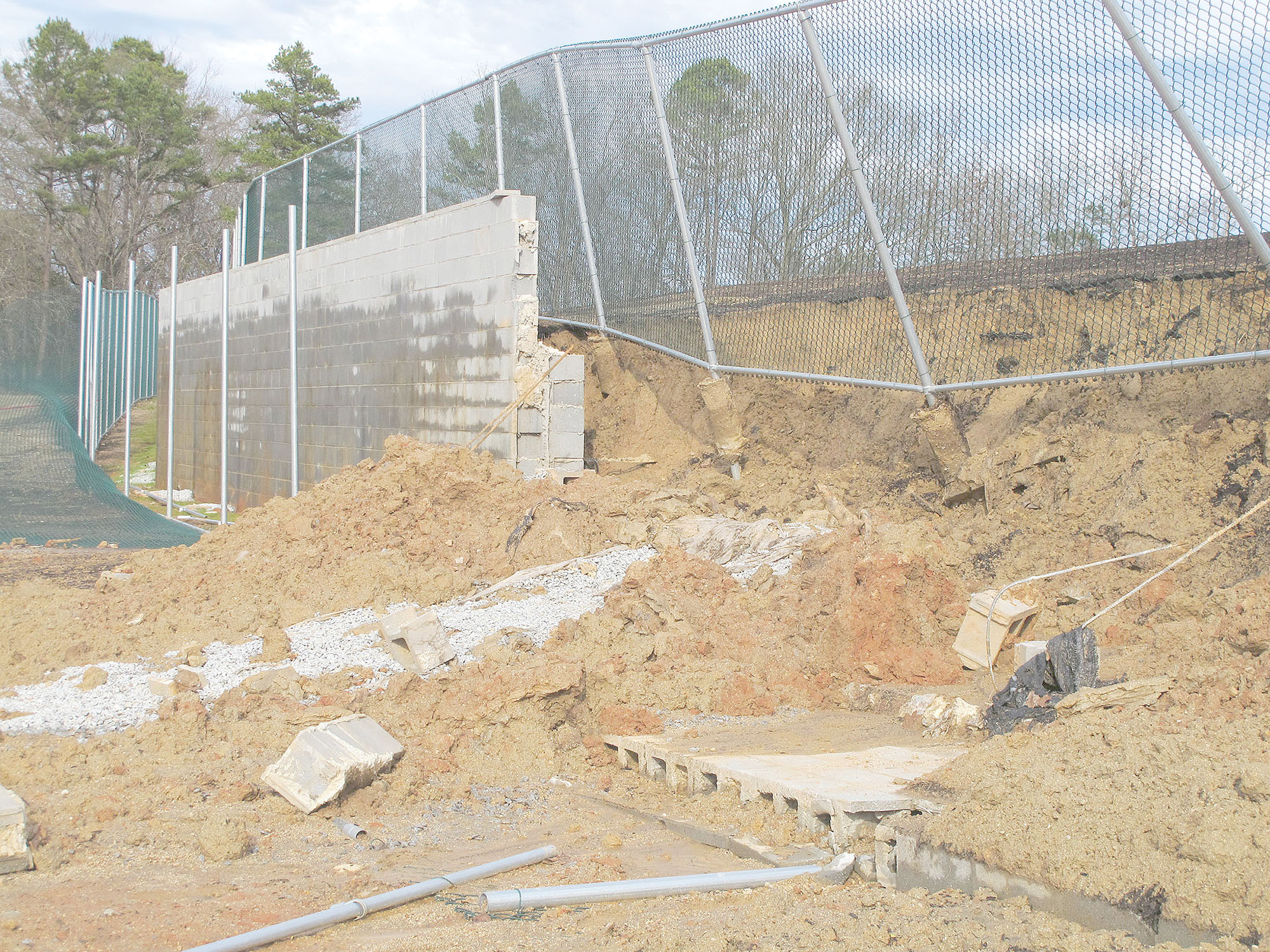
The aftermath of January’s collapse of a portion of the retaining wall around the new Drawdy Park football field. Construction has since picked up the pieces and is in the process of moving on.
WINNSBORO – Six months after nearly 60 feet of a 473-foot long retaining wall around the Drawdy Park football field collapsed into a heap of rubble, a detailed report from an independent engineering firm was obtained this week through an FOIA request by The Voice from Fairfield County Administrator Milton Pope. Although the wall collapsed following a day of heavy rain back on Jan. 12, the report places responsibility for the failure squarely at the feet of the project’s engineer, S2 Engineering and Consulting, their subcontractor, Four Brothers Enterprise, LLC and the unconfirmed individual whose name is on the plans.
“A lack of design detail and a disregard for the design intent during construction directly contributed to the failure,” the report, prepared by Goodwyn, Mills and Cawood, Inc. and dated March 31, states. “The design drawing does not include key elements on the spacing and geometry of the wall section, leaving construction personnel the latitude to deviate from the intent of the design professional. Additionally, the drawing does not include the signature of the design professional or the seal of the company that was responsible for the design as required by South Carolina law.”
Following the collapse, a Blythewood general contractor with experience in wall construction reviewed photographs of the wreckage for The Voice and expressed serious concerns with how the wall was constructed. The contractor, who wished to remain anonymous, said it appeared as if there had been no plan for constructing the wall, or if there had been, the plan had not been followed.
Among his concerns for a wall of that height (10 feet) was the absence of adequate rebar in the construction. Photographs of the collapsed portion of the wall show rebar inserted into about every eighth column of block. The Blythewood contractor said rebar should have been inserted into every column of block and should have been filled with concrete. Photographs of the collapsed section indicate that little or no concrete fill had been included with the rebar.
The Blythewood contractor also said the blocks had not been interlocked, as they should have been, nor were the deadmen (horizontal support sections running from the wall into the earth behind the wall). Rebar had also not been properly installed into the deadmen. Soil behind the wall also should have been compacted with every 2 feet of fill, the contractor said. Photographs of the collapse indicate that it had not. Weep holes (drainage holes) also should have been provided along the base of the wall, he said. No such holes are visible in the photographs.
That analysis was confirmed by the March 31 Goodwyn, Mills and Cawood report.
“The construction of the wall did not follow industry standards for the placement of the fill or the coursing of the reinforced masonry,” the report states. “The lack of adequate drainage behind the wall and the improper construction of the piers led to a failure . . .”
The Drawing Board
According to documents and invoices obtained earlier this year by The Voice, the County paid S2 $39,750 in March of 2012 for “architectural and engineering design layout and drawings.” Less than a month later, the County forked over another $11,275, since S2 discovered that the “total area for the Drawdy Park Survey and Engineering study is more than twice the size that was originally given,” according to the invoice. But as of last February, the County had no drawings for the project in its possession.
Drawings inspected by The Voice shortly after the wall’s collapse were revealed to be merely a set of “as-built” drawings pertaining strictly to the ill-fated retaining wall – drawings dated after construction of the wall had been completed. The drawings are not to scale and include little detailed information. Sources with the County told The Voice that the drawings were not plans, but were “as built” drawings and were protocol for changes that occur during a construction project. Those drawings were indeed unsigned and bore no official seal. The drawings were labeled as having been prepared by Sherman Sumter. A search of the S.C. Department of Labor, Licensing and Regulation database turned up no mention of Sumter.
Rising Costs
The retaining wall was only a few months old and still under warrantee when it toppled, and last month work began on reparations. S2 was still at the helm, but with Mims Contracting serving as subcontractor and Chao Associates as structural designer. The work is being done at no cost to the County.
Former County Administrator Phil Hinely green-lighted the construction of the new football field in May of 2013 with a cost limit of $280,000, but documents obtained earlier this year by The Voice indicate the project actually began much earlier than that, with the price tag quickly climbing to more than $380,000.
Last January, The Voice submitted a Freedom of Information Act (FOIA) request to the County for an itemized breakdown of all costs and expenses associated with the Drawdy Park project. The County answered that request, but instead of providing an itemized breakdown, only supplied The Voice with a copy of the County’s final authorization form and a “technical memorandum” from S2 to the County. Bids and invoices for chain link fencing around the field were also included, but an itemized breakdown of S2’s work was not. Those constituted all of the documentation in the County’s possession regarding costs for the project, Pope told The Voice.
The “Authorization to process on building maintenance projects assigned to S2,” signed for final approval on May 21, 2013 by Hinely, show that the Drawdy Park project was not to exceed $280,000. But the “technical memorandum” from Sam Savage of S2 Engineering & Consulting to Davis Anderson, Deputy County Administrator, dated May 15, 2013, gives a rough outline of “work to be performed and work that is near completion,” with an estimated cost of $321,200.
While the memorandum provides a laundry list of various aspects to the project – from engineering design and site clearing to the installation of an irrigation system and the construction of the retaining wall – it does not include any line-item costs or expenses associated with each aspect. A handful of invoices and other documentation obtained by The Voice through anonymous sources, meanwhile, indicate that the County has shelled out at least $339,750 to S2 for the project since March of 2012.
SLED
Last February, the S.C. State Law Enforcement Division (SLED) launched an investigation into Fairfield County’s procurement practices under Hinely. Of particular interest in the early stages of that investigation, according to a statement made by Council Chairman David Ferguson after Council’s Feb. 25 meeting, was the County’s relationship with S2 Engineering. Between December 2009 and September 2013, the County shelled out more than $8.76 million to S2 for various contracts. According to documents obtained by The Voice, projects over that time period range from improvements to the HON Building, construction of the new Voter Registration offices, work at the County Courthouse as well as the Drawdy Park project.
While records indicate that most, if not all, of these projects were not put out for bid, Pope said during Council’s Feb. 10 meeting that S2 was one of several firms on a list of firms approved for County work by Hinely. Since Pope’s arrival as Interim last summer, the County has returned to a more conventional procurement process, putting projects and purchases out for bid in accordance with County policy. Ferguson said on Feb. 25 that while the former procurement practices may have been unusual, they were not illegal.
“Was it best practices? It was the cheapest practice for us to get jobs accomplished,” Ferguson said. “Did we bid out every job? No. With Milton (Pope) we do. Does that cost you? Yeah, it does.”
A spokesperson for SLED told The Voice this week that their investigation remains open.
The Reconstruction
The March 31 report by Goodwyn, Mills and Cawood concluded that the failed section of retaining wall should be rebuilt by the contractor and that a drainage system, as well as waterproofing, should be installed on the back side of the wall to prevent another failure. Mims Contracting, under the direction of S2’s Sam Savage, has since had to overcome several challenges.
According to daily inspection reports provided to the County by Goodwyn, Mills and Cawood between June 3 and June 26, inspectors were able to prevent Mims Contracting from installing the incorrect rebar size on the new construction. Soil compaction testing, which held up the project for weeks, was finally completed and approved on June 23. Drainage appears to be an ongoing issue at the site, as three times the inspector has instructed the crew supervisor to open a temporary drainage trench at the wall footing. As of June 24, that had not been accomplished. Inspectors also noted safety concerns at the site and on June 19 recommended the installation of a safety fence beyond the top slope at the edge of the football field.
Dr. Sheldon Hudson, senior pastor of Across All Boundaries Christian Church, in her new offices in Blythewood.
Refining Young Ladies with Christian Values
BLYTHEWOOD – After serving as senior pastor at Across All Boundaries Christian Church in Ridgeway since 2000, Dr. Sheldon Hudson is spreading her wings into Blythewood where she recently opened a Christian-based finishing program for girls, ages 4 – 18. Hudson has operated the program, called Destiny’s Daughters, as an in-house ministry at her church since 2005. She said she decided to move it into downtown Blythewood with the hope of reaching more girls.
“The goal of our program is principled-based mentoring, polishing and finishing to help young ladies lead, excel and achieve in their lives,” Hudson said. “That’s something that just isn’t always available and affordable for young ladies these days.”
Hudson is a graduate of Truth Bible College in Jacksonville, Fla. where she earned a Doctorate in Theology. Raised by her grandmother in Mount Pleasant, Hudson said she fondly remembers that her grandmother was assisted in her rearing by a whole village of older women.
“I had a wonderful childhood. They saw to it that I had every opportunity to experience art, culture and a lady’s training,” Hudson recalled. Now she wants to bring that training to young women who might not otherwise experience it.
“My role in Destiny’s Daughters,” Hudson said, “is to mentor and train, to provide skills necessary for these young women’s success in their personal, social and, eventually, their professional lives.”
Hudson said she is now taking applications for the program, which will start Aug. 1.
“Our desire is to bring back the rites of passage, standards that were once passed on in our culture,” Hudson said. “Besides etiquette classes, we will offer dancing, music and other areas of the arts.”
Hudson’s offices and studio are located at 303 Main St. in downtown Blythewood. For information about the program, call 803-569-7131.
Resurrection ferns climb an old oak at Hopelands Gardens near Aiken.
A quick 79-mile jaunt to Aiken will usher you into a past where luxury ruled the day. You can tour a classy town and see where wealthy industrialists spent their winters. Thus was Aiken once known as the Winter Colony. In Aiken you’ll find much to see and do. And should you desire you can check out a splendid hotel, the Wilcox Inn. None other than Sir Winston Churchill stayed there.
One Frederick S. Wilcox established this fine inn long ago in the last years of the 19th century. His inn became a haven for Yankees seeking a warmer clime. Today it’s a sumptuous setting with stonework and rich wood-paneled walls. In the Gilded Age of the 1920s and 1930s, Aiken was known as the “Winter Colony.” Every fall well-heeled northerners came by private railcar to Aiken to play polo, golf, race their thoroughbreds, hunt fox and socialize at high tea, musicales, balls and dinners.
The Wilcox, as I call it, was said to have had the first bathtub in the South connected with hidden plumbing. Over the years, Andy Williams and Bing Crosby came as did John Jacob Astor, Harold Vanderbilt and Evelyn Walsh McLean who owned the Hope diamond. Makeup queen Elizabeth Arden graced the hotel as well. As for Franklin D. Roosevelt, legend maintains that he rode his private train to the inn’s back door where he quietly slipped inside. In 1999, Robert Clark and I included the Wilcox Inn in our book, “Reflections of South Carolina.” Back in 1997 and 1998 when we were working on that book I never made it inside the Wilcox Inn. It took me some 17 years to finally do that. It will be much sooner when I return.
Use the Wilcox Inn as a base camp and go exploring. Aiken has a lot to offer. Nearby are Hopelands Gardens, a 14-acre estate garden, and Hitchcock Woods, one of the country’s largest urban forests. There’s a place called the Rye Patch too, a popular venue for weddings and parties.
Hopelands Gardens features a labyrinth where you can walk and think with a feeling of being lost yet found. It’s a wonderful place to meditate. The labyrinth opened April 17, 2007. It’s patterned after a 13th century design in Amiens Cathedral, France. Its 45 feet in diameter with brick pathways leading to a granite center.
Be sure to see the intersection of Whiskey Road and Easy Street where you’ll see one of the country’s most photographed road signs. Explore the sandy lanes left unpaved for the thoroughbred horses that walk them. And check out the Racing Hall of Fame.
Aiken is a beautiful town of live oaks, resurrection ferns, dogwoods, ivy and brick walls. Best of all it is an easy drive away.
BLYTHEWOOD – At its regular monthly meeting on June 30, Town Council passed first reading on a recommendation from the Planning Commission to rezone a property on Syrup Mill Road from Rural Estate (RE) to Rural (RU). Property owner Jeremy Tesimale had appeared before the Planning Commission earlier in June to request the rezoning, which he said would allow him to subdivide the 4-acre property for sale.
RE zoning is similar to RU zoning except that RE requires a minimum acreage of 4 acres, while RU zoning requires a minimum of 1 acre.
Tesimale told the Commission that his rural neighborhood is a mixture of RE and RU zoning and that he had talked to his neighbors about the rezoning and that they did not object to it. The matter will have to pass one more reading at the next Council meeting before it becomes final. A public hearing on the rezoning and the final vote are scheduled for July 29 at 7 p.m., at The Manor.
BLYTHEWOOD – With no quorum at the Planning Commission meeting on Monday night, the meeting was not convened, but the two members in attendance, Chairman Malcolm Gordge and Buddy Price, informally discussed the only two items on the agenda: a pending federal mandate for the Town to manage its storm water and a pending new plat for Ashley Oaks’ Club House and Swimming Pool. Both were listed on the agenda as discussion-only items. Town Administrator Gary Parker and the Town’s Planning Consultant Michael Criss were also in attendance.
Town’s New Mandate
Gordge explained that existing federal legislation, titled Small Municipal Separate Storm Sewer System (SMS4), an offshoot of the 1970 Clean Water Act, will impose a storm-water management program on the Town, perhaps as early as this summer. The program is legislated federally, and administered at the State level by the S.C. Department of Health and Environmental Control (DHEC). It has already been imposed on larger towns and counties in the state, including Columbia and Richland County. The purpose of the program is to require the small towns in urban-designated areas to provide management, monitoring and reporting of all storm water (not including sewage) and other run off sources in the community with the intent of protecting streams, rivers and other water sources.
Gordge said he and Criss recently attended a workshop, conducted by DHEC, that gave the town government a heads up that it may be designated as one of those smaller towns that must embrace the SMS4 program.
“The designation is a result of the 2010 U.S. Census, which included Blythewood within the urban area of Columbia,” Gordge explained. He said the program is broad, comprehensive and designed to minimize the introduction of chemicals, pollution, bacteria, silt and other run off contaminants into the area’s surface and ground water.
While Criss explained that Blythewood adopted an extremely comprehensive low impact development (LID) ordinance a couple of years ago designed to work with nature to manage storm water as close to its source as possible, that ordinance primarily provides for management of runoff on new construction sites on private property, not on existing properties. He said the park and The Manor were built in compliance with that ordinance. But he said the SMS4 federal legislation addresses storm drainage and runoff from all sources in the community as they affect the whole community.
“This will be a major responsibility for the Town,” Criss said, “and we will have to complete or extend our existing LID storm water program in order to comply.”
Criss told The Voice that he expects Blythewood will receive an official letter from DHEC later this summer requiring the Town to enter the program. Criss said he and Gordge have asked DHEC to send a representative to Blythewood in late July or August to explain to the officials of the town, the media and the public what the Town’s responsibilities are regarding the program. Instead of the town government bearing the entire budget and staffing responsibilities for administering such a program, Criss said Blythewood officials might be able to negotiate an intergovernmental agreement with the County to administer the program.
“When Town Hall receives that letter from DHEC,” Criss said, “we’ll be under a timeline to comply. We will probably have six months to apply for permit coverage, then another year to develop a corresponding Storm Water Management Plan.”
Asked if existing private property land uses would be affected by the Town’s compliance with the program, Criss said they could be if, for example, the Town’s monitoring system discovers a septic system or other source is discharging contamination from private property.
“It would be the property owner’s responsibility to comply with the regulations,” Criss said.
Criss told The Voice that part of the Town’s responsibility in the program will be mapping the entire community’s storm water systems from catch basin to ponds and rivers. He said that while the Planning Commission would probably take the leadership role in fashioning recommendations for consideration by Town Council regarding the regulatory authority to implement and enforce the program on the local level, both he and Gordge said it might be beneficial to assign a task force or work group of citizens to research the implications of SMS4 more fully and help with making the recommendations to Council.
“As a small municipality,” Gordge said, “it is our job to submit a Notice of Intent (to comply with the State requirements) and be accepted by July 1, 2015. If we are approved then we get the benefit of State provided assistance, training, inspections, etc. If we are rejected we would have to prepare a case for independent control and monitoring of our storm water discharges. If we are late with our NOI, or are rejected we would be liable for any water pollution that can be traced back to the TOB.
“Another option to consider,” Gordge said, “is to combine resources with similar municipalities such as Arcadia Lakes and file a joint NOI ideally by November to allow six months for processing by DHEC.
Ashley Oaks Club House and Pool
Gordge, a resident of Ashley Oaks, explained that a new plat was carved out of the neighborhood’s common area that contains the clubhouse and swimming pool. The tract of land, he said, was owned by Mike Shelley the original developer of Ashley Oaks. When Shelley’s property was sold in lieu of foreclosure several years ago, the swimming pool passed to First Palmetto Bank, then to Crown Communities and then Essex Homes.
“To the mutual benefit and agreement of Essex Homes and Ashley Oaks HOA (Home Owners’ Association), the pool, clubhouse and the four acres on which it stands is to be deeded to the HOA since Essex has no use for it and the HOA maintains the property and amenities,” Gordge said.
The plat has already been approved by Jim Meggs, the former acting town administrator.
“The only reason it came before the Planning Commission,” Gordge said, “is to find out if anyone on the Commission had any problems with this arrangement.”
Even though the meeting was not an official meeting of the Commission, the two in attendance decided that it would not be necessary to bring the plat back for the full Commission to consider.
WINNSBORO – The body of a Winnsboro woman was discovered outside her home on S. Garden Street early Friday morning and investigators with the Department of Public Safety are looking for the man they believe was responsible for strangling her to death.
Officers responded to a disturbance call at 417 S. Garden St. at 3:50 a.m. on July 4 where they found 34-year-old Jennifer Monique Stone lying outside on the south side of the house. An EMS crew arrived a short time later, according to Freddie Lorick, Chief of Public Safety, but was unable to revive Stone. She was pronounced dead at the scene, Lorick said.
The search is now on for 36-year-old LaTroy Dante Sampson, whom Lorick said was an acquaintance of the victim. While Sampson’s last known address is 2741 Syrup Mill Road, Lorick said Sampson had been living at 417 S. Garden St. at least part-time.
Lorick said Stone’s son, 18-year-old Matthew Stone, was awakened in the early morning hours of July 4 by the sounds of an altercation taking place outside the home. Matthew came out of the house and was met by Sampson coming from around the side of the home. Sampson reportedly grabbed Matthew by the hair and tried to physically pull him back around to the side of the house, but Matthew slipped away and Sampson fled on foot. A short time later, Matthew ventured around to the south side of the house and discovered the body of his mother.
Lorick said Sampson had just recently been released from prison. Records from the State Law Enforcement Division (SLED) state that Sampson was incarcerated in 1998 for an armed robbery conviction, as well as for assault and battery of a high and aggravated nature. Since his release, Sampson has twice run afoul of the law. Last March he was arrested for public disorderly conduct. A month later, he was charged with trespassing and failure to comply with the direction of a police officer.
Sampson’s list of prior charges in S.C. dates back to 1996 when he was arrested in March of that year by the Fairfield County Sheriff’s Office and charged with second degree lynching. The following September, Sampson was again picked up by the Sheriff’s Office and charged with strong-armed robbery and armed robbery with a deadly weapon. None of those charges merited a conviction, however.
In November of 1996, Sampson was once again arrested by Sheriff’s deputies, this time charged with assault and battery of a high and aggravated nature. He was sentenced to six years, but the sentence was suspended upon five years of probation. One month later, Sampson found himself in the Kirkland penitentiary following a conviction for assaulting a police officer.
As of press time, Sampson was still on the run and Winnsboro investigators were being assisted by SLED’s Fugitive Task Force, which was pursuing leads all over the state. Anyone with knowledge of Sampson’s whereabouts should call the Department of Public Safety at 803-635-4511. Lorick said Sampson should be considered extremely dangerous.
WINNSBORO – Residents of the Rockton and Middlesix communities, concerned with the prospects of Winnsboro Crushed Stone, LLC locating a granite quarry near their homes off Rockton Thruway, met with staff from the S.C. Department of Health and Environmental Control (DHEC) in Fairfield County Council’s conference room on June 26.
DHEC fielded questions primarily from Dorothy Brandenburg and Val Green, who called to attention several areas of primary concern, including the blasting zone radius, water tables and dust control.
Brandenburg asked DHEC to address with the company, which was not represented at the meeting, noise and light pollution during nighttime operations. She also pointed out to DHEC the existence of a public park in the Middlesix community that she said was 1.057 miles from the edge of the mine and that could be in the path of wind-blown dust.
Green asked DHEC if overburden from the mine could be used as a berm along the northwestern boundary of the site to act as a noise buffer. Joe Koon, with DHEC’s Division of Mining and Solid Waste Management, noted on a map of the more than 900-acre site a little more than 405 acres of undisturbed natural buffer around the mining site. Milton Pope, Fairfield County Administrator, who sat in on the meeting as an observer, said it was his understanding from the company that overburden would indeed be used as a berm.
Green’s biggest concern, however, was water, which the company plans to use in dust control and to wash stone.
“Do they know they have enough water (on site)?” Green asked.
Kent Coleman, Director of DHEC’s Division of Mining and Solid Waste Management, said his department had no specific calculations of how much water the company will require, but said the company will use sediment ponds in a closed-loop system and will not be drilling wells. The company will also not be drawing water from nearby Horse Creek, Coleman said.
“They need to give assurances that they have adequate water for dust control,” Coleman said, “and we will ask for that.”
Coleman said local water levels in nearby residential wells, as well as in the pond located on property owned by T.A. Harman adjacent to the mining property, would be monitored by DHEC. Any drop in water levels would be addressed immediately, Coleman said, so residents would not find themselves with a dry well or drained pond overnight.
Green also probed DHEC about existing wetlands on the site, and Coleman said the company’s approach “is to delineate wetlands and stay off of them.”
Pope asked DHEC about the blasting radius, how it is measured and how seismic vibrations would be monitored. Coleman said DHEC requires a minimum distance of 1,000 feet from the edge of the pit to the nearest residence for blasting.
“In this case, so far as we know right now, all of the structures that we would be looking are at least 2,400 to 2,500 feet from the blasting area,” Coleman said. “The mining law requires a maximum ground acceleration – how much can you make the ground vibrate – by law, that’s established. We can measure that or we can ask them to measure that.”
Coleman said he expects the company to submit its air and water permitting applications by late August and residents could expect a public hearing in late October or early November.
WINNSBORO – After sequestering themselves in executive session for more than 90 minutes, Town Council Tuesday night took no action on a potential legal battle over water that was promised in 2008 to a developer of property on Rimer Pond Road in Blythewood, instead accepting items from the closed-door session as information.
In 2008, Sycamore Development, LLC had planned to develop a 300-home subdivision on three parcels of land along Rimer Pond Road and obtained from Winnsboro a Capacity and Willingness to Serve letter for the development of 250 residential lots. The water taps were to be prepaid by Sycamore once the water line went in on Rimer Pond Road. That water line was completed and accepted by Winnsboro in July of 2009, but Sycamore never prepaid for any taps.
The subdivision never materialized, and two of the three parcels have since been sold off. Sycamore still holds a 31.23-acre parcel at 502 Rimer Pond Road that it also wants to unload but cannot, according to documents obtained by The Voice, because Winnsboro allegedly refuses to enter into a Capacity and Willingness to Serve agreement with prospective buyers.
Now Sycamore is considering legal action, documents indicate, unless Winnsboro makes good on its 2008 agreement. Sycamore is requesting 107 residential water taps, which is the equivalent of nearly 43,000 gallons a day, plus an additional 25,000 gallons a day for residential or commercial use. The extra 25,000 gallons per day would only come into play if the City of Columbia refuses to provide water to the property. Winnsboro would charge $1,350 for each tap.
“In 2008 we had promised them water and they never did anything with it,” Winnsboro Mayor Roger Gaddy said after Tuesday night’s meeting. “Now they want water and they wanted an answer rather quickly.”
Gaddy said he could not discuss pending or potential litigation, but said it was the Town’s intent to work out a deal. Documents state that Sycamore wanted a response in writing by July 15.
“We will meet with them (Sycamore), meet with Columbia and see what our options are,” Gaddy said.
Baggy Pants
Council also took no action on an ordinance to prohibit the wearing of baggy pants within the Town limits. Gaddy said a first reading on the ordinance would be taken up at Council’s next meeting on July 15.
Franchise Fee
A resolution to Winnsboro’s water franchise agreement with the Town of Blythewood, which was suddenly and unexpectedly terminated by Blythewood Town Council in April, remains in limbo. Although discussed in executive session, Council only accepted that discussion as information when they returned to open session.
Blythewood’s resolution to terminate the agreement came six years ahead of schedule, as the contract between the two towns is binding until 2020. Winnsboro has approximately 750 taps in the Blythewood area and has been paying the Town of Blythewood a franchise fee of around $13,000 a year for the use of Blythewood’s rights of way. Termination of the agreement, should it stand, would end those payments.
Personnel
Council voted 3-0 to lift the Town’s hiring freeze in order for the Gas, Water & Sewer Department to fill three vacancies.