Blog

  • Board OK’s Fees, Stipends

    WINNSBORO – The Fairfield County School Board set student fees for the 2014-2015 school year at their Aug. 19 meeting, as well as approved stipend for athletic and academic staff. The Board also gave the final OK on a policy governing how coaches and trainers address concussions and collected more than $12,000 from timber sales.

    Student Fees

    On a 7-0 vote, with Board member Andrea Harrison (District 1) joining the meeting by telephone, the Board OK’d fees across the District. The Beta Club membership fee for the middle and all elementary schools was set at $20, while at the high school the fee was set at $45. Additional middle school fees are: Band, $20; Family and Consumer Science, $5; ID card replacement, $5; overdue books, 5 cents.

    Additional high school fees: parking decal, $15; senior fees, $40; Science, $25; Driver’s Ed, $40; Integrated Business, $20; P.E. (T-shirt and lock), $15; Art, $5; Teacher Cadet, $40; National Honor Society, $20; Student Government Officers, $20; Student Government members, $10; Academic Challenge, $30; Instrumentalist Band, $150; Auxiliary Members Band, $200.

    Career and Technology Center fees: Lab fee, $20; FBLA membership, $13; SkillsUSA membership, $20; National Technical Honors Society, $25.

    According to the accompanying policy setting school fees, also passed by the Board, no student will be denied an education because of an inability to pay supplementary fees. Students who qualify for free or reduced lunch may apply for a waiver of fees.

    Stipends

    At the District level, the Board approved $3,500 stipends each for a pair of Induction Coordinators, $250 for a mentor teacher and $7,000 for the Board’s Administrative Clerk. In the Student Services Department, the Board OK’d $2,500 for the Data Manager and for the Lead Social Worker and $1,500 for the Medicaid Supervisor.

    Fairfield Central High School stipends: $2,000 for the yearbook, and $2,000 each for department heads in English Language Arts (ELA), Mathematics, Science, Social Studies, World Language, Electives, ROTC and Business.

    Fairfield Middle School: $2,290 each for department heads in ELA, Science, Math and Social Studies; $1,250 for Special Services and Related Arts; $1,275 for Yearbook Advisor and Academic Team coach; $2,500 for Keep it Real Teen Pregnancy Grant Site Coordinator; $1,000 for Keep it Real Teen Pregnancy Grant Curriculum Delivery; and $1,000 for STEM Lead Facilitator.

    Fairfield Elementary: $2,500 each for Grade Level Supervisors for grades CD-2, 3-4, 5-6, and for Related Arts and Special Services; $1,250 each for the fourth- and fifth-grade team leader.

    Magnet School: $2,500 each for Grade Level Chairs, grades K-3 and 4-6.

    Geiger and McCrorey-Liston: $2,500 each for Grade Level Chairs, grades CD-2 and 3-6.

    Career Center: $2,500 each for two Department Chairs.

    Athletic stipends passed on a 5-2 vote, with Harrison and Annie McDaniel (District 4) voting against. McDaniel tried to amend District 3 Board member Henry Miller’s motion for approval of the athletic stipends so that department chairs received the same stipend as coaches, but received no second from the Board.

    The Board OK’d $15,000 for the Athletic Director and $3,750 each for two assistant A.D.s.; $8,000 for the Recruiting Coordinator; $3,700 for the head Strength coach; and $1,800 for the assistant strength coach.

    Football: $8,000 each for the Offensive and Defensive coordinators; $6,500 for the Special Teams Coordinator; $5,500 each for four assistant varsity coaches; $6,000 for the head JV coach; $4,500 each for four assistant JV coaches; $5,000 for the head middle school coach; $2,500 each for three assistant middle school coaches; and $2,000 each for two filming coordinators.

    Tennis: $3,000 each for the head boys’ and girls’ tennis coaches. Volleyball: $3,000 for the head varsity coach; $1,500 for the assistant varsity coach; $1,500 for the head JV coach; and $2,000 for the head middle school coach. Golf: $3,000 for the head coach.

    Basketball: $8,500 each for the head boys’ and head girls’ varsity coaches; $3,000 each for assistant varsity girls, assistant varsity boys, head JV girls and head JV boys coaches; $2,000 each for the B-team boys’ and girls’ coaches; $1,500 each for the middle school boys’ and girls’ coaches; and $800 each for the assistant middle school boys’ and girls’ coaches.

    Wrestling: $3,000 for the head coach; $1,500 for the assistant/middle school coach. Track: $3,500 each for the head girls’ and boys’ coaches; $1,500 each for assistant boys’ and girls’ coaches. Cross Country: $3,500 for the head coach.

    Softball: $3,500 for the head varsity coach; $2,000 for the assistant varsity and the head JV coaches. Baseball: $3,500 for the head varsity coach; $2,000 for the assistant varsity and the head JV coaches; $1,500 for the assistant JV coach. Soccer: $3,000 each for the head boys’ and girls’ coaches.

    Academic coaches: $3,000 each for two positions. Band: $10,000 for the Band Director; $4,000 for the Assistant Band Director and the Auxiliary Band Coordinator; and $2,000 each for the Woodwind/Brass Instructor and the Percussion Instructor. Cheerleading: $5,000 for the head varsity cheerleading coach; $2,500 for the head JV coach; and $2,000 for the head middle school coach.

    Concussions

    The Board gave final approval on a policy managing concussions among student-athletes. According to the policy, which passed 7-0, if a coach, trainer, official or physician suspects an athlete has suffered a concussion during a game or practice, that athlete must be removed from play and evaluated. The student may return to action after an on-site evaluation by the trainer, physician, physician assistant or nurse practitioner determines that no concussion has occurred. In the event of a concussion, the student may return to action only after being given written medical clearance by a physician.

    Timber Sale

    The Board also received as information the final figures on last month’s sale of timber from land around the existing Career and Technology Center. The District received $12,611.72 for the sale. Forest Land Management, Inc. earned $790.75 in commission from the sale.
  • County Defends Rec Plan

    WINNSBORO – Criticism of how County Council plans to spend $3.5 million on recreation hit the fan Monday night, triggering the dreaded Race Card and sparking tensions between Council and the public.

    Addressing Council during the first public comment portion of the meeting, District 2 resident Beth Jenkins denounced recreation spending entirely, telling Council, “We don’t need playgrounds. We need jobs.” Selwyn Turner, also from District 2, suggested Council should pool its resources and concentrate on a single major facility in the downtown area.

    The $3.5 million is currently divided up into $500,000 allotments for each district, with district 3 and 5 focusing primarily on mini parks, District 2 a playground on Peay Ridge Road, with larger projects hoped for in districts 1, 4, 6 and 7. But Turner said that in the 1940s and 1950s, the community benefited tremendously from a large recreation facility, offering supervised activities and situated on the site that currently houses the Fairfield County government offices.

    “You may argue that a single complex would not help outlying areas, but look at the cars in the student parking lot at Fairfield Central,” Turner said. “Almost everyone of driving age has a car nowadays, and those that don’t could organize car pools. Furthermore we have a little-used expensive transit system that might be able to bus people in. Where there’s a will there’s a way. We could afford to have good supervision. If we can’t, we don’t need to build anything unsupervised like plastic mini parks in seven districts, which could be likely a haven for drugs to come in.”

    Betty Gutschlag, of District 7, echoed Turner’s concerns about mini parks becoming a hotspot for drug activity.

    “You’ve got the money, you’ve got the talent and you’ve got the opportunity to make a complex instead of these mini parks,” she said, “that as you all know have been known in the past to be unsupervised and wonderful drug drops.”

    Councilman Mikel Trapp (District 3), in whose district the majority of the county’s mini park lie, questioned the assessment of parks as drug drops and asked Interim County Administrator Milton Pope to compile some statistics from the Sheriff’s Office.

    “Does that statement imply that all parents’ children are drug dealers?” Trapp asked. “Most of my parks are in black communities. Does that imply that all the kids that go to these parks are drug dealers?”

    The Sheriff’s Office told The Voice Tuesday afternoon that only a handful of drug cases had been made at any of the county’s mini parks and that the majority of the drug trade is conducted in residential settings.

    Trapp also interpreted the suggestion of a large central recreational facility as an effort to roll back the clock on desegregation.

    “It was mentioned earlier about recreation, taking us back to the ‘40s and ‘50s,” Trapp asked Pope, “could you give me some research (on whether or not) blacks were allowed in these recreation facilities back in the ‘40s and ‘50s?”

    Turning to District 4 Councilman Kamau Marcharia, Trapp asked, “Did I misunderstand, Mr. Marcharia?”

    “You weren’t allowed, Mike. Let’s move on,” Marcharia answered.

    Near the close of the meeting, Chairman David Ferguson (District 5) said drugs were an issue everywhere, no more or no less in any of the county’s parks. The main issue, he said, was providing recreational opportunities for the county’s rural outlying areas.

    “I had access to this place right here when it was a facility,” Ferguson said, “but where would the children be now from every area from this county if this was the only facility in this county for them to deal with, with the transportation issues that they face every day? They wouldn’t have any recreation. I don’t know if an apology is what folks are looking for because were trying to do something out in the rural areas for the kids and the adults and the elderly people out there, but there’s not one coming as far as I’m concerned.”

  • COG Deal Moves Forward

    WINNSBORO – County Council Monday night authorized Interim Administrator Milton Pope to engage the Central Midlands Council of Governments (COG) for assistance in mapping out how the County should spend anticipated revenues from a pair of new nuclear reactors expected to go online at the V.C. Summer Station in Jenkinsville in 2019, although not without first fielding some criticism from the public. Council also took action on a handful of ordinances – two fee-in-lieu-of taxes (FILOT) agreements and two donations of property.

    The COG

    Councilman David Brown (District 7) made the motion during Council’s May 26 meeting to enlist the aid of the COG in strategic planning for the County’s expected nuclear windfall. That motion sailed through Council without dissent. Monday night, Pope said the parameters had been set up and Council’s approval was required for the process to move forward. A final document will come back to Council for their ultimate approval in a future meeting, Pope said.

    The County does not have a planning department, Brown noted when making his motion back on May 26, while the COG, with whom Fairfield County already has a working relationship, has a staff of approximately 40 professional strategic planners. Brown’s motion included incorporating existing Fairfield County plans, including the strategic plan that was completed in 2010, as well as the County’s existing economic data from Fairfield’s partnership in the I-77 Alliance. The proposal will also allow the COG to contract out for additional resources as necessary.

    But District 2 resident Beth Jenkins said during the meeting’s first public comment portion that Brown was a little too close to the COG for her liking. Brown sits on the COG Board of Directors (Fairfield is also represented on the COG Board by Councilmen David Ferguson and Dwayne Perry, as well as Winnsboro Mayor Roger Gaddy and State Rep. MaryGail Douglas) and, Jenkins said, the COG pays Brown $30,000 a year to lease a building owned by Brown.

    “This looks bad, smells bad and should not be happening,” Jenkins said. “This is truly a conflict of interest, muddies the waters way too much for honest and clarity in the planning.”

    Brown, however, said he has never voted on real estate issues and was not involved in the COG’s vote to lease his property. Brown said he actually lowered the rent below market value for the COG, but recused himself of voting or any discussion on the lease.

    “I think my accuser needs to read the law as far was what being unethical is,” Brown said. “If you remove yourself from a vote, you’re not doing anything illegal; you’re not doing anything unethical. As long as you don’t vote on an item you’re not breaking the law.”

    Jenkins was not around to hear Brown’s rebuttal, having walked out of the meeting shortly after making her remarks.

    “Apparently my accuser just wanted to accuse and try to do damage on TV and get up and walk out,” Brown said. “Well, that’s fine. But as far as I’m concerned, I sleep well at night.”

    Pope, meanwhile, urged Council to “continue our partnership with the COG to get the best possible planning initiatives that we can.”

    Councilwoman Carolyn Robinson (District 2) voted against the authorization, saying this was the first time she had seen the document. Pope said he had provided Council with the framework at the June 6 intergovernmental meeting.

    “Personally I don’t remember ever receiving one,” Robinson said. “This got passed out to us tonight. It’s the first time I’ve truly had an opportunity to look at it. This is the kind of stuff I look at all day long and I haven’t had a chance to look at it and see if there’s an inoperative word in there that would bind us to something that otherwise might not be good for us.”

    After the vote, Robinson added that the County had engaged the COG for a recreation study in years past but had rejected their recommendations.

    “If we’re going to take the COG to come in here and try to show us a good plan for how were going to spend this money and a strategic plan, what makes me think that this council in its wisdom is going to sit here and think that they know anything,” Robinson said, “because we’ve already said no once.”

    Ordinances

    Robinson also voted against first reading of an ordinance to donate a plot of land located at 205 Means St. in Ridgeway to the Town of Ridgeway. Once the site of a Sheriff’s substation, the property has been idle for many years. Ridgeway Town Council has had designs on the property for use as a community garden.

    “The County didn’t have any use for it, but we’re providing maintenance and upkeep on it, and during discussions with the Council someone made the suggestion why don’t we just donate it to them,” Pope said, “because they’re trying to do a beneficial thing to their downtown area.”

    Council unanimously approved second reading on an ordinance to convey an abandoned road, formerly known as State Road 129 near the site of Element Electronics, to Blackwelder Heating and Air, Inc., and second reading on an ordinance to update the existing FILOT agreement with Lang Mekra North America, Inc. to include Mekra Tool and Mold, LLC.

    Third and final reading also passed 7-0 on a FILOT agreement with Enor Corp.

  • How Do You Like Them Apples?

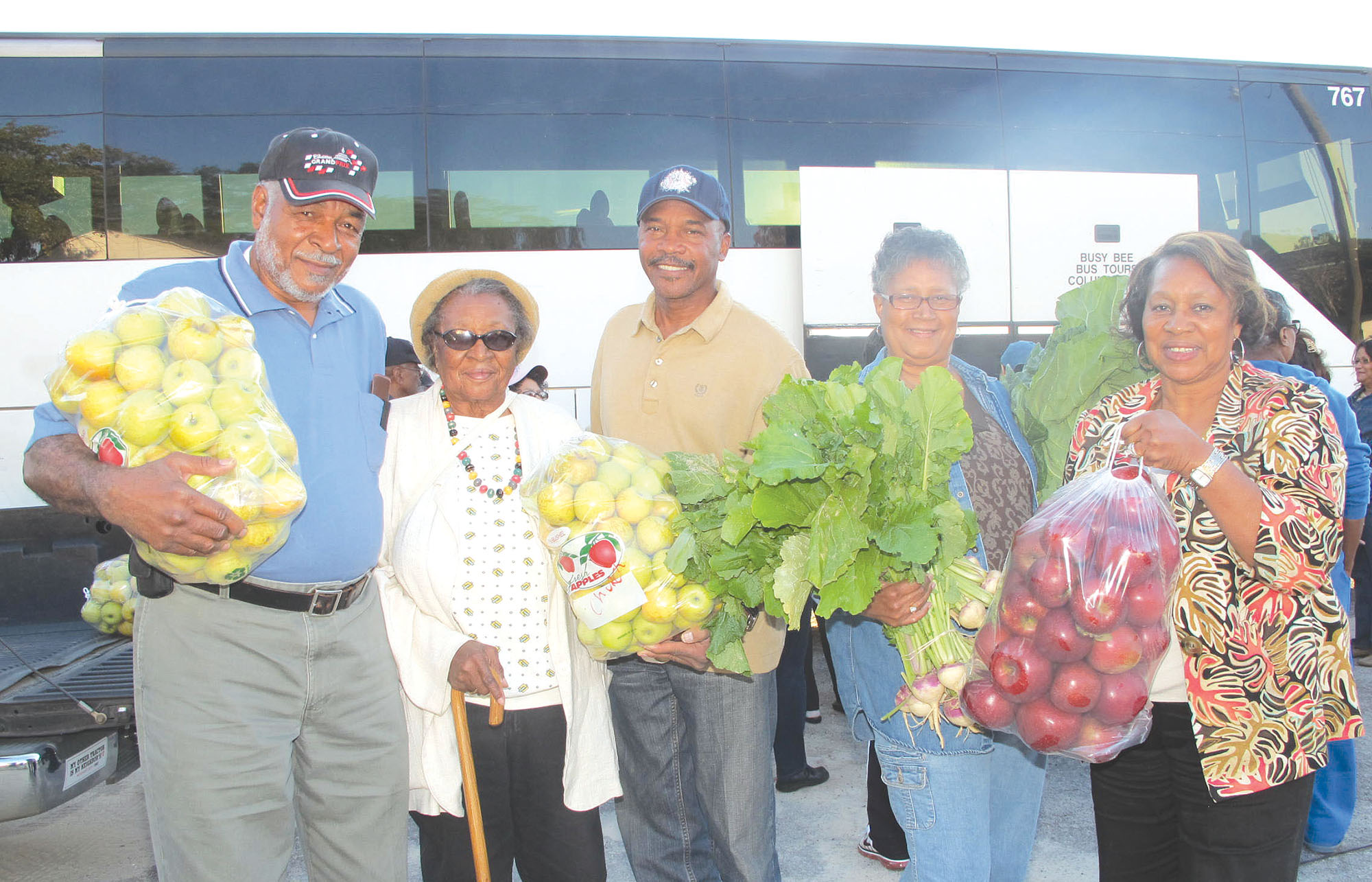
    Walter Anderson, center, was one of several in the community who showed up to help the travelers from a recent apple-picking trip unload the heavy bags of produce from the Busy Bee bus to waiting car trunks and pickup trucks. Also shown in front of the bus are McAuthur Weeks, left, Sara McDaniels, Anderson, Lenora Griffin and Melvina Haigler.

    BLYTHEWOOD – Sara McDaniels, 92, a life-long member of Round Top Baptist Church, has been organizing apple-picking trips to Hendersonville, N.C. every fall for the last 20 years. And it’s that time of year again for folks to sign up for the trip. While McDaniels’ early trips consisted mostly of members from her church, they now include friends and family from Winnsboro, Elgin and other towns as far away as Atlanta.

    “It’s lots of fun, but lots of work to organize it,” McDaniel’s told The Voice recently. That organizing includes contracting with the Busy Bee Bus Lines for a 57-passenger bus months in advance, registering the participants and taking care of a myriad of details. Her daughter, Melvina Haigler of Blythewood, said she suggested to her mother last year that since the passenger list is getting longer every year, it might be getting to be too big of a job. “But mamma said, ‘I’m not giving it up.’ So I said, ‘Go ahead, then!’”

    Haigler said she started going on the trips about eight years ago. “It looked like fun and they always brought back such big, beautiful apples. And not just apples. There are many other fall garden vegetables like collards, cabbages, turnips and lots of other things for sale at the farm.”

    The bus pulls out from Round Top Church about 7 a.m. and arrives in Hendersonville around 11 a.m. “We first pick apples and shop around the farms in the area,” Haigler said, “then we have lunch and sometimes on the way home we stop at an outlet mall in Spartanburg and do a little Christmas shopping.”

    Before they leave the main farm, Haigler said usually sing a gospel song for the woman who owns the farm. “She really loves it,” Haigler said with a smile.

    Haigler said the trip home starts off rather quiet, and she usually starts dozing off after the long day. “But then someone in the back starts a little song and before you know it, everyone is singing. It’s really a beautiful trip,” Haigler said.

    Arriving back at Round Top between 6 and 7 p.m., husbands and children are there to pick up the passengers and load the trip’s bounty into car trunks and pickup trucks.

    “We’re really tired, but it’s a great trip,” McDaniels said. “And I look forward to it every year.”

    Haigler said the bus is always full and that it’s first come-first served. Cost is $30 and payment may be made now until Sept. 25. For more information or to reserve a seat on the Busy Bee bus, call Sara McDaniel at 754-3823.

  • Rainbow Row

    Pastel Chic –
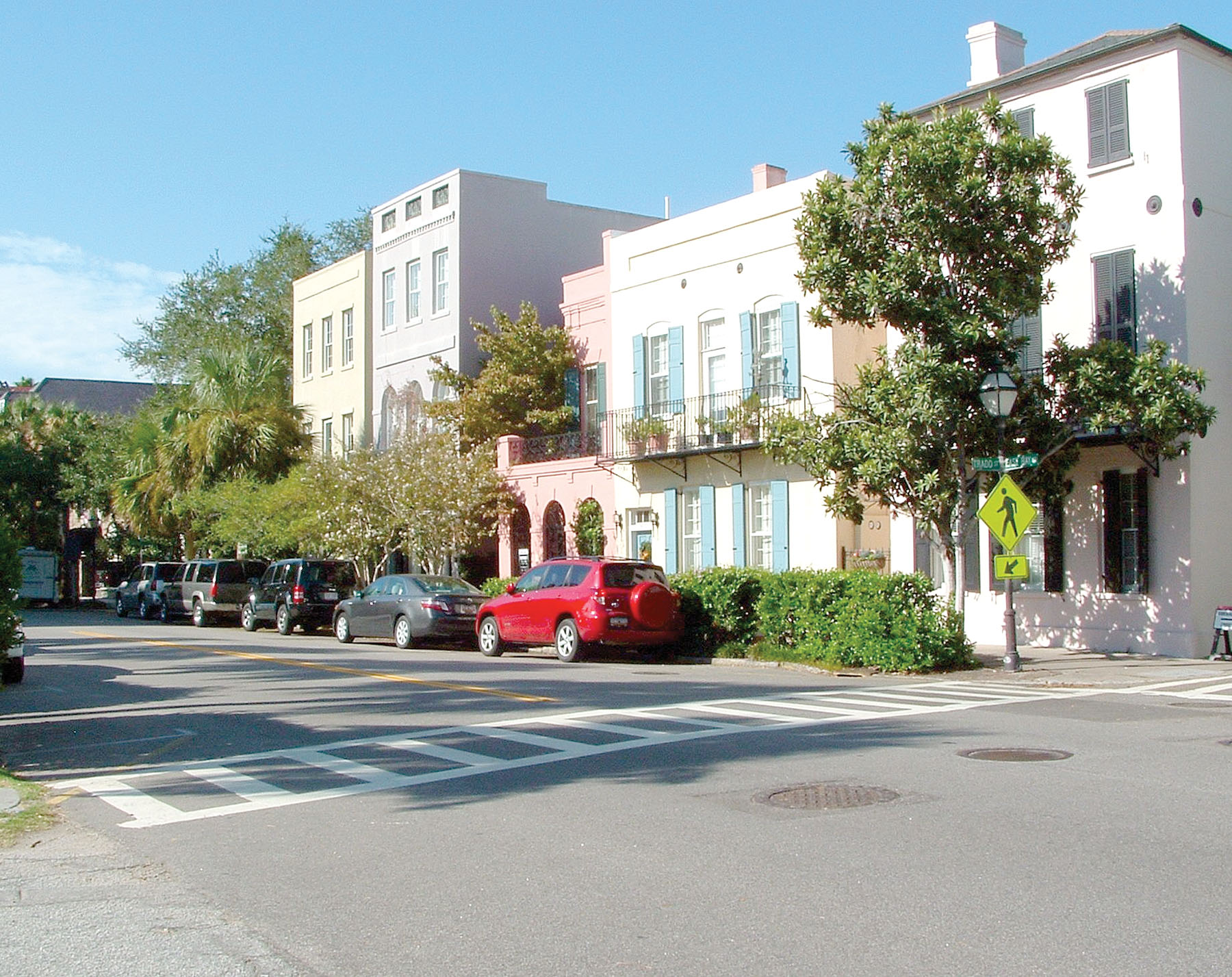
    One of America’s more colorful neighborhoods, 79-107 E. Bay St., Charleston. (Photo/Robert Clark)

    Drive 144 miles to Charleston. Wind your way to East Bay Street and proceed to 79 to 107 East Bay Street. There you’ll find Rainbow Row, the colorful and historic name for 13 colorful houses. North of Tradd Street and south of Elliot Street, that’s where you’ll find them. As you’ll see, the pastel paints make it easy to see how this section of historic homes got its name. An extremely popular tourist attraction, it’s one of Charleston’s more photogenic features.

    What would become Rainbow Row came to bet in the mid 18th century on 83-107 East Bay Street. At first it was a center of commerce on Charleston’s waterfront built to provide services to the wharfs and docks of the Port of Charleston. Merchants ran stores on the first floor and at day’s end they retired in the top floors.

    After the Civil War the Rainbow Row area gained a less-than-stellar reputation as it was run down. Some would have referred to it as a slum. Things changed for the better. Today, Charleston consistently ranks as one of the most-traveled to cities in the world, and Rainbow Row does nothing to diminish that reputation.

    The Row’s history is a strong one. In the 1920s, Susan Pringle Frost, the founder of the Preservation Society of Charleston, bought six of the buildings. Money was tight and she was unable to restore the homes in a timely manner. In 1931, Dorothy Haskell Porcher Legge purchased houses 99 through 101 East Bay and renovated them. She painted them a colonial Caribbean color scheme. Other owners and future owners, taking a cue from her, created the “rainbow” of pastel colors present today. The pastel colors helped keep the houses cool inside, and in time a cool name evolved.

    Restored, the houses represent the very first style of Charleston homes and they were destined for cultural history as well. They were portrayed in “Porgy and Bess,” George and Ira Gerswhin’s opera based on DuBose Heyward’s novel “Porgy.” Heyward was a Charleston businessman fascinated by the Gullah culture. That interest turned him into a novelist. (Heyward’s wife, Dorothy, developed the novel into a play.) All three works deal with African American life in the fictitious Catfish Row, which, of course, was based on the early 1920’s Rainbow Row. George Gershwin worked on “Porgy and Bess” in Charleston where the nearby James Island Gullah community influenced him.

    Like any well-known spot, Rainbow Row suffers myths. An old tale holds that the homes got their unique pastel colors so drunken sailors stumbling ashore could spot the houses where they had rented “landlubber” accommodations. Of course, that’s just a myth.

    Go see the real deal, Rainbow Row, a colorful, historical tourist attraction that a few folks call home.

     If You Go …

    Rainbow Row

    East Bay Street

    Charleston, S.C. 29401

    www.historiccharleston.org/Shop/Rainbow-Row.aspx

    Learn more about Tom Poland, a Southern writer, and his work at www.tompoland.net. Email day-trip ideas to him at tompol@earthlink.net.

  • Council OK’s Planner’s Contract

    BLYTHEWOOD – Town Council approved a list of action items on Monday evening including a Community Planning and Development Services Contract for Michael Criss, the Town’s planning consultant; a zoning text amendment to various residential districts allowing neighborhood recreation facility swimming pools and funding up to $4,900 for a Halloween Festival in the town park in late October. It even approved the park committee’s park bench design and estimated cost, which was not on the agenda.

    Park committee chairman Jim McLean reported to Council the committee’s recommendation for the purchase of five Escalante Model 1547 plastic wood park benches at $864 each for a total of $4,986.20. After approving the bench design and estimated cost, Council recommended the matter next go before the Town’s Architectural Review Board (ARB) for approval. McLean said the committee was not asking the Town to pay for the benches, but would seek donations through the park’s fundraising foundation if the ARB approved the bench’s design.

    In other business, Council thanked Michaela Barno for her volunteer work to organize and run the Town’s farmer’s market during the summer. The market will be open again in the fall, Barno said.

    In his monthly report on the Manor, Booth Chilcutt, the facility’s director, said that while September had seven fewer paid bookings than it had last September, he was encouraged by the changes they had made on the business side of the operations, noting that 43 percent of last year’s bookings were at no charge in contrast to 23 percent at no charge this year.

    “Most of this year’s free bookings are for town government meetings,” Chilcutt explained.

    Chilcutt’s assistant, Pat Connolly, reported that he was making considerable progress booking business and industry events during the week.

    “We’re doing much better during the week,” Connolly said.

    Chilcutt also proposed to Council two other park events in addition to a family-friendly Halloween Event at Doko Meadows on Oct. 31 and a Sept. 24 – Oct. 29 Farmer’s Market. He suggested a Blythewood Poetry Week Jan. 17 – Jan. 24, 2015. He also suggested a Blythewood celebration of Black History Month. The month-long event will celebrate the rich history of Blythewood’s African -American community. The events will include music, art, poetry, a live theatre production, gospel singing, story-telling and discussions.

    The next regular Town Council meeting will be Sept. 25 with a workshop on Sept. 18 beginning at 8:30 a.m. at the Manor.

  • Massa: Town a Gypsy Camp

    BLYTHEWOOD – In opening remarks at Town Council’s Monday evening meeting, Councilman Bob Massa complained once again that because the town government has still not hired code enforcement personnel, the Town looks like “a gypsy camp” on weekends. He said he was referring to the proliferation of unpermitted vendors setting up shop on weekends throughout the town.

    “If we continue to have problems with rogue vendors setting up shop in empty lots throughout the town,” Massa said, “it will look like a town of gypsies.”

    Massa said that he and his wife sometimes shop around the Upstate for a second home and the first thing they judge about a community is what it looks like.

    “Going in,” he said, “if there’s a lot of trashy stuff hanging out, we’re probably not going to move there. I find it interesting that we have more important things to work on,” Massa continued. “Code enforcement will go a long way to make our town a more desirable place to live.”

    He continued, “Coming off I-77 into town, it looks like a gypsy camp. That will cause people not to want to even stop at our restaurants. We need to get a code enforcement officer part time or full time. By leaving this on the table,” Massa said, “we’re allowing residents and nonresidents to create bad habits and a bad image for our community.”

    Massa has on other occasions complained about the lack of regular maintenance on the newly landscaped I-77 exit. Last spring, town hall discontinued the lawn care service that had been hired under former Town Administrator John Perry. Mayor J. Michael Ross said he would like to just mow and maintain on an ‘as-needed’ basis. Since that time, there have been complaints to town hall and in the newspaper about the neglected landscaping on I-77. On Monday evening, Ross said the I-77 exit as well as the landscaped area at Exit 34 would be mowed for the Labor Day holiday.

    While Ross has heretofore opposed hiring a code enforcement officer, he asked Town Administrator Gary Parker to make a note to add code enforcement to the agenda for discussion at the workshop in September.

  • Winnsboro Man Killed in Highway 200 Crash

    WINNSBORO – A Winnsboro man was killed Sunday night in a single-car wreck off Highway 200, just days after his 32nd birthday.

    Fairfield County Coroner Barkley Ramsey said Marhloh Cook, who marked his 32nd birthday on Aug. 20, was pronounced dead at the scene near the 1000 block of Highway 200 after rescue crews spent nearly an hour extracting him from the wreckage of his 1996 Oldsmobile.

    According to the S.C. Highway Patrol, Cook, of 113 Railroad Ave., was traveling west on Highway 200 at 8:10 p.m. when his car ran off the left-hand side of the road and struck a tree approximately .6 miles east of Winnsboro. Cook was wearing a seat belt at the time of the crash and was the only occupant of the vehicle, the Highway Patrol said.

    The Highway Patrol said the accident remains under investigation. Ramsey said an autopsy and a toxicology report were pending, but added that both speed and alcohol are suspected to be factors in the crash.

  • Chamber Hosts Candidate Forums

    WINNSBORO/RIDGEWAY – The Fairfield County Chamber of Commerce will hold three candidate forums as a community service to allow citizens to hear from hopefuls in this year’s Nov. 4 general election and Nov. 18 special election for Sheriff.

    Candidates for County Council seats in districts 3, 5 and 7 will meet in a forum on Sept. 11 at the Winnsboro Woman’s Club, 102 Vanderhorst St., Winnsboro. Mike Kelly will moderate the event.

    Candidates for School Board, district 3, 5 and 7, as well as candidates for Sheriff and Solicitor, will come together for their forum on Sept. 18, also at the Winnsboro Woman’s Club. Ron Smith will moderate.

    District 1 candidates for County Council and School Board, as well as candidates for Sheriff and Solicitor, will meet on Sept. 25 for their forum at the Century House, 170 S. Dogwood Ave. in Ridgeway, moderated by Kelly.

    Doors will open for each event at 6 p.m., with the forum running from 6:30 to 8:30 p.m. Questions from the audience will be taken in writing and presented by the moderator.

  • Council Green-Lights Water for Blythewood Developers

    WINNSBORO – During a 2-hour meeting on Tuesday evening, Town Council approved the request from a developer on Rimer Pond Road in Blythewood for 60 residential water taps and 24,000 gallons per day of the existing uncommitted water capacity of the Blythewood system.

    The resolution quelled a potential legal battle that had been brewing over water that Winnsboro had promised in 2008 to the developer, Sycamore Development, LLC. The developer had planned to develop a 300-home subdivision on three parcels of land along Rimer Pond Road and obtained from Winnsboro a Capacity and Willingness to Serve letter for the development of 250 residential lots.

    The water taps were to be prepaid by Sycamore once the water line went in on Rimer Pond Road. That water line was completed and accepted by Winnsboro in July of 2009, but Sycamore never prepaid for the taps.

    The subdivision never materialized, and two of the three parcels have since been sold off. The water approval on Tuesday evening was for the remaining 31.23-acre parcel at 502 Rimer Pond Road. According to documents obtained by The Voice in July, the developer was wanting to unload that parcel but could not because Winnsboro allegedly refused to enter into a Capacity and Willingness to Serve agreement with prospective buyers of the property. At that time the developer was requesting 107 residential taps for which Winnsboro would charge $1,350 each.

    “In 2008 we had promised them water and they never did anything with it,” Winnsboro Mayor Roger Gaddy told The Voice in July. “Now they wanted water and they wanted it rather quickly.”

    Documents stated that Sycamore wanted a response in writing by July 15. The agreement reached on Tuesday evening includes service to the developer’s successors or assigns.

    Generator Saves Town $1 Million

    In a related matter, Council approved a capital expenditure for a standby generator at the permanent pump station site in Blythewood. The generator will permit Winnsboro to take advantage of Columbia’s storage capacity, which will make additional taps available for assignment in the Blythewood system. Town attorney Creighton Coleman pointed out that the generator will alleviate the Town from having to buy and build an above-ground storage tank, saving the Town about $1 million. Council OK’d up to $95,000 for the generator.

    Langford Crossing Water

    Council also passed unanimously another resolution approving a request by another Blythewood development, Langford Crossing LLC on Langford Road, also in Blythewood, to proceed with the construction of water facilities for Phase 2 of its development plus an additional four water taps.

    Council also approved capital expenditure requests for an additional HVAC unit for the Annex Building at an estimated cost of $3,200; interior renovations to a portion of the second floor of the Public Safety building at an estimated cost of $12,500 and an HVAC maintenance agreement at an estimated cost of $840/year.