WINNSBORO – Mayor Roger Gaddy opened Tuesday’s Town Council meeting with an addition to the agenda, a reimbursement resolution declaring the intent of the Town of Winnsboro to reimburse itself for certain expenditures from the proceeds of debt (bond) to be incurred with the upcoming bond referendum to bring water from the Broad River. The resolution, which was approved unanimously, also allows the Town to be reimbursed for expenses the 60 days prior to Sept. 16.
Council also approved several purchases, including $95,000 to rebuild three tertiary filters at the wastewater plant and $12,000 to purchase a transformer for the Enor Corporation. Council also voted to submit applications for a pair of USDA Rural Development Community Facilities grants for an Amick garbage truck and three Ford Interceptor sedans for the Town’s Public Safety Department. Council committed to matching funds of $63,000 for the garbage truck and $48,986.10 for the three sedans.
Following executive session where Council discussed legal and contractual water issues concerning Mid-County Water Company, Blythewood, Boney Road and Red Gate, et. al., Council voted to allow the Utility Department to fill an open position. It also voted to uphold Town Manager Don Wood’s denial of water to a Boney Road property in Blythewood.
The water line to the home would have had to travel across the yards of other homes. The property owner appealed Wood’s decision to the Town Council.
“We just couldn’t do that,” Gaddy said. “Don Wood looked at it and determined that, of course, we couldn’t just go across somebody’s property.”
BLYTHEWOOD – The Board of Architectural Review Monday night unanimously approved a new design concept for an amphitheater band shell in the town’s Doko Park. The raised permanent structure was recommended to Town Council for approval by the Park Committee. Jim McLean, the committee’s chairman, said the Wave band shell is a smaller, less costly design than the original design, but that it can be increased in size at a cost of about $10,000 per 5 feet in width. Built by Polygon, the shell measures 30×40 feet and features quad beams, a front concrete pad, electrical connections and lighting. The estimated cost is $125,000 – $150,000.
The next stop for the shell is Town Council, where it will be perused for color, scale, lighting and other features.
“We felt it needed to come before the BAR first for approval of the design concept, to be sure it is fitting for the park before Town Council looks at it,” McLean said.
McLean also reviewed for the board some of the town’s historical properties, suggesting that the Town develop an inventory of prospective properties and the Historical Society could help with ranking, using a point system for determining historical importance.
“I believe in an historical ordinance,” McLean said. “In 2007 we identified 58 pieces of historical properties. As the town has grown, the prospects for historical properties have also grown.”
Winnsboro’s Grand Water Plan Fails to Move Blythewood’s Needle
BLYTHEWOOD – The Town of Winnsboro’s multimillion dollar plan, made public for the first time at Town Council’s Sept. 2 meeting, to draw as much as 10 million gallons of water a day from the Broad River does not appear to have swayed the Town of Blythewood from its efforts to terminate its water franchise agreement with Winnsboro and seek service instead from the City of Columbia.
“Reconsideration would be something that our Council might would entertain as an option, but (that’s) certainly not our position now,” Blythewood Mayor J. Michael Ross told The Voice in an email dated Sept. 9, a week after Winnsboro voted to launch the project. “Probably all of this will be discussed at work session on Sept. 25.”
Sept. 25, however, may prove too little too late for Blythewood. According to the water franchise agreement, contractual disputes are subject to arbitration. Winnsboro voted on July 17 to pursue arbitration and hired Robert Bachman to serve as the Town’s mediator. At press time, however, Blythewood was still bucking arbitration and had not hired a mediator to represent them in the dispute.
“We have not (hired an arbitrator) at this time,” Ross wrote on Sept. 9, “and I have sent a letter to (Winnsboro Mayor Roger) Gaddy to request if we could forgo the arbitration process. (It is a) tremendous unnecessary expense dictated by a 20 year old agreement.”
John Fantry, Winnsboro’s legal counsel for public utility matters, told The Voice Tuesday that Blythewood’s window to hire a mediator closed on Wednesday.
Last April, Blythewood abruptly and without warning passed a resolution to terminate the agreement that transferred annually approximately $13,000 from Winnsboro to Blythewood for use of Blythewood right-of-ways necessary for Winnsboro to access, service and maintain water infrastructure. While Blythewood reads the contract as effective until 2016, Winnsboro maintains that the agreement is binding until 2020. Severance of the agreement would, according to the contract, require Winnsboro to sell off that infrastructure at fair market value to Blythewood.
The City of Columbia has since entered the picture, expressing interest in acquiring Winnsboro’s infrastructure on Blythewood’s behalf. In an Aug. 5 letter to Winnsboro, Columbia Mayor Steve Benjamin said the Columbia was ready to begin negotiations pursuant to a sale.
But Winnsboro has remained steadfast in its resolve to pursue arbitration. In response to Benjamin’s letter, Gaddy wrote on Aug. 20 that Winnsboro considers any discussion regarding the sale of the Blythewood system “premature in that Winnsboro is demanding arbitration,” over the disputed termination of the franchise agreement.
“We are not interested in wasting public resources to pay lawyers to determine questions that are insignificant in the practical sense,” Ross wrote Gaddy on Sept. 4. “Whether the agreement expires in 2016 or 202 is really nor material to the public interest. What is important is that Winnsboro has been unable to provide potable water reliably and in sufficient quantities to our community.”
With no arbitrator sitting on the other side of the table, Winnsboro will now have to consider its next steps. Fantry said Winnsboro could take the matter before a Circuit Court judge and ask the court to enforce the contract. Winnsboro could also seek punitive damages, could elect to stop paying the annual $13,000 franchise fee or could even cut off water service to Blythewood Town Hall and the Doko Manor.
What is absolutely clear, Fantry said, is that Winnsboro has no interest in discussing the sale of its Blythewood infrastructure before the expiration of the contract. With the arbitration process derailed, when that contract expires may be up to the courts.
Winnsboro’s plan to draw from the Broad River may cost as much as $13 million and would require Winnsboro to lay approximately 9 miles of water lines between the river and the reservoir. Sources have indicated the first water may not flow through those lines until 2017. Should the Broad River plan deliver as promised, and if Blythewood were to have a change of heart, Ross wrote Gaddy on Sept. 4 that Blythewood would seek to have any potential future agreement reworked.
“The existing Franchise Agreement is flawed in a number of respects and in no event would we wish to renew on the same terms and conditions,” Ross wrote.
RIDGEWAY – After voting at their Aug. 14 meeting to award a $1,200 contract to M.C. Rowe to construct an earthen berm on the east side of the Century House, Town Council changed gears last week, electing instead to erect a cable barrier. Council unanimously agreed on the change of course after Councilman Russ Brown volunteered to construct the barrier himself.
“I know we’ve already voted on that, but I’m not sure if it’s been approved,” Brown said during Council’s Sept. 11 meeting. “I’m going to suggest that if the Town would like to save money I would be willing to put in the wire and the posts.”
Rezoning Hearing
Brown’s attempt to have .82 acres at the junction of highways 34 and 21 failed to make it past the Planning and Zoning Commission on Aug. 25. The property is zoned as R1 (single-family residential) and Brown was seeking to have it rezoned as commercial to conform to surrounding lots. Brown said last week he was considering an appeal of the process.
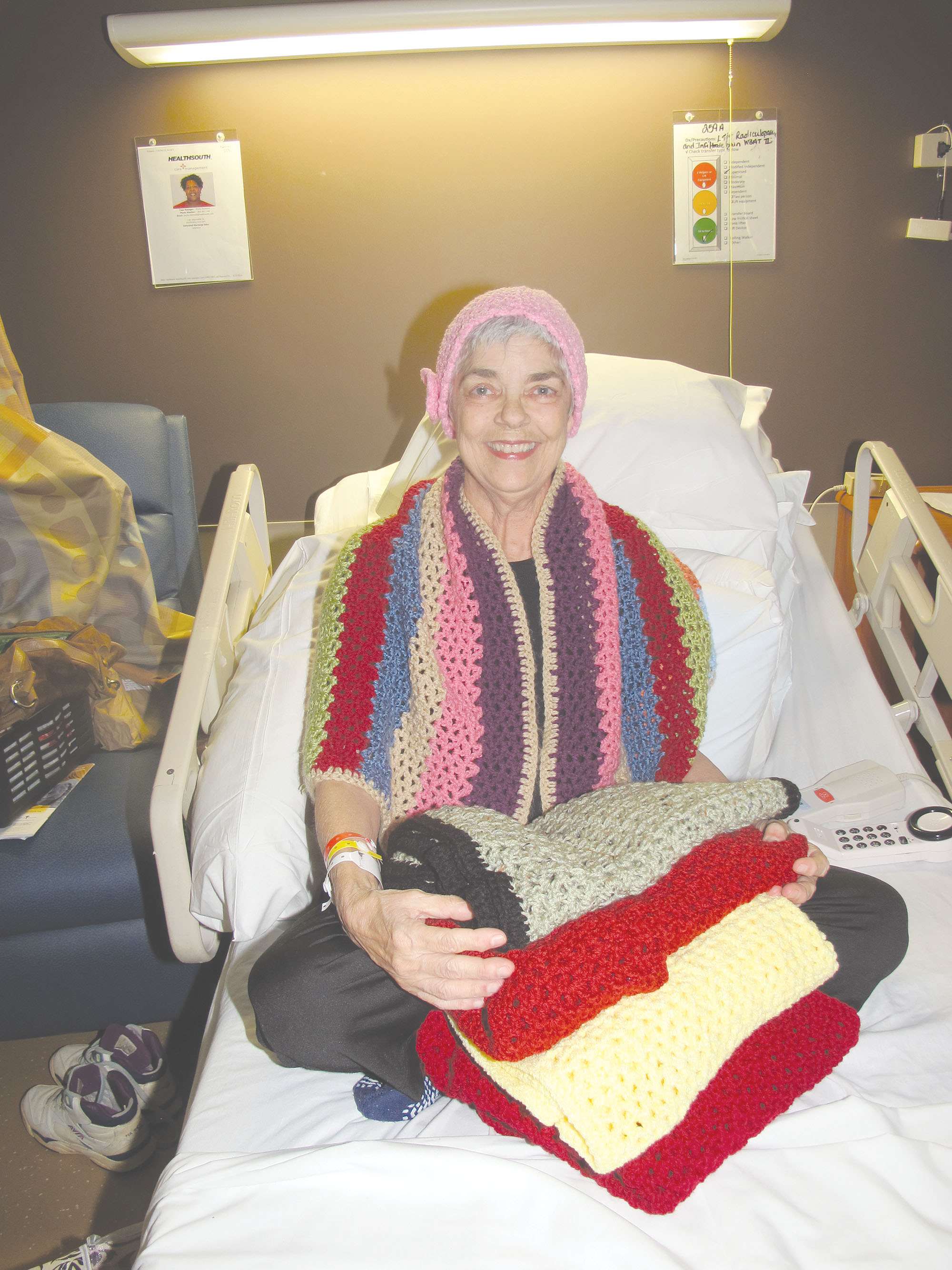
Wearing a colorful prayer shawl crocheted for her by Margaret Richardson and a pink hat knitted by Peni Chandler, Mary Thomas holds a lap full of crocheted prayer shawls that she plans to distribute to other patients in need of comfort. (Photo/Barbara Ball)
WINNSBORO – When Mary Thomas, 68, of Winnsboro underwent surgery last year for a stomach aneurysm and a month later for lung cancer, she faced many challenges, not the least of which was survival. Although optimistic by nature and full of enthusiasm, Thomas, a widow, realized she was facing a daunting battle. To comfort Thomas during those difficult days after her diagnosis, a friend and fellow member of the Church of the Nazarene in Winnsboro, Norma Branham, gave Thomas a shawl that Branham had hand-crocheted especially for her.
“Norma told me she said a prayer for me with every stitch and there were thousands of stitches,” Thomas said, smiling sweetly, remembering the gift with tears shinning in her eyes. “Norma wrapped the shawl around my shoulders. She said it would bring me comfort. And it did. It was warm and the knowledge that I was wrapped in a thousand prayers brought me amazing comfort.”
Following her surgery, Thomas underwent several weeks of chemotherapy at the South Carolina Oncology Association in Columbia. There she waited mornings with other women, most of whom, Thomas said, were undergoing radiation for breast cancer.
“I noticed one young woman was upset, alone and seemed scared. It was cool in the room and she was shivering, so I took off my shawl and put it around her shoulders. I told her it had many prayers crocheted into it and that it was made with love,” Thomas said. “I could see my gesture brought her comfort. Her reaction made me feel like I had given her something very special But I think the comfort came from the shawl.”
Branham crocheted another shawl to replace the one Thomas had given away. Before long Thomas had given that one away as well, and Branham crocheted another one. Thus began what Thomas refers to as her prayer shawl ministry. Other friends, including Cindy Zimmerman, Velma Defibough and others also began crocheting shawls to supply Thomas’ ministry. Twelve shawls were sent from Mississippi friends of Norma and Eddie Branham’s. During the last year Thomas has given away more than 200 shawls.
Then last month, Thomas learned that her lung cancer had metastasized to her brain. Surgeons removed a large malignant tumor about 10 days ago, Still, Thomas is bright-eyed and cheerful, and her prayer shawl ministry is in high gear. After a week at Health South in Columbia for rehabilitation, she had given away another 20 or so shawls.
“Word about the shawls has gotten around the hospital, and other patients are now coming to my room asking for them,” Thomas said.
A native of Virginia, Thomas spent a rather glamorous career in the Army as a receptionist, first for the Army Chief of Staff and later to a string of generals, including General W.C. Westmorland. Along the way she met folks like General Omar Bradley and was photographed visiting with President Lyndon B. Johnson at the White House. At 42, she married Ricky Thomas and settled in Winnsboro.
“I had a nice life,” Thomas recalled, “and I still do.” While she admits her life changed drastically when she was diagnosed with cancer, she said, it hasn’t been all bad.
“That’s when I decided to start living my life for the glory of God,” Thomas said. “I now have a greater purpose and a new outlook on life.”
Thomas said she doesn’t yet know what her prognosis is, but she will be meeting with her doctors next week to learn what lies ahead.
“But, no matter what, I’m not afraid. I’m in God’s hands, so everything is going to work out. Besides,” she said, gently patting the soft pile of crocheted prayer shawls on the foot of her hospital bed. “I have my work, my ministry, to keep me busy, I have lots of work ahead of me that I’m really looking forward to.”
WINNSBORO – Exercising their new protocol for discretionary spending, County Council Monday night doled out $7,000 in community enhancement grants to organizations in five districts, with an additional $2,500 in districts 2 and 7 allocated for street lighting. With $2,500 budgeted for each district, however, Monday night’s allocations left $5,500 on the table, prompting Council to consider extending the application period.
Milton Pope, interim County Administrator, told Council that 12 organizations had applied for funding for community programs in districts 1, 4, 5 and 6. The Girls Scouts of America and the Winnsboro Lions Club had also applied for funds, Pope said, but without a specific district sponsorship. Pope said Councilman Mikel Trapp (District 3) had agreed to sponsor those two organizations under his district so they could qualify for funding.
Council voted unanimously to award $500 in District 1 to the Tiger Toes Literacy Program. The grant will be used to purchase 250 books to give away at free book distributions in Ridgeway, Simpson, Longtown, Centerville and the Lake Wateree area. In District 3, the Girl Scouts and the Lions Club were each awarded $500. The Lions Club will use their portion to provide eye exams and glasses for the indigent. The Girl Scouts will use their grant to help fund their Youth Initiative Program.
Council also OK’d $500 each in District 4 for St. Luke Baptist Church and Mt. Zion AME Church. St. Luke will use the funds to restock its food pantry, while Mt. Zion AME will use the grant to purchase school supplies for its back to school bash, to provide Thanksgiving dinners for the needy and to help fund its Christmas gift bag project for the homeless.
In District 5, Council approved $500 for St. Mark Baptist Church for school supplies for its back to school bash and to restock its food pantry; $500 for the Fairfield Memorial Hospital Foundation to update the walking track around the hospital; and $500 each to Blackjack Baptist Church, New Hope AME Church and River of Life Church to purchase school supplies for their back to school bashes.
Council approved $500 each in District 6 for Fairfield Behavioral Health Services (FBHS), Fairfield Medical Associates (FMA), St. Paul Missionary Baptist Church and the Church of the Nazarene. FBHS will use their grant to fund their tobacco-free initiatives, while FMA will use their grant to help fund a health and wellness fair. St. Paul Baptist will use their grant to fund health and wellness initiatives for youth and elderly, and the Church of the Nazarene will use their grant to purchase school supplies and to help fund their Judgment House community education program.
Council approved the new discretionary spending policy last July and set a deadline to apply for the funds at Aug. 22. While Pope said the County contacted past recipients to inform them of the new deadline and advertised the grants through the local media as well as through the Chamber of Commerce’s website, Councilman Kamau Marcharia (District 4) said the window of opportunity for applicants was too narrow and suggested Council reconsider how the leftover funds are to be treated.
“I had only two people apply. That means $1,500 goes back into the kitty,” Marcharia said. “I’m thinking that we should have that money there for each district to use that money. We already voted on it. Just to kill it like that, I think is not a good idea.”
Marcharia moved that Council send the policy back to committee for reconsideration. After Trapp offered a second, Council unanimously voted to do so. Chairman David Ferguson (District 5) said the matter would be discussed at an upcoming work session.
Pope said the funds must be used and receipts turned in to the County by Dec. 28. Next year, he said, the grants will be allocated prior to the 2015-2016 budgeting process.
JENKINSVILLE – For the third time in four years, the Jenkinsville Water Company is bumping up against the S.C. Department of Health and Environmental Control (DHEC), this time for excessive radium and gross alpha contaminants in well number 15, on Clowney Road.
DHEC issued a Notice of Violation to the company on Aug. 19, stating that the Jenkinsville Water Company (JWC) had exceeded the maximum contaminant level (MCL) in well 15 during the monitoring period of July 2013 – January 2014. A chart accompanying the notice, however, indicates that the levels of radium and gross alpha outstripped their MCLs well into June of this year.
Gross alpha particles occur from the erosion of natural sediments in the soil, the MCL for which is 15 picocuries per liter (pCi/L – a measurement of radioactivity in water). Between July and September of 2013, the Clowney Road well’s gross alpha levels were 22.4 pCi/L. Between October and December of 2013, they were 24.7. Those numbers dipped in the first quarter of 2014 to 18.1 pCi/L, but spiked again to 23.7 pCi/L between April and June of 2014, for a one year average of 22 pCi/L – well above the 15 picocuries per liter limit.
DHEC’s MCL for combined Radium 226 and Radium 228, which also occur from soil erosion, is 5 pCi/L. Between July and September of 2013, the Clowney Road well’s MCL for radium was 6.5 pCi/L. That number jumped to 8.5 between October and December of 2013, and dropped off to 5.3 pCi/L in the first quarter of 2014. Between April and June of 2014, DHEC detected only Radium 228, but above the MCL at 6.5 pCi/L, bringing the JWC’s yearly average at well 15 to 7 picocuries per liter.
According to DHEC, “some people who drink water containing” the gross alpha or radium contaminants in excess of the MCL “over many years may have an increased risk of getting cancer.”
A DHEC spokesperson told The Voice Tuesday that “a public water system is not required to take a well out of service for violation of an MCL for a contaminant where the MCL level is based on long term exposure, but is encouraged by us to do so if the water system has enough excess capacity to meet demand.”
Violations are based on at least a year’s worth of data, DHEC said, and not a single sample result. The MCL for radium is based on 20 or more years of exposure, the spokesperson said, “and there is no immediate health threat from drinking water that has radium levels above the MCL.”
DHEC said the company has already met with the Drinking Water Enforcement Section to discuss the violation and possible course of action to return to compliance. JWC will be required to submit a corrective action plan (CAP) to DHEC for approval, the spokesperson said, which must have a proposed course of action to return to compliance with a schedule for implementation.
An Enforcement Conference was held last week, DHEC said, and a draft Consent Order (CO) has been prepared and reviewed. The draft CO, which specifies that the CAP must be submitted to DHEC within 30 days, was scheduled to be mailed to the JWC this week.
In August of 2012, the JWC was slapped with a $14,000 fine by DHEC for failure to issue a boil water advisory to customers within 24 hours of the July 2012 discovery of E-coli bacteria and total coliform in the system, as well as for failure to collect follow-up samples after the contaminants were discovered. The company made its last installment payment on that fine in June 2013.
In June of 2010, the JWC was issued a notice of violation when DHEC found that the MCL for uranium was exceeded in well number 10 at the Blair fire station for the monitoring period of July 2009 through June 2010. The MCL for uranium is 30 micrograms per liter. Between July 2009 and June 2010, well 10 averaged 33.4 micrograms per liter, with a high of 42.5 between April and June of 2010 and a low of 20.4 between October and December of 2009.
Phone calls to Gregrey Ginyard, president of the Jenkinsville Water Company, were not returned at press time.
WINNSBORO – The County’s long-awaited plan for how to spend $3.5 million of the 2013 $24.06 million bond issue on recreation improvements ($500,000 per district) was finally revealed to the public Monday night and passed by County Council into its next phase of bidding out the projects. But with the entire plan more than $600,000 over budget, Council may well find itself paring down projects by the first of the year.
“You’ll see numbers today that are higher than the budget, but where we are today in the planning process, we feel like that’s appropriate and the right place to be today,” David Brandes, of Genesis Consulting, told Council during his presentation of the plan Monday night. “We’re not trying to get down to the exact budget. We want some ability for the marketplace to play a role. If prices come in better than we anticipated, we wanted to take advantage of that. If prices come in where we think they are or a little bit higher, having a strong strategy of how we get down to the budget has been considered.”
Brandes said staffing and maintenance for the facilities, as well as replacement costs and a 10 percent contingency had all been calculated into the costs. The costs also include architectural and engineering fees.
Features
Not every district has requested the inclusion of a community center in their recreation plan, but those that have will all be looking at essentially the same building, Brandes said – a 4,300-square-foot structure with one large room the size of a half-court basketball court with several smaller rooms that can be used as game rooms, offices, etc. The facilities are designed to be expanded, if necessary.
Playgrounds come in two varieties: for ages 5-12 and for ages 5 and younger. Picnic shelters also come in 40-person and 25-person sizes, featuring concrete flooring, metal roofing, tables and grills. Basketball courts will primarily be half-court, with the option to expand to full-court if necessary. Swing sets are stand-alone items, not necessarily attached to playgrounds, Brandes said.
Property
One cannot have a recreation facility, of any size or caliber, without land on which to put it. Some districts already have land patiently waiting for its new park. Others, meanwhile, will still have to go through the County’s three readings and a public hearing process to either purchase or accept the donation of property. For the districts without land already designated for recreation, Brandes said a placeholder figure of $15,000 was included in the plan for land acquisition.
District by District
District 1: $617,017 (no land). Community center near Ridgeway; outdoor basketball court. Staffing: $28,025. Operation & Maintenance (O&M): $17,294.
District 2: $573,333 (no land). Community center; combination EMS/recycling center facility. Staffing: $10,943. O&M: $12,981.
District 3: $499,337 (no land). Outdoor basketball court; swing set; two 5-12 playgrounds; two 5 and under playgrounds. Staffing: $3,836. O&M: $12,969.
District 4: $641,660 (8.12 acres off Ladd Road currently under lease). Community center; walking trails; outdoor basketball court. Staffing: $30,190. O&M: $20,015.
District 5: $641,930 (no land). Outdoor basketball court; swing set; two walking trails; two 5-12 playgrounds; two 5 and under playgrounds; three picnic shelters. Staffing: $3,836. O&M: $21,199.
District 6: $509,629 (County owned former maintenance facility). Conversion of existing facility into fitness center, to include fitness classes and equipment; lighting for existing football/soccer field; walking trails; picnic shelter. Staffing: $45,579. O&M: $24,723.
District 7: $644,440 (Genealogy building). Improvements to genealogy building; outdoor basketball court; stand-alone rest room facility; baseball/softball field; picnic shelter (larger than 40-person). Staffing: $3,836. O&M: $12,191.
The Next Step
Council voted unanimously to authorize Pope to amend the County’s contract with their consultants (Kenneth B. Simmons Associates and Genesis) to allow them to begin putting projects out for bid. Once those bids come in, Council will then take another look at the costs and consider, if necessary, which things to leave out and what to keep in in order to hit their $3.5 million budget. Brandes said building plans will have to be approved and permitted by the County, and the County engineer will have to OK grading plans and issue a storm water permit.
“We’ll move as fast as we can getting those contract documents together, getting the permits secured, then bidding right on the heels of that,” Brandes said. “Depending on where the sites are available, one to two months, then hopefully by the first of the year we’re actually swinging hammers and sawing boards.”
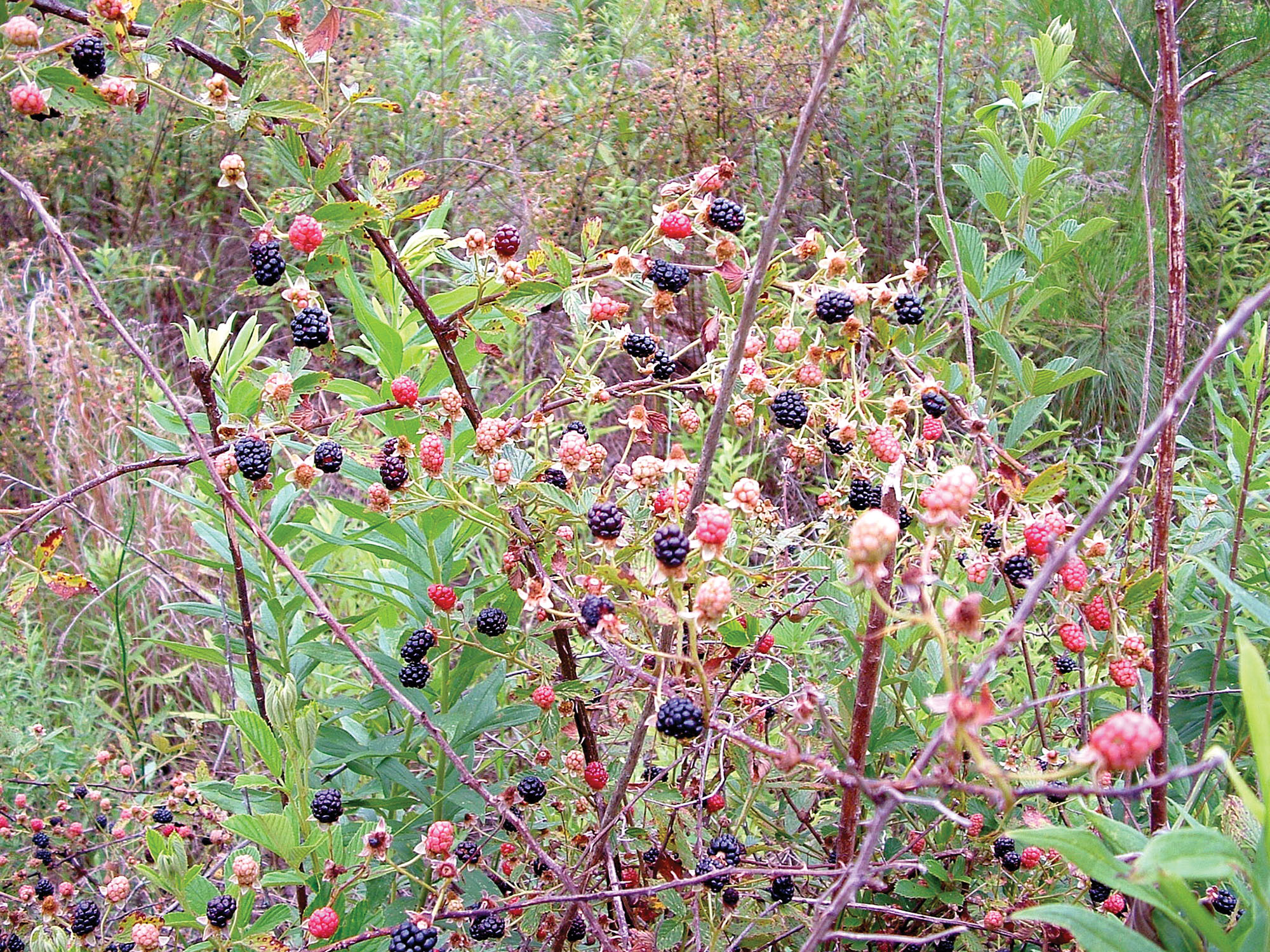
Plump, juicy blackberries, available at a roadside near you. (Photo/Tom Poland)
Last month I was on assignment in a remote place; the kind of place where you see trucks and tractors but few cars. Farm territory. I parked along a weedy, poorly maintained road and as I stepped from the car I saw a sight from childhood. A tangled thicket of briars with succulent, shiny blackberries glistening like onyx pendants. Red berries, hard and yet to ripen, waited their turn for sunshine to do its magic.
Seeing this explosion of blackberries brought back childhood memories. Pickin’ berries was great fun, a tradition. I imagine country kids still look for blackberry patches. We sure did. A bucket: that’s all we needed. The juice stained my clothes but I didn’t care. All those memories and more came rushing back when I parked along the tangle of berries you see pictured here. My timing was perfect. In the South, blackberries peak during June. I just happened to have a container in the car and I set out picking berries. The best berries were hiding deep in the “nettles,” as the British call briars.
I sprinkled them onto my shredded wheat the next morning. Not once did I get sick. I read that anyone picking blackberries today in wild places should contact the landowner and ask if he’s sprayed anything toxic on them. Why does everything we did as kids have to seem so dangerous now? You know, if your child rides a bike he must wear a helmet. That kind of thing. I swear we live in the era of pending disaster at every turn. Now I’m supposed to look up the landowner and ask him if he’s sprayed the wild blackberries? Surely not. I’d sure hate to see picking blackberries go the way snow ice cream went. Ruined by chemicals.
Today it’s advisable to pick blackberries at “agritourism” farms. That’s better than not picking them at all, but I prefer to discover blackberries along a forgotten country lane. It revives the sense of adventure I had as a kid growing up.
Another source of fun and food were plum trees. We had a plum tree down by our driveway. As the days grew warmer, the plums turned from green to yellow and red. We’d pick ’em, eat ’em and spit out the pulp. Didn’t take long to learn that the sweetest plums often had fallen to the ground.
When I was a boy I didn’t keep a bag of gummy bears or skittles around. Such things were foreign to me. I picked and ate wild plums, wild black cherries and blackberries, and not once did I get sick. You knew you were in for a mess of chiggers but that was the price you paid.
I know you fine Southern ladies reading this column have taken kids blackberry picking. As for you young girls recently married or planning a wedding, when you have kids take them into the countryside and let them pick blackberries. It’ll come natural to them and they’ll thank you. Make ’em a pie, and they’ll never forget this day trip I assure you.
If You Go …
Drive out into the countryside and look for read-and-black berries, complete with briars. Free. Chiggers included.
Learn more about Tom Poland, a Southern writer, and his work at www.tompoland.net. Email day-trip ideas to him at tompol@earthlink.net.
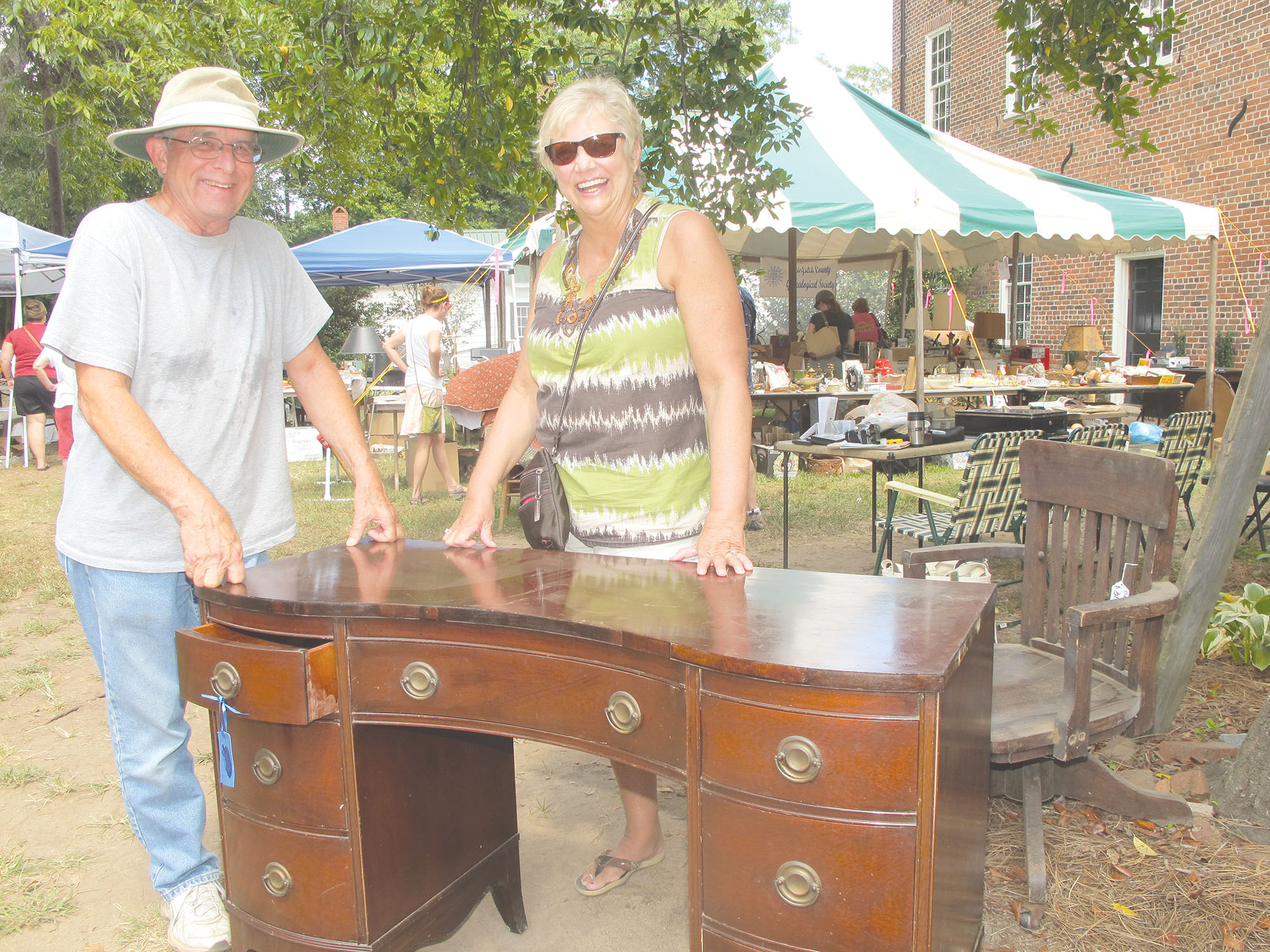
You’ve Been Grabbed – John Davis, a Fairfield County Museum volunteer, helps Janet Spires of Lexington carry her Big Grab $35 purchase (a mid-century vanity that she plans to refurbish and use as a desk) to her truck. Pelham Lyles, director of the museum, reported that the museum’s ‘back yard shade tree’ sale was a huge success.
On Shoestring Budget, Event Gives Local Merchants Shot in the Arm
BLYTHEWOOD/FAIRFIELD – Friday and Saturday were good days for the shops, restaurants, service stations, hotels and other merchants in Blythewood, Winnsboro and Ridgeway. Long lines of cars and trucks began snaking into the towns early Friday for the annual Big Grab Yard Sale. The vehicles’ occupants arrived with large amounts of cash for two days of non-stop bargaining and buying . . . and bargain and buy they did.
“It was two of the best days of the whole year for us,” said Kristen Stratton, owner of Bits and Pieces Consignment Shop in Blythewood where everything in the store was 25 percent off with some items marked down to half price.
“Us, too,” echoed Liz Humphries, owner of Blythewood Consignment. “Our store was packed both days. It was great.”
“We were slammed on Friday,” reported Christine Fair, owner of Winnsboro’s Cornwallis Tea Room. Tina Johnson, owner of Over The Top in Ridgeway, said she had multiple lines at the checkout counter most of the time both days. “It was way more than I expected. Two great days!”
One church that had a sale booth on Congress Street in downtown Winnsboro reported sales of $4,000 before the booth closed on Friday.
Louise Ruff, 10, cashed in big on the home-baked cookies, brownies and breads she sold at her little sidewalk booth in downtown Ridgeway.
“I made about $200,” she said. “I sold everything my mom and I had baked by noon on Friday, so we had to bake more that evening. And on Saturday I sold everything by mid-afternoon. It was a good day,” she said, quite pleased.
Blythewood’s hotels and fast food restaurants as well as service stations in all three towns reported a significant uptick in business.
Larry Sharpe, owner of three Sharpe Shoppes and the Bojangles in Blythewood said his business during the two days was up 25 percent more than when the Rodeo comes to town.
“Until this, the rodeo gave us our big sales days,” Sharpe said. “But there was lots of foot traffic from The Big Grab, lots of people buying snacks and Bojangles. It’s a good thing for the town’s merchants.”
The Big Grab was advertised online, on radio and in newspapers. Vendors came from as far away as Alabama, and shoppers from as far away as Ohio and Florida.
But for all the business it brings the town’s merchants, it doesn’t get the big bucks of support from the respective town governments that other events do. The Blythewood town government donates $15,000 to the rodeo and similar amounts to the Band and Baseball Tournaments each year. But merchants say those events do not bring as much business to the town during shopping hours as The Big Grab. The Town of Blythewood, which had the greatest number of vendors and shoppers over the two days, donated $1,000. Winnsboro Town government donated $300 and Ridgeway, $175. Vendors paid from $20 to $50 for sponsorships.
Terry Vickers, one of the organizers said the event’s no-frills budget is a little more than $3,000, small for such a large event.
“That has to cover insurance, advertising, portable restrooms and other expenses,” she said.
While he agreed that The Big Grab could benefit from more hands on deck to help with the planning, Blythewood Mayor J. Michael Ross said, “if the town gets all this and the organizers only need $1,000 from us, I think that is the way we want it to work.”
He said he is going to get some numbers from the restaurants, hotels and merchants for the weekend to see how much the event might have generated over regular weekends here in Blythewood.
“If the numbers come back with increases, we would certainly entertain increasing the amount if they need it,” Ross said.
The brainchild of Blythewood’s Denise Jones who co-owns the Cottonyard Market in Ridgeway, the sprawling yard sale now in its third year covers 43 miles encompassing Winnsboro, Blythewood and Ridgeway. All but the long stretch on Highway 34 from I-77 to the bypass in Winnsboro was fairly solid with yard sales. Vendor tent cities cropped up in several locations between Blythewood and Ridgeway, at times bringing traffic to a crawl.
“But when it slowed down,” said shopper Nadine Branham, “we just got out and shopped!”
Jones expressed her gratitude to the shoppers, the vendors and the sponsors who signed on with financial support.
“It’s a volunteer effort and we are dependent on volunteers for things to run smoothly,” Jones said. “The organizers try to think of ways each year to improve on the previous year.
“The Big Grab provides a big financial boost for our businesses as well as our church and resident vendors,” Jones said. “Plus, it brings a big selection of bargains for shoppers. It’s a win-win for everyone.”