Blog

  • Blythewood Academy Gets Historic Designations

    BLYTHEWOOD (May 12, 2016) – The Blythewood Planning Commission voted May 2 to designate as historic properties the interiors of the Blythewood Academy gym and auditorium and to change the classification of both the gym and auditorium from Class II to Class I.

    Because those two items were recommended by the Commission, it was necessary to also recommend an amendment to the Town’s zoning map to show those changes on both the zoning map and in the Legend on the map.

    The Blythewood Historical Society recommended the changes, which were in turn recommended by the Board of Architectural Review (BAR) last month. Under 155.538(8) of the Town Code of Ordinances, the Planning Commission provides formal comment on any historic property designation before it goes to the Town Council for a vote.

    “What is the benefit of this?” newly appointed Commissioner Michelle Kiedrowski asked about the change from Class II to Class I. “The owner could not make changes (to the property) without a process of approvals. So what’s the benefit of changing the classification?”

    Town Planner Michael Criss explained that the change in class would require more rigorous review to get approval for changes from the BAR.

    “How is that beneficial?” Kiedrowski asked again.

    “From the perspective of those who value the historic nature of the structure as it is,” Town Administrator Gary Parker explained, “(the owner) can’t change something as easily as if it were Class II.”

    “The representative of the owners, Richland School District 2, are on board with the Historical Society to make the change (for the gym and auditorium) to Class I,” Criss said.

    The vote was unanimous to recommend the changes and zoning map amendment. The issue is expected to go before Town Council later this month.


  • Manor Pulls Out of Slump

    BLYTHEWOOD (May 12, 2016) – The Town’s event center, the Doko Manor, which was once labeled by at least one Town official in a public meeting as a financial albatross, appears to be pulling out of a three-year financial nose dive with a projected revenue of $145,992 for fiscal year 2016.

    While Event Director Steve Hasterok told The Voice last week that The Manor, “is still a little ways from being full-blown profitable, we’re getting there.”

    “We’re now covering operating costs, and sales are great,” he said.

    “I think the fourth quarter this year will probably be the strongest quarter the Manor has ever had,” Hasterok reported to Council during their April 25 meeting. “I projected fourth quarter revenue at $50,800, and we’re looking at revenues now of about $60,650 for the quarter.”

    “The Manor’s busy,” Hasterok said. “We had 22 events in April, with a fourth quarter average of over 17 events per month. We average 20-50 inquiries per week now, and we’re becoming known as the place of choice, especially for Friday night parties and Saturday weddings. We have a beautiful facility, people like it and we’re very competitive in our pricing.”

    Hasterok said The Manor’s newly completed bridal dressing room is currently being furnished, as is his new office, both of which were located in The Manor after the facility’s front porch was enclosed for additional space.

    Hasterok told Council, “We are looking for a very strong FY 2017. We don’t have a weekend available from now until the end of this calendar year. “

    He said The Manor expects to accommodate 40 – 50 weddings during 2016.


  • Scrolling Sign May Scroll No More

    BLYTHEWOOD (May 12, 2016) – Having prevailed in 2011 in what the attorney representing Companion Animal Hospital called “the unpleasantness” of securing a variance for a non-compliant electronic changeable copy (ECC) sign after a long, contentious sign permitting history dating back to 2008, the hospital’s owner, Elaine Meincke, returned to the Board of Zoning Appeals (BZA) Monday evening in an attempt to keep the hospital’s non-conforming ECC portion of the sign scrolling beyond the previous variance’s January 2016 deadline.

    This time, the BZA ordered that the ECC portion of the sign must either come into compliance with the current sign ordinance or cease operation. Compliance would mean the ECC sign would change only once per hour during hours of operation and would not scroll but remain static.

    Companion’s attorney, Alexander Shissias, said the hospital’s ECC sign cannot comply. He said the ECC portion of the sign is an LED, which is subject to burn out when left static over long periods of time, and it cannot display more than one line of text with a few words at a time.

    In a letter to Town Administrator Gary Parker, Shissias wrote, “Without scrolling, the sign is limited to a display of ten characters at any one time. After working with the software, I was unable to change the size of the characters, unable to change the font to fit more characters in, and I was unable to split the text into two lines.

    “The only thing we are asking relief from is the one-hour limitation,” Shissias told the Board. “We are requesting, instead, to have three messages displayed over a nine minute period. No scrolling. That will allow the owner to display three short messages such as hours of operation and the services. And changing every three minutes will keep the sign from burning out. Without something like this, the sign will grind to a halt.”

    BZA Chairwoman Sabra Mazyck reminded Shissias that all the businesses in the town had been asked to have their signs comply with the current sign ordinance by Jan. 16.

    “If we allow you to do this, what about all these other businesses who have come into compliance?” Mazyck asked.

    Shissias reluctantly reviewed the sign’s tortured history in which Companion and many in the community felt the sign’s permit had originally been held up until a new ordinance was put in place that would not allow ECC signs.

    “The sign was purchased in 2008,” Shissias said, “but it took so long to get it permitted that the ordinance (limiting ECC signs) beat it. There was issuance of something that looked like a sign permit and then the sign was turned on and my client was immediately served for non-compliance and taken to magistrate’s court. It wasn’t until April 2009, the sign was allowed to scroll.”

    Shissias concluded his request, saying, “We’re just trying to get the life out of this sign before it dies.”

    The Board expressed sympathy for Companion’s plight and Board member Joseph Richardson offered a possible solution to give Meincke more time before taking the non-complying sign out of commission.

    “I’d like to put on the table that we (give you) a very limited-in-time extension of the right to use this sign,” Richardson said, “perhaps allowing it to change a little bit more often than every hour based on the fact that this is one time in this set of circumstances and that we’re going to limit use significantly, and then a drop-dead date after which there is no more discussion of this sign. And then it has to be gone or operated within the ordinance.”

    While Board Attorney Danny Crowe advised that the Board could, indeed, attach conditions to a variance, the variance was not to be.

    Every variance granted by the BZA must, by law, meet all of five specific findings and conclusions. While the variance met some, it did not meet all and was denied.

    “We tried to find a resolution that would work,” Board member Debra McLean said at the conclusion of the meeting.

    The BZA is a quasi-judicial board and its decisions are appealed to Circuit Court. Meincke said she does not plan to appeal the Board’s decision, but is looking at other sign options.

     

  • BZA Denies Abney Hills Variance

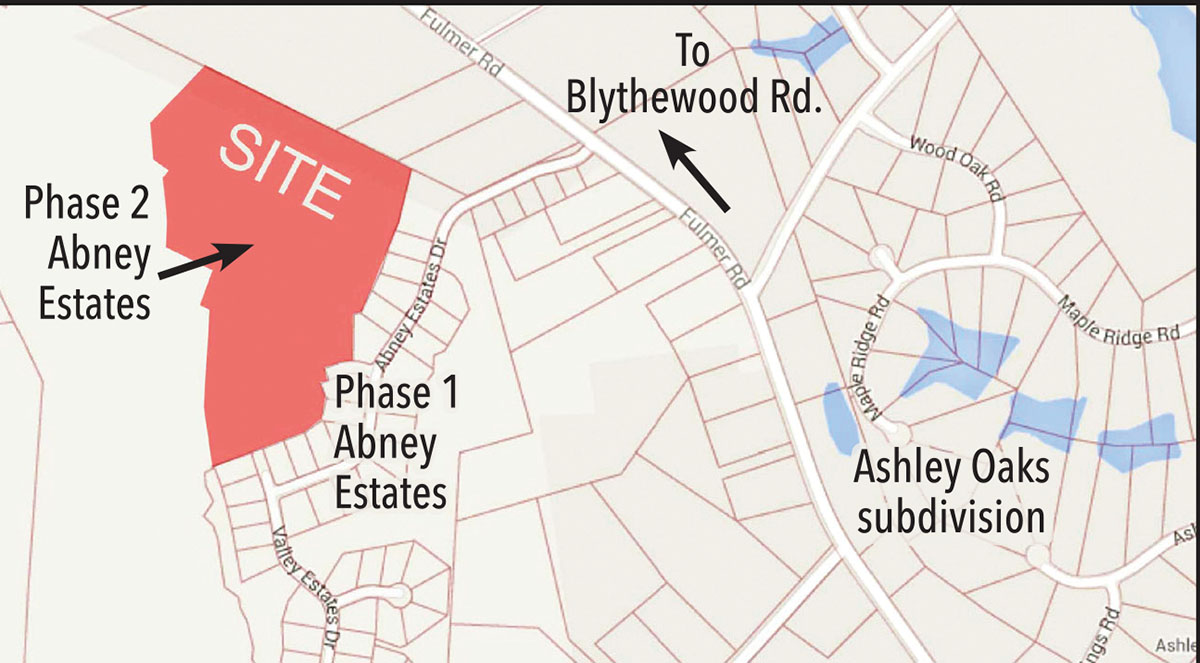
    BLYTHEWOOD (May 12, 2016) – The Board of Zoning Appeals (BZA) rejected a request Monday night for a variance that would have squeezed more homes into less space in the Abney Hills subdivision.

    About 25 residents of the Phase I section of Abney Hills subdivision packed Monday night’s BZA meeting in opposition to the request from Essex Homes, the neighborhood’s developer, for a variance to reduce the residential side setbacks from 15 feet to 10 feet in Phase II of the subdivision. With the reduced setbacks, the houses would be closer together. The side setbacks in Phase I are a combined 17-feet minimum.

    Resident Colin Murch led off a string of speakers opposing the request.

    “The variance request is more of a financial request than a request for (better) land utilization. The letter submitted with the application for the variance was, in my opinion, disingenuous and misleading in the fact that the developer states they don’t want to change the character of the development. They are reducing the lot size (in Phase II) by an average of 19 percent. There were only 47 lots in the original concept of Phase II,” Murch said, “and now Essex proposes 52 lots, an increase of five lots. If you (Essex) went back to the 47 lots, you wouldn’t need the variance to make the houses all fit in. It’s clearly a financial ploy.”

    Because the first phase of the project was designed before the subdivision was annexed into the town of Blythewood, that phase was developed to the standards of Richland County’s Open Space ordinance, which allowed more flexibility in setback metrics, said John Champoux, Vice President of Sustainable Design Consultants, Inc., representing Essex. The second phase is being developed completely under the Town’s regulations, which require the 15-foot side setback.

    “The lots in Phase I are larger than they had to be,” Town Planner Michael Criss confirmed, “and the lots proposed in Phase II are smaller than those in Phase I. But they are not smaller than the 12,000-square-foot minimum required by R-12 zoning, the subdivision’s zoning classification.”

    Champoux pointed out in the letter accompanying the variance application that, “A reduction in the side setback requirement will give (Essex) the ability to offer a comparable product (home) at a comparable price point in the second phase as they were able to offer in the first phase. The more restrictive 15-foot side setback would require Essex to offer a different, downsized product that will change the character of the neighborhood and lower property values of those who have already bought into the community.”

    Board member Joseph Richardson clarified Essex’s position for those in attendance.

    “In order to build the same size home on the smaller Phase II lots as you built on the larger Phase I lots, you are proposing to reduce the setbacks between the (Phase II) homes,” Richardson said. He pointed out that the restrictions could be eliminated if Essex went back to 47 lots.

    Champoux agreed that the reason Essex was asking for the setback was partly financial.

    “The best-selling product in Blythewood is selling in Phase I in Abney Hills Estates,” Champoux said, “so we want to offer the same size (homes) on these (Phase II) lots as we offered in Phase I. We’re asking for a variance in order to do that.”

    Chairwoman Sabra Mazyck reminded the Board that “The fact that property may be utilized more profitably, should a variance be granted, may not be considered grounds for a variance.”

    She also read from the Powers and Duties of Board of Zoning Appeals that the Board can only grant a variance if it can meet all of five findings and conclusions in a written order. After considering each of the five items, Board members concluded that all of the findings and conclusions could not be met and voted 4-0 to deny the variance request.


  • Carrying the Torch –

    FCSO_Torch_Jones_Amber copy

    WINNSBORO (May 6, 2016) — Fairfield County Sheriff Will Montgomery and Amber Jones carry the Special Olympics torch through downtown Winnsboro last Friday. The FCSO partnered with the Winnsboro Department of Public Safety, Fairfield County Detention Center, S.C. Department of Probation, Pardon and Parole, and the S.C. Department of Natural Resources to bring awareness to the Special Olympics which will be held in the next few weeks. Also helping carry the torch were James Bowman and Hannah Bass.


  • Caterpillar Announces Ridgeway Closing

    RIDGEWAY (May 6, 2016) – Caterpillar, manufacturer of construction equipment and machinery, announced the closing last week of five production facilities nationwide, including an assembly facility in Ridgeway.

    The generator set control panel assembly facility in Ridgeway is one of two S.C. Caterpillar sites slated for closure in the next 12-18 months, the company said. The company said it will also be closing down the electric power generator set packaging facility in Newberry. The closings will amount to the loss of about 75 jobs in Ridgeway and 325 jobs in Newberry.

    Nationwide, closings will result in the loss of about 820 jobs, the company said.

    Caterpillar acquired the Ridgeway facility, located at 93 Commerce Blvd., in 2015 from Elite Electronic Systems. The closure is expected to begin this year, Jamie Fox, Senior Public Affairs Manager for Caterpillar, said.

    Work at the S.C. sites will be consolidated into existing Caterpillar engine facilities in Seguin, Texas; Lafayette, Ind.; and Griffin, Ga.

    The company is also shutting down the Jacksonville, Fla. production of buckets and other work tool attachments for the medium wheel loader product line and moving production to existing suppliers. The closing will impact about 70 employees, Caterpillar said.

    Production of engine and undercarriage components at the company’s Morganton, N.C. plant will be moved to existing and outside suppliers over the next year and a half, the company said, impacting around 110 positions.

    In Oxford, Miss., the company will close its facility that produces hose couplings. Some of those operations will move to Caterpillar’s Menominee, Mich. facility, with the rest transitioning to outside suppliers. The closure is estimated to cost 240 jobs.

    In addition to the closings, Caterpillar said it plans to demolish a vacant building at its Mossville, Ill. site. The building, which has stood mostly empty since 2011, was once used to house engine manufacturing. No jobs will be lost as a result of the demolition.

    Since September 2015, Caterpillar’s restructuring process has eliminated approximately 5,300 jobs nationwide. Including these most recent closures, the company has closed or consolidated around 20 facilities.


  • Dog Case Returned to Fairfield

    WINNSBORO (May 6, 2016) – The court hearing for Billy Ray Huskey, 48, of Mitford, that was scheduled to be moved from Fairfield County to Lancaster on May 9, has now been moved back to Fairfield County, Assistant Sixth Circuit Solicitor Riley Maxwell said on Tuesday. The move came after many County residents expressed concerns about why the hearing was being moved out of county.

    Huskey, the man witnesses have said dragged a dog behind his Dodge Ram pickup truck on Sunday morning, Dec. 13, 2015, was arrested on Jan. 30, and charged with a felony for ill treatment of animals.

    A week after learning of the dragging incident, the Hoof and Paw Benevolent Society posted a $1,500 reward for information leading to the arrest and conviction of the person(s) responsible for the dog’s injuries. On Jan. 5, three weeks after the incident, the Fairfield County Sheriff’s Office issued an incident report on the dog’s injuries and a press release announcing that it would investigate the incident. In late January, two people who said they witnessed the dragging, came forward and made statements implicating Huskey, Fairfield County Sheriff’s investigator Lt. Lee Haney said.

    Maxwell told The Voice on Tuesday that the case will now be heard in Circuit Court in Winnsboro the week of May 16; but, he said, he was not yet sure of the exact day it would be held during that week.

    Sources from both the Fairfield County Sheriff’s Office and from the Solicitors Office have said for weeks that Huskey made a statement about the dragging incident after he was arrested and that he plans to plead guilty. Sources also told The Voice last week that Huskey had worked out a plea agreement with the Solicitor’s Office for a misdemeanor charge. Assistant Solicitor Melissa Heimbaugh declined to talk with The Voice, saying she didn’t feel comfortable talking with the media about the case. But Maxwell, her supervisor, said Tuesday that there is no plea deal yet. He said the felony charge is still pending until Huskey actually pleas in court.

    “There is no plea until there is a plea in court,” Maxwell said. “If he pleas, that will be a sentencing hearing. If he does not plea, then the case will go to trial.”

    “We are happy the case is being brought back to Fairfield County where it happened,” said Kathy Faulk, a member of the Hoof and Paw Society that has been working closely with the Solicitor’s Office and has sought to keep the case in the spotlight. “But we would like to see more than just the felony charge brought against Mr. Huskey.

    “This dog, suffering horrible injuries from being dragged behind a truck, was dumped in the woods off Camp Welfare Road that Sunday morning along with two other emaciated, diseased dogs, all of whom, we understand, belonged to Mr. Huskey and his family,” Faulk said. “A lot appears to have happened to those dogs over a long period of time. There needs to be justice for what happened to them.”

    While all the dogs were found and rescued, one of them died just a few days later from his condition, said Dr. Robert Knight who cared for all three dogs after they were brought to Fairfield Animal Hospital in Winnsboro. The dragged dog, who has undergone numerous surgeries, and the other surviving dog are still in Knight’s care and he reports they are making remarkable recoveries.


  • Abney Hill Estates Gets Variances

    Abney Hill map conv copyBLYTHEWOOD (May 5, 2016) – After Town Administrator Gary Parker gave administrative approval to Essex Homes earlier this month for a proposed sketch plan for Phase 2 of the Abney Hill Estates subdivision, the Town’s Planning Commission on Monday evening voted unanimously to delegate authority to Parker to issue a preliminary approval letter for the plat, but with conditions.

    The vote to approve also included a variance from the Town’s land development regulations that will allow Essex to disturb (grade) more than a third of the 90,000 square feet of designated buffered land along a stream that runs through the property. The average width of the buffer zone is 50 feet. The variance specifies, however, that the land disturbance must not intrude upon the 20 feet of land next to the stream, Parker wrote in a memo to Essex Home’s management.

    While Town Planner Michael Criss said the developer would be required to revegetate (according to submitted plans) the land area disturbed by the grading, Parker said it would take the Town’s employees time and resources to inspect and monitor the revegetated stream buffer area for erosion control now and over time.

    Town Planner Michael Criss told the Commission that while the variance will not set legal precedent for buffer land disturbance, it will set design precedent for other developers.

    “Why can you not leave the buffer undisturbed?” Commissioner Marcus Taylor asked John Champoux, Vice President of Sustainable Design Consultants, representing the developer.

    “We would lose a variable amount of land and (housing) units,” Champoux answered.

    In referencing Essex’s storm water management for the development, Criss pointed out that the 25-acre development will be the first low-impact development in the Town and could be a pilot for future developments.

    The following conditions were imposed by the Commission on the plat approval:

    • Ownership of the property being developed must be resolved to the Town’s satisfaction (presentation of a deed).
    • The plat must be reviewed by the Town’s consulting engineer and by Richland County Public Works.
    • Parker must be allowed to review the response from the S.C. Department of Transportation (DOT) to a traffic impact memo issued by the developer’s engineering firm that indicates certain intersections near the Phase 2 development (Fulmer Road at Blythewood Road, Abney Estates Drive at Fulmer Road and Mt. Valley Road at Fulmer Road) will not be significantly impacted by increased traffic from the development. Further, any improvements mandated by the DOT would be incorporated into the subsequent bond plat or final plat and not hold up construction.
    • The Town must receive the National Pollutant Discharge Elimination System permit from the S.C. Department of Health and Environmental Control. The disturbed stream buffer area must be revegetated.
    • The developer must submit confirmation of the calculations for the minimum required replacement of trees.

    Champoux told the Commissioners that the project is on schedule to begin construction in 2017.


  • Council Targets Big Rigs

    BLYTHEWOOD (May 5, 2016) – Many of Blythewood’s former Town Councils have fought the perception that the town is little more than a truck stop on the interstate. Monday night, Mayor J. Michael Ross decided to do something about that perception by offering an ordinance that would limit or eliminate tractor-trailer parking in the downtown area.

    “I’ve asked our attorney, Mr. (Jim) Meggs, to construct an ordinance (that will address) our primary concern in the downtown area behind Carolina Wings,” Ross said. “We’re having tractor trailers park there overnight for two and three nights. They park on the (McNulty) road, everywhere. It’s a traffic hazard and a public safety issue. And the aesthetics of the Town of Blythewood are affected by being blocked by 18-wheelers.”

    Earlier in the meeting, Mike Switzer, Executive Director of the Blythewood Chamber of Commerce, offered that Chamber members were in support of such an ordinance.

    Meggs said the ordinance would address several different aspects of tractor-trailer parking to include where and how long tractor-trailers can park in the town.

    According to the proposed ordinance, “It shall be unlawful for any person to park a truck tractor, semi-trailer having more than two axles or a trailer having more than two axles on any public street, road, right of way or as otherwise prohibited by the Town of Blythewood Code of Ordinances.”

    The ordinance also addresses unlicensed and inoperable tractor-trailers and requires that, if parked in the town limits, they “must be kept in a closed garage or under protective cover not visible from adjacent parcels or public rights of way.”

    The ordinance would require that tractor-trailers parked in the town limits between 9 p.m. and 6 a.m. be parked in areas zoned Rural (RU) and industrial (LIRP, LI, LI-2 and BI).

    Councilman Eddie Baughman made a motion to table the ordinance, “until our work session on May 12 so we can hash this out a little more. We need to look at regulations that go along with this,” Baughman said.

    Councilman Tom Utroska agreed, seconding the motion, “until we have some time to discuss all the wherefores and wherewiths. I don’t want trucks parking on the streets day in and day out. But I want to have a plan that we can go forward with,” Utroska said.

    Councilman Malcolm Gordge also agreed, saying, “There are lots of issues with this we need to clarify.”

    Asked by Ross who would enforce the ordinance once it is passed, Meggs said, “I think we’d have to have a discussion with the Sheriff as to how far he would be willing to go to enforce such an ordinance.”

    Council voted 5-0 to table the ordinance until after discussing it at the May 12 work session that will begin at 9 a.m. at The Manor.


  • Blythewood Man Convicted in VA Scam

    BLYTHEWOOD (May 5, 2016) – A Blythewood man who was convicted in January for defrauding the Veterans Administration (VA) and Social Security Administration of $1.6 million in disability benefits was sentenced in federal court last week to three years and five months in prison.

    According to U.S. Attorney Bill Nettles, Dennis Paulsen, 45, of 108 Ashley Ridge Road “feigned and exaggerated” symptoms resulting from his diagnosis while serving in the Navy in the early 1990s of multiple sclerosis (MS). Paulsen was discharged from the Navy and began receiving monthly checks from the VA in 1993.

    Nettles said the case was “one of the largest fraudulent single disability compensation claims in VA history.”

    Over the years, Paulsen collected $1.5 million in VA benefits and $133,000 in Social Security benefits.

    According to Nettles, Paulsen was able to increase the amount of monthly VA benefits he was receiving by initiating a “pattern of malingering” and claiming that his MS rendered him unable to use his hands or feet. Paulsen increased his benefits further, to the maximum available to a veteran, by lying to doctors, presenting himself as housebound and wheelchair-bound, and making false claims that he required daily professional medical care, Nettles said.

    At the same time, Paulsen used the same feigned impairments to convince the Social Security Administration (SSA) that he was entitled to benefits. All the while, Nettles said, Paulsen lived in a home in Virginia that was not handicap accessible and led an active lifestyle in which he played golf and baseball on a regular basis.

    In 2004, Paulsen and then-wife Kristine sold their 5,000-square-foot home in Virginia for more than $500,000 and moved to Blythewood. In Blythewood, Paulsen bought a home on Ashley Ridge Road that was also not handicap accessible and stopped seeing his neurologist for his MS.

    Paulsen was active in several gyms, Nettles said, joined a baseball league in 2006, and lived an overall active lifestyle. Evidence presented during Paulsen’s January trial showed that Paulsen had even participated in the 2008 Marine Corps Mud Run.

    In 2014, the Paulsens divorced. A short time later, a family member of Paulsen’s ex-wife tipped off the government, which then began investigating the case. According to Nettles, once Paulsen learned of the investigation, he quit his baseball league and began appearing at the VA again in his wheelchair, claiming to be unable to walk or use his hands.

    Nettles said investigators with the VA and SSA tailed Paulsen and collected video and photographic evidence, as well as surveillance footage from banks, stores and even the Columbia Metropolitan Airport that bolstered their case. Family photographs kept by Paulsen’s ex-wife that showed Paulsen playing baseball and participating in the Marine Corps Mud Run were also obtained.

    Assistant U.S. Attorneys William E. Day II and Jay N. Richardson prosecuted the case. Senior U.S. District Judge Margaret B. Seymour presided over the trial and sentencing.