Blog

  • Council Reviews Utilities Bond

    WINNSBORO (Aug. 4, 2016) – Town Council reviewed Tuesday night a draft of an ordinance that will allow the Town to borrow up to $6 million to improve their utility system.

    “This is just a draft of the ordinance,” Mayor Roger Gaddy told Council. “We want to give everybody a chance to review it and see if there are any additions or deletions or anything they don’t understand about it so at the next meeting we can bring it back for the first reading.”

    According to the draft ordinance, the funds will provide for the rehabilitation of Winnsboro’s wastewater treatment plant and related sewer improvements; construction, replacement and rehabilitation of electric distribution lines and substation breakers; and construction and extension of natural gas lines and “cathodic improvements.”

    Town Manager Don Wood said after the meeting that “cathodic improvements” essentially means the grounding of natural gas lines to prevent electrical discharges into the lines. The replacement of some of the Town’s power lines, Wood said, was on the to-do list because some of those lines are undersized.

    “They were OK when we put them (the lines) in,” Wood said, “but we have more people on the system now and people use more electricity now.”

    The infrastructure improvements come as the Town is also acquiring the last of the necessary rights of way to run a raw water line from the Broad River to the reservoir. The approximately $13 million project is expected to bring anywhere between 8 and 10 million gallons of water a day into Winnsboro’s system.

    “Most small towns our size, their infrastructure – water, sewer – most of the stuff under the ground has been there for quite some time, for years we’ve been doing a lot of patchwork,” Gaddy told colleagues at last June’s intergovernmental meeting. “Hopefully (with the bond) we can do larger stretches of infrastructure and get it to where it’s up to snuff and we don’t have as much problems with it – not that we’re always putting out fires, but as everything else, including me, its aging and wearing out.”

    Council will hold first reading of the bond ordinance during their Aug. 16 meeting.


  • County OK’s Deal for Mega Industrial Site

    County Council’s latest venture – a mega industrial park site to attract the heavy hitters.
    County Council’s latest venture – a mega industrial park site to attract the heavy hitters.

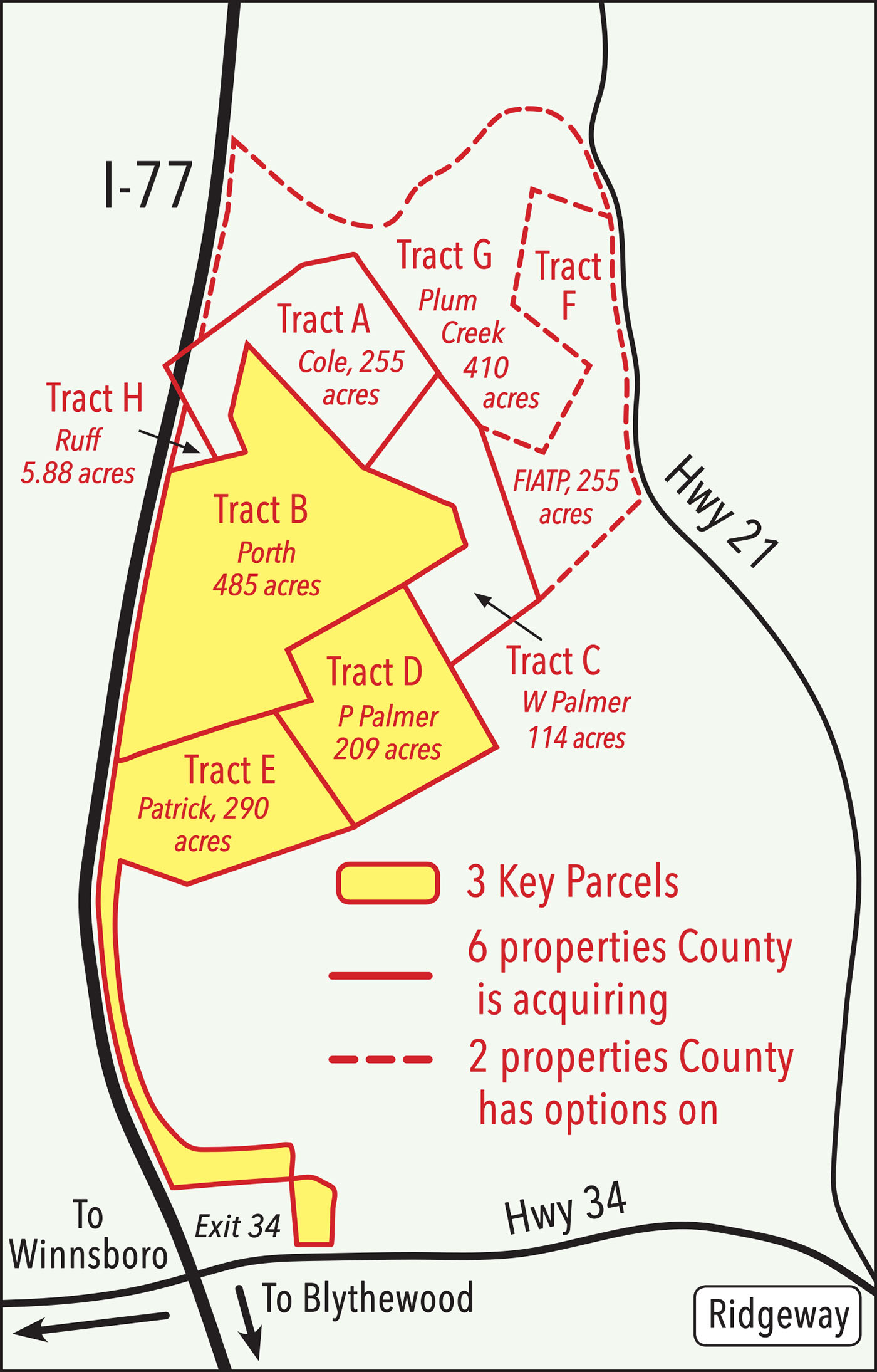
    WINNSBORO (Aug. 4, 2016) – Fairfield County Council officially embarked on a major economic development project last week, giving final authorization to an agreement between the County and the S.C. Department of Commerce to acquire more than 1,000 acres of land in Fairfield County that is located on the east side of I-77 and to the north of Highway 34. Another 800 adjoining acres are under option.

    The anticipated purchase price of the land is $8,583,669. The County will contribute $3 million with the Commerce Department raising the remaining $5.5 million. Once the properties are acquired, the County will hold the titles and will transfer the titles to the Commerce Department when it is certified that an economic development prospect intends to make a qualifying commitment on one or more of the parcels.

    “Council’s goal is to develop a mega site on this land to attract significant economic development prospects,” Ty Davenport, Fairfield County Economic Development Director, told The Voice. “This is a tremendously positive step for the County and for South Carolina. Mega projects can be transformative for communities. Our proximity to the Port of Charleston, the Charlotte International Airport, USC, Midlands Tech and to a large existing labor pool makes this site very attractive.”

    The ordinance specifies that the Commerce Department and the County will lease or buy six contiguous parcels of land that make up the site. Three of the parcels, designated as “key” parcels, meaning they are integral to the development of the mega site, comprise 984 acres and are described as the Porth Tract, the P. Palmer Tract and the Patrick Tract.

    Three other parcels are described as option parcels and include a 5.88 acre tract owned by the Ruff family. Councilman Dan Ruff (District 1) recused himself from the second reading and was not present at the special called meeting for the third reading. In total, the key and option parcels amount to just under 2,000 acres.

    Davenport said utilities and infrastructure can be extended to the site.

    “In the event that a large qualified user becomes interested in the property, funds to cover the costs of infrastructure would come mostly from the state’s resources. The commitment of these funds would be based on several criteria such as job creation, total investment, wage level, environmental compliance and other economic factors,” Davenport said. “No funds will be expended until a mega user has committed.”

    Davenport said the Commerce Department committed to actively recruiting and pursuing large economic development projects to locate on the parcels and to work with third parties in order to fund any site development costs.

    “This will not happen overnight,” Davenport said. “But I am confident that, ultimately, we will see success. Council took a very positive step in the effort to provide future jobs and long-term opportunities for Fairfield County citizens. The opportunity to partner with the State of South Carolina and the S.C. Department of Commerce as well as the I-77 Alliance and the Central Carolina Alliance is very important. Fairfield County will be marketed to significant companies around the globe.”


  • Primrose Residents: We Were Lied To

    ‘Developer Promised Green Space’

    BLYTHEWOOD (Aug. 4, 2016) – “We were lied to when we purchased our property. We were told that the green space would always be there,” said Cobblestone Park resident Lenora Zedosky during the public comment section of Monday evening’s Planning Commission meeting.

    About 30 of Zedosky’s neighbors, most of whom live on Summer Sweet Court in the Primrose area of Cobblestone Park, packed the meeting with six of them addressing the Commission.

    At issue is the residents’ recent discovery that Cobblestone Park developer D.R. Horton is planning to build six new roads in the Primrose section of the subdivision. An aerial map of the area shows that three of those roads, and 74 homes to be built along them, will cut into dense woods between Summer Sweet Court and I-77, which borders the east side of the Primrose neighborhood.

    The Town’s Planning Consultant Michael Criss explained at the beginning of the meeting that the roads were approved by Town Council in April 2015 when it revised the zoning map of Cobblestone Park, reducing the overall density of dwelling units in the Planned Development (PD) community from 1,666 units to 1,155 over the life of the project.

    “In so doing, 143 lots and the six streets were added to the overall Primrose section,” Criss said.

    That was about the time – or just before – many of the current residents moved into the Primrose neighborhood.

    “When we purchased our home in May 2015, we were specifically told by D.R. Horton sales reps that no development was going to take place in the wooded area around us. Some of us paid lot premiums of up to $17,500 to purchase lots adjacent to these beautiful woods,” Zedosky said. “Now we believe that we were deliberately misled by D.R. Horton.”

    Zedosky told Commissioners that removal of the woods to carve out three of the roads and the accompanying homes will threaten their rural-like environment that is now buffered from the noise of I-77 by the dense woods.

    Tammy Orr, who also lives on Summer Sweet Court, said she fears the disturbance of the land to build the roads and homes will increase the already poor drainage in the area that she said has left her front yard perpetually sitting in ankle-deep water.

    “This has affected our quality of life. We can’t sit outside on the patio without being eaten up by mosquitoes,” Orr said.

    Zedosky said she did not know the roads were going to be developed until she saw heavy equipment moving around her property on May 26. By June 24, she said, survey stakes were being planted in yards.

    “The surveyors told us the new roads would be built around us this fall,” Zedosky told Commissioners.

    To remedy the situation, Zedosky is asking the Town government to rescind the zoning approval it granted in April 2015.

    “If you cannot do that, then issue a cease and desist order to stop all tree cutting and construction until we explore other options,” she said. “We also want a commitment from D.R. Horton to provide a detailed walk through with representatives of the neighborhood and Town government to explain exactly what they are planning to do, what trees will be left and how much of the green space will remain.”

    Criss told the group that no major earth moving or construction should have been taking place.

    “It can’t begin until the developer brings the preliminary plat before the Planning Commission for approval. We know they are coming, but we don’t know when. That,” Criss said, “is up to the developer.”


  • Fugitive Dead in Standoff

    BLACKSTOCK (Aug. 3, 2016) – A Tennessee fugitive wanted on federal firearms violations is dead and his wife in custody after a standoff of more than three hours last week at the couple’s home in Blackstock.

    Fairfield County Coroner Barkley Ramsey said former Chattanooga, Tenn. resident Joseph Daniel Roberts, 41, was pronounced dead at 9:15 a.m. July 28 in his camper home at 2068 Mt. Olive Church Road. The cause of death, Ramsey said, was a self-inflicted gunshot wound to the head from a .40 caliber handgun.

    Fairfield County Sheriff Will Montgomery said deputies from his office as well as agents from the S.C. Law Enforcement Division (SLED) arrived at the home at approximately 5:30 a.m. last Thursday to assist agents from the U.S. Marshal’s Office in their execution of an arrest warrant on Roberts. Shortly after law enforcement arrived, Roberts’ wife, Brooke Nicole Roberts, emerged from the home and surrendered. Roberts, however, refused to come out and barricaded himself inside.

    Officers began negotiations with Roberts in an attempt to encourage him to surrender. The talks went on until approximately 8:55 a.m., at which time officers heard a gunshot from inside the home. When officers entered the camper home, they found Roberts had shot himself.

    “While we are disappointed by the outcome, we are thankful no one else was injured during this incident,” Montgomery said. “At no time did Mr. Roberts ever threaten law enforcement officers who were on the scene that day and there was never any gunfire exchanged between Roberts and these officers. We wish that Mr. Roberts would have allowed the criminal justice process to take its course.”

    Brooke Roberts was arrested and charged with obstruction of justice. She was transported to the Fairfield County Detention Center.

    Ramsey said Joseph Roberts had been on the run for nearly four years, but how and why he and his wife came to Fairfield County is still a mystery. Montgomery said the couple had no Fairfield County connections, and they might have remained off the radar of the feds for longer had Brooke Roberts not surfaced on public records as having purchased the 6.5 acres on Mt. Olive Church Road last May.

    County records show Brooke Roberts purchased the property from Stanley Brandon on May 9 for $20,000. The records on file with the County show her mailing address as 8926 Ellis Lane in Powell, Tenn., a town just to the northwest of Knoxville.

    A spokesperson for SLED referred all questions from The Voice to the U.S. Marshal’s Office. Phone calls to the U.S. Marshal’s Easter District of Tennessee Office in Knoxville were not returned at press time.


  • R2 Picks New Superintendent

    Dr. Baron Davis
    Dr. Baron Davis

    COLUMBIA (July 28, 2016) — At a Special Called Board Meeting on July 25, the Richland Two Board of Trustees voted to authorize Board Chairman James Manning to execute two contracts between the Board of Trustees and Dr. Baron R. Davis. Under the first contract, Dr. Davis will serve as superintendent elect from July 25 – June 30, 2017.

    “While the board has accepted Dr. (Debbie) Hamm’s retirement at the end of the 2016–2017 school year, she remains the district’s superintendent until July 1, 2017,” Manning said. “We are committed to working together to make the 2016-2017 school year a success and to ensure a smooth and seamless transition to the new superintendent. Therefore, the Board decided that it was in the best interest of the district to select Dr. Davis as superintendent elect.”

    Chairman Manning was also authorized to execute a separate three-year contract that names Dr. Davis superintendent beginning July 1, 2017.

    “I am very proud to know the district will be in great hands with Dr. Davis,” Hamm said. “He is an outstanding leader and a talented educator and truly has the best interests of students at heart. I look forward to working with him during my final year as Richland Two prepares for our next great chapter.”

    An educator for almost 20 years, Davis currently serves as one of the district’s assistant superintendents who support overall educational excellence in the schools by providing leadership, administrative direction, supervision and technical support.

    “I am beyond honored that the Richland Two Board of Trustees has entrusted me to follow Dr. Hamm as superintendent of our outstanding district,” Davis said. “Dr. Hamm and I both recognize the ultimate reasons for our success come from our extraordinary coworkers, administrators, teachers, parents, students, retirees and community members. We all share a sense of urgency when it comes to providing all learners with meaningful, challenging and engaging learning experiences. Together we will continue our focus on learning, community, character and joy as we help students maximize their gifts and talents, enabling each to chart and navigate a personal pathway towards a purposeful and productive future.”

    Davis earned a Bachelor of Science degree in sociology from Francis Marion University. From the University of South Carolina, he earned master’s degrees in school counseling and educational administration, and Educational Specialist and Doctor of Philosophy degrees in educational counseling. He holds superintendent, school counseling, secondary principal and secondary supervision certifications. In addition to his formal educational training, Davis has participated and completed numerous educational leadership programs offered through the South Carolina Department of Education including the Tapping Executive Educators Program, the School Leadership Executive Institute and the South Carolina Education Policy Fellowship Program.

    During his educational career, Davis has served as a successful school leader in rural, urban and suburban school systems where his schools were recognized for closing the achievement gap, increasing graduation rates and increasing Advanced Placement participation rates. While he was principal of Spring Valley, the school was recognized by the Washington Post as one of America’s Most Challenging High Schools and by Newsweek as one of America’s Top High Schools.

    Davis’s support of education and his community extends beyond Richland Two. Currently, he serves on the Francis Marion University Alumni Board, the University of South Carolina Trio Programs Advisory Board, the South Carolina Male Achievement Conference Planning Committee, Rotary International (Spring Valley Club, Columbia), national and state associations of school administrators, and Omega Psi Phi Fraternity Inc. He participates in the City of Columbia’s “My Brother’s Keeper” initiative. Davis was inducted into the Columbia Housing Authority’s Wall of Fame in 2015 and in past years has given service to the University of South Carolina’s Department of Counselor Education Advisory Council and the SCASA Institute of Innovation Planning Committee.

    Since assuming the role of assistant superintendent, Davis has helped to establish the Richland Two Assistant Principal Academy, the Administrators Development Series, the Training Administrators Program and the Administrators Mentoring Program. He has led the district in the implementation of a principal for a day program and the Richland Two Ready to Read book drive. Under his guidance, all five of the district’s high schools were accepted to TransformSC’s network of innovative schools in May 2016. He developed and assisted in the implementation of Richland Two’s district-wide mentoring program standards that now serves as the common framework for all current and future mentoring programs. In addition, Davis provides leadership and general oversight of the academic and programmatic development of the Richland Two Institute of Innovation, which will open in August.

    A native of Columbia, Davis is a member of the Brookland Baptist Church. He and his wife, Pam, are the proud parents of three beautiful daughters.


  • Green proposes building patio homes for teachers

    WINNSBORO (July 28, 2016) – A proposal by Superintendent Dr. J.R. Green that the Fairfield County School District construct patio homes and rent them out to teachers received mixed reactions at the July 19 regular school board meeting.

    “I’ve been working on an initiative for the last several months that would develop some housing for current and prospective teachers in the District,” Green told the Board. “We hope this will increase our ability to recruit and retain certified staff. We’ve had some conversation with experts in the field as to how we’re going to pursue maybe developing some two- and three-bedroom patio homes that would be financed through conventional financing, how we can fund traditional school district capital projects.”

    While Green did not identify the “experts” he had consulted, he said he thought the project would help teachers who work in Fairfield County and who are unable to buy housing to find a way of eventually moving here, which, he said, presents more stability and would help the entire community by spurring an economic venture. Green said he was “very optimistic about our ability to pull something like this off.”

    “So by next month I will hopefully bring forward the opportunity to make a proposal that we go out and put that project out for bid to see if we could get some firm figures on what it would cost to really pursue such an initiative,” Green said.

    William Frick, District 6, raised some questions about Green’s proposal.

    “So that we won’t run into something we ran into on a previous project, when you say, ‘put out for bid,’ could you tell us specifically what you’re talking about?” Frick asked.

    “OK, probably what I’m going to recommend, is that we pursue a design/build contract and ask firms interested in pursuing the project to give us some proposals and some firm figures on what it would cost to deliver houses that we’ve identified,” Green said. “So the design/build can encompass the architectural design and construction all under one contract. So all I’m saying is if you (contractor) have the capacity to deliver such a project, let us know what you would do it for, what would such a project cost.”

    Frick also asked Green if he had any examples to give the Board an idea what he (Green) is proposing.

    While Green did not have any models for the Board to look at, he said, “Some districts and cities have pursued such projects – Baltimore, San Francisco. One thing that initiates such a move in these cities is that teachers could not find affordable housing because the cost of living is so high. The issue in Fairfield County is not the high cost of housing, but access. There is not an abundance (of homes) available so teachers can’t find houses they are comfortable with to move in to.”

    Board member Rev. Carl Jackson (District 5) asked Green if he was proposing to build the patio homes on property the District already owned.

    “We are exploring other options,” Green said, “but, ideally, we’d like to locate them on District property.”

    Board Member Paula Hartman (District 2) said she preferred spending the District’s money on students’ education rather than building homes for teachers.

    “Let the people who build (homes) do this, not the school district,” Hartman said. “We need to stick to educating our students.”

    Hartman asked Green who would cover the cost of building and maintaining the patio homes.

    After explaining that the school district will pay for the construction of the homes, Green added that, “I will plan this so all the debt will be encompassed in the rent payments, just like a regular apartment complex. While it will cost the District money to construct the facility, my hope is that we will pursue conventional financing and then what would happen is, as we collect (rent) from the tenants, we will pay back the construction loan.”

    Green said the construction, financing, maintenance and upkeep would all be covered by the rental revenue.

    “I just don’t think the business of the school is to construct and rent out homes,” Hartman said.

    Green told the Board that he has talked to some individual County Council members about the proposal and that they told him they would be interested in partnering on such an initiative. But he said that while he is interested in partnering with the County, “I don’t want us to lose our momentum in terms of making this happen.”

    “Sometimes,” Green said, “a lot of people want to talk and evaluate. My concern about involving too many people . . . is that I just want to maintain our momentum as we move forward.”

    Board member Annie McDaniel (District 4) said she liked Green’s proposal, but asked him to keep the Board members in the loop via email so they would know where the District stands on the project and be able to answer the public’s questions about it. Green said he would.


  • Chamber Revises Funds Request

    BLYTHEWOOD (July 28, 2016) – After the Blythewood Chamber of Commerce did not receive a recommendation from the Accommodation Tax Committee last month for a request for $3,000 for salaries for Mike Switzer, the group’s Executive Director, and his assistant to coordinate the upcoming Big Grab event for Blythewood, Switzer and Chamber member Ed Parler brought a revised request for the $3,000 to Mayor J. Michael Ross.

    Chamber Board member Ashley Michie subsequently presented the revised request to the full Council Monday evening. That request called for approval of $2,000 the A-Tax Committee had already approved for security and portable restrooms for the event plus the $3,000 that the Committee had rejected for salaries. Michie told Council the Chamber is no longer going to use the $3,000 for salaries, but for social media and other outside advertising for the event.

    Ross told Council that Switzer and Parler did submit a revised request to him recently during a round table meeting in his office.

    “It was a different version (of the original request) and there would be no salaries,” Ross told Council members.

    But in an email to The Voice, Switzer said there would be salaries, but that they would be handled by the Chamber, also indicating that the $3,000 would be used for outside advertising. Switzer did not say what the source of revenue would be for the salaries.

    During her presentation, Michie read a statement from Denise Jones, founder of the Big Grab, pointing out that the event brings in more people and more money than any other event during the year. In the past, the A-Tax Committee has approved from $1,000 to $2,000 in funding for the annual event. Michie said the Chamber needs the additional $3,000 this year to assure that the Big Grab has as big a turnout as in past years.

    “This is the first year the Chamber has been involved with the Big Grab, and we just want to be sure we do it right this year,” Michie said.

    “The Big Grab has been a very successful event year after year and it is something we should support the best we can,” Councilman Malcolm Gordge said.

    Councilman Tom Utroska agreed, but said, “It just sounds odd to say, ‘We wanted $3,000 for this but if we can’t have it for this, we want it for that.’ If it quacks like a duck and walks like a duck, then it’s probably a duck.”

    Council voted unanimously to approve $2,000 for the Chamber as recommended by the A-Tax Committee, but sent the $3,000 request back to the Committee for further review. Council also approved $1,000 for the Westwood High School Redhawk Invitational, a marching band exhibition to be held Sept. 24, and $2,000 for the All-Star Baseball Tournament that was hosted by the Blythewood Baseball League June 25-30. A request for $10,000 from the Blythewood High School Band Tournament representative was tabled by the A-Tax Committee until it could review the request further.

    Decorative Banners and Poles

    The Christmas Committee presented a request to Council for the purchase of decorative banners and poles to be displayed year-round in the Town. The Committee provided pricing information for both 10 and 20 banners and also for poles with and without lighting. Council voted unanimously to approve the purchase of 20 banners for $4,500 and 10 decorative poles without lights for $5,950 for a total of $10,450.

    Fairfield Electric Company has agreed to install the poles and Town Administrator Gary Parker suggested the funds for the cost of the poles and banners could come from revenue budgeted for Community Promotions.

    “I think this will be welcoming and will give a good image to our community,” Ross said.

    Butterfly Festival Date Change

    Council voted 5-0 to approve changing the date of the Butterfly Festival. Representing Camp Discovery where the festival will be held, Board member Mary Douglas Smith asked permission to move the date of the festival from Labor Day, as planned, to May 20, 2017.

    A main reason for moving the date, Smith said, is that the May date would offer a more humane environment for the butterflies to be released.

    “Our research has shown that most butterfly releases are held in the spring,” Smith said. “That’s when they will have a better chance to survive the release. Labor Day is not a great time for a release. The butterflies won’t all migrate so they might only live a couple of weeks. Given the heat,” she added, “and their limited flight range, their food sources would be sketchy at best and we want them to survive. We don’t want to set them up for failure.”

    Palmetto Citizens Granted License

    Council passed unanimously an ordinance granting a license to Palmetto Citizens Federal Credit Union to display its corporate logo on an amphitheater and covered band shell to be constructed at Doko Park.
     

  • Fireworks take center stage at Council

    WINNSBORO (July 28, 2016) – The Fairfield County Council quickly dispatched with the items on the agenda during its regular meeting Monday night which included a public hearing that no one spoke at and a two-hour executive session after which Council took no action.

    The fireworks began during the second public comment period when citizens are allowed to speak on any issue they choose concerning Fairfield County and continued during County Council time at the end of the meeting.

    Bertha Goins of Jenkinsville addressed Council about the issues surrounding the Jenkinsville Water District and her concerns for the community.  She specifically addressed her remarks to Councilman Kamau Marcharia (District 4).

    “Over $10,000 of the people’s money in your district went missing belonging to both black and white. You didn’t demand an explanation or call for a protest.”  At this point Council Chairwoman Carolyn Robinson (District 2) reminded Goins of Council’s rule that speakers are not to call anyone by name.

    Goins complied and continued.

    “Much needed businesses are still trying to come into western Fairfield. It won’t cost the taxpayers anything and we can benefit greatly from them, but once again lies are being told why they cannot come in.  We deserve better and demand better and need better leadership.  Infrastructure and smart business development is a must to make our county a home we can continue to be proud of,” Goins said.

    She added that it was everyone’s responsibility to nurture, train and direct the young people in the community.

    “County and nation starts with them.  Teach them values and morals and then send them out to be an example for others.  That’s our job,” Goins said.

    “We covered up so much, swallowed so much, backed off so much, accepted too many lies…”

    At this point Marcharia interrupted Goins.

    “Madame Chair – that is not the purpose of her being up there.  What was the nature of her conversation?”

    With that, Goins sat down without completing her comments.

    Later, during the County Council time portion of the agenda, Councilman William “Billy” Smith (District 7) commented on Marcharia’s interruption of Goins’ address to Council.

    “I think we need to make sure that we respect everyone when they speak in here,” Smith said, “whether it is a citizen or a Council member.  That needs to go both ways, not just one way.  I know that the second public comment portion in our bylaws states that anybody can come out and speak pretty much about anything…I just want to make sure we don’t quiet or hush citizens when they come in here because that is a right we have afforded them with our bylaws,” Smith said.

    When it came Marcharia’s turn during County Council time, he began by lamenting that there were no police officers in the room.

    “I do not feel safe in this Council,” Marcharia said. “At the last Council meeting I feel like I was verbally attacked and called a liar.  I feel like again (tonight) I was going to be verbally attacked. I certainly want police officers in here until I feel safe…I have been verbally attacked and I don’t know where (those) attacks are going to lead to or what’s going to happen.”

    Chairwoman Robinson said that the lack of an officer was not intentional, but was due to the day of the Council meeting being changed from Monday to Tuesday.

    Marcharia then turned his attention to Chairwoman Robinson, asking her how many miles of paved County roads were in her district.  Robinson responded that most of the roads in her district are state roads, and that dirt roads were paved only after the County started its road paving program.  She noted that districts 1, 2 (her district), 3 and 4 (Marcharia’s district) have the most unpaved dirt roads in the County.

    “All the roads up there (District 2) were as smooth as a baby’s face,” Marcharia said, “but with the roads at Lake Monticello, you are lucky if there are 25 miles of paved road, and every one of those roads will tear your car up. There is some discrepancy going on as to what roads get paved and don’t get paved.  You have 3 or 4 members in your district that sit on the CTC (County Transportation Committee)…I think it’s unfair if you have 3 or 4 people in (your) district to speak for your roads and everybody else might not even have a representative.”  CTC members are appointed by the legislative delegation, not County Council.

    Marcharia’s final target was what he perceived to be accusations that he had divulged confidential information.

    After several minutes of a high decibel back-and-forth between Marcharia and Chairwoman Robinson about the issue of confidentiality and whether he (Marcharia) had been unfairly maligned in the newspaper, Robinson resorted to her gavel. Smith put an end to the noisy bickering with a motion to go into executive session to discuss a contractual matter regarding Fairfield Memorial Hospital. It was seconded simultaneously by Marion Robinson (District 5) and Mary Lynn Kinley (District 6), and the open meeting abruptly ended.

    County Administrator’s report

    Jason Taylor, Fairfield County Administrator, also brought several recommendations for action to the Council Tuesday night, all of which were approved unanimously.  Chief among these was the recommendation to put Phase II of the Commerce Park off Peach Road out for bid.  The engineering plans for the road extension and water and sewer infrastructure are done, Taylor said, with a total estimated cost of $5,970,000, and will be paid for with funds the County has.

    The Council also voted to replace the old EMS substation in Rufus Belton Park with a new modular

  • Council Sticks to Impact Fees

    WINNSBORO (July 28, 2016) – Developers of a second phase of a Blythewood subdivision will have to pony up for impact fees, Town Council decided last week, if they want water from Winnsboro. Council’s vote during their July 19 meeting to stick to those fees, however, means Landtech Asset Management, LLC will likely draw water from the City of Columbia.

    “They wanted to know if there was any wiggle room in those charges for impact fees and tap fees,” Mayor Roger Gaddy said after last week’s meeting. “They had an option to get water from us or Columbia. And I think they did what any person would do whenever they’re representing their own business, they’re going to see if there’s any way they can cut their costs.”

    The development, near 502 Rimer Pond Road, represents the second stage of Coatsbridge, John Fantry, Winnsboro’s utilities attorney, explained this week. Winnsboro had previously approved 33,150 gallons of water per day for the 100 lots in the initial phase, which is currently under construction. Landtech’s request for phase one was submitted and approved prior to Winnsboro’s implementation of impact fees, which went into effect last August. When Landtech began exploring a second phase of 126 lots to Coatsbridge, they asked Council for a reduction or waiver of the impact fees.

    Under the impact fee policy, residential customers are charged a one-time fee of $1,500 for water and $2,100 for sewer service. Industries pay anywhere from $1,500 for a 5/8 of an inch meter to $172,500 for a 10-inch meter. Wastewater ranges from $2,100 to $241,500, also based on meter size. The fees were recommended by a rate study undertaken by the Town last year.

    “We had a rate study done and we paid like $40,000 for it and that’s their recommendation, those rates,” Town Manager Don Wood said, “and Town Council looked at it and they said that is fair and if he (the developer) wants to go to Columbia, he can investigate that.”

    Fantry said Council has been weighing the Landtech request for several weeks. At issue, he said, was the choice between adding 126 potential customers to the system versus collecting fees designed to keep that system viable over the long term.

    “That’s 126 additional customers at approximately 300 gallons per day per home,” Fantry said. “That’s a chunk of money, too. If we don’t provide some incentive to the developer, those customers will never come onto our system.”

    The development, Fantry said, is on the tail end of Winnsboro’s system where developers have a choice between Winnsboro and Columbia water.

    “If this developer jumps (to Columbia), others may follow,” Fantry said, “and that end of the system will be under-used.”

    But, Fantry added, if Council waived or reduced fees for Landtech, they would be setting a precedent for the next developer, and the next.

    “Council felt they needed to stay the course with the development fees,” Fantry said.

    “The more customers we put on, the more infrastructure we have to build,” Gaddy said. “Since we have such a low margin on water, we have to have an impact fee to help support the infrastructure we have to put in. The more we add down there on that far end the more we have to start looking at another water tank.”

    And that, Gaddy said, could run into the million-dollar range.


  • FMH ER Under New Management

    WINNSBORO (July 21, 2016) – One vital part of Fairfield Memorial Hospital is under new management, the hospital announced recently, with FMH partnering with EmCare to manage and staff the hospital’s Emergency Department.

    “We wanted to ensure that everyone in our community gets exceptional patient care,” Suzanne Doscher, Fairfield Memorial Hospital CEO, said. “EmCare is known for its commitment to patient satisfaction, so I know they will make an excellent partner for Fairfield Memorial Hospital and deliver high-quality care to our citizens.”

    EmCare has attained its industry-leading results by constantly working to improve quality, metrics and efficiencies and to improve the patient experience, the hospital said. The company focuses on hospital-wide patient flow and offers programs designed to decrease patient wait times. EmCare partners with nearly 1,000 practices, serving hospitals, hospital systems and other healthcare organizations from coast to coast.

    “We’re always pleased to be asked to partner with facilities like Fairfield Memorial Hospital that are known for their mission to provide high-quality, compassionate care,” said Bill Yarbrough, EmCare Divisional CEO. “We share that commitment to patient-centered care and look forward to working with the hospital to deliver consistently outstanding care for patients.”

    EmCare, the hospital said, works to achieve better patient outcomes through a variety of methods, including:

    • A dedicated partnership with Studer Group, a nationwide organization devoted to increasing patient satisfaction;

    • Implementation of Lean Strategies that streamline processes, improve efficiency and eliminate redundancies;

    • Front-end redesign to decrease patient wait times;

    • Working with existing staff to provide them with proven tools, training and technologies; and

    • Patient experience surveys conducted in real-time through feedback-collecting kiosks that are installed in the Emergency Department.

    EmCare launched its partnership with Fairfield Memorial on April 1.