Blog

  • JWC Board Member Responds to Mail-Outs

    JENKINSVILLE (Jan. 26, 2017) – “My name is Peach, and I’m the guy that wrote the letter,” Preston Peach said, rising from his seat on the Jenkinsville Water Company (JWC) Board to address the 100 or so JWC members assembled for the company’s annual meeting at the former Jenkinsville fire station on Jan. 11.

    The referenced letter was one of two written by Peach and mailed in late December, along with a JWC newsletter, printed in color on glossy paper, to 800-plus members of the water company. The first letter was mailed with the newsletter in an envelope pre-printed with the company’s name and address in the upper left corner. It appeared to be mailed by the company.

    In the letter, Peach randomly praised the water company’s leadership, defended the Board’s various decisions and actions, lamented what he called “complaints at every Board meeting from one person” and criticized The Voice’s news reports on JWC Board meetings as “mischaracterizing the conduct of the Board and the water company itself.”

    After The Voice reported, on Dec. 15, that a Freedom of Information Act lawsuit had been filed on Dec. 5 against the JWC by customer Donald Melton, Peach sent out a second letter on Jan. 5, directed primarily at The Voice for its “negative front page (lawsuit) story.”

    “Using the words ‘alleges,’ ‘claims,’ ‘according to,’ etc., to shield (itself) in publishing accusations from another person that are unproven, is not a defense for defamation,” Peach wrote. He signed the full-page, single-spaced letter, “Sincerely, Preston Peach, Jenkinsville Water Company Board member.”

    This letter was also mailed to the company’s 800-plus water customers in an envelope pre-printed with the company’s name and address. Like the first letter, it appeared to have been mailed by the company.

    A letter to the editor, published in The Voice on Dec. 29, questioned whether Peach mailed his letters of personal opinion on the JWC’s dime.

    In a 20-minute soliloquy during the Jan. 11 annual meeting, Peach took the opportunity to address the uproar from all corners as to who paid for the mailings.

    “I paid for all the postage, all the printing, all the envelopes, even the colored newsletter on glossy paper that went out (to JWC customers). All out of my own pocket to the tune of over a $1,000,” Peach told the audience whose skepticism was audible in the crowded room.

    “I ordered 2,500 envelopes over the internet,” Peach told The Voice on Tuesday during a phone interview. He said he had the envelopes emblazoned with the company name and address to look official. Then he wrote a newsletter for the company and had it and the two letters printed at Copy Pickup on Millwood Ave. in Columbia. He said he paid for the postage as well.

    Peach told The Voice that he did it to help the company out.

    “The Board members are trying to make the water company work and we are being sued right and left. It’s costing us time and money,” Peach said.

    He also pointed out that after the lawsuit was filed against the JWC for alleged Freedom of Information Act violations, the company has tried to do the right thing. It has issued agendas, he said, and, unlike last year at the annual meeting, did not elect new Board officers in executive session this year.

    “But our bylaws call for us to elect our officers in executive session, so we aren’t doing anything wrong to do it that way,” he told The Voice. “Our bylaws say that after the meeting is over, the Board members are to elect officers from among themselves. That means in executive session. We are going by our bylaws.”

    Article V, Sec. 1 of the company’s bylaws states, “. . . the Board of Directors shall immediately, following the annual Members’ meeting, elect a President and Vice-President from among themselves and a Secretary and Treasurer who need not be Members of the Board of Directors. . .”

    The next meeting of the JWC will be Feb. 6, at 6 p.m., in the former Jenkinsville fire station next to the water company.

     

  • Town Tackles Street Vendors

    BLYTHEWOOD (Jan. 26, 2017) – With more mobile street vendors rolling into town these days, Town Council is considering an ordinance that will require those vendors to roll out of town during nighttime hours when they are not open for business.

    Town attorney Jim Meggs said Council members had brought the issue to his attention recently, asking him to create an ordinance that would limit or eliminate overnight, long-term parking for trailer-type street vendors in the Town Center District (TCD).

    “That use is not deemed to be consistent with the objectives of the (TC) District,” Meggs said.

    “We now have a coffee vendor,” Mayor J. Michael Ross added, referencing the increasing number of vendors in the town. “When we initially talked with them (coffee vendor), they were going to take the trailer away each night. But now it sits there. It’s another example of how a vending stand comes in and is just left there. It’s frustrating.”

    Meggs presented Council with a draft ordinance that would amend the TCD regulations in the zoning ordinance to require the removal of ‘vending stands’ from the TCD every evening when the vending stand is closed for business.

    The draft suggested that vending stands open for relatively short durations (less than 30 days in a calendar year) would not be affected.

    The draft defined a ‘vending stand’ as any hut, trailer, stand, cart, tent or vehicle not permanently affixed to real property, including any signs or other accessories related to such and which operates under one itinerant merchant for more than 30 days in any calendar year within the town.

    “I’d like to see this on our next agenda,” Councilman Tom Utroska told Council

    “Street vendors can bring business to town, but they need to be controlled,” Town Planning Consultant Michael Criss told Council.

    According to Town Clerk Melissa Cowan, who issues business licenses for the Town, vendors pay a $40 fee for an initial business license and the following year must pay an annual fee based on their gross income of the previous year.

    “Vendors who serve cooked food also have to pay a 2 percent hospitality tax, which they collect from customers,” Cowan said.

    First reading for the vendor ordinance will be held at the Jan. 30 Council meeting at 7 p.m., at Doko Manor.


  • Charges Pending in Dog Starvation

    WINNSBORO (Jan. 26, 2017) – A Winnsboro woman will soon be facing charges after County officials were forced to euthanize a dog that she had allowed to virtually starve to death.

    “The dog was in dreadful condition,” Bob Ennis, Director of Fairfield County Animal Control told The Voice Tuesday. “We did all we could. We had the vet (Dr. Robert Chappell) come out, we gave it medication. We gave her a blood transfusion – her blood count was in terrible shape. But in the end, we had to put her down.”

    Acting Chief of Public Safety Maj. John Seibles said Tuesday that a warrant had been signed on Katera Latrice Alexander, 28, for a charge of animal cruelty. Seibles said his office was giving Alexander the opportunity through this weekend to turn herself in, after which time if she had not done so the warrant would be served.

    According to the incident report, a delivery driver alerted Public Safety on Jan. 13 of an apparently malnourished, weak and distressed dog tied up on the front porch of Alexander’s home in the 300 block of Forest Hills Drive. Just after 5:30 p.m., a Public Safety officer found the dog – a brown female pit bull, approximately three- to four-years old – cowering under the front steps of the home. The dog was tethered to the front porch by a length of cable, approximately 15-feet long.

    The dog was emaciated, the report states, with the outlines of vertebrae, ribs and hip bones pressing through the skin. A bucket for water sat on the porch, but it was turned over on its side and empty. There was no food bowl available for the dog, the report states. Instead, there was a milk jug with a hole cut into the top sitting on the porch near the dog’s house. Inside the jug, according to the report, was what appeared to be milk with a layer of grease floating on top.

    When Alexander arrived home a short time later, the report states, she told the officer that the dog had been sick for more than a month and would not eat. The officer then produced a pack of crackers and offered them to the dog, who devoured them almost instantly. The dog quickly went through a second pack, “so it appeared to be very hungry,” the report states. The dog also lapped up a large amount of water when the officer filled her water bowl.

    Alexander reportedly told the officer that she had given the dog deworming medication, but that it did not help. She showed the officer an empty box of worm medicine, which she said had “just run out.” Someone told her, she said, to give the dog milk and grease as a remedy, but the officer noted that it did not appear as though the dog had consumed any of the concoction. Alexander also told the officer that she had not taken the dog to a veterinarian “because she could not afford it,” the report states.

    When the officer asked Alexander to show him the food she had been feeding the dog, she said she did not have any. She had only been feeding the animal table scraps, she said. She also told the officer she suspected her neighbors, who had also been feeding the animal, may have poisoned the dog.

    Alexander agreed to allow Fairfield Animal Control to pick up the dog and take it to the Adoption Center, but by the time the County took possession of the animal it was too late. The County euthanized the dog on Sunday.

    Seibles said Dr. Chappell’s report stated that the dog suffered from “obvious animal neglect,” and was “severely anemic” as a result of malnutrition.

    “When an animal is that malnourished,” Ennis said, “it affects the internal organs. We gave it medication, but there was no improvement and the dog became lethargic. It was in just dreadful condition.”


  • And the Answer is . . .

    WHS Principal Wins on Jeopardy!

    During a watch night party at Columbia Country Club, Dr. Cheryl Guy, Principal of Westwood High School, stands next to a big screen showing Jeopardy host Alex Trebek congratulating her on her big win on the show Friday night. (Photo/Barbara Ball)
    During a watch night party at Columbia Country Club, Dr. Cheryl Guy, Principal of Westwood High School, stands next to a big screen showing Jeopardy host Alex Trebek congratulating her on her big win on the show Friday night. (Photo/Barbara Ball)

    BLYTHEWOOD (Jan. 19, 2017) – Westwood High School principal Cheryl Guy, who won $20,600 on Jeopardy Thursday night, was the star of a watch party at Columbia Country Club as she and more than 100 friends, family and colleagues gathered to have dinner and watch the show on a big screen in the Club’s ballroom.

    Because Guy had been prohibited by the show’s rules from revealing any information about the outcome of her participation on the show, which was taped several months ago, the suspense in the audience was palpable as the first round ended for a commercial break with Guy having the correct question for only one answer and the lowest score. But as the half-hour show resumed, Guy picked up steam and winnings.

    For the final Jeopardy question, Guy bet big – $10,000 of her $10,600. Trebek read the answer: “Unlike newer Bibles, the King James version usually translates pneuma hagion as this, which can lead to unnerving images.”

    As the familiar musical clocked ticked, Guy wrote, “What is Holy Ghost?” Trebek pronounced Guy the winner, and the audience in the ballroom shot to their feet with cheers and clapping. For Guy, it was like winning all over again.

    While she came back on Friday night for another try at the jackpot, it wasn’t to be. Still, she said she was thrilled with her visit to the show, which was the culmination of 30 years of planning.

    “I always wanted to be on Jeopardy,” Guy told the audience before the broadcast, “and I auditioned several times but was never chosen. It was a goal I wanted to achieve,” she said, happily, “and I did. I had a dream and I never stopped working toward it.”


  • Effort Emerges to Save Water Tower

    Water Tower copyRIDGEWAY (Jan. 19, 2017) – Although Town Council has yet to nail down a definite site for a new water tank, the fate of the old water tower standing over downtown Ridgeway has been the subject of some concern among merchants and citizens.

    During Council’s Nov. 10 meeting, the Merchants Association asked Council to preserve the old tower and seek an alternate site for the new tank. Last week, during public comment, Dee Dee Ruff told Council she agrees with the Merchants.

    “The historic nature of our current tower is part of what we sell as merchants,” Ruff said. “When you think about replacing this tower, think about what we have; and I’d also like you to think about what we could have in the future.”

    Ruff said the future of Ridgeway’s water sales lies closer to I-77, where Fairfield County is buying up parcels for a proposed mega-industrial site. A new water tower closer to the interstate, she said, could support industrial and residential growth in the future.

    Lee Dixon, of the Fairfield County Revitalization Commission, presented Council with a proposal to help in preserving the old tower. Dixon said his organization would, at no cost to the Town, garner bids and facilitate funding for the restoration of the water tower; provide consultation to the Town regarding the selection of contractors and scheduling of project estimates; serve the Town as consultants to discuss and research all findings; and ensure that the project meets all municipal, county, state and federal guidelines.

    Dixon asked for a period of between 30 and 90 days to complete the proposal to restore the tower as a non-working historical landmark.

    “I’ve spoken to two tower restoration companies already – one out of North Carolina – and they are ready to give us soft bids,” Dixon said.

    Funds to complete the project would come from grants or private or corporate donations, Dixon said.

    “The whole point would be that the Town would then be relieved of the cost of restoration,” Dixon said, “also no cost for me to do the work to facilitate this subcontracting and finding out is it being done through the proper channels of municipal government, whether it’s in a grant situation or whether the council requires a certain regulation or code.”

    During Councilman Doug Porter’s Water Committee report, Porter said the condition of the existing water tower was exceptionally poor, but, he added, he was glad to hear Dixon’s proposal.

    “It’s safe to say that the old tank will stay there,” Porter said. “There’s no worry about it coming down.”

    Porter said the Committee has explored several alternate sites for the new tower, including behind the existing tower on S. Palmer Street, beside the new fire station, behind Aimwell Cemetery on N. Dogwood Ave. and behind the Century House.

    To erect a new tower behind the existing tower, Porter said, would cost approximately $22,000 more just to connect with the water main.

    But, Porter said, “we don’t want to mess up the skyline with another tank nearby.”

    To build it beside the fire station would cost an additional $25,000 to $35,000 to run the lines from the fork at highways 21 and 34 to the new tower. Building it behind the Aimwell Cemetery would involve purchasing an acre of land from the church and running lines to the main. The Town owns the property behind the Century House, Porter said, and the water main is on the Century House side of the road.

    The Town recently received a Rural Infrastructure Authority grant for $500,000 to replace the tank. The Town would have to front $97,550 for engineering services, geotechnical services, DHEC fees and contingencies.

    “It’s an 18-month grant,” Mayor Charlene Herring said. “It will take 18 months. Only two tank companies in the U.S. build these. Then it takes them about a year to do that. The real issue is, do we have the money if we find another site? Remember we already have to pay $95-98,000 for this grant anyway. Do we have additional funds? The County says they will do the piping and whatever. We hope. So it’s almost like we’re maxed out on what we can spend.”

    Council will hold a work session tonight (Jan. 19) at 6:30, followed by a special meeting.


  • New Amphitheater Brings New Concerns

    BLYTHEWOOD (Jan. 19, 2017) – As Council, contractors, major donors and friends of the park spent the better part of Tuesday celebrating the eminent rise of the amphitheater in the park with a ground breaking, ribbon cutting and big check photo op, Town Administrator Gary Parker suggested they will also soon have to tackle some of the worrisome realities associated with having an amphitheater in the park and its proximity to the Manor.

    “Over the last few months, the Town staff has met three times on various matters to do with the amphitheater,” Parker told Council at an early morning workshop Tuesday. “We would like to get some direction from Council about the facility’s availability and rental. Is it only for local groups or is it to be marketed to outside private, for-profit groups as well?”

    Parker asked who would be using the facility – faith-based, civic, non-profit, government, corporate users and commercial performers? He also asked about hiring professional management.

    “We need a plan,” Steve Hasterok, Events and Conference Director, told Council. “Our amphitheater is going to be very accessible from all angles. We don’t have fencing or gates. So I have some questions about security. It’s built in tiers and we have lots of skate boarders in the park. So that’s a worry.

    “And how are we going to market it?” Hasterok asked. “To make a profit, or do we just cover our costs?”

    “As I recall,” Councilman Tom Utroska said, “this was going to be a public forum. There were comments from the citizens and from the media asking what affect it would have on a performance when the train goes by,” he joked. “When I was on the Park Committee, the intent was for local use. If we want it to be a business enterprise, then we can. If we want to keep it as a public forum, then we can keep it that way.”

    Hasterok also questioned what kind of security the amphitheater would have.

    “Will we have our own security here on weekends? Even during the week, it will be an unprotected facility. We will have very expensive equipment over there, lighting, boom lights, things like that.” Hasterok said.

    “If we have to have security when there is nothing going on, then we have totally defeated our original idea. Unless someone comes up with some funds to pay for it, we’re bordering on the ridiculous,” Utroska said. “If it’s going to be public, we need to think about getting sponsors.”

    Hasterok said his greatest concern was how the amphitheater would interact with The Manor.

    “On Saturdays and Sundays when people are paying $3,000 or $4,000 to rent The Manor, what’s the interplay between it and the amphitheater? We have weddings on Saturdays and Sundays. We need to get ready, because we’re already getting inquiries from community groups about renting the amphitheater,” Hasterok said.

    “Why don’t we focus on it being a community venue at first – learn as we go before we see if there is a commercial demand,” Parker said. “I think professional groups will be interested.”

    Mayor J. Michael Ross agreed.

    “I’m not ready to commit money to a marketing manager,” he said. “We have sister towns and communities that have already dealt with these issues. We need to learn from them.”

    Construction of the amphitheater is expected to be completed by May.


  • JWC Meeting Turns into Bedlam

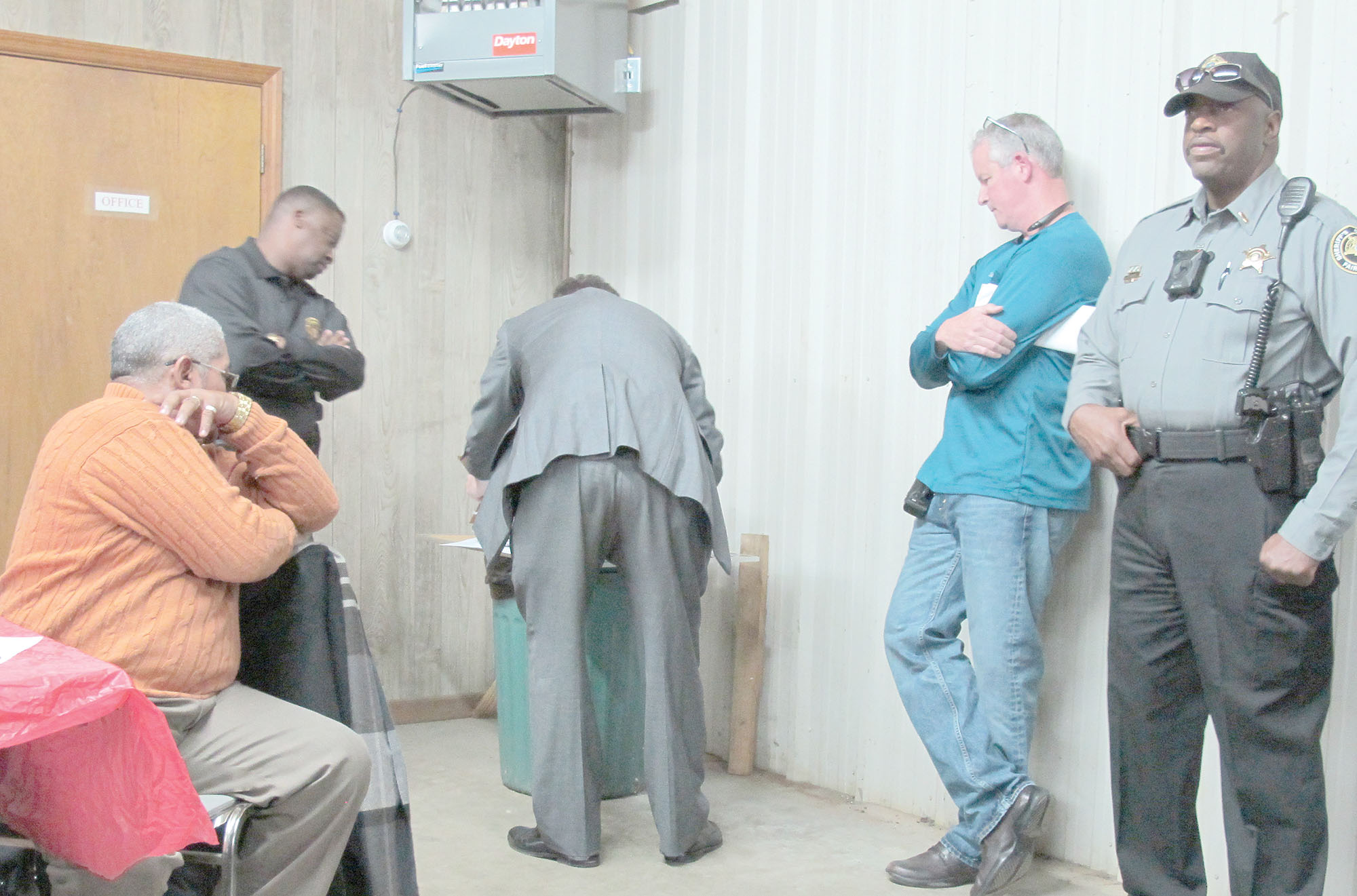
    Jenkinsville Water Company Board President Gregrey Ginyard (left) looks on as ballots are counted during last week's annual meeting. (Photo/Barbara Ball)
    Jenkinsville Water Company Board President Gregrey Ginyard (left) looks on as ballots are counted during last week’s annual meeting. (Photo/Barbara Ball)

    JENKINSVILLE (Jan. 19, 2017) – The Jan. 13 annual meeting of the Jenkinsville Water Company (JWC) was, by most any standard, a Donnybrook, complete with angry outbursts and shouting matches between the President of the Water Company Board and many of the 100 or so members in the audience. It was a repeat of last year’s annual meeting.

    Claiming that the JWC Board did not adhere to the Freedom of Information Act or even their own bylaws in conducting last year’s meeting, which included the election of Board members, Donald Melton and Broad River Campground, LLC filed a pre-emptive motion in the Fairfield County Court of Common Pleas for a temporary restraining order and preliminary injunction to delay the Jan. 13 meeting until 1) proper notification is given, 2) a procedure is put in place to verify that voters claiming to represent commercial customers were actually asked to represent them and 3) the Board can ensure that the one-member/one-vote rule in the bylaws is being followed.

    After hearing testimony from both sides on Jan. 6, Sixth Circuit Judge DeAndrea Benjamin ruled that while she would allow the JWC to proceed with its annual meeting as scheduled, she would also allow the plaintiff, if not satisfied that the meeting and the election of Board members had adhered to the company’s bylaws, to bring the case back before the court for a re-hearing.

    Melton’s attorney, Glenn Bowens, told The Voice on Monday that he hopes to bring the case back to court to challenge the election within the next couple of weeks.

    “We’re hoping to have the election overturned and a new election held that will result in properly elected trustees,” Bowens said.

    Bowens said that while notice of the meeting probably met the requirements of the bylaws this year, he said the election process itself was obstructed.

    “Some members were allowed to cast more than one vote if they had a water bill for both a residence and a business,” Bowens told The Voice. “That is not allowed in the bylaws, which state, ‘No member shall be entitled to more than one vote at meetings of the Members or to hold more than one membership in the corporation.’”

    Bowens also expressed concern that members who cast ballots on behalf of commercial entities were not asked for verification from the commercial entities as required by the company’s bylaws.

    Melton asked JWC President Gregrey Ginyard from the floor if members were allowed to “just show up and say they are casting the ballot for a church or company without some verification from the commercial entity?”

    “That’s been taken care of,” Ginyard said. “We have an attorney here, and that’s been taken care of.”

    But the issue did not appear to be entirely resolved when at least some members requesting ballots to cast votes for commercial entities were not asked for verification supplied by the commercial entities. Instead, they were allowed to offer only self-verification, with their own signature, that they had been authorized to vote for the commercial entity. Instead, those members were allowed to self-verify, on the strength of their notarized signatures, that they had been authorized to vote for the commercial entity. The Board’s attorney notarized the signatures on the self-verified forms, and told The Voice that the notarized form was sufficient.

    Shortly after the meeting opened, Ginyard called for approval of the minutes. When it was discovered that there were no minutes, Ginyard suggested tabling their approval until they could be found, which did not happen during the meeting.

    Other issues causing angst boiled over during public comment time.

    After CPA Yvette Jones reviewed the company’s annual financial report, Ginyard was asked by a member in the audience about the reported $8,089 in travel expenses.

    “That’s mileage for driving to the law firm, to the bank to make deposits and things like that,” Jones explained.

    Ginyard added that some of the mileage is from trips to meetings.

    “Who is this being paid to?” member Billy Hendrix asked.

    “To Mr. Ginyard,” Jones replied.

    Asked by Hendrix if any disciplinary action had been taken by the company last year when Ginyard reported to the Sheriff’s Office that $10,000 in water receipts had been stolen after he had left it in his unlocked pickup truck overnight, Board member Julie Brendall quickly came to Ginyard’s defense.

    “That was a mistake,” Brendall said.

    “We made a police report, but it was taken out of the truck,” Ginyard said.

    Another point of contention erupted into noisy pushback after Board members seeking re-election were allowed to give lengthy campaign speeches, but shouted down member Bertha Goins as she introduced Tony Taffer who had been nominated from the audience for Peach’s seat.

    The voting process itself was marred as voters roamed around the room as the votes were being collected in the president’s hat by a company employee, making it difficult to determine who had already voted and who had not.

    When Ginyard was nominated for another term during the first round of nominations, another Board member called for the nominations to close. Again, the audience shouted down the Board until a second nomination was allowed.

    After the ballots were collected, they were given to the Board’s attorney, Jeff Goodwyn, who took them to a small table in the corner at the front of the room, shielding the ballots from the audience as he counted and piling them into two stacks. Later, Melton and a Deputy Sheriff approached Goodwyn’s ballot table to observe the count.

    Of the five Board members seeking re-election, only Tim Roseborough was unopposed by the audience and retained his seat without a battle. No vote was taken for that seat. The other four incumbents (Ginyard, Preston Peach, Joseph McBride and Tangee Jacobs) each received the same number of votes – 46, while the votes for those nominated from the audience ranged from 30 to 40 each. All Board members were re-seated.

    (Next week, a report on Board member Preston Peach’s explanation to a raucous crowd of how the cost was covered for two letters and a JWC newsletter that he mailed to 800+ water members in envelopes with the Jenkinsville Water Company logo.)


  • Columbia Man Killed in I-77 Crash

    BLYTHEWOOD (Jan. 18, 2017) – A Columbia man was killed Monday after the 1998 Ford Expedition he was driving struck a tractor trailer at mile marker 28 on I-77, just north of Blythewood.

    Richland County Coroner Gary Watts said Barrett Keith Scott, 55, was pronounced dead at the scene Monday night. An autopsy conducted Tuesday indicated Scott died from multiple blunt trauma injuries.

    According to the S.C. Highway Patrol, Scott was traveling northbound on I-77 at approximately 9:20 p.m. when his Expedition struck the rear of a 2006 Freightliner that was also traveling north. Scott’s Expedition then overturned several times in the roadway. He was not wearing a seatbelt at the time of the collision, the Highway Patrol said.

    The driver of the tractor trailer, the Highway Patrol said, was wearing a seatbelt and was not injured in the accident.

    The crash remains under investigation by the S.C. Highway Patrol.


  • Clothing Donations Earn Discounted Sweets

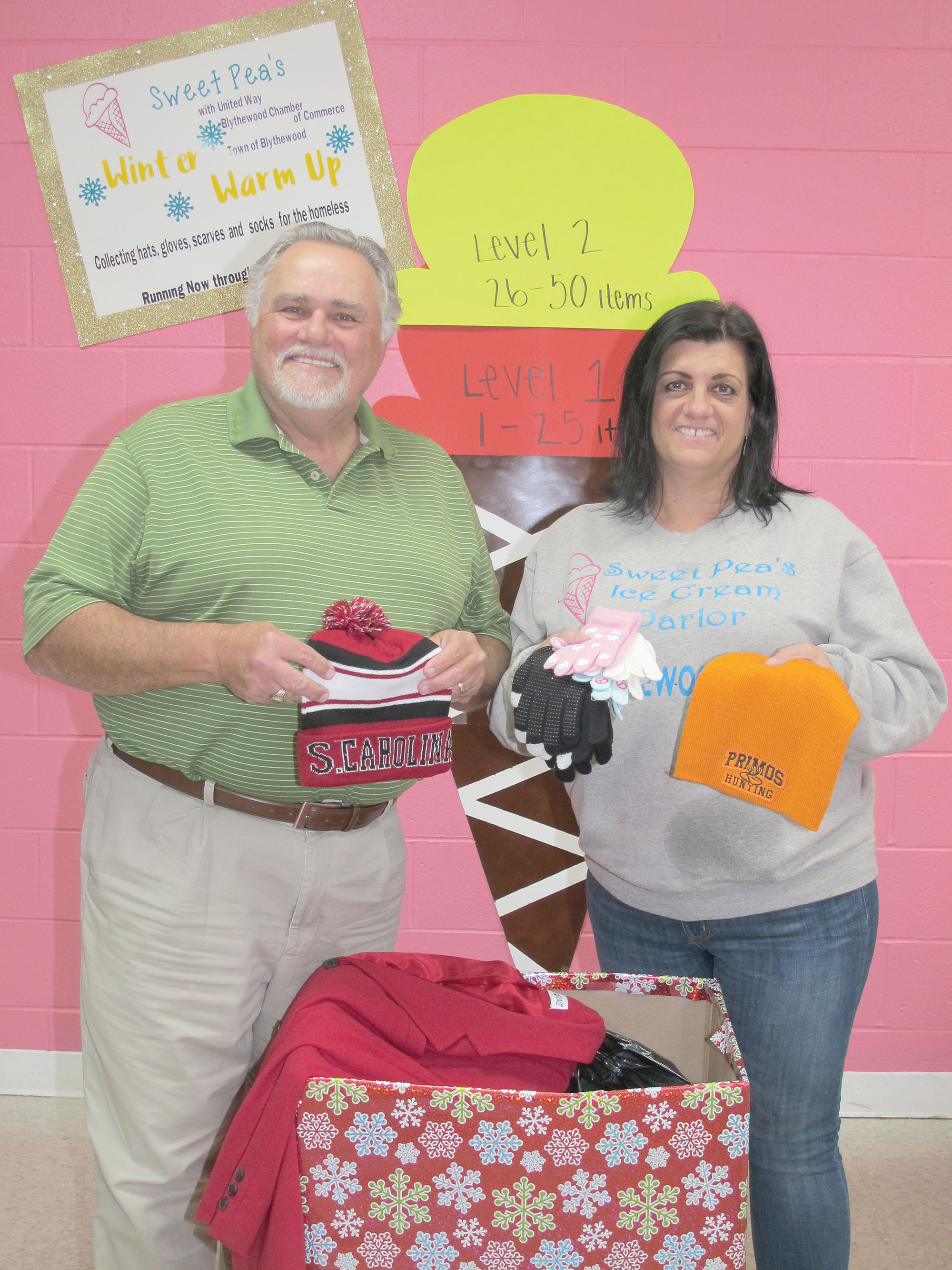
    Blythewood Mayor J. Michael Ross and Susan DeMarco, owner of Sweet Pea’s Ice Cream in Blythewood, display some of the warm weather jackets, hats and gloves that have been donated for homeless people in the community. (Photo/Barbara Ball)
    Blythewood Mayor J. Michael Ross and Susan DeMarco, owner of Sweet Pea’s Ice Cream in Blythewood, display some of the warm weather jackets, hats and gloves that have been donated for homeless people in the community. (Photo/Barbara Ball)

    BLYTHEWOOD (Jan. 12, 2017) – Folks in the community are being asked to donate lightly used, good winter clothing (coats, gloves, hats, scarves warm sweaters) at Sweet Pea’s Ice Cream shop in Blythewood to be given to United Way for distribution to the homeless.

    The shop’s owner, Susan DeMarco, will give each donor a 10 percent discount on any menu item as well as a chance to win a $50 Target gift certificate. The donations are part of the Winter Warm Up collection effort by Sweet Pea’s, The Town of Blythewood, The Blythewood Chamber of Commerce and United Way of the Midlands to provide warm clothing for homeless people in the area this winter.

    The event, which ends Jan. 20, was kicked off at Sweet Pea’s by DeMarco, Mayor J. Michael Ross, Town Councilmen Eddie Baughman and Malcolm Gordge, Blythewood Chamber of Commerce President Belinda Portnall and United Way representative Helen Cotton. Landon Penfield, a Sweet Pea’s regular, made the first donation.

    DeMarco records the donations with mock ice cream scoops that she adds to a giant ice cream cone replica on the wall of her shop. For every 25 items donated, DeMarco ads another ‘scoop.’ The donation level is currently at two scoops.


  • Richland 2 Seeks Bus Drivers

    COLUMBIA (Jan. 12, 2017) – Because of the increasing difficulty in recruiting and retaining school bus drivers, last week the Richland Two Board of Trustees approved an incentive package that awards bonuses to the District’s bus drivers based on performance, and adds days to drivers’ contracts for professional development and training.

    The move comes on the heals of an unusually high number of problems this year from bus shortages, driver shortages and mechanical issues resulting from an aging bus fleet, District Superintendent Debbie Hamm said in a statement released by the District.

    “We are working diligently to find solutions to the issues and regret the inconveniences our families face due to the delays and changes to bus routes,” Hamm said.

    “While we may not have much control over the age and number of buses provided to us by the state, we can make sure our bus drivers know they are a valuable part of the Richland Two Family and play an important role in supporting the mission of our district,” Board Chairman James Manning said.

    During a press conference outside the State House on Monday, S.C. schools Superintendent Molly Spearman said the bus shortage is statewide and asked the Legislature for $95,000 to buy 1,000 new buses. The state’s plan to phase out older buses is not working, she said. Because some of the buses are nearly 30 years old, there are concerns about reliability, safety and the cost to tax payers to provide maintenance and fuel needed to keep the aging fleet going.

    “School buses have gone to the bottom of the (Legislature’s) list” while setting spending priorities, Spearman said.

    A District spokesperson said that Richland Two transports 14,000 students over 581 routes each day, beginning with the pick-up and drop-off of middle school students, then elementary school students and, last, high school students. The buses also provide service for a wide range of extracurricular activities including sports games, said District Two Superintendent Debbie Hamm.

    The District has approved pay increases for bus drivers for the past two years and will soon evaluate new bus routing software to help improve efficiency. Hamm said transportation administrators post information daily to the Districts mobile app regarding delayed pick-up and drop-off times.

    Anyone interested in driving a bus for Richland Two can complete an online application at richland2.org or call Dennis Jones at 803-736-3774.