Blog

  • Rimer Pond dodges zoning bullet

    COLUMBIA – Rimer Pond Road area residents barely dodged another commercial zoning bullet Monday afternoon when the Richland County Planning Commission failed to muster the votes it needed to recommend that County Council approve commercial zoning at the intersection of Rimer Pond Road and Longtown Road West. Commissioners voted 4-4 on the rezoning request. The tie vote means the Commission will not send any recommendation at all on the issue to Council.

    It was an uphill battle for the residents who have fought repeatedly, over four years, against as many requests by Hugh Palmer to rezone 5.23 acres on Rimer Pond Road to some level of commercial zoning. Prior to the meeting, County staff had sided with Palmer, recommending approval of the rezoning request, saying the requested Neighborhood Commercial zoning designation complied with the County’s comprehensive land use plan for the area.

    But LongCreek resident Joe Johnson said the requested commercial zoning was not compliant with the comp plan which states, on page 197 of the plan, “the NC zoning district is designed to be located within or adjacent to residential neighborhoods where…small neighborhood oriented businesses are useful and desired.”

    “That’s your rules,” Johnson told Commissioners. “Is it desired?” he asked the audience.

    “No!’ they answered in unison.

    More than 20 residents protesting the rezoning addressed Council with passion and information for almost two hours at the public hearing. About 50 residents attended.

    Palmer, representing his family’s land which, about a year ago, was listed at $350,000 per acre, said last February that he was requesting commercial zoning because the property was unusable as residential property for which it is zoned – Medium Density Residential (RS-MD).

    “It has a traffic signal at the intersection, a cell tower on the property and an access easement to the tower,” Palmer said at the time. “No one wants to live with these things in their yard.”

    Palmer had already sold an adjacent 28 acres with 100 lots zoned RS-MD, a zoning he had requested and received in 2008.

    But resident Michael Watts suggested on Monday that the Palmers had already made a profit from the land and that the cell tower was there when they bought the property 10 years ago and had it rezoned RS-MD. Let’s look at it as it is. It’s all about the dollar bill,” Watts said.

    “The area is growing and changing. Anyone who understands that knows that. Council knows that,” Hugh Palmer told Commissioners Monday.

    “It’s very simple,” Patrick Palmer, said, promising no more than a 6,000 square-foot building with four 1,500 square-foot bays with commercial uses that he suggested could include a UPS store, a Subway, a coffee shop and dry cleaner drop-off. “These are uses that are ideal for neighborhoods,” Patrick Palmer said.

    “What we have here is like a business with obsolete inventory,” Windermere resident Jerry Rega told Commissioners. “They are buying and selling land and they now have an obsolete inventory and they want you [Commissioners] to bail them out after they made a ton of money from the rest of the property.”

    “He asked for and got RS-MD, and he needs to live by that,” Trey Hair of Rimer Pond Road said. He also noted that, “It’s the applicant’s job to show up here today. He could profit from that. I had to take a half day off work today. We are just residents opposing commercial zoning in our area. Let the residents decide what happens to our community not one developer deciding. We don’t want it. We don’t need it.”

    That mantra was repeated many times during the meeting by disgruntled residents who said they were tired of fighting the Palmers in an effort to keep the neighborhood character intact.

    “I moved here from Ohio and wanted a country feel,” resident David Wallace said. “And that’s what we have today. These proposed changes will impact our community. I left work to be here because it’s important to us. This matters to us. It’s where we live.”

    “Commercial is a crime magnet,” Catherine Raynor told Commissioners. “Look at any live TV and you’ll see our Circle K, our BP station, the Dollar Store. Do you want to replicate that two miles around the corner? Once you open the flood gates, you can’t close them,” Raynor said. “I never wanted to come here and speak. We’re grateful for what you do. But it’s different now. Our neighbors are upset, outraged [over the commercial zoning requests] and they are getting worn down,” Raynor said.

    “Before we moved from Ashley Hall subdivision to Westlake Farms, I used to sit on the back porch and look at the back side of Hardscrabble Road. Then a gas station was built in back of our house. When we heard the first gun shots, we decided to move out here to avoid such things.”

    While both the County planning staff and the Palmers tried to convince the Commissioners that Neighborhood Commercial zoning complies with the comp plan for the Rimer Pond Road area, Hair said the comp plan is out of touch with his neighborhood.

    “After the vote in February defeating the last proposal commercial zoning on Rimer Pond Road, Ashley Powell, Manager of Richland County Planning Services, started a series of public workshops to include residents’ input on the county growth plan rewrite. Powell was quoted as saying, “The Land Development Code is the zoning law regulating how land can be used. It’s what punches that comp plan (vision) into action (law). But right now in some areas, like Rimer Pond Road, the people who live there are not liking what the county has planned for their area in terms of zoning,” Powell said.

    “We want to protect the character of the neighborhood that the people moved out there for,” Powell said. “We need to amend (the Richland County comp plan) based on the feedback we get from the people.”

    But, 10 months after the meetings, there have been no reports on the results of those meetings issued by the County.  Tracy Hegler, Director of Planning and Development for Richland County, told The Voice that no reports would be forthcoming until after the second group of meetings which she said would be held around next February. At that point, the results of the first meetings will be made known and the public can then have further input.

    Putting a finer point on why any level of commercial zoning is not right for the Rimer Pond Road area, Benny Sullivan of LongCreek Plantation said Neighborhood Commercial is not much different than General Commercial. Both can have convenience stores with gas pumps, also known as gas stations.

    Only one person, besides the Palmers, spoke in favor of the Palmer’s zoning request. Vickie Brooks said she did not know the Palmers, but agreed with everything they said.

    “The time is right for a small building. I’d love to see a dry cleaners or Fed Ex. We have all these neighborhoods and we have nothing to serve us,” Brooks said.

    Last month, Brooks identified herself as a realtor at a Blythewood Planning Commission meeting where she was applying for commercial zoning on a 2-acre corner lot on Wilson Boulevard in the Dawson’s Pond neighborhood near the end of Rimer Pond Road. She denied planning to sell the land for a service station but said she wanted to bring in a doctor’s or a dental office since there were none in Blythewood. Those Commissioners voted unanimously against that zoning, saying that Blythewood has three doctors’ offices and three dentists’ offices. Brooks has not yet brought the request before Town Council for a vote.

    As the meeting wound down and Commissioner David Tuttle moved for the Commissioners to vote to send the request for commercial zoning to County Council with a recommendation for approval, Commissioner Heather Carnes came to the defense of the residents.

    “I have sat through many of these [Rimer Pond Road zoning] discussions and I have found this case to be horribly difficult,” Carnes, an attorney, said. “One of the inherent natures of Neighborhood Commercial zoning is that it is inconsistent. It drops itself into residential areas. I used to work in Blythewood and I know this area. I find it unique in that it is nothing but residential with unbelievable commercial all around it,” Carnes said.

    “Listening to you guys tonight – and I know what this area is like – I stand opposed to this rezoning. To me, the Blythewood area has created something very unique with the fact that there is no other commercial. It’s partly why I wouldn’t want to live here,” she joked. “I’m a city girl. But I appreciate that you guys love it. It is what it is,” Carnes said.

    “I came in today expecting to support this zoning. As I look at Neighborhood Commercial, I appreciate what it does for communities, I think Neighborhood Commercial is a great thing.” she said.

    “Even so, in this particular situation, given what Rimer Pond Road is and that there is no commercial zoning for, like, forever, in this area, I will vote against the request for commercial zoning.”

    After the residents’ applause and cheering died down, Carnes was joined by commissioners Prentiss McLaurin, Wallace Brown and Karen Yip in voting against the request for commercial zoning.

    Voting to recommend commercial zoning on Rimer Pond Road were Beverly Frierson, David Tuttle, Christopher Anderson and Stephen Gilchrist.

    County Council will vote on the zoning request on Tuesday, Oct. 24, at 6 p.m. in Council chambers, at 2020 Hampton Street, Columbia.
  • Council hears 55+ housing proposal

    BLYTHEWOOD – Preliminary plans for a senior living campus in downtown Blythewood were floated past Council along with a request for Mayor J. Michael Ross to sign a letter of support for the project last month.

    Tom Ulrich of Lancaster, representing Pendergraph Development, told Council on Sept. 25 that his company is proposing to build a senior citizen independent living facility on Creech Road behind the Russell Jeffcoat real estate offices.

    Ulrich said the facility would be three stories high, with an elevator and 64 one- and two-bedroom units. The facility will sit on five acres and would be for seniors 55 and older and disabled residents.

    “We’ve built these all over South Carolina for 25 years,” Ulrich said. “There’s one in Lancaster if you’d like to go up and see it. Just let me know.”

    “The reason we asked you to come here tonight is because you have asked us for a letter of support,” Ross said. “I’ve done one of these letters before for a multi-family dwelling for senior citizens, then it got changed. If we approve sending this letter of support to you we will emphatically have something in here that we don’t need any other housing right now,” Ross said. “We already have low income housing. I just want to make it clear to you that there will be no other type of housing. I’m not signing another one of these letters without Council’s approval.”

    Council voted to have attorney Jim Meggs look over the letter and make any necessary changes before resubmitting it to Council.

  • No relief to pay $24M bond early

    WINNSBORO – During a presentation to County Council last month, County Comptroller General Laura Johnson answered a couple of burning questions that, for many in the County, even some County Council members, have remained elusive since March, 2013 – Can the County’s 2013 $24M installment purchase revenue bonds (IPRB) be paid off early and, if so, at what cost?

    “Yes, the bonds can be paid off early,” Johnson said at the Sept. 24 meeting, “but there are certain requirements. The process to do this is called defeasance. You would have to pay the principal and interest for the bonds all the way up until 2023.”

    “To pay the bonds off tomorrow, you still have to pay the principal and interest until 2023,” Johnson said, “After that, any bonds that are left, you would have to pay the principal only. “So for Series A bond ($3.7M), the maturity date is 2024. Maturity date for the Series B bond ($20.9M) is 2022. After 2023, you only have to pay the principal amount on any remaining bonds.”

    “So to pay the bonds off now, we’re still looking at a payout of about $30,000,000,” Johnson said.

    “What amount is left of the original IPRB’s that has not been spent to date?” Council Chairman Billy Smith asked.

    “There’s about $10M left that has not been spent,” Johnson said. “We can’t just send that $10M back. We still have to follow defeasance regulations, paying the principal and interest until 2023.”

    “It would be foolish to pay it all and still pay all the interest,” Councilman Jimmy Ray Douglas said.

  • Former students return to alma mater… the restored Fairfield High School

    WINNSBORO – Don Prioleau has been saying to many people lately, “You’re going to be surprised what you see inside.” He was talking about the extensive restoration of Fairfield High School by some of its alumni, still true to their school.

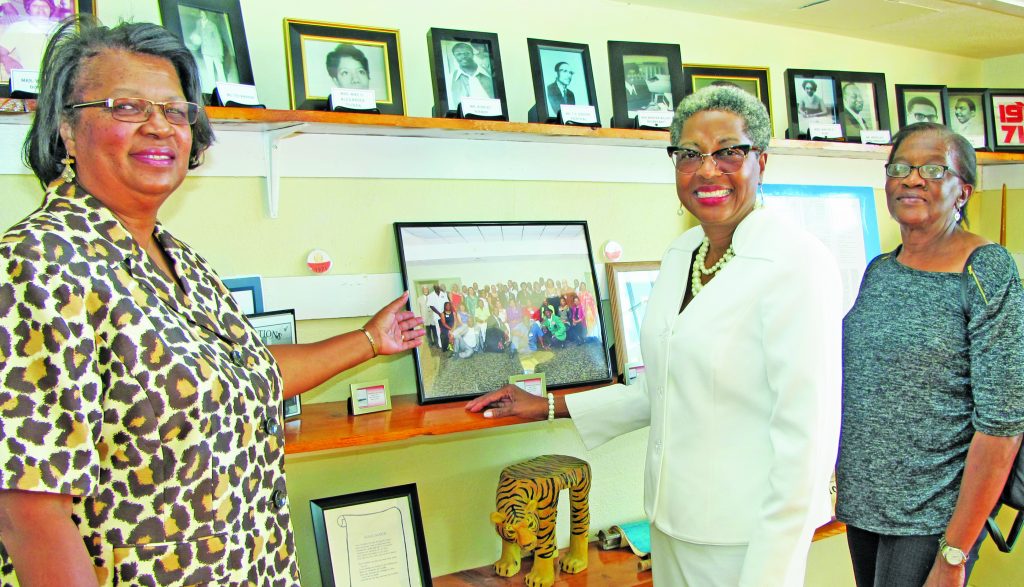
    Fannie Ford, Easter Samuels and Dorothy Smith, members of the class of ’71, admire the walls of Fairfield High memorabilia, including their class picture. | Photos/Barbara Ball

    And on Sunday, everyone found out that he was right.

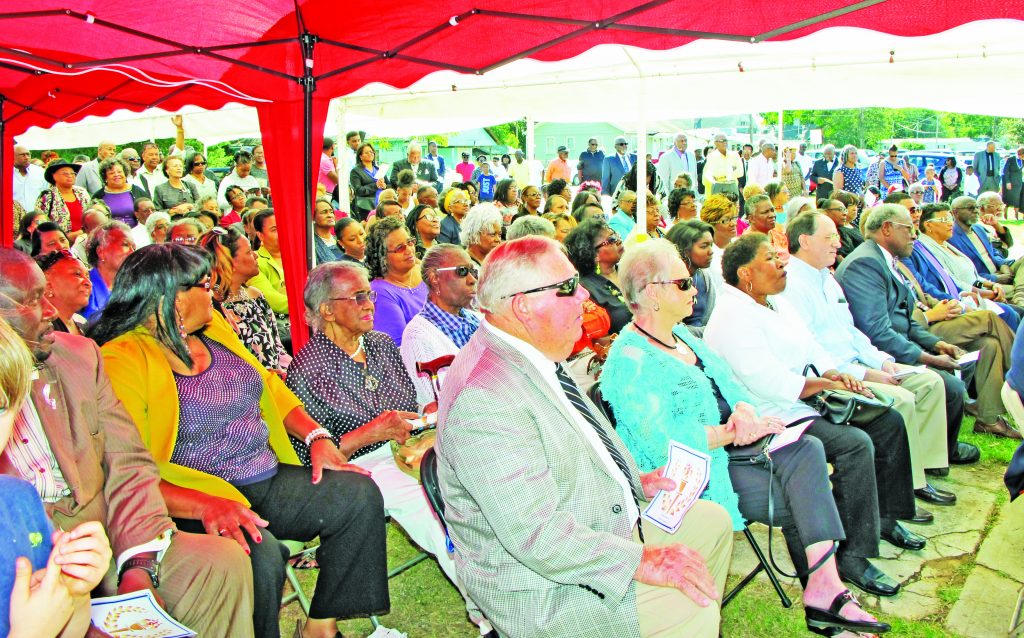
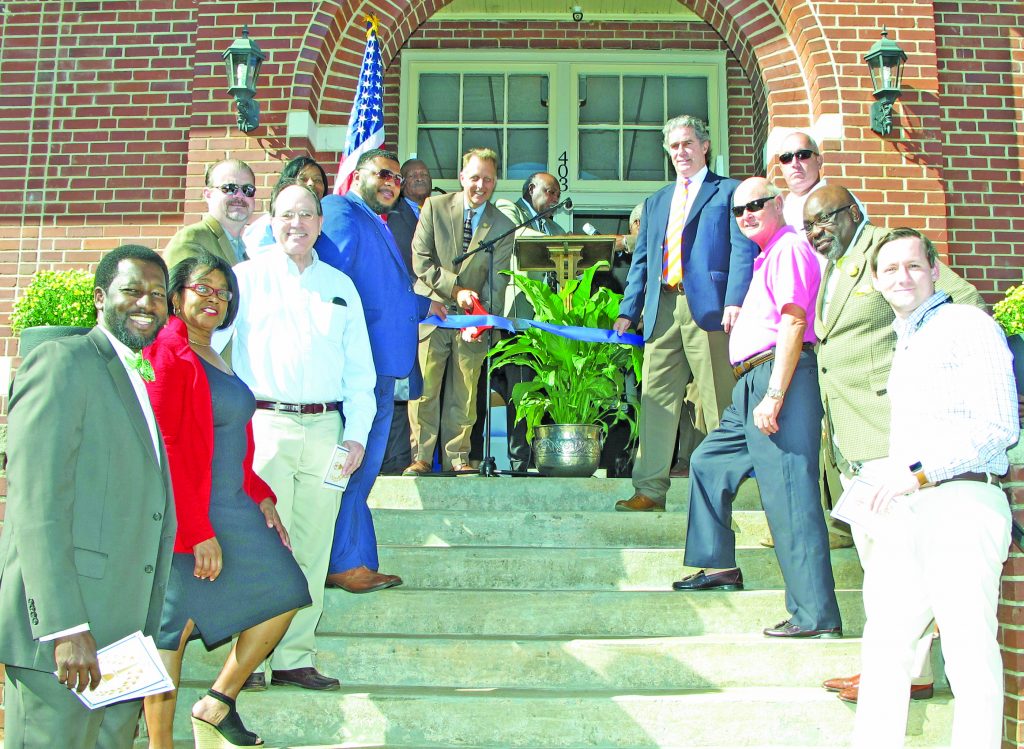
    It was a day to behold as about 300 former students, local dignitaries and friends entered the building to relive the students’ glory days through not only the restoration, but through the memorabilia displayed for each class.

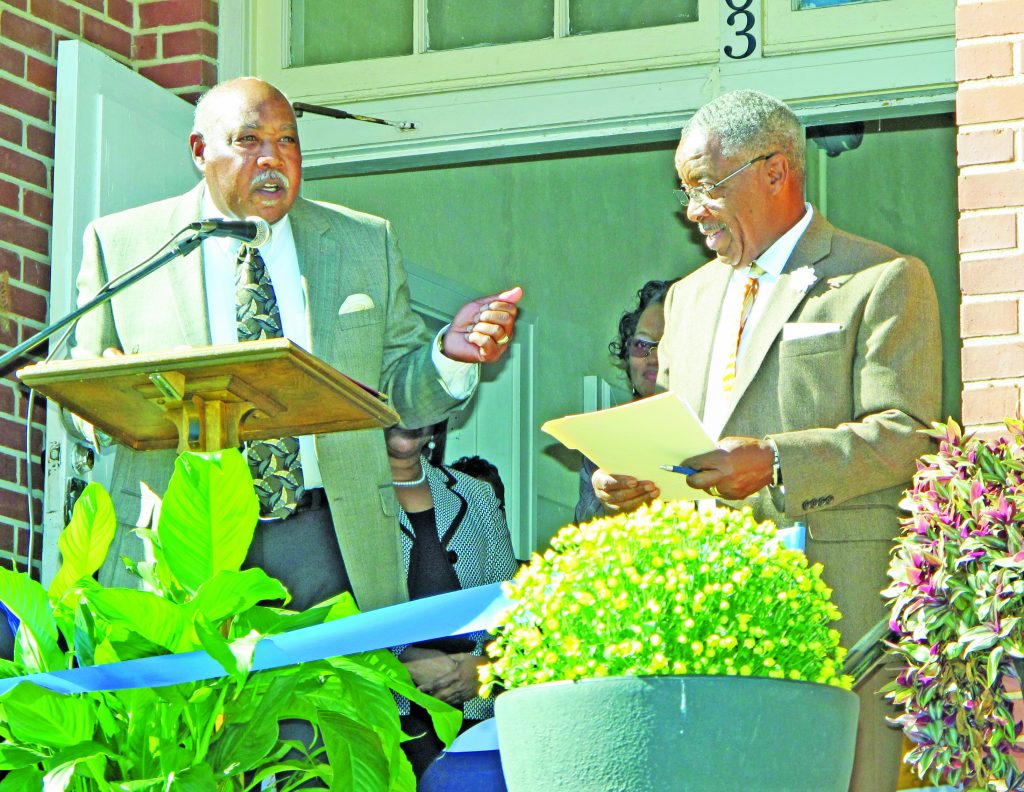
    Following opening ceremonies Alumni President Don Prioleau and Vice President Robert Davis introduced town, school, county and state dignitaries. An entertaining welcome speech by Eva Armstrong brought the house down. Fannie Ford introduced alumni officers and Janie Davis gave a brief history of the school.

    After a ribbon cutting and tour of the facility, refreshments were served in the cafeteria. For those who had attended the school, the day was one of catching up with former classmates and savoring the days when they were young.

    Senator Mike Fanning cut the ribbon held by a collection of members from County Council, Town Council, School Board and Alumni Officers. (Look for more photos in next week’s Voice.)

    The red brick school located at 403 Fairfield St. in Winnsboro was built in 1924 and initially accommodated grades 1-9. During the ensuing years, the school added secondary grades, but it was not referred to as a high school. In those days, African-American high schools were generally called ‘training schools,’ with the idea of training students for certain jobs rather than offering a true academic curriculum.

    But the students and teachers at the Fairfield Training School rose above that distinction and the negative implication of its name. In 1963, they changed the name to Fairfield High School, and today the Fairfield High School Alumni Association owns the school’s main building and restored it to the days when it was the center of their world.

    The school compound, which consisted of a main building, a gymnasium and two other buildings, closed in 1970 when Fairfield County schools were integrated. FHS students were transferred to Winnsboro High School, which was located across the bypass from where the Winnsboro Wal-Mart building stands today. Owned by the Fairfield County School District, the school’s stately main building sat empty for years and would have simply deteriorated with age, if not for the efforts of its devoted graduates.

    Mrs. Eva Armstrong, class of ‘47, welcomed the crowd to the Open House. (See her entertaining speech on our Facebook page – The Independent Voice of Blythewood & Fairfield County)

    By the late 1980s, several former FHS students began exploring the possibility of saving their old school building. The idea gained momentum, and they were soon planning an alumni reunion for the fall of 1989. It was a roaring success with almost 800 people coming together for a weekend of socializing, celebrating and planning the restoration in earnest.

    According to Donald Prioleau, Class of ’62 and president of the alumni group since 1995, they were determined to save their beloved alma mater from desolation.

    “This building has the kind of quality you don’t see much of anymore,” said Jean McCrory, the representative for the Class of ‘64 and a member of the alumni group’s Historical Committee. “It’s very well constructed, with high ceilings, thick walls and the hardwood floors are in great condition. Our goal is to preserve the original character as much as possible.”

    On April 22, 2010, the association acquired the building for $5 and a promise to complete a laundry list of improvements within the first 10 years. Prioleau said they’ve kept those promises and more. So far, the group has volunteered untold hours of labor and raised funds to hire out other projects such as installing a new roof, gutters and windows and painting the exterior trim. Prioleau said they restored the restrooms to working order, painted the interior walls and refinished the hardwood floors.

    Alumni Vice President Robert Davis (‘66) and President Donald Prioleau (‘62)

    “The main building housed the principal’s office, several classrooms and the home economics room. The teachers’ lounge and the old cafeteria were in the basement,” McCrory said. “Our goal was to restore all of that to its original state. We did. But it took a lot more money and a lot more work.”

    McCrory said the finished building will now ideally be used for a variety of recreational and community educational endeavors, such as a meeting place for scout troops and tutoring services.

    Paging through the school’s yearbooks Sunday afternoon, it is evident there was a sweet bond between the teachers, and the students and the teachers are still cherished in their former students’ comments. Several, in fact, are still active in the alumni group.

    “Each class stayed with the same home room teacher for all three years of high school,” McCrory recalled fondly, “from ninth grade to 11th grade, which back then was when you graduated. I’m still in touch with my homeroom teacher, Mrs. Bernice J. Brown, all the time! She lives across the street from the school, where she’s lived since she started teaching. When new teachers came to the school, they always boarded with Mrs. Brown until they got settled somewhere. And two other teachers, Miss Margaret Roseborough and Mrs. Maude Ross, are both in their 90s and very much part of our group.”

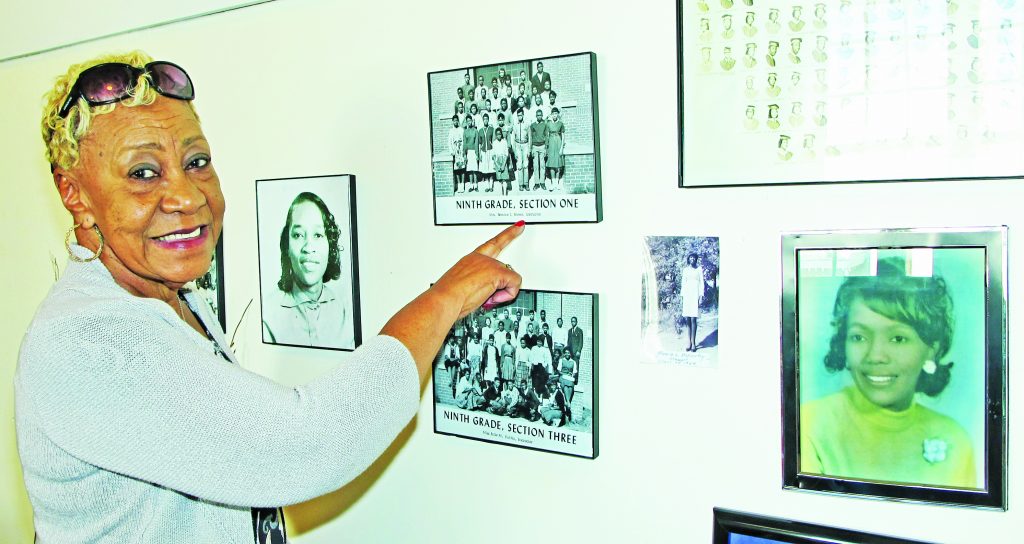
    Gladys Allen, class of ‘64, shows the photo of her ninth grade class with a wall of memorabilia in a renovated classroom.

    The devotion the former students have for the school is alive and well. As McCrory and Alumni Association Vice President Robert Davis (Class of ’66) paused for their photo in front of the school recently, an unidentified woman driving past the school rolled down her window and called out proudly: “Class of ‘52!”

    McCrory and Davis smiled and waved.

    Alumni meetings are held at 7:30 on the third Tuesday evening of every month at the school, and individual graduating classes hold their reunions at various times throughout the year. Lively reunions for the entire 650 registered alumni are planned every two or three years. They’re always held on Thanksgiving weekend and begin with a Friday evening banquet.

    “Then, on Saturday, we have a parade through downtown Winnsboro,” McCrory added, eager to go on about the weekend of fun, “and each class is represented on a beautiful float – we have about 20 floats. After that, we have a big tailgate party on the football field at Garden Street behind the school. On Sunday, we end our weekend with a church service. It’s always a wonderful event. At our reunion, in 2013, we had over 400 people.”

    Almost 300 attended the open house and toured the school.

    “But we’re getting older and we’re dying off,” Prioleau, 73, laughed. “The class of ’55 is about our oldest class to actively participate. But the school will go on through our kids and grandkids. We’ve passed down the importance of it and many of them now volunteer their time and donate to further the project.”

    “The combined work of so many people has kept the spirit of the restoration alive,” McCrory said. “This project is very dear to our hearts. That school produced some very good people.”

    For more information or to donate to the Fairfield High School historical restoration, contact Donald Prioleau at 803-337-2105, or mail donations to the Fairfield High School Alumni Committee, P.O. Box 1182, Winnsboro, S.C. 29180.

  • Winnsboro Lion of the Year

    Richard Hodges of the Winnsboro Lions Club was recently named 2016-2017 “Lion of the Year.”  In addition to having served as club secretary for three decades, Hodges also heads up the club’s eye exams and glasses provision program and serves as chaplain for the club. Winnsboro Lions President Bill Haslett, right, presented a “Lion of the Year” plaque to Hodges during a recent club meeting.

  • Chamber, Utroska spar over Chamber’s report

    A financial report that Blythewood Chamber of Commerce Chairwoman Brenda Portnall said would be a full disclosure of the Blythewood Chamber of Commerce’s funding and expenditures for the eclipse events held in Doko Park last August, fell short of Councilman Tom Utroska’s expectations Monday evening.

    While general categories of revenue and expenses were listed in the report, no receipts for any of the Chamber’s roughly $20,000 expenditures were included. The Chamber received $13,000 in accommodation tax (A-tax) funding from the Town and $6,165 from vendors and sponsors after it requested and received the A-tax funds from the Town.

    Three of the councilmen did not comment at all on the report. Councilmen Malcolm Gorge, Larry Griffin and Mayor J. Michael Ross told The Voice they had not yet read through the report which was delivered on Friday prior to the Council meeting on Monday evening.

    Utroska first addressed attendance numbers for three weekend events prior to the eclipse event on Monday. He and, earlier, Councilman Eddie Baughman, said the numbers were disappointing. When applying for accommodation tax funding for the three weekend events, Chamber Executive Director Mike Switzer told Council he expected to draw at least 3,000 visitors for those events, 90 percent of which would be classified as tourists.

    “I don’t see [in the report] how many people were in attendance Aug. 18, 19 and 20,” Utroska said, “or what percentage of them were tourists.”

    Switzer said attendance was only about 200 each night, taking no responsibility but blaming the low attendance on the warm weather. He said he didn’t know the percentage of tourists.

    “We did our best and that’s what you got,” Switzer said.

    The Town also awarded the Chamber $1,900 to market and advertise the three weekend events and $6,600 to market and advertise all four events.

    “How many Facebook followers did you have when you were promoting the event and how many do you have now?” Utroska asked.

    “I don’t know,” Switzer answered.

    “I would like to have that information,” Utroska said.

    According to the social media statistics in the report, the Chamber spent $75 on the eclipse event and received 104 Facebook response. Copies of a sampling of daily Facebook posts were included in the report. There was no other documentation identified as Facebook expenditures.

    “You paid staff $7,500 for the events. Who is the staff?” Utroska asked.

    “Kitty Kelly and myself,” Switzer answered.

    Switzer initially said that Kelly received about two-thirds of the $7,500, then changed that to three-fourths.

    The Chamber reported the following revenue/expenditures for the Aug. 18, 19 and 20 weekend events and the Monday eclipse event.

    Revenue:

    $12,950   Town A-tax funds

            915   Vendor fees

         5,250   Sponsorships

     $19,115   Total revenue

    Expenditures:

    Staff                          7,475.25

    Amphitheater         2,400.00

    Musicians & DJ     2,185.00

    Marketing               1,113.10

    Movies (2)              2,318.00

    Eclipse Glasses      2,750.00

    Waste                          755.00

    Prize Money               850.00

    Security (RCSD)        600.00

    Parking                       200.00 

    Misc.                            191.68

     Total:                  $20,838.03

    Controversy over the funding and expenditures first arose two weeks prior to the eclipse event when it was learned that the Chamber had not provided items it was funded for and the eclipse glasses provided by the Chamber were unauthorized and had to be recalled.

    After publishing a scathing letter in which she criticized Councilmen Tom Utroska and Eddie Baughman for not praising the Chamber enough for the success of the events and expressing disappointment that the Chamber didn’t keep its word on certain things that Switzer promised when requesting funds from Council, Chamber Chairman Belinda Portnall was effusive Monday night repeating several times that the Chamber’s work was phenomenal and that the event was phenomenal and that the chamber had a tremendous turnout.

    But, after thanking the Chamber for organizing the events and praising them for their work, Ross weighed in further.

    “The events on Friday, Saturday and Sunday lacked the numbers we thought we’d get,” Ross told Switzer. “For the money we spend, we like to get results and the food vendors didn’t do that well.” Ross said.

    “And Monday’s attendance [for the eclipse] was a no-brainer. You probably didn’t have to do much – it was the eclipse! And some people just stumbled on us,” Ross said. “But it was great.”

  • Ridgeway Council hires $60/hr consultant

    Ridgeway Town Council voted unanimously last week to hire a part time, temporary administrative consultant for the Town. The announcement was made by Mayor Charlene Herring following executive session during the Sept. 21 meeting. The hiring had not previously been discussed in open session of town meetings.

    The motion was made by Councilwoman Angela Harrison to pay David Hudspeth $60 per hour one day each week with a mileage allowance of 53.5¢ per mile. Herring said Hudspeth is currently a part time town administrator in Mullins, S.C. Harrison’s motion called for the hiring to become effective with the mayor’s signature and Hudspeth’s agreement to the contract.

    Herring said the job did not have to be advertised because the position is part time.

    “We talked to a person who recommended him,” Herring said. He has worked for the towns of Rock Hill, Ft. Mill and Bamberg as a city administrator. The position is temporary, 30 days over six months. We can decide how much we need him and what advice he gives,” she said.

    Asked what his duties would be, Herring at first replied, “Administrative duties.”

    Pressed by The Voice for details, Herring read from a list: Day-to-day running of the town operations, pursuing grants, helping with the bidding process, improvements regarding legal matters, working with committees for interpretation of zoning laws in the County, assist employees with efficiency and effectiveness of the workplace, strategic planning implementation and whatever else Council needs.”

    Hudspeth began his duties last week and Herring said he would be in the office on Wednesdays.

  • Lake Wateree study points to CAW

    WINNSBORO – The Fairfield County Council agreed, back in June, to pay $3,000 of a $4,000 hydrology study to investigate sediment inflow into Lake Wateree. The request for the study came from the Lake Wateree Homeowners’ Association. Southern Ecological Consultants of Lugoff conducted the study and County Administrator Jason Taylor presented those results during Council meeting Monday evening.

    “We did commission a hydrologist,” Taylor said. “He came back with a study and his feelings are that Carolina Adventure World does contribute to the runoff and the infill.”

    Researchers tested the turbidity levels (the cloudiness of the water) in three locations. One location was tested upstream, and the other locations progressed further downstream higher turbidity levels were found.

    According to the report, turbidity levels upstream of Camp Welfare Road were in line with the South Carolina Department of Health and Environmental Control water quality thresholds. However, samples from downstream east of Highway 21 exceeded those levels by as much as five times.

    Carolina Adventure World’s allowance of off-road vehicles in active stream channels is identified as likely the cause of the higher turbidity levels in the downstream portion of Lake Wateree. The report goes on to suggest further investigation into the Carolina Adventure World facility to make sure they are properly transporting sediment offsite per DHEC guidelines and thresholds.

    Taylor said they would be having a follow up with the hydrologist and listen to recommendations for how to stop the problem and reverse the effects.

    Fire Alarm Bid

    The Fairfield County Detention Center will be getting a much needed upgrade to their fire alarm system. Council unanimously approved a $79,000 bid from Technology Solutions of Charleston for the upgrade which was also reviewed and recommended by Mead & Hunt Architecture.

    “The Fire alarm system at the detention center right now is approaching 20 years old, I think it’s 19 exactly,” Taylor said. “We knew that it was having problems and in the last budget cycle we budgeted $100,000 to go towards the replacement of the system.”

    Control Management Incorporated of Columbia submitted a bid of $131,860.

  • County reorganizes planning, airport management

    Fairfield County approved reorganizing the structure of both the management of the County airport and the community planning organization. Both moves were recommended by the Administration and Finance Committee prior to the meeting.

    Under the reorganization, the Fairfield County Airport will no longer be under the management of a Fixed Based Operator. Those duties will be handed off to a new Airport Director who will report directly to the County Administration.

    Prior to the change, the FBO was in charge of managing the Fairfield County Airport and collecting fees on hangar rentals and fuel. He was paid by the County. The fees that the airport generates yearly, about $61,036 will now be used to cover the $60,000 salary of the new Director.

    “We are taking all those back and bringing it in house,” Taylor said. “We’ll have a manager in house, use all those fees to pay that person’s salary and then rent back space to the current FBO and treat him more as a vendor and allow him to use space for mechanic services and things like that.”

    According to Council’s Request of Action, the airport was deemed to be sub-par in safety levels and overall professionalism by an operational assessment performed in June.

    The County also unanimously approved a motion to separate the positions of Planning Director and Certified Building Official, both of which are currently held by a single county employee. This reorganization had already been budgeted for.

    “A Planning Director generally is proactive, and looks to secure funds for community revitalization projects,” Taylor said. “A Certified Building Official handles code enforcement and ensures projects are being built up to the proper codes and ordinances.”

    “We’re suggesting that we split those duties and hire, and we did budget this also, a true Planning Director and have our current Planning Director concentrate on building code and code enforcement,” Taylor said. The reorganization is already in process.


  • Rimer Pond zoning issue heating up

    The battle to take Rimer Pond Road continues as developer Hugh Palmer and his son Patrick, a former chairman and 14-year member of the Richland County Planning Commission, try for the fourth time in as many years to establish the first commercial zoning on the road.

    Residents from Rimer Pond Road, LongCreek Plantation, Eagles Glen and surrounding areas are expected to show up at a Richland County Planning Commission public hearing Monday a little before 1 p.m. to sign up to speak against the proposed rezoning of a 5.23-acre parcel of land at the intersection of Rimer Pond Road and Longtown Road/Trading Post Road. That meeting, which is usually held in Council chambers at the County building, has been relocated to the second floor of the main Richland County public library at 1431 Assembly Street in Columbia.

    The owner of the property, Hugh Palmer, is requesting a change in zoning from Medium Density Residential (RS-MD) to Neighborhood Commercial (NC). The parcel is located across the street from Blythewood Middle School.

    The County’s Planning Department staff is recommending that the Planning Commission recommend the rezoning to Richland County Council.

    During the other three attempts by the Palmer family to bring commercial zoning to Rimer Pond Road, Patrick Palmer was either a member or Chair of the Planning Commission that determined whether the recommendation to Council would be for or against the rezoning. While Palmer recused himself from voting on the rezoning, his proximity with staff and the other Commissioners didn’t sit well with the residents who opposed the rezoning. After Hugh Palmer’s last loss to the residents in February of this year, Patrick Palmer resigned from the Commission.

    The fourth battle between Palmer and the residents is playing out in a new dimension – Facebook – where Patrick Palmer has put himself into the mix, trying to convince residents that the information on anti-commercial Facebook sites and in The Voice is not correct.

    “Nicole, this is Patrick Palmer and I would love to talk with you about the proposed rezoning at the corner of Rimer Pond and Longtown Rd. My cell is xxx-xxxx. Please call me anytime with any questions you have. The Facebook sites you are listening to are not correct. Please call me,” Palmer wrote on the Keep it Rural site which is managed by Rimer Pond Road resident Trey Hair. The site, which is the hub of the base who oppose commercial zoning on the Road, gets an average of about 2,500 clicks per update since the public hearing notice was staked out by property, Hair said.

    For his part, Patrick Palmer and his father say they just want to bring commercial uses in small 6,000 square foot offices to the neighborhood as a convenience to the residents.

    The neighbors disagree. Their mantra has become, “We don’t want it, and we don’t need it.”

    “The only beneficiary of this zoning change will be the applicant who stands to make a large sum of money from the property sales,” Trey Hair said when addressing Council on the issue in February.

    The 5.23 acre parcel which is home to a cell tower, makes it undesirable for residential use, Palmer told the County Council. The parcel is what’s left from a larger 36+ acre parcel after the Palmers sold 31.23 acres to Kevin Steele of Land Tech, the developer who is now building Coatsbridge neighborhood on the 31.23 acres.

    In the spring of 2013, a flyer, which was verified by Patrick Palmer at the time, advertised the 5.23 acre parcel for $350,000 per acre.

    Residents say they don’t want commercial zoning of any kind because they fear the domino effect – one commercial zoning making it easier for the next commercial zoning request to be granted.

    Hugh Palmer told Council in February, when he was asking for Rural Commercial Zoning, that commercial zoning will not bring to fruition the residents’ worse fears. He also said commercial zoning is what the County, as a whole, has instructed the development community to do.

    “Maybe it’s against what the residents out here want. But as a person who owns property in the county, all I have to go on is what the county says. So that’s what I’m going to do.”