Blog

  • PC to OK sketch plan approvals

    BLYTHEWOOD – Council discussed during a workshop last week a proposal drafted by Town Attorney Jim Meggs that would give the Planning Commission the authority to approve sketch plans for developers of subdivisions rather than making it an optional function.

    “This will give developers greater certainty about the Town’s subdivision review and approval process,” Town Administrator Gary Parker told Council members last week during their monthly workshop.

    Currently, Town Planning Consultant Michael Criss and Parker review and approve sketch plans. It later goes before the Planning Commission for preliminary plat approval, but, Parker pointed out, maybe not before the developer has already committed to expensive engineering, to the drafting of a preliminary plat and before the developer even knows whether their project’s basic design is going to be acceptable to the Planning Commission with regard to zoning conformance, lot count and layout, road geometry, proposed utility services, sidewalks and trails, open space and tree preservation, etc.

    “One developer complained that he had the sketch plan approved by staff, then, before he could get it back to the Planning Commission for preliminary plat approval, he had already spent a lot of money. That is wasted money if the Commission turns it down,” Meggs told Council.

    “This proposal moves it (sketch plan) to the Commission for approval, giving the developer vested rights for two years,” Meggs said. “This protects the developer from rule changes during that time.”

    Councilman Tom Utroska asked how the Commissioners would get sufficient training to understand how to make the approvals of a sketch plan.

    “We currently rely on the Town Administrator who is qualified to do that,” Utroska said.

    “From a legal perspective,” Meggs said, “it’s Council’s responsibility to make sure that the people you appoint to the Commission actually comply with the statutory required hours of education to make these decisions.”

    Meggs said he would be willing to become certified to conduct this training for the Commissioners to be sure they are prepared for the task of approving sketch plans.

  • Council mulls industrial next to park

    BLYTHEWOOD – Council will give second and final reading on Monday evening to an ordinance that would allow industrial zoning on property in the town that borders Doko Park.

    “Keith Gilstrap is requesting a rezoning of a portion of his business’ property located at 212 McLean Road in order to expand his insulation-cutting and wholesaling business,” Town Administrator Gary Parker told Council last month.

    Gilstrap is requesting that a 2-acre portion of his approximately 4.5 acre tract of land be rezoned from Community Commercial (CC) to Limited Industrial (LI). The entire tract is adjacent to the Town park property.

    The Planning Commission unanimously recommended the rezoning at their Sept. 5 meeting, and Council approved first reading at their September meeting.

    Other items on the agenda include a revision of the subdivision regulations process and amphitheater user guidelines. In executive session, Council will discuss negotiations for the sale of the Doko property.

  • Rimer Pond Rd. hearing postponed until Nov. 16

    BLYTHEWOOD – The public hearing and first reading by Richland County Council for a request by the Palmer family for Neighborhood Commercial (NC) zoning on a 5.23 acre parcel at the intersection of Rimer Pond Road  and Longtown Road West has been moved to Council’s Nov. 16 meeting at the family’s request according to Richland County Assistant Zoning Administrator Tommy DeLage,

    County Councilman Chip Jackson was to meet with residents of the Rimer Pond Road area on Wednesday, Oct. 18 at the Columbia Country Club inBlythewood to discuss the zoning request. That meeting will be reported on in the Oct. 26 issue of The Voice. Residents in the area have fought to keep commercial zoning off the Road for more than three years.

  • Notice of Rimer Pond Road Meeting


    Wednesday, October 18 at 7:00 p.m. at Columbia Country Club

    Neighbors,

    As many of you know there has been a lot a conversation regarding the rezoning request by Hugh Palmer of Sycamore Development, owner of the corner parcel at Longtown Rd and Rimer Pond Rd, by the property owners in the area who oppose this property being zoned Neighborhood Commercial.   On October 2nd, many of your neighbors attended a Planning Commission Hearing regarding this property, despite more than 2 dozen residents in the surrounding area speaking out and voicing our concerns David Tuttle made a motion to Approve the request of Neighborhood Commercial and Chris Anderson seconded that motion which lead to a board vote of 4 to 4, a tie, to send this request to County Council with no recommendation.   While Neighborhood Commercial sounds innocent, as if it is something we would could get behind like a coffee shop, or kids karate studio it also allows for convenience stores with gas pumps and alcohol sales just like we have at the corner of Longtown Rd and Lee Rd 1.5 miles away.

    Many of your neighbors have spent time fighting this for 3 years now, countless zoning hearings, county council meetings, lots of emails and letters to local leaders.  They feel strongly about the rural residential feeling we have here in Blythewood, especially Rimer Pond Rd and the surrounding area, they appreciate the fact commercial development has not seeped in on Rimer Pond Rd yet, they feel secure knowing commercial development will not be right across the street from their children who attend Blythewood Middle School and Round Top Elementary School, they are proud of the community we have molded and equally as important they want to maintain the value a rural residential community maintains.

    So with all this said, if you have been wondering how to participate or how to speak up, here is your chance Wednesday October 18th, 7pm at Columbia Country Club.  Calvin “Chip” Jackson, Richland County Council District 9 Representative will be in attendance to hear what the community has to say regarding the commercial zoning request of 502 Rimer Pond Rd  (Case #17-025MA Hugh Palmer’s 5.23 acres from Medium density Residential to Neighborhood Commercial).  Gwendolyn Kennedy, Richland County Council District 7 Representative has formally been invited but has not accepted as of sending this email

    If you feel so inclined please tell anyone you feel may want to come from surrounding neighborhoods, please forward to friends you think may care, the more the merrier.  Please see the attachment for a map and description of the property. Also, click on the following link to view the Zoning descriptions: Neighborhood Commercial is on pages 171-172 and the Use Table starts on page 311.

    http://www.richlandonline.com/Portals/0/Departments/DevServices/Docs/Current%20Land%20Development%20Code%20(through%207-15-14)%20with%20TOC.pdf

    Tracy Corson

  • Woman arrested for feeding cat methadone

    WINNSBORO – After Fairfield County Animal Control Director Bob Innes received a tip on July 28 that a woman living on Chatam Circle in Winnsboro was either feeding or injecting her cat with methadone and klonapin, the woman, Johnnie Ann Shirle, 33, was arrested by Winnsboro Public Safety officers later that day and charged with Ill Treatment of Animals, part B, a felony that will come before a sixth judicial circuit judge in general sessions court.

    Johnnie Shirle

    Acting on a witness tip, Innes went to the home and took photos of the cat, which appeared to be neglected, according to the incident report.

    After persuading the owner to surrender the cat, Innes took it to a local veterinarian and presented photos of the cat to Winnsboro Department of Public Safety officers, the report stated.

    WDPS Investigator Michael Carrell accompanied Innes back to the residence where the homeowner and her daughter (the witness) stated to the officer and Innes that the cat did belong to the offender (the mother’s daughter-in-law).

    The report states that the witness, who also resides at the address, said the cat had been given the drugs by the offender, who also melted the drugs that were subsequently ingested by her dog. The report states that the dog then had a seizure in the bathtub of the residence.

    It was reported that the offender also had two snakes inside the residence and that a search warrant request was made for the residence in order to seize the remaining animals and locate the drugs in question.

    WDPS officers did return later that day, according to Carrell, and arrested Shirle. After being booked into the Fairfield County detention center, Shirle was release on her personal recognizance and did not have to pay a bond.

    At press time, The Voice has not received information from WDPS as to whether other charges were filed against Shirle.

    No court date has been set by the Solicitor at this time.

  • 15 land owners sued over property lines

    What began as a property line dispute over a driveway has resulted in Winnsboro resident William (Bill) Haslett filing a lawsuit against 15 people who own properties in the same block as two properties owned by Haslett on the west side of N. Congress Street in downtown Winnsboro. One of Haslett’s two properties, located at 141 N. Congress Street, houses the Winnsboro House of BBQ. The other property sits directly behind it.

    Some properties named in the suit do not touch Haslett’s property. Defendants include: Randy Wheeler, L. Hubert Brice and Bonnie Brice, Bernard Pauling, Bernard Pauling, Jr., Dexter Pauling, George Kemp, Lee Kemp, Nathaniel Green, James E. Branham and Norma W. Branham, Ross Burton, Robert Ford and Vanessa Hollins.

    “I’m not really suing these people,” Haslett told The Voice, “I just want to be able to use the alley between my building (the barbecue restaurant) and the barber shop next door.” Haslett said the alley is rightfully his and has been part of his family’s property since the early 1900’s when the land was purchased by his grandfather. “I want to be able to at least share the use of the alley,” Haslett said.

    Bernard Pauling, who is part owner of the barber shop, told The Voice he purchased his property five years ago and that his survey shows that about 12 feet  of the alley belonged to his property and about three feet belonged to Haslett.

    “Recently Haslett had a survey done and the Courthouse awarded him three more feet of my alley, leaving me only nine feet,” Pauling said, now he’s suing about the property lines to get the rest of my driveway.”

    Glenn Bowens, Haslett’s attorney who filed the civil action in Circuit Court in Fairfield County, said that, technically, it is a lawsuit, but he termed it a friendly lawsuit and that the only intent of the suit is to correct property lines that over the years have been shifted and are now incorrectly placed.

    “In the town’s early days, most people did not have property surveys done. My property was never surveyed until recently,” Haslett said. “But I have a copy of the original layout of the town and it doesn’t match the property lines as they are today.”

    The suit alleges that, over the years, as the parcels currently owned by the plaintiffs and defendant have changed ownership, errors have occurred in the plats and property descriptions in the various deeds. Haslett argues that these errors have resulted in a shift of the property lines for the parcels owned by the defendants and Haslett.

    The lawsuit references a map that shows the original Town of Winnsboro property lines in yellow and the property lines as reflected in the current deeds in red.

    The lawsuit is asking for a declaratory judgment to determine the legal property lines between the plaintiff’s properties and the defendants’ properties. The lawsuit states, also, that the defendants’ rights could be affected by the final resolution of the property lines.

    While Bowens said that all the property lines on the street have moved over the years, some of the defendants have asked why Wells Fargo Bank, First United Methodist Church and the old Harold Building recently purchased by commercial realtor Wanda Carnes are not included in the lawsuit. Bowens said the surveyor made the determination to not include those properties, but Bowens said he doesn’t know why they were not included.

    Haslett and the surveyor for Glenn Associates also say they don’t know why those properties were not included in the lawsuit.

    “The surveyor gathered all the documents and current surveys of all these properties and compared them to the town’s original plat,” Bowens said. “When the property lines are shifted back to how they are supposed to be, one property line might overlap another property line, but, in the end, it will all balance out.”

    While Bowens said there is no financial component to the lawsuit, that Haslett is not suing the defendants for a settlement, the suit states that the defendants are required to answer the complaint. Some defendants have told The Voice they have had to hire lawyers to answer the complaint. Should they not answer, then the lawsuit states that Haslett can “apply to the Court for the relief demanded in the complaint and judgment by default will be rendered against (property owners) for the relief demanded in the complaint.”

    “He only wants his property lines straightened out, but to do that, we may have to adjust other property lines,” Bowens said. Bowens did not, however, rule out the possibility that some defendants might end up suing other defendants over any newly adjusted property lines.

    “The current property lines cannot stay the way they are,” Bowens said. “Once the judge decides where the property lines should be, then the property owners will know their true property line. That’s important when they want to buy or sell their properties or take out a mortgage, etc.”

    Bowens has requested the Court to appoint Ridgeway attorney Robert Hartman as special referee to try the entire action by taking testimony, ruling on any motions, issuing any interlocutory or other orders he deems prudent, receiving evidence and issuing a judgment with finality. Any appeal would have to be taken to the S.C. Court of Appeals or the Supreme Court.

    Bowens said that in larger towns/counties, a master of equity would hear the case, but since Fairfield does not have a master of equity, a judge usually appoints a referee. He said that should happen soon and then a date will be set for the defendants to meet with the special referee.

  • Chamber to host TC candidate forum

    BLYTHEWOOD – Candidates for the Blythewood Town Council will be on the hot seat Monday, Oct. 30, from 7 – 9 p.m., when they participate in a candidate debate at The Manor at Doko Meadows, the town’s community and event center.

    Mike Switzer announced at the September Town Council meeting that the Chamber of Commerce would be hosting the event as it has the last couple of years.

    “As for the questions asked of the candidates, will there be community involvement? Can the residents send in questions or will the Chamber make up the questions?” Mayor J. Michael Ross asked Switzer.

    “We’ll put out a press release about that and ask for any input,” Switzer said.

    In past Chamber forums, the questions had to be submitted directly to the Chamber in advance and were sometimes changed or tweaked by Switzer or other Chamber members organizing the debate. The audience has not been allowed to ask questions at the from the floor to the candidates.

    The election will be held Tuesday, Nov. 7, with all precincts in this election located at Blythewood Recreation Center, 126 Boney Road in Blythewood. Candidates include Donald Brock (Planning Commissioner), Bryan Franklin (Chairman, Planning Commission), Larry Griffin (Incumbent) and Michelle Kiedrowski (Planning Commission). Courtney Leavitt of Cobblestone Park declared his candidacy but has since withdrawn.

    In a prepared statement issued on Tuesday, Leavitt wrote, “It is with a heavy heart that I share with you my decision to withdraw from the town council race. With my current work environment and commitments to external activities, I feel as if I would not be able to give full effort towards Blythewood, and the town council seat. Perhaps in the future I will not be so worn thin and would be able to effectively contribute 100% of my efforts to the town.”

    To find out the qualifications and process to vote via absentee ballot, go to www.scvotes.org or call 803-576-2240.

  • RW Council to vote on parking, junkers

    RIDGEWAY – A second and final vote will be taken by Ridgeway Town Council Thursday night that will, if passed, put the nail in the coffin on leaving junked vehicles on property in excess of 30 days by the owner and parking for more than three hours on Palmer Street. Council will also make their final vote to eliminate overnight parking on any property owned or leased by the Town unless for special Town approved events with the exception of law enforcement and emergency vehicles.

    Final vote will also be given on an amendment of the Town’s purchasing ordinance, raising the limit on the amount the Town government can purchase without bids from $500 to $1,500. If the final vote passes, Council will be allowed to spend up to $1,500 without a bid process.

    While these items would normally be listed under ‘new business’, they are listed under ‘old business’ on the agenda.

    Listed under ‘new business’ is consideration of location for public restroom facilities for the Town. While it is not clear whether the item will be voted on, Councilman Don Prioleau told The Voice that he thinks it will be for discussion only.

    Council may also vote following executive session regarding the purchase of property from Norfolk Southern (the cotton yard).

  • FMH board reluctantly passes budget

    WINNSBORO – In the midst of declining revenues, absent patients, a dismal August financial report and an uncertain future for some of the hospital’s departments, the Fairfield Memorial Hospital Board of Trustees Finance and Audit Committee reluctantly adopted a controversial fiscal year 2017-18 budget presented last month by Timothy Mitchell, Chief Financial Officer of the hospital. The hospital’s fiscal year began Oct. 1.

    But the passage was not without stiff opposition.

    Committee chairman Randy Bright expressed strong concern that the new budget was overstating projected revenues and downplaying potential losses based wholly on revenues, patient numbers and costs during the first seven months (October – April) of last fiscal year. Bright worried that the new budget did not take into account the sharp financial declines in the months following April.

    The new budget still includes revenues and costs associated with the inpatient hospital and ER department even though the hospital will no longer provide inpatient services once Providence Hospital opens the new free-standing emergency clinic in Fairfield County. The FMH emergency clinic is not expected to close this fiscal year, CEO Suzanne Doscher said.

    Mitchell’s new budget shows a dramatic decline in expected inpatient revenue but projects modest revenue increases in other services, including mammography, ultrasounds, radiology, and CT scans.

    Bright was set off by Mitchell’s “significant assumptions driving those revenue numbers,” and pointed out that gross patient revenues (what the hospital charges for its services) are budgeted at $17,741,958 for 2017-18. Gross patient revenues for the first seven months of last year came in at $16.8 million, about 60 percent below the $24,326,758 that was budgeted last year.

    Mitchell also predicted that the goal for bad debt provision (non-payment of medical bills by patients and insurance companies), would drop from last year’s 14.5 percent of charges (gross patient revenues) to 14 percent this year.

    Bright quickly took issue with using numbers as of April 2017.

    “We are actually looking at a much larger debt (bad debt expense)… Do you think it’s realistic we can reduce our bad debt allowance?”

    Mitchell said the goal anticipates improvements the hospital has made in collecting debts, and he said he felt confident that he could shave half a point from this projected percentage.

    “With the exception of a few departments, specifically Blue Granite medical center, we pretty much maintained revenue at the historical levels – we haven’t budgeted any increases. We did budget some increases in radiology, ultra sound and mammography. I’m talking about 8 percent.” These increases were due to the fact that the hospital hired a full time person to go out and market outpatient diagnostic services, he said.

    Mitchell said that increases in patient volume and revenues were expected at Blue Granit because the staffing has stabilized.

    The revenues budgeted for the Blue Granite are based on an average of 14 patients per day rather than the seven or eight during the previous year.

    Trustee Ronald Smith asked if the revenue would then become balanced versus costs for Blue Granite. Mitchell assured him that revenues were projected to increase due to patient volume.

    “But not exceeding expenses,” Dorcher said.

    “That’s the one thing I get from every county council member I talk to. They ask about Blue Granite.” Smith said.

    “Here’s why,” Bright said. “ If it wasn’t for Blue Granite and home health, we would not be underwater with EBITDA (earnings before interest, taxes, depreciation, and amortization.) If we had taken the suggestion to close those at the beginning of the year, we would now have a positive EBITDA.”

    Mitchell concurred that in the new budget, home health and home care are projected to lose about $437,000.

    Smith said it would be hard to eliminate home health in the county due to patient need and lack of other options. Blue Granite, though, is another issue, and he asked if it is needed.

    “There are a lot of nurse practitioners and other options out there,” Smith said.

    “There are not,” Doscher said.   “For the number of healthcare providers to residents we probably have half as many as Columbia and the state average. We are very susceptible to losing providers in this community. There are four, I believe, who are over age 65. There’s a couple of things that really restrict access to care – one is not having providers and the other is not having insurance or a means to pay for providers.”

    “These are both things we need, but they are the heavy losers,” Smith concluded.

    “Why keep them if they don’t contribute anything to the hospital?” board member William Turner asked.

    “Dollar wise they’re negative, but they’re needed by the community,” Smith said.

    Bright circled back to his main concern, that the methodology being used to determine the year the budget would be based on was not accurate.

    “When we take the April projection out for the entire year, that is not an accurate figure for most of these baseline numbers, because we have not done well. We have not met that trend since April. We have slid and slid and slid in most aspects. Actual gross patient revenues for the 11 months through the end of August 2017 were $14,420,553. This means that for the projection to match actuals, the hospital should generate another $2.4 million in September,” Bright said.

    “A budget is a goal, and it’s a map. If the goal is too far of a stretch, like last year’s, it’s meaningless. We did not even talk about the budget last year because it was so far off. If we are going to plan expenses in a realistic way, we have to have a realistic baseline,” Bright insisted.

    However, Mitchell said, very few numbers in this budget are based on the annualized values.

    “In fact, 70 percent of our budget is labor and benefits, because that is 70 percent of our costs…. We don’t even look at what we did last year, we look at what we anticipate the staffing patterns will be going forward. These numbers have nothing to do with the baseline data. We are only presenting baseline data so you have some basis to compare it to.”

    But Bright persisted on the need to base the hospital’s budget on accurate trending.

    “How much was our inpatient volume last month?” he asked.

    “Zero.” Mitchell answered. “We actually had two patients in the beds but they were not discharged so we made zero revenue.”

    “Okay, thank you,” Bright responded. “You made my point. We don’t have the trend to prove your assumptions.“

    After further intense discussion, getting into the weeds of the hospital’s financial situation, the committee approved a motion to accept the budget as it is, but also agreed that the finance committee will meet on the budget in December to review and adjust it accordingly and then as often as deemed necessary.

    In the end, the new budget projects an operating loss of a little more than $1 million. That is projected to be $450,000 less of a loss than the projected loss for last year.

    At the full Board meeting, with no further discussion, trustees voted to accept the 2017-2018 budget along with the requirement to review it again and adjust if necessary.


    August Financial Report

    CFO Timothy Mitchell briefed the Board on the hospital’s monthly financial report. Net operating losses for the month of August were $282,619, and average daily gross revenues decreased from $39,286 in July to $35,670 in August. For the fiscal year to date (October 1, 2016 through August 31, 2017), the hospital has a loss of $1,286,239. While the hospital has decreased its operating expenses by $965,375 from the previous year, revenues from patient services decreased twice as much, by $1,957,893.

    Other statistics show that only one patient was admitted to the hospital during August, but there were 570 ER admissions and 586 other outpatient admissions. While the ER admissions decreased in August, other outpatient admissions increased from the previous month.


  • Board of Behavior Health Awards

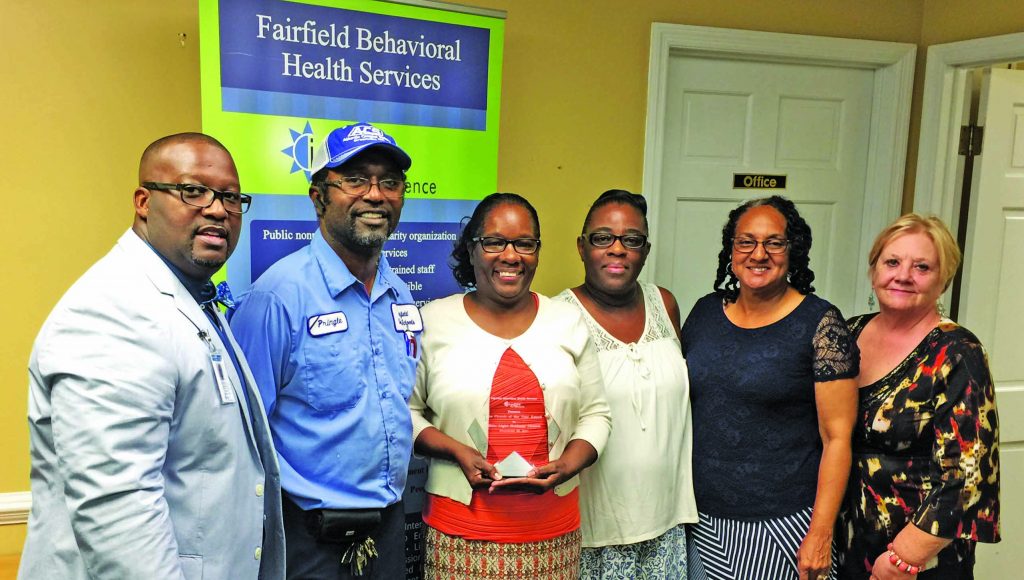
    Vernon Kennedy, Sr., FBHS Executive Director, left, and Rev. Quincy Pringle (FBHS Board Chair) honor Bible Light Holiness Church as the FBHS Church of the Year. Accepting the honors are Jeanette Miller (church FAN coordinator), Jerlean Cook (church FAN committee member), Jannita Gaston (FBHS Board Member) and Virginia Schafer (FBHS Boad Member).

    Rev. Quincy Pringle, Chairman of the Fairfield Behavioral Health Board, second from right, presents the Marion C. Smith Partner of the Year award to County Council in appreciation of annual operational funding, rent-free building and maintenance as well as a $500,000 contribution towards FBHS’s new outpatient treatment facility. Davis Anderson, Jason Taylor and Douglas Pauley accepting.