Blog

  • FCSD Board approves $2.2M loan

    WINNSBORO – Fairfield County school board members are taking out another line of credit, one of many the district has sought to help pay for building and facilities projects.

    At its July meeting, the board voted 6-1 to borrow $2.2 million to fund a variety of building and facilities projects. Board member Paul Hartman cast the lone dis­senting vote.

    Hartman asked for the record to show that she favored using alternative funding sources as op­posed to seeking a loan.

    “I feel like we should use the re­mainder of what’s left over from the calendar year, finishing up than borrowing money,” she said.

    Superintendent Dr. J.R. Green said the bond was necessary be­cause the district has recurring capital needs.

    “You still have to put roofs on buildings. Air conditioners do not last forever,” Green said. “We’ve not had one single year where we’ve not done things to upgrade our facilities. We’re in a much bet­ter place but we aren’t where we need to be yet.”

    Borrowing has become a com­mon theme as of late for the Fair­field County School District.

    In June, the board approved a $5.4 million loan in the form of a tax anticipation note, a short-term

    loan to help the district cover temporary shortfalls until tax revenue starts rolling in beginning in January 2019.

    The board took out a similar note worth $5 million in 2017, according to district documents.

    Two years ago, they approved a $2 mil­lion general obligation bond to renovate Kelly Miller Elementary School.

    And in 2013, the board approved a $20 million bond to help build a new career center, resulting in a tax increase from 24 mils up to 34 mils that the district, at the time, said would only be for two years.

    The loan included $15.6 million for the building, with the remaining $4.4 mil­lion diverted to finance other facility and equipment needs in the district.

    All told, the sampling of loans totals about $29.6 million, according to district documents and reporting by The Voice.

    The most recently approved bond in­cludes a laundry list of various facility projects, with line items ranging from $16,000 to $300,000.

    Interior and exterior LED lighting and bathroom renovations led the list at $300,000 each, followed by $250,000 from bleacher renovations.

    Also included within the $2.2 million is a district-wide contingency fund of $274,000, school board documents show.

    A breakdown of what contingency funds would cover was not available, and Green couldn’t be reached for follow-up comment as of press time.

    The bond itself would take about a year to repay, and debt millage would remain constant at 20.6 mils, according to district documents.

    The interest rate wasn’t immediately available, though board documents state the district could receive a competitive rate through the S.C. Association of Gov­ernmental Organizations (SCAGO), which the district is utilizing to issue the bond.

    “The SCAGO program pools other school district bond issuances, which results in lower issuance costs and potentially bet­ter interest rates due to increased compe­tition for the purchase,” board documents state.

    In addition to quizzing Green about identifying funding sources other than borrowing, Hartman also asked for the amount of the district’s current outstand­ing debts.

    Kevin Robinson, the district’s director of finance, said he couldn’t provide an exact amount.

    “I don’t know the exact amount. We are still paying on the career center,” Robinson said. “That debt has not been extinguished as of yet. And that’s per the schedule that was initially approved.”
  • Taco Bell finds a spot on Blythewood Road

    BLYTHEWOOD – It has been rumored for over a year that a Taco Bell might be coming to Bly­thewood. A public hearing on Monday, Aug. 13, will confirm that rumor.

    An application for the hearing before the town’s Board of Zoning Appeals (BZA) requests a variance to permit a reduction in the width of the buffer transition yards between adjoining commercially zoned lots at 209 Blythewood Road (Richland County TMS# R1-5112-03-01) so that a Taco Bell restaurant with a drive-thru can be built on that lot.

    The permit comes to the BZA after being denied by the town’s zoning official on the grounds that the proposal would be in violation of the town’s zoning ordinance 155.384 (B) (2).

    Town Council amended the town’s zoning or­dinance last year to allow fast food restaurants to have drive-thru service on the front side of the buildings located along Bly­thewood Road between Main Street and I-77.

    For the BZA to grant the variance for the proposed Taco Bell property, the board must find that the ordinance will result in an unnecessary hardship on Taco Bell. The standards for granting a variance, as set by state law, and the or­dinance must meet five facts of finding.

    Before the variance application can be heard by the BZA, a quazi-judicial board, all surrounding property own­ers must be notified by the Town and a public hearing is required.

    Public testimony regarding the vari­ance application will be held at The Manor, at 6 p.m., Aug. 13.

    A public notice of the meeting states that texts and documents related to this variance application are available for public inspection in the office of the Town Clerk at Blythewood Town Hall, 171 Langford Road, Blythewood, South Carolina, during regular work­ing hours, and also will be available at the public hearing.

  • Update: Doko hitch

    Doko Depot

    BLYTHEWOOD – Further de­lays are expected in the closing of the Town of Blythewood’s con­tract for the purchase of the Doko Depot facility.

    Possible defects in title in some of the underlying land have been revealed and the Town is in the process of remedying those is­sues. A portion of the land under contract was originally conveyed to the Blythewood Volunteer Fire Department by Charles W. Proc­tor in 1971. In his deed, Proctor reserved a reversion of title if the property ceased to be used for fire department or other community uses. The same parcel was con­veyed to the Town after the volun­teer service was discontinued but subject to the reservation by Proc­tor. Proctor passed away in 1976 leaving no children. His wife died shortly thereafter.

    The sale of the former Proctor land for uses unrelated to fire or other community use might cause a reversion in title. Town attor­neys are working to find a solu­tion.

    – Mayor J. Michael Ross

  • Element blames closing on tariff

    Smith: It’s crazy… a 25% tariff on the only TV assembler in the United States. County pressing for tariff exemption

    First layoffs for Element Electronics will be Oct. 5. | Callie Sims

    WINNSBORO – Just months after Element Electronics sought the county government’s help to begin looking to expand its footprint and potentially increase employment and tax revenue in the county, the company announced this week that it will be closing.
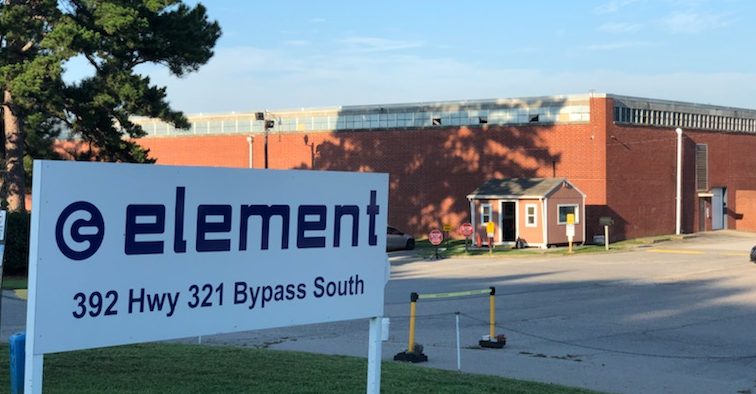
    In a letter issued to employees on Monday, Element’s Vice President of Human Resources, Carl Kennedy, announced that the company would be laying off most of its employees and closing its facility located at 392 Hwy 321 South in Winnsboro.
    “We hope the closure will be temporary and that we will be able to re-open in three to six months,” Kennedy said in the letter. “But we cannot predict this with any certainty at this time.”
    Kennedy said the closing would begin on Oct. 5, when most of the plant’s 134 permanent, full time employees will be laid off. Smaller groups of employees will be separated on a rolling basis from then until the end of the year, Kennedy said. A skeleton crew of approximately eight employees will remain at the facility, according to Kennedy.
    In a separate letter to employees, Mike O’Shaughnessy, Manager of Element, put a finer point on the situation.
    “Our closure is entirely due to ongoing and increasingly difficult tariff related matters,” O’Shaughnessy wrote. “Element, the only U.S. based television assembler, will soon be subject to duties on our parts far in excess of those of any foreign importer.”
    O’Shaughnessy said the tariffs would make it impossible for Element to continue its U.S. production. He said the duty inversions would cause Element’s factory to pay more in duty on its parts than foreign companies would pay on TVs built and exported from Mexico into the United States.
    Fairfield County Council Chairman Billy Smith said officials in the county and Winnsboro were contacted on Tuesday by several national news outlets about the closure. Smith spoke with CNBC Tuesday afternoon. He said he took that opportunity to press for the components imported for Element to be exempt from the tariff.
    “Our goal at this point,” Smith said, “is to bring attention, from the state and local level, to hopefully get the parts used by Element exempted from the tariff. It’s crazy that, first, a new 10 percent tariff and now the threat of a 25 percent tariff is effecting the only television assembler in the United States, while companies that build and import complete televisions from Mexico and other countries are facing zero increase in tariffs,” Smith said. “These companies contribute nothing to employment in the United States. Element has 134 employees and wants to expand.”
    “This is especially hard to swallow when, just a few months ago we [the county] were assisting Element in finding a suitable building to expand its footprint and potentially grow its employee base more than two-fold. That was after the Administration signaled the new tariffs were going to be placed on fully assembled televisions being imported, which would have given Element a leg up on the foreign competition. That isn’t what happened though,” Smith said. “Now this.”
    On July 10, the Trump administration announced a new 10 percent tariff on $200 billion of goods produced in China. Those goods, O’Shaughnessy wrote in a letter to employees, included the LCD panels and motherboards that Element uses.
    Then, last week, the administration announced that it plans to raise that tariff to 25 percent.
    “No tariffs were placed on fully assembled TVs arriving in the US from China or Mexico,” O’Shaunessy said. “This contrast makes it impossible to sustain our U.S. production operations.”
    O’Shaughnessy said, however, that Element’s management had not given up the battle to get back the company’s ability to produce Element TVs in the United States.
    It was in August, 2013 that Element Electronics, a Minnesota based company, announced its plans to relocate manufacturing operations from China back to the United States, tapping the former Perry Ellis Menswear building in Winnsboro as their new home.
    Vlad Kazhdan, vice president of product for Element, said during the announcement that expected the new venture to create 500 new full-time jobs over the next five years.
    Purchase and Lease
    As part of the agreement, Fairfield County purchased the Perry Ellis building from a Perry Ellis subsidiary for $2 million in a deal that closed on Oct. 14, 2013. But the County only ponied up $600,000 for the property, while the Department of Commerce, through an economic development grant, put up $1.25 million. Element, meanwhile, kicked in the remaining $150,000 for the purchase. An additional $50,000 in DOC grant money went toward the cost of upfitting the building, transforming it from a clothing manufacturing center into a high-tech electronics plant. Fairfield Electric Cooperative and SCANA offered to reimburse Element $100,000 each for upfit costs.
    Element leased the property from the County for $1 a year for 30 years with the option to purchase the property for $1 if, by Dec. 31, 2018, it had created at least 500 new, full-time jobs and had invested at least $7.5 million in taxable property; or, if by the same date, Element had created at least 350 jobs, invested at least $5.25 million, repaid a pro rata amount of the grant money and paid to Fairfield County an additional amount based on the following formula:
    400-499 jobs by Dec. 31, 2018 = $120,000;
    350-399 jobs by Dec. 31, 2018 = $200,000.
    Payments were due to the County by June 1, 2019. Element could also continue to lease the property for $1 a year for an additional five years, but must have created at least 250 new, full-time jobs, invested at least $2.5 million by Dec. 31, 2018, and paid to the County $600,000, plus the pro rata grant amount. Failing to have met those conditions, Element could then lease the property at market value, but still must repay the County’s $600,000 investment.
    Fee in Lieu of Taxes
    Manufacturing property in South Carolina is taxed at 10.5 percent, while commercial and other property is taxed at 6 percent. To level the playing field and help attract industry, Tiffany Harrison, Director of Fairfield Economic Development at the time said, local governments often offer as an incentive fees equivalent to the 6 percent rate that companies may pay instead of taxes. Such an agreement is known as a Fee in Lieu of Taxes, or FILOT. Perry Ellis, however, had no such agreement and their property at 392 Highway 321 Bypass N. was listed on the tax rolls. And once a property is on the books, Harrison said, it cannot be removed. Element, therefore, did not qualify for a FILOT on the property itself, but instead was offered by the County an annual tax credit of 42.8 percent for 30 years to bring their contributions to Fairfield County coffers down to the 6 percent level. Like the lease agreement, that tax credit was contingent upon Element creating at least 500 new, full-time jobs and investing at least $7.5 million over the next five years. Otherwise, the credit decreases by the following formula:
    • If, by Dec. 31, 2018, Element has created less than 500 jobs, but at least 400 and invested less than $7.5 million, but at least $6 million, tax credit = 33 percent;
    • Less than 400 jobs, but at least 350 and an investment of less than $6 million but more than $5.25 million, credit = 23 percent;
    • If, by Dec. 31, 2018, Element has failed to create at least 350 new, full-time jobs and has invested less than $5.25 million, the credit agreement terminates and all property taxes shall be paid retroactively.
    Although the building does not qualify for a FILOT, equipment does, Harrison said, and for their equipment Element will pay a FILOT equivalent to the 6 percent property tax rate for 30 years, provided Element has met the 500 job and $7.5 million investment threshold. Otherwise:
    • Less than 500 jobs, but more than 400 and less than $7.5 million, but at least $6 million = 7 percent;
    • Less than 400 jobs, but at least 350 and less than $6 million but more than $5.25 million = 8 percent.
    • If, by Dec. 31, 2018, Element has failed to create at least 350 new, full-time jobs and has invested less than $5.25 million, the FILOT terminates.
    Typical jobs at Element will pay about $12.50 an hour, on average, Harrison said. Element plans to create 250 jobs in the initial phase of start-up. An additional 250 jobs will be added over the course of five years. Element is a main supplier of electronics to Wal-Mart, as well as Target and QVC.

  • McCrorey-Liston cafeteria named for Eugenia Wilson

    BLAIR – More than a hundred people gathered on Friday in the McCrorey-Liston Cafeteria to honor Eugenia G. Wilson for her years of service in the school’s cafeteria.

    School Principal Chandra Bell said Wilson “was the matriarch of the school.” She also recalled Wilson’s oft-repeated mantra – “It’s all about the children.”

    Many of those children, now adults, returned on Friday to witness the naming of the cafeteria for Wilson who began her career as a Food Service worker at the school in 1966 and retired forty years later as the cafeteria’s supervisor. By all accounts, she was beloved beyond measure by the children she fed and by those she worked with at the school.

    Eugenia Wilson accepts a plaque from Superintendent Dr. J.R. Green, recognizing the naming of the cafeteria after her. | Barbara Ball

    In 1979, Wilson received a certification of completion from the National Institute for the Food Service Industry. She also received continuing education credits through Midlands Technical College, Johnson and Wales University and the University of South Carolina. In 1995, she was named Fairfield County Food Service Manager of the Year.

    Bell said Wilson was known for making sure that the students had wholesome, balanced meals, and the students loved the delicious meals she prepared for them.

    “But the students were not the only ones who loved her meals,” Bell said. “About noon, people from all over Fairfield County would start coming through the front door headed to the cafeteria – from VC Summer, from the doctors’ office down the road, our maintenance crew, lined up!”

    Former student Rodney Gibson, like other speakers, recalled “the wonderful food Mrs. Wilson prepared for us – nice warm, creamy grits and fried chicken. But what I remember even more,” he  said turning to Wilson, “was your beautiful, kind smile and humble behavior that you showed us and instilled in us,” Gibson said.

    “The pride she took in her cafeteria work was truly inspiring,” Sandra Conyers, a longtime teacher at the school, said. “I was constantly impressed with her work ethic. Her output was one of a kind. My room was right across the hall from the cafeteria, so you can imagine the wonderful aromas that seeped into my classroom about 10:30 or 11 every morning. No matter what Ms. Wilson and her staff prepared, it was always tasty, especially at holidays – fried chicken, macaroni and cheese, peach cobbler,” Conyers said. “She never disappointed.”

    Wilson’s nephew, Brandon Henderson, now a college sophomore, recalled his first day of kindergarten at McCrorey-Liston.

    “I knew that my Auntie ran that cafeteria back there,” Henderson said, smiling. “During Martin Luther King month in February, she would set up a table for everybody to sit at who had a birthday that month. She made sure I was at the front of the table…and that I had four chicken wings.”

    The audience laughed.

    Wilson’s daughter, Leslie, recalled her mother’s dedication to her work in the cafeteria, her co-workers and to the children she cooked for.

    “She left the house at 5 in the morning, left us still in bed to be at work on time,” Leslie Wilson said. She said her mother and the other cafeteria ladies, also dedicated, arrived at the school before dark and didn’t leave until the end of the school day. It was a time when school meals were prepared from scratch.

    “I have always been proud that my mom was a cafeteria worker,” Wilson said.

    “Mom began cooking at the age of eight. She was the youngest girl of nine children. The others were working in the cotton fields, so as soon as Mom was old enough she was put in the kitchen cooking meals for the family,” Leslie Wilson said.

    Wilson grew up in Blair and, as a teenager, boarded with families in Winnsboro so she could attend Fairfield High School. After high school, she met Aaron Wilson. They were married for 30 years until his death in 1980.

    “Mom always cooked for the love of it. She didn’t want you messin’ with her pots and pans. And if she tells you this is the way she wants it done, then that’s the way she wants it done,” Leslie Wilson said, laughing. “My sister and I were not allowed to cook anything growing up except cornbread and biscuits because Mom said she didn’t have enough food to waste. I guess she didn’t think we could mess up cornbread and biscuits,” she said.

    Leslie Wilson said her mother’s contribution was one of the things that made the school special and recalled her own glory days at McCrory-Liston.

    “Later in life when I’d say there were only 60 students in my graduating class. They’d say, ‘Great!’ and I’d say, ‘Yeah, it was a small, private school,’” she said as the audience laughed and applauded. “Because that’s what it seemed like.”

    After family members took turns speaking and presenting flowers to Wilson, Superintendent Dr. J. R. Green announced that a special plaque emblazoned with ‘The Eugenia G. Wilson Cafeteria’ would be attached to the wall next to a door into the cafeteria. He also presented Wilson with a scrapbook with messages from former students and memorabilia from Wilson’s years at the school.

    Wilson then thanked the audience for their attendance and shared several stories from her years at the school – some poignant, others funny and all heartwarming.

    “I loved the time I worked here at McCrorey-Liston. I loved cooking. I loved my work in the cafeteria, and I loved the children. Everything I did was for them,” Wilson said. “It was all about the children.”

  • Citizens call for audit of Chamber

    Gordge: Chamber Hopes to Continue Visitor Center Funding

    BLYTHEWOOD – Town council has yet to publicly address questions that have been raised recently about the Greater Blythewood Chamber of Commerce’s finances and how it spent thousands of dollars of the town’s A-tax money. However, several citizens who addressed council on Monday night called for an audit of the chamber’s books.

    “I’ve expressed previously that I think we need to audit how the town’s A-tax money is spent [by the chamber],” former councilman Tom Utroska said. “I don’t know whether the allegations about the chamber’s use of A-tax funds made by Mr. [Bob] Massa in The Voice are correct. But he is a CPA and I trust his judgement when he says the numbers don’t add up,” Utroska said.

    “Council needs to look at how this money is spent. You need to request an audit to determine if what was said is accurate,” he continued. “You need receipts, you need check stubs and bank statements. Spreadsheets look good, but they don’t give you documentation to back it up.”

    Utroska told council they are remiss if they don’t get an opinion and understand if [the chamber’s books] are correct or not.

    Cobblestone resident Doug Shay also addressed reported discrepancies in the chamber’s financials.

    “I can remember the chambers in my career were always self-supporting. If we did get money to do a project, we had to report our exact expenses. Reading the articles in The Voice, they [the chamber] are way off,” Shay said. “If [council] gives them more money for anything, there should be an accounting of it, right to the penny.”

    Lenore Zedosky expressed her concern about the town’s funding of the chamber.

    “I regularly attend council meetings and at almost every meetings and at almost every one of those meetings, people question money the town has given to the chamber and where was spent. The financial records have not been available to council in a timely manner and the same ones are asked for over and over again. And, just recently, we received a copy of The Voice and the numbers were appalling, frightening,” Zedosky said.

    “So, I plead with you to require quarterly reports – not a spreadsheet – from the chamber, with receipts attached. Ask for documentation for expenses, line by line, and cancelled checks,” Zedosky said. “And I ask that you cease funding them until such time as you do get this information. I also urge you to ask the chamber to do what council has just done – get a certified audit of their books and get a system set up so they know how much they have spent and where it went. As a citizen of the Town of Blythewood, I urge you to hold their feet to the fire. It’s critically important.”

    In a report published in the July 19 issue of The Voice, CPA and former town councilman Bob Massa said the visitor center, which is run by the chamber and funded by A-tax money, appeared to be little more than a conduit for laundering A-Tax money to the chamber to cover its operating expenses. Massa said the chamber’s operating expenses are not an approved use of those funds.

    In early June, while facing growing criticism for charging a quarter of the chamber’s operating expenses to the $18,500 A-Tax funds the town gave the visitor center last year for a dedicated employee, Switzer increased the amount of operating expenses he was charging to the visitor center from one-quarter to one-third, effectively immediately.

    Town council also funds the chamber with an annual $17,500 grant which a state official told The Voice, does not meet the criteria for a grant because it is designed for the chamber and is not offered to other eligible applicants.

    In May, Council called for the chamber to turn over its complete financial records by June 12. Copies of those documents were subsequently provided to The Voice by two different council members. After reviewing the documents, Massa concluded they were “confusing, lacking in detail and sometimes impossible to follow and understand.”

    On June 25, council voted to stop funding the visitor center after Dec. 31. However, that vote also continued full funding ($9,250 for six months) through Dec. 31. During that meeting there was no specific criticism of the chamber’s financial records by council and council did not set forth any clear expectations for how the chamber was to spend the $9,250. There was no mention of the chamber’s plan to increase the amount it was charging the visitor center for the chamber’s operating costs. Councilman Eddie Baughman said he “wanted to be fair to the chamber,” and not pull the rug out from under them.

    At an earlier council meeting, it was suggested by Ross that the visitor center could be moved to town hall where questions from visitors could be fielded. He said that, with the internet, most travelers now check out events and facilities in a town on the computer before coming to the town, leaving little reason to fund an expensive visitor center.

    However, according to a report last week from councilman Malcolm Gordge, who said he recently met with the chamber’s executive director, Mike Switzer, and newly elected president, Matt Cunningham, the chamber hopes to continue operating the visitor center after Dec. 31 even though council voted to defund it at that point.

    “We will have to find an alternative source for funding,” Gordge told council. “We may continue to explore this. It just depends on where another source of funding comes from.”

    In addition, Gordge said the chamber operatives are now questioning whether the town actually owns the visitor center.

    “It seems it’s not an entity, as such,” Gordge said, “but a service the town provides.”

    Rich McKendrick addressed council later on the agenda, asking Gordge how council could use A-Tax funds to fund something that is not an entity. No one on council responded.

    Gordge said it is difficult to provide direction and accountability for the visitor center.

    “That’s something we need to think about more clearly,” Gordge said, “whether or not the town is responsible for the visitor center or should offer it out to someone else who wants to provide that service.”

  • Governor to attend airport unveiling

    WINNSBORO – It was so dark, a state plane carrying S.C. Department of Commerce Director Bobby Hitt couldn’t land at the Fairfield County Airport.

    Not exactly the impression Fairfield County, a county hungry to land new industry, wanted to leave.

    Now when Hitt and his boss, Gov. Henry McMaster, potentially return in a few weeks for a ribbon cutting on the refurbished airport, the sky and runway beneath it will be much friendlier.

    The Fairfield County Airport will unveil its new look during a ribbon cutting ceremony scheduled for Aug. 20. Airport Director Denise Bryan made the announcement at Monday night’s County Council meeting.

    “Everybody had a part in this project,” Bryan told council members. “For your investment and support of this community, I applaud you.”

    Work began in October 2017 and reached substantial completion in late June.

    The Federal Aviation Administration, or FAA, picked up 90 percent of the tab of the $780,000 total cost, spending $702,000.

    Fairfield County and the state each pitched in with 5 percent, leaving their portions at $39,000 each, Bryan said.

    “We got a $780,000 project done at our county airport for $39,000,” she said. “That’s a spectacular investment and I can’t wait to show you what we’ve got.”

    Bryan invited all council members to attend the Aug. 20 event, which starts at 7 p.m. She said she plans to invite state lawmakers and the governor as well.

    The airport upgrades have been a long time coming. Although signage and pads were refurbished, the absence of adequate lighting was the most pressing problem.

    All lights have been replaced with LED lights, which are more energy efficient. They will also be protected by a series of conduits, which Bryan said would greatly increase their life expectancy.

    During her presentation, Bryan noted poor lighting caused a state plane to be diverted.

    “We had a state plane come in one night, and the [runway] lights wouldn’t even come on,” she said.

    County Administrator Jason Taylor later noted that Hitt was among the passengers on board.

    “I had to hear quite a bit about it [the lights] from him, so I’m glad they’re working now,” Taylor said. “It was not good.”

    Council members were ecstatic to learn of the airport news, especially since the report followed a series of votes and presentations focusing on economic development.

    “When I first came on [council], I went to the airport and saw the conditions,” Goins said. “So I’m excited about what I’m about to see very soon. Very excited about it.”

    “I think it’s fantastic for our county to pay $39,000 and get almost $800,000 in value,” Councilman Dan Ruff added. “As an economic development deal, it’s outstanding. I compliment you on that.”

  • RW lifts ban on overnight parking

    RIDGEWAY – Overnight parking is legal once again in Ridgeway, but only for brief durations and under certain circumstances.

    By a 3-0 vote at its July meeting, the Ridgeway Town Council amended its overnight parking ordinance to allow for overnight parking for up to 48 hours. Town permission is needed for longer periods.

    In October 2017, the council under different leadership enacted the ban, largely due to a sod truck that sometimes parked overnight in the Cotton Yard.

    The town, however, backed up on the ban, opting instead to allow a 48-hour grace period.

    “Additional parking needs to be approved by the police department or town council,” Prioleau said. “In the past we’ve had people go on cruises or family reunions, so sometimes we park a few cars longer than 48 hours, and this [ordinance] would restrict that.”

    Mayor Heath Cookendorfer, who in the past has supported limited overnight parking, said the process Prioleau requested was being built into the amended ordinance. He said anyone wishing to park longer than 48 hours should fill out a form.

    “If after that time frame is up and your car is still there, we’d notify you and say we need you to move your vehicle,” Cookendorfer said.

    In addition, parking longer than 48 hours would be allowed with permission for special events.

    Cookendorfer did say he wanted to restrict how long cars for sale can be parked overnight.

    “In the past, we’ve had cars set up out there [with ‘for sale’ signs] for months on end,” he said.

    Priolieau wanted to allow cars for sale for up to 10 days, which the council approved.

    The July parking debate was substantially more civil than previous parking talks.

    At the October 2017 meeting, discussion grew heated over trailers parked at the Cotton Yard, near where Ridgeway’s former mayor lived.

    And at the June 2018 council meeting, tempers flared between Councilwoman Angela Harrison and Rufus Jones.

    Harrison insisted that Jones abstain from voting on first reading of the ordinance because she said Jones sometimes parks vehicles overnight.

    “I have a picture of it if you would like to see it,” Harrison said.

    Jones declined to recuse himself.

    Other council members expressed concern that residents of Winnsboro and other communities might take advantage of overnight parking in Ridgeway.

    At the June meeting, Cookendorfer said while overnight parking does invite abuse, disallowing it altogether was too restrictive.

    “You do get some people up there putting their car up for sale and abusing it,” Corkendorfer said.

    In other business at the July meeting, the council approved final reading to an ordinance that increases water and sewer rates by 2 percent.

    Originally the town considered 4 percent, but dropped it to 2 percent at the June meeting.

    “Ridgeway has one of the highest rates in the state,” Jones said at the June meeting. “I think we should give that to the community.”

    There was no discussion at the July meeting. The vote passed unanimously.

    In June, the vote passed 4-1, with Harrison opposing because she supported 4 percent. Harrison was absent from the July meeting, as was Jones.

    The Ridgeway ordinance increases resident water rates to $16.58 for the first 1,000 gallons and $5.68 for each additional 1,000 gallons. Residents pay $16.25 for the first 1,000 gallons and $5.57 for each additional 1,000 gallons, according to the town.

    Sewer rates will rise from $13.25 to $13.52 for the first 1,000 gallons and from $5.04 to $5.14 for each additional 1,000 gallons.

    Non-residents will pay $21.93 for the first 1,000 gallons of water and $7.03 for each additional 1,000 gallons.

    Non-resident sewer rates rise to $14.79 for the first 1,000 gallons and $6.22 for each 1,000 gallons, council documents state.

    Commercial water customers will pay higher rates as well.

  • Meals on Wheels in critical need of volunteers

    WINNSBORO – The Fairfield County Council on Aging currently delivers meals to 190 senior citizens throughout Fairfield County every week, and more are waiting to receive the service. But without additional volunteers to deliver those meals, it’s impossible to add more routes and more recipients to the program, according to Angela Connor, Executive Director of the county’s Council on Aging.

    “We’re touching lives one meal at a time,” explained MaryCathryn Wilson, the agency’s Volunteer Coordinator, “but we need help.  Currently, even our staff is serving routes in the Winnsboro area due to a critical lack of volunteers,” Wilson explained.

    Many of the seniors in the program are homebound and live alone, often in isolated areas.

    Linda Branham delivers a meal to 92 year-old Rosalee Peay. | Darlene Embleton

    “It’s not unusual for our volunteer to be the only person they see in a day,” said Conner.   “This daily contact is a large component of what the program is all about.”

    Good nutrition is the key, though.  The meals provided to seniors in the program are nutritionally balanced to meet the 1/3 recommended daily allowance (RDI) for seniors.

    The volunteers help to improve the quality of life for older adults by providing them with services that allow them to remain independent and in their own homes for as long as possible.

    The home-delivered meals program receives funding from a number of sources – the federal government, the state, Fairfield County as well as private donors.  Participants who receive meals may also donate toward the cost of their own meals, but it is not required. All contributions received through the home delivered meals program remain in the program and are used to sustain it.

    The volunteers deliver both hot and frozen meals, depending on the location of the recipients.

    “Strict regulations regarding food safety temperatures determine where the hot meals can be delivered,” Connor said. “We are currently running 10 hot meal routes in Winnsboro, Ridgeway and the Lebanon area.”

    Frozen meals are delivered to outlying areas once a week in boxes of five meals with supplements.

    The volunteers come from all walks of life.

    “We have 3 families who home school their children and use this as their service project,” Wilson said.

    Ridgeway residents Linda and Rodger Branham have been volunteering for years.

    Routes typically take just 45 minutes to one hour to complete and are picked up from the Winnsboro Senior Center at 210 E Washington Street at 10:45 a.m.  Ridgeway has some other arrangements for pick-up.

    “Volunteers can deliver as often as they like or as little as they can,” Connor explained.  “We know that everyone’s time is stretched thin these days, therefore we have availability for volunteering from one hour a month to one hour a day.  Our Volunteer Coordinator will work with each volunteer to help make the schedule as suitable as possible. “

    Helping seniors be able to stay in their own home for as long as possible is a wonderful way to give back to others in our community.

    Volunteers need to be at least 18 years of age and have their own transportation. Those who would like more information about volunteering to serve the meals, can contact MaryCathryn Wilson at 803-635-3015.


  • FCSD salary debate grows testy

    WINNSBORO – Once again questions over compensation arose during the Fairfield County School District board meeting.

    And once again, discussions got thorny at times.

    For nearly 40 minutes, board member Annie McDaniel sparred with Superintendent Dr. J.R. Green and board chairman William Frick over district salaries during the July meeting.

    At one point, McDaniel, who is running for the District 41 Representative in the State House, suggested board recordings of prior discussions had been removed from the district’s website.

    “Normally we have a tape that reflects the full conversation,” McDaniel said. “For some reason, I didn’t see that tape on there today.”

    “Are you insinuating I’m part of some conspiracy now, Ms. McDaniel?” Frick replied.

    At issue was a motion approved during the June 5 meeting that directed Green to develop options in which every employee makes at least $20,000 a year.

    As of Sunday, video of the meeting was viewable on the district’s website. And on that video, the motion the board approved instructed Green to present options that result in every employee making $20,000 a year.

    McDaniel pressed Green for other options at the July meeting. She grew frustrated over Green’s and Frick’s responses that Green was carrying out the board’s instructions to the letter of the law.

    McDaniel also said she hoped to vote to increase salaries that night. Board members said Green’s plan was presented for information only, and no votes were taken.

    “The concern was the sensitivity and the compassion for people making $13,000, $14,000 a year,” McDaniel said. “Whether I asked for a horse ride, a donkey or a monkey jumping upside down, for you guys not to take this seriously, I can’t even come up with the word for it.”

    “The board directed me to present an option, so I presented an option,” Green replied. “I told you from my professional expertise the only way I can do it is to increase the hourly rate.”

    Frick agreed.

    “That was the motion. It was voted upon,” Frick said. “I asked Ms. McDaniel to clarify. The motion was to bring back options to make sure no employees make less than $20,000 a year.”

    Green’s proposal increases starting hourly wages from $10.67 to $15.45 for Salary Class 1010 employees, which includes bus monitors, food service/cafeteria operators and safety officers.

    Class 1020 employees, including custodians, wouldn’t receive raises. They earn $11.67 an hour with zero years of experience.

    Green said the disparity is due to days worked. Class 1010 employees work 190 days while Class 1020 employees work 250 days, which is why Class 1010 employees earn less, he said.

    Because of the disparity, Green and other board members instead supported a comprehensive overhaul of the district’s salary schedule.

    “The only way you can ensure that there is no employee in the district that makes less than $20,000 is to increase the hourly rate,” Green said. “It is not feasible to say we’re going to have every employee work 245 or 260 days. The question would be what they would do for the 245 or 260 days.”

    Board members Sylvia Harrison and Henry Miller chimed in, both expressing support for a comprehensive salary overhaul.

    “I want to see Dr. Green bring an option back where everybody is considered to get a raise,” Harrison said. “I do like the fact that the support staff need a bigger raise, but I’d like to see an option for everybody because they all deserve a raise.”

    McDaniel opposed waiting for a comprehensive salary, saying it would be too time-intensive when employees are struggling to make ends meet.

    “Are we going to just leave this tonight, or are we going to wait two years down the road after we get a salary study, which is a waste of money?” she said. “We’re talking about people making $13,000, $14,000 a year. That is awful.”