Blog

  • Martin: Sheriff’s contract saves Ridgeway $70K a year

    RIDGEWAY – After voting on Aug. 9 to contract with the Fairfield County Sheriff’s office for law enforcement services for the Town of Ridgeway and on Aug. 11 to defund the Ridgeway Police Department, Town Councilman Dan Martin reported that the change would save the Town approximately $70,000 annually.

    “The fact is, we spent $108K on our police department last year. That’s what it cost after deducting the revenue the town took in for traffic tickets,” Martin said. “What we are proposing will be the same or better coverage and will cost us about 39,000 a year.”

    Martin said the town would be getting more police coverage by contracting with the Sheriff’s Department than it had funding its own police department.

    “According to our chief’s own records, he patrolled the town six hours and fifteen minutes per day, on an average of five days a week,” Martin said. Because Culp scheduled longer hours for himself on some of the days, he was on duty only four days during some weeks, Martin explained.

    Martin said that on days/weeks when Culp was away on vacation or training sessions, the town had coverage only from the Sheriff’s department but had no officer on duty within the town.

    “We won’t have this with a contract officer,” Martin said. He said the town would have an off-duty Fairfield County Sheriff’s deputy on duty in the town six hours a day, five days a week every week. He said the Sheriff’s department would continue to provide round-the-clock law enforcement for the town the other 18 hours just as it does now. The on-duty officer would be paid $25 per hour.

    “What we’re doing is equal or better than we have right now,” Martin said. “These off-duty police officers are highly trained, professional men and women who are more than adequately prepared to protect us. No one on this council would allow this town to go unprotected,” Martin said.

    Jones added that small towns are more and more abandoning their police departments for contracted security from county sheriff departments.

    “Blythewood contracts with Richland County, Lugoff with Kershaw County, Jenkinsville with Fairfield County,” Jones said.

    Martin provided The Voice with a list of the some of the biggest expenses the Town had last year in funding its own police department.

    Culp’s total salary expenses – $49K+; office expenses, supplies, equipment, legal and professional – $4,073; utilities – $7,248; fuel and maintenance for two patrol cars – $6,081 and insurance – $10,778. The town recently purchased a new Tahoe for Culp at a cost of approximately $34,000 and there were other miscellaneous expenses.

    There was also the cost of $4,000 for the town to provide court and a judge that are required when the town has a police department.

    “We could use this money in better ways, to provide more and better services to our citizens,” Martin said.

    But Councilman Donald Prioleau disagreed.

    “We aren’t putting the safety of our citizens first,” Prioleau countered. “Chief Culp is a top police officer that raised policing to a professional level and his criminal justice experience is helping to hold down crime. We make three to four times what our foreparents made and they had a police department and we’re getting rid of our police department with the salaries we make today. Let the citizens advise council what they want for safety,” Prioleau insisted. “We’re on the wrong track.”

    “You say we have a great officer. That’s okay,” Martin said. “But what you’re saying is that our officer is better than the Fairfield County Sheriff’s officers. That they cannot do as good a job as our officer.

    “That’s not true.”

    Martin said the contract off-duty officer(s) who serve the town will patrol a mixture of daytime and nighttime hours.


  • Blythewood BZA denies Taco Bell variance

    BLYTHEWOOD – Plans for a Taco Bell with a drive-thru to come to Blythewood Road were doused Monday evening when the Blythewood Board of Zoning Appeals (BZA) denied the company a variance request to enlarge the usable area of the property the fast food restaurant proposed to build on.

    The applicant, BWL Holdings, LLC, represented by Cason Development Group, requested a variance to reduce the necessary buffer transition yard on each side of a lot located at 209 Blythewood Road in the Town Center across from the Waffle House.

    Because the 130 foot x 220 foot property is not wide enough to accommodate the building and a drive thru lane, the variance was requested to reduce the buffer transition yard on the western side of the lot to 3.4 feet and on the eastern side to four feet.

    The Town requires a buffer between adjoining commercially zoned lots in the Town Center District to be a minimum of 10 feet in width, or 7 feet if a wall, fence or berm is used between adjoining properties on both sides and to the rear.

    For a variance to be granted, according to Town ordinance all of the following findings and conclusions in a written order:

    (a)  There are extraordinary and exceptional conditions pertaining to a particular piece of property;

    (b) These conditions do not generally apply to other property in the vicinity;

    (c)  Because of these conditions, the application of the chapter to a particular piece of property would effectively prohibit or unreasonably restrict utilization of the property;

    (d)  The authorization of the variance will not be a substantial detriment to adjacent property or to public good, and the character of the district will not be harmed by the granting of the variance; and

    (e) The effect of the variance would not allow the establishment of a use not otherwise permitted in the zoning district; would not extend physically a nonconforming use of the land; would not change the zoning district boundaries shown on the official zoning map.

    Cason spoke on behalf of granting the variance indicating they had to “skinny up the site plan” due to the dimensions of the site.  One of his suggestions to enhance the narrow buffer zone was a ‘living fence.’  He had some examples to share of hedge plantings used to create borders.

    “This will most likely come back up again,” Darren Rhodes, with Coldwell Banker and the realtor for the sale of the property, said. “It is a unique challenge to fit something on that site,” he told the BZA members.

    Marie Berry said she is a co-owner of the property and represents the other three owners, all of whom she said were longtime residents of Blythewood.

    “It would be an attractive addition to the community and economic development for the community,” Berry said.

    Shelia Finkel, who along with her husband own the dental practice located on the property adjoining the east side of the site, reminded the Board that any decision they make now will come up again.

    “Whatever decision you make will be for all of the town,” she said.

    Stan Harpe, who said he owned the parcel to the west of the property, said the site was too small for the use.

    “I went through the zoning process before trying to get Walgreens,” Harpe said.

    After closing the public hearing, BZA Chair Pat Littlejohn read each of the five findings required to be met for a variance to be granted.

    “There are lots of narrow lots, and shoehorning in this sets a precedent. This would be over-reach,” Board member Ray Fantone said.  He asked Cason if the variance requester had tried to purchase land from the properties on either side.

    “Yes, they have not been able to get land from either side,” Cason said.

    Board member Derreck Pugh commented “that the variance brought up the same issues and they should keep in mind what the Town did before.”

    “What if the live fence dies?  What will we be looking at?” Board member Sharron Pickle asked.

    Board member Marlon Hinds also had some concern about the fence and questioned what if it would change down the line.

    “I don’t feel this is a special case. Not unique,” Hinds said.

    Hinds made a motion to deny the request for a variance to reduce the buffer transition yards between adjoining commercially zoned lots at 209 Blythewood Road for a proposed commercial use. The motion was seconded by Fantone and the Board voted unanimously to deny the request.

    Board member Tom Utroska was not present.

  • Counties differ on animal abusers

    WINNSBORO  – A man convicted of setting a dog on fire is serving a five-year prison sentence, the maximum allowed under state law.

    Another man who dragged a dog with a truck more than a mile didn’t spend one day in prison.

    So what makes these cases different?

    One was prosecuted in Richland County; the other in Fairfield County.

    Hykeem Dontavious Jabar Golson, 23, of Columbia, was sentenced to five years in prison and fined $5,000 after a Richland County jury convicted him in December 2017 of one count of felony ill treatment of animals, according to Richland County court records.

    Golson is one of only two South Carolina defendants to receive the maximum sentence, according to media reports.

    Billy Ray Huskey, 51, of Great Falls, pleaded guilty in July 2016 to dragging a nine-month-old dog with his Dodge Ram pickup truck in Fairfield County.

    Two other dogs were later found emaciated and had to be euthanized.

    Huskey had been charged with ill treatment of animals, torture – also a felony.

    But instead of going to prison, Huskey was allowed to plead to the misdemeanor charge of ill treatment of animals and sentenced to 90 days in prison, suspended to three years of probation.

    Richland throws book at abusers

    The disparity between the Richland and Fairfield cases is representative of how both counties traditionally handle animal abuse cases.

    A recent investigation by The Voice found that of 14 ill treatment of animals cases prosecuted since 2016 in the 6th Judicial Circuit, which includes Fairfield County, very few resulted in actual jail time.

    Often times, defendants either received probation or the cases were nolle prossed, meaning the cases weren’t prosecuted.

    Richland County, however, has quickly developed a reputation for a no-nonsense approach to animal cruelty.

    “Our pets need to be properly cared for and treated with love because they are a part of our families,” Richland County Sheriff Leon Lett said in a news release announcing Golson’s arrest.

    A lot of Richland County’s assertiveness appears to be in allocating resources to combat animal cruelty.

    In 2015, the Richland County Sheriff’s Office founded an animal cruelty task force.

    That year, its founder, senior investigator Holly Wagner, also investigated at least four dog fighting rings, according to a sheriff’s office news release, landing her honors from the American Society for Prevention of Cruelty to Animals and Humane Society of the United States.

    Judicial discretion

    Often times, how defendants are prosecuted hinges on the presiding judge, a point raised during a recent Winnsboro Town Council meeting.

    In June, Police Chief John Seibles told council members that officers have charged several people with cruelty to animals, with some facing felony counts.

    Penalties, however, are set “at the discretion of the court,” Seibles said. Katera Alexander, however, was arrested by a police officer in Seibles jurisdiction and charged with only a misdemeanor after it was discovered that she had tied a pit bull to her porch and starved it to the point that it had to be euthanized by the County’s Animal Control. Seibles’ comments were part of a larger discussion council members were having about proposed revisions to the Fairfield County animal control laws.

    While some Winnsboro town leaders were reluctant to follow the county’s lead, others were open to tougher penalties in more severe cases.

    Councilman Clyde Sanders, for example, said he thinks the town should mirror the county’s $500 fine for cruelty cases.

    “I can’t stand seeing dogs chained in the yard without anything to eat,” Sanders said. “If we catch someone doing that, the fine ought to be high enough to prevent them from doing it again.”

    In the Huskey case, Assistant Sixth Circuit Solicitor Melissa Heimbaugh, who prosecuted, told the Court she thought the state would not win a felony case with the available evidence.

    The presiding judge grudgingly agreed.

    “The State (solicitor) is right, they would have had a high burden to prove your guilt,” Gibbons said. “We have no evidence of intent, so I’m giving you the benefit of the doubt, which I have to do under the law.”

    Huskey faced up to five years in prison, but escaped prison by pleading guilty to the misdemeanor charge. He was also ordered to perform 30 hours of community service and banned from owning a dog.

    “I want to sentence you to the maximum jail time that I can under the guidelines,” Gibbons said. “I’m going to give you not two years of probation but three.”

    Lax laws

    Prosecutorial leniency is one reason most Fairfield defendants have escaped accountability in animal abuse cases, but not the only reason.

    One S.C. House member says South Carolina lags when it comes to meaningful protections for pets.

    “The laws need to be strengthened,” said Rep. Bill Taylor, R-Aiken. “It’s common knowledge that people who torture and abuse other animals are one step away from torturing or harming human beings.”

    In 2014, Taylor introduced a bill that would’ve toughened penalties for animal abusers, making most cases felonies. The measure, however, failed to gain traction.

    That year, though the General Assembly did revise animal abuse laws that cases are now heard in general sessions court versus magistrate or municipal court, where penalties tend to be lighter.

    But it’s not enough, Taylor says.

    “There’s a myriad of bills filed every session about this,” he said. “Very few of them ever get passed.”

    As recently as February, the S.C. Senate introduced a bill, which among other things, tightened anti-tethering laws. The Senate passed the bill, but it died in the House.

    Penalties for violating the tethering law would’ve included up to 90 days in prison and a $1,000 fine.

    The law also required magistrates to receive animal cruelty training and improving shelter standards, but the anti-tethering provisions drew opposition.

    “Serial killers over the years tortured animals at some point,” Taylor said. “These are serious crimes that can lead to other crimes, we need to be serious about this.”

  • Council defunds RWPD and Culp

    RIDGEWAY – After failing on Aug. 9, to finalize a vote to defund its Police Department, the Ridgeway Town Council held a special meeting Saturday, Aug. 11, at 10 am to pass the vote.

    Following executive session at the Aug. 9 meeting, Councilman Dan Martin moved to ‘implement a reduction in force by eliminating funding for the town’s police department personnel, non-personnel and capital expenditures effective Friday, Aug. 10, at 9:01 a.m.”

    Mayor Heath Cookendorfer seconded the motion.

    Before council could vote, however, Councilman Don Prioleau made what he called a substitute motion to call a town hall meeting before defunding the police department. Council, in its confusion, then stumbled into increasingly familiar territory – another parliamentary faux pas.

    “I would call for a town hall meeting where the citizens of the town would be able to help and guide council which way we might proceed,” Prioleau said. “So I offer a substitute motion that would have a town hall meeting for deciding on the police department.”

    A lengthy discussion then ensued on which motion to vote on first and whether or not to vote on the first (Martin’s) motion at all after the second motion failed 3-1.

    At one point, a woman from the audience walked up to the council table, interrupted proceedings and addressed the mayor and council without identifying herself or asking permission to speak.

    “I’m very concerned about something that happened while you all were in executive session,” the woman said as she laid a paper on the council table and pushed it toward the mayor and Prioleau. She then walked back to her seat to the bewilderment of council and the audience.

    Then, without comment, Cookendorfer and Prioleau, returned to bantering over whether to vote on the first motion.

    Finally, Cookendorfer warily accepted Prioleau’s parliamentary tact that the first motion actually won without a vote since the second motion failed.

    Councilman Dan Martin objected to that reasoning, insisting that the first motion still needed a vote. Prioleau prevailed, however, and Cookendorfer announced that the first motion, to defund the police department, passed, 3-1 without a vote.

    Martin then made a second motion to authorize the mayor to sign an agreement of understanding with the Fairfield County Sheriff’s Department to provide law enforcement for Ridgeway.

    “What we’re doing,” Martin said, “is hiring off-duty Fairfield County Sheriff’s deputies to come and patrol our town for however many hours we contract an officer to be here. We will have that officer here to protect the town, and he will not leave during the time he’s on duty,” Martin said.

    “When the contracted officer is not on duty, we will still have the same round-the-clock service from the Sheriff’s department we’ve always had, just like when Chief Culp was not on duty. We still had 24-hour protection provided by the Fairfield County Sheriff’s Department. Plus we’ll have a contracted officer five days a week here in town.

    Councilman Rufus Jones added that Culp would receive three weeks’ pay plus pay for three weeks of vacation upon separation from the Town.

    “It’s a bad day in Ridgeway!” former mayor Charlene Herring, a Culp supporter, shouted out immediately after council voted to adjourn the meeting. She continued to talk loudly as the audience dispersed, but what she said was not clear.

    Armed with advice from the S.C. Municipal Association that the non-vote for the first motion, to defund the police department, was just that – a non-vote, Cookendorfer, on Friday, called a special meeting for Saturday, at which time council voted 3-1 to pass the motion to defund the police department, effectively immediately.


    NOTE: Following the Aug. 9 meeting, The Voice obtained the handwritten note the unidentified woman left on the dias. Titled ‘Evidence of Collusion,’ it stated that Councilman Rufus Jones winked his eye at a person the woman said is well known to be obsessed with causing harm to the chief of police.

    Asked about the wink, Jones said it was a common practice for him to smile and wink at people he knows.

    “Everyone who knows me knows I do that,” Jones said.

  • The Pig Gives Back

    RIDGEWAY – Pig on the Ridge committee representatives Tom Connor and Henry Dixon present a check for $1,000 to the Barclay School to help fund its fledgling program for students who learn differently. Below, they also donated $300 to Geiger Elementary Principal Myra Bramlett for the school’s “Look For The Good Project” that the school implemented for the coming school year.

    Committee members not shown are Don Prioleau and Rufus Jones.


  • Back to School

    BLYTHEWOOD – Marsha Washington, left, and Christine Stoney, kindergarten teachers at Bethel-Hanberry Elementary School, ready their rooms with last minute touches before welcoming their charges on Wednesday, the first day of school for Richland 2 students.

  • Legal loopholes complicate R2 code

    BLYTHEWOOD – It’s being billed as a way to simplify the school district’s procurement code.

    But loopholes in state law could pose legal and ethical complications to the Richland 2 school procurement policy.

    Approved at its July 24 meet­ing, the Richland 2 Board of Education voted to strike a se­ries of policy revisions, includ­ing one that prohibited the dis­trict from doing business with board members.

    “No purchase of materials or services shall be made from any member of the Board,” the stricken measure states.

    Dr. Harry Miley, the district’s chief financial officer, said via email that the probation al­ready exists elsewhere in the board’s policy. He also said the district follows state law.

    “A board member may not provide services or sell prod­ucts to the district or to in­dividual schools,” the policy states.

    “We are undertaking a com­prehensive review and update of all of our policies with par­ticular attention to trying to eliminate places where the same topic is addressed in mul­tiple policies,” Miley said. “We are also undertaking a review of our procurement code to see if there are revisions needed.”

    State law, however, appears to provide an escape route for public bodies whose elected members could potentially be awarded contracts.

    The law states that: “A public official, public member, or pub­lic employee may not have an economic interest in a contract with the State or its political subdivisions if the public offi­cial, public member, or public employee is authorized to per­form an official function relat­ing to the contract.”

    “Official function” is defined in the law as “writing or pre­paring the contract specifi­cations, acceptance of bids, award of the contract, or other action on the preparation or award of the contract.”

    Similar verbiage appears on the State Ethics Commission website. But the law was revised in 1995, with an amendment that appears to allow elected officials to bid on contracts if they don’t participate in awarding the contract.

    “Nor does it [the law] prohibit the award of contracts awarded through a process of public notice and competi­tive bids if the public official, public member, or public employee has not performed an official function regarding the contract,” the amendment states.

    On July 24, Richland 2 board members voted unanimously to approve the revised purchasing policy. There was no discussion of the policy change prior to the vote.

    Miley said during the June 26 board meeting that the changes were made merely to simplify the district’s pro­curement code.

    “We think the policy should be very simple,” he said. “We have a procurement code. We think the policy should state that we adhere to the procure­ment code.”

  • BW still looking to expand ball fields

    BLYTHEWOOD – For at least five years, town council has, off and on, been looking at ways to expand and improve the ball fields available to Bly­thewood baseball and softball teams. While the county made several hundred thousand dollars of improvements to the town’s current (county-owned) ball fields about four years ago, adding new fencing and restrooms, it did not add ball fields.

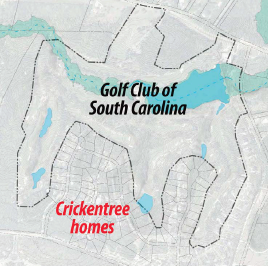
    Golf Club of South Carolina proposed for Blythewood ball fields.

    During council members’ comment time at the July coun­cil meeting, Councilman Bryan Franklin, whose children play on the fields, brought up once again the town’s need for more ball fields.

    “Ten days ago, the last of our Bly­thewood Youth Baseball teams fin­ished their run for the Dixie Youth Little League World Series,” Franklin said. “Four of our teams made it to state playoffs this year. With the help of Town Administrator Brian Cook, we are going to go to the Richland County Recreation Commission with some of our statistics on the last five years and how good our teams have gotten and how badly we need an upgrade of our Blythewood Park fields.”

    Franklin said he had received some communications from Crickentree residents that, since the golf course in the Crickentree neighborhood had gone into foreclosure, it would make a great venue to put some ball fields on the course.

    “I know that’s not in the town lim­its,” Franklin said, “but it’s a great idea. If we can’t get Richland County to move forward with more fields in Blythewood, then maybe we can get them to create a few new fields in some of those open [golf course] spaces,” Franklin said. He said Katie Rummel, secretary of the Blythewood Youth Baseball and Softball League, suggested that youth ball fields might be preferable for those concerned res­idents of Crickentree neighborhood who own property right on the golf course and are worried about homes being built on the course.

    Rummel told The Voice that she hopes the county, as a preventative measure, might buy the golf course property and use it to build a new sports complex for all sports including baseball, softball, lacrosse, football, soccer, etc.

    Franklin said he plans, with Cook, to take some of these ideas to the county.

    Another option for more ball fields, Franklin told The Voice, is the prop­erty where Bethel-Hanberry sits if and when the school district rebuilds the school on property behind the current school building and demolishes the current building.

    “When that happens,” Franklin said, “I would like to see that property used for more ball fields. That would help expand the current overcrowded park.”

    Franklin said he is working on an opportunity to go before the Richland County Recreation Commission and discuss these issues in depth.


    Related:

  • JWC has quorum, no meeting

    JENKINSVILLE – It’s not often that a public body violates the state’s Freedom of Information Act without actually holding a meeting.

    But that’s exactly what hap­pened when the Jenkinsville Water Company refused to re­lease an agenda after cancel­ling Monday night’s meeting, according to open government experts.

    The Voice requested a copy of the agenda as board members shuffled out of the meeting room. Instead of complying, board members said only the chairman is allowed to distribute the agenda.

    When The Voice pointed out that state law gives the board permission, another board member questioned the newspa­per’s intent.

    “If we don’t have a meeting, then why do you need an agenda?” asked board mem­ber Jeral Smith.

    “We don’t have permission,” another board member quipped.

    The Voice requested the agenda to re­port on items of business that the board otherwise would’ve discussed had it met.

    It’s also a violation of FOIA to refuse to provide an agenda when a member of the public asks for one, said Jay Bender, an at­torney representing the S.C. Press Associa­tion.

    “Very clearly, if there’s an agenda, there’s a public record and it’s supposed to be made available with notice of the meeting,” Bender said. “It doesn’t matter whether the chairman thinks it should be released.”

    State law also requires the JWC and other public bodies to post the meeting notice and agenda at its meeting location within 24 hours of the meeting.

    That didn’t happen either, according to an inspection by The Voice.

    It’s unclear why the water company board didn’t hold a meeting. Five mem­bers were present, constituting a quorum of the nine-member board, though chair­man Greg Ginyard and vice-chairman Jo­seph McBride were absent.

    Fairfield County Councilwoman Bertha Goins, a frequent critic of the water com­pany, came to Monday’s meeting.

    Goins said she attended to observe the board. She expressed dismay that board members wouldn’t release the agenda, and lamented the board’s general lack of transparency.

    “Nobody’s documenting anything. There are no facts or policies and proce­dures for anything,” Goins said. “Nothing has changed. It’s the same thing withhold­ing of information.

    “They’re not following state regulations, they’re not reflecting the members,” Goins continued. “It’s irritating. It says you’re not doing the job that the members require of you.”

    In the past five months, the Jenkinsville Water Company has continued to come under fire for transparency issues during virtually every meeting.

    In April, after a lengthy executive ses­sion, the board voted to accept “Items A, B and C” without specifying what those items involved.

    The following month, the JWC didn’t publicize when and where the unsealing of bids to a company tapped to install a new water well. Board members also refused to answer questions about the water usage report at the direction of Ginyard.

    Dee Melton with Broad River Camp­ground sued the JWC in 2014, alleging vio­lations of FOIA. The lawsuit is pending.

    In 2011, the State Attorney General’s Of­fice issued an opinion that the Jenkinsville Water Company is a public body that must comply with the FOIA.

    Also in 2011, the water company faced criminal charges under the “willful viola­tion” provision of the FOIA.

    However, the case died in 2012 when the solicitor’s office declined to prosecute.

  • Hilton’s Home 2 Suites eyes Blythewood site

    A new hotel brings site plans to Blythewood Planning commission.

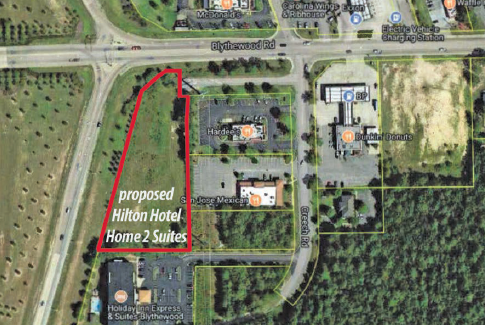
    BLYTHEWOOD – Hilton Hotel’s Home 2 Suites is considering putting down roots in Blythewood. The hotel’s owners are seeking permission from the Town to build a four-story, 88-bed hotel building on a 1.93 acre vacant lot adjacent to the I-77 ramp. But without considerable adjustments to the entrance to the property, the 55,672 square foot building would have no direct access to Creech Road.

    The parcel is tucked between I-77, the Holiday Inn Express & Suite, Hardees and San Jose’s Mexican restaurant. A site map shows access to the parcel off Creech Road across from the west side of the Sharpe BP Service Station.

    But that access doesn’t meet SCDOT standards.

    Civil Engineer Jeff Carter, of Georgia-based Carter Engineering Consultants, presented Paragon Hotels’ plans to the Blythewood Planning Commission Mon­day night.

    Consensus of the Commission members was that it is a good project for Blythewood but the access is problematic.

    Commission Chair Donald Brock ad­dressed the lack of a traffic study and said traffic access to the site presents problems.

    “Ingress and egress to the site is a prob­lem,” he said. “I see that the right-in and right-out onto Creech Road is going to send everyone down a dead end street. What are drivers supposed to do when they get there and have no place to go?” Brock asked.

    Town Administrator Brian Cook said staff has been working with SCDOT on this issue, and that SCDOT has conditionally granted access to the site using SCDOT’s right-of-way.

    “The existing service road would have to be removed and replaced to enable two-way traffic,” Cook told the commissioners. “The access road would need to be a mini­mum of 24’ wide with an appropriately designed connection to Creech Road so as not to negatively impact Creech Road or Blythewood Road which is directly adja­cent,” Cook said.

    Cook said the design would need to in­clude proper radii and an approximate median enforcement to satisfy the SCDOT requirement that this access be a right-in, right-out due to the proximity to Bly­thewood Road.

    Carter expressed his concern that even after doing a traffic study the options would still be very limited and driven by what SCDOT would allow. He said he felt that the developer would agree to install­ing a turnaround at the end of Creech Road where it dead ends.

    Councilman Rick McKenrick asked Carter whether the hotel owners were considering buying additional lots around the site to improve the traffic pattern. Carter said he felt they are still considering that possibility.

    Councilman Marcus Taylor cited the ex­treme traffic problems that already exist on Blythewood Road during high traffic times and said this would significantly add to the problem.

    After lengthy debate and persistent ad­monition by Brock that even conditional approval would not be the best way to proceed, a motion was made to defer the agenda item until the Sept. 4 Planning Commission meeting. The motion was seconded and all council members voted in favor of deferral.

    Cook told the commissioners that he would continue to work with SCDOT and the engineers to address the traffic pattern concerns.

    Blythewood Consultant Michael Criss announced that his services to the Town would end on Aug. 31, 2018 and expressed that he had enjoyed working with the Commission members.