Blog

  • Fairfield cruelty law not updated for 11 years

    WINNSBORO – It’s perfectly legal to abandon hunting dogs in South Carolina.

    It’s also technically legal to kill a dog when it is threatening or causing personal property damage.

    And perhaps most troubling to animal rights advocates, state law doesn’t automatically ban convicted animal abusers from owning pets in the future.

    These deficiencies and others in state and local laws help explain South Carolina’s poor ratings in a pair of national reports that rate how well the state regulates animal cruelty.

    Two reports – one by the Animal Legal Defense Fund and the other by the Humane Society of the United States – rank South Carolina in the bottom tier when it comes to protecting pets.

    Deborah Richelle, former president of the Hoof and Paw Benevolent Society, a Blythewood-based organization that has been lobbying for stronger animal abuse laws, isn’t surprised.

    “We’ve been trying locally for the past four years to get something done about their ordinance, because it is so antiquated,” Richelle said.

    It’s been nearly 11 years since Fairfield County last updated its animal control laws, according to the Fairfield County government website.

    The animal cruelty and abandonment provisions are codified in Ordinance 321, the website states. Enacted in October 2007, the law essentially mirrors state law at the time.

    Animal cruelty provisions are limited to two paragraphs. Four more paragraphs are devoted to animal abandonment.

    For years, Hoof and Paw have been lobbying Fairfield County to update the 2007 law, and are currently working to draft a new one.

    In June, the county presented an early draft of a revised ordinance to the Town of Winnsboro, which dismissed it as excessive. Progress since then has slowed.

    Three months later, the ordinance still hasn’t received a vote

    Council Chairman Billy Smith said his preference remains with increasing enforcement, not legislation, though he does hope some revisions can receive a council vote sometime this fall.

    “I think law enforcement is doing their job,” Smith said. “I just don’t think the follow through has occurred on the prosecutorial level.”

    Smith added that he’s open to toughening laws relating to tethering of animals, but doesn’t support automatic bans on pet ownership for offenders. Nor does he support granting civil immunity to veterinarians who report suspected animal abuse.

    Advocates look to Aiken

    As Fairfield County continues working on its animal control ordinance, Hoof and Paw representatives think the county needs better laws, pointing to communities such as Rock Hill and Aiken as examples.

    Both cities have revamped their animal cruelty laws. Aiken most recently adopted new standards relating to tethering in March, said Tim O’Briant, city spokesman.

    Aiken’s ordinance says animals can only be tethered for a maximum of 13 hours. The tethering cap shrinks to 15 minutes during severe weather.

    The law also includes new regulations regarding animals locked inside motor vehicles during extreme heat or cold.

    “This was added to provide more definable criteria for our Public Safety to have when addressing these situations,” Aiken City Manager Stuart Bedenbaugh said in a memo.

    Kathy Faulk, community outreach director for Hoof and Paw, and a Fairfield County resident, thinks the county should adopt similar regulations, but expressed concern about slow progress.

    “I’ve begun to feel this has landed on deaf ears,” Faulk said. “The sheriff is doing better about bringing charges, but it gets to the solicitor’s office and it’s pled.”

    Recently, Hoof and Paw adopted a list of bullet points it thinks should be incorporated into any revised ordinance.

    Leading the list are tighter restrictions on tethering. Hoof and Paw recommends capping tethering to four hours, which is shorter than the City of Aiken limit, but also matches Aiken County’s law.

    Other wish list items include:

    • Require all dogs and cats to have proof of rabies vaccination and be registered with the county.
    • Greater punishment for animal abuse and neglect
    • Law enforcement and solicitors need to be committed to punishing animal abusers appropriately.

    Richelle, the former Hoof and Paw president, said in the end there must be accountability for offenders.

    “If you know somebody and you’ve done something bad to an animal, nine times out of 10 you can get out of it,” she said.

    Chicken and the egg

    Another reason for the state’s weak animal cruelty laws boils down to ownership of the issue.

    State lawmakers often punt animal cruelty legislation to local governments, viewing the issue as a local matter.

    But local leaders, including Smith, the Fairfield County chairman, think the state should take the lead.

    “I’m trying to take a step forward, but not necessarily a leap or jump,” Smith said. “That would be my preference.”

    Rep. Bill Taylor, R-Aiken, who’s previously filed bills to strengthen animal cruelty laws, said some lawmakers are adamantly opposed to stricter regulations of any kind, including an anti-tethering bill that died in the last session.

    Other legislators, he said, hunt in their private time and view hunting dogs as property instead of companions.

    “They come at it from a different perspective than those who own dogs as pets,” Taylor said. “They tend to look at things differently.”

    “I don’t know the exact source of all the problems with that [tethering] bill, but there were clearly people who didn’t want it to move forward,” Taylor added. “There were people in leadership positions who wanted that bill derailed.”

    Richelle agreed.

    “They just don’t pay attention to us,” she said. “It’s like ‘this is what grandpa did, so we’ll keep doing what grandpa did.’”

    South Carolina’s deference to hunting is evident in the state’s existing animal abandonment law.

    Animal abandonment carries a fine of $200 to $500 and up to 30 days in prison. Fairfield County’s ordinance stipulates that cases must be tried in magistrate court.

    The penalty for animal abandonment doesn’t apply to owners of hunting dogs, however. Hunting dogs are specifically exempt from the statute, which says animals should be provided with adequate food, water and shelter.

    Weak laws and loopholes

    South Carolina cruelty falls under Section 47 of state law and includes three basic offenses – ill treatment of animals (misdemeanor), ill treatment of animals (felony) and animal abandonment.

    But lines are blurred between what distinguishes felonies and misdemeanors.

    Generally speaking, animal cruelty cases resulting in death qualify as felonies. Torture, mutilation or inflicting “unnecessary pain or suffering” are additional conditions listed in the law for felony charges.

    The misdemeanor ill treatment charge is more vague, merely stating that anyone who “overloads, overdrives, overworks, or ill-treats an animal, deprives an animal of necessary sustenance or shelter, or inflicts unnecessary pain or suffering” is guilty of a misdemeanor.

    A felony conviction carries up to five years in prison and a $5,000 fine, though virtually none of the Fairfield County cases reviewed by The Voice since at least 2013 have resulted in the maximum penalty.

    The last known case regionally when a defendant received the maximum penalty was in December 2017, when a Columbia man was convicted of setting a dog on fire in Richland County.

    More loopholes and ambiguities exist elsewhere in state law.

    For example, killing a dog that’s identifiable carries a fine of $500 to $1,000 and between 30 days and six month in prison.

    It’s a stronger penalty than the misdemeanor ill treatment of animals charge, but weaker than the felony.

    Penalties, however, don’t apply “to the killing of a dog threatening to cause or causing personal injury or property damage,” the law states.

    S.C. ranks low in reports

    The Animal Legal Defense Fund’s 2017 report ranked South Carolina 39th among 56 states and U.S. territories surveyed, placing the state in the bottom tier.

    South Carolina ranked 38th in 2016.

    “ALDF’s goals in these ongoing reviews are to continue to shed light on the important issue of animal protection, to compare and contrast the differences and similarities in these jurisdictions and to garner support for strengthening and enforcing animal protection laws throughout this country,” the report states.

    In a separate report by the Humane Society of the United States, South Carolina ranked tied for 43rd with Wyoming, placing both states just outside the bottom five states.

    The Humane Society report did note that in 2017, South Carolina “severely restricted the keeping of big cats, bears, and great apes.” Otherwise, the state’s ranking could have been even lower.

    South Carolina’s lackluster showings are consistent with findings of an investigation by The Voice, which found that virtually none of the 15 cases prosecuted since 2015 ended in jail time for offenders.

    Most cases were either plea bargained, resulting in probation, or dismissed outright, court records show.

    “Perpetrators of the most unthinkable violence against animals deserve more than a slap on the wrist,” Lora Dunn, director of the Animal Legal Defense Fund, stated in a news release. “Sadly, many cruelty cases go undetected, hidden from view.”

    Building better laws

    So what traits exist in strict animal cruelty laws?

    The top five states – Illinois, Oregon, California, Maine and Rhode Island – generally ranked high in the following categories identified by the Animal Legal Defense Fund:

    • Adequate definitions/standards of basic care
    • Increased penalties for repeat offenders
    • Courts may order forfeiture of abused animals
    • Mandatory forfeiture of animals upon conviction
    • Mandatory reporting of suspected cruelty by veterinarians
    • Mental health evaluations/counseling for offenders
    • Broad range of felonies for abandonment, neglect and abuse.

    States that ranked poorly lacked many of these protections.

    Kentucky, which finished dead last in the report, actually prohibits veterinarians from reporting suspected animal abuse.

    Most low ranking states do not mandate the surrender of abused animals, and penalties do not increase for repeat offenders.

    South Carolina does give veterinarians immunity from civil litigation when they provide emergency care to an abused animal. But state law does not grant civil immunity for reporting cases of abuse.

    The state also doesn’t require convicted animal abusers to surrender their animals, though judges can set that condition. And they have.

    In sentencing Billy Ray Huskey, 51, of Great Falls, for dragging a dog with his pickup truck in July 2016, Circuit Judge Brian Gibbons banned Huskey from owning a dog during his probation period.

    A year later, Judge Gibbons issued a similar order against Christopher Pauley of Ridgeway, who was charged with torturing and killing a cat. He was sentenced to 90 days, suspended to three years probation.
  • In Memory

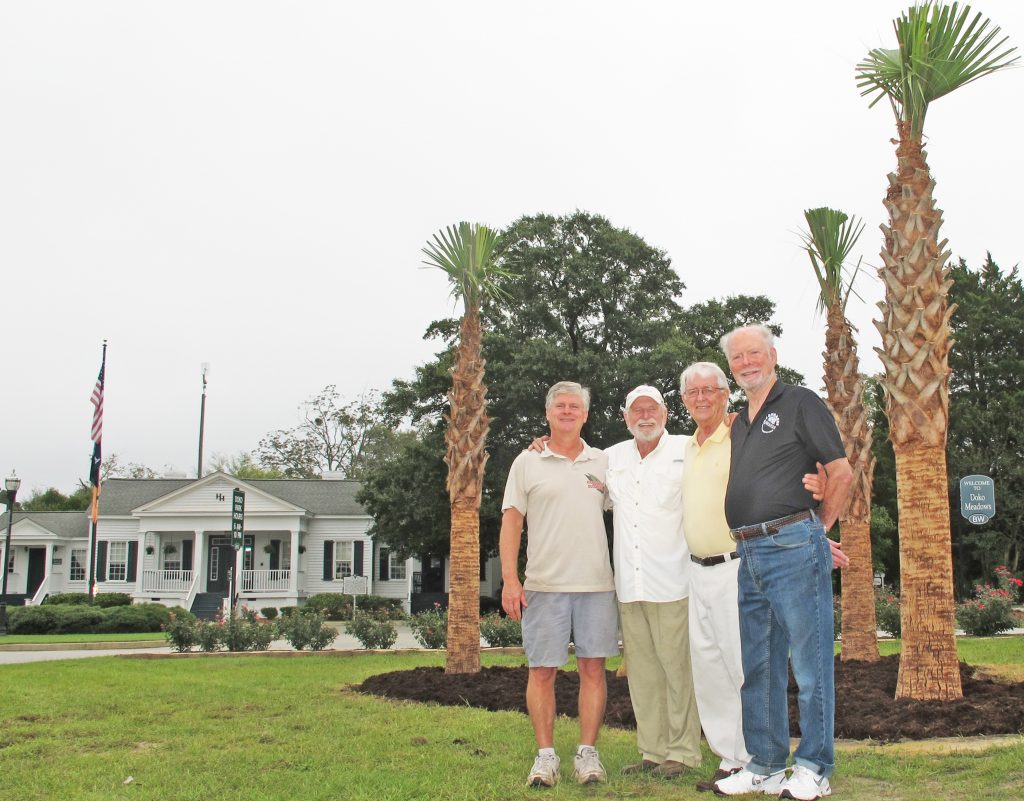
    BLYTHEWOOD – Three palm trees planted at the entrance to Doko Meadows Park last week were donated by Glenn Cooper, left, in memory of his father, Ralph Cooper, Jr. (1930 – 2017); Harold Branham in memory of his mother, Pauline Branham (1920 – 2018) and Jim and Tom Mclean in memory of their brother, Hudnalle (Hud) McLean, Jr. (1934 – 2018). A dedication ceremony will be held later this fall.

  • North Interrupted

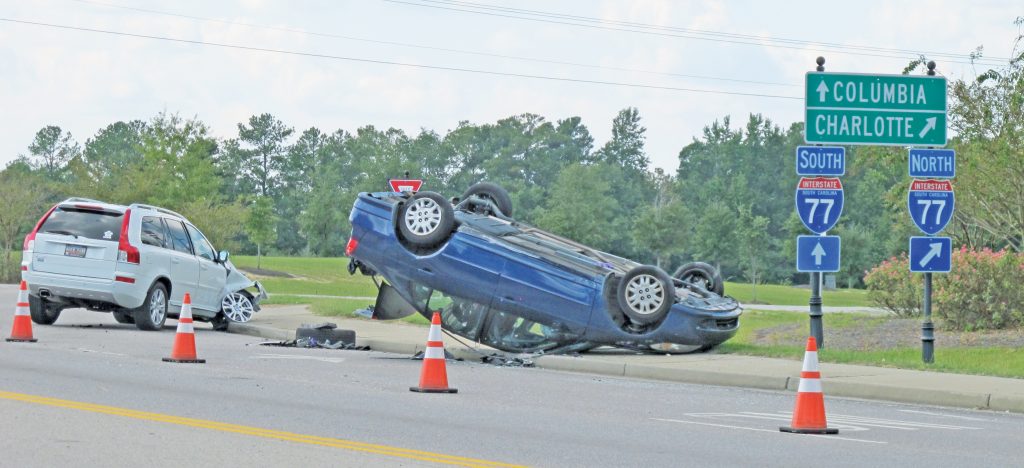
    BLYTHEWOOD – No serious injuries were reported after cars driven by two women, ages 18 and 26, were involved in an accident about 1:30 p.m., Saturday, on Blythewood Road at the north-bound entrance to I-77.

  • Mainstay Senior Living expands


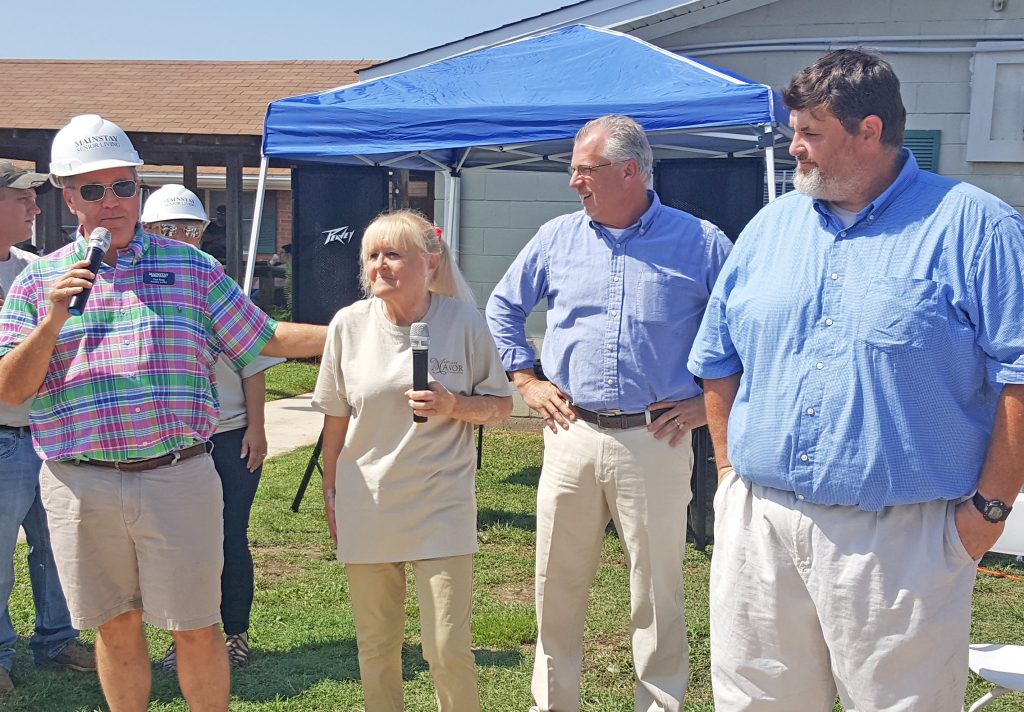
    Opening the Mainstay Senior Living barbecue festival are President and CEO Tod Petty, left; Frances Mattox, Admissions and Activity Director; Ridgeway Town Councilman Dan Martin and Ridgeway Mayor Heath Cookendorfer. | Photos: Darlene Embleton

    RIDGEWAY – Tod Petty, President and CEO for Mainstay Senior Living, says his company is all about southern hospitality. As the new owner of Ridgeway’s former Fairfield Manor Assisted Living location at 117 Belfield Road, he showed that he knew what he was talking about when he feted his staff and the residence’s seniors with a barbeque festival last Saturday.

    Frances Mattox, Admissions and Activity director for Mainstay introduced Ridgeway’s Mayor Heath Cookendorfer and Council member Dan Martin, and the Mayor welcomed Mainstay officials on behalf of the Town.

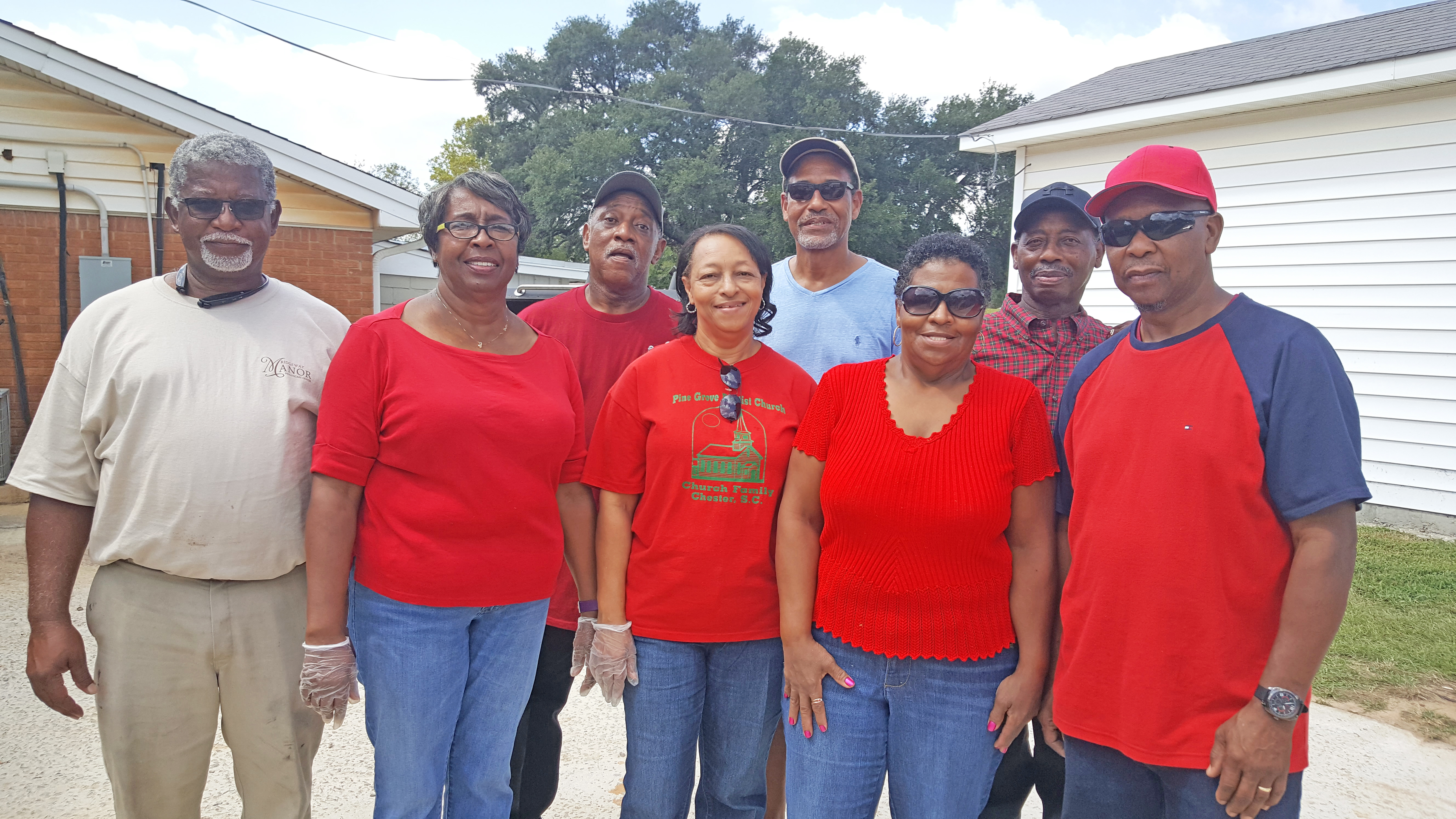
    The day was filled with entertainment that included the Freedom Dancers, antique and classic cars and barbecue cooked by Dwight Robinson and served by his seven assistants.

    Site renderings were on display of an expansion planned for the facility.

    “We have an amazing group of contractors who work with us on improving existing locations. They allow us to create an affordable venue. Here, we have already reworked the asphalt in the front and upgraded the landscaping. We are in the process of repainting the building, fixing the roof and bringing in a full time therapist and 26 fully electric beds for our residents.

    “It will be a great venue for long term care”, Petty said.

    The new expansion will bring Mainstay up to 112 beds.

    Barbecue pit master Dwight Robinson and his cook crew, all classmates who graduated high school in 1971, served up barbecue to the residents and guests. From left: Robinson, Delores Squirewell, Larry Bell, Nadine Boyd, Elijah Squirewell, Linda Gaither, Melvin Peay and Larry Young.
  • Residents want dilapidated houses removed

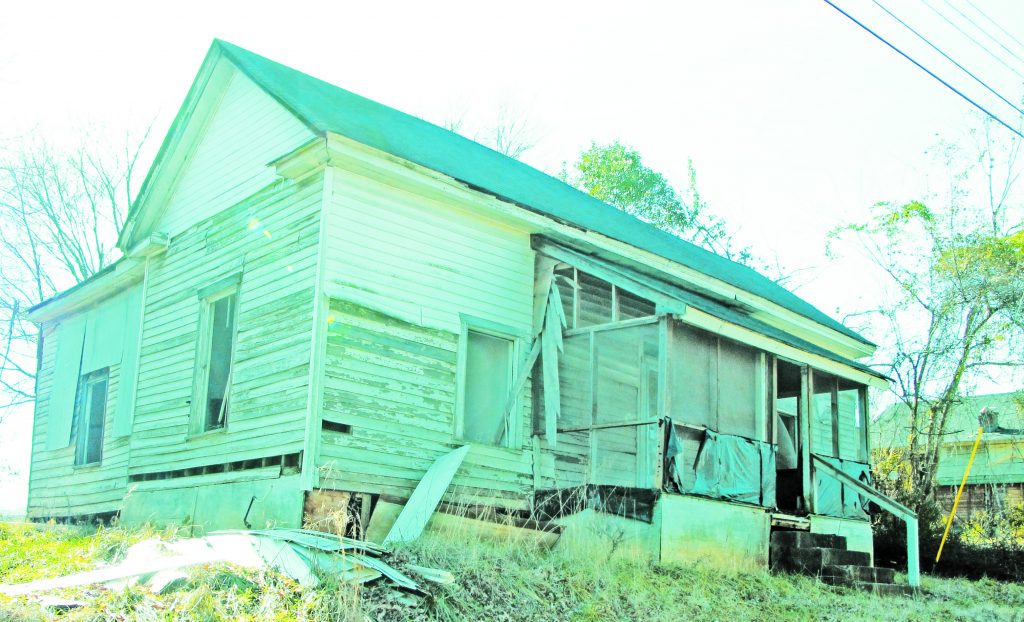
    The above home is one of many abandoned on Cemetery Street. | Barbara Ball

    WINNSBORO –  Distressed properties have Winnsboro resident Yvette Howard feeling well, distressed.

    For more than a year, Howard has been voicing her concerns about abandoned and dilapidated housing in the vicinity of Cemetery Street and Davis Circle. She again voiced those concerns at the Sept. 4 council meeting.

    “Four years ago, letters went out to property owners to comply with the town codes,” she said. “Some of the absentee property owners are local people who can be easily located.

    “However, the codes are not being enforced equally to all citizens down on Cemetery Street,” Howard continued. “We have to get people to clean up their lots, whether they have the money or not, somehow get them to abide by the town codes.”

    A Google Street View tour of the neighborhood shows some homes with clean facades and freshly cut grass.

    Other properties, however, are boarded up or have weeds overgrowing the fence line. Several cars can be seen parallel parked along the narrow streets.

    Council members didn’t specifically have any conversation about dilapidated houses after the public comments, and in a telephone interview Tuesday, Councilman Clyde Sanders said he sympathizes with Howard’s plight.

    But Sanders said addressing the issue is a slow process, noting that sometimes after one home is brought into compliance, another falls into non-compliance.

    He also said state law has very specific rules on the books governing how nuisance properties can be handled.

    “The thing that makes it stand out in Winnsboro is that it’s concentrated in a small area, so it stands out more than it would in Columbia or Myrtle Beach,” Sanders said.  “Every town or city has dilapidated houses. We’re doing everything we can, we’ve identified a lot of them, or a majority of them, and we’re doing everything we can to get them taken care of.”

    Public Safety Director John Seibles couldn’t be reached by telephone Tuesday.

    At the Sept. 4 meeting, Seibles delivered a report that said the town received 21 complaints in August.

    No citations or building demolition permits were issued, though the report said many of the violations involved abandoned homes and vehicles.

    The report listed several bullet items referencing various property owners with whom the town is working.

    One item noted that an illegal scrap metal business was found operating on Columbia Road. The town issued the business a warning to cease doing business in a residential area.

    “There had been several complaints from residents about the noise and visual appearance of a gas tank machine and scrap metal,” town documents state.

    Abandoned and distressed homes have become a statewide issue.

    Greenville, Rock Hill and Clemson in recent years have enacted strict laws addressing dilapidated structures.

    Clemson, for example, requires owners choosing to rent their properties to live within a 75-mile radius of the home to more closely monitor it. The City of Aiken recently considered a 45-mile radius requirement in a proposed rental registration ordinance, according to city documents.

    Sanders said the issue in Winnsboro mainly involves local residents who, after passing away, bequeath their homes to relatives. Tracking heirs is tricky.

    “The ones that are local are more willing to work with us,” Sanders said.

    Other homes are tied up in legal proceedings.

    Manpower is another issue.

    At the council meeting, Howard quizzed members about whether a full-time code enforcement officer will be hired soon. She noted the current code enforcement officer works part time.

    “I would like to know if any progress has been made on this,” she said.

    Rock Hill employs five code enforcement officers. The city also dedicates $100,000 to a fund dedicated to demolishing boarded buildings.

    Sanders said demolishing buildings is costly, estimating the cost at between $10,000 and $20,000 per home.

  • R2 Board extends Super’s contract

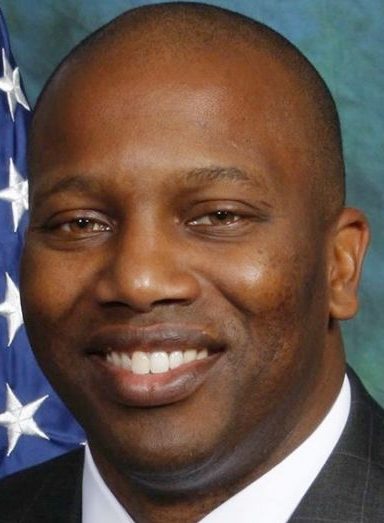
    COLUMBIA – On Tuesday, Sept. 18, 2018 the Richland School District Two Board of Trustees met to conduct the superintendent’s performance evaluation for Dr. Baron Davis.

    Davis, Superintendent for Richland School District Two,  was given an overall distinguished evaluation for the 2017-18 school year, his first year as superintendent of the district, by the School Board, it was announced at Tuesday evening’s school board meeting.

    Board Chair Amelia McKie also announced that the board approved a motion to extend Davis’ contract with the district by one year, to June 30, 2021, and to increase the contribution to his annual annuity by 2.5 percent effective Sept. 30, 2019.

    Board members assessed Davis’ performance in the areas of policy and governance; planning and assessment; instructional leadership; organizational management; communications and community relations; and professionalism.

  • Brandon Wilds called up by Jaguars

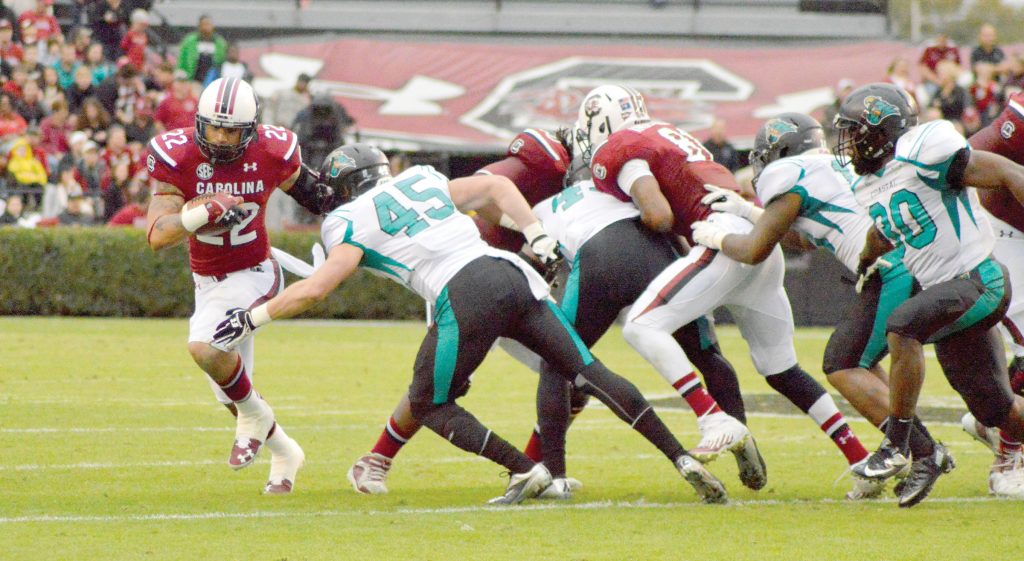
    Brandon Wilds (22) showing a glimpse of what made him a star at Blythewood and the University of South Carolina.

    JACKSONVILLE, FL – Leonard Fournette was a stellar collegiate football talent at LSU and was the fourth overall pick by the Jacksonville Jaguars in the 2017 draft. However, Fournette went down with a strained hamstring in the opening week of the 2018 season, and this opened the door for Blythewood native Brandon Wilds to be activated from the Jaguars’ practice squad.

    Wilds, a former PrepStar All-American and North-South All-star, was a running back for the Bengals from 2007 until he graduated in 2011, and he had superb career at Blythewood. As a junior, he became the first player in school history to accumulate 1,000 rushing yards in a single season. He finished his junior year with 1,551 yards and 20 touchdowns.

    He followed his stellar junior season with another strong season the following year. Wilds tallied 881 yards and eight touchdowns in his senior year. After his Blythewood career was said and done, he had racked up 500 carries for 2,700 yards and 29 touchdowns.

    He was ranked a three-star prospect and the 29th best player in the state by Rivals.com coming out of high school. Scout.com slated Wilds as the 115th running back in the country and also named him as a three-star prospect.

    East Carolina, Illinois, Arkansas and Maryland were among the major universities that showed interest in recruiting the tough running back. Eventually, Wilds elected to take his talents to the University of South Carolina and play for Steve Spurrier.

    Wilds was listed as the fifth running back on the Gamecocks’ roster heading into his freshman season in 2011, but team injuries allowed him to make an immediate impact. He started five games as a true-freshman and ran for over 147 yards against the University of Tennessee, 120 against Florida and hung 109 on the Citadel. His 486 rushing yards in his freshman season were good enough for the third highest total on the team.

    A high-ankle sprain led to Wilds being red-shirted in 2012. He kicked off the 2013 season by earning the Joe Morrison Offensive Player of the Spring at the Garnet and Black game. Despite the positive spring performance in sophomore year, he had to fight through injuries most of the 2013 season and only started two games.

    Wilds had a much better season in 2014, finishing second on the team in total rushing with 570 yards on 106 carries with four starts in 12 appearances. He had a 24-yard, game-winning touchdown that season to knock off the number-six ranked Georgia Bulldogs, and, in a game against Auburn, he became the 42nd Gamecock to ever amass 1,000 total rushing. His 143-yard performance against Tennessee that year turned out to be a career-high, and he also had a career-long 70-yard touchdown in the same game.

    The 2015 season was a big one for Wilds. He led the team in rushing in his senior year with 567 yards in nine starts and was invited to play in the National Football League’s Player’s Association Collegiate Bowl. He finished his Gamecock career as the 20th leading rusher in school history with 1,844 yards and piled up seven 100-yard rushing games.

    Wilds was not selected in the 2016 NFL Draft, but quickly signed a free agent deal with the Atlanta Falcons. He had 26 yards on 10 carries and one touchdown in his NFL preseason debut against the Washington Redskins. The following week against the Cleveland Browns, he had 49 yards on eight carries and a 32-yard touchdown. Shortly after the Browns game, Wilds was waived by the Falcons.

    After his release from the Falcons, he signed to the New York Jets practice squad and got his first shot of regular season action in late 2016. His first regular season game was against the San Francisco 49ers in December, and he had four yards on two carries. He played again a couple of weeks later in a loss to the New England Patriots, but was waived the following offseason.

    Wilds had a short stint with the Cleveland Browns after his Jets’ tenure, but injuries prevented him from seeing any playing time. He signed to Jaguars practice squad on Oct. 9, 2017. He will wear no. 34 for Jacksonville.

  • Green, Douglas spar over millage

    WINNSBORO – They came to tout their successes as governmental agencies.

    But an emerging kerfuffle over the distribution of property tax revenues quickly became the focal point at a Fairfield County intergovernmental meeting Monday.

    At the previous week’s council meeting, Councilman Jimmy Ray Douglas publicly called out the Fairfield County School District, saying that the district had improperly collected more than $11 million in tax revenues.

    Douglas said inflated millage rates attributed to the school district overages. He noted that the windfall is on par with the $11.5 million price tag associated with renovating the old Mt. Zion institute to serve as a new Fairfield County Administration building.

    “Fairfield County can’t support and pay for the new office complex at Mt. Zion if we can’t control the extra money the school system has been taking from the county funds,” he said. “Since 2012, someone in the school system has secured $11,198,389.90 over the 9.9 school debt millage they should have received.”

    District superintendent Dr. J.R. Green vehemently denied any improper tax collections. Green spent about 10 minutes Monday refuting Douglas’ claim.

    “The suggestion the school district is taking the county’s money is not grounded in fact,” he said. “When you start making suggestions that people are doing things illegal or unethical, that challenges and ques tions someone’s integrity.”

    Other county officials were reluctant to weigh in. County Administrator Jason Taylor deferred comment to Council Chairman Billy Smith. Smith said he understood why Dr. Green defended the district’s position, but stopped short of staking a position on Douglas’ claims.

    “It’s not an issue council is discussing or addressing in any way. It’s just an issue that a councilman raised,” Smith said. “I don’t see anything happening next unless Mr. Douglas develops a compelling argument to get enough people behind him for us to move forward.”

    Douglas said the windfall is the result of a series of millage errors dating to at least 2012.

    A year later it leaped to 32 mils, where it remained for two years. Those are the years following a school board vote to issue a $20 million bond to build a new career center.

    At the time, the bond included $15.6 million for the career center, with the rest reserved for miscellaneous facility and equipment needs.

    Originally the bond called for an increase to 34 mils, but in actuality it only rose from 9.9 mils to 32 mils. Millage then trickled to 23.6 mils in 2015, and then 20.6 mils in subsequent years, according to county tax documents.

    Green said the district was able to issue the bond without a referendum because it met criteria that said local governments are allowed to issue bonds up to 8 percent of the assessed value of all taxable property in the county.

    He also said the debt would be retired in 2025. Debt service would revert to 9.9 mills at that time.

    In a telephone interview Monday, Green said it was always the district’s intent for debt service millage to gradually reduce until the debt is retired.

    The Voice reported in 2013 that the debt service millage would increase for two years before dropping back down.

    “It [millage] is down further than we thought it would come down,” Green said. “It’s not as if you can pay for the career center in two years.”

    Douglas, however, maintains the district is reaping a windfall.

    In an interview with The Voice, Douglas said he was informed by the county treasurer’s office that the district has received $175,000 in the past month alone from the county. He wrote in a memo to Taylor, the county administrator, that he thinks the district isn’t allowed to raise millage.

    “State law gives the school system the right to increase millage by 3 mils each year or the cost of living increase, whichever is the least amount,” the note reads. “The millage cannot be increased at a larger amount without the Fairfield County Council’s approval.”

    Green said Douglas is conflating operating millage and debt service millage. He noted the 3 percent rule Douglas cited refers to operating millage, not debt service millage.

    “People are conflating two things that aren’t the same,” Green said.

  • Blythewood artist shines at WEG

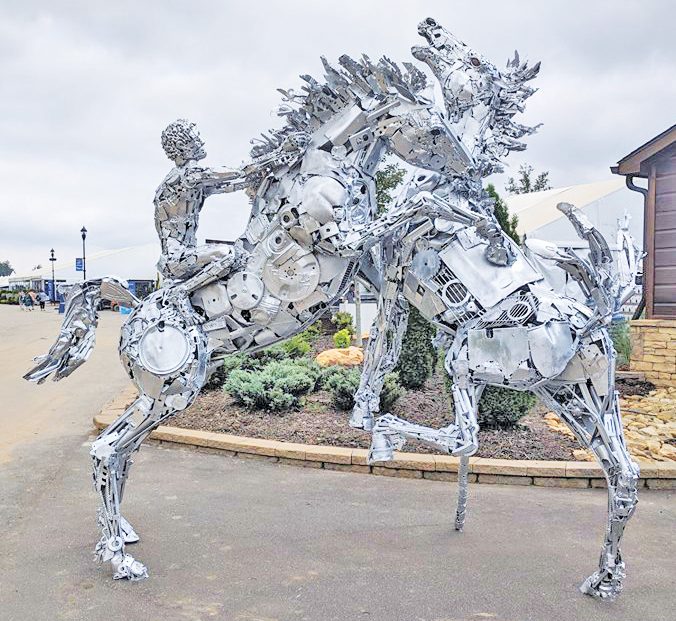
    These ‘Fighting Stallions’ designed and created by Thomas Humphries, who grew up in Blythewood, brought bigger-than-life art to the World Equestrian Games. | Maria Ott

    TRYON, NC – Blythewood sculptor Thomas Humphries, 45, is enjoying the international limelight after receiving a last-minute request from the World Equestrian Games in Tryon, North Carolina to display one of his recent works of art. The shimmering metal sculpture – a ten-foot-tall depiction of clashing stallions – was, until Saturday, Sept. 8, sitting in Humphries’ backyard. Two days later, the sculpture was prominently displayed at an entry point of the Games, attracting the attention of equestrian sports spectators from all around the world. And Humphries, a longtime hobbyist sculptor, said he couldn’t be more thrilled by the twist of fate.

    Humphries

    “When I started this piece in 2014, I’d been looking for a new idea, something that would challenge me and really push my abilities,” he said in an interview with The Voice.  “I was thinking of the wonderful ‘Fighting Stallions’ piece by Anna Hyatt Huntington at the entrance to Brookgreen Gardens in Murrells Inlet, and I thought, wow, something like that would be exciting to do. That’s where this piece came from. It’s a tribute to Huntington’s sculpture.”

    Humphries, who also owns and manages a roofing and home maintenance business, has other sculptures on display at locations closer to home, including a giraffe, lions and zebra at Riverbanks Zoo and a dancing couple at the Blue Room Ballroom in West Columbia. He creates his often larger-than-life art from discarded odds and ends of metal that he regularly finds and collects.

    “It’s like an Easter egg hunt every day,” he said with a laugh. “I’ve got a certain eye, and I can spot metal in a pile of leaves. I’m always scanning and looking for it. I average about one to three pieces a day. I find them in parking lots or wherever I happen to be doing roofing or maintenance jobs. Old barbell pieces, old caulk guns, stuff that people consider trash. I know I can weld it together, so I add it to my big pile of stuff.”

    Humphries said the 1500-pound equestrian sculpture consists of about 500 pieces of stainless steel and carbon steel. He used a stick welder to bind it all together before spraying the whole thing with shiny silver paint.

    His fiancé, Maria Ott, spent time reaching out to a number of people about the possibility of displaying Humphries’ work, and one of the people she connected with was Annette Compson-Goyette, the Director of Vendors at the Tryon Equestrian Center.

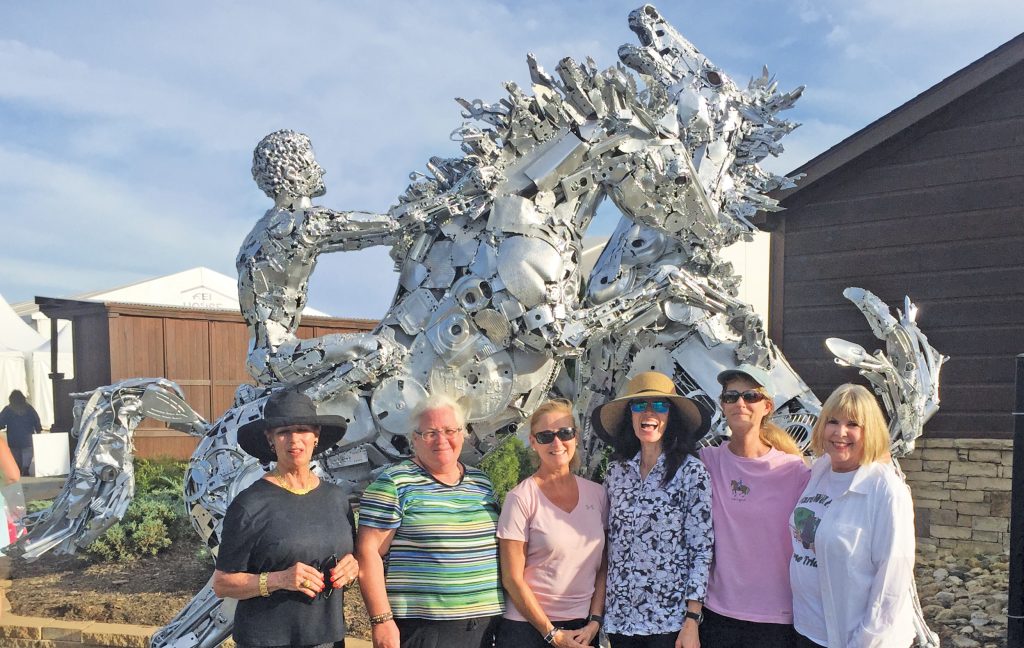
    A group of Blythewood residents attending the World Equestrian Games in Tryon, NC last week, had their photo snapped with Thomas Humphries’ ‘Fighting Stallions’ sculpture. From left: Carroll Ann Bowers, Jan Reynolds, Diane Smith, Paula Spinale, Kit Turner and Joyce Hill. | Submitted by Joyce Hill

    “It was really exciting to get that call from Annette, asking us to bring it on up,” he said. “But getting it up there was a big ordeal.”

    At a cost of $2500, Humphries hired a team of professionals who came with the necessary heavy-duty equipment to place the sculpture onto a flatbed and transport it safely. He also spent about 10 hours welding a cage around the outer sides of the horses to secure them for travel.

    “That was made from some old bedframes that I’d picked up along the side of the road,” he said. “It made a really strong frame.”

    It had rained before they arrived, and Humphries said it was nerve-wracking to watch the huge flatbed truck navigate a steep, wet clay hill at the event grounds.

    “The truck started to slide, almost into a jackknife,” he said. “It was pretty scary, but luckily the driver was able to stop it completely before the truck flipped over with the sculpture. It was a really close call. But those guys did a great job.”

    The sculpture was on site by Monday, though he still had to stabilize it against the threat of heavy winds from the approaching Hurricane Florence, remove the shipping supports and touch up the paint.

    “By the early afternoon on Tuesday, it was ready for action,” he said. “And I’ll be up there again this week. They’re going to set up a tent where I can talk to folks [about the artwork] and hold a silent auction for the piece.”

    Compson-Goyette has also invited him to display the horse sculpture at the 2019 Winter Equestrian Festival in Wellington, Florida, unless it ends up being purchased in Tryon. Humphries said that he’s delighted to be able to reach more people with his art.

    “The enjoyment that people get out of what I make is one of the biggest things that I enjoy about it,” he said. “I was down at the zoo, refurbishing a lion sculpture I’ve got there, and a gentleman said to me, ‘man, I’ve never really cared about art, but I like that.’ It makes me feel good, to take art and put a twist on it that people enjoy.”

    Humphries said his goal is to work full-time as an artist.

    “Until now it’s strictly been a hobby,” he said, “but I’m hoping that will change here in the near future, to become something that I can share regularly with people and maybe make an income from.”

    Spectators will be able to view Humphries’ sculpture in Tryon until the World Equestrian Games wrap up on Sept. 23.

  • Solicitor Johnson of Blythewood indicted

    Charges Include Mail and Wire Fraud, Theft of Federal Funds

    COLUMBIA – Blythewood resident and Fifth Circuit Solicitor Daniel Johnson, 47, was charged on Tuesday in a 26-count indictment for wire fraud, mail fraud, conspiracy to commit wire and mail fraud and theft of federal funds.

    Johnson

    Also indicted on the same charges was Nicole Halliett Holland, 49, Director of Communications for the Solicitor’s Office.

    The defendants are facing penalties of up to 20 years with a potential fine up to $250,000 for the first three charges and imprisonment up to 10 years with a potential fine of up to $250,000 for theft of federal funds.

    Johnson and Holland are accused of siphoning public funds from the Fifth Judicial Circuit to finance their private lifestyles, according to the indictment.

    Holland is accused of aiding and abetting Johnson, who was her boss.

    Johnson, who was elected solicitor in 2010 and re-elected in 2014, and Holland are accused in the indictment of having used solicitor’s office credit cards to pay for personal expenses including travel, vacations, romantic liaisons, medical expenses and double-reimbursements for military training.

    If convicted, Johnson and Holland would have to forfeit a sum of money equal to all proceeds the defendants obtained from the offenses charged in the indictment – a minimum of approximately $55,000.

    The case was investigated by the Federal Bureau of Investigation and South Carolina Law Enforcement Division.

    Gov. Henry McMaster on Wednesday formally suspended Johnson from office and appointed state deputy Attorney General Heather Weiss as interim solicitor.

    Weiss will serve until early January, when an election will be held for a new solicitor.