Blog

  • Richland 2 board members fail Ethics 101

    BLYTHEWOOD – Most sitting members of the Richland 2 Board of Education have major gaps in their state-mandated ethics filings, a review of public records shows.

    Three board members failed to file Statements of Economic Interest forms for at least one calendar year.

    Two of those three board members also haven’t filed quarterly campaign disclosure forms since 2016.

    And virtually everyone currently on the board has either been late or missed at least one quarterly report, according to the S.C. Ethics Commission online database.

    Craig Plank, who did not win election to the board last month, filed his SEI form on time every year. He also filed an initial report, one quarterly report and a final report, documents show.

    The Richland 2 school board plays a direct role in developing the district’s annual budget, which for the 2017-2018 fiscal year totaled $273.9 million, according to the school district website.

    The board also recently voted to place a referendum question on the November ballot that asked taxpayers for permission to borrow an additional $476 million to pay for school facility projects.

    Voters approved the referendum, resulting in a property tax increase for homes and businesses in Richland 2.

    Because Richland 2 board members are entrusted with spending millions of dollars in taxpayer money, greater scrutiny of their ethics filings is appropriate, said Jay Bender, a media law attorney representing the S.C. Press Association.

    “You have all these people who take office who pay no attention what the requirements are, and that’s unfortunate,” Bender said.

    Forgotten forms

    As of Tuesday, Richland 2 board member James Shadd III still had not filed Statements of Economic Interest forms for 2017 or 2018. SEI forms disclose an elected official’s income and potential conflicts of interest.

    Shadd III, who ran a separate campaign for solicitor, hasn’t filed quarterly campaign disclosure statements since Oct. 31, 2016. State law requires quarterly reports to be filed in January, April, July and October.

    “All candidates with contributions on hand must file a quarterly report covering from the last report through the end of the calendar quarter,” the Ethics Commission web site states. “The quarterly report is required of all candidates once they have begun to file, whether there has been any financial activity or not.”

    Shadd III couldn’t be reached for comment Tuesday.

    Board chairwoman Amelia McKie (2015-2018) and newly elected board member Teresa Holmes (2018) also missed filing SEI forms.

    The forms weren’t filed with the Ethics Commission until Dec. 4, nearly a month after the general election. They were due March 30.

    Both McKie and Holmes filed their SEI forms after The Voice informed them that they hadn’t been filed.

    McKie said she had filed her forms “months ago.” The Voice has been unable to reach Holmes for comment.

    Richland 2 board member Cheryl Caution-Parker, who was more than a month late in filing all of her 2018 quarterly campaign disclosure reports, said she saved her work when filing online, but forgot to click ‘File.’

    As with McKie and Holmes, Caution-Parker filed shortly after being contacted by The Voice.

    “It just didn’t cross my mind to double check because I thought everything was fine when I sent it,” Caution-Parker said.

    “A lot of times when you’re smack in the middle of the campaign and things are coming at you from so many different directions, it’s very hard to keep up with everything,” she continued.

    Walker said filing dates published on the Ethics Commission website are considered the official filing dates. She said that “it’s the duty of every candidate” to file the forms correctly.

    Two other Richland 2 board members have late or missing ethics forms, according to the agency’s online database:

    James Manning – Campaign Disclosure Initial Report not filed. Initial reports must be filed within 10 days of spending or receiving the first $500 of campaign funds. Manning reported receiving a $1,000 contribution from Brownstone Construction Group, LLC on Aug. 21, 2018.

    Monica Elkins – Quarterly campaign disclosure reports not filed since April 10, 2017.

    Board member Lindsay Agostini’s last Campaign Disclosure report on file was a final report dated March 24, 2017.

    Final reports are filed only after a candidate’s campaign account is closed. To qualify, a candidate must have a zero balance and no outstanding campaign debts, according to the Ethics Commission website.

    “Once a final report is filed, a candidate may not accept or spend any funds for the campaign,” the website states.

    Agostini’s final report listed a zero balance on her form. She would have to file a new initial report once she spends or receives at least $500 in new donations, according to the commission.

    Her last SEI report was properly filed March 29, 2018.

    More trouble for McKie

    Walker, the ethics commission spokeswoman, said she “can neither confirm or deny” whether any new complaints have been filed against Richland 2 board members.

    Complaints only become public when the commission determines that probable cause exists.

    So far, McKie is the only sitting board member who’s been fined for prior ethics violations, according to ethics commission records.

    In July 2018, the commission fined McKie $41,000 as part of an eight-count complaint for failing to disclose campaign contributions.

    The agency’s online database states McKie hasn’t filed any campaign disclosure reports since February 2015.

    McKie has until Dec. 30 to pay the first $20,000 and if she doesn’t, the fine increases to $51,750, public records show. She hadn’t paid any of the money as of Tuesday, Walker said.

    In addition to ethics fines, McKie recently faced legal troubles in Richland County civil court.

    McKie is listed as a co-defendant in a foreclosure lawsuit that was filed in June 2017.

    According to the suit, McKie’s homeowner’s association placed a lien on property located on Hunters Pond Road after $1,800 in assessments went unpaid. The HOA later foreclosed on McKie’s home.

    “The Defendant(s) has failed to make consistent payments of the assessments and interest, although demand for payment has been made,” the suit states.

    The suit also sought legal fees and expenses, bringing the total bill as of August 2018 to about $6,050, court filings state.

    On Oct. 2, a judge signed off on the foreclosure and request for sale at public auction.

    The case, however, was disposed Nov. 29 after court documents were filed stating that sufficient funds had been paid to satisfy the judgment.

    How did this happen?

    As ethics reporting deadlines have eluded Richland 2 board members, tracing how the tardy filings went unchecked remains equally unclear.

    Section 8-13-1110 of state law says no public official “may take the oath of office or enter upon his official responsibilities” unless a Statement of Economic Interest form is filed.

    According to that definition, it would mean that McKie has illegally served on the school board since 2015, the first year she failed to file an SEI form. The oath of office statute likely doesn’t impact Holmes since she only filed a month late.

    Chris Whitmire, spokesman for the State Election Commission, said the agency is only responsible for ensuring that candidates file statements of candidacy.

    Whitmire said the agency would only remove from the ballot any candidate who fails to file that form. He noted campaign disclosures and SEI forms fall under the Ethics Commission’s purview.

    “I would think compliance would be a question for that body,” Whitmire said.

    Walker, the ethics commission spokeswoman, said only the election commission has the power to remove a candidate from the ballot.

    Instead, the ethics commission only fines candidates, and only for violations of campaign finance and ethics laws, Walker said.

    “We don’t file an injunction or anything,” she said.

    Fines wouldn’t kick in until after candidates are notified by mail and a formal complaint is filed.

    Complaints aren’t made public until the commission determines “probable cause” exists that a violation occurred, Walker said.

    Failing to file SEI forms previously carried dire consequences for more than 200 candidates in one recent election.

    In 2012, the S.C. Supreme Court ruled anyone failing to file SEIs when officially filing for public office must be removed from the ballot.

    “We fully appreciate the consequences of our decision, as lives have been disrupted and political aspirations put on hold,” the ruling stated.

    “However, the conduct of the political parties in their failure to follow the clear and unmistakable directives of the General Assembly has brought us to this point. Sidestepping the issue now would only delay the inevitable.”

    In 2013, the General Assembly passed a new ethics law which placed the election commission in charge of candidacy filings and the ethics commission in charge of campaign finance and ethics-related reporting.

    The issue of public officials being sworn in after failing to file economic interest forms has yet to be tested in court.

    In August 2017, the S.C. Attorney General’s Office issued an opinion relating to economic interest forms.

    The opinion, though, only affirms that candidates must file an SEI form after either filing a statement of candidacy or if the candidate has an open campaign account. It doesn’t address what happens if a candidate fails to file an SEI, and is subsequently sworn in.

    An attorney general spokesperson couldn’t be reached for comment.
  • Top Employee

    Jamison

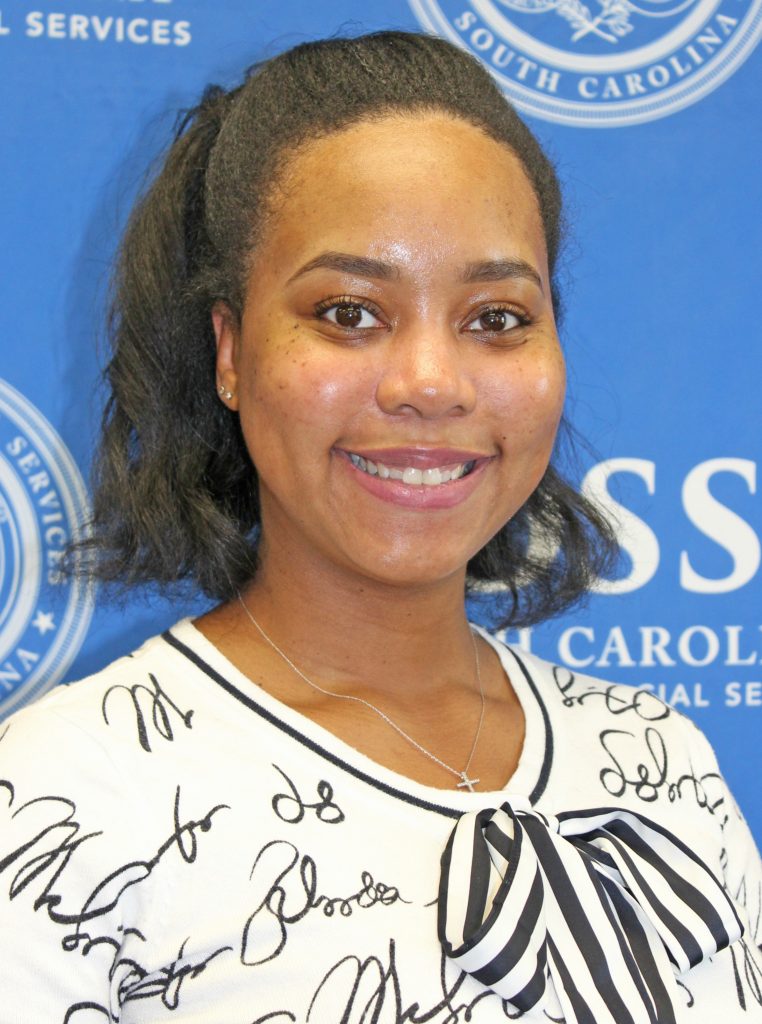
    COLUMBIA – Ereka Jamison of Blythewood, was recently named a November Employee of the Month for the S.C. Department of Social Services. Jamison is a Benefit Integrity Claims Specialist for Region 2 which includes Aiken, Bamberg, Barnwell, Chester, Edgefield, Fairfield, Kershaw, Lancaster, Lexington, McCormick, Richland, Saluda, Union and York counties. According to her nomination, Jamison is a “dedicated and exceptional DSS employee.” As an employee of the month, Jamison was given a dedicated parking space and invited to lunch with the acting State Director.

  • Fairfield buck may be new state record

    A four-year quest ended when Sims bagged Waldo on Nov. 30. | William Ladd

    FAIRFIELD COUNTY – The four-year saga of James Sims and Waldo finally ended Nov. 30 when Sims finally bagged the Fairfield County buck with the massive 13-point rack that could become South Carolina’s new state record.

    Four years of frustration finally ended with Friday’s hunt, four years when the buck seemingly taunted Sims, who recently moved to Blythewood from Fairfield County where he grew up. The buck was a regular on Sims’ trail cameras – at night. He flirted from time to time with Sims appearing in front of his stand when there was not enough light to see through the rifle scope.

    And then, to add insult to injury, the monster buck would appear on camera in broad daylight – when Sims was not there. He was so elusive that Sims tagged the buck Waldo as in “Where’s Waldo?” He even created a Snapchat account with that name for him and his hunting buddies to keep up with sightings of the buck.

    Sims first saw the buck four years ago this past August when he was scouting a new hunt lease in Fairfield County. A check of the area on Google Maps showed a thicket with an opening and he walked in there to check it out.

    “I jumped two deer, a big 8-point and a big 10-point. So I put some trail cameras in there and I’d always have pictures of the big 8-point. The big 10-point would be in the background. He was not camera friendly but I knew he was a good young deer.”

    For a good part of the fall of 2016 the big buck was a no-show, then he suddenly appeared right in front of one of the trail cameras in mid-November.

    “He was an absolute monster,” Sims said. But he showed at the wrong time for Sims, who had not been hunting a lot because of an infected foot from stepping on a nail, plus his son was born on Dec. 2. But he hunted the buck as hard as he could until the season’s end and never saw the deer.

    With his cameras out Sims knew the buck was there when deer season began in 2017. On opening day of rifle season the buck teased Sims with an appearance.

    “I was in a spot where I could see for about 300 yards and this deer stepped out about 225 yards from me,” he said. “I put the gun on him and looked through the scope. The deer turned and looked my way and I could see a huge mass of rack. But he was walking steadily through some tall vegetation and I could not get a clear shot.”

    He hunted the buck every chance, but by Thanksgiving he had not seen him again so he and his brother-in-law went duck hunting that morning.

    “We only killed two ducks, not a great hunt. When I checked my cameras the buck was right there after daylight. That broke my heart,” Sims said.

    After that he took two weeks off from work and hunted the buck every morning and afternoon. He did not see the buck in daylight, but it appeared on his trail cameras almost every night in December.

    “On Dec. 20, I saw a small 8-point come out. Then a few more small bucks came out along with some small does,” Sims said. As the evening grew darker, the deer turned into just silhouettes and he could no longer see them through his scope.

    “I saw a big-bodied deer come out at about 100 yards and run the other deer off the corn pile. I could not shoot because all I could see was the silhouette. So I sat there for probably half an hour to 45 minutes so I would not scare him as I walked out. I changed memory cards in my camera on the way out and when I got home and viewed the card I could see it was him.”

    “I kept telling my Dad, my brother-in-law and my buddies at work that the buck was torturing me. I never saw him again the rest of the year except on camera.”

    By late June this year Sims had his cameras in place. The buck appeared on camera two nights in a row, then disappeared. But those two nights revealed how massive his rack had grown, how much mass had been added, plus the addition of a split brow tine.

    As the season wore on Sims began to worry. Shooting on adjacent properties made him wonder if someone else might take the huge buck. But in the previous years the buck had not shown up until mid-October and this year was no exception. On Oct. 22 he appeared again and added to Sims’ frustration in the process.

    “I had to go into work earlier than normal that morning so I checked the cameras that afternoon after work and he was there at 7:57 a.m. I was happy to see him, but I was disappointed that he was there in daylight when I had to be at work.”

    Sims’ resolve grew and he began hunting every morning from 6 to 8 a.m. and every evening the last hour and a half of daylight. But the only time he saw Waldo was when he appeared at night on camera.

    Last Friday morning was the end of a long, hard week at work and rain was in the forecast. Sims said he did not feel much like hunting, but dragged himself out of bed and headed to the deer stand where he fought sleep by playing on Facebook and Instagram.

    By 6:30 the sky was beginning to lighten up and Sims laid the phone down and got his hat and face mask on.

    “I could see the silhouette of a deer feeding, so I put the scope on it and kept watching. As it grew a little lighter, he turned and faced me, and I could see it was him,” Sims said. For the next several minutes he prayed silently, “Please don’t let me miss.”

    Then the buck turned sideways, giving him a clear shot and he squeezed the trigger. The buck fell instantly and Sims shot a second time to make sure it did not suffer or get up and run off. Then he climbed down from the stand and ran the 120 yards to where the deer lay.

    With his eyes filling with tears, he dropped to his knees, grabbed the antlers and prayed to God for “letting me even hunt that deer, for letting me be a part of that deer’s life.”

    Then Sims changed the group name on Snapchat from “Where’s Waldo?” to “Found Waldo.”

    With a 19-inch inside spread the rack features a 28 1/8-inch right main beam and a 27 3/8-inch left main beam with a 5 ¼-inch circumference at the base for both. The shortest antler is the left G5 at 4 3/8 inches, but all the other antlers are over 6 ½ inches and the G3 and G4s are all over 8 inches.

    “Based on the pictures, it is a very impressive buck and I feel certain it will likely be in the top 15 all-time,” said Charles Ruth, the SC DNR Deer Project Supervisor and Big Game Coordinator who maintains deer antler records. “It is truly a giant.”

    It definitely is the largest rack ever for Fairfield County, according to the records, and if the overall green score of 188 inches holds up when it is officially scored it would become the No. 1 typical buck for South Carolina. The current record is 176 0/8, taken by William C. Wyatt in Pickens County in 1994.

    A rack has to dry for 60 days before it can be officially scored, so it will be February before the verdict is in on Sims’ buck. But one thing is for sure – Waldo has finally been found.

  • China-based mattress manufacturer coming to former Mack Truck plant

    WINNSBORO – China-based Healthcare Co., Ltd., announced Monday that it plans to establish new operation, Healthcare US Co., Ltd., in Fairfield County. The company’s $45 million investment is projected to create 250 new jobs in the county.

    Healthcare US Co., Ltd. is expected to launch its new, 650,000-square-foot, Fairfield County facility in the first quarter of 2019. Located at 1 Guardian Way in Winnsboro, where Mack Truck was previously housed, the operation will specialize in the production of memory-foam mattresses for a variety of customers. Hiring is also slated to begin early next year, and interested applicants should contact healthcare.us@hkfoam.com for more information.

    At Monday night’s council meeting, council members gave second reading to an ordinance authorizing the execution of a fee in lieu of taxes and incentive agreement with the company. Third and final reading will likely occur in January, 2019.

    Besides mattresses, Healthcare Co. Ltd. also produces pillows and sofas and is the largest memory foam manufacturer in China. It has doubled its production capacity every year since it was established in 2003.

    Company global export volumes exceeded $250 million in 2015, the company’s website reported.

    “Fairfield County is beyond excited and thankful that Healthcare USA Co., Ltd. has chosen to locate its first U.S. factory in Winnsboro,” said Fairfield County Council Chairman Billy Smith. “The representatives of this company with whom we’ve worked throughout this process have been a pleasure to do business with, and we look forward to their future operation and success within the county. We welcome them with open and supporting arms and are hopeful that others will see this and know that Fairfield County is open for business and focused on the kind of growth that will be beneficial both for our citizens and the businesses that choose to locate and invest with us.”

    Smith said one feature of Fairfield County that appealed to Healthcare Co. Ltd. is its proximity to I-77, and that it is strategically located between Columbia and Charlotte.

    Smith also said the region has a skilled workforce, a trait he attributed to the state’s technical college system.

    “It’s a big plus, a big positive for Fairfield County,” Smith said. “It’s one of the globally leading manufacturers in China, and they are expanding. We look forward to welcoming them here.”

    “We’re happy to be establishing this new facility in Fairfield County, and we are very appreciative of the ongoing support from both the local and state governments,” Healthcare Co., Ltd. President James Ni said. “This is a milestone for our company, and we are excited to support the community we will soon be calling home.”

    Founded in Jiangsu, China in 2003, Healthcare Co., Ltd. is the first publicly-traded, memory-foam mattress manufacturer in China. Becoming a global industry leader, the company has established overseas production operations in both Serbia and Spain, with approximately 3,600 workers globally.

    The S.C. Coordinating Council for Economic Development has awarded a $300,000 Rural Infrastructure Fund grant to Fairfield County to assist with the costs of building renovations.

    “South Carolina’s ongoing economic success can be attributed, in part, to our manufacturing prowess and ability to recruit foreign direct investment,” Secretary of Commerce Bobby Hitt said. “This $45 million investment in Fairfield County only reinforces that notion. We look forward to this new partnership.”

    FIVE FAST FACTS

    Healthcare US Co., Ltd. is launching new Fairfield County operations.

    $45 million investment to create 250 new jobs.

    Healthcare US Co., Ltd. is a China-based manufacturer of memory-foam mattresses for a variety of customers.

    Located at 1 Guardian Way in Winnsboro, the company is expected to launch its new, 650,000-square-foot facility in the first quarter of 2019.

    Hiring is expected to begin simultaneously, and interested applicants should contact healthcare.us@hkfoam.com for more information.

  • Enter The Voice’s U Pick ‘Em Contest

    BLYTHEWOOD – Need some extra cash to pay off some of those Christmas bills that are adding up right now? Then you might want to consider entering The Voice’s annual College Bowl U Pick ‘Em contest.

    Two $100 dollar bills will be presented to the winner of the contest after the Jan. 7 College National Championship game. The contest entry form will be published again in the Dec. 20 issue of The Voice or you can fill out our form online here. Only one entry per person, no photo copies of entry forms, and all entries must be postmarked by midnight Dec. 28 (and don’t forget the tie-breaker!). Online form will also close at midnight Dec. 28.

  • Neighbors nab thief in their own front yard

    BLYTHEWOOD – In the Plantation Parkway neighborhood of Blythewood, neighbors worked together earlier this month to catch a 17-year-old who was charged with burglary.

    Around 9:30 p.m. Sunday night, Dec. 2, a Plantation Parkway resident went outside to turn off his Christmas lights when he noticed a man walking down the sidewalk in the neighborhood wearing black clothing and a black backpack.

    The resident later told Sheriff’s deputies that he was suspicious of the man and decided to take a second look outside.

    It was then that the resident noticed the male in black clothing pulling on car door handles.

    It was reported that the resident confronted the suspect who then ran off. The resident drove through the neighborhood in an effort to find the suspect, according to the report. As the resident drove around the neighborhood, he came upon neighbors who were discussing an incident in which a woman’s wallet had just been stolen out of her car while she was visiting a home on the street.

    While those neighbors were calling law enforcement, they reportedly saw the man in black clothing walking around the corner but no longer wearing the backpack. The man went into a home that turned out to be his parents’ home on the same street as the burglaries.

    With the help of the neighbors, deputies arrested Parker Grant ,17, and charged him with Larceny/Breaking Into a Motor Vehicle. Grant was released on an $800 Personal Recognizance bond and could face up to five years in prison or a $1,000 fine if convicted.

    Representatives from the sheriff’s department, who have recently been conducting neighborhood meetings to encourage residents to take precautions against car break-ins, applauded residents in the neighborhood for looking out for each other.

    The Sheriff’s department has recently advised residents in Blythewood neighborhoods to lock their vehicle doors, hide belongings from view and invest in security or alarm systems.

  • Richland 2 chair owes $41,000 in ethics fines

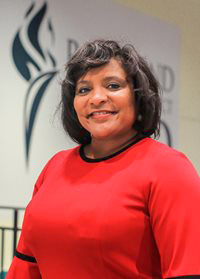
    BLYTHEWOOD – Amelia McKie, chair of the Richland 2 Board of Education, owes at least $41,000 in fines to the S.C. Ethics Commission, according to agency documents obtained by The Voice.

    McKie

    McKie has until Dec. 31 to pay the first $20,000. The remaining $21,000 is due June 30, 2019, documents state.

    The fines are spelled out in an order the ethics commission issued July 3.
    According to an eight-count complaint the commission filed, McKie failed to file quarterly campaign disclosure reports on seven occasions in 2015 and 2016 for the 2014 election.

    The eighth count says McKie failed to disclose expenditures on a campaign report, documents show.

    As of Thursday, the forms still had not been filed. The most recent quarterly report appearing on the ethics commission’s online database is dated Jan. 10, 2015.

    Campaign disclosure reports for the 2018 election also don’t appear on the ethics commission’s website.

    If the fines aren’t paid, McKie faces a judgment of $51,750, the order states.

    Attempts to reach McKie by phone and email were unsuccessful.

    More ethics forms remain unfiled

    McKie’s $41,000 fine is in addition to any additional fines or penalties she may face for failing to file Statements of Economic Interest forms with the ethics commission.

    On Dec. 4, McKie filed her 2018 economic interest forms, hours after The Voice telephoned her about the forms not being filed, according to the ethics commission website and an agency spokeswoman.

    The forms were due March 30, according to state law.

    In a telephone interview Tuesday, McKie told The Voice that she had filed her 2018 form “weeks ago.”

    “I’ll try to find out where the disconnect was,” McKie said. “There here shouldn’t have been a problem. Certainly I want to get to the bottom of whatever the disconnect is.”

    The ethics commission stood by its assertion that the form was filed Friday, Dec. 4, not weeks ago.

    “The statements were filed on the date and time shown on the website,” the agency said via email. “I am aware of no glitch in the application that would cause a document to become ‘lost’ in the system.”

    In addition to 2018, McKie also didn’t file economic interest forms for 2015-2017 until Dec. 4, 2018.

    McKie filed her 2014 form on Aug. 15, 2014, the ethics commission online database shows.

    The ethics commission spokesperson declined to comment about the potential for additional fines relating to McKie’s economic interest forms, but reiterated that the online database is correct.

    “Everything on the website is accurate but may not contain the latest information,” the spokesperson said.
    According to state law, a $100 civil penalty is levied to candidates failing to file on time following a five-day grace period. Penalties increase to $10 per calendar day starting 10 days after the commission provides notice by certified or registered mail.

    Daily fines increase to $100 for every day the form isn’t filed, with total fines capping at $5,000. Criminal penalties kick in if forms still aren’t filed.

    The ethics commission website also lists McKie on the agency’s debtor’s list, a list consisting of public officials with unpaid fines and civil penalties.

    As of Dec. 6, the list said McKie owes $233.30 stemming from an unspecified 2016 debt. It’s unclear whether or not that debt is associated with the $41,000 judgment.

    The ethics commission said it couldn’t respond to The Voice’s inquiries about McKie’s inclusion on the debtor’s list.

    Why McKie owes $41,000

    McKie’s $41,000 fine includes a “reduced late-filing penalty” of $24,245, a $16,000 civil penalty and a $575 administrative fee, documents show.

    According to the order, McKie’s failed to file campaign disclosure reports after January 2015. The ethics commission fined McKie $600 for late filings of her 2015 and 2016 quarterly contribution reports.

    Daily fines began accruing in August 2016. A complaint was then filed after the ethics commission said it received no response from McKie.

    The filing further states that an agency investigator telephoned McKie on Sept. 29, 2016, instructing her to file the required paperwork.

    “From October 27, 2016, and January 10, 2017, Commission investigators made multiple attempts to bring Respondent into compliance with no success,” the order states.

    Investigators visited McKie’s home on Jan. 10, 2017, “to advise Respondent of the accruing penalties and the need to file the requisite reports,” the order continues.

    McKie made an appointment with the agency the following day, but failed to file the reports, according to the order.

    At that point, the ethics commission subpoenaed McKie’s campaign bank records. The last check written from that account was dated April 3, 2016.

    “Respondent’s campaign bank account records revealed no other activity with the exception of bank fees in the amount of $10.00 per month until the bank account was force-closed on January 30, 2017,” ethics documents state.

    The commission issued a Notice of Hearing to McKie in May 2018. The hearing took place June 21, but McKie didn’t appear, agency records state.

  • Hoof & Paw raises over $100,000 for animals

    Joyce Martin Hill, who owns Farewell Farm in Blythewood, and her two horses, Kodak Moment and Noah, are featured inside the front cover of The Hoof and Paw Benevolent Society’s new fundraiser coffee table book, Friends of Hoof & Paw, 2018. The book was released during a presentation party at The Farm last week. | Harold Dodson

    RIDGEWAY – The Hoof and Paw Benevolent Society debuted its much anticipated coffee table book last week in a special reception that paid tribute to the sponsors and volunteers who made the book a reality.

    “They say it takes a village to raise a child. Well, this book was our baby and you were our village. Without all of you this would not have been possible,” fundraiser chairman and Blythewood horsewoman Minge Wiseman told the crowd of supporters who filled The Farm at Ridgeway’s reception hall last week.

    The 160-page hardcover book, underwritten by philanthropist and Blythewood horsewoman Joyce Martin Hill and her husband George, grossed over $100,000 and features photographs of dozens of local dogs, cats and horses and their human families. Many of the animals pictured are rescues, now living the good life. The photos of the loved and loving animals reflect Hoof and Paw’s vision for all animals.

    The books were paid for by pet owners who shelled out from $400 to $1,000 for glossy, full page photos of their dogs, horses, cats and other animals. Professional photographers Dr. Robert Buchanan, Harold Dodson, Kelly Garin, Morgan Auld and Megan Timmerman donated their time and talent during the summer to snap photos at farms, lakes and other bucolic settings. The Farm’s owners, Larry and Eileen Sharpe, donated the use of the venue for the event which was catered by Olde Town Hall Restaurant in Ridgeway. Musicians Kristi Hood and Richard Maxwell entertained.

    Hoof and Paw also raffled the book cover to pet owners. For $25, anyone could enter their pet’s photo in the contest. The winning photo was submitted by Blythewood horsewoman Kit Turner of her two Cocker Spaniels, Hannah and Heaven, and her cat, Tuk.

    “Artist Mary Bliss very graciously donated her time and talent to turn the photo into a beautiful painting that appears on the book’s cover,” Wiseman said.

    “It’s always a wonderful moment to see your work bring so much pleasure to its owners, and it was an honor for me to have been able to work on this piece for Minge and Hoof and Paw,” Bliss stated.

    A highlight of the reception was a special unveiling of the painting which was then donated by the artist to Turner, bringing her to tears.

    Created in 2012 to advocate for and support animal welfare in Fairfield County, Hoof and Paw – now Blythewood-based – has evolved into a formidable Midlands fundraising organization that benefits South Carolina animals and shelters through financial support and community awareness.

    Last year, the organization helped finance a spay and neuter campaign in conjunction with the Fairfield County Animal Shelter and assisted the County shelter in achieving its goal of becoming a no-kill facility. The group has more recently taken its battle to the front lines of county courtrooms and the state capital, turning its attention to lawmakers in an aggressive move to strengthen animal abuse laws in the state.

    “We have worked very hard to fix what we believe are laws lacking in the ability to protect animals and ensure that animal abusers are held accountable for their actions,” the group’s president Deborah Richelle stated.

    “It’s a battle that sometimes seems never-ending, but then on days like today when we are surrounded by supporters and we see these pictures of the animals, some of whom we helped saved, it gives us the boost that we need to go out and fight another day,” Richelle stated.

    But these efforts take money – lots of money. Addressing the crowd of about 200, Richelle explained in simple terms what Hoof and Paw is about.

    “We are not a rescue organization, and we are not a shelter. We just ask for money,” Richelle told the crowd who responded with appreciative laughter.

    The coffee table book has been the nonprofit organization’s most aggressive and successful fundraiser to date, according to co-chairman Kathy Faulk.

    “It’s amazing, it truly is. We had no idea this project would be so wildly popular and successful,” Faulk stated.

    In past years, Wiseman said the organization mainly fundraised through local yard sales and other small events that brought in around $1200 each year. She said the success of this year’s fundraiser will allow the organization to increase its support to local rescue groups.

    “There are so many animals in shelters that need homes, but they often need medical treatment that shelters can’t afford. And, of course, the shelters sometimes need money for food and supplies. That’s where we come in,” Richelle stated.

    Faulk said the photos in the book will serve as a touching memento to the people who purchased pages. Each was presented a copy of the book at the end of the evening.

    “There were about 14 animals featured in the book that have since passed away. The photos that we have included will be a special way for their families to remember them,” Faulk said.

    “It was a wonderful get together of like-minded people,” attendee Addie Walker stated. “A wonderful evening.”

    Several books are available for sale. To purchase one, to make a donation or for more information about joining Hoof and Pay, call Wiseman at 803-960-9770 or Faulk at 803-429-3509.

  • Council says goodbye to Smith

    WINNSBORO – Billy Smith is going out like Ted Williams.

    Since his election four years ago, the departing Fairfield County Council chairman has set a new standard for Fairfield County government from bringing parliamentary procedures to meetings to getting things done. Smith, his council and administration have challenged a major utility over a failed nuclear plant, successfully fought for the repurposing of the crumbling Mt. Zion Institute for administrative offices, helped broker major economic deals, including one this week that promises to create 250 jobs, brought state of the art emergency health care to the county brought civility and efficiency to county council meetings – no mean feat.

    Councilwoman Bertha Goins thanks Council Chairman Billy Smith for his service. | Michael Smith

    Not bad for a 28-year-old.

    Elected at age 24, Smith is moving to Louisiana where his wife has accepted a position with LSU. Smith announced in June that he wasn’t seeking re-election. He officially steps down Dec. 31.

    “Being on council has been a very challenging and humbling experience,” he said. “But most of all it’s been self-rewarding, both internally and externally. It’s given me experiences that I never thought that I would have had.

    “I hope in the next few years I’ll be able to see the progress that’s been built on the foundation the county laid, and see the positive benefits from that,” Smith continued.

    Council members honored Smith at Monday night’s council meeting, his last as chairman.

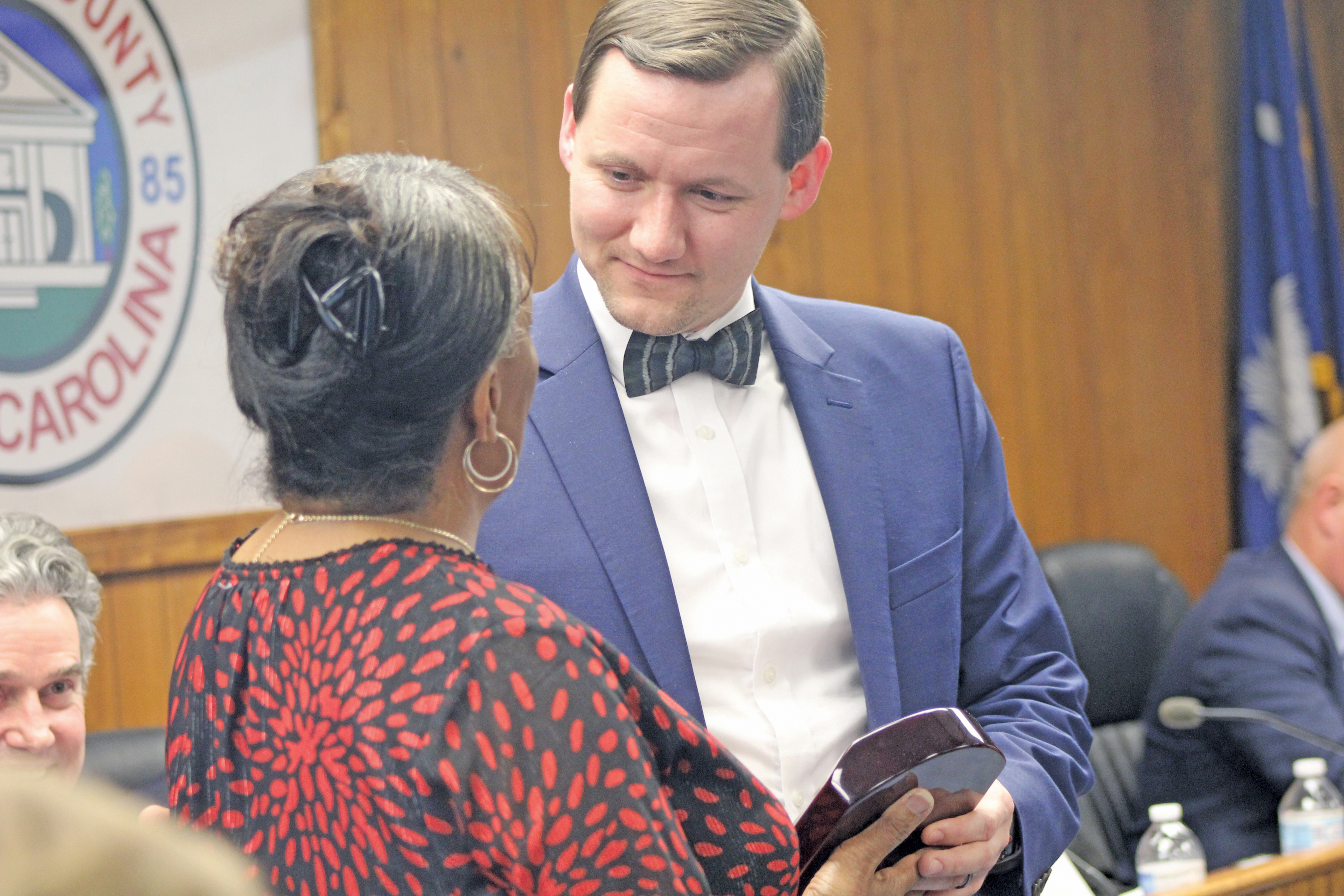
    They presented him with an award honoring his service and held a reception following the meeting. Councilman Dan Ruff, who is also stepping off council, was honored as well.

    Bertha Goins, vice-chairman of the council, said Smith was, “an excellent team leader” who led by example.

    “You’re a tough, young man and you need to stay that way,” Goins said. “You’ve had concern and compassion for the team and for the public as well. May God bless you and continually open doors for you.”

    Ten people signed up to speak during the first public input session, and two more in the second session. Several took time to thank Smith for his service.

    One woman, who fought tears from the podium, said Smith has developed into “such a fine young man,” saying he always kept residents in mind.

    Fairfield County resident Kathy Faulk, a spokeswoman with the Hoof & Paw Benevolent Society, has worked closely with Smith over the past several months on a new animal control ordinance, which passed third reading Monday night.

    “Thank you to Mr. Smith for your service and your hard work. You will be missed, and we wish you well in this next phase of your life,” she said.

    Representing District 7, Smith was elected to County Council in 2014. He was elected chairman two years later, making him one of the youngest – if not the youngest – council chairs in the state.

    But don’t mistake his youth for inexperience.

    Smith possesses a deep understanding of the issues, allowing him to confront difficult political topics, from the failed V.C. Summer nuclear plant to the school district’s proposed Teacher Village.

    Smith scored several political victories over the past several months.

    He successfully lobbied to repurpose the Mt. Zion building into a new county administration building.

    Under his leadership, the county is on the verge of finalizing a major economic development deal with Healthcare US Co. Lt., which has announced plans this week to expand operations into the old Mack Truck building, creating 250 jobs and investing $45 million.

    Smith’s preparedness allowed him to run fluid, efficient meetings, in which he breezes through agenda items like an auctioneer. He said his style helped bring consistency and order to meetings in which complex topics are often up for debate.

    “When you make up rules as you go along, you unfortunately apply those rules differently as well,” Smith said. “I wanted to get away from that. I wanted to get everyone on the same page and have them understand what the rules are. The goal of a meeting is to conduct the business of the county.”

    As for the future, Smith doesn’t know if he’ll seek public office again after making the move to Louisiana, though he didn’t rule anything out.

    “I saw an opportunity to help the place (Winnsboro) I call home, then help it improve, and I took that opportunity,” Smith said.

  • Council OKs animal ordinance

    WINNSBORO – For a brief moment, Fairfield County’s new animal control ordinance seemed like it might freeze in its tracks.

    In the end, however, Fairfield County Council voted 5-0 Monday night on final reading of the new ordinance, which increases fines up to $500 and more specifically defines offenses.

    Councilman Dan Ruff abstained and Councilman Mikel Trapp was absent.

    With a motion to approve third reading on the floor, Ruff introduced a motion to table third reading. The motion to table failed 4-1.

    Ruff said he agreed with the spirit of the ordinance, especially areas addressing animal cruelty, but he also thought other elements required further review.

    “There is still some fine print before this is finalized,” he said. “I think it would be better to totally have it clear.”

    Council Chairman Billy Smith asked Ruff for specifics, and Ruff pointed to previous comments from William Coleman, a farmer from Blair who expressed concerns during the opening public input session.

    Like Ruff, Coleman said he supports cracking down on animal cruelty, but also argued that some provisions aimed at residential owners shouldn’t apply to farmers.

    For example, he thought leash laws shouldn’t apply to hunting dogs, nor should they apply to herding dogs.

    “I’m in the cattle business,” he said. “Does this mean a cattle dog has to be under restraint when we go to work our cows?”

    Council members said the ordinance’s intent isn’t to leash farmers, and Smith pointed out that most of the concerns mentioned were already addressed in the ordinance. Council also noted the ordinance adopted Monday night was merely a starting point to close loopholes governing mostly residential owners.

    “It’s definitely better than what we have in place right now,” said Councilman Cornelius Robinson. “It’s like a car, we can fine-tune it in the future.”

    It’s been 11 years since Fairfield County last updated its animal control ordinance.

    It also took more than a year of discussions between the county and concerned residents to craft the revised ordinance.

    Two council members, including Ruff and Smith are leaving the council at the end of the year, which would’ve placed the ordinance’s fate up in the air after new council members are sworn in January.

    “I find it necessary we go ahead and do this ordinance tonight,” said Councilwoman Bertha Goins. “We need to lock this in tonight so that we have something to start with.”

    Fairfield County’s updated ordinance comes following a series of investigative reports by The Voice, which found that almost nobody charged with animal cruelty in the past 18 months received any jail time.

    Though those prosecutions were for state crimes that the solicitor’s office prosecutes in state court – the county ordinance only addresses magistrate level offenses – the lack of prison sentences galvanized public interest in updating the county ordinance.

    Highlights of the new law include:

    Mandatory reporting of any pet struck by a motor vehicle or bicycle

    More detailed definitions of nuisance animals

    Pets must be fed at least once a day and have potable water

    Tethers are allowed, but must be at least 12 feet long and no more than 15 percent of an animal’s body weight.

    Smith, the council chairman, had said during the Nov. 26 meeting, that he hoped tighter rules regarding swing chains could be incorporated. On Tuesday, though, he said, there wasn’t enough time to include that verbiage as it was difficult to clearly define and since he said his chief goal was for the ordinance to pass by the end of the year.

    “Our regard for life, human or animal, is all related. It’s so very important and a reflection of who we are as human beings,” Faulk said.