Blog

  • Budget tweaks divide Council

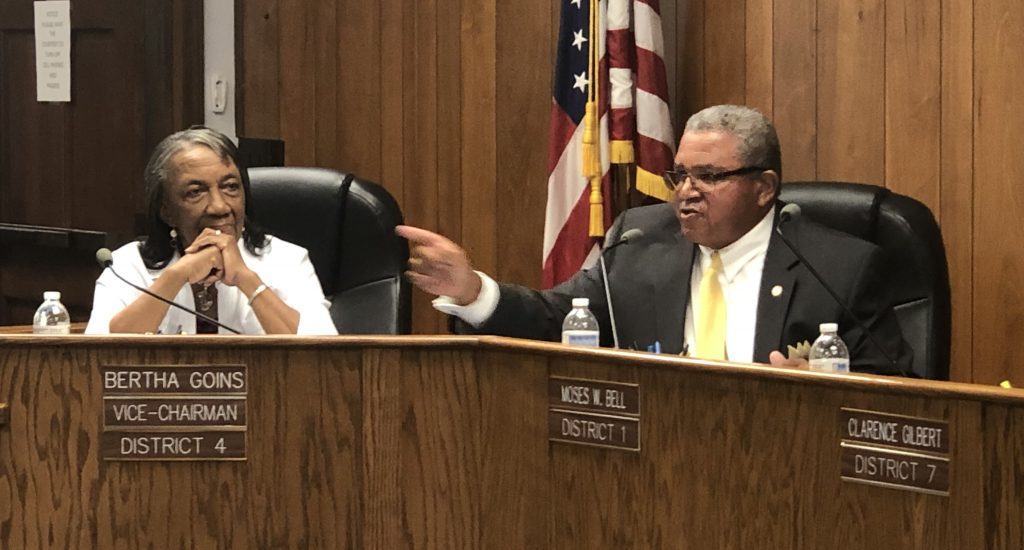
    Councilman Moses Bell, right, and Councilwoman Bertha Goins

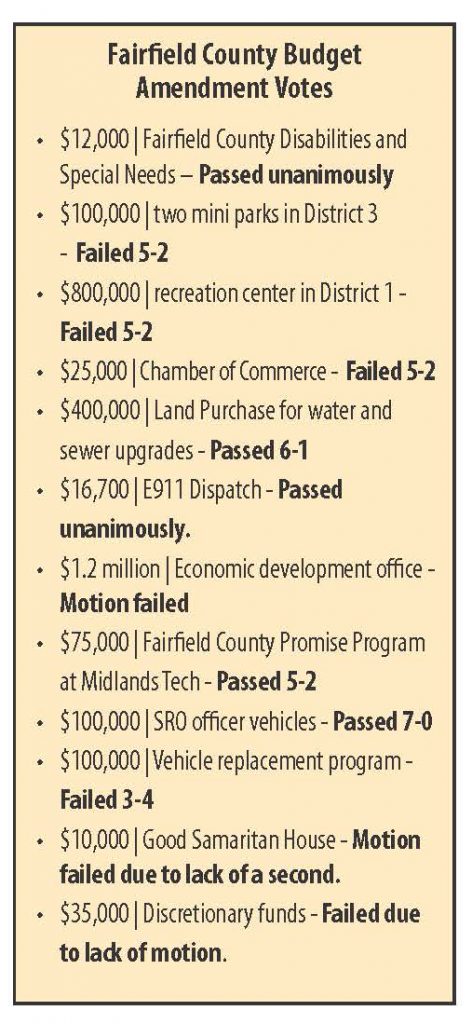
    WINNSBORO – In a series of votes Monday night, council members struck down budget amendments that would have added $900,000 in recreation improvements, $100,000 for vehicle replacement and a $1.2 million economic development office.

    Council members also balked at a proposal to fund individual discretionary spending accounts following public outcry. As one council member suggested, the votes boiled down to needs versus wants.

    “We cannot be selfish and think that we have all the answers,” said Councilman Clarence Gilbert. “I wouldn’t put a playground in my backyard if I knew I needed a refrigerator in my house and I didn’t have enough money for both.”

    Councilman Douglas Pauley, who voted against most of the amendments, raised concerns that the proposed $45.2 million budget rose 12 percent while it increased only an average of about 5 percent during the last four years.

    Reading from a prepared statement, Pauley called upon council members to cite the funding source for their various budget amendments.

    “We might be able to accommodate this by pulling from the fund balance,” he said. “But we will be increasing property taxes if we go down this path.”

    County Administrator Jason Taylor said a few amendments could be funded through other sources, such as bond revenue. But Taylor also agreed that dipping into reserves is unsustainable, noting that a three-mill tax increase would only generate about $450,000.

    “We cannot continue to do it (dip into reserves) year after year,” he said.

    In order to fund every council member’s request, “you’d have to raise taxes significantly,” Taylor added.
    Some council members, however, pressed   for increased spending.

    Angrily pointing his finger at the end of the meeting, Councilman Moses Bell said he was “really disappointed” a majority of council members wouldn’t support his request for $800,000 [toward a $1.5 million estimated cost] for a recreation center in his district [Ridgeway].

    In the end, Council members voted 5-2 against the $800,000 appropriation, with only Mikel Trapp and Bell supporting it.

    Bell claimed from the dais Monday night that the previous District 1 Council member had said the recreation center had been approved. That original approval, however, had been for $500,000, not $1.5 million.

    “The constituents are the same, the district lines haven’t been moved. The only               difference is that I’m here. This was not right what was done,” Bell said. “I am disappointed, I am so disappointed. This is a disgrace to this county.”

    One hot button issue not receiving a vote was a controversial proposal to allocate $35,000 for discretionary spending accounts for council members. If approved, the measure would have given each of the seven council members $5,000 to spend with no restrictions.

    After significant public outcry against the discretionary spending, none of the council members brought it up for vote.

    Five speakers addressed the proposal during public comments.

    “At best it’s Santa Claus at taxpayers’ expense,” resident Carol Turner said. “If $35,000 worth of pipeline could be funded, the money would be much better spent that way. You are not Santa Claus, you are our elected representatives.”

    Councilman Bell, who supported discretionary spending accounts, pointed to Richland County, saying council members there receive $12,000 apiece.

    Jackie Workman, spoke in favor of discretionary funds.

    Ridgeway resident Randy Bright noted that the Richland County discretionary accounts had come under fire following investigative reports published in The State and Charlotte Observer newspapers.

    “Terms like “loose,” “no accountability,” and “chaos” reigned supreme in the story,” Bright said. “Discretionary funds didn’t work before [in Fairfield], don’t work in Richland. It’s outside the true parameters of how our government is set up.”

    Final reading of the Fairfield County budget is tentatively scheduled for the May 28 meeting, which is being held on a Tuesday since Memorial Day falls on a Monday.

    (NOTE: There is an error in the box at right of the story –   $25,000 for the Chamber was actually approved, not denied.)

  • Rec plan may be on the table

    BLYTHEWOOD – As homeowners in Crickentree brace for a second rezoning request that could allow as many as 600 homes to be built on the 183-acre former Golf Club of South Carolina, Town Councilman Bryan Franklin announced to council last week that there could be a light at the end of the tunnel for residents.

    Franklin said he met with the executive director of the Richland County Recreation Commission, the board chair and two Crickentree residents – Traci Cooper and Russ St. Marie – about the residents’ desire to have the golf course property either remain green space or be used as a much needed recreation facility for youth in the Blythewood area. The latter, however, hinges on the county purchasing the property from the owner, E-Capital, a Texas investment firm.

    “The discussion was very productive,” Franklin said, adding that the Richland Conservation Commission had already sent a letter to council in November 2016, in support of the resident’s desires for the property’s Traditional Residential Open Space (TROS) zoning to remain in place. That letter asked county council not to rezone the property, but to leave it as a conservation district, Franklin said.

    “The Recreation Commission committed to write a similar letter to county council before the June 3 planning commission [makes a recommendation to council on the issue]. We’ll have those two support letters, many letters from Crickentree residents and any emails the mayor and council send. County council will have all that documentation before they weigh their decision of how to vote,” Franklin said.

    E-Capital’s second application for a zoning change, this time for Low Density Residential (RS-LD) zoning. would allow 3.63 homes per acre. A previous request by the company for Medium Density Residential (RS-MD) zoning was withdrawn last month shortly before county council was to take its vote.

    The residents have appeared at several council meetings since February, even before the issue appeared on the agenda, asking that the property retain its TROS zoning for use as a recreation facility. Councilwoman Joyce Dickerson, who represents the Crickentree community, was quoted in The State newspaper last month, saying, “The County is not purchasing that property.”

    The newspaper also quoted Dickerson as saying that it caused ill will that Blythewood Mayor J. Michael Ross approached the Richland County Recreation Commission about purchasing the property before the first rezoning request was filed. The mayor skirting County Council and pitching a plan to the recreation commission for land not in the Blythewood city limits was out of bounds, Dickerson was quoted as saying.

    “If he wants a park, he can put it in there,” she said of the city of Blythewood.

    Ross said Dickerson was probably just frustrated.

    “As we work with the recreation commission, we’ll keep the county council informed so they don’t feel like we’re running an end-around as I believe the state paper quoted,” Franklin said. “All we’re doing is when you have a recreation desire in the community, it’s very logical that you go to the recreation commission first, not directly to the Richland County Council,” he said.

    “We desperately need sports fields out here,” Franklin said. “In Blythewood, if your children play soccer, you have to go all the way to Polo Road to play. So you get home from work at 5:30 and have to pick the kids up and drive from here to Polo in all that traffic. It’s difficult to make it on time.”

    “Hopefully the county will agree to purchase it,” Franklin said.

    “This is what a local government getting involved in an area outside the town should do – promote what is best for the town,” Ross said. “It does affect all of us in this area.”

  • TC proposes $1,670,875 budget

    BLYTHEWOOD – Last week, Council held the first of two budget workshops scheduled for the proposed $1,670,875 budget for fiscal year 2019-20. It exceeds last year’s budget by $105,761.

    The discussion on the budget was led by Town Administrator Brian Cook.

    Reviewing the General Fund revenue, Cook said building permits and fees are projected at $180,679, down slightly from the $202,111 budgeted for 2019. Building and permit fees came in at $173,389 in 2017; $200,437 in 2018 and the actuals at the end of April were $150,565.

    Cook said fees for business license from both inside and outside the town are expected to be slightly higher than the current year, and that revenue for franchise fees next year is looking good, projected to be $273,457, up from $250,000 in 2019.

    Revenues and expenses for the governing body for 2020 are on par with 2019, Cook said. Total administration budget is projected to increase almost $45,000, going from $396,096 to $441,978, with almost $40,000 of that increase allocated for a 2.5 percent cost of living raise and a 3 percent merit increase for town employees.

    Mayor J. Michael Ross said he requested a $5,000 increase in community promotions from $7,500 to $12,500 for advertising and other promotions that he said might come up during the year that are not budgeted for.

    Costs for VC3, the Town’s computer software company, that Cook said maintains the town’s computer systems, will increase from $46,350 to $58,320. Some of that cost, he said, is a one-time cost that will go down some next year.

    In anticipation of updating the Town’s comprehensive plan, contracted services with the Central Midlands Council of Governments will increase from $20,000 to $35,000.

    The increase from $261,820 to $268,444 for Public Works is attributable to increased costs in contracted services for additional irrigation and landscape beautification projects in the Town. The Christmas committee also received an increase of $1,000 over 2019, and inspections and code enforcement expenses are expected to increase about $10,000.

    The budget for Parks and Recreation will be reduced by about $40,000 in 2020 due to an annual cost savings of $19,000 as the result of eliminating the park mowing contract and purchasing a mower for Town Hall to do the mowing inhouse.

    Cook said there will be some increase in the Parks and Recreation budget, however, to allow for the purchase of a new piece of playground equipment and the addition of benches and possibly a shade in the playground area.

    Ross said council will discuss at the 6 p.m., May 23 workshop how to better allocate Accommodation and Hospitality Tax revenues. Council will also address the Blythewood Chamber of Commerce’s financials at that meeting, and the Chamber is expected to request $20,500 – $17,000 for an economic development work subsidy (previously called a grant by town officials) and $3,500 for an ‘elite partner’ chamber membership for the Town government at the premiere level.

    Council will take the first vote on the budget on May 28 and the second on June 24. Both meetings will be held at 7 p.m. at the Manor.

  • Coyotes raising concerns in Blythewood neighborhoods

    BLYTHEWOOD – Blythewood has a coyote problem.

    But it is not unique to the Blythewood community. Once native to the western states, coyotes now inhabit almost every available habitat in the Eastern United States, including residential and urban areas.

    Reports are rampart of the wily predator being sighted in highly-populated communities like Cobblestone Park and Abney Hills Estate and killing chickens and goats in more rural areas like Loner and Muller Roads. Even pets are not safe, as coyotes are known to prey on cats and small dogs, along with wild species such as squirrels, rabbits, rodents and even wild turkeys and deer fawns.

    The loss of pets, chickens, goats and small livestock, plus reports of rabid coyotes in West Columbia and attacks on children and a few adults in other parts of the country have some Blythewood residents in fear and frustrated that no government agency is charged with coyote eradication or removal.
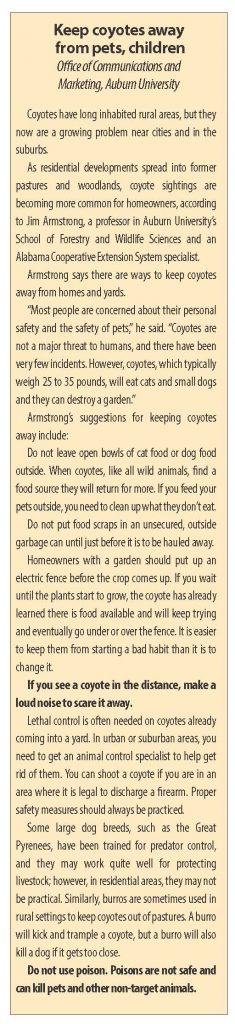
    “It’s an ongoing, horrible problem,” said Melanie Chastain who lives on Loner Road. “One came after me in February. Thank goodness I had another neighbor there, blowing her horn at it.” The coyote ducked through or over a fence and ran away. The coyotes also raided Chastain’s chicken flock.

    “I had 40 chickens and now I am down to 12,” she said. “Occasionally, you might lose a chicken, but I lost all those in a month. One night they walked off with an 80-pound goat.”

    Chastain complained that she has not been able to find any government agency that will help with coyote control in her area. In fact, no local or state government agency is charged with coyote removal in South Carolina – or apparently in any other Southeastern state.

    “Animal Control says they don’t do coyotes and to call DNR. DNR says you can shoot them,” she said.

    Richland County Animal Control’s mission is to deal with issues related primarily to dogs and cats. The agency does not deal with wildlife issues. The S.C. Department of Natural Resources deals with wildlife issues, but only tries to capture or kill a coyote when it presents an immediate danger to the public such as wandering into a schoolyard or shopping mall.

    “DNR has no role for removing coyotes. That is up to the private landowner,” said Charles Ruth, the DNR’s Deer and Turkey Project Supervisor, who also oversees scientific studies on wildlife species, including coyotes. But, he added, DNR has made it extremely easy for state residents to remove coyotes on their property and in their neighborhoods.

    “There is not a lot that you cannot do to coyotes,” Ruth said. “Coyotes can be hunted year-round.”

    He said property owners have to register their property with DNR to hunt coyotes year-round. Registration is done on-line and no fee is involved. A hunting license is required.

    Although there are no figures on how many coyotes are in South Carolina, Ruth said DNR estimates that hunters and trappers take at least 30,000 annually. Many are killed by deer hunters, he noted.

    A federal agency that conducts coyote controls in Western states does not provide that service in Eastern states, including South Carolina. A spokesman for the U.S. Department of Agriculture’s Animal and Plant Health Inspection Service in Columbia said the agency does some coyote control in Western states where they create problems with livestock.

    “But here in South Carolina coyotes have really not become a significant problem affecting livestock because there is not a large livestock industry here, other than chicken houses and we’ve never had a request (from chicken growers) for dealing with coyotes,” said Noel Myers. “There are backyard farm operations, such as people raising goats for milk, and they could experience some predation from coyotes and bobcats.”

    Myers said his office does get some calls, mainly from people who see coyotes in an urban area, but his agency does not relocate animals.

    “As we have more and more people, more growth and more urbanization, people are going to see more coyotes moving into their backyards,” he said.

    And that is what has some Blythewood area residents concerned. Chastain noted that several children were attacked by coyotes in North Carolina last year, both in Davie County between Statesville and Winston-Salem.

    Newspapers and television news reported that in March, 2018, a 9-year-old girl was bitten as she tried to escape a coyote and get into her house outside Advance, N.C. Two months later a father and his 7-year-old daughter were bitten by a coyote that attacked the girl as she was swinging on a swing set in the back yard of their home in Mocksville, N.C.

    These reports concern Clarence Bibbins, who has observed a coyote eating a dead deer in his backyard in Cobblestone Park.

    “I have small kids that play in my backyard. It’s kind of nerve wracking knowing the coyotes are out there.”

    Carol Propps-Wright, who lives in Abney Hill Estates said she can hear the coyotes howling in her neighborhood.

    “My neighbor and I used to walk in the neighborhood, but not any more. We are afraid of being attacked by the coyotes.”

    Every resident who expressed concern also expressed the desire that some agency, local or state, come in and trap or eradicate the coyotes. Under current laws and funding directives that is not likely to happen.

    Ruth suggested property owners and property owner associations should pay for hiring a wildlife control business to attempt to remove coyotes from local neighborhoods. DNR has a list of Wildlife Control Operators (WCOs), who perform wildlife control services on a contract-fee basis, at http://www.dnr.sc.gov/wildlife/control.html.

    The agency notes that WCOs are not DNR employees and are not affiliated with the DNR. DNR recommends asking for references and make sure all fees and guarantees are in writing

    The situation in South Carolina is basically the same as it is in all the other states in the Southeast and the situation in Blythewood is basically the same as it is in other communities throughout the region.

    Wildlife biologists in most states believe that reducing the coyote problem in a specific area is a short-term solution and basically lasts for only one breeding season.

    The North Carolina Wildlife Resources Commission recently drafted a coyote management plan which noted that coyote reproduction is density dependent. According to the CMP, if there are more coyotes than an area can support, coyote litter sizes will decrease, fewer pups will survive to adulthood and young coyotes will wait longer before first mating. If there are fewer coyotes but abundant food, then coyotes will produce bigger litters, will start breeding at younger ages and the odds of pups surviving to adulthood will increase.

    “Surprisingly, when as much as 60 percent of the coyote population is removed from an area, the population can recover within a year,” the management plan says. “Even if 90 percent of coyotes are removed, the population can recover in 5 years.”

    An NCWRC spokesman said capture and relocation of coyotes is not an option for the agency. The spokesman said NCWRC provides advice for local entities and residents to conduct their own removal programs. Adding: “We have no funding for local agencies to remove or eliminate coyotes.”

    Nor does Davie County where the two coyote attacks were reported last year.

    A spokesman for Davie County Animal Control said there is no government or public funding available for coyote control or eradication.

    “That would cost a lot of money and it’s very expensive just providing for dogs and cats,” the spokesman said. “We do advise people when they call that they can hunt coyotes year-round.”

    That doesn’t sit well with Chastain.

    “It’s just a matter of time before they attack some child here,” she said.

  • Doko title snafu cleared, but costly

    BLYTHEWOOD – During its first budget workshop for the fiscal year 2019-20 last week, Mayor J. Michael Ross asked Town Administrator Brian Cook to confirm that the $39,000 listed under capital improvement expenditures is the year-to-date amount the Town has spent on legal and professional fees associated with the sale of the Doko Depot building in 2019.

    Cook confirmed that it is.

    “So that should be enough to carry us through to closing?” Ross asked

    Cook said an additional $2,500 is budgeted for the closing.

    The sale of the Depot has been delayed since December, 2017, for myriad reasons. In September, 2018, Ross announced a new, more serious delay – this one caused by the discovery that property title restrictions had not been disclosed to the Town in prior financing efforts with Santee-Cooper.

    At last week’s council meeting, Ross said the title is now clear, but because the process took so long, the bank is requiring the purchaser to get new financing.

    “They are in the process of doing that now,” Ross said.

    Ross said the delay in the sale has also caused extra costs for the Town, including taking insurance out again on the building.

    “Hopefully, we’ll soon be able to announce a closing,” Ross said. But he said he could not yet estimate when that would be.

    Freeway Music and a second location for a popular Lexington restaurant, the Old Mill Brew Pub, are expected to be the eventual tenants of the building.

  • Bridge Champ

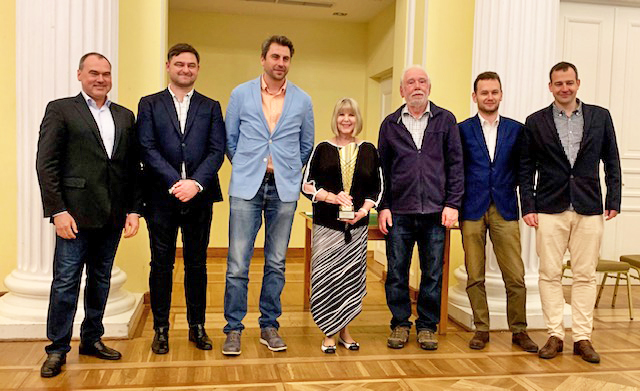
    WARSAW, POLAND – Blythewood’s Joyce Martin Hill competed last week in the Palace Cup International Bridge Tournament in Warsaw, Poland. The team, made up of Hill and six others from around the world, took home a $1,000 prize.

    Hill began playing bridge at age 12 with her parents, who belonged to two bridge clubs. On a World Cruise in 2003, she took up duplicate bridge. “After that, I was hooked,” Hill said. She currently has over 10,000 points, which puts her in the top .02% of competitive players. She is a Grand Life Master, has four national titles and a second place, won in Hawaii last November.

  • Blythewood claims Game 1 of the 5A championship series

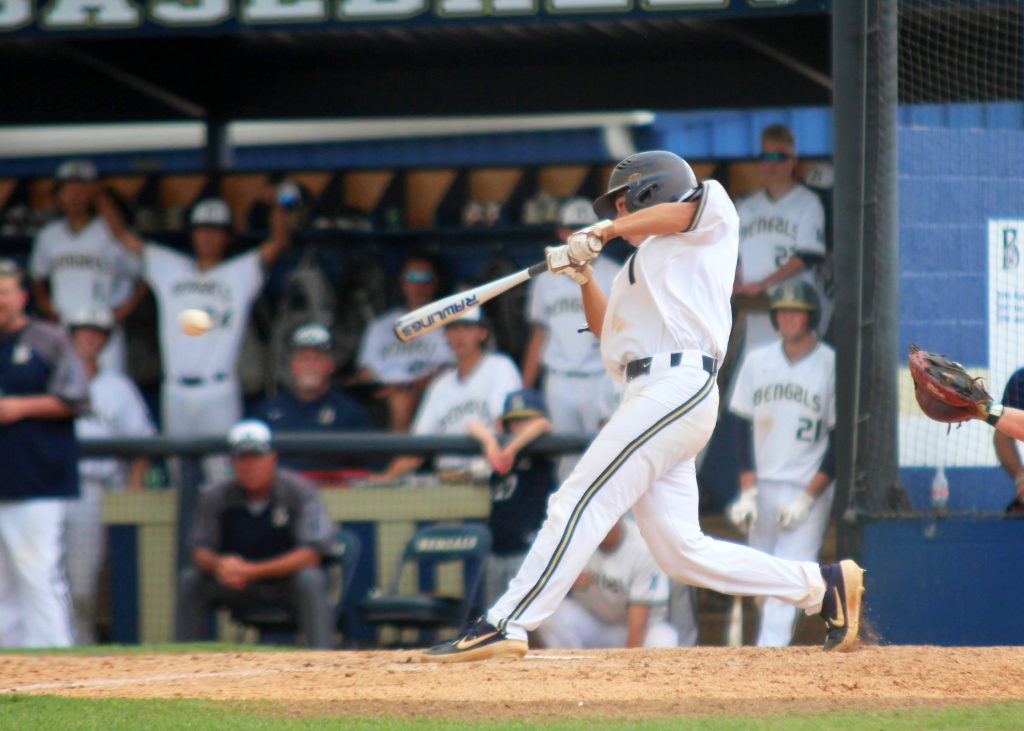
    Michael Gregory (12) scores from Zach Bailes’ walk-off single to give the Bengals the 2-1 win in the ninth. | Photos: Martha Ladd

    BLYTHEWOOD – Zach Bailes’ last hit in his home ballpark was a bouncer up the middle that barely made it to the outfield.

    For the Bengals, that little hit Bailes cracked with two out in the bottom of the ninth was the shot heard ’round the Midlands.

    Zach Bailes (7) was 2-5 on the night.

    Bailes hit a 1-0 pitch hard back to the mound, but neither relief pitcher Andrew Fulmer nor second baseman Noah Jackson could get a handle on it. As the ball bounced beyond second base, Michael Gregory easily made his way home to clinch a 2-1 Game One victory in the best-of-three series in the last game of the season at Bengals Field.

    “It was the ninth inning and rain was coming, I just figured we may as well go home,” Bailes said. “Rain was coming, I heard the thunder. I just did everything to get a hit there.”

    The play happened as Blythewood head coach Banks Faulkner signaled Gregory to go for home and for courtesy runner Mulukan Hass to break for second.

    “We were grasping for it there,” Faulkner said. “Michael Gregory does what he’s done all season. He comes up with a huge hit with two outs and we took a chance there—sort of who we are—we took a chance running them there, and it was just an incredible job by our guys finding a way to win.”

    The walk-off win erased a strong performance from Dutch Fork left-hander Sam Hatcher. Hatcher worked eight full innings, scattered six hits and struck out four. He threw 101 pitches and picked off or stranded eight Blythewood baserunners from the second through the sixth inning.

    “Hats off to their kid, I thought he competed,” Faulkner said. “He did a good job keeping us off balance. We just could not scratch a run there in the middle innings. It was almost a relief to get him off the mound and see a different arm.”

    Blythewood (26-8) travels to Dutch Fork (22-11) Tuesday at 7 for the second game. Winning Saturday obviously was advantageous for the Bengals, but the team knows the season isn’t finished.

    “It’s big,” Faulkner said about Saturday. “Anytime you win the first one, it’s huge. We like our position, but we know we’re going to go into a hornets’ nest Tuesday night against a really good team. We’ll face a really, really good arm and we’ve got our work cut out for us.”

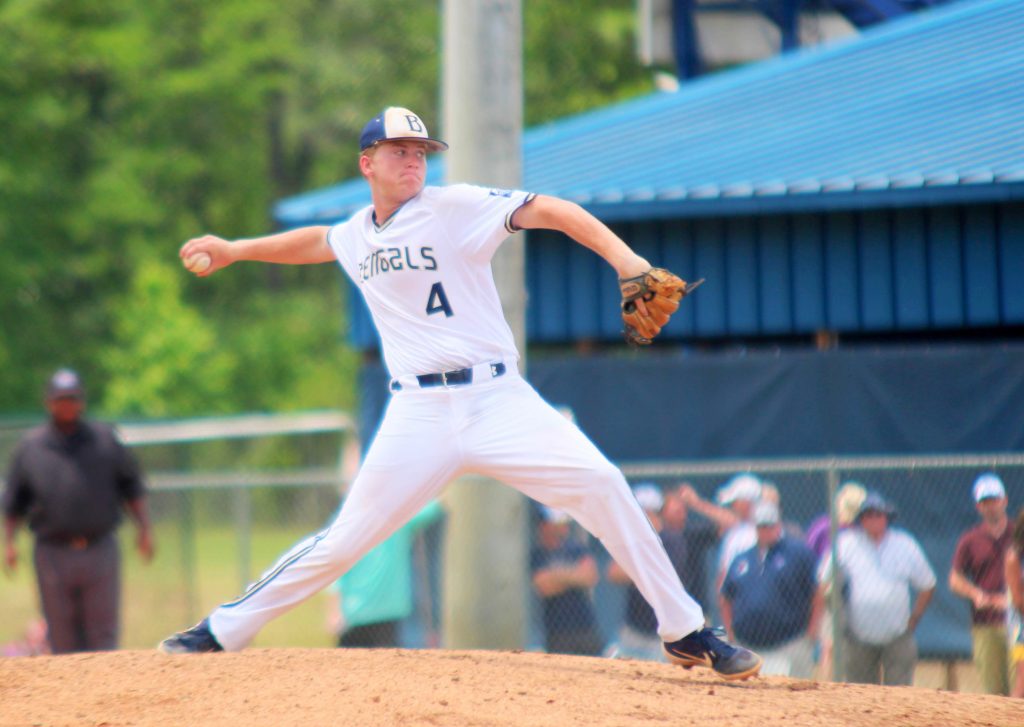
    Bailes’ hit gave the win to closer Josh Cowan, his first of the year. Cowan came on in relief of starting pitcher Landon Lucas, who worked 7 1/3 innings and pitched five innings of no-hit ball after giving up Dutch Fork’s only run in the second. Cowan also no-hit the Silver Foxes over his 1 2/3 innings on the mound.

    Lucas and Cowan frustrated the Dutch Fork bats after the Silver Foxes got a run on Jay Metts’ sacrifice fly that scored Brice Alexander. After that play, the pitchers retired the next 22 batters.

    Landon Lucas (4) worked 7.2 innings on the mound in Game One, allowing only two hits and one run.

    “Landon kept it tight, pitched great the whole game, Josh came in and shut it down,” Bailes said about the pitchers holding off. “It was a great team effort, Mulukan running to second hard helped us, everyone before me getting on base helped.”

    Dutch Fork actually got to Lucas early, getting its first three batters, Ty Olenchuk, Hugh Ryan, and Brian Holmes to reach base with a walk, a single and an error, respectively.

    From there, Lucas stuck out Noah Jackson and Crosby Jones, then tossed Lance Fuhr’s shot back to the mound to first baseman John Lanier to get the third out.

    After putting Blythewood on the scoreboard with a solo home run in his team’s half of the first, Lucas gave up a hit to Alexander and saw Jaylen McDuffie reach on an error with nobody out. Metts drove a long fly ball out to centerfield for Nate Hinson to glove, and that enabled Alexander to tie the game at 1.

    Lucas then got Olenchuk to pop out and Ryan to ground out to retire the side.

    “It goes to my teammates making the plays,” Lucas said about his mound performance. “I didn’t make as many strikeouts as I would’ve liked, but they just hung in there and made the plays for me.”

    From the second inning onward, Dutch Fork had just one baserunner, Jones. Jones reached base on a catcher’s interference call with two out in the ninth.

    Cowan got Fuhr to hit into a fielder’s choice to retire the side in the ninth and set up Blythewood’s last offensive effort.

    With Fulmer on the mound to start the ninth, Dutch Fork got Brady Beasley and Jansen Stokes out in infield grounders. Gregory’s single to left gave the Bengals life though, and they leapt at their chance to clinch Game One.

    Cowan reached base on an infield error that brought Gregory over to third. With Hass taking the place of Cowan at first, the Bengals had the table set for Bailes, who delivered.

    “You know, the bats had to break eventually,” Faulkner said. “Thankfully for us we hit it in just the right spot and found a way to win.”

    Blythewood 2, Dutch Fork 1, 9 Innings

    Dutch Fork – 0-1-0-0-0-0-0-0-0 – 1, 2, 2

    Blythewood – 1-0-0-0-0-0-0-0-1 – 2, 8, 2

    WP: Josh Cowan (1-0) LP: Andrew Fulmer

    Hitters: Blythewood – Zach Bailes 2-5, GWRBI. Landon Lucas HR (7).

  • Blythewood artisan creates flowers from clay

    BLYTHEWOOD – A dewy, delicate arrangement of orchids . . . that lasts forever. It sounds like hothouse hocus-pocus, but Blythewood’s Chatchakorn ‘Jom’ Sonday can make it happen.

    A native of Thailand, Sonday is one of the few artists in America who specialize in clay flowers, a traditional Thai art that involves sculpting and painting a fine white clay into remarkably lifelike flower arrangements.

    Sonday displays some of her clay flowers at Arts on the Ridge. | Barbara Ball

    Sonday’s award-winning clay flowers are favorites at juried art shows in Atlanta, Asheville, Charleston, Hilton Head and Charlotte and are available for sale in area art galleries and through custom orders. Sonday designs 70 or so kinds of flowers, including orchids, which are arranged in natural driftwood or decorative pots.

    “Each arrangement is unique,” Sonday said. “I receive a lot of custom orders around Valentine’s Day, Mother’s Day and Christmas.”

    She also has available in her studio a collection of ready-to-purchase arrangements on those holidays for those procrastinating shoppers who are looking for something both beautiful and unique at the last minute.

    Sonday first discovered clay flowers in 2004, while still living in Thailand.

    “I was shopping at the JJ (Chatuchak) Market, a huge weekend bazaar in Bangkok, when I noticed an exquisite lady slipper orchid display in a flower vendor’s booth,” Sonday recalled.

    “I love orchids, and lady slippers especially,” she said, “because each flower is so unique, like a fingerprint. The flowers I saw, which were arranged in driftwood, looked so real. But the shop keeper explained that the flowers were actually made of clay. I was fascinated. Even though I had a small budget, I bought a little flower to bring home.”

    Sonday grew curious about the process of creating the lifelike flowers, and she eventually signed up for a six-month class at an art school in Bangkok.

    “At the time,” Sonday said, “I worked as a hotel receptionist, and didn’t imagine I’d be able to do something else, much less become a professional artist!”

    But she’d always loved art, especially drawing and painting, and soon she was creating clay flowers as an enjoyable hobby and sharing them as gifts for friends. Before long, she was selling her work to the market vendor where she had first discovered clay flowers.

    “Then I started receiving requests from my friends,” Sonday said, “for flowers that they could give as gifts.”

    Now her work is displayed in local galleries and at regional festivals and flower shows. She said she appreciates the many opportunities for artists in America.

    “I love it here,” she said. “Everywhere you go, you can show and sell your work. In Thailand, it’s much harder to connect with buyers and display and show art.”

    Sonday and her husband, Donald, moved to the U.S. in 2009 after marrying in Thailand the previous year. They settled for a short time in Pennsylvania, then moved to Blythewood when his company relocated. Sonday now stays home with their 7-year-old son, Jason, and spends many hours in her studio creating new work for shows and custom orders.

    “I wake up at five every day,” she said, “and work in the studio for three hours, before my son gets up. Then I work a couple of hours after breakfast and three or four hours in the evening.”

    Although Sonday learned the basics of the craft in her Bangkok class, she said that practicing and experimenting on her own over the years is how she’s learned many meticulous techniques that make her flowers look extraordinarily real.

    “You have to learn those things yourself,” she said.

    Sonday uses Luna and Thai clays, which she purchases in bulk during her trips home to Thailand every couple of years.

    “I can’t get those types of clay here,” she said. “The clay available here breaks easily. The quality of Thai and Luna clay is like Japanese clay. Luna clay is soft and delicate, and creates a more realistic-looking flower. Thai clay is hardier, and better for stems and leaves.”

    Her process varies depending on the specific flower, but often includes mixing oil color into the fresh clay, pressing the clay through a pasta maker for uniform thickness, shaping the individual petals and forming the flowers. When the flowers have dried, she makes and attaches the leaves, then paints details by hand and places the arrangement into a base. The process can take a couple of weeks, and she often works on four or five arrangements at a time.

    She also continues to incorporate new skills into her work.

    “I recently took a class in Thailand to learn how to sculpt small-scale items such as animals and human figures,” Sonday said. “It will be fun to combine that with the flowers and make a small garden scene, with trees and people sitting in the shade.”

    Depending on the dimensions and complexity, Sonday’s flowers are priced from $7 to $600. Custom orders range from detailed miniature and even bonsai sizes to 2-foot-tall displays. Locally, her work can be seen at the Village Artists Gallery in the Sandhills and on her website at jjsclayflowers.com, and shipping is available. For more information or to order for Mother’s Day, go to her website.

  • Drop-in planned for departing magistrate

    Robinson

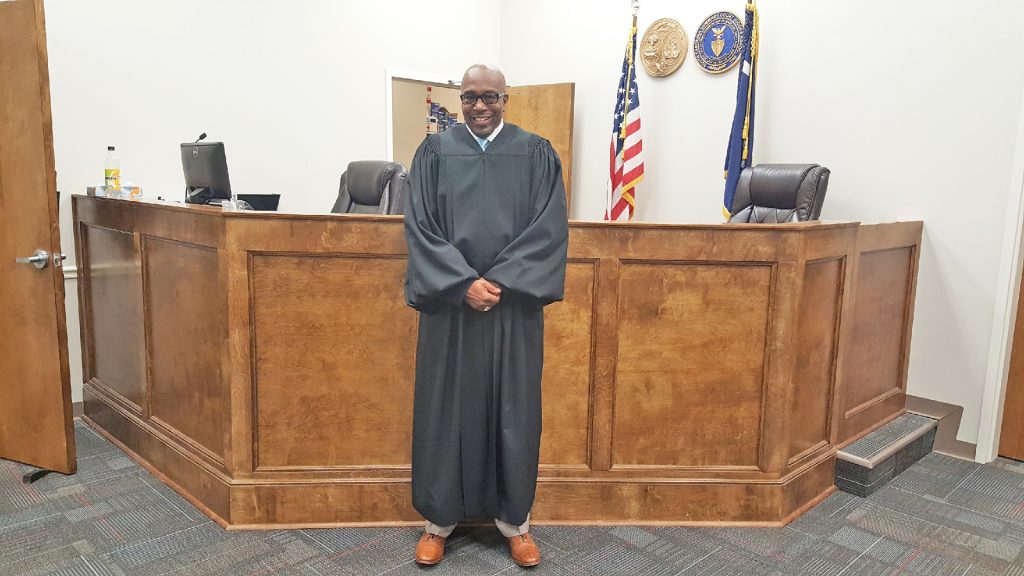
    BLYTHEWOOD – Prior to the May 28 town council meeting, Mayor J. Michael Ross and council members will host a reception honoring Blythewood’s Magistrate, Judge Josef Robinson, and his staff.

    Robinson, who was serving his second term after being appointed to the bench by Sen. Joel Lourie in 2014, said he was notified by Sen. Mia McLeod last month that he would not be reappointed. After Lourie did not seek re-election in 2016, McLeod was elected in 2016 as his successor.

    A popular magistrate with both the community and the town government during his tenure in Blythewood, Robinson made himself available for town government functions such as swearing in ceremonies, as well as riding in the town’s Christmas parade and attending other community events as well.

    “We are going to truly miss Judge Robinson,” Ross said. “We couldn’t have had a better judge to serve as Blythewood’s first magistrate. He did a great job in the Courtroom here and I think most everyone regarded him as fair and compassionate.

    “I was disappointed that we were not contacted that the Judge was not going to be reappointed,” Ross said.

    “It would have been a nice courtesy to have been notified about something like this that effects our community,” Ross said. “Judge Robinson is a fine example of a public servant and our community will miss him,” Ross said.

    A 14-year veteran of the S.C. Highway Patrol before being appointed Blythewood’s magistrate, Robinson said he felt being a state trooper turned out to benefit his role as a judge.

    “It prepared me for the criminal and civil sides of my job, learning traffic laws, making traffic stops and dealing with attitudes all over the place,” Robinson said. “When Sen. Lourie appointed me he stressed that a judge needs to be fair and impartial. I lived by those tenets. I tried to give everyone their time and hear them out till their case was done. I tried to listen to what people had to say and not rush to a decision. A lot of people would come to court feeling they didn’t have a chance. But I think most people who came before me felt I was fair – even some of those who I ruled against,” Robinson said.

    “I loved the job and I loved serving the people in this community,” he said.

    Robinson said he now plans to return to law enforcement, serving as a public information officer under Sheriff Leon Lott.

    The public is invited to the reception for Judge Robinson and his staff at 6:30 p.m., Tuesday, May 28, at the Doko Manor in Blythewood.

  • Switzer resigns chamber post

    BLYTHEWOOD – In what it called a leadership transition, the board of directors of the Greater Blythewood Chamber of Commerce announced Friday that executive director Mike Switzer has resigned his post with the Chamber.

    Switzer has served as the Chamber’s executive director since 2014. During his tenure he has expanded the Chamber’s membership and programming, Chamber board chair Matt Cunningham said in an email to Chamber members.

    “I am proud to have led the Chamber during this period of tremendous growth,” Switzer was quoted in the email. “I am grateful for the many businesses who have joined the Chamber and for all who have given of their time and talents to help the Chamber and our community grow and prosper.”

    While the Chamber has grown from 20 or so members to 187 under Switzer’s leadership in the last five years, much of that growth has come from businesses outside the town. Switzer has come under increasing public criticism from Mayor J. Michael Ross and some of the town’s businesses for focusing on bringing in large out of town businesses instead of focusing on bringing prosperity to what Ross calls the town’s mom and pop businesses.

    The Chamber’s financials have been a target of investigation by The Voice newspaper for almost two years.

    Last month, almost a year after the Chamber was unable to produce a credible set of books to Town Hall for the previous budget year, the Chamber’s board chairman-elect Phil Frye told Council last month that the Chamber still does not have a working budget or even a draft budget to present to Council.

    In May, 2018, after an investigation by The Voice of the Chamber’s financials, Council called for the Chamber, which is funded primarily by the Town, to turn over its complete financial records by June 12, 2018. Copies of those documents were subsequently provided to The Voice by town government officials.

    After being asked by The Voice to review the documents, CPA and former Town Councilman Bob Massa concluded the submitted financials were “confusing, lacking in detail and sometimes impossible to follow and understand.”

    Massa said records submitted by the Chamber indicated that $18,500 provided to the Chamber by the Town Council to fund a Visitor Center was more likely used to help pay the Chamber’s operating expenses, and that the Visitor Center served as little more than a pass-through for those funds to the Chamber.

    On June 25, 2018, council voted unanimously to stop funding the Visitor Center after Dec. 31, 2018.

    Financial records submitted to the town government at FY 2017-18 year end were also lacking in details for thousands of dollars the Chamber received from the town, t-shirt sales, sponsorships and other sources for events including the Big Grab and the Eclipse.

    Still, in February, 2019, Town Council voted to award another $14,000 of Hospitality Tax revenue to the Chamber for a fundraiser for itself.

    In an application requesting the funding, Sarah Ballard, an event manager hired for the event – a Bavarian Oktoberfest – noted that it was being held to raise funds for the Greater Blythewood Chamber of Commerce, and that it will also provide an opportunity for residents of Blythewood and the surrounding areas to build community and learn about Bavarian culture.

    The request said the total project cost would be $37,394 and would be partially funded by the proceeds from food, merchandise and beer sales ($14,500), cow paddy bingo ($18,450) and sponsorships ($10,000) plus $1,520 in in-kind services.

    According to the request, the Chamber expects a total net profit of $21,125.12.

    The Town has also funded the Chamber with a grant each year to cover operating expenses. Last year, the grant was for $19,500. According to the agenda of the April, 2019 Council meeting, the Chamber is expected to ask Council for $20,500 for the upcoming budget – $17,000 for an economic development work subsidy (previously called a grant by town officials) and $3,500 for an ‘elite partner’ annual membership for the Town government at the Premier Level.

    Since last summer, Ross has partially, though not officially, recused himself from discussions/voting on Chamber funding since he and a business partner are the Chamber’s landlords for the space the Chamber rents in McNulty Plaza in downtown Blythewood.

    In the announcement on Friday of Switzer’s resignation, Cunningham said Switzer is leaving his post with the Chamber in order to dedicate more time to one of his business ventures.

    The board has appointed Phil Frye to serve as interim manager, effective immediately. Frye is managing director of Pee Dee Enterprises, Ltd. and is the former chair-elect of the Chamber board. He received the Chamber’s community service volunteer of the year award at its gala in December.