Category: Schools

  • Scholarship Gala set for Feb. 16

    WINNSBORO – “This is a time to come together for a good cause…to help our children,” Sylvia Harrison, the founder of Sylvia’s Foundation, said.

    Harrison’s 10th annual Scholarship Gala is scheduled for Feb. 16, from 7 to 11 pm., at the Old Armory, 301 Park Street, Winnsboro, SC 29180.

    “We have been so blessed,” Harrison said.  “Thanks to this fundraiser we have been able to provide college scholarships to 60 students over the years.  Last year we awarded 10 scholarships to Fairfield County students.”

    Each scholarship this year will be in the amount of $500.

    A committee processes the applications for the scholarships and selects the recipients from high school seniors. Students who attend Fairfield Central High School or Richard Winn Academy are eligible.

    “I do this because I know how expensive it is to put kids through college. I know because I put my three through,” Harrison said.

    The semi-formal, dinner and dance event will be catered by Jackie Bannister and will include music with DJ Don Prioleau and DJ Pete.  Highlighting the evening will be a line dance performance by the Palmetto Groovers. The evening’s guest speaker will be Pastor Reginald Bryden.

    Photographer Dwight Robertson will be on hand taking individual photos of the guests.  A portion of the proceeds from photo purchases will be donated to Sylvia’s Foundation.

    Tickets are $30 and can be purchased in advance at Sylvia’s Designs Unlimited, 126 N Congress Street in Winnsboro, from 7 a.m. to 6 p.m.,Tuesday through Friday, and Saturdays from 7 a.m. to 2 p.m.

    For more information call Sylvia Harrison at 803-635-6939.

    “Our feedback from the student recipients has indicated that these funds make a big difference in getting them started on a successful path.  Hope you will join us in this opportunity for fellowship for a good cause.  Children are our future,” Harrison emphasized.

  • Planning Commission gives Village green light for Feb. 14 vote

    WINNSBORO – In a workshop held last week at the Old Armory to discuss the Fairfield County School District’s application for R-3 zoning for a Teacher Village, the Winnsboro Planning Commissions determined they had sufficient information to move forward with the request.

    Moving forward meant setting dates for a Planning Commission meeting that will include a public hearing followed by a vote on whether or not to recommend (to town council) the zoning change from C-2 to R-3, which permits three homes per acre and would allow cluster housing on 22 acres behind the district office off U.S 321 bypass.

    While there was some discussion as to whether the public would attend a public hearing on Valentine’s Day evening, the Commission decided to set both the public hearing and vote for Feb. 14, at 6 p.m.

    The preliminary site plan for the development does not subdivide the Teacher Village into individual lots. Rather, the entire development consists of one lot, planning documents show.

    R3 has less strict design standards than other residential zones, allowing for reduced spacing between buildings – 25 feet, front to front; 20 feet, front to side; and four feet, side to side – than R1 or R2 zones.

    It also only requires 20 percent of open space, as opposed to 35 percent for R1 and 25 percent for R2.

    Yard sizes are also significantly less, planning documents state.

    Required rights of way in an R3 zone are 6,000 square feet for the first home and 2,500 square feet for each additional dwelling unit. An R1 zone requires 6,000 square feet for all units. In an R2 zone, the minimum square footage is 10,000 square feet.

    Fairfield County educational leaders have touted the Teacher Village as vital in recruiting and retaining teachers.

    At issue during the workshop was whether the school district’s request had met the requirements for moving forward.

    For openers, Building and Zoning Director Billy Castles told Commissioners that, based on the scaled drawings submitted, the house footprints were too large for the spaces allotted.

    Later in the discussion, Vice Chair Sam Johnson concurred that the house footprints were all too large for the rectangle spaces allotted for the houses.

    “Would it have been to our benefit to have had the engineer (who drew the plans) here tonight to help with this?” Commissioner Sonja Kennedy asked.

    “It would have been,” Castles said, but explained that because the engineer is doing pro bono work for the school, he would not be attending the meeting.

    “Dr. Green sent me an email saying if I had any questions, get them to him and he would go to the engineer and get it in writing,” Castles said.

    To move past what was becoming a logjam, Sue Rex, president of the Fairfield County School District Education Foundation, reached the engineer, Josh Rabon, on the phone. After some discussion with Commissioners, he determined that the scale was apparently off and offered to re-scale the drawing and email it to them, which he did. While Castles and Rex went to Castle’s office to print out the new scaled plat, the Commissioners discussed whether they had sufficient information (with the corrected scale drawing) to move forward with a recommendation to Town Council.

    Going over the list of requirements as outlined in the town ordinance, Johnson suggested they should not quibble over details.

    “The real issue,” he said, “is whether they (District) are presenting a somewhat coherent plan that meets the intentions that are laid out for us to make a decision as to whether we can justify making a recommendation to Council to change it from C-2 to R-3. As I see it, it looks like we’re headed in the right direction. At the end of the day, it’s probably not going to look like it does as it was given to us.”

    Commissioner Oliver Johnson agreed.

    “Are these perfect architectural drawings?” Oliver Johnson asked, then answered, “No. It (ordinance) doesn’t say they have to present to us the final detailed plan, just, basically, do they have a plan that looks potentially doable.”

    Johnson said the detailed site plan will be in the permitting process, “when they start to build,” Johnson said.

    The public hearing and vote is set for Feb. 14, at the Old Armory, 301 Park Street, Winnsboro. The Planning Commission’s recommendation for or against the rezoning will go to Town Council for the first of two votes on Feb. 19.

  • BHS Junior scores perfect on ACT

    Luedicke

    BLYTHEWOOD – Adrienne Luedicke, a Blythewood High school junior, received a perfect score of 36 on her ACT the first time she took it.


    “I wasn’t expecting to do well at all,” she said.  “I saw it [the score] and showed my mom and we both just started screaming. I definitely cried.”

    She hopes her scores will help her get into the college of her dreams in Germany.

    School officials say they weren’t surprised at Luedicke’s score. She is currently taking four AP classes, has a 5.0 GPA, is a 1st Lieutenant in the ROTC with one of the highest PT scores.

  • R3 zoning sought for Teacher Village

    WINNSBORO – Fairfield County education leaders have amended a rezoning request for the proposed “Teacher Village” from PD-R, Planned Development-Residential to strictly residential.

    The change in zoning plans was presented last week to the Winnsboro Planning Commission, a week after a previously scheduled meeting was canceled to give the Fairfield County School District more time to assemble the required planning documents.

    Now the district is requesting an R3 zone, which permits three homes per acre and would allow for cluster housing on 22 acres behind the district office off U.S. 321 Bypass.

    The planning commission took no action on the Teacher Village at a meeting last week, but did vote to accept the district’s application package.

    Speaking in public comment, Winnsboro resident Shirley Green, a member of the Fairfield County Education Foundation, said the rezoning should be approved.

    “This rezoning is a large step for the Fairfield County School District Education Foundation, and a giant step for the Town of Winnsboro to infuse our community with housing to attract teachers, first responders and their families,” Green said.

    The R3 zone is a strictly residential zone, allowing only residential uses, whereas the PD-R allows a limited amount of non-residential structures as secondary uses, according to town planning documents.

    A preliminary site plan for the development does not subdivide the Teacher Village into individual lots. Rather, the entire development consists of one lot, planning documents show.

    R3 also has less strict design standards than other residential zones, allowing for reduced spacing between buildings – 25 feet, front to front; 20 feet, front to side; and four feet, side to side – than R1 or R2 zones.

    It also only requires only 20 percent of open space, as opposed to 35 percent for R1 and 25 percent for R2.

    Yard sizes are also significantly less, planning documents state.

    Required rights of way in an R3 zone are 6,000 square feet for the first home and 2,500 square feet for each additional dwelling unit. An R1 zone requires 6,000 square feet for all units. In an R3 zone, the minimum square footage is 10,000.

    Fairfield County educated leaders have touted the Teacher Village as vital in recruiting and retaining teachers.

    Billy Castles, Director of the Town of Winnsboro Building and Zoning Department, has set a workshop for the Planning Commissioners to discuss the preliminary site plan at 4 p.m., Thursday, Jan. 24, at the Old Armory, 307 Park Street, Winnsboro.

  • Public puts pressure on R2 chair

    Board Opens Door for Removal of Members from Office

    COLUMBIA – Calls for the resignation of Richland Two school board chair Amelia McKie grew Tuesday night, with a fellow board member joining in those calls.

    Meantime, two other board members are suggesting publicity of missing school board ethics forms has been “racially motivated.”

    During the Board and Superintendent Comments portion of Tuesday’s board meeting, board member Lindsay Agostini publicly called for McKie to step down as chair.

    Agostini said McKie has been evasive and dishonest in addressing unfiled ethics reports and subsequent fines from the state.

    “After being informed by media of missing documents which took over a month for the chair to complete, she has taken no ownership of any wrongdoing,” Agostini said. “As you try to straighten things up for you and your family, I at a minimum ask that you step down as chair. A premier district deserves a premier board.”

    In prepared remarks, McKie apologized later in the meeting for not filing her ethics forms. She said her forms are now current, and that she’s working with legal counsel to address nearly $52,000 in fines she owes the S.C. Ethics Commission.

    “I am responsible and I am not running from those problems,” she said in prepared remarks.

    McKie went on to state she’s faced numerous personal attacks since her ethics problems came to light.

    “I have a problem that my character is maligned. Everything that I have said has been accurate at the time. My filings are accurate with the commission,” she added. “Not necessarily everything you have read or seen is accurate. I will not have my character maligned when there are two sides to a story.”

    McKie’s statement didn’t address whether or not she planned to resign.

    After the meeting, she declined to comment, deferring The Voice to her prepared statement.

    Board members float race issues

    At the Jan. 8 meeting, Board member Teresa Holmes thanked The Voice for its news coverage of missing ethics forms, including her own.

    “I’m brand new to this, I had no idea,” Holmes said. “I’m glad that you actually did the story. Nobody tells you these things when you’re running.”

    But at the Tuesday night meeting, Holmes did an about face, questioning the accuracy of the news reports about ethics issues, hinting race factored into it.

    “All of the stuff you saw in the paper wasn’t necessarily factual,” Holmes said. “Some of it was racially motivated, I really do believe that.”

    When asked after the meeting what specifically was reported incorrectly, Holmes would not comment.

    Board member Monica Elkins-Johnson challenged the accuracy of news reports as well, but also could not say what was incorrect.

    “I hope that we will not judge people on their skin tone, on mistakes, on their actions,” Elkins-Johnson said. “Give people an opportunity to prove themselves. People don’t know what’s going on in your household. Sometimes the media doesn’t always report things accurately.”

    Stephen Gilchrist, a board member with the Richland Two Black Parents Association, said following state ethics laws is not about race.

    “It’s not a racial issue from our perspective,” Gilchrist said. “This is about ethics issues Ms. McKie is dealing with, and of course the board in Richland 2.”

    Similar messaging appears on the association’s website and Facebook page.

    “Ethics is not synonymous with race! Let’s not draw that association,” the group’s Facebook page states. “When an issue is about personal ethics, let’s not attempt to draw parallels to our turbulent socio-politically, charged racial climate. Wrong is wrong and right is simply right!”

    Jay Bender, an attorney with the S.C. Press Association, of which The Voice is a member, noted that in 2012 about 250 Republican candidates for state office were booted off the ballot for not properly filing ethics forms.

    Most of the candidates were white, Bender said.

    “Ethics problems in South Carolina appear to be as neutral as anything,” he said. “The threshold is are you a public official, not whether you are white or black.”

    The Ethics Commission’s debtor list, a running public list of individuals with unpaid ethics fines, also consists of a clear mix of black and white candidates and lobbyists.

    More resignation calls

    Richland Two parent Rhonda Meisner once again asked McKie to resign during public comments. She also asked McKie to return any public money she’s received as a board member.

    “I know that is not a very nice message, but that is a message that needs to be addressed in my opinion,” Meisner said.

    Columbia resident Gus Philpott called for McKie’s resignation as well.

    “In view of the $52,000 amount of her fines from the ethics commission, I request that she immediately and voluntarily step down from the board,” Philpott said. “If she fails to step down, I believe that the board must remove her.

    “Matters of ethics are definitely not a distraction,” Philpott added. “This is an ethical issue, please address it now.”

    Calling McKie a “doer,” Innocent Ntiasagwe spoke in support of the board chair.

    “It’s good for us to pay attention to look at the good in the work that we do, not just some innuendos that may arise every now and then,” Ntiasagwe said. “Some people only look back and see what is wrong and don’t offer solutions.”

    In June 2018, the ethics commission fined McKie $41,000 in connection with multiple violations of not filing campaign disclosure reports.

    McKie was ordered to pay $21,000 by Dec. 31, 2018. When she didn’t, the fine jumped to $51,750, agency records state.

    Board proposes policy change

    Almost unnoticed, the district unveiled proposed revisions to a board policy relating to the election of officers, such as chairperson, vice-chair and secretary.

    According to the proposed change, a supermajority can vote to remove a Board officer from his or her office, which would require five votes.

    “In such a case, or in any case where there is a vacancy in a board office, the board may as soon as practical elect a member to fill the vacated office for the remainder of the term,” the revision states.

    If enacted, the board under the policy could strip a board member of their office position, but not their board seat.

    “I’m saddened that we had to revise this policy, but I’m grateful for those who’ve worked expeditiously to get this to us tonight,” Agostini said.

    Board member James Manning said the purpose of the policy is to address edge cases. He cautioned against using it for political purposes.

    “It gives us an opportunity should the need arise for us to address potential issues,” Manning said. “It really has to be a high bar for cause.”

    No votes were taken on the policy Tuesday night. That would likely occur at the next meeting scheduled for Feb. 12.

    The policy proposal comes in response to an investigation by The Voice into McKie and other board members with previously unfiled ethics forms. Six of seven board members either filed late or failed to file.

    Manning, previously believed to have filed his forms, told The Voice on Tuesday that he was recently fined $200 for two late filings. That information, Manning told The Voice, was only released by the Commission last week.

    He said the ethics commission reviewed all board members’ ethics filings after The Voice’s reports, and that he has since paid the fine.

    Other board members filed missing forms in December and January following reports in The Voice, public records show.
  • Feaster picked for Disney event

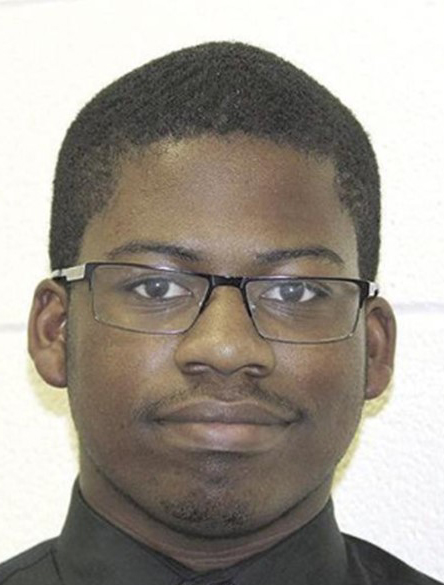
    WINNSBORO – Fairfield Central High School senior Jeffery Feaster, Jr. has been selected as one of 100 youths from across the nation to participate in the 2019 Disney Dreamers Academy featuring Steve Harvey and ESSENCE Magazine.

    Feaster

    Feaster will receive an all-expenses paid trip to Walt Disney World to participate in an immersive, four-day experience from March 21-24.

    According to the program, now in its twelfth year, it is billed as part of Disney’s commitment to helping the next generation of young people at a critical time in their development.

    “These students are in for a life-changing experience,” said Tracey D. Powell, Walt Disney World Resort vice president and Disney Dreamers Academy executive champion. “Our goal is to help them see the unlimited possibilities and to inspire them to achieve their full purpose- to become the heroes of their own stories.”

    Feaster and the other 100 “Disney Dreamers,” will embark on a journey that takes them throughout the Disney theme parks and behind the scenes of this 40-square-mile vacation destination were they will discover new career opportunities, pursue their dreams and interact with Harvey and other celebrities and motivational speakers.

    Additionally, students will participate in immersive career-oriented workshops ranging from animation to zoology.

    For more information, visit DisneyDreamersAcademy.com

  • Public puts pressure on R2 chair, board

    COLUMBIA – Calls for the resignation of Richland Two school board chair Amelia McKie grew Tuesday night, with a fellow board member joining in those calls.

    Meantime, two other board members are suggesting publicity of missing school board ethics forms has been “racially motivated.”

    Board member Lindsay Agostini led the charge of those calling for McKie’s resignation.

    “As you try to straighten things up for you and your family, I at a minimum ask that you step down as chair,” Agostini said. “A premier district deserves a premier board.”

    In prepared remarks, McKie apologized later in the evening for not filing her ethics forms. She said her forms are now current, and that she’s working with legal counsel to address nearly $52,000 in fines she owes the S.C. Ethics Commission.

    “I am responsible and I am not running from those problems,” she said in prepared remarks.

    She declined to comment on calls for her resignation, referring The Voice to her prepared statement.

    At least two board members injected race into the ethics debate.

    Board members Monica Elkins-Johnson and Teresa Holmes said news reports have been inaccurate, but, when asked, wouldn’t say what was incorrect.

    “All of the stuff you saw in the paper wasn’t necessarily factual,” Holmes said. Some of it was racially motivated, I do believe that. “Some of it was racially motivated, I really do believe that.”

    Stephen Gilchrist, a board member with the Richland Two Black Parents Association, said following state ethics laws is not about race.

    “It’s not a racial issue from our perspective,” Gilchrist said. “This is about ethics issues Ms. McKie is dealing with, and of course the board in Richland 2.”

    Read more about this story in Thursday’s edition of The Voice.

  • R2 board to discuss ethics issue again Thursday

    COLUMBIA – Once again the Richland Two school board plans to discuss ongoing ethics issues behind closed doors.

    Only this time the board is also slated to discuss board policies that address how board officers are chosen, suggesting changes to one or more leadership positions.

    An agenda for Tuesday night’s meeting lists six executive session items, including one for the “receipt of legal advice regarding Ethics Act issues and Board Policy BD.”

    Board Policy BD involves “Organization of the Board,” according to the school district’s website.

    Among other things, the policy details the process for the election of officers: chairman, vice-chairman and secretary. Officer elections occur in June, the policy states.

    Legally, the board couldn’t proceed with electing officers at Tuesday’s meeting.

    Recent changes in state law prohibit public bodies for taking action on an executive session item without also stating on the agenda that action may be taken.

    Tuesday night’s agenda lists three executive session items that may receive a vote, but the ethics discussion isn’t among them.

    At the board’s Jan. 8 meeting, concerned parent Rhonda Meisner called for board chairwoman Amelia McKie to resign.

    Meisner cited a section of state law that says elected officials failing to file Statements of Economic Interest forms with the S.C. Ethics Commission can’t be legally sworn in to office.

    A week later, the board scheduled a special meeting that consisted of a single agenda item – an executive session to “receive legal advice concerning Ethics Act issues.” The session lasted an hour and a half. No action was taken in public session.

    An investigation by The Voice found that McKie and four other board members failed to file either SEI forms or quarterly campaign disclosure reports, also required under state law.

    In June 2018, the ethics commission fined McKie $41,000 and ordered her to pay half by Dec. 31, 2018. When she didn’t, the fine jumped to $51,750, agency records state.

    Tuesday’s meeting will be held at the Richland Two Institute of Innovation at 763 Fashion Drive, Columbia. The executive session starts at 5:30 p.m., followed by a business meeting at 7 p.m.

  • R2 keeps ethics debate behind closed doors

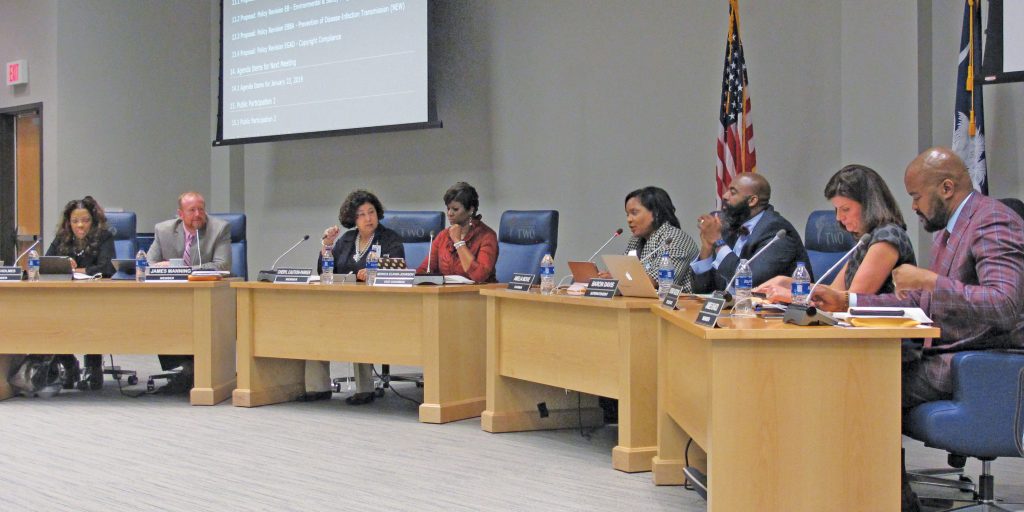
    Richland Two school board members, from left: Teresa Holmes, James Manning, Cheryl Caution-Parker, Monica Elkins-Johnson, Amelia McKie, Superintendent Dr. Barron Davis, Lindsey Agostini and James Shadd III. | Barbara Ball

    COLUMBIA – Despite some members dismissing an ongoing ethics flap as merely a distraction at a meeting last week, the Richland Two school board spent 90 minutes behind closed doors Tuesday night discussing that topic.

    At a special meeting, the board immediately retreated into executive session to receive “legal advice regarding Ethics Act issues.”

    No action was taken after the executive session – some of which was audible in the hallway – and the board promptly voted to adjourn.

    When pressed by The Voice about whether the executive session pertained to an individual member or the entire board, board chairwoman Amelia McKie wouldn’t say.

    “I can’t clarify that any more than what was said in the motion,” McKie said.

    Jay Bender, an attorney with the S.C. Press Association, of which The Voice is a member, said if the board discussed individual members’ ethics issues behind closed doors, the discussion would violate state law.

    “I don’t see any legitimate reason to get advice unless it’s regarding other board members,” Bender said. “If it’s regarding board members with individual ethics problems, I don’t think they can discuss any punishments that may be meted out.”

    During executive session some board member conversations were discernable in the hallway beyond the closed doors to the boardroom.

    Those conversations seemed to focus on violations of individual board members, which Bender said is not permitted under the S.C. Freedom of Information Act.

    The session appeared to become heated at times.

    Board member James Manning, one of two sitting board members with no previously missing ethics forms, wouldn’t comment on the specifics of what was discussed.

    “There was nothing to take action on. It was all just legal counsel,” Manning said.

    Manning noted the issue of ethics is likely to arise at a future board meeting.

    “I would keep an eye on the agenda,” he said.

    That was difficult to do with Tuesday’s meeting agenda, which was buried among four unrelated press releases in an email titled, “Dear reporters and editors, please find attached four news releases from Richland Two…” with no mention of the agenda or the special called board meeting in the body of the email. The agenda also did not appear on the school’s board docs.

    In recent weeks, several board members have come under scrutiny for failing to file various ethics forms required by state law.

    Richland Two parent Rhonda Meisner called upon those board members to resign. At the Jan. 9 meeting, Meisner stated during public input that state law prohibits members from being sworn into office if they haven’t filed Statements of Economic Interest (SEI) forms.

    In the 2018 election, board members James Shadd III, Cheryl Caution-Parker, Monica Elkins-Johnson, Teresa Holmes and McKie failed to file either SEI forms or quarterly campaign disclosure reports by deadlines set in state law, according to the State Ethics Commission.

    Those board members have since filed their forms following a series of investigative reports by The Voice.

    McKie, however, has garnered the most attention.

    In July 2018, the ethics commission fined her $41,000 for failing to file multiple quarterly campaign reports between 2015 and 2018. Those forms were not filed until last week, the ethics commission website states.

    The fine zoomed to $51,750 after McKie failed to pay the first $21,000 of the original $41,000 fine on Dec. 31, 2018.

    In all, McKie filed 16 forms on Jan. 9, 2019, including her 2019 SEI form that isn’t due until March 30. Also on Jan. 9, she filed her first quarterly campaign report of 2019, which was due Jan. 10.

    After the Jan. 8 board meeting, McKie said she planned to issue a press release addressing the ethics issues, but no statement had been released as of press time.

    The status of McKie’s fine remained unclear, however, as the ethics commission, as of Tuesday, listed her outstanding debt at $41,000, the original fine amount, instead of the $51,750, according to the agency’s debtor’s list.


    Barbara Ball contributed to this story.

  • District budgets $5K bonus for teachers

    Dr. Green and William Frick

    WINNSBORO – Hoping it will help recruit and retain teachers, the Fairfield County School District plans to dole out annual bonuses – $5,000 for educators and $3,000 for district and school staff.

    At its monthly meeting Tuesday night, the board voted 5-1 to award the bonuses. Board member Paula Hartman voted against the measure.

    Hartman said she’s not against bonuses, but felt caught off guard by the bonus proposal. She noted the district previously discussed using surplus funds to commission a salary study.

    “I’ve asked for salaries every year I’ve been on the board, and they don’t give it,” she said.

    At $49,288, Fairfield County’s average annual teacher salary ranks 37th out of 82 districts in South Carolina, according to state report card data.

    Richland 2 ranks sixth at $51,802. Lexington 5-Richland leads at $55,023, while Florence 4 is last at $43,087, report card data shows.

    Hartman also expressed reservations about budgeting money that doesn’t exist yet.

    “I thought this was going to come up in the budget. I didn’t think this was going to come up now,” Hartman said. “I feel like it would be more of an incentive for employees who’ve been here three years and have a commitment. That might keep them here.”

    It will cost the district $2.8 million to fully fund bonuses for 2019. Bonuses would be available to any existing full-time employee, no matter the length of employment, as well as future full-time hires, district officials said.

    The first $1 million comes from a surplus carried over from last calendar year, money Superintendent Dr. Jr. Green has previously stated would be applied to boosting teacher pay.

    Green said during the meeting that the general fund would increase by $1.8 million to cover the rest.

    “I am hoping this inspires people who aren’t part of Fairfield County to be inspired to join Fairfield County,” Green said.

    Board chairman William Frick said after the meeting that the source of the $1.8 million comes from presently unbudgeted surplus funds the district anticipates receiving.

    “There is a forecast that next fiscal year we’ll have an additional $2 million that can be rolled over instead of allocating it toward capital projects as we’ve done,” Frick said. “The idea is to take that entire $2 million to fund this.”

    There are no tenure requirements for the bonuses; Green said he plans to make them an annual perk. He said this is an annual program, adding it would take a major economic downturn to cut bonuses, a downturn he thought was unlikely.

    All employees would be eligible, including district office administrators, though board members said they don’t know if Green would qualify for a bonus since he’s a contract employee.

    If Dr. Green did receive a $3,000 bonus, it would bump his annual salary from $182,287 to $185,287.

    Green also has an annuity contribution of $29,165, though district officials still can’t say whether the annuity is paid from the district budget or by Green personally. The Voice filed a public records request for that information on Dec. 19, 2018, and is still waiting for clarification.

    District officials said Tuesday that a bonus is better than a conventional salary increase because the district and employees aren’t required to contribute a percentage into retirement funds for bonuses.

    However, the federal government taxes most bonuses at 22 percent, according to the Internal Revenue Service.

    That means a school district employee receiving a $5,000 bonus would take home $3,900 after federal taxes. A $3,000 bonus translates to $2,340 after federal taxes.