BLYTHEWOOD – A Westwood High School student has been charged
with multiple crimes after bringing weapons on campus Tuesday, the Richland
County Sheriff’s Department reported.
The 15-year-old student was overheard by another student
threatening to “shoot up the school.” He later brought the weapons to the
school, the sheriff department’s news release said.
The student who heard the threat reported it to his parents
and school staff, who contacted Westwood’s school resource officer, it was
reported.
When the student arrived at school Tuesday morning, he was
interviewed by Sheriff’s deputies and admitted making the threats, according to
the news release.
Sheriff’s deputies searched the student and found two
knives, officers said.
The teen was charged with carrying a weapon on school
property and making threats before being turned over to his parents’ custody,
according to the release.
WHS Principal Dr. Cheryl Guy notified parents saying there
was no danger to the school and no injuries reported.
The teen will appear in Richland County Family Court, but no
date has been set, according to the Sheriff’s Department.
BLYTHEWOOD – Richland School District Two acknowledges school threat from a student at Westwood High School.
Libby Roof, Chief Communications Officer at Richland Two
District Office released this statement:
“I know that the Richland County Sheriff’s department has released an advisory regarding a Westwood High student charged. Below is a copy of the email Westwood High principal, Dr. Cheryl Guy, sent to her parents this morning.”
Dear Westwood High Parents,
I’m writing to share information about an investigation into a threat made against our school. First let me reassure you that there is no immediate threat or danger to our school. Hopefully, my email will help prevent the spread of rumors and misinformation and help reassure you that we take school safety very seriously.
Yesterday after school, a student reported overhearing another student making a threat against our school. The safety tip led to an investigation that involved interviewing the student who reportedly made the threat. During the investigation, school administrators and School Resource Officers found two knives in the student’s possession. Our school resource officer immediately secured the weapons. No one was harmed prior to or during the investigation.
We are following district procedures and board policy in administering disciplinary consequences. The Richland County Sheriff’s Department will be releasing additional information about legal consequences.
We are proud of our student for sharing the safety tip with us and appreciate all that our employees, students and parents do to help keep our school a safe place for learning. Remember, our schools are staffed with lots of caring adults, including our school counselors, who are available to help work through issues in a productive way. If you have any questions or concerns about school safety, please contact a school administrator.
Sincerely,
Dr. Cheryl Guy
Principal
The Voice will update with more information as it becomes
available.
COLUMBIA – It’s been a profitable summer for Dr. Baron
Davis, superintendent of the Richland Two school district.
On July 1, Davis’ salary rose from $191,904 to $197,661
after he accepted a STEP increase coupled with a 1 percent raise the district
gave administrators.
Six weeks later, the Richland Two Board of trustees tacked
on another 12.3 percent, elevating the superintendent’s base pay to $221,973,
fifth highest in the state, according to public records.
William Royster, superintendent of Greenville County
schools, leads the state at $253,636, followed by Gerrita Postlewait
(Charleston-$233,000), Rick Maxey (Horry-$230,869) and Darryl Owings
(Spartanburg 6-$224,924).
On Aug. 13, the Richland Two board voted 5-2 in favor of
Davis’ increase, which includes a two-year contract extension and a 2.5 percent
increase in annuity contributions. Davis also can only be dismissed by
supermajority (5-2) vote.
Trustees Monica Elkins-Johnson and Lindsay Agostini voted in
opposition.
Elkins-Johnson said aside from objecting to the
supermajority clause, she supports Davis.
“I want to publicly apologize to you Dr. Davis because I
support 75 percent of your contract. There is only one item that I have an
issue with and that is the supermajority,” she said.
Elkins-Johnson also claimed Board Chairman James Manning
polled board members.
“We were polled by the chair. He made a phone call and
polled the board prior to, so I will not be supporting this,” Elkins-Johnson
said during the meeting.
Manning said he did occasionally speak with board members
about the contract, but never polled anybody.
While she voted against the contract, Agostini also said she
didn’t get the perception that Manning polled other board members.
“He did not poll me. He and I had a conversation about where
I stood, as I frequently have discussions with other board members to discuss
or seek clarity,” Agostini said in phone interview Tuesday. “It’s not uncommon
for us to speak outside of a board meeting.”
She did voice concerns about the supermajority clause, as
well as the size of Davis’ raise.
“I, too, am unable to support the new contract based upon
the supermajority vote,” Agostini said on Aug. 13. “I also have a concern about
setting precedent with such a large salary increase.”
Agostini said she would have been more comfortable approving
an increase that would have placed Davis in the $200,000 and $205,000 a year
range.
“I don’t have an exact percentage,” she said Tuesday. “I do
believe that he deserves a raise.”
Trustee Teresa Holmes also thought the supermajority clause
was improper, though she ultimately voted for the contract.
“I am not in agreement with the five-vote (clause in the)
contract,” Holmes said. “When we make policies, we can’t make policies for one
specific person.”
State law doesn’t specifically prohibit public bodies from
instituting supermajority thresholds to approve a measure.
In 2017, an S.C. Attorney General Office opinion said a
Greenville County ordinance requiring a supermajority vote to enact a fee
paying for a new communications system didn’t violate state law.
“Courts have consistently recognized the basic principal
that a local ordinance, just like a state statute, is presumed to be valid as
enacted unless or until a court declares it to be invalid,” the opinion states.
Manning said the supermajority clause has been in previous
Richland Two superintendent contracts, and it’s only fair to include it in
Davis’ contract.
“Dr. Davis has proven himself to be an exceptional leader,”
Manning said. “We were simply bringing his contract in line with where we had
other superintendents.”
As to the raise, Manning said Davis deserved 12.3 percent
because of his vast responsibilities leading one of the state’s biggest
districts.
“You could look that as a huge increase or you can look at
that he’s an at will employee who serves at the will of the board and can be
terminated at any point,” Manning said. “There is some additional risk in his
position that most of our staff do not have.”
The raise Davis received is substantially more than the 2.5
percent increase he got in September 2018. It’s also greater than the 4 percent
raises – newer teachers received more – included in the state’s 2019-2020
budget.
Lisa Ellis, a board member for SC for ED, a teacher advocacy
group that led a State House rally in May calling for higher educator pay, said
school districts in general should dedicate less money to administration and
more into the classroom.
“We worked hard at the state level all year to try to get
that salary increase,” Ellis said. “Money is not really getting into the
classroom. [School districts] are spending money at the district office. For
teachers, that’s a really frustrating place for them to spend it.”
Hartman: Proposed Policies are Attempt to Control Information, Shut Down Dissent
WINNSBORO – The Fairfield County School District is taking
steps some trustees say are designed to muzzle anyone offering alternative
viewpoints.
At Tuesday night’s monthly meeting, the Fairfield board
passed first reading of a pair of policies – one a revision and one a new
policy – addressing board member communications.
An amendment to Policy BEDB restricts questions board
members can ask during meetings. The other, BEDL, is a new policy crafted by
Board Chairman William Frick that prohibits board members from using electronic
devices to communicate with others during meetings.
The vote to amend BEDB passed 5-1-1. Paula Hartman voted in
opposition and Joe Seibles abstained
The new policy, BEDL, passed 6-1 with Hartman opposing.
Hartman often casts the lone opposing vote on a board that
typically votes in lockstep. She vehemently objected to the policy changes.
“This is an attempt by the chair, by the superintendent to
control information that the public has a right to hear,” Hartman said. “This
is simply an attempt to control information and board members you don’t agree
with. The amendment is abuse of power to shut out dissent.”
Hartman continued by asking if the district’s legal counsel
had reviewed the policies. Frick said they had not.
A revision to policy BEDB would compel trustees to present
any questions about an agenda item to the superintendent before the meeting.
“Requests for additional information shall be specific and
relevant to the topics on the agenda,” the revised policy states. “Onerous
requests or ‘fishing expeditions’ shall be denied.”
Board member Joe Seibles also voiced concerns about policy
BEDB, saying he fears that legitimate questions could be perceived as
capricious.
“My knowledge base may not be at a point where it needs to
be,” he said. “What criteria are we using to determine what’s real and what’s
phishing?”
The new policy titled BEDL would bar trustees from
communicating electronically with the public during board meetings.
The impetus for that policy started with a recent claim by
board chairman William Frick.
In an email obtained by The Voice, Frick wrote — without
providing any factual evidence for his claim — that “some board members are
engaging in electronic communication with members of the public, including
media,” during public meetings.
Asked after the meeting if he had attempted to confirm these
accusations, Frick said he had not.
“This conduct will no longer be tolerated,” the email says.
“Such behavior is disruptive, inappropriate and likely violates public
participation in meetings and receiving information requests from the media.”
The policy, however, permits board members to communicate
with family members during meetings.
Frick did not say how he would discern who a board member
was texting or emailing with. He also did not say what the consequences would
be for violations.
Board members are also encouraged to use devices to conduct
research, provided they are “limited to purposes of the meeting.” Examples
include viewing board materials or polices, according to BEDL.
Frick also said during the meeting and afterwards in an
interview with The Voice that Hartman had stood up to take a picture during the
July meeting, and that it disturbed him.
The Voice didn’t observe Hartman stand up. She said she took
a photo of the audience with an iPad. The District’s video of the meeting is no
longer available for viewing on YouTube.
The S.C. Freedom of Information Act specifically allows
anyone at a public meeting to record the proceedings. It doesn’t exempt elected
officials.
Section 30-4-90(c ) states: “All or any part of a meeting of
a public body may be recorded by any person in attendance by means of a tape recorder
or any other means of sonic or video reproduction” except during executive
session.
The law defines the threshold of a disturbance as being
“active interference with the conduct of the meeting.” The Voice did not
observe any discernable interference due to photography.
Jay Bender, a media law attorney with the South Carolina
Press Association, of which The Voice is a member, said board members are
allowed to take photos during meetings and disputed whether raising an iPad
from the dais constituted a disruption or interference.
Relating to Policy BEDL, the policy prohibiting board member
electronic communications, Bender said it likely violates First Amendment
protections.
“I cannot imagine how that [policy] would be legitimate.
That’s a classic First Amendment problem,” Bender said. “It’s the substance of
the communication that the government wants to block here, which makes it
suspect constitutionally.”
Frick said – again, without presenting evidence to support
his claim – that the use of electronic devices has become a distraction. He also said several school boards in the
state have similar policies.
As to policy BEDB, which relates to board agendas, Bender
didn’t think requiring trustees to request information in advance violated any
laws.
However, he does think such policies make it easier for
public bodies to avoid accountability.
“The superintendent is probably afraid somebody is going to
ask a question he can’t answer and will make him look bad,” Bender said. “What
the chair and superintendent are trying to do is limit the information that can
come to the one engaged board member.”
Frick acknowledged the policy originated after Hartman asked
about the cost of the Honors Chorus’ recent trip to Italy.
Frick said he considered that to be a surprise question.
“What we’re saying is
you can’t ask a surprise question,” Frick said.
The “surprise question” Hartman asked was an inquiry at the
July meeting about how much the Italy trip cost and how many people went on the
trip. Superintendent Dr. J.R. Green said at the meeting that he was unable to
say.
Green said it’s unreasonable to expect him to know on
command the cost of any district expense, calling Hartman’s questions part of a
“gotcha game.”
“If you ask me a question for a specific dollar figure, it
would be unreasonable to suggest I have these figures off the top of my head,”
Green said. “There was no expectation that we were even going to discuss the
Italy trip.”
Discussion of the Italy trip, however, was actually
initiated by the Superintendent’s Report portion of the agenda, in which Green
and other board members discussed and praised the Honors Chorus’ trip.
Hartman’s financial question came up during that discussion.
At Tuesday night’s meeting, Green said the trip cost
$77,102.
In January, the board kicked in $30,000 to help defray costs
of the trip, leaving $47,102 from students and their families, Green said.
WINNSBORO – Fairfield County and the Fairfield County school
district still have some homework to finish before a plan allowing students to
attend college at no cost takes effect.
County Council on Monday approved its version which would
cover college costs for qualifying Fairfield County students enrolling in
Midlands Technical College’s Winnsboro campus.
The vote was 5-1 with Councilman Douglas Pauley opposing.
Councilman Mikel Trapp left the meeting before the vote, which followed a
60-minute executive session.
However, it is not clear exactly what the council actually
approved.
Council members voted to “approve the Promise Program
agreement as amended,” according to the motion to approve.
It was not disclosed in public session what those amendments
are.
Council Chairman Neil Robinson wouldn’t release a copy of
the agreement or even a summary of the new amendments, saying after the meeting
that the county’s attorney needed time to draft the formal document.
The S.C. Freedom of Information Act states that negotiations
incident to proposed contracts can be discussed behind closed doors, but
contracts themselves become public once entered into.
“These documents are not exempt from disclosure once a
contract is entered into,” the law reads.
The Promise Program’s reception has been mixed since the
school district announced the proposal in May.
A majority of school board and council members have touted
the Promise Program as an opportunity for Fairfield students to receive a
college education that otherwise would remain out of reach. They also see it as
a way to facilitate economic development.
Critics have raised concerns about cost, lack of course
offerings and accountability.
On Monday night, Ridgeway resident Randy Bright said while
he supports the Promise Program’s general premise, the lack of course offerings
at MTC concern him.
“We need to leverage MTC. We need to offer enough classes to make this a viable situation for our Fairfield County students,” Bright said. “The last time I looked the Fall schedule had 12 entire classes. Most of them were germane to basic studies. It needs to be a more robust program.”
Differences between the agreement signed by the school
district last month and what some council members say they want to approve for
the Promise Program were enough to concern Councilman Moses Bell, but not
enough for him to vote against the deal.
“Let me discuss my reservation to the new agreement. At this
point we do not know whether they [school board members] agree. Do we give them
a courtesy review?” Bell asked. “We may be looked upon as a group that can’t
keep its word. Yes, I definitely want the promise program to educate the
students of Fairfield County, regardless of circumstance.”
While one council member told The Voice that the school
district jumped the gun by signing an agreement last month that the county had
not yet agreed to, Bell said he thought the school district should have been
allowed to view the county’s modifications before it gave final approval on
Monday night.
Robinson said the county would share its version of the
contract [with the school district] now that it is approved.
“The reason they haven’t got any copies is because this is
the official [document] we’ve agreed upon now … I’m sure they will view it and
make notes as they see fit.”
However, at least one council member disagrees that the
council has actually approved an agreement at all.
Councilman Jimmy Ray Douglas told The Voice that council’s
vote was only ‘approving’ that the Promise Program is a good thing, not a vote
for approval of the agreement that was presented to them in executive session.
The agreement that was included in the school board packet
and voted on was identified as a Memorandum of Understanding.
Councilwoman Bertha Goins said it is only natural that the
agreement the council approved Monday night would evolve from the Memorandum of
Understanding that was signed in July. But the July 8 MOU ‘agreement’ signed by
representatives of the council, school board and Midlands Tech was half a page
long and lacked specifications that were included in the three-page agreement
approved later in July by the school board.
“It’s my understanding this began with the [July 8] MOU to
understand the process,” Goins said. “Both parties have the discretion of
choosing their own avenue of how to do the proceeds.”
The Fairfield County school board’s meeting is scheduled for
Tuesday, Aug. 20. It will be held at the District Office Auditorium, with
executive session starting at 6 p.m. and the regular meeting following.
An agenda for the meeting had not been published as of
Tuesday, though the Promise Program is likely to be discussed.
COLUMBIA – On July 10, 2019 the South Carolina Ethics Commission filed a $51,750 Judgment in Richland County Common Pleas Court against the immediately previous Richland Two School Board Chairwoman Amelia McKie.
This Judgment is to collect the $51,750 in fines and fees that McKie owes the Ethics Commission under Decision & Order No. 2017-023, which was issued on July 3, 2019.
That Decision was based on McKie’s failure to file numerous required documents between 2015 and 2018, including Campaign Disclosure Reports and Statements of Economic Interests Reports.
A 2018 Decision & Order informed McKie that, if she didn’t make payments as scheduled on Dec. 31, 2018, and later on June 30, 2019, the Judgment would be entered.
Another Deadline Passes
In addition, another deadline has passed with McKie failing to publicly declare campaign contributions and expenditures, a procedure required by state law.
McKie filed her quarterly campaign disclosure report on July 18, eight days after the July 10 deadline, the S.C. Ethics Commission said.
As of 12:13 p.m. July 18, McKie had not filed the report. The Voice left a message for McKie and within an hour, the Ethics Commission website said the report had been filed on July 18.
McKie said via email last week that she filed on time.
“My campaign disclosures were prepared in advance of July 10 and were ‘saved’ until the July 10th date,” McKie wrote. “The saved disclosure has been ‘filed.’ If a screen shot of the same would be helpful, please let me know. The [ethics commission] can attest to the same.”
Meghan Walker, executive director of the ethics commission, said McKie started the online application process on July 10, but didn’t complete it until Thursday [July 18].
“Ms. McKie saved her report on July 10. It was saved and not filed,” she said.
McKie also missed the April 10 quarterly deadline, not filing those documents until May 9, and not until after The Voice contacted her then.
Walker said McKie has paid a $100 fine for that violation.
Other Richland Two board members either filed their July 10 forms on time or have filed a final report, closing their accounts and negating the need to file, ethics records show.
In a related development, fellow trustee Teresa Holmes was recently fined for failing to file Statements of Economic Interest forms before taking the oath of office, according to documents obtained by The Voice.
Holmes paid a $100 fine to settle the matter, the June 21 order states.
Richland County resident Gus Philpott, who has spoken out against Richland Two ethics violations in past board meetings, filed the complaint in April.
Philpott also asked the commission to invalidate any votes Holmes took while in violation and to remove her from office. The agency declined to do so.
“The Act contains no provisions which would allow the Commission to invalidate a public official’s votes or remove him from office,” the order states.
In a 2008 opinion, the S.C. Attorney General’s Office opined that only school boards and boards of trustees can remove a member “for cause.”
The opinion contains a lengthy definition of “for cause.” In part, it says “cause is a flexible concept that relates to an employee’s qualifications and implicates the public interest.
“Neglect of duty, inefficiency, and the good faith abolition of a position for valid reasons are all legally sufficient causes for removal,” the order continues.
Philpott said he didn’t want to discuss the Holmes case. Regarding McKie, he said the former board chair should be sanctioned for her latest missed filing.
“The Ethics Commission should fine her,” Philpott said. “She’s not attending to her responsibilities.”
This is the 15th time since July 2015 that McKie has failed to file campaign disclosure reports on time. She only met the deadline once, filing her January 2019 statement Jan. 9, 2018, one day early, according to online ethics filings.
Ethics records also show that McKie went three years – from 2015 to 2018 – without filing Statements of Economic Interest forms. She did not file forms for those years until December 2018.
SEI forms must be submitted by March 30 every year. They list a candidate’s income sources and other positions they hold that may pose a potential conflict.
Section 8-13-1110 of state law says no public official “may take the oath of office or enter upon his official responsibilities” unless an SEI form is filed.
Richland Two trustees were sworn in Nov. 13, 2018, according to a Richland Two news release. Neither McKie nor Holmes filed file SEI forms until Dec. 4, 2018, ethics filings show.
WINNSBORO – Fairfield County School District leaders are borrowing another $2.3 million.
At its July 16 meeting, the district’s board of trustees voted to issue a one-year general obligation bond totaling $2.3 million to finance various school building projects. The vote was unanimous.
At the July 16 meeting, Kevin Robinson, the district’s finance director, said debt millage would remain at 20.6 mills, the same as last year, which wouldn’t result in any tax increases for residents.
Robinson said the district requested the $2.3 million bond issue even though it has a surplus that exceeds $2 million. The surplus, he said, is being set aside to fund employee bonuses that were approved earlier this year.
“So it’s to maintain a good cash flow,” Frick said at the meeting. “What we don’t want to do is budget these out of our surplus funds and something unexpected happens.”
Bond money will help cover $600,000 in heating and air equipment at Fairfield Central, and also at Geiger, McCrorey Liston and Fairfield elementary schools. It also includes floor tile, carpets, signage and awning improvements at those elementary schools, as well as Fairfield Magnet and Kelly Miller Elementary. Another $50,000 in paving is included at Gordon Odyssey, Geiger Elementary and Fairfield Elementary.
The bond covers several district wide projects as well:
WINNSBORO – After praising the Fairfield School District Honors Chorus’ recent trip to Italy, school officials couldn’t answer questions about how much the trip cost, how many people actually went or questions about funding.
At Tuesday night’s board meeting, when pressed by board trustee Paula Hartman for participation and cost figures, Superintendent Dr. J.R. Green couldn’t specifically say.
“It was less than 20 [students], Ms. Hartman. Apparently some were not able to make the trip,” Green said. “I won’t say definitively. I can’t remember what it wound up being, but it was less than 20. I would have to check to say for sure.”
“And how many adults?” Hartman asked.
“I couldn’t say for sure either,“ Green answered.
Hartman then questioned the cost.
“What was the total that the district paid for the trip?“
“I couldn’t recall that off the top of my head, Ms. Hartman,“ Green replied.
In January, the Fairfield County Board of Trustees called a special meeting where they voted to pledge $30,000 in taxpayer money toward a $35,000 down payment for the trip.
In January, school officials said the $30,000 expenditure was necessary to meet a time-sensitive booking deadline. A school district memo estimated the trip would cost $129,000, with about 30 people attending at a cost of $4,300 per person.
Green said in January that students would “contribute the vast amount of the cost” by fundraising. An exact breakdown of public versus private funding for the Italy trip was not available late Tuesday.
Things turned heated when Hartman asked if some district students had been involved in cheating on an exam. Green and several board members pushed back on Hartman’s question, without offering an outright denial.
“I’m not even going to address that,” Green said. “The fact that you cast that kind of aspersion, whether it’s a student in the STEM program, honors program or a student in a general program, I think is totally inappropriate.”
Board Chairman William Frick chided Hartman for raising the issue in public because he thought it should have been discussed privately with the superintendent. He also suggested Hartman was opening herself to litigation.
“Ms. Hartman, I would caution you to not bring up rumors that you heard on the street at a board meeting,” Frick said. “You are libeling a group of people and I would caution you to be careful about that.”
Hartman defended raising the issue, saying she thought the board should be informed if student cheating was taking place.
The discussion continued for a few more minutes, ending with Frick slamming his gavel on the dais and ruling Hartman out of order.
WINNSBORO – The Fairfield County Board of Trustees voted 6-0 Tuesday night to approve a detailed Memorandum of Understanding (MOU), pledging the district’s participation and $75,000 in taxpayer money to launch the program in Fairfield County.
Trustee Paula Hartman abstained.
Fairfield County Council has budgeted, but not yet awarded, an additional $75,000 for the Promise initiative. Council members discussed the Promise Program in executive session at its July 8 meeting.
If approved by the County, school district and Midlands Technical College, qualifying Fairfield County students could attend MTC-Winnsboro at no cost. The county has yet to weigh in on whether the program would fund tuition only, or also include books and supplies.
At Tuesday’s school board meeting, Hartman quizzed district officials about the MOU the district signed Tuesday night, which differs greatly from a document signed at a July 8 ceremony between the county, school district and Midlands Tech.
“This particular document that’s in front of us, is that what was signed on [July] 8th?” Hartman asked.
“No ma’am, it is not,” said Board Chairman William Frick. “There was some conversation about what the final agreement would be between the three parties. Since it [the signing] had been scheduled, we chose to go forward [with the shorter MOU]. It was very specifically a non-binding agreement, so essentially that was a ceremonial event that said ‘we intend to do this thing.’ This is the actual document that says ‘we are going to do this thing.’”
Council has not signed the detailed document passed by the Trustees Tuesday night.
Hartman isn’t the only person raising concerns about the Promise Program.
County Councilman Jimmy Ray Douglas has been vocal about his belief that the Winnsboro campus can’t fill classes.
Councilman Douglas Pauley thinks the details of the program are still too vague.
Pauley said any money, if approved, should be dispersed in installments based on conditions instead of by lump sum. The final contract should also clearly state academic, administrative and financial details, he said.
On Tuesday, Superintendent Dr. J.R. Green said approving the Promise Program is a no brainer.
“To suggest Fairfield County should not engage in this kind of innovative thinking is a bit perplexing,” Green said.
The detailed MOU passed by the school board requires applicants to have a 2.0 grade point average, which they must maintain at MTC to continue receiving aid.
Students can receive aid for up to nine semesters and can wait 12 months before enrolling, according to the document.
Kershaw County’s Promise Program, which also serves students in Sumter, Lee and Clarendon counties, restricts aid to six consecutive semesters. Students must also enroll in the summer or fall immediately after high school, the Kershaw Promise website states.
Kershaw only offers tuition aid, not books, supplies, lab fees and other costs.
Fairfield school district is proposing offering aid not only for tuition, but for books and supplies “pending availability of funds.” Greenwood covers tuition and fees.
Greenwood County offers two-year and four-year aid to students attending Piedmont Technical College or Lander University, respectively, according to the Greenwood Promise website.
There are no GPA requirements for high school seniors, though students in two-year programs must maintain a 2.0 and students in four-year programs must maintain a 2.5. They must also take at least 12 credit hours a semester and 24 hours a year, the website states.
Research into the public benefits of Promise Programs is mixed.
In April, NPR affiliate Michigan Radio published a report saying the Kalamazoo Promise Program, previously cited by Dr. Green as the gold standard of Promise Programs, has faced challenges.
Less than half of the initial students receiving aid have successfully earned a college degree. Only 15 percent of those receiving degrees are of African-American or Latino descent, the report states.
“It simply hasn’t changed the socio-economic numbers in our community,” Michael Rice, superintendent of the Kalamazoo school system, told the NPR affiliate.
A 2018 study by The Education Trust, a nonprofit advocacy group focused on educational equality, states that Promise Programs are often underfunded.
The report, though, states eligibility requirements tend to impair the effectiveness of Promise Programs.
“Free college programs that require students to maintain more than half-time enrollment or a GPA higher than 2.0 may shut out the students who stand to benefit the most, including adult students and students who are working while in school,” the report said.
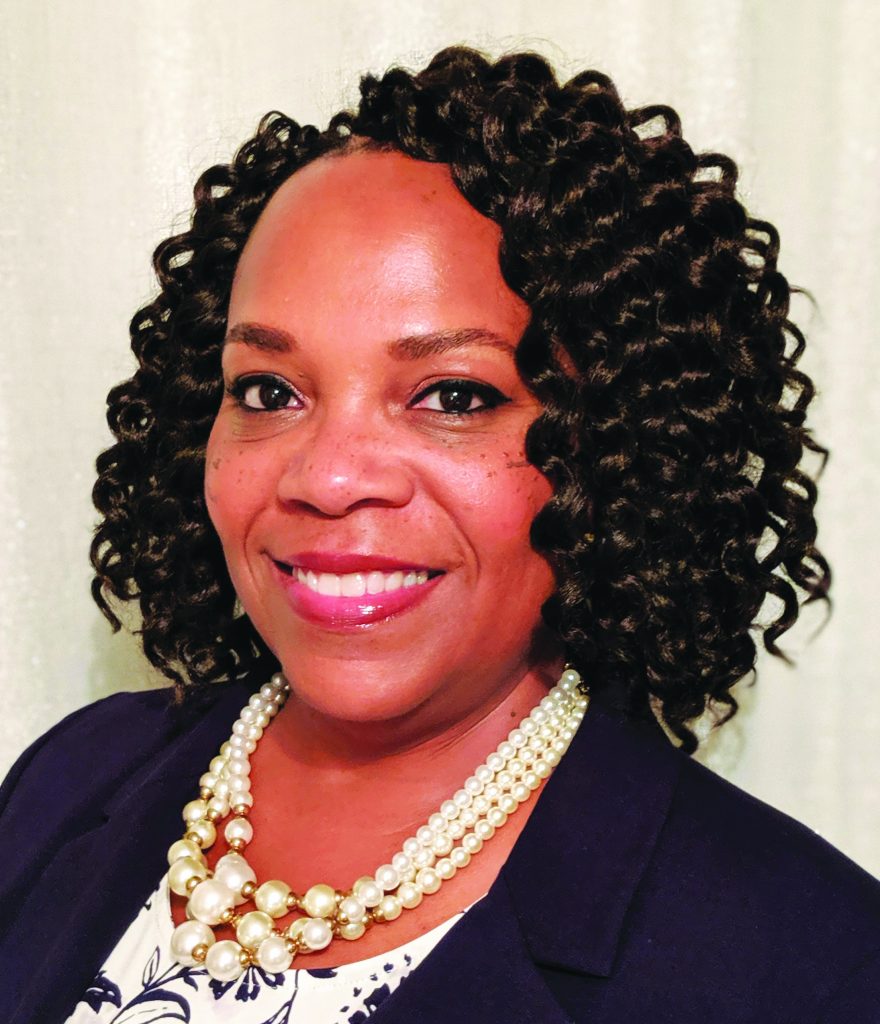
WINNSBORO – Cynthia Prince has been named the new Executive Director/Principal of Midlands STEM Institute, a tuition-free public charter school.
Prince
“Ms. Prince has led successful outcomes in education for over 20 years as a clinical counselor, special education teacher and program director. She has also served as professional development speaker with the National Business Institute,” board chairman Kevin Thomas said.
Prince holds a Master’s in Educational Administration from the University of South Carolina and is a licensed principal with the SC Department of Education.
“Ms. Prince brings a wealth of talent and leadership capacity to the position and is looking forward to building strong and lasting relationships with MSI students, parents, faculty, staff and community stakeholders to ensure the school’s mission to produce academically and physically fit STEM proficient students,” Thomas said.
Prince is the mother of three children.
All students can attend MSI which is now enrolling students in grades K-10.
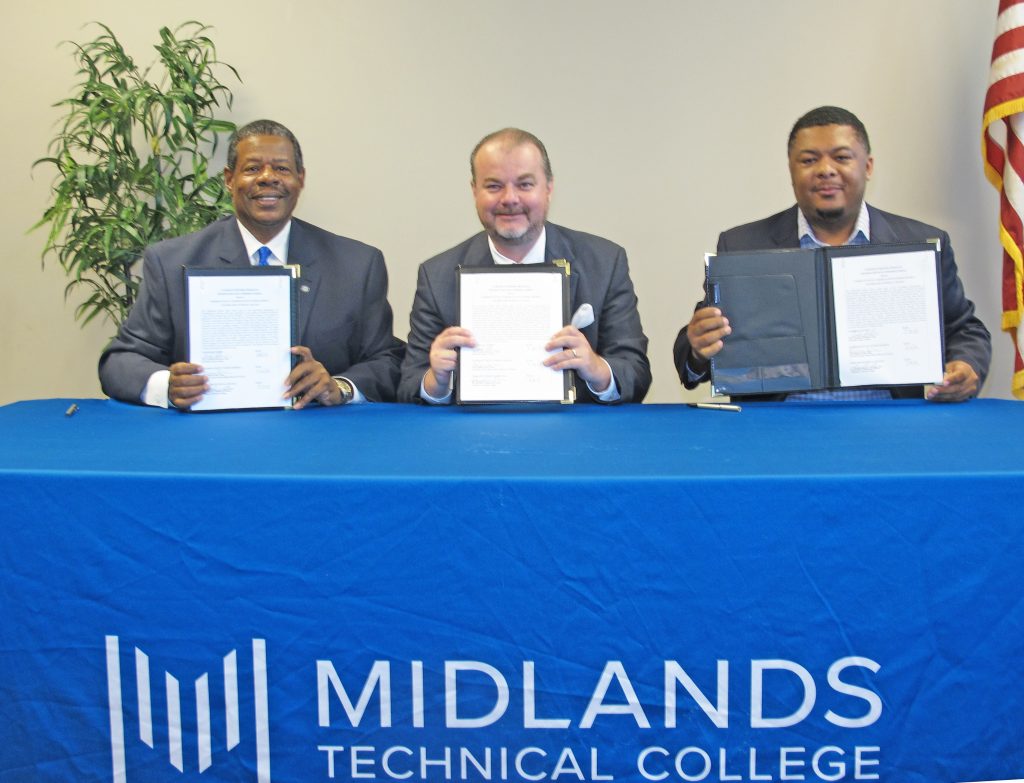
A memorandum of understanding to create a Promise Program was signed Monday by Midlands Tech President Ron Rhames, Fairfield County School Board Chair William Frick and County Council Chair Cornelius Robinson. | Barbara Ball
WINNSBORO – Providing free technical college tuition to financially struggling students is noble. Supporters say the Fairfield County taxpayer-funded Promise Program initiative will open college to more students and boost the local workforce.
On Monday, representatives from Fairfield County, the Fairfield County School District and Midlands Technical College inked a Memorandum of Understanding (MOU), pledging their commitment to the Promise initiative.
“This is a wonderful program and a way to move our county forward,” County Administrator Jason Taylor said to those gathered at the signing. “A good education is one of the surest ways to guarantee that our children will have access to good jobs and the opportunity for a better future.”
Later that night, Fairfield County Council discussed in public, and also behind closed doors, its role in the Promise Program, recently pitched by Dr. J.R. Green, district superintendent.
“Any kid in Fairfield County could go to Midlands Technical Institute at no cost,” Green said. “Students have to apply for financial aid. They’ll look at all the federal and state aid, and Promise revenue will cover the difference. But no one will be required to pay any tuition.”
Similar programs exist in Kershaw, Sumter, Lee, Green wood, Clarendon and Williamsburg counties, according to the S.C. Technical College System, which governs the state’s technical schools.
Most counties make free tuition available, but not unconditionally. The only conditions of note in the Fairfield MOU are that recipients must live in Fairfield County and graduate from a public or private school, approved homeschool or have a GED.
Greenwood prorates tuition aid based on a student’s length of residency, according to the Greenwood Promise Program website.
Sixty-five percent aid is offered to students attending grades 9-12, but students attending two years or less receive nothing. Full aid only goes to lifetime residents.
In Sumter County, qualifying students can attend Central Carolina Technical College at no cost provided they maintain a 2.0 GPA and remain enrolled for six consecutive semesters, according to the CCTC website.
Aid only covers tuition, however. Books, lab fees and other miscellaneous costs aren’t covered, the website states. What the funding covers is not made clear in the Fairfield Promise MOU.
Promise creates confusion
There’s some disparity between how some council members, the school district and MTC perceive the Promise Program arrangement.
The MOU signed Monday describes the deal as a “nonbinding Memorandum of Understanding to announce their intent and purpose to work together to establish the Fairfield County Promise Program.”
An MTC media advisory announcing the signing states that dignitaries “will sign an agreement that allows 2019 high school and GED graduates living in Fairfield County to attend MTC at no cost.”
Both the school district and county have budgeted $75,000 for the Promise Program, but neither body has formally voted to authorize any expenditures for the program, though approval is likely.
At Monday’s council meeting, Councilman Jimmy Ray Douglas repeated prior assertions that MTC doesn’t attract enough students to its Winnsboro campus to justify holding classes there.
“I’m not against educating children, I’m all for it,” Douglas said. “I’ve been trying to get Midlands Tech to teach classes in the last five years, yet they’ve had no classes whatsoever. It’s a shame we have to pay them $75,000 to start a class.”
Speaking to The Voice on Tuesday, Councilman Douglas Pauley identified several elements that concern him, namely cost and accountability.
Pauley said MTC needs to more clearly state how many students plan to attend and what classes will be offered. He said county’s $75,000 share should be doled out in quarterly installments based on MTC’s ability to meet those standards.
“To give a lump sum of money with no accountability to the taxpayers how that $75,000 is specifically going to be used, I’m not in favor of that,” he said.
In addition, Pauley said students should be required to take more classes than the six-credit-hour minimum he said other council members support.
Many traditional student loan programs require students to register for at least 12 credit hours to receive full financial aid.
Pauley also said students should meet specific academic standards to qualify.
“To me, with a C average, you’re just kind of coasting along,” he said. “If someone else is paying for your college tuition, you can do better than a C average.”
Other council members embraced the Promise Program.
“This is a huge deal to be able to allow our students to go to school tuition free,” Councilman Moses Bell said. “This is big, this is a good thing. This is something we ought to be jumping up and shouting about.”
Council Chairman Neil Robinson also supports the Promise Program.
“I just think investing in our future for the kids is definitely something that’s needed in this county so we can have a stronger workforce, a better quality of life,” he said. “We’d be bridging that gap for the workforce.”
Robinson said the Promise Program would likely receive further discussion at the next meeting set for July 22.
Transparency concerns
Government secrecy is also throwing cold water on the initiative for some.
On Monday night, council members retreated behind closed doors to further discuss the Promise Program. Ridgeway resident Randy Bright chided the council for doing so.
“You’ve taken a slip back with this Promise Program. There’s lots of confusion, lots of secrecy,” Bright said during public comments. “Why are you talking about this in executive session? This is between governments. You shouldn’t need to talk about this in executive session. It should be open.”
An agenda for the meeting stated the executive session was for a “contractual matter” to discuss and receive “legal advice regarding [an] agreement between Fairfield County, Fairfield County School District and Midlands Technical College as to the Promise Program.”
Pauley said he didn’t agree with discussing the Promise Program behind closed doors.
“I thought that matter pertaining to the Promise Program could’ve been done in an open forum,” he said. “I didn’t see a need for it to be in executive session.”
Monday night’s executive session was improper because the county had already signed an MOU, said Jay Bender, an attorney with the S.C. Press Association, of which The Voice is a member.
Bender also called the receipt of legal advice explanation “vaguely worded.”
“The MOU sounds like a contract to me,” Bender said. “If there’s an MOU, which is a contract, you can’t go into executive session under the rubric of contractual matters.”