Category: Schools

  • County, School District Lock Horns

    Debate Rages Over Plan for Nuke Money

    WINNSBORO – If the air hasn’t been cleared between Fairfield County Council and the School Board of Trustees after their Oct. 7 joint meeting, then it may never be. Of the 90 minutes the two groups spent together at the Midlands Technical College campus, approximately 75 was spent on the airing of grievances, toying with semantics and dancing around fundamental questions.

    When the dust had finally settled, a basic understanding appeared to have emerged as to what role the School Board will play in planning for the enormous influx of cash expected to flow into the County in the next five years from fee-in-lieu of (FILOT) ad valorem tax dollars from the two new V.C. Summer Nuclear Station reactors.

    Rumors

    County Council Chairman David Ferguson (District 5) sent the meeting off the rails from the opening gavel by declaring that word had gotten back to him that there were some School Board members who felt that the County had been shortchanging the District in recent years. Ferguson claimed that Fairfield County Schools spends more money per student than any other district in the state, so to assert that the County was shorting the District was inaccurate, he said.

    Beth Reid, School Board Chairwoman, said the District was no longer at the top of the spending list, however. What Reid wanted to know, before discussing the future V.C. Summer FILOT money, was what arrangements had been made to cut the District in on the County’s recent FILOT agreements with Element Electronics, BOMAG and Enor Corp.

    Milton Pope, Fairfield County Administrator, exhausted several long minutes explaining how FILOT agreements work (fees paid directly to the County by an industry, in place of ad valorem property taxes of which the District would, by law, receive a percentage) and said that FILOT agreements create an indirect benefit to the District by adding to the county’s assessed property values.

    “The one thing we can acknowledge is that Fairfield County Schools have been funded substantially,” J.R. Green, Superintendent of Fairfield County Schools, said. “Whether we’re number 5 or number 1 or number 12, there’s no point in debating that. I don’t think that has any bearing on the question Miss Reid has asked. Her question is, for previous Fee-in-Lieu-of arrangements, with Element, with Enor, with other corporations, has there been a percentage identified to go to Fairfield County Schools?”

    “The answer is easy,” Reid added. “It’s either yes or no.”

    And the answer, Pope revealed at last, is No.

    Who Controls the Spending?

    Talk then shifted to how to plan for the future V.C. Summer revenues. County Council earlier this year announced it would partner with the Central Midlands Council of Governments (COG) to create a long-term strategic plan for those monies and Council has made meeting with the county’s other elected bodies part of that process. In late August, Council sat down with the state legislative delegation for the first of those discussions. On Oct. 7, it was the School Board’s turn.

    “Does the County Council plan to have the School District submit items for approval or does the County Council plan to identify a certain percentage that will go to the School District?” Green asked. “I think that’s the fundamental question. There’s a lot of ambiguity in terms of how this is going to work. Are you talking about me submitting a plan to County Council . . . or are you talking about giving a percentage of the revenues to the School District and the School District approves or not?”

    Ferguson said his vote on that question would be for the District to surrender its autonomy to County Council.

    “If we’re going to downplay the ad valorem taxes, if we’re going to help the citizens down-draft that part of the taxation, can we say that we’re going to give the School District X amount of money to spend and we don’t have any idea about what that amount of money is going to be spent for?” Ferguson said. “As far as I’m concerned, my vote would be No. And I don’t know of any county in the state of S.C. that does it that way. Not one.”

    But that is exactly how things work now, Green pointed out, with ad valorem taxes.

    “That’s currently the structure,” Green said. “Ad valorem taxes are dictated by state statute, and so if we get a check for $12 million from the County, it’s not as if you come to the District to talk about how we spend that $12 million. The School District as an entity determines how those funds are spent. They have that kind of fiscal autonomy.”

    Pope then asserted that the District was, in fact, not autonomous at all, citing a County ordinance that requires the District to seek Council’s approval of budgets that exceed the previous year’s budget by more than 3 mills.

    “To my understanding and from my research, the School District is not fiscally autonomous in Fairfield County,” Pope said. “That’s something we need to get clarified, because I agree with you. If in fact the School District were fiscally autonomous, we wouldn’t be having that conversation. But you’re not.”

    Board member Annie McDaniel (District 4) told Pope that the Board was partially autonomous in its budgeting, then went on a tangent of her own about how property taxes work. Residential property taxes do not go toward the District’s operational budget, she said, because of Act 388. She then claimed the County dipped into that property tax relief.

    “Property is zeroed out, as far as property taxes go,” McDaniel said. “As you recall, when that happened, County Council should have not taken any of that millage. I think it was 30-something mills that went back to the citizens, and you all took about 10 or 15 mills of that. The citizens didn’t know, because they thought they were getting a tax break and so they were happy, but they didn’t get all the tax break they should have got because County Council ended up taking part of that millage and assessing it.”

    Council members did not agree with McDaniel’s claim, but she remained adamant.

    “Yes they did,” she said. “If anybody goes back and researches the last 15 years, they’ll be able to see it.”

    And regardless of where the District ranks in per pupil spending, McDaniel continued, they should be spending even more.

    “If we look at the condition of our students when they come to our school district, we probably need to be paying more than we’re paying to get them where they need to be,” McDaniel said. “Granted, we may spend some money – and I’m the first to fuss about it – that we maybe should not be spending, but every dime that comes to this school district we try to use for our children in spite of the conditions a lot of them live in.”

    Ferguson then stated that the District had indeed come before Council in recent years for approval of a (2009-2010) budget that went up 7 mills.

    “To say that we haven’t done what we’re supposed to do for the School District,” Ferguson began, but before he could continue, angry cross-talk drowned him out. Finally, Green brought the noise back down to a more reasonable volume.

    “Mr. Ferguson, I have not heard that,” Green said. “If someone has said that here, I have not heard anyone say that County Council has not done what they’re supposed to do for this school district.”

    “All that I was saying about the way that we’ve gone about coming to County Council or not needs to be clarified,” Pope said. “You asked a question I think is valid. If you are autonomous, then I would agree with you. If you are not . . .”

    Green said he wanted to stay focused on the plan moving forward and not quibble over how autonomous the District may or may not be.

    “I don’t think we need to get bogged down in whether we’re totally autonomous or partially autonomous, and I don’t necessarily think that’s the whole purpose of this meeting,” Green said. “All the School District needs to know are the intentions of the Council. Mr. Ferguson has already stated (that he) would not just give the District a percentage (of the FILOT) and let the Board of Trustees determine how those funds are expended. I think that’s very clear. I don’t necessarily agree with that, but at least I know how we move forward.”

    That model clearly did not sit well with Board member Henry Miller (District 3), who may very well have offered the most eloquent speech of his career.

    “So, are we partners?” Miller began. “I feel like County Council puts themselves on a pedestal. Mr. Ferguson, I am one of the ones who thinks that you think we have to come to you and beg. We’re supposed to be partners. If we are partners, we can work this out. We’re all elected officials. We have the same districts. We’re elected by the same people. If ya’ll want to give the School District 25 percent, then we can handle that; or 35 percent. But to say we’ve got to come to you every year, that’s not going to work. Not with me. I don’t feel that way.”

    Councilman Dwayne Perry indicated that he differed from Ferguson on how the District’s portion should be handled.

    “You run the School District,” Perry said to Green. “You’ve got a board that works with you. Making sure that we’re doing what’s right by statute, that’s all I care about. The way I look at it is you hire people who know what they’re doing, they do their job and you let them do it.”

    How Much Is It?

    Board members pressed throughout the meeting for figures, even estimates, indicating how much money V.C. Summer might be pouring into the county in coming years. While early estimates have put the annual take at anywhere between $80 million and $100 million, Pope and Council consistently sidestepped the issue.

    “We can sit here and keep on beating this horse, but right now we don’t know,” Councilman David Brown (District 7) said. “As far as what we have done in the past with fee-in-lieu-of, the majority of it has been put in the budget just like ad valorem taxes. Has the precedent been set? No. The intent is to make the county grow, to get industry, to put money in infrastructure.”

    The main thing that drives – or impedes – growth in Fairfield County, Brown said, is the school system.

    “And we all know that,” Brown said. “As far as us spending money on economic development, building schools and giving ya’ll the programs ya’ll want or whatever, that’s the most important thing of all. Don’t lose focus. The number one thing to attract industry is still education.”

    While agreeing with Brown in part, Board member Bobby Cunningham (District 5) said property taxes are also stunting the county’s growth potential.

    “One of the things that deters people from coming into Fairfield County is the property taxes,” Cunningham said. “Property taxes have a big impact on us not being able to bring people into this county. Taxation needs to be addressed as well as this other stuff we’re talking about.”

    Brown said property tax relief should be part of the plan, but a sudden and drastic drop in ad valorem property taxes would have a severely negative impact on the School District more than it would have on the County. The plan, Brown said, should entail a gradual “buy-down” of property taxes over the next several years. It had to be done carefully, he said, because the drawback could come in 20 years, when the FILOT agreement with SCANA expires and the energy company renegotiates based on the significantly lower millage rate. That could leave everyone scrounging for cash in the long run, if the County and the District were not prepared.

    “We can all talk about the needs that we have and what we want to do, but fundamentally we have to be responsive to the tax payers,” Pope added. “We have to be responsible to the tax payers in these future plans, and also have the ability to reduce our taxation. I think we need to be doing that on a parallel graph.”

    Buying In

    As emotions leveled off, Pope addressed Miller’s impression of the County’s position and asked the District to contribute a long-range plan for the COG’s consideration.

    “It wasn’t a point of making the School District come begging to the County,” Pope said, “but being a part of the plan so it’s in the planning document. That way people have a buy-in to what the overall plan is for the entire planning and not it just being a County document.”

    Green told Council the District could have something submitted in a matter of weeks.

    “We’re all going to be in this together,” Ferguson said, “to see where this county needs to go.”

  • RWA Ushers in First Hall of Fame Class

    WINNSBORO – Richard Winn Academy proudly announces the launching of an athletic Hall of Fame. The first annual Hall of Fame induction will take place during halftime of the home football game this Friday, Sept. 12, at Ruff Field. The kickoff for the football game featuring the RWA Eagles versus Charleston Collegiate will be at 7:30 p.m.

    The inaugural Hall of Fame inductees include Carol Caughman Turner, Beth Reid, Mike Robinson and Jena Barnett Johnson.

    Carol Caughman Turner was a member of the inaugural girls’ basketball team, playing from 1968-1971. Serving as team captain, she also was selected as Most Valuable Player. After graduation, she was one of the first Lady Eagles to go on to play basketball at the collegiate level, playing for Baptist College.

    Beth Reid began her high school basketball career as a seventh grader in the 1970-1971 season and was member of the inaugural softball team in 1973. She achieved numerous individual and team awards. Beth also continued her basketball career playing at the College of Charleston. After college, she returned to her Alma Mater to serve as teacher, coach and later as Head of School. In 1985 coach Reid led her basketball team to RWA’s first girls’ basketball state championship.

    Mike Robinson came to Richard Winn in 1978 as a teacher and coach. Over the years he served as head basketball coach for both girls and boys as well as golf and assistant football coach. Coach Robinson was a part of five state championships and three state runners-up teams while at RWA.

    Jena Barnett Johnson was a member of the varsity basketball program from 1980-1985 and a member of the softball team from 1980-1984. In basketball she was selected as All Conference for four years and Player of the Year for three years. During her high school career she scored 2,300 points and was named as an Honorable Mention All American. Jena went on to play basketball at Clemson University.

  • ACT Scores Inch Upward

    COLUMBIA – While statewide results in this year’s American College Testing (ACT) composite scores edged upward by a percentage point, graduating seniors in local high schools taking the test last spring produced varying results, according to data released last month by the S.C. Department of Education. While the benchmark scores in the subjects of English, Math, Reading and Science improved or stayed nearly the same among local test takers, only test takers at Blythewood High School, and only in one subject – English – met or exceeded the ACT benchmark numbers.

    The Benchmarks

    The ACT sets benchmark scores as a minimum required to indicate a 50 percent chance of earning a B or higher, or a 75 percent chance of earning a C or higher, in the college courses of English Composition, Algebra, Social Science and Biology. The corresponding ACT test subjects and their benchmarks are English, 18; Mathematics, 22; Reading, 22; and Science, 23.

    (2013 benchmark scores in parentheses)

    Blythewood High School

    BHS had 213 seniors take the ACT in 2014, compared with 180 a year ago. Test takers scored an average of 19.2 in English (19.8); 20.2 in Math (20.6); 20.8 in Reading (21); and 20.3 in Science (20.1), with a mean composite score of 20.2 (20.4). This was on par with Richland 2’s district-wide scores of 19.2 in English (19.3); 20.2 in Math (20.4); 20.7 in Reading (20.5); and 20.2 in Science (20), with an average composite of 20.2 (20.1).

    Westwood High School

    WHS tested 82 seniors in 2014, compared with 26 in 2013. Test takers averaged scores of 16 in English (15); 16.9 in Math (17); 17.6 in Reading (17.2); and 17.4 in Science (17.1). WHS senior test takers averaged a composite score of 17.1 (16.6).

    Fairfield Central High School

    The lone high school in the Fairfield County School District tested 70 seniors in 2014, down from 76 last year. Test takers averaged scores of 15.6 in English (14.2); 16.8 in Math (16.5); 17.1 in Reading (16.2); and 16.6 in Science (16.5), with an average composite score of 16.6 (15.9).

    National Averages

    State and local scores remain below the national averages in all four subjects. In 2014, those averages were: English, 20.3 (20.2); Math, 20.9 (20.9); Reading, 21.3 (21.1); and Science, 20.8 (20.7), with an average composite of 21 (20.9).

    “While South Carolina’s average ACT composite score was slightly under the national average, its proximity proves that we are making progress,” State Superintendent of Education Dr. Mick Zais said. “These are positive results that we can build on for the future.”

  • Toys in the Attic . . .

    A Tale of the Grail –
    Dr. John Nicholson, Bobby Arndt and Rufus Jones proudly show off the Ridgeway High School state championship trophy that the school’s 6-man basketball team brought home in 1935. The trophy was recently found after it went missing in 1960. (Photo/Barbara Ball)

    Title Trophy Turns Up After 54 Years in Exile

    RIDGEWAY – The Ridgeway Cardinals, the former Ridgeway High School’s 6-man basketball team, made their town proud in 1935 when they brought home the state championship trophy for Class C schools.

    “It was the only time Ridgeway High School had ever won a state championship and the whole town was proud,” recalled Rufus Jones whose dad, Rufus Baxter Jones, played guard on the team.

    Indeed, the folks in Ridgeway were proud of their boys. And the sports reporter for the Winnsboro newspaper at that time, A. B. Fennell, was euphoric in his story about the game.

    “Displaying a brilliant-brand of basketball, the Ridgeway class C basketball team defeated Mt. Croghan at the University of South Carolina annual high school basketball tournament. The score was 39 to 23. The Ridgeway floor game was superior to that displayed by the Mt. Croghan team, and this was the biggest factor in their favor,” Fennell wrote.

    But when the Fairfield County schools were consolidated in 1960, and all the county’s students were sent to the new Winnsboro High School (now Fairfield Central High School), the prized trophy went missing and was never seen again, until recently when Ridgeway resident Sarah Arndt was cleaning out her attic searching for treasures to sell in the Big Grab Yard Sale this weekend.

    “She brought down this trophy and showed it to me and said, ‘What is this?’” her husband, Bobby Arndt, told The Voice.

    After examining the slightly battered pewter trophy, Arndt realized it was the missing 1935 championship trophy. His mother, Frances Arndt, a first-grade teacher in the Ridgeway School for over 30 years, had apparently saved it from being discarded when the school was abandoned after the consolidation and eventually packed it away. Upon her death, the trophy passed to her daughter Sarah among boxes of household items.

    Arndt immediately contacted Ridgeway brothers Rufus and Minor Jones to tell them that he had their dad’s trophy. Then he contacted retired Ridgeway dentist, Dr. John Nicholson, whose grandfather, A. R. Nicholson, had been both coach of the championship team and principal of the school in 1935.

    The players’ names were engraved on the trophy: brothers Lawton and Billy Harley, Robert Hinnant, Rufus Baxter Jones, W. D. Watson, Arthur Heins and coach A. R. Nicholson.

    Billy Harley, a cousin of Rufus and Miner Jones, is the only member of the team still living. He moved to Clemson several years ago where he lives with his son, Little Billy.

    Arndt, Nicholson and Rufus Jones recently met at Ridgeway’s City Gas & Oil Café (formerly Stevie D’s) to pose for pictures with the trophy and make plans for its future safekeeping.

    “As soon as the story about the trophy comes out in the paper,” Jones said, “Little Billy is going to drive down here and pick up the trophy and the newspaper and take them back to Clemson for his dad to see. Then he’ll return it and we’re going to put it in the Ridgeway Museum in The Century House where it can stay on display.”

    “It has a few dents in it,” Jones said, examining the trophy closely, “but otherwise it’s in good shape to be 79 years old.”

  • Board OK’s Fees, Stipends

    WINNSBORO – The Fairfield County School Board set student fees for the 2014-2015 school year at their Aug. 19 meeting, as well as approved stipend for athletic and academic staff. The Board also gave the final OK on a policy governing how coaches and trainers address concussions and collected more than $12,000 from timber sales.

    Student Fees

    On a 7-0 vote, with Board member Andrea Harrison (District 1) joining the meeting by telephone, the Board OK’d fees across the District. The Beta Club membership fee for the middle and all elementary schools was set at $20, while at the high school the fee was set at $45. Additional middle school fees are: Band, $20; Family and Consumer Science, $5; ID card replacement, $5; overdue books, 5 cents.

    Additional high school fees: parking decal, $15; senior fees, $40; Science, $25; Driver’s Ed, $40; Integrated Business, $20; P.E. (T-shirt and lock), $15; Art, $5; Teacher Cadet, $40; National Honor Society, $20; Student Government Officers, $20; Student Government members, $10; Academic Challenge, $30; Instrumentalist Band, $150; Auxiliary Members Band, $200.

    Career and Technology Center fees: Lab fee, $20; FBLA membership, $13; SkillsUSA membership, $20; National Technical Honors Society, $25.

    According to the accompanying policy setting school fees, also passed by the Board, no student will be denied an education because of an inability to pay supplementary fees. Students who qualify for free or reduced lunch may apply for a waiver of fees.

    Stipends

    At the District level, the Board approved $3,500 stipends each for a pair of Induction Coordinators, $250 for a mentor teacher and $7,000 for the Board’s Administrative Clerk. In the Student Services Department, the Board OK’d $2,500 for the Data Manager and for the Lead Social Worker and $1,500 for the Medicaid Supervisor.

    Fairfield Central High School stipends: $2,000 for the yearbook, and $2,000 each for department heads in English Language Arts (ELA), Mathematics, Science, Social Studies, World Language, Electives, ROTC and Business.

    Fairfield Middle School: $2,290 each for department heads in ELA, Science, Math and Social Studies; $1,250 for Special Services and Related Arts; $1,275 for Yearbook Advisor and Academic Team coach; $2,500 for Keep it Real Teen Pregnancy Grant Site Coordinator; $1,000 for Keep it Real Teen Pregnancy Grant Curriculum Delivery; and $1,000 for STEM Lead Facilitator.

    Fairfield Elementary: $2,500 each for Grade Level Supervisors for grades CD-2, 3-4, 5-6, and for Related Arts and Special Services; $1,250 each for the fourth- and fifth-grade team leader.

    Magnet School: $2,500 each for Grade Level Chairs, grades K-3 and 4-6.

    Geiger and McCrorey-Liston: $2,500 each for Grade Level Chairs, grades CD-2 and 3-6.

    Career Center: $2,500 each for two Department Chairs.

    Athletic stipends passed on a 5-2 vote, with Harrison and Annie McDaniel (District 4) voting against. McDaniel tried to amend District 3 Board member Henry Miller’s motion for approval of the athletic stipends so that department chairs received the same stipend as coaches, but received no second from the Board.

    The Board OK’d $15,000 for the Athletic Director and $3,750 each for two assistant A.D.s.; $8,000 for the Recruiting Coordinator; $3,700 for the head Strength coach; and $1,800 for the assistant strength coach.

    Football: $8,000 each for the Offensive and Defensive coordinators; $6,500 for the Special Teams Coordinator; $5,500 each for four assistant varsity coaches; $6,000 for the head JV coach; $4,500 each for four assistant JV coaches; $5,000 for the head middle school coach; $2,500 each for three assistant middle school coaches; and $2,000 each for two filming coordinators.

    Tennis: $3,000 each for the head boys’ and girls’ tennis coaches. Volleyball: $3,000 for the head varsity coach; $1,500 for the assistant varsity coach; $1,500 for the head JV coach; and $2,000 for the head middle school coach. Golf: $3,000 for the head coach.

    Basketball: $8,500 each for the head boys’ and head girls’ varsity coaches; $3,000 each for assistant varsity girls, assistant varsity boys, head JV girls and head JV boys coaches; $2,000 each for the B-team boys’ and girls’ coaches; $1,500 each for the middle school boys’ and girls’ coaches; and $800 each for the assistant middle school boys’ and girls’ coaches.

    Wrestling: $3,000 for the head coach; $1,500 for the assistant/middle school coach. Track: $3,500 each for the head girls’ and boys’ coaches; $1,500 each for assistant boys’ and girls’ coaches. Cross Country: $3,500 for the head coach.

    Softball: $3,500 for the head varsity coach; $2,000 for the assistant varsity and the head JV coaches. Baseball: $3,500 for the head varsity coach; $2,000 for the assistant varsity and the head JV coaches; $1,500 for the assistant JV coach. Soccer: $3,000 each for the head boys’ and girls’ coaches.

    Academic coaches: $3,000 each for two positions. Band: $10,000 for the Band Director; $4,000 for the Assistant Band Director and the Auxiliary Band Coordinator; and $2,000 each for the Woodwind/Brass Instructor and the Percussion Instructor. Cheerleading: $5,000 for the head varsity cheerleading coach; $2,500 for the head JV coach; and $2,000 for the head middle school coach.

    Concussions

    The Board gave final approval on a policy managing concussions among student-athletes. According to the policy, which passed 7-0, if a coach, trainer, official or physician suspects an athlete has suffered a concussion during a game or practice, that athlete must be removed from play and evaluated. The student may return to action after an on-site evaluation by the trainer, physician, physician assistant or nurse practitioner determines that no concussion has occurred. In the event of a concussion, the student may return to action only after being given written medical clearance by a physician.

    Timber Sale

    The Board also received as information the final figures on last month’s sale of timber from land around the existing Career and Technology Center. The District received $12,611.72 for the sale. Forest Land Management, Inc. earned $790.75 in commission from the sale.

  • PASS/HSAP: Little Movement in Fairfield Numbers

    WINNSBORO – Scores from last spring’s Palmetto Assessment of State Standards (PASS) tests, released last week by the State Department of Education, show numbers holding more or less steady across the board for Fairfield County students in grades three-eight. The District experienced some moderate gains on Writing test scores, while Math scores failed to meet the expectations of Superintendent J.R. Green.

    “We are going to launch a full-out assault on attacking math standards for next year,” Green said. “We are going to redouble our efforts to ensure students have a solid math foundation and conceptual understanding of the standards.”

    Last year, Green said he was shooting for Math scores in the 80 percent range. That did not transpire, as the percentage of students scoring Met or Exemplary ranged from 48.3 in seventh grade to a high of 65.3 in eighth grade.

    Fairfield Elementary saw upticks in the percentage of students scoring Not Met in Math in grades three-six, with the largest drop off coming between fourth-graders in 2013 (51.4 percent Not Met) and fifth-graders in 2014 (62.1 percent Not Met). Fairfield Magnet School for Math and Science, meanwhile, saw some improvements, with the percentage of students scoring Not Met decreasing somewhat between 2013 and 2014. Those numbers were marred, however, by the comparison between 2013 fourth-graders (2.6 percent Not Met) and 2014 fifth-graders (18.4 percent Not Met).

    “I set the bar high,” Green said. “(80 percent) was an aggressive goal and I don’t back off from that. We will continue to push for it.”

    Social Studies scores were also largely unmoved, with gains between 2013 fifth-graders (41 percent Not Met) and 2014 sixth-graders (23.3 percent Not Met) offset by losses elsewhere. McCrorey-Liston Elementary saw some of the biggest gains in the subject between 2013 third-graders (40 percent Not Met, 60 percent Met and Exemplary) and 2014 fourth-graders (5.9 percent Not Met, 94.1 percent Met and Exemplary).

    Overall, the District lost a few percentage points in English Language Arts (ELA), while Writing scores increased at every grade level.

    “Writing was one of our bright spots, across the board,” Green said. “We pretty much went up at every school.”

    District wide, the biggest gain came between fourth-grades in 2013 (56.7 percent Met and Exemplary) and fifth-graders in 2014 (73.8 percent Met and Exemplary).

    Science scores were also modestly improved across the board, with sixth-graders in 2013 (53.7 percent Met and Exemplary) performing much better as seventh-graders in 2014 (70.6 percent Met and Exemplary). Although Fairfield Elementary’s Science numbers took a hit between grades four and five , with 66.2 percent of 2013 fourth-graders scoring Not Met compared with 81.3 percent of 2014 fifth-graders scoring Not Met, the same transitioning class at the Magnet School saw their percentage of students scoring at Met and Exemplary go from 97.4 percent in 2013 to 100 percent in 2014.

    “We had a pretty big year in 2012,” Green said. “Of course, I would like to continue to see that kind of growth every year, but it’s not realistic to expect to be in a perpetual state of growth. We’ve set the bar high, but we have to be reasonable. We want to create substantial levels of achievement, and not just blips on the radar.”

    HSAP

    The District’s High School Assessment Program (HSAP) test scores also remained virtually constant with 2013 numbers. In ELA, the percentage of students scoring at Level 1 (did not demonstrate competence) was up by a decimal point, from 13 percent last year to 13.1 percent in 2014. The percentage of students scoring at Level 4 (exceptional) fell from 16.6 in 2013 to 14.1 this year, while the percentage of students meeting HSAP standards ticked downward from 87 percent last year to 86.9 in 2014.

    In Mathematics, the percentage of students scoring at Level 1 crept up from 33.2 in 2013 to 35 in 2014, while the percentage of students scoring at Level 4 dropped from 13.5 in 2013 to just 4.9 in 2014. The percentage of students meeting the HSAP standards also fell from 66.8 to 65.

    Green said the math scores represent a conundrum, as this is the first year in which the District’s End of Course (EOC) scores did not trail the HSAP scores. The District experienced significant gains in EOC scores in Algebra I, Green said (that data has not yet been made public by the Department of Education), and in years prior those gains have translated into even higher numbers on the HSAP exam. This year, however, that was not the case.

    “Our End of Course scores in Algebra I are good,” Green said. “For the same kids a year later to test 15 points lower on the HSAP is a problem.”

    Green speculated that some specialized math teachers may be teaching fewer HSAP standards and more standards specific to their particular branch of math – geometry, for example – during the year. The District will not get the opportunity to address that problem directly, however, as HSAP will be replaced next year by an as yet unknown assessment test, testing for an as yet unspecified set of standards.

  • HSAP Scores: BHS Outpaces District

    WHS Numbers Dip

    BLYTHEWOOD – The community’s two high schools saw some dramatically different results from their 2014 High School Assessment Program (HSAP) test scores, according to data released last week by the State Department of Education.

    Blythewood High School’s numbers improved significantly in two key areas – the percentage of students scoring at Level 1 (competence not demonstrated) and percentage of students scoring at Level 4 (exceptional). For first-time test takers in English Language Arts (ELA), tested in their second year of high school, only 4.4 percent scored at Level 1 at BHS, down more than 50 percent from last year’s 8.7 percent. The percentage of student scoring at Level 4 jumped from 22.7 percent in 2013 to 40.8 percent in 2014. The percentage of students scoring well enough to meet HSAP standards grew from 91.3 percent in 2013 to 95.6 percent in 2014.

    BHS outscored the Richland 2 School District as a whole in ELA, in which 8.9 percent tested at Level 1, 31.5 percent at Level 4 and 91.1 percent met the standards.

    In Mathematics, BHS also showed improvement, with 14.5 percent testing at Level 1 (down from 24.5 in 2013), while 28.9 percent tested at Level 4 (up from 13.7). The percentage of students meeting the standard increased 10 full points, from 75.5 a year ago to 85.5 percent in 2014.

    BHS’s math scores also outpaced R2 overall, which had 21.9 percent scoring at Level 1, 22.2 percent at Level 4 and 78.1 percent meeting the standard.

    Westwood High School, on the other hand, saw its numbers trend downward across the board, albeit with well over 80 percent of students still achieving standards in one of the two subjects tested. In ELA, 12.7 percent scored at Level 1 (up from 6.3 percent last year), while 18.4 percent scored at Level 4 (down from 22.7 percent). The percentage of students scoring well enough to meet HSAP standards fell from 93.8 percent in 2013 to 87.3 percent in 2014.

    In Mathematics, 32.1 percent of WHS students scored at Level 1 (up from 12 percent in 2013), with only 11 percent (down from 13.7 percent in 2013) scoring at Level 4. The percentage of students meeting standards fell from 88 percent a year ago to 67.9 percent in 2014.

  • Crews Race to Beat Clock on Rimer Pond Road

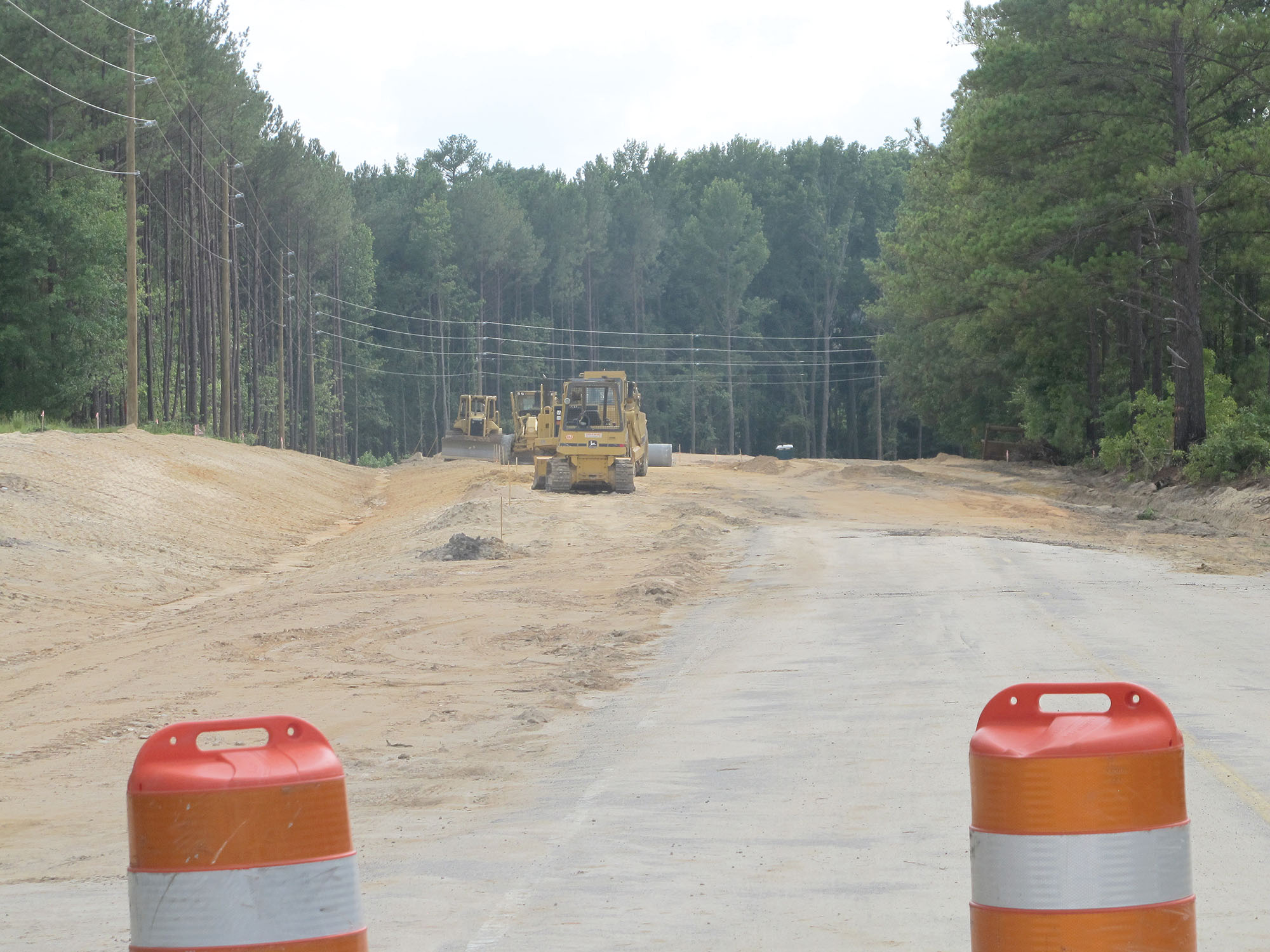
    With time running out before heavy school traffic begins to flow, crews make haste on Rimer Pond Road. (Photo/Barbara Ball)

    BLYTHEWOOD – The deadline is looming for construction crews on Rimer Pond Road to finish straightening and widening the road’s curve and have it paved and ready to go by Aug. 31. With schools in Richland District 2 starting on Wednesday, Aug. 20, and the Rimer Pond Road detour still in place, traffic along Langford Road, Highway 21 and Blythewood Road is expected to be backed up during heavy traffic hours. The S.C. Department of Transportation (SCDOT) closed Rimer Pond Road to thru traffic on April 14.

    Jason Fulmer, Project Manager for the construction, told The Voice last week that he thinks the work will be finished and paved on time.

    “To accommodate moving the road over as much as 50 feet from center line in some places, we had to move utility lines, cable lines, gas and sewer lines. We also installed storm water pipes, but there are no water lines in that area,” Fulmer said. “I think everything is looking good to open the road on time.”

    The curve that wraps around Felix Rimer’s Pond has long been a high accident area and is being re-aligned for safer travel starting between the entrance to Eagles Glen and Perfecting Faith Church and continuing to a point near where the road intersects with Adams Road, according to Fulmer.

    Besides moving the road in some areas, Fulmer said the crews are also widening it about 2 feet on each side and paving the shoulders for safety. He said the road will still be two lanes, but will have guardrails and rumble strips installed at the low point in the curve where there are a couple of creeks alongside the road.

    When a statistical comparison was made a few years ago with other one-half mile sections of roads around the state with high crash incidents, the curve on Rimer Pond Road easily met the qualifications for improvement – 20 crashes in four years with 12 of those being injury crashes, according to Joey Riddle, Safety Program Engineer for SCDOT. But during construction, traffic has been detoured though downtown Blythewood causing an increase in traffic congestion in downtown Blythewood and on main roads leading into and out of the town, especially at times when school traffic on Langford and Rimer Pond roads is heavy.

    Libby Roof, Executive Director of Communications for Richland School District 2, told The Voice that the District has notified parents in the area about the detour and advised them to take it into consideration when dropping off or picking up their children.

    “We have posted updated bus schedules on our District website and some may be different than last year,” Roof said, “so parents need to check those.”

    She also reminded parents that traffic is always worse the first couple of days of the new school year and could be expected to be very congested with the detour still in place.

  • Career Center Classes Spark Debate

    WINNSBORO – Although the District only just broke ground on the new Career and Technology Center last month, and classes aren’t expected to begin there until August of 2015, the addition of four new programs and the elimination of two programs at the new facility sparked questions from two School Board members at the Board’s July 15 meeting.

    Superintendent J.R. Green announced the addition of a Barbering program, a Firefighting/EMT program and two Project Lead the Way (PLTW) programs – one in Engineering and one in Biomedical Science – for the 2015-2016 school year. PLTW programs offer a project-based curriculum, Green said, and the transition into the Biomedical Science program will begin this school year, provided the District can hire a PLTW certified Health Science teacher. The District currently has three PLTW certified instructors on staff, Green said.

    “We hope we are able to expose our children with the Engineering Program to a host of new opportunities as it relates to robotics, engineering and how the sciences work together,” Green said. “And we hope that this Biomedical Science program really is an extension of our already very very successful Nursing program. So we’re looking to expand what we’re doing in Nursing as a function of the Biomedical Science program.”

    Green said the addition and subtraction of programs was based on several factors, including employment opportunities, feedback from the community and enrollment.

    “Most importantly, we looked at interest from students,” Green said. “And I can tell you in all the programs that were selected there was high interest from the student body.”

    Board member Paula Hartman (District 2) questioned the validity of the Firefighter/EMT program, since, she said, nearly all of the firefighting opportunities in Fairfield County were unpaid volunteer positions.

    “Everything is volunteer, except for the Town of Winnsboro,” Hartman said. “How is that going to get them a job in Fairfield County?”

    “It may not get them a paying job in Fairfield County,” Green answered, “but there are opportunities elsewhere outside Fairfield County.”

    Hartman said the school district should be preparing students for college or employment and questioned how a program aimed primarily at volunteer positions was accomplishing that. Green said students had expressed significant interest in the Firefighter/EMT program through the survey, and paid positions are available in places other than Fairfield County. Green also said it was important to give students opportunities to explore things they may not necessarily choose as a career.

    “There should always be an opportunity for some personal development skills,” Green said. “It’s not as if everyone who takes Building & Construction plans to build homes for a living, or who takes Brick Laying or Electricity plans to do that for a living. I don’t look at it through the prism of simply what you’re exposed to at the Career Center is simply things that you plan to earn a living doing.”

    Green said the District has discontinued the Machine Tools program and the Accounting and Marketing program, as student enrollment in those programs has dwindled. Board member Annie McDaniel (District 4), who joined the meeting via telephone, asked Green how the decision to cancel those programs, specifically Accounting, was reached. Green said the decision was based on a recommendation from the Career and Technology Center Director, J. Christopher Dinkins, as well as on enrollment numbers.

    McDaniel also asked if the District was in close communication with the V.C. Summer Nuclear Station in Jenkinsville to ensure the District was offering courses “so that students who want to go straight into the workforce, that we’re giving them some kind of assistance as far as their vocation so they are qualified for the jobs being offered at V.C. Summer,” McDaniel said.

    Green said the District was indeed in constant contact with the plant; however, opportunities for people possessing merely a high school diploma were few and far between.

    “There are very few opportunities outside of labor for students to move straight from high school and go straight into the workforce without any kind of advanced certification and training,” Green said. “I think we begin that process at Fairfield Central High School and our career center.”

    When McDaniel asked for specific examples of careers requiring advanced certification or training, Green rattled off a list that included welding, computer technician and computer programming. Hartman then asked Green about the demise of the Machine Tools program.

    “Have you talked with anybody at Lang-Mekra? My understanding is that you can go into having two years of Machine Tools and go into a job there,” Hartman said.

    Green said he did not know if jobs were available at Lang-Mekra for graduates with a two-year certification in Machine Tools, but added that even if that were the case, the Career and Technology Center was not able to support the program.

    “Students were simply not enrolling in the program,” Green said. “So, the one thing we have to acknowledge, regardless of how great we think the opportunities are for students in a particular career, if students aren’t interested in being a part of the program, then it really does not happen. There could be $100,000 jobs out there in machine tools, but if students aren’t interested in enrolling in the Machine Tools program, earning their certification and sticking with it, then it really has no value in terms of offering the program. We simply did not have students who were interested, obviously, based on enrollment, to be a part of that program.”

    McDaniel said she hoped the District was doing everything it could to make students aware of these opportunities.

    “Students don’t often know what they don’t know,” McDaniel said. “They don’t always know what fields are best for them.”

    “At the end of the day, kids have to determine what their passions are,” Green said. “As much as, as adults we feel as if we know best, if kids don’t want to do it, then they’re not going to do it. So we have to offer programs not only that are beneficial to students, but programs they have an interest in.”

    In addition to discontinuing the Machine Tools and the Accounting and Marketing programs, Green said the Auto Mechanics program and the Auto Body program were consolidated into a single program.

  • Mitford Battle Comes to a Close

    High Court Upholds Ruling in Favor of Chester County

    WINNSBORO – In a 3-2 ruling filed last week by the S.C. Supreme Court, the four-year chapter commonly known as the “Mitford Case” came to a close for the Fairfield County School District, with the High Court affirming a lower court’s ruling in favor of Chester County Schools.

    The Fairfield County School District’s failed effort to thwart special legislation crafted to cover Chester’s cost of educating Mitford students means Fairfield County will annually shell out in local revenue to Chester 103 percent of Chester’s per pupil cost for each student residing in Mitford and enrolled in Chester County schools.

    “We’re obviously disappointed the ruling didn’t go in our favor,” Board Chairwoman Beth Reid said, “but I also feel it never should have escalated to this point. Previous Boards should have reached a compromise that would have prevented the legislative delegation from feeling the necessity to jump in. The whole situation could have been avoided if previous Boards had acted responsibly.”

    From 1972 to 2007, Fairfield paid Chester County $25,000 a year to cover the cost of educating the approximately 200 Mitford children enrolled in Chester schools. When those payments suddenly stopped under then Superintendent Samantha Ingram and then Chairwoman Catherine Kennedy, State Sen. Creighton Coleman (D-17) stepped in to negotiate a deal between the districts. In early 2010, an agreement was struck to bring the payments up to date, but after remitting $50,000 to Chester, Fairfield once again abruptly ceased payments. Coleman then introduced local legislation to ensure the continuation of the payments. Coleman’s bill called for Fairfield to annually pay Chester 103 percent of Chester’s prior year per-pupil cost for each Mitford student enrolled in Chester schools.

    The District filed suit in July of 2010, claiming that the legislation was unconstitutional in that it conflicted with general law as set forth by Article III, Section 34 of the S.C. State Constitution, where local legislation is prohibited when a general law may apply, or when lawmakers have a “logical basis” for the legislation.

    In July 2012, Fifth Circuit Court Judge J. Ernest Kinard ruled in favor of Chester County and released nearly $2 million in back payments, which had been accruing with the Fairfield County Treasurer since the start of the 2009-2010 school year. A month later, the Fairfield School Board voted 5-2 to appeal the ruling. Board members Henry Miller (District 3), Andrea Harrison (District 1) and Annie McDaniel (District 4) voted for the appeal, as did then Board members Marchella Pauling and Danielle Miller. Reid and Board member Bobby Cunningham (District 5) voted against.

    “Let me go back to day one, when we were paying (Chester) $25,000 a year,” Cunningham said last week. “That was a sleeping dog that should have been left on the porch undisturbed.”

    Kinard’s ruling stated that the Fairfield County School District “presented no evidence” that the General Assembly had abused its discretion in enacting the special legislation. The ruling also stated that the General Assembly did, in fact, have “a logical basis and sound reason” for enacting the special law.

    Kinard also said that, based on Fairfield County’s local per student funding level of $8,875 versus Chester County’s local per student funding level of $3,452, Chester County Schools are “not unduly profiting” from the arrangement and Fairfield County Schools are not being “unreasonably burdened.”

    Arguing the case before the Supreme Court last November, Armand Derfner, a Charleston attorney representing Fairfield County Schools, said that Coleman’s special legislation was unconstitutional. Derfner argued that a general law should be applied to the Mitford conflict, a law that would apply to every district in the state. But Derfner faced some hard questions from the five-judge panel.

    “Where do we draw the line?” Chief Justice Jean H. Toal asked during the hearing. “We have school districts all over the state that are governed by special law. If we adopt your view, we’re going to interrupt a lot of long-term arrangements that have been in place for some time.”

    Representing the Chester County School District in the case, John M. Reagle, of the Childs and Halligan law firm in Columbia, also faced a tough cross examination from the judges during the November hearing.

    “How is it appropriate to treat Fairfield differently than any other county in the state?” Justice Kaye G. Hearn asked.

    Reagle said the general law requires appropriate arrangements to be made between school districts in cases where a large number of students cross district lines. In the case of Mitford, those arrangements were made between the Chester and Fairfield districts. In fact, an arrangement did exist between the districts from 1972 to 2007, during which time Fairfield paid Chester $25,000 a year. When those payments stopped, Coleman stepped in with special legislation.

    “Why should Fairfield pay to educate these kids?” Justice Donald M. Beatty asked.

    “Because it is the right thing to do,” Reagle answered. “This relationship was fostered for 40 years.”

    The Supreme Court filed its ruling on July 16, affirming Kinard’s ruling that the Fairfield County School District “presented no evidence” that the General Assembly had abused its discretion in enacting this special legislation. Justice Costa M. Pleicones wrote for the majority. Justice John W. Kittredge and Chief Justice Toal concurred.

    In the dissenting opinion, Justice Beatty said the Court took a “myopic” view of the case, focusing only on the procedures while failing to “fully address the constitutional propriety” of the special legislation. Justice Hearn concurred.

    As of late last year, the Fairfield County School District had spent nearly $150,000 in legal fees on the case. Reid said the District expects a final bill from Derfner in the next month.

    With the Chester money having been held in escrow over the duration of the legal battle, Reid said the payments would not have an immediate impact on the District’s bottom line budget. The payments would, however, be an ongoing line item to be considered in future budgets, she said.