Category: Schools

  • District Surveys Teachers on Patio Homes Plan

    WINNSBORO (Sept. 1, 2016) – Following an update by Dr. J.R. Green, Superintendent, at the beginning of the Aug. 16 School Board meeting concerning his proposal last month that the School District construct and rent out patio homes to teachers, School Board member William Frick (District 6) suggested the District first survey teachers who have left the District to determine whether, if those teachers had had viable housing options, it would have kept them from leaving the District. Frick said a survey might determine if there’s a demonstrated need for teacher housing and if it would be helpful for teacher retention.

    “That’s an interesting point,” Green said. And last week he followed up with a survey, but to current teachers, not to teachers who have left the District as Frick suggested. The surveys were email generated to individual teachers from the District office.

    Green said in the July meeting that he had spoken with the County’s strategic planners who thought providing housing for teachers was a great idea.

    David Gjertson, a planner with Landscape Architecture/Urban Design, told The Voice that while he liked Green’s idea of using housing as an incentive, he would like to see it broadened to include other Fairfield County public employees as well – fire fighters and EMS employees, for instance.

    He also questioned how the project would be funded. Gjertson told The Voice that he would like to see a combination of public and private funding including federally subsidized funding rather than the traditional funding that Green initially suggested.

    Gjertson also said he would rather see the program based on home ownership instead of patio home rentals to avoid the appearance of public housing. Gjertson also said, most importantly, that the project be developer driven.

    “We are not advocating public housing,” Gjertson said. “We are advocating home ownership, and for a broader group of County employees.”

    Green further clarified the project, saying, “We are in the research phase (of the proposal). We don’t have all the details worked out yet. A lot of issues I will be working on. I had a conversation with (State Education Superintendent) Molly Spearman last week about some assistance from the state to make this vision become a reality.”

    Green included some documentation in the Board’s packet of similar projects in North Carolina. He said he is looking at how some of those are being funded.

    “There are more options that we are exploring to make this a reality,” Green said. “When I have all the details I will present it to the Board as an action item to be approved.”

    Board member Paula Hartman (District 2) asked Green if the school could legally finance the project with school funds. Green said he did not know.

    Bus Driver Pay Increase

    “Some have asked what it will cost the School District for the 3.2 percent pay raise the state has mandated for the District’s bus drivers (discussed at the July Board meeting),” Green said at the Aug. 16 meeting.

    Green said that while most of the raise for the bus drivers will be covered by the state, he wants to also provide a 3.2 percent increase for the bus monitors, which is not covered by the state. That will bring the cost to the District to about $36,000.

    “We determined we have adequate funding in the budget for that,” Green said.

    Renovations of Kelly Miller

    Green told the Board that renovations to Kelly Miller Elementary School would allow the portables to be removed from the campus and that a six classroom addition would alleviate overcrowding. He gave as an example that the school band now has to use the stage as a ‘practice room’ while at the same time physical education classes are being conducted in the gym.
     

  • Teens Charged in Bus Incident

    COLUMBIA (Aug. 31, 2016) – Two teenage girls were arrested last week after an altercation aboard a school bus bound for Westwood High School.

    According to the Richland County Sheriff’s Department, an argument broke out at approximately 8:30 a.m. on Aug. 23 between a brother and a sister on the bus as the bus approached the intersection of Hardscrabble and Sloan roads. A 15-year-old girl on the bus produced a can of pepper spray and discharged it into the face of the male victim. The 15-year-old and her 16-year-old sister then both attacked the female victim, the Sheriff’s Department said.

    The male victim was overcome by the pepper spray and had to exit the bus, the Sheriff’s Department said, while several other students were transported to area hospitals for observation.

    On Aug. 24, the Sheriff’s Department said, the 16-year-old was charged with third-degree assault and interfering with the operation of a school bus. The 15-year-old was charged with third-degree assault, interfering with the operation of a school bus and carrying a weapon on school property.

    Both have since been released into the custody of their parents, pending a date in Family Court, the Sheriff’s Department said.


  • Board OK’s $2 Million Bond

    WINNSBORO (Aug. 25, 2016) – During last week’s Fairfield County School Board meeting, Superintendent Dr. J.R. Green asked the Board to approve a $2 million General Obligation (GO) bond to renovate Kelly Miller Elementary School.

    The District’s Finance Director Kevin Robinson told the Board that passing the $2 million GO bond “would result in a 3 mill drop in the School District’s debt millage.”

    However, when pressed by Board member Paula Hartman (District 1) to explain how adding a $2 million bond would reduce the District’s debt millage, Robinson clarified that the drop in millage this year will actually result from a reduction in the amount of the District’s payment on a previous GO bond. He said the payments (on a $20 million GO bond passed by the Board in 2013 to build the Career Center) were structured to be high the first three years and lower beginning this year. Green said he expects the bond payments for the Career Center to remain low through 2025 and that the $2 million bond will be paid off in one year.

    Also contributing to the drop in the District’s debt millage, according to Green, is that the District is not using all the funds that were designated for capital projects in the 2013 GO bond. Only $15.6 million of the $20 million bond went to the Career Center. The remaining $4.4 million was earmarked for other capital projects.

    When the Career Center bond was passed in 2013, Mike Gallagher, the District’s financial advisor on the bond issue, said the $20 million GO bond would bump millage rates to 34 mills for the first two years, then drop to about 24 mills.

    “The expectation when we passed the bond was that we were going to stay at 23.6 mills through 2025,” Green said. “That would give us the capacity to have a certain amount of funds for capital improvements in addition to funds for the career center payments. Since we are not going to use all the capacity we have for capital improvements this year, we will have a further millage decrease.”

    While Green did not say how much the millage would decrease, he did say that even with the issuance of the $2 million bond the millage would be at about 20.5 mills this year and probably until 2025.

    “If we don’t borrow the money ($2 million GO bond), would the millage drop more than three mills?” Hartman asked.

    “Yes,” Robinson said, but he did not say how much the debt millage would drop in 2016 if the District does not pass the $2 million GO bond.

    “Where are we with the Middle School renovation?” Board member William Frick (District 6) asked. “Are we still looking to do that as a capital project or with a GO bond?”

    “We will use the $2.25 million surplus that we transferred into the capital account last year,” Green said.

    “So it should not be necessary to go outside these capital funds for additional money?” Frick asked.

    “The architects always tell you what the project will cost, but it doesn’t mean anything until a contractor tells you they’ll do it for that,” Green said.

    Frick also questioned why a letter sent to Board members stated the bond will be for $2 million, but the resolution says $2.5 million.

    “The way the millage stands (at 23.6), based on last year, the bond could generate enough for $2.5 million, but that’s not necessary,” Robinson said. “What’s necessary is $2 million.”

    Green said the Kelley Miller renovation would include the addition of six rooms for band, music, art, dance, science and in-school suspension. The next step, Green said, is to put the project out for bid and he expects construction to begin around the end of the year.

    After the renovation of the Middle School and the Kelly Miller School, Green said he would like to build a new field house.

    The Board approved the bond 6-1, with Hartman voting against.


  • Community Pitches in for RWA Facelift

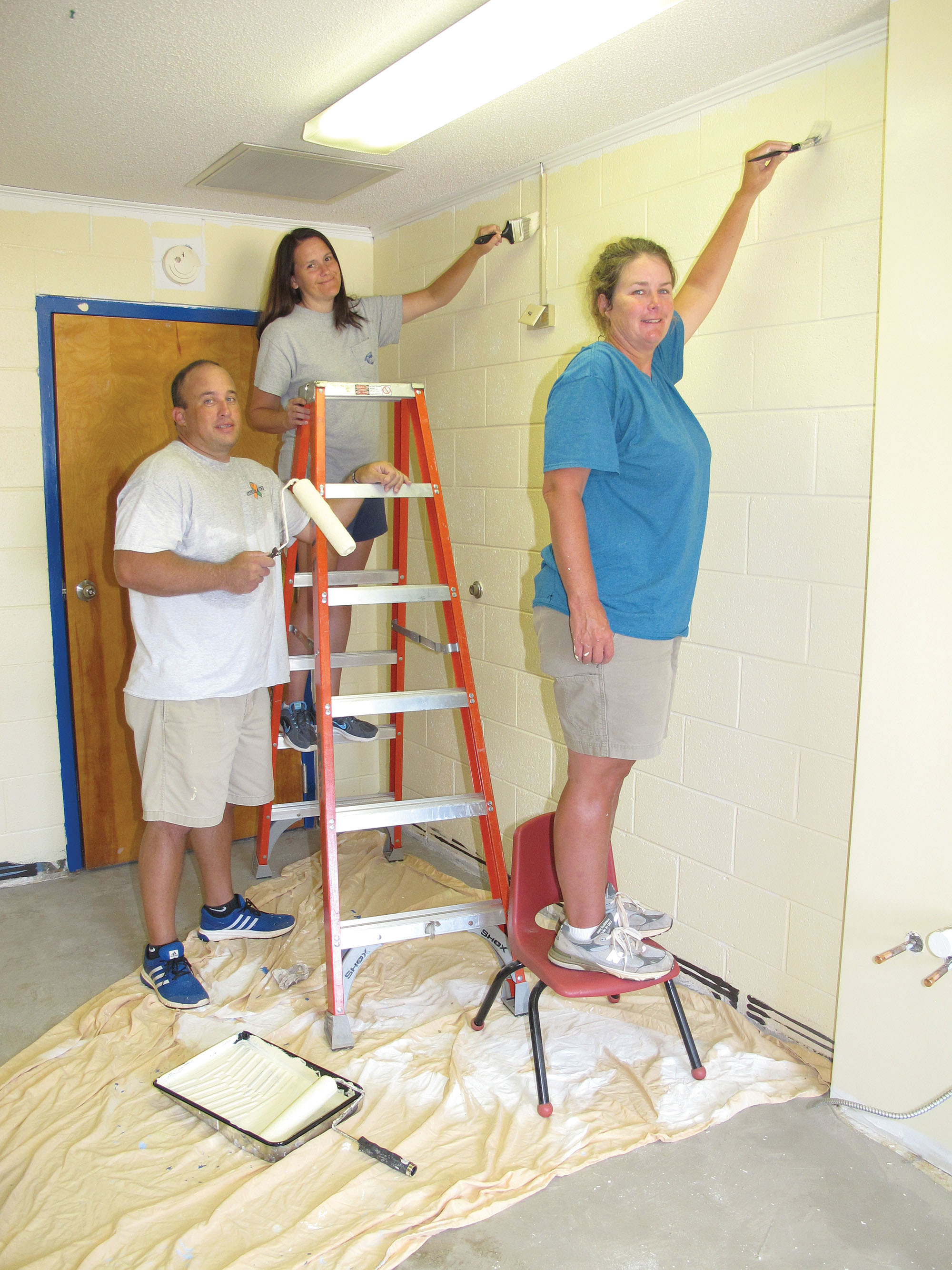
    Volunteer painters Jeff and Allison Spires and Rhetta Taylor put the finishing touches on a classroom at Richard Winn Academy. (Photo/Barbara Ball)
    Volunteer painters Jeff and Allison Spires and Rhetta Taylor put the finishing touches on a classroom at Richard Winn Academy. (Photo/Barbara Ball)

    WINNSBORO (Aug. 4, 2016) – Already sporting a new head football coach, new girls’ basketball coach and a new head of school, the Richard Winn Academy building itself is going to have a new look when classes start Aug. 11.

    Since accepting the job as Head of School in the spring, Brandy Mullennax has thrown herself into a two- month whirlwind of overseeing a major renovation of the school, which consumed the better part of June and July. But oversight was just one part of the job. Mullennax also pulled together volunteers, donors and rolled up her own sleeves to get the job done before the start of the new school year and under budget – way under budget.

    “In addition to our actual costs, we would have had additional expenses of about $20,000 had the RWA community not stepped in to paint, repair and donate money, equipment and supplies,” Mullennax said.

    “We couldn’t have done this without those volunteers and donors. It’s been seven days a week for the last two months. We’ve painted most of the interior of the school and brought the school colors in to brighten the hallways. Everyone has pitched in to do something. K4 student Avery Warren was up here painting hallways alongside her parents Todd and Reid,” she said.

    Some teachers painted their own rooms while RWA family, friends and students painted and fixed up other areas including the administrative offices, hallways, classrooms, gym and outside areas. There’s also a new awning at the entrance to the school.

    “We’ve renovated some locker rooms and restrooms, made major roof repairs, replaced air conditioning units, added an Early Learning Center with infant and toddler rooms, added fencing to the playground . . . the list is long,” Mullennax said with a weary smile. But she said there is more to do – more painting, more air conditioners to be replaced, the back side of the gym roof needs replacing and more restrooms need to be renovated. Mullennax said some of these needs will have to wait, however, until she can come up with more funds.

    “It’s been an extraordinary effort,” she said. “These people (volunteers) are tireless.”

    “But it was Mullennax who planned and guided the project and provided the energy behind it,” RWA staff member Martha Ladd told The Voice. Indeed, Mullennax recruited volunteers from near and far, including her Lugoff neighbor, Glenn Smith, who donated over $1,000 in labor to patch drywall and repair ceilings.

    With all the tearing out, painting and replacing over the summer, the school was a mess by mid-July. Workers and visitors could hardly get through the hallways to their work stations. But Mullennax said she is confident the building is going to look great when the students arrive for the new school year.

    “The renovation was truly a community effort,” Mullennax said. “It’s amazing how they transformed the school on a shoestring budget in such a short time. And we at the school are grateful.”


  • Board Awards Stipends

    WINNSBORO (Aug. 4, 2016) – The Fairfield County School Board voted 6-1 during their July 19 meeting to award stipends district wide for certified, classified, athletic and band staff. Paula Hartman (District 2) was the dissenting vote and explained that she voted against the stipends because she had asked Superintendent J.R. Green a year ago for a job description of the Board’s clerk who receives a stipend of $7,000 for  assisting the Board. Hartman said her request was never answered.

    At the District level, the Board approved $3,500 stipends for an Induction Coordinator, $2,500 for mentor teachers and $7,000 for the Board’s Administrative Clerk. In the Student Services Department, the Board approved $3,500 for the Data Manager/Medicaid Supervisor and $2,500 for the Lead Social Worker.

    Academic Supplements

    • Fairfield Central High School stipends: $2,000 each for department heads in English, Mathematics, Science, Social Studies, World Language, Electives, ROTC and Business; $1,500 for an Academic Challenge Team Lead; $1,000 each for a Beta Club Advisor and a Student Government Advisor; $2,500 for a STEM Lead Teacher; $2,000 for Yearbook; $750 for Junior Class Sponsor/Prom; $375 each for Sophomore and Freshman Class Sponsors.

    • Fairfield Middle School: $1,150 each for department heads in ELA, Science, Math and Social Studies; $1,050 each for Special Services and Related Arts; $1,155 each for six Academic Team Leaders; $900 for an Academic Team Coach; $2,500 for STEM Early College Academy Lead Teacher and $1,050 for a PBIS Coordinator.

    • Fairfield Elementary: $3,750 each for Curriculum Chairs for grades K-3, 4-6, Related Arts and Special Services.

    • Magnet School: $2,500 each for Curriculum Chairs, grades K-3 and 4-6.

    • Geiger and McCrorey-Liston: $2,500 each for Grade Level Chairs, grades CD-2 and 3-6.

    • Kelly Miller: $2,500 each for two Curriculum Chairs.

    • Career Center: $2,500 each for two Department Chairs; $1,500 for a Robotics Team Leader.

    Athletics Supplements

    The Board approved $15,000 for the Athletic Director and $3,750 each for two assistant A.D.s.; $8,000 for the Recruiting Coordinator; $5,500 for the Head Strength Coach.

    • Football: $8,000 each for the Offensive and Defensive coordinators; $6,500 for the Special Teams Coordinator; $5,500 each for four assistant varsity coaches; $6,000 for the head JV coach; $4,500 each for four assistant JV coaches; $5,000 for the head middle school coach; $2,500 each for three assistant middle school coaches; and $2,000 each for two filming coordinators.

    • Tennis: $3,000 each for the head boys’ and girls’ tennis coaches. Volleyball: $3,000 for the head varsity coach; $1,500 for the assistant varsity coach; $1,500 for the head JV coach; and $2,000 for the head middle school coach. Golf: $3,000 for the head coach.

    • Basketball: $8,500 each for the head boys’ and head girls’ varsity coaches; $3,000 each for assistant varsity girls, assistant varsity boys, head JV girls and head JV boys coaches; $2,000 each for the B-team boys’ and girls’ coaches; $1,500 each for the middle school boys’ and girls’ coaches; and $800 each for the assistant middle school boys’ and girls’ coaches.

    • Wrestling: $3,000 for the head coach; $1,500 for the assistant coach. Track: $3,500 each for the head girls’ and boys’ coaches; $1,500 each for assistant boys’ and girls’ coaches. Cross Country: $3,500 for the head coach.

    • Softball: $3,500 for the head varsity coach; $2,000 for the assistant varsity and the head JV coaches. Baseball: $3,500 for the head varsity coach; $2,000 for the assistant varsity and the head JV coaches; $1,500 for the assistant JV coach. Soccer: $3,000 each for the head boys’ and girls’ coaches; $2,000 for head JV boys’ and girls’ coaches.

    Academic coaches: $3,000 each for two positions. Band: $10,000 for the Band Director; $4,000 each for the Percussion Instructor and the Auxiliary Coordinator; and $2,000 each for the Woodwind Instructor. Cheerleading: $5,000 for the head varsity cheerleading coach; $2,500 for the head JV coach and $2,000 for the head middle school coach.


  • R2 Picks New Superintendent

    Dr. Baron Davis
    Dr. Baron Davis

    COLUMBIA (July 28, 2016) — At a Special Called Board Meeting on July 25, the Richland Two Board of Trustees voted to authorize Board Chairman James Manning to execute two contracts between the Board of Trustees and Dr. Baron R. Davis. Under the first contract, Dr. Davis will serve as superintendent elect from July 25 – June 30, 2017.

    “While the board has accepted Dr. (Debbie) Hamm’s retirement at the end of the 2016–2017 school year, she remains the district’s superintendent until July 1, 2017,” Manning said. “We are committed to working together to make the 2016-2017 school year a success and to ensure a smooth and seamless transition to the new superintendent. Therefore, the Board decided that it was in the best interest of the district to select Dr. Davis as superintendent elect.”

    Chairman Manning was also authorized to execute a separate three-year contract that names Dr. Davis superintendent beginning July 1, 2017.

    “I am very proud to know the district will be in great hands with Dr. Davis,” Hamm said. “He is an outstanding leader and a talented educator and truly has the best interests of students at heart. I look forward to working with him during my final year as Richland Two prepares for our next great chapter.”

    An educator for almost 20 years, Davis currently serves as one of the district’s assistant superintendents who support overall educational excellence in the schools by providing leadership, administrative direction, supervision and technical support.

    “I am beyond honored that the Richland Two Board of Trustees has entrusted me to follow Dr. Hamm as superintendent of our outstanding district,” Davis said. “Dr. Hamm and I both recognize the ultimate reasons for our success come from our extraordinary coworkers, administrators, teachers, parents, students, retirees and community members. We all share a sense of urgency when it comes to providing all learners with meaningful, challenging and engaging learning experiences. Together we will continue our focus on learning, community, character and joy as we help students maximize their gifts and talents, enabling each to chart and navigate a personal pathway towards a purposeful and productive future.”

    Davis earned a Bachelor of Science degree in sociology from Francis Marion University. From the University of South Carolina, he earned master’s degrees in school counseling and educational administration, and Educational Specialist and Doctor of Philosophy degrees in educational counseling. He holds superintendent, school counseling, secondary principal and secondary supervision certifications. In addition to his formal educational training, Davis has participated and completed numerous educational leadership programs offered through the South Carolina Department of Education including the Tapping Executive Educators Program, the School Leadership Executive Institute and the South Carolina Education Policy Fellowship Program.

    During his educational career, Davis has served as a successful school leader in rural, urban and suburban school systems where his schools were recognized for closing the achievement gap, increasing graduation rates and increasing Advanced Placement participation rates. While he was principal of Spring Valley, the school was recognized by the Washington Post as one of America’s Most Challenging High Schools and by Newsweek as one of America’s Top High Schools.

    Davis’s support of education and his community extends beyond Richland Two. Currently, he serves on the Francis Marion University Alumni Board, the University of South Carolina Trio Programs Advisory Board, the South Carolina Male Achievement Conference Planning Committee, Rotary International (Spring Valley Club, Columbia), national and state associations of school administrators, and Omega Psi Phi Fraternity Inc. He participates in the City of Columbia’s “My Brother’s Keeper” initiative. Davis was inducted into the Columbia Housing Authority’s Wall of Fame in 2015 and in past years has given service to the University of South Carolina’s Department of Counselor Education Advisory Council and the SCASA Institute of Innovation Planning Committee.

    Since assuming the role of assistant superintendent, Davis has helped to establish the Richland Two Assistant Principal Academy, the Administrators Development Series, the Training Administrators Program and the Administrators Mentoring Program. He has led the district in the implementation of a principal for a day program and the Richland Two Ready to Read book drive. Under his guidance, all five of the district’s high schools were accepted to TransformSC’s network of innovative schools in May 2016. He developed and assisted in the implementation of Richland Two’s district-wide mentoring program standards that now serves as the common framework for all current and future mentoring programs. In addition, Davis provides leadership and general oversight of the academic and programmatic development of the Richland Two Institute of Innovation, which will open in August.

    A native of Columbia, Davis is a member of the Brookland Baptist Church. He and his wife, Pam, are the proud parents of three beautiful daughters.


  • Green proposes building patio homes for teachers

    WINNSBORO (July 28, 2016) – A proposal by Superintendent Dr. J.R. Green that the Fairfield County School District construct patio homes and rent them out to teachers received mixed reactions at the July 19 regular school board meeting.

    “I’ve been working on an initiative for the last several months that would develop some housing for current and prospective teachers in the District,” Green told the Board. “We hope this will increase our ability to recruit and retain certified staff. We’ve had some conversation with experts in the field as to how we’re going to pursue maybe developing some two- and three-bedroom patio homes that would be financed through conventional financing, how we can fund traditional school district capital projects.”

    While Green did not identify the “experts” he had consulted, he said he thought the project would help teachers who work in Fairfield County and who are unable to buy housing to find a way of eventually moving here, which, he said, presents more stability and would help the entire community by spurring an economic venture. Green said he was “very optimistic about our ability to pull something like this off.”

    “So by next month I will hopefully bring forward the opportunity to make a proposal that we go out and put that project out for bid to see if we could get some firm figures on what it would cost to really pursue such an initiative,” Green said.

    William Frick, District 6, raised some questions about Green’s proposal.

    “So that we won’t run into something we ran into on a previous project, when you say, ‘put out for bid,’ could you tell us specifically what you’re talking about?” Frick asked.

    “OK, probably what I’m going to recommend, is that we pursue a design/build contract and ask firms interested in pursuing the project to give us some proposals and some firm figures on what it would cost to deliver houses that we’ve identified,” Green said. “So the design/build can encompass the architectural design and construction all under one contract. So all I’m saying is if you (contractor) have the capacity to deliver such a project, let us know what you would do it for, what would such a project cost.”

    Frick also asked Green if he had any examples to give the Board an idea what he (Green) is proposing.

    While Green did not have any models for the Board to look at, he said, “Some districts and cities have pursued such projects – Baltimore, San Francisco. One thing that initiates such a move in these cities is that teachers could not find affordable housing because the cost of living is so high. The issue in Fairfield County is not the high cost of housing, but access. There is not an abundance (of homes) available so teachers can’t find houses they are comfortable with to move in to.”

    Board member Rev. Carl Jackson (District 5) asked Green if he was proposing to build the patio homes on property the District already owned.

    “We are exploring other options,” Green said, “but, ideally, we’d like to locate them on District property.”

    Board Member Paula Hartman (District 2) said she preferred spending the District’s money on students’ education rather than building homes for teachers.

    “Let the people who build (homes) do this, not the school district,” Hartman said. “We need to stick to educating our students.”

    Hartman asked Green who would cover the cost of building and maintaining the patio homes.

    After explaining that the school district will pay for the construction of the homes, Green added that, “I will plan this so all the debt will be encompassed in the rent payments, just like a regular apartment complex. While it will cost the District money to construct the facility, my hope is that we will pursue conventional financing and then what would happen is, as we collect (rent) from the tenants, we will pay back the construction loan.”

    Green said the construction, financing, maintenance and upkeep would all be covered by the rental revenue.

    “I just don’t think the business of the school is to construct and rent out homes,” Hartman said.

    Green told the Board that he has talked to some individual County Council members about the proposal and that they told him they would be interested in partnering on such an initiative. But he said that while he is interested in partnering with the County, “I don’t want us to lose our momentum in terms of making this happen.”

    “Sometimes,” Green said, “a lot of people want to talk and evaluate. My concern about involving too many people . . . is that I just want to maintain our momentum as we move forward.”

    Board member Annie McDaniel (District 4) said she liked Green’s proposal, but asked him to keep the Board members in the loop via email so they would know where the District stands on the project and be able to answer the public’s questions about it. Green said he would.


  • Fireworks take center stage at Council

    WINNSBORO (July 28, 2016) – The Fairfield County Council quickly dispatched with the items on the agenda during its regular meeting Monday night which included a public hearing that no one spoke at and a two-hour executive session after which Council took no action.

    The fireworks began during the second public comment period when citizens are allowed to speak on any issue they choose concerning Fairfield County and continued during County Council time at the end of the meeting.

    Bertha Goins of Jenkinsville addressed Council about the issues surrounding the Jenkinsville Water District and her concerns for the community.  She specifically addressed her remarks to Councilman Kamau Marcharia (District 4).

    “Over $10,000 of the people’s money in your district went missing belonging to both black and white. You didn’t demand an explanation or call for a protest.”  At this point Council Chairwoman Carolyn Robinson (District 2) reminded Goins of Council’s rule that speakers are not to call anyone by name.

    Goins complied and continued.

    “Much needed businesses are still trying to come into western Fairfield. It won’t cost the taxpayers anything and we can benefit greatly from them, but once again lies are being told why they cannot come in.  We deserve better and demand better and need better leadership.  Infrastructure and smart business development is a must to make our county a home we can continue to be proud of,” Goins said.

    She added that it was everyone’s responsibility to nurture, train and direct the young people in the community.

    “County and nation starts with them.  Teach them values and morals and then send them out to be an example for others.  That’s our job,” Goins said.

    “We covered up so much, swallowed so much, backed off so much, accepted too many lies…”

    At this point Marcharia interrupted Goins.

    “Madame Chair – that is not the purpose of her being up there.  What was the nature of her conversation?”

    With that, Goins sat down without completing her comments.

    Later, during the County Council time portion of the agenda, Councilman William “Billy” Smith (District 7) commented on Marcharia’s interruption of Goins’ address to Council.

    “I think we need to make sure that we respect everyone when they speak in here,” Smith said, “whether it is a citizen or a Council member.  That needs to go both ways, not just one way.  I know that the second public comment portion in our bylaws states that anybody can come out and speak pretty much about anything…I just want to make sure we don’t quiet or hush citizens when they come in here because that is a right we have afforded them with our bylaws,” Smith said.

    When it came Marcharia’s turn during County Council time, he began by lamenting that there were no police officers in the room.

    “I do not feel safe in this Council,” Marcharia said. “At the last Council meeting I feel like I was verbally attacked and called a liar.  I feel like again (tonight) I was going to be verbally attacked. I certainly want police officers in here until I feel safe…I have been verbally attacked and I don’t know where (those) attacks are going to lead to or what’s going to happen.”

    Chairwoman Robinson said that the lack of an officer was not intentional, but was due to the day of the Council meeting being changed from Monday to Tuesday.

    Marcharia then turned his attention to Chairwoman Robinson, asking her how many miles of paved County roads were in her district.  Robinson responded that most of the roads in her district are state roads, and that dirt roads were paved only after the County started its road paving program.  She noted that districts 1, 2 (her district), 3 and 4 (Marcharia’s district) have the most unpaved dirt roads in the County.

    “All the roads up there (District 2) were as smooth as a baby’s face,” Marcharia said, “but with the roads at Lake Monticello, you are lucky if there are 25 miles of paved road, and every one of those roads will tear your car up. There is some discrepancy going on as to what roads get paved and don’t get paved.  You have 3 or 4 members in your district that sit on the CTC (County Transportation Committee)…I think it’s unfair if you have 3 or 4 people in (your) district to speak for your roads and everybody else might not even have a representative.”  CTC members are appointed by the legislative delegation, not County Council.

    Marcharia’s final target was what he perceived to be accusations that he had divulged confidential information.

    After several minutes of a high decibel back-and-forth between Marcharia and Chairwoman Robinson about the issue of confidentiality and whether he (Marcharia) had been unfairly maligned in the newspaper, Robinson resorted to her gavel. Smith put an end to the noisy bickering with a motion to go into executive session to discuss a contractual matter regarding Fairfield Memorial Hospital. It was seconded simultaneously by Marion Robinson (District 5) and Mary Lynn Kinley (District 6), and the open meeting abruptly ended.

    County Administrator’s report

    Jason Taylor, Fairfield County Administrator, also brought several recommendations for action to the Council Tuesday night, all of which were approved unanimously.  Chief among these was the recommendation to put Phase II of the Commerce Park off Peach Road out for bid.  The engineering plans for the road extension and water and sewer infrastructure are done, Taylor said, with a total estimated cost of $5,970,000, and will be paid for with funds the County has.

    The Council also voted to replace the old EMS substation in Rufus Belton Park with a new modular

  • Richland 2 Superintendent Announces Retirement

    Debbie Hamm
    Debbie Hamm

    COLUMBIA (July 21, 2016) – Dr. Debbie Hamm, Superintendent of the Richland 2 School District, will be calling it quits at the end of the 2016-2017 school year, the Richland 2 School Board said last week. Her retirement will take effect June 30, 2017.

    Hamm took over as Interim Superintendent in June 2013 after the resignation of Katie Brochu. In November 2013, Hamm took the reins in earnest, accepting a $199,000 a year deal from the Board.

    The Board announced Hamm’s planned retirement during their July 14 meeting. At that same meeting, the Board conducted Hamm’s performance evaluation.

    “Dr. Hamm received an overall commendable evaluation based on her outstanding work in her Four Squares of focus – learning, character, community and joy,” Board Chairman James Manning said.

    As a result of the evaluation, the Board voted to give Hamm a 2.5 percent raise for the 2016-2017 school year.

    “With almost 40 years of service to Richland 2, Dr. Hamm will be sorely missed,” Manning said. “Her outstanding leadership has cultivated joy and motivation throughout the District.”

    Manning said the Board will announce in the future its process for selecting Hamm’s successor.


  • Board Questions Student Trips

    WINNSBORO (June 30, 2016) – Field trips and senior trips were once again on the Fairfield County School Board’s agenda earlier this month with some Board members arguing against the District sponsoring the trips.

    Dr. Claudia Edwards, Deputy Superintendent of Academics, first asked the Board to approve a field trip to England in 2017 for the high school’s Early College Academy, so the students could experience real-life applications of STEM (science, technology, engineering and math) concepts. Edwards said the trip would cost $3,635 per student.

    According to Edwards, a payment plan will be offered for both students and adults who take the trip.

    “Does that (the payment plan) mean the students will be paying for this trip, the entire trip?” Board member William Frick (District 6) asked.

    Edwards said the students are planning to have fundraisers to help offset the cost of the trip. District Superintendent Dr. J.R. Green added that the Board is only being asked to approve the trip so that students can begin fundraising and collecting money.

    “No one is requesting any funding of the Board,” Green said. “We are simply approving the trip, which gives the students the opportunity to begin fundraising and making payments on the trip. So if there is a question about whether the Board will be accepting (financial) responsibility for sending these students abroad, the answer to that is no.”

    The trip was approved 6-0, with Board member Annie McDaniel (District 4) abstaining.

    Similarly, the Board was asked to approve two senior trip options for the 2017 graduating class of Fairfield Central High School – a cruise to the Bahamas and a Grad Bash in Orlando, Fla.

    Again, it was made clear to the Board that only Board approval for the trip was being requested; the students would be responsible for coming up with the money.

    “We have been discussing this for a couple of years . . . about getting away from sponsoring this,” Frick said. “When we attach our name to it we assume responsibility – why are we still doing this?”

    Green said he had some conversations with the senior class members several years ago, and the consensus was that if the school didn’t sponsor it, it wouldn’t happen. The students felt they could not get enough support to organize the trip on their own

    Board Vice-Chair Carl Jackson Jr. (District 5) and Board member Henry Miller (District 3) also expressed concern about the school being involved and liable for the students’ welfare. Despite these misgivings, the trip was approved 5-1-1, with Board Charwoman Beth Reid (District 7) voting no because she also believed that “we should get out of the student trip business.”

    New Grading Policy

    The Board approved the second and final reading for the new grading policy required by state rules.

    The new grading policy, adopted by the State Board of Education in April, implements a 10-point grading scale for students in grades one through 12, effective for the 2016-17 school year. For example, students entering ninth grade will start on the 10-point grading scale; at that point a “90” will be considered an “A.” Previously, under the seven-point grading scale, a student had to score a 93 in order to receive an “A” grade.