Category: Schools

  • And the Answer is . . .

    WHS Principal Wins on Jeopardy!

    During a watch night party at Columbia Country Club, Dr. Cheryl Guy, Principal of Westwood High School, stands next to a big screen showing Jeopardy host Alex Trebek congratulating her on her big win on the show Friday night. (Photo/Barbara Ball)
    During a watch night party at Columbia Country Club, Dr. Cheryl Guy, Principal of Westwood High School, stands next to a big screen showing Jeopardy host Alex Trebek congratulating her on her big win on the show Friday night. (Photo/Barbara Ball)

    BLYTHEWOOD (Jan. 19, 2017) – Westwood High School principal Cheryl Guy, who won $20,600 on Jeopardy Thursday night, was the star of a watch party at Columbia Country Club as she and more than 100 friends, family and colleagues gathered to have dinner and watch the show on a big screen in the Club’s ballroom.

    Because Guy had been prohibited by the show’s rules from revealing any information about the outcome of her participation on the show, which was taped several months ago, the suspense in the audience was palpable as the first round ended for a commercial break with Guy having the correct question for only one answer and the lowest score. But as the half-hour show resumed, Guy picked up steam and winnings.

    For the final Jeopardy question, Guy bet big – $10,000 of her $10,600. Trebek read the answer: “Unlike newer Bibles, the King James version usually translates pneuma hagion as this, which can lead to unnerving images.”

    As the familiar musical clocked ticked, Guy wrote, “What is Holy Ghost?” Trebek pronounced Guy the winner, and the audience in the ballroom shot to their feet with cheers and clapping. For Guy, it was like winning all over again.

    While she came back on Friday night for another try at the jackpot, it wasn’t to be. Still, she said she was thrilled with her visit to the show, which was the culmination of 30 years of planning.

    “I always wanted to be on Jeopardy,” Guy told the audience before the broadcast, “and I auditioned several times but was never chosen. It was a goal I wanted to achieve,” she said, happily, “and I did. I had a dream and I never stopped working toward it.”


  • Richland 2 Seeks Bus Drivers

    COLUMBIA (Jan. 12, 2017) – Because of the increasing difficulty in recruiting and retaining school bus drivers, last week the Richland Two Board of Trustees approved an incentive package that awards bonuses to the District’s bus drivers based on performance, and adds days to drivers’ contracts for professional development and training.

    The move comes on the heals of an unusually high number of problems this year from bus shortages, driver shortages and mechanical issues resulting from an aging bus fleet, District Superintendent Debbie Hamm said in a statement released by the District.

    “We are working diligently to find solutions to the issues and regret the inconveniences our families face due to the delays and changes to bus routes,” Hamm said.

    “While we may not have much control over the age and number of buses provided to us by the state, we can make sure our bus drivers know they are a valuable part of the Richland Two Family and play an important role in supporting the mission of our district,” Board Chairman James Manning said.

    During a press conference outside the State House on Monday, S.C. schools Superintendent Molly Spearman said the bus shortage is statewide and asked the Legislature for $95,000 to buy 1,000 new buses. The state’s plan to phase out older buses is not working, she said. Because some of the buses are nearly 30 years old, there are concerns about reliability, safety and the cost to tax payers to provide maintenance and fuel needed to keep the aging fleet going.

    “School buses have gone to the bottom of the (Legislature’s) list” while setting spending priorities, Spearman said.

    A District spokesperson said that Richland Two transports 14,000 students over 581 routes each day, beginning with the pick-up and drop-off of middle school students, then elementary school students and, last, high school students. The buses also provide service for a wide range of extracurricular activities including sports games, said District Two Superintendent Debbie Hamm.

    The District has approved pay increases for bus drivers for the past two years and will soon evaluate new bus routing software to help improve efficiency. Hamm said transportation administrators post information daily to the Districts mobile app regarding delayed pick-up and drop-off times.

    Anyone interested in driving a bus for Richland Two can complete an online application at richland2.org or call Dennis Jones at 803-736-3774.


  • Coaches’ Teaching Credentials Questioned

    WINNSBORO (Jan. 12, 2017) – During public comment time at the December School Board meeting, parent Thomas Armstrong raised the question of how many head coaches in the Fairfield County School District are not certified. While he suggested to the Board that none are certified, he later backed off that assessment in a follow-up interview with The Voice, saying there may be as many as five who are not certified and that at least two head coaches are not college graduates.

    “It’s a sad day when we can’t hire certified coaches in Fairfield County with the money we are paying,” Armstrong said. He challenged the Board to be sure they are doing their due diligence; to be sure they are getting the best their money can pay for.

    “I’m told that in the old days we had certified coaches. We’ve got to raise the bar when it comes to our kids. They’re all we’ve got,” he said.

    Armstrong said he had “praise for the accomplishments we’ve made with Dr. Green . . . and I, too, want to see us continue to grow. But when we employ people,” Armstrong said, “I want the best for our kids. We need to educate the whole child. And when it comes to sports, we can’t cheat our kids.”

    Armstrong also addressed the Board on several issues of coaches’ accountability and brought up what he said is an unwritten policy in the District to close (sports) practice sessions to parents.

    “Now, parents can go into the classroom in Fairfield County, but we close our practices to parents. What’s going on in practices that parents can’t see?” Armstrong asked.

    With that, Board Chairman Beth Reid (District 7) rapped her gavel, and Armstrong sat down.

    Asked later about Armstrong’s assertions, Superintendent Dr. J. R. Green confirmed that several coaches are not certified and that some are not college graduates.

    “The varsity boys’ baseball coach, boys’ track coach, girls’ track coach, wrestling and cross country coaches are all certified,” Green wrote in an email to The Voice. “I can confirm that, to my knowledge, we do have some that have not completed their degree requirements. As a district, we continue to support our classified staff members that are interested in eventually becoming certified, and (we are) proud to celebrate those that achieve that milestone.”

    Evaluation of Superintendent

    During Board business that followed, Reid said she handed out forms to Board members during an executive session prior to the public meeting that members were to complete for the purpose of the annual evaluation of the Superintendent.

    “We went over the five components of the evaluation – engagement, achievement, leadership, learning environment and fiscal management,” Reid said. Green presented his own validation of his achievements in the five areas in executive session, she said. Reid asked Board members to complete their evaluation forms during the public meeting and return them to her at the end of the evening for compilation. Reid said she would announce the results of the evaluation at a later date.

    Beta Club Trip

    The Board approved unanimously a trip for the High School Beta Club to Myrtle Beach on Feb. 10 for a workshop. Green said the Middle School Beta Club would not be going to Myrtle Beach this year, but to Berry Island. When asked by Paula Hartman (District 2) if the Middle School students would be involved in a Beta Club competition at Berry Island as they had been the previous year at Myrtle Beach, Green said he was not sure.

    Green noted that the students are required to pay a $50 non-refundable trip deposit as an incentive not to back out at the last minute. Annie McDaniel (District 4) amended the motion to provide for the $50 deposits to be refunded to those students who actually take the trip. The motion passed unanimously.

    Employee Incentive

    Green recommended a $100 Christmas incentive for all fulltime and permanent part-time employees, for a total cost to the District of $65,000 which, he said, had been budgeted for the 2016-17 school year.

    Board member Sylvia Harrison (District 1) suggested doubling that amount to $200 for a total of $130,000.

    Board member Rev. Carl Jackson (District 5) had some advice for his fellow Board members in this regard.

    “As long as we don’t set a precedent that will be expected in the future,” Jackson said. “This is a one-time deal for this particular year. We don’t have a windfall every year. If they expect $200 next year and we don’t give it, they may be a little disgruntled.”

    The $200 Christmas incentive passed 6-1. Hartman was the lone dissenter, saying the extra amount had not been budgeted.

    Reid said the Board will meet at the District Office in January and will, at that time, set a date for the annual Board retreat.


  • BHS Seeks New Head Football Coach

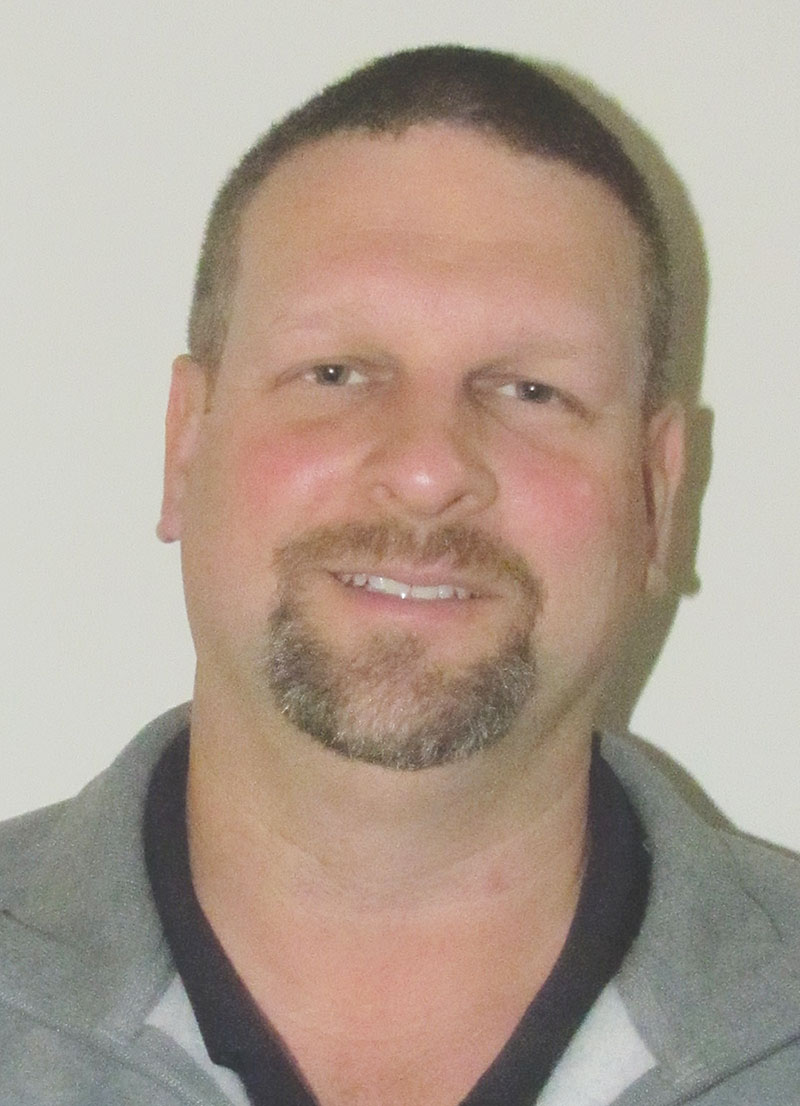
    Dan MOrgan
    Dan Morgan

    BLYTHEWOOD (Dec. 22, 2016) – After four seasons as a head coach and five as defensive coordinator, Dan Morgan has resigned as head football coach for the Blythewood High School Bengals.

    Barry Mizzell, Athletic Director, said the school accepted Morgan’s resignation last week, on Dec. 6.

    “We appreciate everything Dan has done for us,” Mizzell said. “He’s been here nine years – four as head coach. After nine years, I think he was ready for a new challenge.”

    Morgan took over for the Bengals after Reggie Kennedy departed following the 2012 football season. He posted a 29-20 record while in charge of the program, leading the Bengals to the playoffs in each of his four years. The first two years, the Bengals exited the playoffs in the first round. The last two seasons ended in second round losses.

    Mizzell said the search is on for Morgan’s replacement and the school hopes to have a new head coach by the end of January.

    Morgan could not be reached for comment.

    Morgan’s departure marks the second shake-up in the Bengals’ football program in recent weeks. Junior quarterback Jordyn Adams two weeks ago announced he would be transferring to a school in North Carolina to play out his senior season and to be closer to his father, Deke, an assistant coach at East Carolina.


  • Board OK’s Education Foundation

    BLYTHEWOOD – During the Nov. 15 School Board meeting, Superintendent J.R. Green discussed his ongoing plans to construct teacher housing in Fairfield County and called on the Board to establish an Educational Foundation that, he told the Board previously, would benefit a teacher housing initiative in Fairfield County.

    At last week’s meeting, Green and Board member William Frick (District 6) talked about that benefit in terms of financing, spending about a half hour on a detailed report on how an apartment complex for teachers in North Carolina was financed at zero interest through an Educational Foundation.

    It appeared to be a snapshot of what could be done in Fairfield County and, at the end of the meeting, the Board voted 5-2 to establish the Educational Foundation. However, in an interview with The Voice earlier this week, Green said the zero-interest financing that made the North Carolina teacher housing financing possible is not available to the Fairfield County School District.

    During the meeting, Green reported that he and four Board members – Silvia Harrison (District 1), Henry Miller (District 2), the Rev. Carl Jackson Jr. (District 5) and Frick – traveled to Hertford, N.C. earlier this month to tour the apartment complex and find out more about the project and the financing.

    But Green was not specific that the type of financing used for the N.C. teacher housing could not be used for a teacher housing initiative in S.C.

    Frick explained the N.C. housing project’s financing process. He said it was not acquired by the Hertford School District, but by an Educational Foundation, a 501(c)3 charitable corporation, that is independent of the Hertford School District’s Board of Trustees. The Educational Foundation’s Board acquired the zero-interest financing from the N.C. State Employee Credit Union, which routed the funding through its own special foundation set up for the purpose of supporting such projects, Frick said.

    According to newspaper reports about the financing of the N.C. project, the Credit Union’s own foundation (not the Educational Foundation) holds the lien until the loan is repaid. The loan payments are made by the Education Foundation Board from rent it collects from the tenants.

    “The property the N.C. housing project sits on is owned by the school district, which rents it to the Educational Foundation for $1 per year,” Frick added, saying the school district pays the Educational Foundation $20,000 a year to manage and oversee the day-to-day operation of the housing project, including interviewing the housing applicants, collecting rent and calling the plumber for emergencies.

    Green said the Fairfield School District owns 90 acres between the District office and the high school and that if the teacher housing project is built there, only three or four of those acres would be used.

    Both Miller and Jackson said they were impressed with the N.C. project, noting that it was within walking distance of one of the schools.

    Frick said that another benefit of the Educational Foundation is that people who wish to make donations to the school district might be more encouraged to do so through the foundation.

    Annie McDaniel (District 4) asked how the chairman of the Hertford Educational Foundation Board was selected.

    Green said he was not sure, but guessed that, “the chair was appointed by some people affiliated with the (School) District and some people affiliated with the Foundation.”

    Green told the Board that he would want to appoint the Foundation’s Board members. He later told The Voice that the Board members will then elect their chairman and other officers.

    McDaniel also asked about the cost of applying for a 501(c)3 corporation.

    Green said the Fairfield County School Board would pay the approximately $1,000 cost, which would include attorney’s fees, for the Educational Foundation to apply for 501(c)3 status.

    When asked by McDaniel what role the School Board would play in the Educational Foundation, Green said it would have no role.

    Although discussion about the zero-interest financing for teacher housing in N.C. was lengthy, Green did not actually say that financing was being considered for Fairfield County teacher housing, nor did he identify another source of financing he might seek.

    The Board voted 5-2 to establish the Educational Foundation. McDaniel and Hartman voted against the measure.

    “I support an Education Foundation for Fairfield County School District, but there are a lot of questions that should be answered before we move forward to establish it,” McDaniel said.

    Earlier this week, The Voice asked Green if he was planning to seek the zero-interest type of credit union financing used in N.C. since that was not made clear at the meeting.

    “No. I am looking to do conventional financing through a traditional financial institution,” Green said.

    Green told The Voice that the N.C. financing package for the teacher apartment complex in Hertford is “very unique” and not available to the Fairfield School District or in S.C.

    “That situation in North Carolina is something that that particular credit union is doing to help transform education in their community. They are not doing it as a business to make a profit,” Green said.

    Asked what the relationship would be between the School District and the Educational Foundation, Green said they would be two separate entities.

    “The School District’s Board establishes the Foundation, but after that, the District has no oversight or control over the Foundation,” Green said, noting that the Foundation would obtain the financing and repay it to the loan institution out of the rental revenue. He said that, like any housing financing, the housing complex would be the collateral for the loan.

    Asked if Educational Foundations in S.C. can finance construction projects, Green said he thinks they can but did not know for sure. He said he would look in to it.

    Green said he was not familiar with any school districts (in S.C.) that have secured financing (like N. C.’s) through an Educational Foundation to construct teacher housing.

    “The circumstances are different here. It’s just not available in South Carolina,” he said.

    Green said the District’s attorneys are moving forward to set up the Educational Foundation for Fairfield County.

    Barbara Ball contributed to this story.

     

  • Magnet School Earns High Marks in the Arts

    Art Smarts – Kimi B. Daly (back row, center), Art teacher at Fairfield Magnet School for Math and Science, and her students: Makayla Mann, Gianna Rhodes, Kimi Daly, Reniya Lyles, Tiauna Turner, Sharmelle Holmes, Caniya Brown, Paige English, Tavetria Amponsah, Layla Metts, Senai Greene, Trinity Skye, Tyus Armstrong, Skyla Hart, Alexia Hernandez and Jazzalyn McConnell. The Magnet School recently received the highest scores in the state in both Art and Music. (Photo/Stephanie Boswell)
    Art Smarts –
    Kimi B. Daly (back row, center), Art teacher at Fairfield Magnet School for Math and Science, and her students: Makayla Mann, Gianna Rhodes, Kimi Daly, Reniya Lyles, Tiauna Turner, Sharmelle Holmes, Caniya Brown, Paige English, Tavetria Amponsah, Layla Metts, Senai Greene, Trinity Skye, Tyus Armstrong, Skyla Hart, Alexia Hernandez and Jazzalyn McConnell. The Magnet School recently received the highest scores in the state in both Art and Music. (Photo/Stephanie Boswell)

    WINNSBORO (Nov. 17, 2016) – Fairfield Magnet School for Math and Science has received the highest scores in the state for both Art and Music for last year’s S.C. Arts Assessment Program (SCAAP). SCAAP is a part performance-based and part computer-based standardized test where students are asked to show their knowledge in their creative field, including techniques, genres and mediums.

    “It is a huge honor to have the highest scores in even one of the arts areas, but I don’t know if there has ever been a school to receive the highest scores in both!” Coordinator of Visual and Performing Arts for the Fairfield County School District Julianne Neal told The Voice in an email.

    It took long hours and dedication from Kimi Daly’s fourth-grade art classes and Latasha Watson’s music students, but the effort paid off in top marks and state-wide recognition.

    “I put their little noses to the grindstone and we researched artists and held many in-depth class discussions. We practiced and experimented with different mediums and produced many amazing 2-D and 3-D art pieces,” Daly said.

    “Mrs. Daly continues to inspire her students to shine through a number of different opportunities and has an amazing talent in bringing out the very best in each of them,” Neal said in her email.

    Watson, who recently moved to Virginia, made great strides in building up the music program and pushing her students to work to their greatest potential, Neal added.

    “We are missing her,” Neal said in her email.

    The test itself challenges students, both in music and in art, to focus on many different areas of their creative passion and makes them look at the arts from all angles, Daly told The Voice. She said she not only teaches the basics of art, but also how to apply art to other subjects in school and to future career paths that her students could take. The SCAAP pulls from many different areas of art to make sure students are getting a well-rounded education, Daly said.

    “[The SCAAP] asks you questions just like any other test. In science they might ask you questions about vibrations, and our test might say, ‘What are tertiary colors?’ So this minute thing in the middle of everything else we study is asked,” Daly said.

    Daly’s students don’t seem to mind putting in the extra work. When The Voice visited the hallowed art room, students came through the door in a steady stream to ask for more time to work on their art and to see if they could stay after school to get the hang of new techniques.

    “Many of my gifted art students are perfectionists and so I give them my time after school to complete their projects that require more than our 50-minute classes allow,” Daly said. While she doesn’t receive any supplemental pay for her extra time, she said, “the rewards of the heart are great.”

    Many of her students, Daly said, want to be creating all the time. Unfortunately, crafting masterpiece after masterpiece with no reprieve for lessons wouldn’t allow time to prepare for the SCAAP and finish the designated standards assigned to the art department each year.

    “It was hard on the fourth-graders last year,” Daly said. “They don’t like taking tests, they like to actually do art. I know that I have [the SCAAP] in March, and there are so many things I have to get to. So when they’re like, ‘Mrs. Daly, you told us we could paint!’ I have to say that after the test we can do whatever projects you want to do, but first we have to prepare for the test.”

    To see her students gain new skills and face the challenge of a difficult standardized test, only to get the highest scores in the state, fills Daly with pride and joy.

    “I live the dream every day watching my students come to their potential and surpass with excellence with a higher level of thinking that creative endeavors extend,” Daly said. “This is what sets them apart. They don’t work for grades. They create from their love of the arts.”


  • Board OK’s Trips, Tables Education Foundation

    WINNSBORO (Nov. 3, 2016) – When the Fairfield County School Board was asked last week to once again approve out-of-state and overnight student trips, Board member William Frick (District 6), got right to the point.

    “As we typically have, just to clarify, are we approving trips listed or are we approving a trip to be funded?” Frick asked.

    “The Board has a policy that it must approve all overnight and out-of-state trips,” Superintendent Dr. J.R. Green said. “So what we are asking the Board to do is just approve the trips and not necessarily to provide any funding. This does not imply any request to the Board to approve any funding.”

    Green said, however, that the money for some trips would be raised by students and funds for other trips are already approved as part of the individual schools’ budgets. Of the 14 trips approved by the Board, trips that students would have to raise their own funds for included:

    • A trip for the high school marching band to Ahoskie, N.C., for a band competition, with a projected cost of $3,700 or $25 per student;

    • A trip to the Bahamas for the District Honors and Fairfield Middle School choruses to perform on Carnival’s “Rock the Boat Cruise,” with a total projected cost of $18,150 or $605 per student;

    • A science trip for Fairfield Magnet School of Math and Science fifth- and sixth-grade students to John’s Island, with a projected cost of $6,800 or about $50 per student.

    The trips already funded though the individual school budgets, at a zero cost to the students, included a trip to Asheville, N.C., for the elementary Gifted & Talented program, and annual Junior Beta Club trips to Myrtle Beach for the four elementary schools and Fairfield Middle School.

    The trips were approved 5-1 with Board member Paula Hartman (District 2) opposed. The Rev. Carl Jackson Jr., (District 5), was not present.

    Education Foundation Tabled

    Green also asked the Board to approve moving forward to establish a non-profit educational foundation for the District’s schools. Green said he had some conversations with financial institutions concerning his teacher housing proposal, and those institutions said a non-profit foundation would benefit the housing initiative. He also noted that all the districts surrounding Fairfield already have a non-profit educational foundation.

    “It puts us in a better position to go forward with the housing initiative, but even outside of the housing initiative, it gives us the ability to receive donations from donors and individuals in the community who can receive a tax advantage,” Green said.

    “What does ‘move forward’ mean?” Frick asked. “(Does it mean) we explore before we agree to this, or does it mean it’s going to happen?

    “‘Moving forward’ means I will ask the attorneys to file the paperwork to establish the foundation,” Green said.

    Frick said he was a little hesitant to agree to a foundation right now when he did not have a lot of experience with it.

    “I would like the opportunity to explore this a little bit . . . and then we could move forward with it in November once the Board has more information,” Frick said.

    The Board agreed 6-0 to table the matter.

    Student Records Policy

    The Board gave a second and final reading to revisions of the Student Records policy and administrative rule to define which should be designated for the District’s directory information (information that can be given out without a parent’s release) and which information would require a parent’s release.

    Green said he wanted to clarify why the policy revision was made. He said it was because technology has changed so much that when information is subject to the Freedom of Information Act (FOIA), anyone can file an FOIA request and get that information.

    The motion to approve the amended policy was approved 6-0.

    Change in School Calendar

    Green asked the Board to approve changes in the academic calendar to make up the three days the county schools were closed during Hurricane Matthew. The make-up days will be Oct. 21, 2016 and Jan. 3 and Feb. 20, 2017.

    Next week: Board votes to move a $2.2 million surplus from last fiscal year into Capital Projects account.


  • Mixed Result on Local Test Scores

    school-table-copy

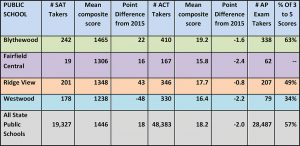
    BLYTHEWOOD/WINNSBORO – Data released last month by the State Department of Education show mixed results in national standardized test scores for local schools in 2016.

    Of the four local schools, Blythewood High School out-performed statewide results in the SAT, ACT and Advanced Placement (AP) exam.

    SAT SCORES

    Three of the four local schools – Blythewood High School (BHS), Fairfield Central High School (FCHS) and Ridge View High School (RVHS) – showed significant gains in SAT scores.

    RVHS had the most significant improvement in SAT scores – 43 points – and BHS had a 22-point improvement in scores over 2015. FCHS continued its upward trend in SAT scores with a 16-point increase this year on top of a 63-point increase last year.

    However, Westwood High School’s SAT scores dropped 48 points in 2016 after increasing 33 points in 2015.

    Asked what could have influenced the fluctuation in Westwood’s 2016 SAT scores, Dr. John Arnold, Director of Accountability and Assessment for Richland Two School District, replied in an email to the Voice that fluctuations in test scores, whether SAT, ACT, or other national assessment, are not unusual, and can be more pronounced at a single school because of the relatively small number of students tested and where each student’s performance has a greater impact on the school’s performance.

    The State Department of Education shows a statewide decrease of 16 percent in the number of public school students taking the SAT in 2016. The number of FCHS students taking the SAT dropped from 36 in 2015 to 19 resulting in only about 10 percent of the senior class taking the SAT in 2016. RVHS had 21 percent fewer students taking the SAT in 2016, while the numbers for BHS and WHS declined only slightly.

    Deputy Superintendent for Academics at Fairfield County School District, Dr. Claudia Edwards, attributed the low numbers of students at FCHS taking the SAT to the fact that the State requires students in their third year of high school to take the ACT and pays for the cost of the ACT. Therefore many students elect to use their ACT score for college admission. Students can take the SAT if they are also applying to colleges that don’t accept ACT scores.

    SAT is a standardized test often used in the college admissions process. The current SAT consists of three 800 point sections testing English/language arts, mathematics and writing, with the highest possible score being 2400.

    ACT SCORES

    The ACT is also used in the college admissions process and consists of subject area tests in English, mathematics, reading and science. The ACT includes 215 multiple-choice questions with 36 as the highest possible score. There was a large increase locally and statewide in the number of students taking the ACT in 2016. Beginning last year, all students in South Carolina are now required to take the ACT in eleventh grade. But ACT scores for all four local schools as well as statewide are down in 2016.

    RVHS scores showed the least decline with 0.8 points; BHS dropped 1.6 points; WHS dropped 2.2 points and FCHS, 2.4 points.

    AP SCORES

    College bound students can also take Advanced Placement (AP) courses in grades 11 or 12. These classes prepare students for the national AP examinations. Students who score 3, 4, or 5 on an AP exam are generally considered qualified to receive credit for the equivalent course(s) at colleges and universities that give credit for AP exams.

    BHS had the highest number of students (63 percent) scoring 3 to 5 on the AP exam; RVHS was next with 49 percent, and WHS had 34 percent.

  • Board Revises Student Privacy Policies

    After a power outage plunged their meeting room into semi-darkness, the Fairfield County School Board of Trustees cut short its Sept. 20 meeting, excluding an agenda item seeking approval of out-of-state and overnight field trips for students and a review of the August 2016 finance report.

    The Board approved the renewal of a contract with the Fairfield County Sheriff’s Office for the School Resource Officer Program that included a five-year extension with changes to provide for two officers at Fairfield Central High School, one officer at Fairfield Middle School and an officer to float between Geiger, Kelly Miller and McCrorey-Liston elementary schools, as well as budgetary changes to address overtime.

    Board members approved the contract 7-0 even though they did not have the revised document in front of them. Board member Annie McDaniels (District 4) reminded the Board that at a recent conference they were cautioned, “that we should not vote on things unless we have the final document.  So if you still want to go ahead and vote on it, maybe we could just have that revised document, maybe Dr. Green could just send it to us as soon as possible.  So if there are any issues we can get that addressed as soon as possible.” Board Chairwoman Beth Reid (District 7) agreed to provide the document.

    Student Records Policy

    The Board also approved 7 – 0 the first reading of a revised student records policy based on recent updates to the federal Family Educational Rights and Privacy Act (FERPA). Dr. Claudia Edwards, Deputy Superintendent of Academics, said parents are sent two kinds of notices at the beginning of each school year – a notice of their child’s rights under FERPA and a notice outlining what ‘directory’ information the school usually releases to the public about students.

    The District’s law firm, Childs & Halligan, P.A., recommended to the Board that it revise its student records policy and an accompanying administrative rule defining what should be included or limited as student directory information, including digital images.

    The revised policy rule includes the following language recommended in the Childs & Halligan memo: “With the exception of electronic images related to school-sponsored or district-sponsored events, activities and special recognition, the District will treat all video recorded of students through surveillance videos on District property or school buses as student records entitled to confidentiality pursuant to FERPA and other applicable federal and state laws. Accordingly, the District shall release or allow viewing of video only in certain defined situations, consistent with federal and state law.”

    This recommendation prompted McDaniel to ask what generated the policy revision. For example, she said, if there was a video tape showing a student fight or altercation, “You could put a situation to rest real quick (by releasing this tape)… to take those tapes and secure them … might cause us some different issues.”

    Her concern, McDaniel said, is if the video needed to be used to determine what occurred with a fight, it might cause problems later if the district refused to release the tape. She didn’t understand why a tape of students fighting would be protected in the same manner as a student record.

    “The question is what information (about a student) should be part of the public record and what is private,” Green answered. “As FERPA has been expanded we have a responsibility to our students to ensure that we do not release any privileged information.

    “If there were a film of something happening on a bus, for example,” Green said, “as a parent, my perspective may be that I don’t want a video of my child released. An argument could be made that FERPA would cover that. The way the attorneys are framing it, is that all of that falls under the context of the student records.”

    The revised policy also states that: “The educational records or school records include all materials directly related to a student that a school maintains. Schools will treat each student’s education records as confidential and primarily for local school use.”

    The exception to this rule is for directory information, which the District defines to include the student’s name, address and telephone number as well as participation in officially recognized activities and sports, dates of attendance, diploma or certificate and awards received and similar information which may appear in newspaper articles, on television, in radio broadcasts, school displays, etc.

    Teacher Housing

    Green also gave a brief update about his proposal for the District building teacher housing – a “teacher village” – as a way to retain and attract good teachers. At the Aug. 16 meeting, Board member William Frick (District 6) suggested Green first survey teachers who have left the District to determine whether, if those teachers had had viable housing options, it would have kept them from leaving the District. Frick said a survey of those who left might determine if there’s a demonstrated need for teacher housing and if it would be helpful for teacher retention.

    The next week Green followed up with a survey, but to current teachers, not to teachers who have left the District as Frick suggested. The surveys were email generated to individual teachers from the District office.

    At the September meeting, Green said he received 202 responses from his survey with 36% saying they currently live in Fairfield County. Sixty-six employees, he said, indicated that if the housing option was available as early as August 2017, they would be interested in moving into that facility.

    Green noted that he was interested in pursuing traditional financing options as opposed to a bond issue, although he said the teacher village could be constructed on about 90 acres of land the district currently owns near Fairfield Central High School.

    Green also pointed out that four such projects have been funded in North Carolina. One of these projects, in the Hertford County school district, a district which Green said mirrors Fairfield County, was constructed in 2007. Green said there is always a waiting list for those housing units.

    “So this is not a far-out concept,” he added.

    Board member Paula Hartman (District 2) asked if Green was able to find out whether the district “was able to venture into this,” since the project would be using district property. Green responded, “Absolutely…why shouldn’t we use district property?”

    McDaniel then cautioned that “you do need to check that out, Dr. Green.”

    Green agreed, stating that he was still in the investigative phase.

  • BHS Honors State Champions

    BLYTHEWOOD (Sept. 21, 2016) – Blythewood High School will celebrate the 10th anniversary of the Bengals’ remarkable class 3A state championship run this Friday during halftime of the Blythewood’s homecoming football game against River Bluff.

    Jeff Scott, head coach of the 2006 team and now co-offensive coordinator at Clemson, will be on hand to welcome back former players and join them for dinner in the school cafeteria prior to the game.

    The Bengals captured the 3A title in their first year of varsity play, the first team in the state to do so. After dropping their opening game in 2006 to Ridge View (21-13), they went on an amazing 14-game winning streak en route to the crown.