Category: Schools

  • Green, Douglas spar over millage

    WINNSBORO – They came to tout their successes as governmental agencies.

    But an emerging kerfuffle over the distribution of property tax revenues quickly became the focal point at a Fairfield County intergovernmental meeting Monday.

    At the previous week’s council meeting, Councilman Jimmy Ray Douglas publicly called out the Fairfield County School District, saying that the district had improperly collected more than $11 million in tax revenues.

    Douglas said inflated millage rates attributed to the school district overages. He noted that the windfall is on par with the $11.5 million price tag associated with renovating the old Mt. Zion institute to serve as a new Fairfield County Administration building.

    “Fairfield County can’t support and pay for the new office complex at Mt. Zion if we can’t control the extra money the school system has been taking from the county funds,” he said. “Since 2012, someone in the school system has secured $11,198,389.90 over the 9.9 school debt millage they should have received.”

    District superintendent Dr. J.R. Green vehemently denied any improper tax collections. Green spent about 10 minutes Monday refuting Douglas’ claim.

    “The suggestion the school district is taking the county’s money is not grounded in fact,” he said. “When you start making suggestions that people are doing things illegal or unethical, that challenges and ques tions someone’s integrity.”

    Other county officials were reluctant to weigh in. County Administrator Jason Taylor deferred comment to Council Chairman Billy Smith. Smith said he understood why Dr. Green defended the district’s position, but stopped short of staking a position on Douglas’ claims.

    “It’s not an issue council is discussing or addressing in any way. It’s just an issue that a councilman raised,” Smith said. “I don’t see anything happening next unless Mr. Douglas develops a compelling argument to get enough people behind him for us to move forward.”

    Douglas said the windfall is the result of a series of millage errors dating to at least 2012.

    A year later it leaped to 32 mils, where it remained for two years. Those are the years following a school board vote to issue a $20 million bond to build a new career center.

    At the time, the bond included $15.6 million for the career center, with the rest reserved for miscellaneous facility and equipment needs.

    Originally the bond called for an increase to 34 mils, but in actuality it only rose from 9.9 mils to 32 mils. Millage then trickled to 23.6 mils in 2015, and then 20.6 mils in subsequent years, according to county tax documents.

    Green said the district was able to issue the bond without a referendum because it met criteria that said local governments are allowed to issue bonds up to 8 percent of the assessed value of all taxable property in the county.

    He also said the debt would be retired in 2025. Debt service would revert to 9.9 mills at that time.

    In a telephone interview Monday, Green said it was always the district’s intent for debt service millage to gradually reduce until the debt is retired.

    The Voice reported in 2013 that the debt service millage would increase for two years before dropping back down.

    “It [millage] is down further than we thought it would come down,” Green said. “It’s not as if you can pay for the career center in two years.”

    Douglas, however, maintains the district is reaping a windfall.

    In an interview with The Voice, Douglas said he was informed by the county treasurer’s office that the district has received $175,000 in the past month alone from the county. He wrote in a memo to Taylor, the county administrator, that he thinks the district isn’t allowed to raise millage.

    “State law gives the school system the right to increase millage by 3 mils each year or the cost of living increase, whichever is the least amount,” the note reads. “The millage cannot be increased at a larger amount without the Fairfield County Council’s approval.”

    Green said Douglas is conflating operating millage and debt service millage. He noted the 3 percent rule Douglas cited refers to operating millage, not debt service millage.

    “People are conflating two things that aren’t the same,” Green said.

  • Benjamin: Richland County Schools to close on Tuesday

    S.C. Gov. Henry McMaster ordered the evacuation of schools across the Midlands and Low Country starting Tuesday.

    During a 2:30 p.m. press conference, McMaster announced the closures of schools in 26 counties, echoing warning tweets from Palmetto State lawmakers hours before.

    Several member of the South Carolina State House tweeted Monday afternoon that schools across the state will close in anticipation of Hurricane Florence.

    According to the Tweets, S.C. Gov. Henry McMaster spoke to members of the General Assembly, saying he plans to order the closure of schools.

    Senate Majority Leader Shane Massey tweeted that will include all Lexington County Schools and all Aiken County schools. Massey tweeted the school districts will close starting Tuesday.

    Lexington County officials tweeted about the closures — which will be in accordance with McMaster’s order — Monday afternoon.

    Columbia Mayor Steve Benjamin tweeted that Richland County schools will also close Tuesday.

    Rep. Peter M. McCoy, Jr. tweeted that Charleston County schools will close also.

    Rep. Alan Clemmons tweeted about the closures of coastal schools, along with an evacuation of the areas.

    “Governor @henrymcmaster just announced to members of the Geveral Assembly that he will order evacuation of all three coastal zone and the closure of all schools and state offices in the coastal counties effective tomorrow 9/11 at 12pm,” Clemmons tweeted.

    It’s unclear from the tweets whether the ordered closure will affect all school systems across the state.

    Read more here: https://www.thestate.com/news/local/article218125510.html#storylink=cpy


    By Emily Bohatch

    ebohatch@thestate.com

    September 10, 2018 02:26 PM

  • Virtual learning coming to FCSD

    Winnsboro – They won’t be replacing live teachers.

    But when the Fairfield County School District finds itself in a pinch due to a long-term absence, virtual teachers could help fill the void.

    At the August board meeting, district leaders briefed the school board about a new partnership with Proximity Learning, which would provide virtual instruction to elementary students.

    Implementation could begin as early as Sept. 17, but would be confined to Spanish instruction one day a week in child development through sixth grade, said Dr. Claudia Avery, the district’s deputy superintendent of academics.

    “We are hoping with this opportunity that we will be able to fill short-term and long-term vacancies for certified teachers,” Avery said.

    Virtual teachers would provide customized learning to students’ needs and also provide remediation options if needed. Teachers are certified to teach in South Carolina.

    McCrorey-Liston School for Technology and Geiger Elementary School students are participating in the program, according to district documents.

    “Proximity Learning courses are built around live class sessions delivered via web-conferencing,” district documents state. “The live instruction model mirrors the experience of a traditional brick and mortar classroom setting, but is conducted entirely online.”

    Founded in 2008, Proximity Learning is an Austin, Texas firm that provides online instruction and tutoring services to school districts, particularly in districts facing teaching shortages.

    Evan Erdberg, the company’s founder, started Proximity Learning after observing high numbers of long-term substitutes and teachers with emergency certifications covering classrooms.

    “Evan noted disturbing trends: schools in the most impoverished communities had the highest number of teacher vacancies which quite often exceeded more than half of teacher population in a school,” the district’s website states.

    “Principals in these schools would hasten to explain that their hands were tied, no teachers applied for these positions, and/or, refused to work in their school when placed by the district,” the website continues. “This led to students who suffered inequity two-fold, the students were deprived of highly qualified teachers which in turn reflected an average student pass rate of only 20%.”

    Avery said the Greenville County school district is working with Proximity Learning. Districts in Milwaukee, Wisconsin; Richmond, Virginia; and New York City work with the firm too, she said.

    Virtual learning wouldn’t supplant existing teachers.

    As Dr. Green noted later in the meeting during his superintendent’s report, the district’s staffing status is robust.

    “We are in very good shape in relation to staffing,” Green said. “There are lots of districts that are having tremendous struggles filling positions, but we are in an excellent position and looking forward to an outstanding school year.”

    Avery said existing substitute funds and grants would cover the total cost, which wasn’t specifically stated at the August meeting.

    “We have received preliminary approval that this has been approved through the Title V funds we receive from the federal government,” Avery said. “Those funds will cover the entire cost of our virtual learning program.”

    Board member Paul Hartman asked how virtual teachers would know where students were in the curriculum. Avery said principals already have an idea of a particular class’ progress when there’s advance notice that a teacher will be out long-term.

    “Of course with maternity leaves and long term substitutes, we typically know when that’s going to happen. If we know now a teacher is going to leave in December, we can go ahead and plan now.”

    Live persons would still provide classroom management. It’s just the instructional component that virtual teachers would handle.

    “A teacher assistant or another person within the building will serve as the facilitator,” Avery said. “This person basically is inside the classroom with the students to make sure they are on staying track and following along with the virtual teacher.”

    A media specialist would also provide some support with the technology component, Avery added.

  • Residents push back against R2’s $468.4M bond as excessive

    BLYTHEWOOD – Before Richland 2 voters decide whether or not to approve a tax increase to pay for $468.4 million in various school projects, school officials are heavily promoting the referendum.

    One stop on the district’s information tour occurred Monday in Blythewood before a small crowd at Doko Manor. The public forum featured presentations from district staff and a question and answer session, which at times saw some residents questioning the referendum as excessive.

    Scheduled to appear on the Nov. 6 ballot, the referendum would increase taxes by about 10 mils. The last bond referendum, valued at $306 million, was approved in 2008.

    District officials say a typical homeowner living in a $167,000 home would pay an extra $65 a year in taxes. Taxes would also go up for cars, boats and other taxable property.

    If approved, construction projects could begin building as early as summer 2019, district documents state.

    At a public forum Monday in Blythewood, district officials said the intent was to present residents with facts.

    “This is about facts. We are not here in a persuasive manner,” said Superintendent Baron Davis. “We aren’t here to ask you to vote a specific way, but to give you facts. We are here in an educational capacity to address any misconceptions that may exist.”

    Davis said safety and security are the main drivers of the referendum. Richland 2 schools face additional infrastructure needs, including schools needing sufficient learning spaces, he said.

    “We have some immediate needs that have to be addressed in our school district,” Davis said. “There really is only one way to address these needs, and that’s through a bond. It will require us to borrow a significant amount of money to accomplish these things.”

    Other areas the referendum addresses include two new football stadiums, new buses and enhanced bus security and a Fine Arts center in the Sandhills area, about 12 miles from Blythewood.

    Residents at Monday’s forum, however, raised concerns about costs.

    “Why not design three separate schools – elementary, middle and high school? If you need to add, add,” resident Herb Wofford stated. “We can stop all of these million-dollar architectural fees, save some money and put it on something else. What in here is not absolutely necessary to educate our children? How much fluff is in there?”

    The crowd applauded.

    Another parent raised concerns that Blythewood projects, particularly those involving the fine arts, were receiving less priority than other projects in the district.

    “As a Blythewood parent, I don’t understand why those are under the third tier of things,” she said. “We need more space for our band. Why are we not expanding those facilities that we need for fine arts?”

    “This is all about patting ourselves on the back and putting a name on the building,” resident Rhonda Meisner said. “This needs to be student-centric, not facility-centric.”

    One resident asked what would happen if the bond fails.

    “We’ll continue to do what we’ve always been doing, to provide our students with a premier education with what we have,” Davis replied.

    Dr. Harry Miley, the district’s chief financial officer, said 98 percent of the district’s $250 million plus operating budget goes primarily to salaries and benefits, leaving little to address infrastructure.

    “A referendum really is our only option,” Miley said.

    The $468.4M bond referendum will be requested of voters in two parts.

    Question 1: Can the district borrow $381,952,000 for:

    Safety and security ($288.1M) include secure entrances, replacing Bethel-Hanberry Elementary, Forrest Lake Elementary and E. L. Wright Middle, applying film on windows, adding security cameras and reducing use of portables.

    Academic spaces ($61.5M) include creating collaborative learning spaces, and spaces for magnet programs.

    Transportation ($7M) includes 60 new buses, bus and transportation hub security, facility improvements.

    Technology ($25M) will go to infrastructure improvements and sustainability.

    Miscellaneous costs, including unspecified improvements, costs of land, engineering fees and legal costs.

    Question 2: If question 1 is approved by voters, can the district borrow an additional $86,454,000 for:

    Athletics/Arts ($86.5M) include two new football stadium so BHS and Spring Valley won’t have to share stadiums, performing arts center at Sandhills, new field houses.

    Davis urged residents to go to www.richland2.org/bond for more information about the bond.

  • R2 hosts meeting in Blythewood to explain proposed $428M bond

    BLYTHEWOOD – Richland County School District 2 officials have announced a meeting in the Blythewood community to tell residents why they want to levy a $468,406,000 bond. A bond referendum will be on the Nov. 6 ballot.

    In a press release issued by the District on Tuesday, District officials state that the referendum includes a new facility and renovations for Bethel-Hanberry Elementary. They say the referendum addresses the safety and security needs of the District and will pay for improvements that support teaching and learning with a new programming capacity of 747.

    The statement issued by the District says the B-HE historic gym will be renovated. It also states that there is room to rebuild the school in an area behind the current school while keeping the current school open.

    The meeting will be held Aug. 27, 2018 from 7 – 9 p.m. at Doko Manor. Superintendent Dr. Baron R. Davis and his staff along with several school board members will address the audience. The Town of Blythewood and the Bethel-Hanberry Alumni Association are sponsoring the event.

    The Bethel Hanberry Alumni Association will meet at Doko Manor at 5:30 p.m., prior to the referendum meeting.

  • The Pig Gives Back

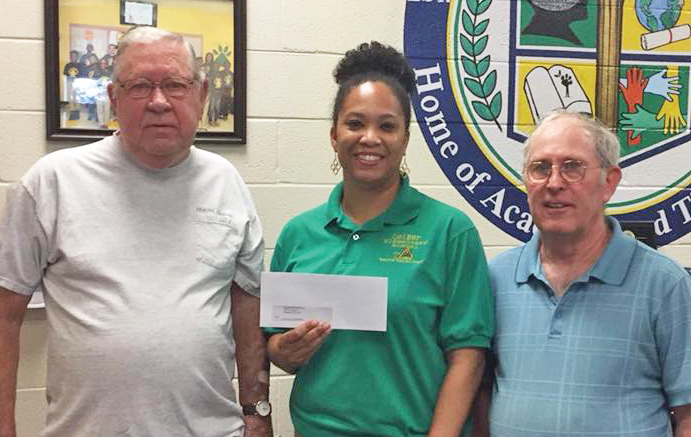
    RIDGEWAY – Pig on the Ridge committee representatives Tom Connor and Henry Dixon present a check for $1,000 to the Barclay School to help fund its fledgling program for students who learn differently. Below, they also donated $300 to Geiger Elementary Principal Myra Bramlett for the school’s “Look For The Good Project” that the school implemented for the coming school year.

    Committee members not shown are Don Prioleau and Rufus Jones.


  • Back to School

    BLYTHEWOOD – Marsha Washington, left, and Christine Stoney, kindergarten teachers at Bethel-Hanberry Elementary School, ready their rooms with last minute touches before welcoming their charges on Wednesday, the first day of school for Richland 2 students.

  • Legal loopholes complicate R2 code

    BLYTHEWOOD – It’s being billed as a way to simplify the school district’s procurement code.

    But loopholes in state law could pose legal and ethical complications to the Richland 2 school procurement policy.

    Approved at its July 24 meet­ing, the Richland 2 Board of Education voted to strike a se­ries of policy revisions, includ­ing one that prohibited the dis­trict from doing business with board members.

    “No purchase of materials or services shall be made from any member of the Board,” the stricken measure states.

    Dr. Harry Miley, the district’s chief financial officer, said via email that the probation al­ready exists elsewhere in the board’s policy. He also said the district follows state law.

    “A board member may not provide services or sell prod­ucts to the district or to in­dividual schools,” the policy states.

    “We are undertaking a com­prehensive review and update of all of our policies with par­ticular attention to trying to eliminate places where the same topic is addressed in mul­tiple policies,” Miley said. “We are also undertaking a review of our procurement code to see if there are revisions needed.”

    State law, however, appears to provide an escape route for public bodies whose elected members could potentially be awarded contracts.

    The law states that: “A public official, public member, or pub­lic employee may not have an economic interest in a contract with the State or its political subdivisions if the public offi­cial, public member, or public employee is authorized to per­form an official function relat­ing to the contract.”

    “Official function” is defined in the law as “writing or pre­paring the contract specifi­cations, acceptance of bids, award of the contract, or other action on the preparation or award of the contract.”

    Similar verbiage appears on the State Ethics Commission website. But the law was revised in 1995, with an amendment that appears to allow elected officials to bid on contracts if they don’t participate in awarding the contract.

    “Nor does it [the law] prohibit the award of contracts awarded through a process of public notice and competi­tive bids if the public official, public member, or public employee has not performed an official function regarding the contract,” the amendment states.

    On July 24, Richland 2 board members voted unanimously to approve the revised purchasing policy. There was no discussion of the policy change prior to the vote.

    Miley said during the June 26 board meeting that the changes were made merely to simplify the district’s pro­curement code.

    “We think the policy should be very simple,” he said. “We have a procurement code. We think the policy should state that we adhere to the procure­ment code.”

  • FCSD Board approves $2.2M loan

    WINNSBORO – Fairfield County school board members are taking out another line of credit, one of many the district has sought to help pay for building and facilities projects.

    At its July meeting, the board voted 6-1 to borrow $2.2 million to fund a variety of building and facilities projects. Board member Paul Hartman cast the lone dis­senting vote.

    Hartman asked for the record to show that she favored using alternative funding sources as op­posed to seeking a loan.

    “I feel like we should use the re­mainder of what’s left over from the calendar year, finishing up than borrowing money,” she said.

    Superintendent Dr. J.R. Green said the bond was necessary be­cause the district has recurring capital needs.

    “You still have to put roofs on buildings. Air conditioners do not last forever,” Green said. “We’ve not had one single year where we’ve not done things to upgrade our facilities. We’re in a much bet­ter place but we aren’t where we need to be yet.”

    Borrowing has become a com­mon theme as of late for the Fair­field County School District.

    In June, the board approved a $5.4 million loan in the form of a tax anticipation note, a short-term

    loan to help the district cover temporary shortfalls until tax revenue starts rolling in beginning in January 2019.

    The board took out a similar note worth $5 million in 2017, according to district documents.

    Two years ago, they approved a $2 mil­lion general obligation bond to renovate Kelly Miller Elementary School.

    And in 2013, the board approved a $20 million bond to help build a new career center, resulting in a tax increase from 24 mils up to 34 mils that the district, at the time, said would only be for two years.

    The loan included $15.6 million for the building, with the remaining $4.4 mil­lion diverted to finance other facility and equipment needs in the district.

    All told, the sampling of loans totals about $29.6 million, according to district documents and reporting by The Voice.

    The most recently approved bond in­cludes a laundry list of various facility projects, with line items ranging from $16,000 to $300,000.

    Interior and exterior LED lighting and bathroom renovations led the list at $300,000 each, followed by $250,000 from bleacher renovations.

    Also included within the $2.2 million is a district-wide contingency fund of $274,000, school board documents show.

    A breakdown of what contingency funds would cover was not available, and Green couldn’t be reached for follow-up comment as of press time.

    The bond itself would take about a year to repay, and debt millage would remain constant at 20.6 mils, according to district documents.

    The interest rate wasn’t immediately available, though board documents state the district could receive a competitive rate through the S.C. Association of Gov­ernmental Organizations (SCAGO), which the district is utilizing to issue the bond.

    “The SCAGO program pools other school district bond issuances, which results in lower issuance costs and potentially bet­ter interest rates due to increased compe­tition for the purchase,” board documents state.

    In addition to quizzing Green about identifying funding sources other than borrowing, Hartman also asked for the amount of the district’s current outstand­ing debts.

    Kevin Robinson, the district’s director of finance, said he couldn’t provide an exact amount.

    “I don’t know the exact amount. We are still paying on the career center,” Robinson said. “That debt has not been extinguished as of yet. And that’s per the schedule that was initially approved.”

  • McCrorey-Liston cafeteria named for Eugenia Wilson

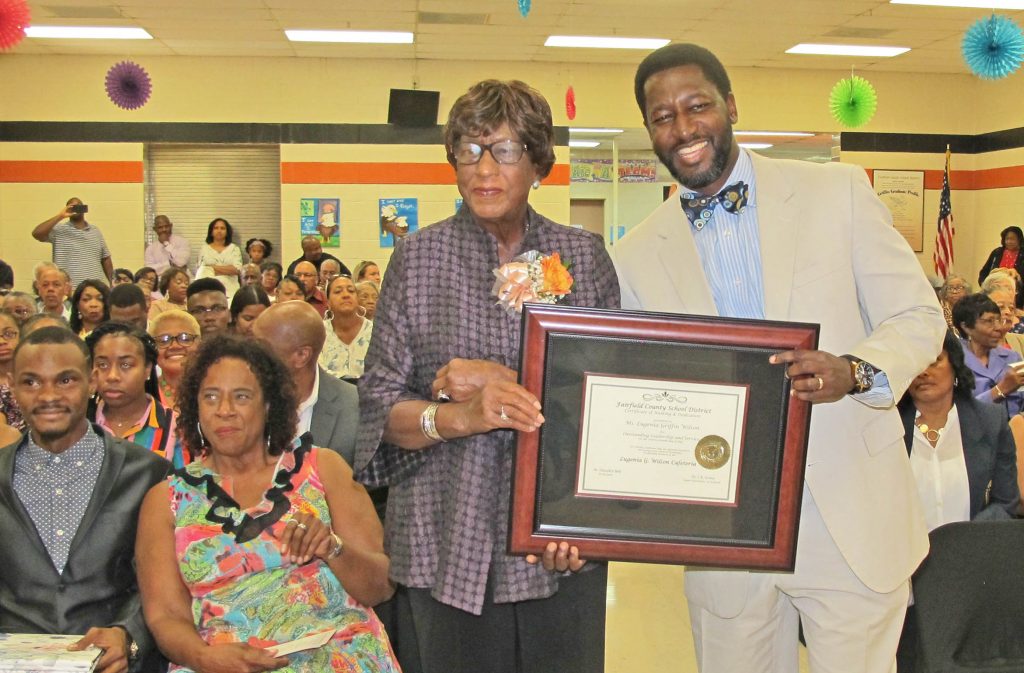
    BLAIR – More than a hundred people gathered on Friday in the McCrorey-Liston Cafeteria to honor Eugenia G. Wilson for her years of service in the school’s cafeteria.

    School Principal Chandra Bell said Wilson “was the matriarch of the school.” She also recalled Wilson’s oft-repeated mantra – “It’s all about the children.”

    Many of those children, now adults, returned on Friday to witness the naming of the cafeteria for Wilson who began her career as a Food Service worker at the school in 1966 and retired forty years later as the cafeteria’s supervisor. By all accounts, she was beloved beyond measure by the children she fed and by those she worked with at the school.

    Eugenia Wilson accepts a plaque from Superintendent Dr. J.R. Green, recognizing the naming of the cafeteria after her. | Barbara Ball

    In 1979, Wilson received a certification of completion from the National Institute for the Food Service Industry. She also received continuing education credits through Midlands Technical College, Johnson and Wales University and the University of South Carolina. In 1995, she was named Fairfield County Food Service Manager of the Year.

    Bell said Wilson was known for making sure that the students had wholesome, balanced meals, and the students loved the delicious meals she prepared for them.

    “But the students were not the only ones who loved her meals,” Bell said. “About noon, people from all over Fairfield County would start coming through the front door headed to the cafeteria – from VC Summer, from the doctors’ office down the road, our maintenance crew, lined up!”

    Former student Rodney Gibson, like other speakers, recalled “the wonderful food Mrs. Wilson prepared for us – nice warm, creamy grits and fried chicken. But what I remember even more,” he  said turning to Wilson, “was your beautiful, kind smile and humble behavior that you showed us and instilled in us,” Gibson said.

    “The pride she took in her cafeteria work was truly inspiring,” Sandra Conyers, a longtime teacher at the school, said. “I was constantly impressed with her work ethic. Her output was one of a kind. My room was right across the hall from the cafeteria, so you can imagine the wonderful aromas that seeped into my classroom about 10:30 or 11 every morning. No matter what Ms. Wilson and her staff prepared, it was always tasty, especially at holidays – fried chicken, macaroni and cheese, peach cobbler,” Conyers said. “She never disappointed.”

    Wilson’s nephew, Brandon Henderson, now a college sophomore, recalled his first day of kindergarten at McCrorey-Liston.

    “I knew that my Auntie ran that cafeteria back there,” Henderson said, smiling. “During Martin Luther King month in February, she would set up a table for everybody to sit at who had a birthday that month. She made sure I was at the front of the table…and that I had four chicken wings.”

    The audience laughed.

    Wilson’s daughter, Leslie, recalled her mother’s dedication to her work in the cafeteria, her co-workers and to the children she cooked for.

    “She left the house at 5 in the morning, left us still in bed to be at work on time,” Leslie Wilson said. She said her mother and the other cafeteria ladies, also dedicated, arrived at the school before dark and didn’t leave until the end of the school day. It was a time when school meals were prepared from scratch.

    “I have always been proud that my mom was a cafeteria worker,” Wilson said.

    “Mom began cooking at the age of eight. She was the youngest girl of nine children. The others were working in the cotton fields, so as soon as Mom was old enough she was put in the kitchen cooking meals for the family,” Leslie Wilson said.

    Wilson grew up in Blair and, as a teenager, boarded with families in Winnsboro so she could attend Fairfield High School. After high school, she met Aaron Wilson. They were married for 30 years until his death in 1980.

    “Mom always cooked for the love of it. She didn’t want you messin’ with her pots and pans. And if she tells you this is the way she wants it done, then that’s the way she wants it done,” Leslie Wilson said, laughing. “My sister and I were not allowed to cook anything growing up except cornbread and biscuits because Mom said she didn’t have enough food to waste. I guess she didn’t think we could mess up cornbread and biscuits,” she said.

    Leslie Wilson said her mother’s contribution was one of the things that made the school special and recalled her own glory days at McCrory-Liston.

    “Later in life when I’d say there were only 60 students in my graduating class. They’d say, ‘Great!’ and I’d say, ‘Yeah, it was a small, private school,’” she said as the audience laughed and applauded. “Because that’s what it seemed like.”

    After family members took turns speaking and presenting flowers to Wilson, Superintendent Dr. J. R. Green announced that a special plaque emblazoned with ‘The Eugenia G. Wilson Cafeteria’ would be attached to the wall next to a door into the cafeteria. He also presented Wilson with a scrapbook with messages from former students and memorabilia from Wilson’s years at the school.

    Wilson then thanked the audience for their attendance and shared several stories from her years at the school – some poignant, others funny and all heartwarming.

    “I loved the time I worked here at McCrorey-Liston. I loved cooking. I loved my work in the cafeteria, and I loved the children. Everything I did was for them,” Wilson said. “It was all about the children.”