Category: News

  • VillageChurch provides Post Game fun

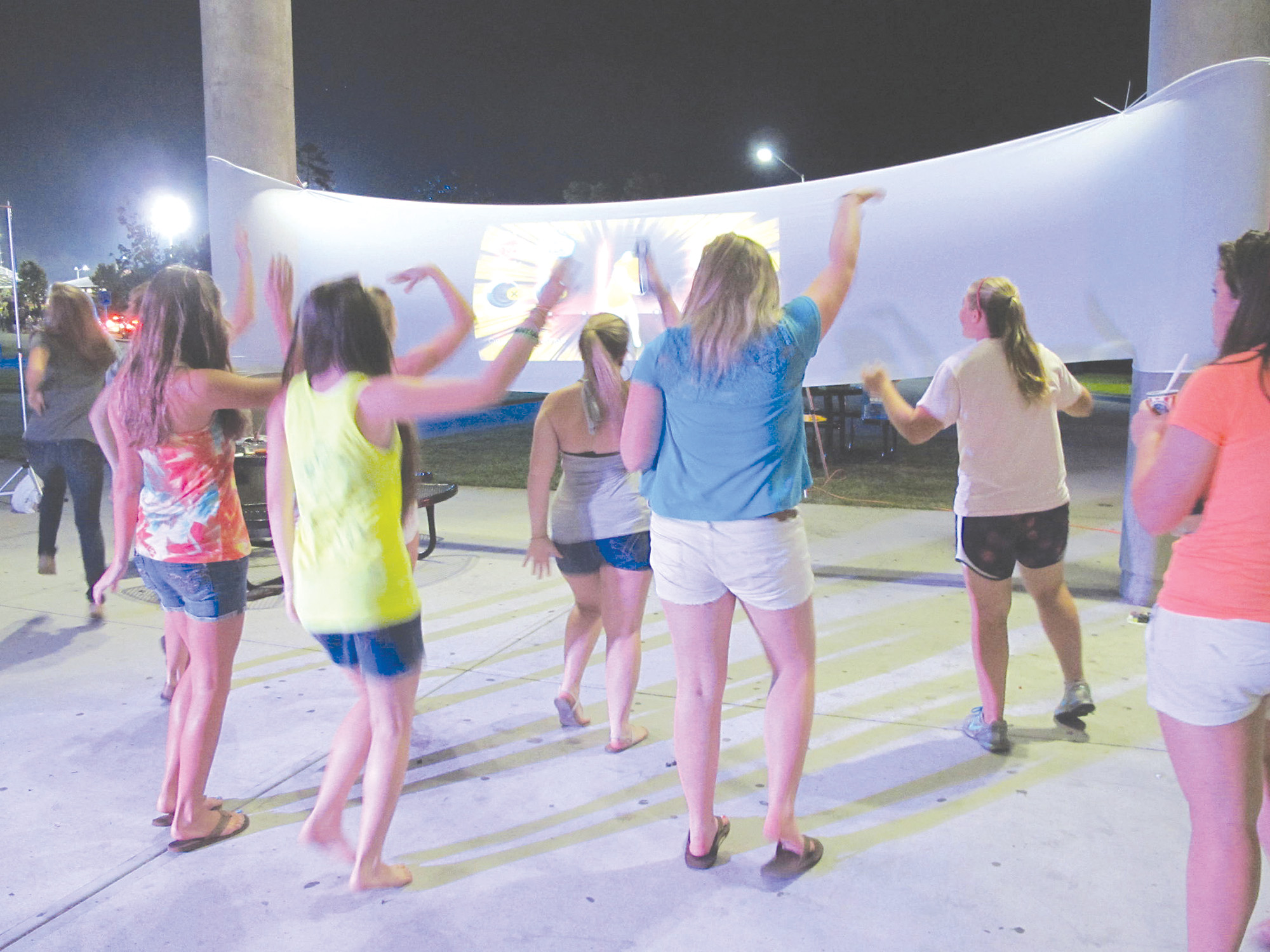
    These girls danced to the Wii game “Just Dance.”Renewing their energy at the snack bar are Bengal safety DaShon Pollin, wide receiver Shyheim Brown and Cornerback Earl Wilson.These girls just wanna have fun at Post Game. From left are: Jessi Larimore, Lexi Brannon, Alexis Kiser, Meagan Kiser, Shelby Villnow, Jordon Cook, Gracie Page and Caroline Larimore.BHS teacher Amy Whitfield (center) serves as faculty advisor for Post Game. At right is Matthew Phillips, who is in charge of the after-game event and serves as chaplain to the BHS and WHS football teams.

For students at BHS and WHS, the post game fun begins after every Friday night home football game.

Sponsored by VillageChurch on Rimer Pond Road in partnership with the Fellowship of Christian Athletes at Blythewood and Westwood high schools, Post Game is intended to provide a safe atmosphere for students and football players to relax and have fun after home football games.

It began in 2008, when the church hosted parties after the last home game of each month at the church building. About 75-100 students and athletes attended that year.

“We’d have a band or play laser tag,” said Matthew Phillips, the church’s pastor of students since 2008 and chaplain for both the BHS and WHS football teams. “The next year, we moved the event to the BHS gym and attendance averaged 350-400 students.”

Last Friday night, the Post Game following BHS’s first home game against South Pointe set a record with more than 350 students and football team members attending.

As students and team members arrived following the game, they signed in, then headed for the refreshment table featuring free Rita’s Italian ice and San Jose’s taco chips and salsa. Then they danced to the Wii game ‘Just Dance,’ played basketball in the gym or just hung out with friends.

“They have a good time,” said Phillips. “Moving Post Games to the school gym made them more accessible. The kids can just walk over after the game . . . no driving.”

VillageChurch also provides meals before home games for both BHS and WHS football teams. “We love being part of the teams,” said Phillips, who also prays with the teams before and after the games.

The Post Game schedule for BHS and WHS appears in the Fall Sports Preview published in the Aug. 23 issue of The Voice.

  • New buildings in Town Center must have two or three stories

    In sweeping legislation, Town Council has passed an ordinance to establish three new commercial zoning districts (for a total of six), establish regulations pertaining to those districts and to amend and conform the current Blythewood Town code ordinances to reflect all of that.

    Among the most noticeable changes and additions in the ordinance is that all new buildings on existing public streets in the Town Center would have to be at least two stories tall.

    Three-story construction would be required for buildings on six specified street corners along Blythewood Road: Blythewood Road at Wilson, at both McNulty extensions, at Creech, Boney, at University Village Drive and at Community Road.

    The amendments would affect primarily commercial and some non-commercial uses, such as apartment buildings and condominiums, so that those buildings would also be subject to the Board of Architectural Review.

    The 145-page document will soon be available on the Town website.

  • LongCreek residents appeal DRT ruling

    It was reported in the Aug. 16, 2012 issue of The Voice that, on Aug. 9, the Richland County Development Review Team (DRT) had approved an application by LongCreek Associates, LLC to develop 332 housing units (including high density cluster homes and duplexes) on 100.7 acres within LongCreek Plantation subdivision. The developer applied and was approved for Green Code status under Richland County’s Green Code standards. The project, called The Villages at LongCreek, is opposed by many in the residential subdivision because they say the County’s Green Code ordinance has been misapplied to this project.

    To that end, two LongCreek Plantation residents – Sam Brick and Monica Iskersky – have appealed DRT’s decision to the County’s Planning Commission, which may meet Oct. 1.

    Brick explained that appeal to The Voice in the following Q & A session.

    The Voice: What, specifically, are you appealing about DRT’s decision?

    Sam Brick: Basically, we are appealing DRT’s rubber stamp of the developer’s sketch and concept plans, which do not actually meet the Green Code requirements. LongCreek Associates wants to develop three villages on this 100.7 acres, each one being a major county subdivision. They want to develop under the Green Code in order to get special treatment as a reward for setting aside, from development, some conservation areas. While the developers in this case have set aside some land in two of the villages so as to get relief from some development standards, they have then proposed building without consideration of any zoning standards.

    V: What do you mean ‘without consideration of any zoning standards?’

    SB: One of the villages/subdivisions has no primary conservation areas and is basically no different than any other subdivision in LongCreek. It has buffers that are already required by code and two neighborhood greens similar to many other neighborhood greens throughout LongCreek. They get credit for the greens as secondary conservation areas but there is nothing green about the third village. In actuality, it appears to look very similar to other areas in LongCreek and seems to follow the Single Family Residential-Low Density district in which it resides. There may be some minor changes to lot sizes, etc but otherwise it is a vanilla subdivision of approximately 59 houses alongside Longtown Road near the entrance to Long Creek Plantation.

    V: What are some other ways you feel the developers fail to follow requirements for green development?

    SB: There are several ways. First, they propose 80 or so duplexes in two of the villages on ultra small lots. In a low density-single residential community, there can only be one house to a lot, unattached, and set up in a side-by-side design. The developer did not do this and the DRT said nothing.

    LongCreek Associates’ designs feature minimum lot widths that do not comport with the requirement for the zoning district. The green code does not mention lot widths as a reward but the builders took it anyway. Again, the DRT turned a blind eye to this important requirement of the Green Code.

    Parking in any green development is a big thing, and the County’s Green Code requires the developer to address parking. It does not. In the RS-LD zoning district two parking spots are required for each dwelling unit. Whether the area is pervious or impervious means a lot in water management. Green is, among many other environmental practices, supposed to minimize erosion and manage water flows. The developer’s plan says nothing about this. To the contrary, this developer piles up dwelling units with no rear entries which would appear to increase erosion. This area of LongCreek Plantation consists of rolling hills that already exhibit substantial erosion on the little dirt roads that traverse it. The land obviously is not permeable.

    While applying for green, these developers do not seem to appreciate the full significance of Green in their plan. There is very little they have included in their concept/sketch plan that shows green practices.

     V: What significance is density in the County’s Greeb Code standards?

    SB: Density is a major column upon which the Richland County Land Development Code leans.

    Density changes with the different zoning districts and the County Council manages our zoning maps through the application of these density provisions. The County’s Green Code rewards a developer who sets asides conservation areas by authorizing a bonus density. In other words, the developer can build densely in one area by setting aside conservation areas.

    The developers have turned a blind eye to this provision and have tried to substitute another development provision in the Green Code that takes away the requirement for square footage minimums in exchange for proper green code developments. That provision is not to be exchanged with the otherwise very clear density requirements for the zoning districts involved.

     V: Are there inherent problems in the Green Code that lend themselves to developers skirting the requirements.

    SB: Density is stated in the Land Development Code as square footage per acre with the square footage changing throughout the different zoning districts. The two provisions obviously conflict. The Land Development Code understands this problem and cured it with a provision that states when such a circumstance occurs, the more stringent provision applies. The County Council has seen this problem and they directed the Planning Department to come up with changed legislation to fix it. So far the Planning Department has not acted. Maybe this initiative on our part will help nudge them in the right direction.
  • Deport Replica Could Become Business Park

    Town Council passed a resolution at its Monday night meeting to pursue an economic development project in what it called the town’s “municipal business park,” which Town Administrator John Perry explained is the site of the train depot replica long proposed to be built in the town park near the railroad track in front of Town Hall.

    The resolution stated that the Town could “use funds paid by a utility to fund certain, eligible infrastructure projects owned or constructed by the Town.”

    The resolution identified the construction of the depot as part of that infrastructure.

    Perry told The Voice that the utility paying the funds for construction in this case would be Fairfield Electric Co-op.

    The depot was originally scheduled to be built out of the $5.5 million park bonds. When those funds fell short, town officials said an offer had been made by an unidentified source to donate or build the depot, but would not name that source.

    At one point last spring, the mayor’s park review committee was held up from deciding whether to go forward with the park because of certain ‘data points’ that Perry said could influence their decision. He would not disclose what those ‘data points’ were.

    But Perry told The Voice prior to the council meeting that the entity that would be affiliated with the proposed depot for economic development purposes had to do with those certain ‘data points.’

    Perry told council that the Town would also like to set the boundaries for a Doko Meadow Municipal Business Park on the site of the proposed depot and the grounds around it.

    “Along with other funds and loans available to the Town, the Town would like to use funds paid by a utility to fund the project,” the resolution stated.

    Council authorized the Town Administrator to seek a determination from the S.C. Department of Revenue regarding the eligibility of the depot under the Utility Tax Credit Act.

    Council also delegated authority to Perry to determine the best way to develop and finance the depot and other projects associated with it in the proposed Municipal Business Park

    The resolution also established a General Repealer that repealed all rules, regulations and resolutions that conflicted with this resolution.

  • Middleton Named to Blythewood Planning Commission

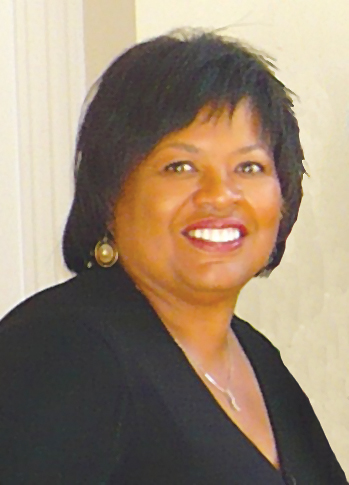
    Ernestine Middleton

    At its regular monthly meeting Monday, Blythewood Town Council appointed Ernestine Middleton to the Planning Commission seat vacated on Aug. 6 by Neil McLean who resigned with 2-1/2 years left on his term.

    The appointment was made with no public solicitation by Town Hall for applicants for the seat.

    According to the town’s statute, Title XV, Chapter 150.02, (B) and (D): “Open solicitation for Commission members shall begin no less than 30 days prior to the Town Council meeting during which an appointment, or appointments, are to be made . . . A vacancy may be filled at any Council meeting providing that open solicitation began no less than 30 days prior to the Council meeting during which an appointment, or appointments, are to be made.”

    Middleton, who served on the Commission a short period of time several years ago, said she was offered the seat by a Town Hall official.

    Middleton, who lives in Lake Ashley, was Director of Internal Operations for the S.C. Lottery from 2001-2009 and then served 2-1/2 years as the Vice President of Administration for the Arkansas Lottery before returning to Blythewood last fall. She ran unsuccessfully for town council last winter and currently serves on the Mayor’s Park Committee.

  • Fairfield County Incident Reports

    FCSO

    29014

    Red Hill Church Road, 100 block, between 4:45 and 4:50 a.m. Aug. 12. Someone stole two air conditioning units worth $4,400 from a church.

    29065

    Highway 215 S., 9900 block, between 5 and 6:30 p.m. Aug. 8. Someone stole a water heater and an air conditioning unit worth $4,025 from outside a home.

    29130

    Carolina Drive, 300 block, between 6 and 6:28 p.m. Aug. 9. Someone stole stereo equipment of undetermined value from an unlocked car parked outside a home.

    Highway 21 S., 1900 block, between 5:42 and 7:35 p.m. Aug. 10. Someone broke into a home and stole computer equipment and other items worth $4,755. Someone also stole a 2001 Mercury Grand Marquis worth $5,000 from outside the home.

    Westshore Drive, 700 block, between 2:30 and 3:09 p.m. Aug. 12. Someone broke into a shed outside a home and stole a lawn mower and other items worth $600.

    29180

    Walnut Street, 100 block, between 6 p.m. Aug. 8 and 6:30 a.m. Aug. 9. Someone stole tools and other items worth $2,780 from a work truck parked outside a home.

    Fifth Street, 600 block, between 2:30 and 4 p.m. Aug. 9. Someone stole an assault rifle worth $300 from a home.

    Highway 321 Bypass, 1300 block, between 7:46 and 8 p.m. Aug. 9. Someone stole an air conditioning unit worth $3,000 from outside a restaurant.

    River Road, 2300 block, between 8:06 and 8:15 a.m. Aug. 12. Someone stole a four-wheeler of undetermined make and model worth $300 from a wooded area near a home.

    Bundrick Road, 600 block, between 8:38 p.m. Aug. 12 and 8:50 p.m. Aug. 12. Someone stole prescription medications worth $150 from a home.

  • Railroad Museum Lands Grant

    The NRHS, America’s largest rail preservation organization, announced this week the S.C. Railroad Museum as one of its 2012 recipients of its annual Heritage Grants Program. The museum will receive $2,500 to repair the their 1924 Pullman dining car, used for educational trips and public charters.

    NRHS will award $50,000 to support 21 non-profit organizations from 14 states and the District of Columbia. Recipients include NRHS chapters, historical societies, museums and municipalities.

    “This year’s applicant pool was the largest in NRHS history and one of the best in recent memory, making the award decisions painfully difficult,” said NRHS President Gregory Molloy. Since the program’s inception in 1991, NRHS has now awarded 221 grants for a total of $548,000 to support a wide variety of railroad history preservation projects.

  • Faith-based organizations get ‘on board’ for a healthy Fairfield

    All Aboard for Healthy Fairfield! This is the theme for a new initiative from the Healthy South Carolina Initiative – Community Transformation Grant that was awarded to Fairfield Community Healthy Partners in May 2012. “All Aboard for a Healthy Fairfield” focus areas include tobacco-free living and healthy eating/active living. Fairfield Behavioral Health Services, one of the Health Partners along with support from other partners will Coordinate with members of the Fairfield Ministerial Association, the Blair Coalition of Churches and other faith based organizations to provide tobacco education with the goal to adopt and implement a model tobacco-free policy, smoke-free environments including vehicles and homes.

    A group of 15 faith based organizations came out July 7 to participate in a Faith Based Tobacco Education Training at Christ Central Community Center. The purpose of this training was to provide the latest information on tobacco, the impact it has on health, and to enhance faith based communities’ abilities to educate its congregation, families, and community as well as implement strategies to improve their health.

    “A lot of people in the community are affiliated with faith communities so what better way to get the word out on the dangers of tobacco and second hand smoking than by partnering with the faith community,” said Vernon L. Kennedy Sr., Executive Director of Fairfield Behavioral Health Services.

    Tobacco use is the leading preventable cause of disease and premature death in South Carolina. The key word is “preventable.” Currently, 21 percent of S.C. adults smoke cigarettes, and 23.7 percent of the state’s high school students report having smoked within the past 30 days. The economic cost due to smoking in South Carolina is more than three billion dollars, and attributes to deaths exceeding 6,000 residents of the state as reported by presenter Megan Hicks, State Program Director at South Carolina Tobacco Collaborative.

    South Carolina Tobacco Collaborative along with Fairfield Behavioral Health Services and its partners are working hard to make Fairfield County and South Carolina a healthier place to live, work and raise a family declares presenter, Cheryl Y. Goodwin, Special Service Coordinator at Fairfield Behavioral. “We’re primarily here to educate people about the dangers of smoking and second-hand smoke for people and pets. Mrs. Goodwin also explained how help was needed from faith based organizations to encourage and support efforts to prevent youth from starting to smoke and assist current smokers in quitting.

    Thank you to the 15 faith based organizations who participated in the training: Bethel ARP, Bethesda A.M.E.Z., Bible Light Holiness Church, Brown Chapel Baptist., Bringing Down the Walls, Calvary Baptist, Christ Central Community Center, Gethsemane Baptist, Golden Rock Fellowship, Mt. Olive Baptist, River of Life, St. Mark Baptist, Sion Presbyterian, St. Paul Baptist Missionary and Tabernacle of Praise Church.

    “This was a great learning experience and I’m thankful for the opportunity to participate in this Tobacco Initiative and will use the information from this training to help impact others , I believe that working with the faith-based will make a positive input on Fairfield County,” said Teresa Reed, a participant from Sion Presbyterian Church.

    We would like to especially thank Christ Central Ministries and staff for the use of their Center.

    For more information or to sign up for participation, please contact Cheryl Y. Goodwin, Special Service Coordinator, at 635-2335 ext. 33,  cgoodwin@fairfieldbhs.org or P.O. Box 388 Winnsboro, S.C. 29180.

  • The Olympic Games come to Ridgeway and Laurel Baye

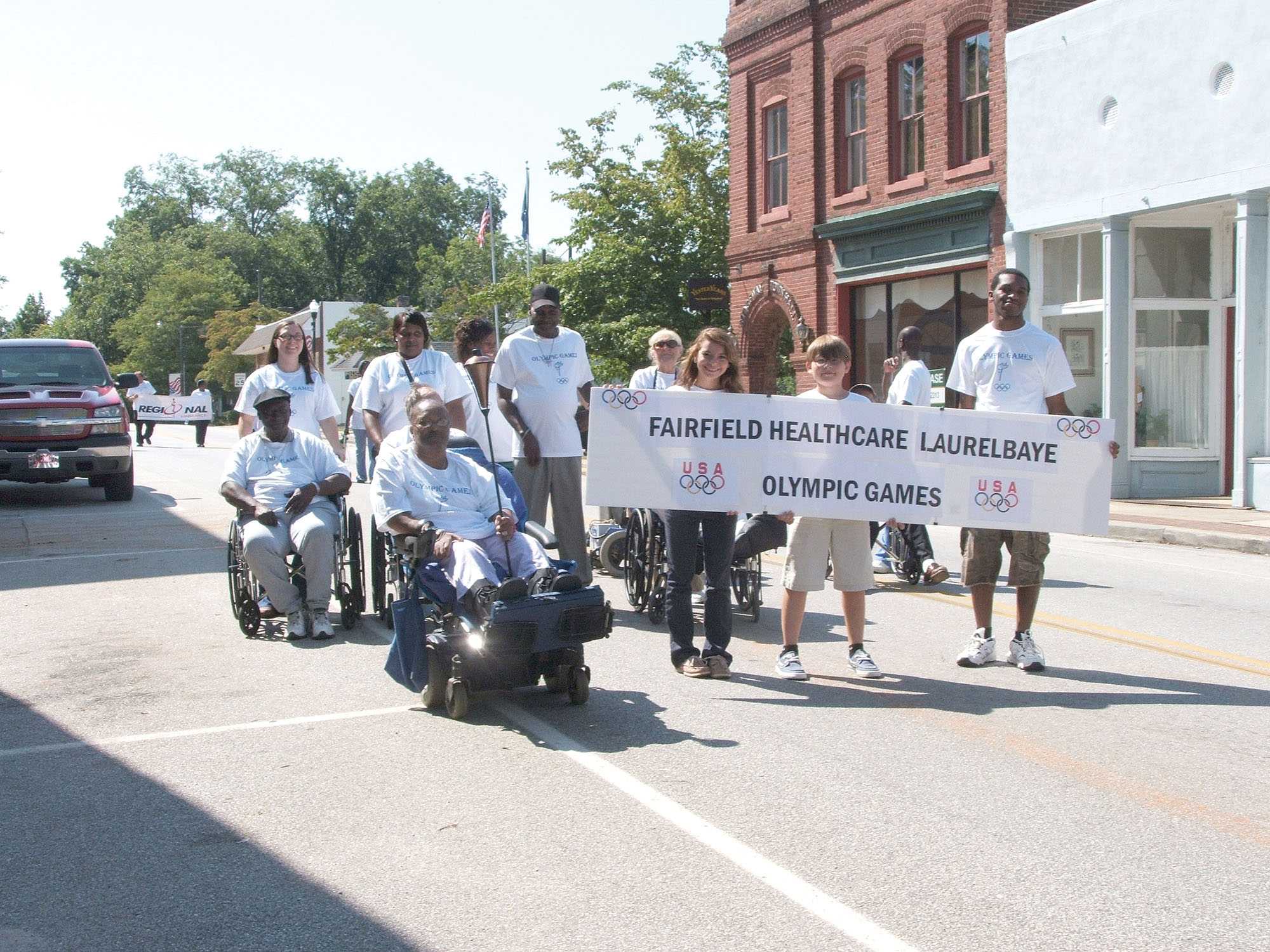
    Fairfield Healthcare Center of Laurel Baye held their Olympics in Ridgeway. The opening parade is led by torch carrier Ruby Burns.

    In keeping with the spirit of the summer Olympic games that we enjoyed from London, England earlier this month, the Fairfield Healthcare Center of Laurel Baye in Ridgeway held its own Olympics for their residents called simply The Olympic Games.

    The first Olympic games were created in 776 B.C. in Ancient Greece by Hercules, the Greek hero of myth. The games lasted until 393 B.C. when they were abolished by the Roman Emperor Theodosius. He had been tolerant of most pagan practices, but in 392 B.C. he enacted laws against all pagan practices, of which he considered the games to be. And so they were discontinued until their revival in 1892 by a Frenchman who founded the first Olympic Committee. The first Olympic flame was introduced in 1928. During war time was the only time when the games were not held. That was 1916, 1940 and 1944.

    The Olympic Games of the Fairfield Healthcare Center started at the Ridgeway post office with a parade and the carrying of the Olympic torch by resident Ruby Burns. American banners lined the streets and spectators and shop owners came out from Ruff’s Hardware, the Cotton Yard Market and the First Citizen’s bank to cheer on the marchers. A hydration station was sponsored by Regional Ambulance who also used their vans to transport the marchers to their starting point. Each of the participants wore a white T-shirt with the words “Olympic Games” and the emblem of the Olympic rings on them. The shirts were made by Roger Browning of Browning Tee’s. Thanks to the support and efforts of the Fairfield County Sheriff’s Office, deputies Steve McDonald, Rick Gibson and Ronald Mull closed the street to traffic and an escort deputy car lead the group with siren wailing. Due to an illness in the family, Mayor Charlene Herring was unable to attend the event this year.

    The rest of the week, the residents were kept busy with such games as wheelchair races, horseshoes, volleyball, javelin throw, dance, Wii bowling, Frisbee golf, a spelling bee and trivia games.

    An awards ceremony was held at the end of the week’s activities with the winners receiving gold, silver and bronze ribbons.

    This was a week of fun and a feeling of achievement for the residents, thanks to the efforts and thought that went in to making their Olympic Games special, by Activity Director Frances Maddox, the staff of the Fairfield Healthcare Center, volunteers and sponsors Regional Ambulance and Laurel Baye.

  • Board Leaders Silent on Details of Unauthorized Atlanta Trip

    Nearly two months after a pair of Fairfield County School Board members independently made excursions to Atlanta to attend a conference on bullying, questions continue to surface about the propriety of the trip. Indeed, during the public comment portion of the Board’s Aug. 7 special called meeting, Thomas Armstrong brought the trip back into the light with a public Freedom of Information Act request for records of the trip, including the rental of an SUV and hotel costs.

    That Andrea Harrison, Board Chairwoman, escorted four female students to the conference at the Atlanta Hilton hotel June 28 – 30 without Board approval is a matter of record. Harrison has since apologized for allowing the matter to “slip through the cracks.” Harrison told The Voice last month that the District’s social worker rented an SUV for the trip and Harrison used her District mileage to provide gas.

    Documents obtained by The Voice show that Harrison was issued a check for $623.37 by the District on June 21. The total amount included $300 for Harrison’s per diem, $84 for parking and $239.37 for mileage. Documents show Harrison returned $72.77 of her unused mileage funds to the District on July 2, indicating $166.60 in gasoline was pumped into the rented SUV.

    The rental of the SUV has also raised questions.

    Sources told The Voice in July that Harrison had sought to obtain a District bus for the trip, but was denied by the Director of Transportation when he learned that the Board had not approved the outing. Harrison said that was not true.

    “It was not that we couldn’t get a bus,” Harrison said last month, “but that a bus was not cost effective. We only had four students going on the trip.”

    According to District documents, the District paid $1,123.60 for the rental of the SUV. The documents do not, however, indicate where this SUV was obtained. The District’s credit card statement for July, on the other hand, shows $1,123.60 was paid to Hertz Rent-A-Car of Columbia. That transaction posted on July 3.

    Research by The Voice, meanwhile, has found three other car rental agencies where a similar vehicle could have been rented for less money. In fact, Hertz in Columbia actually quoted a price of $819.86 for an identical vehicle for a five-day round trip to Atlanta with a full insurance package and 700 miles.

    Thrifty Car Rental in Columbia offered a similar vehicle for $647.50; Enterprise for $738.55. Locally, the District could have rented either an SUV or a minivan from Independent Body and Car Rental for $492.69.

    So why did the District pay more than $1,123 to Hertz, and why did Hertz quote The Voice a price that was more than $300 less?

    Phone calls and e-mails to Harrison seeking clarification to these points were not returned at press time.

    Danielle Miller, Board Secretary, also attended the conference, although not with Harrison’s group. Miller drove a District car to Atlanta and was issued a check for $528.38 by the District on June 21. That total amount included a $225 per diem (Miller was originally only to attend two days of the event), $63 for parking and $240.38 for mileage. An additional per diem check of $75 was issued to Miller June 27 after Miller found she could attend the full conference.

    Miller was contacted by phone and by e-mail in order to determine how gas was provided for the District’s car and if any of the $240.38 she received for mileage was returned. Records obtained by The Voice do not show any indication that any of the mileage funds were returned. Reached by phone, Miller asked The Voice to pose its questions in an e-mail. As of press time, Miller had not responded to that e-mail.