Category: News

  • Shooting Victim Sues Police

    WINNSBORO – A Winnsboro woman who was shot and wounded last October by her estranged husband, then a Winnsboro Department of Public Safety officer, has filed a civil lawsuit against the department on behalf of herself and her two children who witnesses the shooting.

    John T. Mobley, attorney for Takisha (Keisha) Roseboro, filed the complaint Feb. 26 in the 6th Judicial Circuit’s Court of Common Pleas in Fairfield County. The suit claims that the Winnsboro Department of Public Safety was negligent in hiring and retaining Roseboro’s husband, Michael Bernard Roseboro, knowing that “prior to October of 2012, multiple parties have filed claims and made allegations indicating that (Michael) Roseboro had a history of using excessive force and/or engaging in other conduct that indicated he was mentally unstable and or had a tendency to engage in violent behavior,” the complaint states.

    The Winnsboro Department of Public Safety “knew, or should have known, that the continued employment of (Michael) Roseboro would create an unreasonable risk of harm to others,” the lawsuit states. The suit claims that the department was negligent in its failure to properly screen, evaluate and make adequate inquiries into Roseboro’s background before hiring him; failure to properly supervise him; failure to take steps to determine if Roseboro was unfit, incompetent or a danger to third parties; failure to properly investigate allegations made against Roseboro; failure to terminate his employment after being put on notice of his propensity for violence and mental instability; failure to have proper guidelines and procedures in place that would have identified Roseboro as a danger to the community; failure to take precautionary steps to protect third parties from the risk of harm presented by Roseboro; and retaining Roseboro without remaining knowledgeable about his competence, fitness and safety around others.

    As a result of seeing their mother shot, the suit claims, Roseboro’s children have “suffered emotional distress that has manifested itself by physical symptoms. . . .”

    Takisha Roseboro is seeking relief for pain and suffering; cost of past and future medical treatment; permanent physical injury; permanent emotional/psychological harm; disfigurement; lost wages; loss of future income; diminished quality of life; and other damages.

    Freddie Lorick, Chief of Public Safety, said all of his officers go through the same rigorous vetting process before hiring.

    “We went through the same procedures with (Roseboro) as we do anyone else,” Lorick said.

    Michael Roseboro was on duty and in his patrol car when he shot Takisha with his service weapon outside her home on 8th Street in Winnsboro, Oct. 28. He fled the scene, setting off a manhunt that lasted for nearly four days. The patrol car was found on the morning of Oct. 29, abandoned outside a Masonic Lodge on Highway 21 near Great Falls. He was spotted Nov. 1 at the home of his sister off Highway 21, a few miles from Camp Welfare, initiating a search by agents from the State Law Enforcement Division (SLED), assisted by Fairfield County Sheriff’s Chief Deputy Keith Lewis. As the agents combed Camp Welfare, off Arrowhead Road near Great Falls, Lewis spotted Roseboro and attempted to convince him into surrender. SLED agents in the field were closing in when Roseboro drew his gun and shot himself in the chest. The wound was not fatal and Roseboro was later charged with attempted murder.

    At the time of the shooting, Roseboro had been with the Department of Public Safety for three months, Lorick told The Voice last October. Roseboro had also served with the Fairfield County Sheriff’s Office from 2001 to 2010, first as a deputy and finally as an investigator.

    Roseboro, along with officer Dwayne Robinson, the Town of Winnsboro and the Department of Public Safety, were named as defendants in a 2001 lawsuit filed by Ronnie O. Armstrong. That suit, which was settled in 2003, claimed negligent use of unreasonable and excessive force, false arrest and confinement, assault, battery and outrage, as well as negligent hiring and negligent supervision and training.
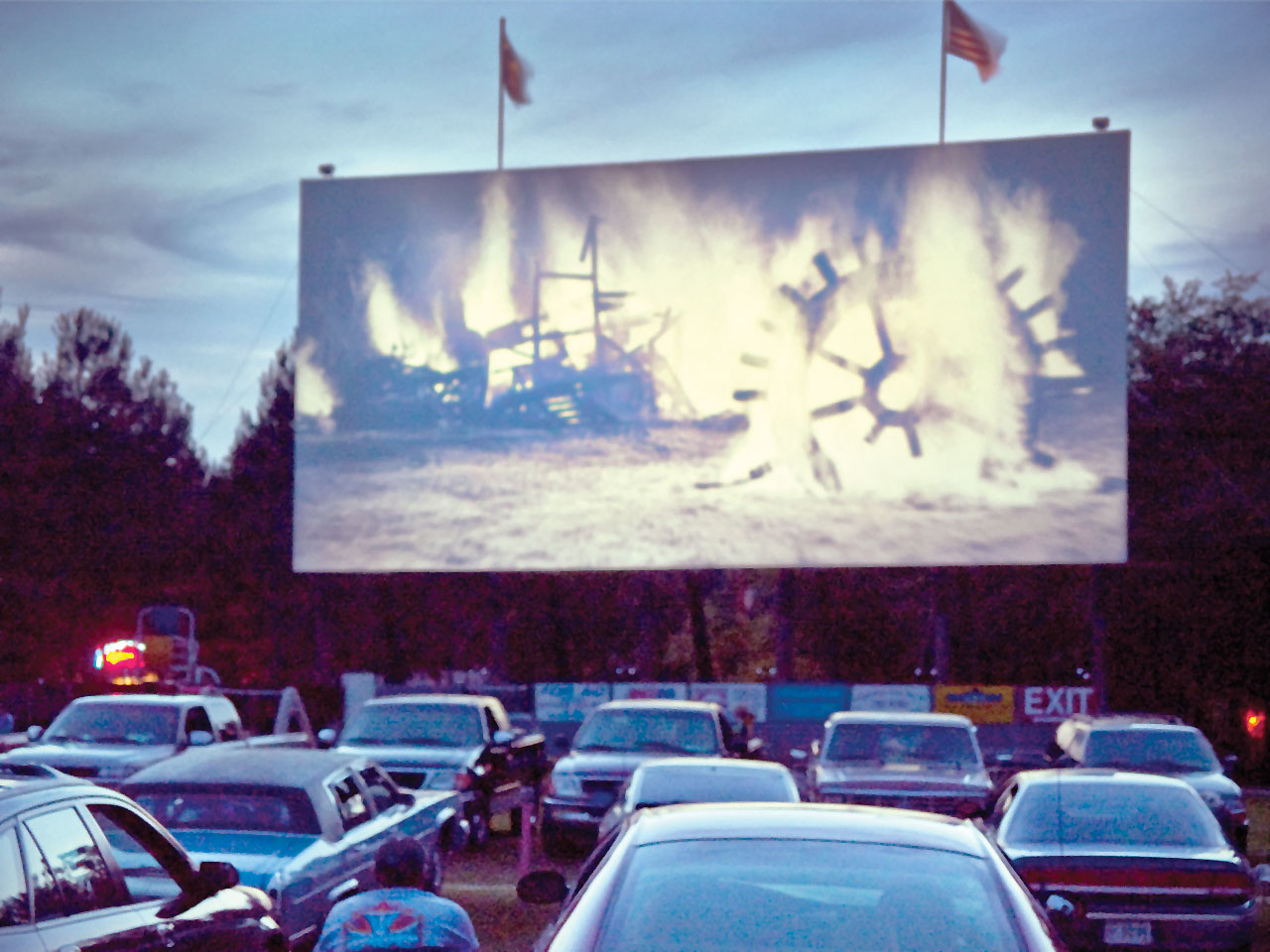
  • A Night at the Movies, ‘50s Style

    The Monetta Drive-In, a blast from the past.

    A 70-mile afternoon drive to Monetta takes you to a 1950s cultural icon: the drive-in theater. Consider a “dusk trip” to the Big Mo, which begins its season March 1. Make your way to I-20 West and take Exit 33 (S.C. Route 39). Follow S.C. 39 to Monetta (approximately 7 miles), then turn right onto U.S. 1. The drive-in is a mile down U.S. 1 on the right. If you use GPS, the physical address is 5822 Columbia Highway North, Monetta S.C.

    Ease along to a parking spot with a good view of the screen and get ready for a great family event. Bring your dog if it’s well behaved. Bring lawn chairs too and sit on the grass if you like. Tune in movie audio over three different frequencies and get ready for the show. The days of hanging a clunky speaker on your car window are passé.

    When the lights drop, that one-time Mecca for wanderlust teenagers — the drive-in — flashes Hollywood idols onto the silver screen and the aroma of grilled hot dogs and buttered popcorn fills the air. At the Big Mo you partake of Americana. The drive-in is unique in that it is the only one in South Carolina to survive since the heyday of drive-ins in the 1950s.

    The concession serves standard fare, such as hot dogs, hamburgers and pizza. Funnel cakes and cotton candy bring a state fair feel to the evening. Popcorn is a given, as are soft drinks. Prices are very good, nothing like the big fees multiplex theaters charge. (You can’t bring your own food. No alcohol.)

    When Richard and Lisa Boaz opened the Big Mo March 26, 1999, they saved a cultural icon from junkyard duty. “The Wizard Of Oz” debuted, and some 60,000 cars have since rolled in for family fun and a return to the 1950s. Here’s your chance to add to the total. Just get there an hour early because people get turned away when tickets sell out. During inclement weather the show goes on. Go when peach trees are abloom for a touch of Palmetto State beauty.

    Frequent patrons get Stargazer cards for a $10 credit, and it’s not just marketing. The Monetta heavens, free of big-city light pollution, sparkle with celestial treats. One night a total lunar eclipse occurred, and, “One year,” said Richard Boaz, “Mars put on a fantastic show.”

    An evening at the Big Mo is quite a treat. Visit the Big Mo’s Web site and see what’s coming soon. Gates open one and a half to two hours before show time. Rediscover what it’s like to be 17 again at a ‘50s icon in peach country. The Big Mo.

    If You Go …

    • Admission (cash only) $8 adults (12 & over), $4 kids (4 to 11), under 3 free.
    • Gates open at 6:30 p.m. • Show starts around 8:15 p.m.
    Friday, Saturday and Sunday nights.

    • For Directions:

    NOW SHOWING

    803.685.7949


    Learn more about Tom Poland, a southern writer, and his work at www.tompoland.net. Email day-trip ideas to him at tompol@earthlink.net.

  • Following the ‘Green’ in Evergreen

    In late 2010, newly hired Richland 2 Superintendent Dr. Katie Brochu created a District Design Team to carry out an internal survey of the effectiveness and efficiency of the operations of the District. The team comprised District office employees, school administrators and teachers. A few months later, Dr. Brochu called for the gathered survey information to be evaluated. She suggested the School Board hire Evergreen Solutions out of Atlanta to do this evaluation, called an Effectiveness and Efficiency (E&E) study, on all areas of operation in the District at a cost to the District of $150,000. The Board gave its full approval and the E&E was launched.

    In an early April 2011 Board meeting, Linda Recio, president of Evergreen Solutions, presented the resulting 441 page E&E report along with 161 recommendations for improvements in the District’s operations. Dr. Brochu told the Board that she intended to appoint a Task Force to work as a team to implement the recommendations and that she would report their progress to the School Board publically each month. But it was not until two years later that the first report on the implementation was presented to the Board, and it was presented by Sue Melette, Chief Academic Officer, not by the Implementation Task Force.

    Stephanie Burgess, then Chairmen of the Board (but no longer on the Board), called for the Task Force to be started immediately. Following the April 2011 Board meeting in which Evergreen made their presentation, the Spring Valley School Improvement Council (SIC) hosted a community forum where numerous parents pointed out inaccuracies in the data that lead to Evergreen’s recommendations and that the five chosen S.C. school districts that were used as comparison for Richland 2 were underperforming Richland 2 in every measure of achievement.

    In the second April 2011 Board meeting, Dr. Brochu elaborated that the Implementation Task Force would “provide a cooperative and collaborative method of researching items that were noted in the report. They [will] share that information with the administration and our Board and whether the recommendation would be practical, feasible or ready to be implemented as it is currently written.” The inaccuracies were of concern to Board member Chip Jackson who was reassured by Brochu that checking the levels of accuracy is part of the Task Force’s responsibility.

    The initial Implementation Task Force comprised nine people from schools, 12 District employees and four community members. Of the parents represented, only two were not employed by the District. The initial Task Force was divided into four sub-groups that were to review recommendations grouped in four areas: Curriculum & Human Resources; Information Technology; Administration and Building. Three meetings were held before parents protested their lack of input, and eight additional parents/community members were added by the Board based on a random drawing. Since the parents were added, the new, expanded Implementation Task Force has never met.

    While the initial Task Force actually met, at no point were the members told that 110 (68 percent) of the 161 recommendations were already in effect or in process prior to the first Task Force Implementation meeting. While this has been disputed by Board members and District executives, it was confirmed by phone calls to individual schools and District departments. Still to be answered is what constructive work the Task Force would have ever been able to contribute if many of the 161 recommendations were already in the process of implementation before the Task Force was even appointed?

    Richland 2’s long-standing tradition has been one of community involvement from many facets – realtors, Chamber of Commerce, elected officials, civic organizations, business people and parents. The Board has seen the success of this collaboration. Certainly the community has felt the success of this joint effort. It is the Board’s responsibility to impart this cultural knowledge to the newest members. While the District must remain open to new ideas and positive direction from any source, they have an obligation to preserve what does work for the district – and that is ongoing collaboration to ensure that each student has more than a fighting chance for success.

    Given the reputation and success of R2SD over such a prolonged period of time, why were such wide sweeping changes deemed necessary and what was the driving force to make those changes so rapidly without transparency and without the promised community input? Why did Superintendent Brochu ask the Board to fund this study? Why did Evergreen Solutions receive $150,000 for a comprehensive study when 68 percent of their recommendations were already in progress without adequate community input?

    Example of some of the recommendations:

    Educational Services 3.4 Evergreen postulates that site-based management (meaning principals guide the individual culture of their schools within the larger context of the district) is a deterrent for academic learning. For example, our high schools have different schedules within the day (although all start and end at same time) and time makes for difficult coordination for students working with other students in other schools.

    Evergreen traditionally recommends programs and initiatives that are specific to the programs of Schlechty Center – a training program with direct personal ties to our Superintendent, and the relationship between the District and professional development has been in question since Ms. Brochu’s hire. It is the same training program that was used in her previous district. Also, Evergreen, as an outside consultant, had not previously made recommendations for specific professional development as it was asked to do for R2SD. There are deep concerns with some administration and parents that Evergreen was encouraged to suggest programs that Dr. Brochu had every intent of initiating. In fact, the entire report is full of vocabulary that is unique to the Schlechty teaching. Professional training and Schlechty are a future column.

    After a year of silence, the Board, at the suggestion of Jackson, has once again called for monthly E&E updates. At last week’s Board meeting, Board Member James Manning asked for the status of the E&E study given that, to date, neither the Task Force nor anyone from the community had been given any voice in the process.

    Melinda Anderson, in a reversal from past Board musings, stated that “a lot of things recommended in the Study we have already done – we had done prior to the study . . . we are still using the study, a limited number of things we have not addressed. ” When asked if we are still using the E&E Study, Dr. Brochu said, “We look at a number of different reports and studies and information as we are building toward greater efficiency and greater effectiveness. We are taking each and every one of those – whether a report, study or audit, if you will. We are taking all that info and utilizing that to make the best decision moving forward for Richland 2. So that is why we are taking a variety of things and bringing them to you. It all comes to a Richland 2 program.”

    Like opening Pandora’s Box, one circle of answers, leads to another circle and still the public doesn’t have the answer.

    We do know that the procedures for community partnership that were laid out by the Board and District have not been followed, were never followed even with repeated e-mails, public input and phone calls from the community. This brings to question – if the Board and District do not value the input from the community for this highly publicized study, how can the public trust that the requests for the community to partner with the schools will have value for our students?

    Stevie Johnson can be reached at stevie@blythewoodonline.com

  • Council OK’s Funding for Secret Project

    BLYTHEWOOD – Last week’s Town Council meeting was moved from its regularly scheduled meeting time on the last Monday night of the month to Wednesday night to coordinate with the mayor’s schedule. The main action item on the agenda was a second resolution aimed at “securing funding for certain projects in the Town,” dubbed Project Booster, a code name the Town Council uses for a building it proposes to construct in the Town Hall park. The resolution would “authorize Town Administrator John Perry to work in concert with Fairfield Electric Company, legal counsel and such other professionals as the Town Administrator shall deem appropriate to secure funding under the Rural Development Economic Development Loan and Grant (REDLG) program.”

    Perry told The Voice last month that the Town plans to use the REDLG funds, provided through the Fairfield Electric Cooperative, to landscape the grounds around the “Projects.” A previous resolution passed by Council last August regarding constructing the depot “Projects” in the Town Hall park, referred to the park as a Business Park (“Park”) and said the Town would like to expand the boundaries of that Business Park to include the Doko Depot “Projects.”

    While the Resolution repeatedly refers to the building as a depot, Mayor J. Michael Ross told The Voice last week that the term depot is used for convenience, and that the Town is not building a depot but a “Project.” When he asked Perry to clarify that point at the Council meeting on Wednesday evening, Perry confirmed that the Town was not building a depot, but he said the building that is proposed for the park has a spacial relationship to the depot that was once planned for the park. That depot proposal was later scrapped when there was not enough funding to complete the park as originally planned.

    A source who asked not to be identified told The Voice last year that Project Booster is the Town’s plan to build in the park a restaurant that will have an exclusive contract with the Town to cater events held at the as yet unfinished Doko Manor.

    Council voted unanimously to pass the resolution.

    In other business, Council voted unanimously to pass second reading on two ordinances: one to rezone a 2-acre parcel on Farrow Road near Highway 21 from Limited Industrial (LI) to Community Commercial (CC) District, the other to accommodate a utility easement on Town Hall property.

    During the Town Administrator’s report, Perry told Council that the I-77 beautification project would be completed within a couple of weeks.

    The Mayor announced that, “This will be the last meeting of the Blythewood Town Council at the Blythewood Community Center.” The April meeting will be held at Westwood High School.

  • Solid Waste Bill Causes Stir

    FAIRFIELD – What began as a local dispute between Horry County and a Marion County solid waste disposal company has made its way to Assembly Street, drawing opposition from counties across the state – including Fairfield – and inciting the ire of the S.C. Association of Counties.

    The bill (H.3290) was mentioned by Council member Mary Lynn Kinley (District 6) at Fairfield County’s Feb. 11 Council meeting, and the County has since signed on to a resolution opposing the amendment to the state’s Solid Waste Management Plan that would change the way counties direct the flow of their garbage.

    “We’re now hauling our own waste, which is saving us about $375,000 a year,” Council Chairman David Ferguson said. “Lobbyists for the waste industries have persuaded our representatives to get behind this, and if we don’t stop it, these companies are going to be able to come in here and put their trash dumps wherever they want to put them.”

    “Right now, counties have the responsibility to decide where waste sites go,” said Wes Covington, a lawyer with the Association of Counties. “This is the biggest determent to mega-dumps. The new bill says an ordinance that impedes the development of a waste disposal program, regardless of location, is invalidated.”

    But Sen. Creighton Coleman (D-17), who co-sponsored the Senate version of the bill (S.203), said that argument is incorrect. It was never the intent of the bill to supersede county zoning ordinances, he said, and no bill can be made to retroactively strike down existing ordinances. Furthermore, he said, the language Covington is referring to was removed from the House bill last month, before the bill went into the Senate Medical Affairs Committee.

    “The intent is to keep counties from forming a monopoly and running private industry out of business, like Horry County did,” Coleman said. “The marketplace will determine where waste goes. It was never the intent of any of the sponsors of this bill to prohibit zoning laws.”

    More directly, the bill prohibits counties from mandating where solid waste must be disposed.

    “To the extent that a county ordinance requires disposal of waste at one or more designated solid waste management facilities or requires recovered materials to be processed or recycled at one or more designated facilities, the ordinance is void,” the most recent version of the bill states. Language from the previous Senate version of the bill, which stated, “To the extent that a county ordinance restricts or prohibits disposal of waste at a permitted solid waste management facility regardless of location or impedes the development or implementation of a public or private recycling program regardless of location, the ordinance is void,” is not included in the version currently in committee.

    Still, opponents of the bill warn of unintended consequences and argue that the act is too broad.

    “This bill goes way beyond the Horry County dispute,” Covington said.

    In 2009, Horry County passed an ordinance mandating that all Horry County waste be disposed of at its facility in Conway, essentially blocking Marion County businessman William Clyburn from picking up Horry County waste and dumping it in his construction and demolition disposal site across the county line. That, Coleman said, created a de facto monopoly on the waste disposal business for Horry County.

    “The government got involved in private industry, manipulated it and created a monopoly,” Coleman said. “This bill prevents that from happening again.

    “This bill does not legislate counties out of the solid waste business,” Coleman added, “but it puts private industry on a level playing field.”

  • Rezoning Passes Without a Fight

    FAIRFIELD – The army of Western Fairfield County residents opposed to the rezoning of land on Highway 215 in Jenkinsville for a new healthcare clinic, while visible and vocal at County Council’s special called meeting Feb. 18, did not turn out Monday night to make one final stand against the ordinance, which County Council passed without dissent, 7-0.

    Councilman Kamau Marcharia (District 4) did, prior to the vote, attempt to shed light on why Dr. Stuart Hamilton, who applied for the rezoning and who will be directing the Eau Claire Health Clinic, was not made aware of other properties, properties opponents of the rezoning said last week he could have had for free.

    “There appears to be a lot of confusion around that zoning,” Marcharia said. “Some of the folks in my community want to know why I didn’t inform Dr. Hamilton about other land. It was a failure of communication between the Council of letting the doctor know and other community members know there was other land available. I came up with three people, and one particular person was willing to donate the land, but after the fact.”

    Marcharia said Council had initially been in talks with Richland Health Center, but when they went into bankruptcy they left behind a $100,000 lien on their property.

    “That certainly eliminated us from that,” Marcharia said. “Within the last two months it became obvious the County was under no circumstance going to buy that land due to bankruptcy. At that time, we received notice from Dr. Hamilton that he was applying for the ordinance to put the health center on 3.7 acres of land, and he presented it to council. Let it be clear, it was a government grant and that grant could only be placed on property that was not leased but purchased.”

    Council Chairman David Ferguson (District 5) said Council made every effort to purchase the original piece of property.

    “We had been after it for about nine months, but weren’t able to pull the trigger on it,” Ferguson said. “Every time I inquired about it, it was kind of a moving target. Come to find out that moving target was because they were in bankruptcy, and I was not being told the entire truth the whole time I was dealing with that property. At that time, Council backed off of it because that was not a reasonable and plausible way to spend taxpayers’ money.”

    A month after that deal fell through, Ferguson said, Dr. Hamilton appeared on the scene touting a federal grant that would build and equip the facility. All Hamilton required from Council was a rezoning ordinance, from RD-1 (Rural Residential) to B-1 (Limited Business), on property he had located just south of 8991 Highway 215, owned by the Trustees for the Praise and Deliverance Temple.

    “I hate there’s a controversy over the way this thing’s going,” Ferguson said, “but I’m not sad we’re getting out of a portable building and getting into a healthcare facility that looks like a healthcare facility.”

    Last week, residents of the Dawkins and Blair communities spoke before Council, urging them to reject the rezoning.

    Marshal Windham, one such resident, said last week, “I don’t understand the motivation for moving a health facility from a more densely populated area to a more sparsely populated area. There are more people in the Blair area than in Jenkinsville.”

    “We were granted 8.12 acres on Meadowlake Drive to have a doctor’s office put there,” Bruce Wadsworth of the Dawkins Community Association said last week. “The land is already cleaned off, it’s already paid for. Jenkinsville is a very small area. The Blair community is very large, and that facility is greatly needed there (in Blair).”

    Jeff Schaffer, another Dawkins resident, said last week, “Thirty-eight people in Jenkinsville – 30 adults, eight children – don’t require a healthcare facility. There’s no need for this to be moved and built there.”

    Although Schaffer publicly urged more of the community to come and speak out before Monday’s third and final reading, the ordinance passed with no further public input.

    Council also passed final reading on an ordinance to update the County’s solid waste management plan, as well as an ordinance to rezone 1 acre at 177 and 179 Meadow Lake Road in Blair from B-2 (General Business) to RD-1, and an ordinance to rezone 1 acre at 394 Hungry Hollow Road in Winnsboro from B-2 to RD-1.

    Finally, Council ratified the appointment of Brian B. Bonds (at-large) and the reappointment of Steve Vickers (District 7) to the Behavioral Health Board, as well as the reappointment of Pam Smith (District 3) to the Council on Aging.

  • Another Close Call for Cat Colony

    BLYTHEWOOD – Blythewood’s local feral cat colony has survived another close call, and Cam Chappell, the colony’s manager, said relations between her project and neighboring Cobblestone appear to be on the mend.

    Chappell said last week she received a call from Richland County Animal Control, notifying her that one of the colony’s residents had been trapped at Cobblestone and removed to the City of Columbia’s shelter. It was the second such trapping and removal in less than a month, and a feline apprehended Feb. 4 met a less kind fate than last week’s stray. Last month’s trapped cat was euthanized by the City of Columbia less than 24 hours after being removed from Cobblestone, violating the city’s ordinance that mandates a five-day hold on strays. Columbia Animal Services employees also ignored the cat’s tipped ear, which indicates the animal has been spayed or neutered, received shots and was part of a managed colony.

    Chappell said she was able to retrieve the most recent abductee, however, and traps have been removed from Cobblestone for the time being.

    “The good news is that Animal Control did as they promised,” Chappell said. “When they saw that a cat had been picked up from that area, they called and I was able to retrieve the cat.”

    Chappell, who has managed the Homeward Bound Pet Rescue’s cat colony near Blythewood Road since 2008, said she thought the issue had been resolved days before the latest cat was picked up. She discovered last week, however, that Richland County had a standing order to place traps on the property and that order had never been rescinded. That has since been rectified, she said, and a better working relationship with Cobblestone appears to have been forged.

  • Vote on Cell Phones Tabled

    At Tuesday’s Richland 2 School Board Meeting, held at Bookman Road Elementary School, students presented to Board members how the programs at Bookman are ‘lighting the way’ for future success. Project Unify, an after-school club, pairs students for participation in Special Olympics. Each class has a chore or responsibility to contribute to the Bookman family. This in-school service might include composting, keeping the marque current or recycling. Service projects beyond the school walls are further encouraged.

    The Board voted 6-1 (Chip Jackson, nay) to table the vote for the expansion of cell phones in the middle schools. Safety and appropriate use of cell phones for education value will be reviewed before the policy revision will be considered.

    The Board voted 7-0 to revise three policies that would put the district in compliance with a state law that allows students currently attending the virtual school or home-schooled students to participate in after-school activities.

    A District policy labeled ‘Self-Esteem Promotion/Suicide Prevention’ was also presented for vote. This policy had had considerable overhaul and was tabled for more time for discussion. Melinda Anderson was concerned that bullying and the role that it plays in teen suicide was not mentioned. Barbara Specter felt the policy as revised put the burden of prevention on the District without equal consideration of community accountability. Also of concern for Specter was the vague language on who was responsible for funding the programs outlined in the policy.

    Jack Carter, Director of Operation, provided an update on the District’s security and crisis response, reporting that Richland 2 is currently adhering to the safety procedures recommended by the State Department of Education. “The strongest and best line of defense is a well-trained school staff,” Carter said, adding that this is what the district has. One improvement on the horizon is a Grab and Go Kit with rosters and other vital student information for each teacher. Currently this kit is held in the school main office and not the individual classrooms.

    Wrapping up old business, the Board discussed the Human Resources section of the Effectiveness and Efficiency Study. The discussion focused on the District’s desire to have employee handbooks written specifically for each school as opposed to the single handbook available on the District Web site to serve all the schools. The Board approved 7-0 to have the HR department write employee handbooks specific for each school. Also approved unanimously was the refinement of performance evaluations for classified employees. The Effectiveness and Efficiency Study generated much discussion among Board members, which will be reported in detail next week.

    The next Richland 2 School Board meeting will be held at Polo Road Elementary School on March 12 at 7 p.m.

    Stevie Johnson can be reached at stevie@blythewoodonline.com

  • Council Pursues Funding for Mystery Project

    BLYTHEWOOD – Town Council moved its regularly scheduled Monday night meeting to Wednesday night just hours after The Voice went to press, so voting results from the meeting were not available at press time.

    Council’s first action item was to be a vote on a resolution to fund “Project Booster,” the Town’s code name for what sources have told The Voice is a closely guarded plan to build a restaurant in the Town Hall park – a restaurant that will have an exclusive contract with the Town to cater events held at the Town Council’s soon to be finished Doko Manor, also located in the park. Sources close to the project who are not authorized to talk about the plans have told The Voice that the Town has applied for a $1 million grant that it hopes to use to build the restaurant building. According to sources, the Town plans to lease the building to a restaurateur out of Camden. While the restaurateur would not speak on the record about specifics of the project, he did tell The Voice last fall that he was excited about the opportunity.

    Wednesday night’s resolution for funding, however, makes no mention of a restaurant, but refers to the construction of a depot building that will promote the economic development and general welfare of the Town.

    The resolution, which was expected to be passed by Council, is vague, stating that the Town “desires to develop, construct and own certain infrastructure projects, including site preparation for and construction of a depot building (‘Projects’), for the exclusive purpose of aiding and promoting the economic development and general welfare of the Town.”

    It also stated that the Town would like to use funds provided to Fairfield Electric Cooperative by the USDA under the Rural Economic Development Loan and Grant (REDLG) program for the “Projects,” providing the “Projects” qualify as eligible under the REDLG program.

    Town Administrator John Perry told The Voice last fall that the Town planned to use the RELDG funds, provided through Fairfield Electric Cooperative, to landscape the grounds around the “Projects.”

    A resolution passed by Council last August regarding the depot “Projects” in the Town Hall park, referred to the park as a Business Park (“Park”) and said the Town would like to expand the boundaries of that Business Park to include the Doko Depot “Projects.”

    The idea of building a replica of the Town’s former depot came in the late 1990s when Roland Ballow was mayor and his brother-in-law, Jim McLean, was on Town Council. McLean said many times at public meetings that he would like to see the Town’s former train depot replicated in honor of his father who was the Town’s last train master. While the train depot was initially included in the plan for the proposed $10+ million Town Hall park, the depot was later scrubbed from the plan when the park ran over budget.

    After Council voted to pass a resolution last August to construct a depot building in the park as part of an economic development plan for the Town, The Voice asked Mayor J. Michael Ross if Council still plans to build the depot and he replied that it does not.

    The resolution to be voted on Wednesday night authorized the Town Administrator “to work in concert with Fairfield Electric Cooperative, legal counsel and such other professionals as the Town Administrator shall deem appropriate to secure funding under the REDLG program.”

    Other business that was to be taken up at the meeting included second and final reading on an easement for sewer utilities for a small strip of Town Hall property having to do with a utility easement.

    Council was also expected to pass second reading to rezone a 2-acre parcel on Farrow Road near Highway 21 from Limited Industrial (LI) to Community Commercial (CC) District. The property is owned by J. B. and M. L. Bishop and was previously used as a flea market. Bishop told The Voice that he plans to sell the property for recreational use.

  • Day trip to the Dawn of Creation

    The cypress swamp at Congaree National Park, a day trip to another era.

    To travel back to Earth’s distant past, you need only make a one-hour drive to Congaree National Park near Hopkins. From Blythewood or Winnsboro, drive about 50 miles and you can enter cypress-vaulted cathedrals that tower over black water. You can canoe or walk beneath one of Earth’s tallest canopies. Everything is free and you can bring your dog.

    When you arrive, park near the Harry Hampton Visitor Center. Rangers will answer your questions and help you plan your day. Check out the natural and cultural history exhibits. Watch a film on the park’s history and activities.

    More than 25 miles of hiking trails lead you into Congaree floodplain wilderness. (Colored markers keep you on trails.) The 2.4-mile boardwalk, suspended over still water and swampland, can be walked in two hours or less. (Limited access for dogs.) From it you can spot ample wildlife. Varying seasons bring different species. Look for cardinal flowers, salamanders, mushrooms, tree frogs and even osprey. Want a guide to explain things? Call the park to make reservations for special walks and canoe trips.

    You’ll find much to do all day — picnicking, fishing, kayaking and just enjoying the beauty and serenity. Bring your own canoe or kayak, and don’t be surprised to find yourself staring up a lot. South Carolina’s last virgin forest stands as tall as any temperate deciduous forest in the world. World-record size trees here take their place among California’s redwoods and Yosemite’s sequoias. Three-hundred-year-old loblolly pines, exceeding 15 feet in circumference and 150 feet tall, reach into the sky.

    Before saws and dams arrived, 24 million acres of bottomland beauty carpeted the East Coast. Congaree Swamp — the one bottomland refusing to go quietly in the night — saved itself, but not without a fight. In the 1890s, loggers felled some bald cypress monarchs whose water-soaked logs sunk in revenge rather than float downriver to saw mills. The frustrated loggers abandoned their quest. Only nature has touched Congaree since.

    Nature set this green-variegated gem — the country’s 57th national park and South Carolina’s first — along the Congaree River’s north bank some 20 miles southeast of Columbia. It’s the country’s largest contiguous tract of old-growth bottomland hardwood forest.

    Exploring the park will work up an appetite. Unless you plan to make the 25-minute drive down Bluff Road to a restaurant in Columbia, you might want to pack a picnic for eating in designated areas.

    Drive. It’s there — the dawn of creation, you could say. Walk the boardwalk over the black water. Take trails deep into the primeval forest. Canoe where otters braid through cypress knees. Inhale the same rich forest scents prehistoric foragers breathed. Then let out a thankful sigh that a relic of the great forest primeval endures — just a day trip away.

    If You Go …

    • No entrance or tour fees.

    • Open 24 hours a day, seven days a week.

    • Visitor Center 9 a.m.–5 p.m. daily except Thanksgiving, Christmas and New Year’s Day.

    • There are three rest rooms and one is open 24/7.

    • For directions visit http://www.nps.gov/cong/index.htm

    803.776.4396

    Learn more about Tom Poland, a southern writer, and his work at www.tompoland.net. Email day-trip ideas to him at tompol@earthlink.net.