Category: News

  • District, Board Feeling Heat from Bond Issue

    FAIRFIELD – Last month, the Fairfield County School Board unanimously approved a $20 million bond to finance the construction of a new career and technology center. With that bond comes a tax increase, from 24 mils to 34 mils, for two years, and numerous readers have expressed their outrage about the hike in letters to The Voice and postings on the newspaper’s Web site, www.fairfieldcountyvoice.com.

    One reader, “Treasha,” posted on our Web site: “How much more can we take? The Board is making it impossible to live at Lake Wateree. Watch your vote next time. Enough is enough!” Another reader, “gmd123,” posted: “Unbelievable! Have these people lost sight of the fact that we are not in the best of economic times? I promise that my District rep. will not get my vote next time. . . . If the new nuclear facility will bring the funds they so desperately want to spend, then wait until those funds arrive.” And in his letter to the editor in last week’s edition of The Voice, David L. Waters of Ridgeway wrote: “. . . they threw taxpayers under the bus. No referendum or opportunity for public input. Millage increased by 50 percent for two years without even telling those responsible for footing the bill is underhanded and sneaky.”

    Beth Reid, Chairwoman of the Fairfield County School Board, said the vast majority of the feedback she has received on the bond has been positive. And, she said, there was nothing “sneaky” about the process.

    “We’ve not been hiding our discussions at all,” Reid said. “We’ve had a number of meetings over the last eight to 10 months on the subject, our agendas have been posted, and it has been clear that we have been on this path.”

    The District was not legally required to hold a referendum, Reid said, and doing so as a simple courtesy would have only added additional cost and time to the process.

    “We didn’t want to spend even more money to go through that, win or lose,” Reid said. “Construction of a new career center is long overdue. We’ve had the facility studies. The research has been done and the time to act is now.”

    Exactly how much will homeowners be expected to pony up for the new facility?

    According to the Fairfield County Tax Assessor’s Office, taxes on a $50,000 home will increase by $68, from $372.80 to $440.80, for two years under the 34 mils rate. On a $75,000 home, a homeowner can expect their taxes to go up $102, from $559.20 to $661.20. A homeowner living in a $100,000 home will see their taxes go up $136 for two years, from $745.60 to $881.60. On a $150,000 home, the bill will increase by $204, from $1,118.40 to $1,322.40. For a $200,000 home, a homeowner’s contribution will rise from $1,491.20 to $1,763.20, an increase of $272. And on a $500,000 home, taxes will go up $680, from $3,728 to $4,408.

    Prior to the vote at the Feb. 19 School Board meeting, Brent Jeffcoat, the District’s bond attorney, told the Board that the $20 million was within the District’s debt limit and the millage increase beneath the threshold required for a referendum. J.R. Green, Superintendent of Fairfield County Schools, said at the meeting that tax revenues from the two new reactors at the V.C. Summer Nuclear Station could also help alleviate the District’s debt ahead of schedule, once those reactors come on line.

    The estimated cost for the new career center is $15.6 million. The remaining $4.4 million will be used to finance other facility and equipment needs within the District.

    “I think there are people who don’t understand how millage works,” Reid said. “Since the passage of Act 388 (in 2006), school operation funds no longer come from homeowner taxes. Only our bond service debt is being dealt with through taxes. Most people don’t mind taxes going up if it improves our county.”

    And, Reid said, her taxes will go up as well.

    “The hardest part is being a property owner and voting to raise your own taxes,” Reid said. “I’m going to feel it, too.”

  • Council Questions Timing of Tax Hike

    FAIRFIELD – With a light agenda for Monday night’s meeting, County Council devoted considerable time to discussion of the Fairfield County School Board’s February vote to approve a $20 million bond for the construction of a new career and technology center. That bond comes with a tax increase, from 24 mils to 34 mils, for two years, and Councilman David Brown (District 7) said the increase comes at a bad time.

    “A 34 mil increase is going to financially impact residencies and it’s also a pretty good jump for second homes, businesses, trying to attract industry,” Brown said. “Apparently they (the School District) loaded it up with the most millage rate the first year, then it goes down a little bit the second year, then levels out. I don’t know if that’s so lawyers can get paid up front, but that concerned me.”

    Brown said he had received numerous calls about the tax hike and asked if the School District had made any effort to contact the County prior to voting to issue the bond. County Administrator Phil Hinely said the District had not done so, and corrected Brown on the actual amount of the increase, saying the increase was up to 34 mils, and not an increase of 34 mils. Davis Anderson, Deputy Administrator, said he had met with Kevin Robinson, the District financial officer, to discuss the impact of front-loading the millage rate.

    Council Chairman David Ferguson (District 5) said he was concerned that the District had voted on the bond without a referendum, adding that any hoped-for relief for the bond debt from future V.C. Summer tax dollars is further out than some anticipate.

    “We keep talking about the V.C. Summer money being a few years out. The V.C. Summer money is six years out,” Ferguson said. “The earliest we will see that money is 2019. Folks need to be real careful about how they start spending that money. Tax increases never come at a good time, but when you’re trying to get off the train we’re on, we keep putting road blocks up in front of ourselves, and this is going to one of them.”

    Ferguson said that while it is clear that a new career center is needed, the question is how the District has chosen to fund it – and whether or not the District actually has the ability to follow through with the bond.

    “Does the school need a new career center? Yes they do. But is this the time to do it and is this the way to finance it without going to the public? I’m not sure about that,” Ferguson said. “I’m not sure how the public is going to feel about that. That’s a question for them and not for us. When I asked Mr. Hinely to check and see what their bond load was, they didn’t have anything like what they’re talking about borrowing. Those numbers aren’t anywhere as close to what they’re talking about putting out there in bonds.”

    Councilwoman Carolyn Robinson (District 2) noted that the tax increase on a home slightly over $100,000 in value would be more than $200 [See accompanying story, page 1].

    “And that’s a permanent residence,” Brown said. “Putting that on a second home or a business, you’re doubling that.”

    Ferguson said the Council was resigned to go along with the tax increase, regardless.

    “This council has absolutely nothing to say about tax increases,” Ferguson said. “We’re just going to sign on at the end, evidently, the way this thing looks.”

    Councilman Dwayne Perry (District 1) suggested that County administrators meet with the Superintendent in order to at least get everyone on the same page.

    “Rather than wait, we could meet with the administrators and superintendent so we don’t get to the end and they give us a number,” Perry said. “Maybe we could schedule a meeting to see what they’re actually trying to do. I still think we can be proactive and reach out, even though they’re not reaching out, and try to work together. Maybe they don’t have a good understanding. I’m not sure.”

  • Richland 2 Chief Linked to Educational Consultants

    Richland – As reported in last week’s edition of The Voice, an Efficiency and Effectiveness Study (E&E study), conducted by the Evergreen Solutions consultant group and commissioned by the Richland 2 School District, was full of vocabulary unique to the teaching model of the Schlechty Center, a private professional development consultant for school districts that has close ties to Richland 2 Superintendent Dr. Katie Brochu. Evergreen Solutions, which was recommended by Dr. Brochu, had not previously recommended programs and initiatives supporting Schlechty Center initiatives. In fact, Evergreen Solutions had not even conducted a district-wide E&E study prior to the study it conducted for Richland 2.

    The connection between the Schlechty Center, Evergreen Solutions and Richland 2 Superintendent Dr. Brochu has raised some eyebrows, and the relationship between the District and professional development has been in question since Brochu’s hire. It is the same professional development program that was used in her previous district.

    Prior to her first superintendent position, Brochu was a principal in Georgia under Superintendent George Thompson. In 1994, Brochu took the helm of Sumter County Schools in Georgia, a 4,500-student district. In 1995, Thompson left his superintendent position to become senior associate of the Schlechty Center based in Louisville, Ky. In 1997, Thompson launched the Superintendents Leadership Network (SLN), with Brochu as a founding member. Thompson has since moved from senior associate to president of Schlechty Center.

    The SLN received its funding from the Bell South Foundation to increase technology benefits to schools in the Southeastern part of the United States. The SLN broadened its focus to national public schools with the support of Cisco Systems, a worldwide leader in networking that aims to transform how people communicate and collaborate. Several times a year, member superintendents are invited to attend private conferences hosted by the Schlechty Center with the purpose of networking and sharing practices with one another. A recent reply to a Freedom of Information request to Richland 2 seeking membership costs reported that “no membership fees are paid to Schlechty Center.” Schlechty Center is a private organization that does not have to publish their membership dues. An investigative reporter for the Dalton (Ga.) Daily Citizen reported in May 2010 that Schlechty’s membership fees vary by district, but that minimum membership fees are $60,000 annually. If the elusive comprehensive professional development report that was requested of Dr. Brochu months ago by the Richland 2 School Board had came to fruition, perhaps the public would have easy access to this information.

    Schlechty proponents are outspoken critics of national education standards and the new Common Core Standards that are currently the model for most school districts. Schlechty’s concern is that in the current system, teachers spend an inordinate amount of time teaching for success on assessment tests (whether state or nationally required) and that the measurement on the test is not indicative of the student’s grasp of knowledge. Schlechty advocates collaboration and high technology integration in schools.

    During the first year that Schlechty Center handles professional development for a school district they seek to teach teachers, administrators and district personnel a new language. Schlechty takes it a step further in that every student should have material presented to them in a customized approach that gives them ownership of the subject and a willingness to delve into it further without teacher prodding. The lessons are called “Work.” A book written by Schlechty founder Phillip Schlechty, “Working With Work,” is the foundation of the WOW conference series that many Richland 2 teachers have attended multiple times around the country.

    In an interview shortly after his book “Inventing Better Schools” was written, Schlechty was quoted as saying, “If we fail, the education of our youth will increasingly be in the hands of sources and forces totally outside the ken [range of knowledge] and control of the family, the local community, or even the state; for increasingly, the de facto educative agencies are those agencies such as national electronic media that take for granted that students are customers whose attention must be earned and whose commitment must be deserved rather than commanded. When family and communities lose control of the education of the youth, they have lost control of the future, and with this loss of control comes, almost certainly, the demise of democracy and the rise of a totalitarian system of information control. School reform is a civic matter as well as a matter of economic concern.”

    Like the SLN, the Standard Bearers Network is a program for school districts willing to follow the tenets of CEO Phillip Schlechty and President George Thompson. Richland 2 has been doing Standard Bearers work for the last couple of years. Last fall, a group from Richland 2 (Sue Mellette, Chief Academic Officer; Nancy Gregory, Director of curriculum Instruction and Professional Development; Denise Barth, Principal of Catawba Elementary; Alison Mathews, elementary teacher) travelled to FIFE School District in Tacoma, Wash., to see firsthand how entire school districts can do the “work” of transforming entire communities and the transforming nature of Schlechty.

    FIFE school district has 3,500 students, five schools and, according to School Digger data, is currently ranked 140th out of 216 districts in Washington. Richland 2 has 27,000 students, 39 schools and, according to School Digger, currently 20th out of 75 S.C. districts.

    If Schlechty Center has been pushing these design models for education for 20-plus years – why are only 1 percent of the school districts in the United States using the models? Why are so many of the Schlechty users from small, under-performing districts? Why won’t the Board supply a comprehensive list of the professional development fees paid to Schlechty and others? Why has the Board been so silent on the direction of our district?

    Where are the community partnerships that have been mentioned as a foundation pillar by Schlechty? Why has the public not been kept informed of this process, which has been in the works for nearly three years? The Board has heard concerns and been asked for explanations that might have been settled with an open forum, but for nearly three years the District and Board have stubbornly refused to engage in an open dialogue.

    Also of great concern to parent groups has been the assumption by Schlechty that the Superintendent and Board are experts in education and willing to do the research and stay abreast of local, national and global trends.

    Schlechty Center, their language and philosophy have become embedded into the fabric of Richland 2 school district. Since the point is not to reform (make improvements) but to transform the district into an entirely new animal with leadership coming from the District Office and community building coming from the School Board, the time has well come for both to have transparent dialogue with the public.

    The inquisitive, ground-breaking and collaborative work expected from every student has not been replicated between the District, the School Board and the community.

    Next week, a look at the district and board’s new promotion of Schlechty and at what the district is spending with Schlechty for personal development.

  • Turkey Farm Road Targeted for Traffic Light

    BLYTHEWOOD – The installation of a traffic light has been recommended for the intersection of Turkey Farm Road and Wilson Blvd. After numerous complaints from citizens about heavy traffic resulting from the opening of Westwood High School last August, a traffic study was conducted by the S.C. Department of Transportation (SCDOT).

    Berry Mattox, Assistant District Traffic Engineer for SCDOT, notified Blythewood Town Hall earlier this month that, based on the study, increased traffic volumes at the intersection met the requirements needed for signal control at that location.

    Mattox said the study “consisted of vehicular turning movement counts, a review of the accident history for the past three years and general observations of traffic operations at this location.”

    He said the department’s signal shop will have the traffic signal installed as soon as their schedule permits.

  • Blythewood Chamber offers scholarships

    The Blythewood Chamber of Commerce is offering $7,000 in scholarships to six high school seniors who live in the Blythewood 29016 zip code or are the children of Blythewood Chamber members who live outside the 29016 zip code. Chamber members’ children are eligible even if they do not attend Blythewood-area schools.

    There will be four $1,000 awards, a $1,500 Carolyn Raines Scholarship with extra emphasis on community service and a $1,500 award based primarily on financial need.

    Applications are available from guidance counselors at all Richland 2 schools and other selected schools, or visit www.blythewoodcoc.com to download an application.

    Applications must be postmarked by April 15 and mailed to: Scholarship Chair, c/o Greater Blythewood Chamber of Commerce, PO Box 1055, Blythewood, S.C. 29016. Applicants will need to be available for interviews on Monday, May 6 or Tuesday, May 7.

    Winners will be honored at the Chamber’s Scholarship Banquet on May 20 at Blythewood High School.

  • Rebar Issue Resolved at V.C. Summer

    JENKINSVILLE – After a nearly three-month delay, S.C. Electric & Gas (SCE&G) announced this week the successful pour of concrete on the nuclear island at V.C. Summer Unit 2 in Jenkinsville. The pour marks the first new nuclear construction in the U.S. in three decades, SCE&G said.

    Last December, the Shaw Group, which is leading construction at the site, laid off approximately 140 workers after the Nuclear Regulatory Commission (NRC) detected problems with the rebar construction on which the basemat was to be poured. Shaw had deviated from the original design of the rebar (steel bars used to reinforce concrete), an NRC spokesman said in December, causing construction to come to a halt until either the NRC accepted the deviation or Shaw reinstalled the rebar. In the ensuing months, Shaw reinforced the rebar, paving the way for this week’s successful pour.

    A spokesperson for SCANA, of which SCE&G is principal subsidiary, said the project remains on schedule, with Unit 2 slated to go online in 2017, followed by Unit 3 in 2018. Emails to CB&I, the company that now owns Shaw, regarding the status of the employees laid off in December were not returned at press time.

  • Ministry Launches GED Program

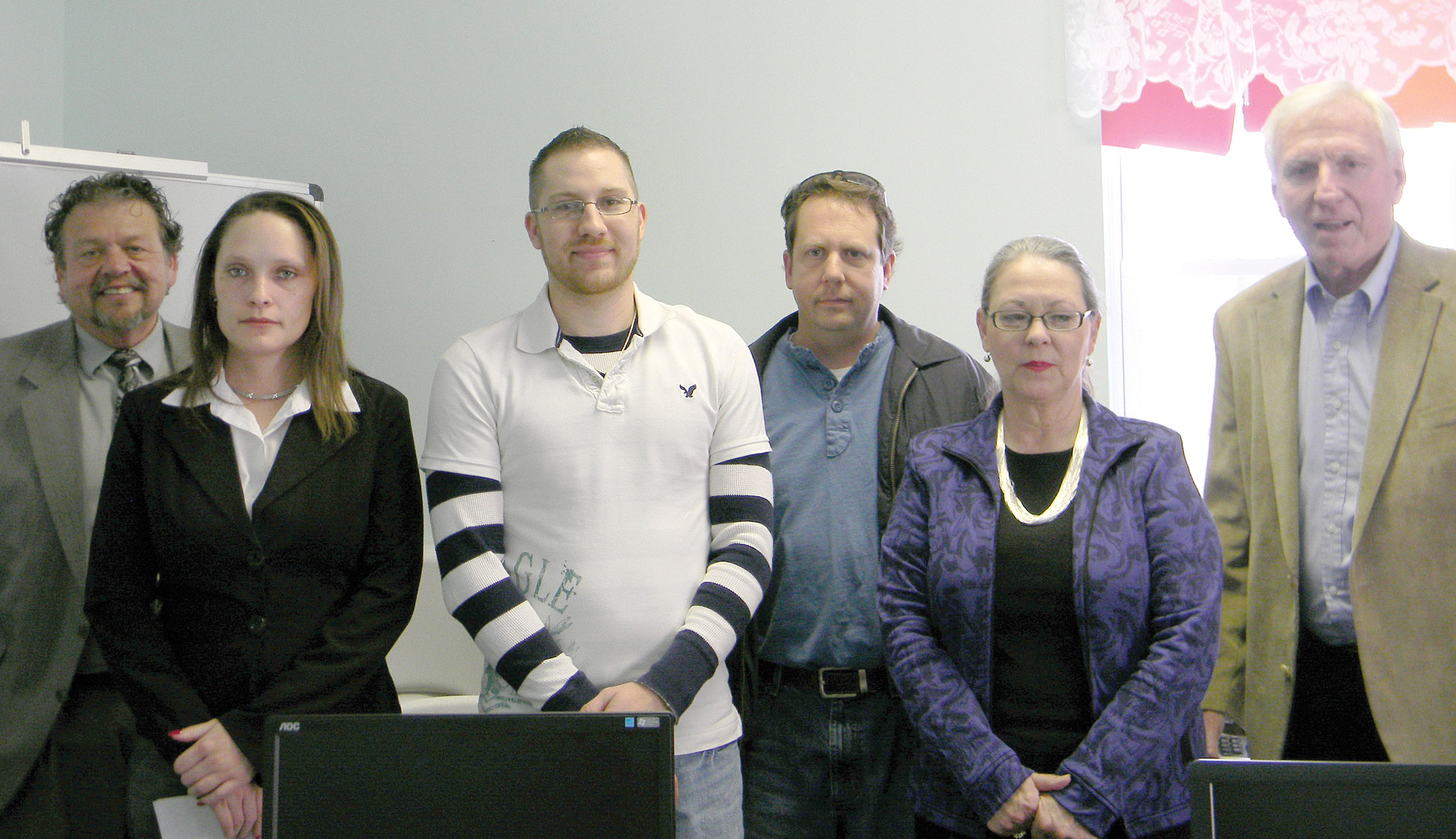
    Jimmy Burroughs (Christ Central Pastor), Wendy Wright (Center Operations Manager), Lucas Vance (Christ Central Associate), Rich Nash (Christ Central Associate), Bonnie Austin (Director of Midlands Workforce) and Roger Floyd (Vice President of Christ Central GED Program) gather to kick off the new GED Fast Track program.

    The Christ Central Fast Track GED program is coming to Winnsboro next month. Pastor Jimmy Burroughs hopes to have classes starting in April and will use mass advertisement with signs and flyers to attract as many people as possible. Those interested can call 815-HELP or just visit the administration building at 108 Moultrie St. Students drop out of high school for multiple reasons varying from pregnancy, drugs or being forced into the workforce.

    According to statisticbrain.com, over three million students dropped out of high school last year and those dropouts are not eligible for 90 percent of jobs available in the United States. The GED classes will be all day classes where lunch is provided. Training and instruction will take place in the morning with the after lunch hours consisting of practice tests. In addition, there is no cost to students. The classes, materials and $80 exam fee are all paid in full. The Vice President of Christ Central’s GED program, Roger Floyd, believes the program can make a positive difference in an individual’s life.

    “There is such a great need for this service,” Floyd said. “It is just so hard to get any type of job without a GED or its equivalent.”

    From Wagner all the way to Aiken, the Christ Central Fast Track GED program has a 90 percent pass rate since 2011 and their average score of 2,619 ranks higher than the state average of 2,532. In fact, they rank higher in every section from science (538-521) to social studies (533-515), reading (564-542), writing (489-481) and math (495-473). This past month, Christ Central had their best month ever with 13 graduates from Columbia, nine from Wagner and 20 from Aiken. The town of Winnsboro has high hopes to join those ranks in the coming months. Bonnie Austin is the Director of Midlands Workforce and she is looking forward to the prospect of educating high school dropouts.

    “We are very excited to have this resource available to assist our residents,” Austin said. “This is a wonderful opportunity for all of Fairfield County.”

    Transportation will be provided for those individuals in need to take the placement test. Classes will hold up to 15 students and be held mostly on Saturdays with an emphasis on math, writing and test taking skills.

  • Town Clock to get Facelift

    WINNSBORO – Much-needed work on the structure most closely associated with downtown Winnsboro will get under way next month after Town Council voted unanimously Tuesday night to accept the bid from Huss, Inc., an historical restoration contracting firm from Charleston. The Huss bid came in at $258,747, beating out the MCON Construction Company’s bid of $394,583 and the Carolina Restoration and Waterproofing, Inc. bid of $719,731.

    Huss has a track record of historic renovations, Winnsboro Mayor Roger Gaddy said, and the company’s Web site notes their work on the Chesterfield County Courthouse, the Bishopville Town Hall and many faҫades on buildings along Bishopville’s Main Street. Gaddy said Huss would remove the earthquake stabilizers from the clock, paint the building and restore the face of the clock. Don Wood, Town Manager, said Huss’ first order of business would be to ensure the structural stability of the building.

    “The major emphasis is stabilizing it for the next 20 years,” Wood said. “Once they do that, then we can do some of the cosmetic stuff.”

    Work is scheduled to begin on the clock April 3, with no firm completion date; although Wood said the project would be completed before October’s Rock Around the Clock festival.

    Councilman Bill Haslett, noting the availability of $500,000 in community enrichment grant funds, suggested Council consider purchasing property behind Wal-Mart and the building there once home to a local skating rink.

    “It’s got plenty of parking,” Haslett said. “It’s a building we can buy right. I’d like us to consider that.”

    Wood said the Town had considered the property in the past, but found the asking price – $700,000 – to be too high.

    “When we looked at it, we thought it was overpriced,” Wood said.

    “I think we can buy it cheaper,” Haslett said. “The people are anxious to sell. Their agents have called me every week. I haven’t returned their calls, yet.”

    Haslett and Billy Castles, the Town’s Building and Zoning Director, speculated that a similar sized building – 30,000 square feet – could cost as much as $1.2 million to build today.

    “I think we could have it for half a million dollars,” Haslett said.

    Wood said the building could be used as a new location for the Town’s Public Safety Department, which is currently housed in an aging building with a leaky roof. Wood also suggested that the Town Hall could also relocate some or all of its offices there.

    “Public Safety has an issue,” Wood said. “It would be good to keep all the fire trucks together. We’ve still got one in the storage warehouse. And we feel kind of odd in this building (Town Hall), with only four of us here. We could also have Council meetings there.”

    The building comes with 3 to 4 acres of property, Haslett pointed out.

    Gaddy said the grant funds in question come with some restrictions on how they can be used, but added that a fire substation and public safety were among the allowed uses. He said he was also not sure how much the Town would have to pony up in terms of matching funds.

    “We can explore that and look at it,” Gaddy said. “That’s not an unreasonable thing to do.”

    Council meets again March 19 at 6:15 p.m. at Town Hall.

  • Raid Uncovers Meth Lab

    Douglas Turner Wilkes

    WINNSBORO – Three men were arrested by Fairfield County Sheriff’s investigators last week and the remnants of a meth lab were discovered in a drug raid at Lamplighter Apartments in Winnsboro.

    Douglas Turner Wilkes, 28, was arrested in his home at apartment 16-B at Lamplighter Apartments Feb. 27 and charged with manufacturing methamphetamine. Although investigators recovered no finished product, numerous items associated with the production of meth were located and seized from the home. Officers also discovered waste products and other materials left over from previous meth productions. A small amount of what officers said they believed to be a substance that was in the final stages of meth production was also discovered in the home and sent to the State Law Enforcement Division’s lab in Columbia for testing.

    According to Fairfield County Sheriff’s Capt. Brad Douglas, items recovered from the raid included packets of cold medicine, lithium strips from batteries, starter fluid and other items, clearly indicated a methamphetamine operation.

    “These items are so specific to the production of meth, there is no other conceivable reason to have them all together in one place,” Douglas said. “In South Carolina, you don’t even have to have the drug anymore. If you’ve got the stuff to make it, you can be charged.”

    A simultaneous raid on apartment 12-C netted John Terrence Lawry, 29, of Ashford Ferry Road, Blair, and Jonte Lamar Long, 26, of Reservoir Road, Winnsboro on charges of possession with intent to distribute marijuana. Four bags of suspected marijuana, a digital scale, a handgun and more than $1,000 in cash were seized from the home. Investigators also discovered a ledger containing names and transaction information during the raid.

    Douglas said the ledger appeared to be a customer list, which he said “could possibly generate leads for continuing investigation.”

    All three men were transported to the Fairfield County Detention Center.

  • Everything on the Table for Water Authority

    WINNSBORO – Representatives of Mid-County Water and the four local governments (Fairfield County Council and the towns of Winnsboro, Ridgeway and Blythewood) exploring the possibility of forming a regional water authority met Wednesday afternoon at Midlands Technical College in Winnsboro to discuss the framework of the project. While much of the discussion, chaired by Winnsboro Mayor Roger Gaddy, revolved around meeting procedures and proposed bylaws, the topic with the most bearing on the future of the authority was ownership of the water system itself.

    “What is going to be the system that the regional water authority wants to own?” Margaret Pope, an attorney with the Pope Zeigler law firm advising the committee, asked. “I believe the Town of Winnsboro has the only water treatment plant of all the members here.”

    Gaddy told the committee that, as far as the Town of Winnsboro was concerned, all options for the water plant were on the table.

    “From the Town of Winnsboro’s standpoint, nothing is set in stone,” Gaddy said. “Winnsboro has been supplying the water, but it’s getting to the point where it’s become so expensive, and with future costs we know that’s something Winnsboro is not going to be able to absorb by itself.”

    Gaddy said Winnsboro has a preliminary agreement with South Carolina Electric and Gas (SCE&G) to draw up to 1 million gallons of water a day from Lake Monticello, but getting that water into Winnsboro will be expensive. That kind of expense, he said, is exactly the kind of thing a regional water authority could help cover.

    “You’ve still got to run the water to the reservoir,” Gaddy said. “That’s going to cost probably $8 – $12 million. If you’re going to try to get some funding for it from the federal government or other special funding, they look more favorably on a water authority that represents Mid-County, Blythewood, Ridgeway and Winnsboro. That’s going to carry a lot more clout.

    “We don’t necessarily have any proprietary feeling that we’ve got to own the water plant or we’ve got to be the wholesale provider,” Gaddy continued. “My feeling is that if the group doesn’t want that, that’s fine. If they want us to be the wholesale provider, that’s fine too. I don’t want anybody walking into this meeting thinking the Town of Winnsboro has got a pre-set agenda of how we expect this thing to look and what we want out of it.”

    Gaddy said the water plant is in need of upgrades, which represent an additional expense, and the Town is also saddled with the upkeep of the entire system that feeds Blythewood, Ridgeway and Mid-County.

    “Even though we’ve spent millions of dollars on water, there’s about a 1 percent profit margin,” Gaddy said. “We’re not making a killing off water.”

    David Ferguson, Chairman of Fairfield County Council, said the County was not necessarily interested in becoming a water provider, but wants to ensure water is available for County economic development projects now and in the future.

    “With the investments we’ve made (in the new industrial park) on Peach Road, we need to be proactive,” Ferguson said. “That’s what the County’s looking at. The distribution and that kind of stuff, we’re really not interested in it. We have property on Highway 200 and I-77, we have that industrial park (on Peach Road), and as soon as we get that one up and where it needs to be that will not be the only park in the county. We’ve got to know we’ve got the resources at Highway 200 and 77 to do the same thing we’ve planned to do on Peach Road.

    “I don’t think we did a real good job of getting to this place,” Ferguson said, “but we need to do a good job moving forward.”

    Mid-County Water has yet to convert their governing body to a public entity, a transition necessary before officially joining any water authority. The other governing bodies represented on the steering committee have yet to pass resolutions necessary for joining. The Town of Ridgeway has held public hearings on the matter, but has thus far not held a vote.

    The committee also discussed how the existence of the authority might affect future water rates for consumers.

    “That depends on what the water authority wants to buy,” Gaddy said, referring to Winnsboro’s treatment plant. “If they want to buy everything, the rates will go up quite a bit. They will go up no matter what. It’s just a matter of degree.”