Category: News

  • Chamber Delves into History for Latest Culinary Publication

    Oldies and Goodies –
    Scouring older Fairfield cookbooks for favorite recipes from the county are Terry Vickers, President of Fairfield County Chamber of Commerce; Joyce Dean, resident of Ridgeway and a 37-year employee in the Richland County School District lunch rooms; Denise Jones, co-owner of the Cotton Yard Market in Ridgeway and member of the Fairfield County Chamber of Commerce and Dan Ruff, son of the late Nancy (and Daniel Walter) Ruff, whose recipe for Chow Chow Pickles appeared in the 1998 Bank of Ridgeway Cookbook and will be back by popular demand in the new Fairfield Cookbook.

    FAIRFIELD — The Fairfield Chamber of Commerce’ cookbook project is in full swing. More than 200 of the county’s great cooks have submitted their recipes for publication in the soon to be completed Fairfield County Cookbook.

    “Our goal,” said Chamber member Denise Jones, “is to produce a cookbook that is indicative of the cuisine of the County.”

    Cookbook sales will serve as a fund raiser for the Chamber. “

    The Chamber will use proceeds from cookbook sales to promote Fairfield County through advertising, training and other means,” Jones said.

    The deadline date for submitting recipes is June 20. The cookbook is scheduled to print on June 30 and should be on sale around the end of the summer.

    A special feature of the cookbook are older recipes from recipe books that originated in Fairfield County – the Bank of Ridgeway Cookbook (published in 1998 to commemorate the bank’s 100 year anniversary), the Ridgeway Cookbook compiled in 1977 by The Ridgeway Garden Club, the “See and Taste” cookbook published in 1986 by the Fairfield County Extension Homemakers Council, the “Recipes We Adore” cookbook distributed in 1978 by Richard Winn Academy PTO, the “Who’s In the Kitchen #2” cookbook compiled in 1995 by Maude F. Timms and Ruth’s Recipes (date unknown) compiled by Ruth Metcalfe, Chairman of the Alter Guild, St. Stephen’s Episcopal Church in Ridgeway.

    “If others are available,” Jones said, “we would love it for cooks in the community to bring them to our attention as soon as possible.”

    Jones said the cookbooks will be ready for sale about two months after it is submitted for printing.

    “We hope to have all the recipe contributors bring their dishes for tasting during a kickoff event for the cookbook sales,” Jones said.

    A date and location for the event will be announced later in the summer.

  • Student Art on Display at Century House

    Displaying some of the portraits of J.R. Green, Superintendent of Fairfield County Schools, that are on display at the Century House in Ridgeway, are Phyllis Nichols Gutierrez, chairwoman of Arts on the Ridge Committee; Theresa Brown, Fairfield Central arts teacher; Julianne Neal, Coordinator of Visual and Performing Arts and Charlene Herring, Mayor of Ridgeway.

    RIDGEWAY — The first exhibit of a new revolving art exhibit to be housed at the Century House in Ridgeway will be a series of portraits created by students in the advanced art class at Fairfield Central High School. The portraits are of Fairfield County School District Superintendent J. R. Green, complete with his signature bow tie. Each portrait gives a slightly different take on the District’s top administrator. The exhibits are part of the long-standing partnership between the Visual and Performing Arts Department of the SDFC, the Fairfield County Arts Council (FCAC) and the Ridgeway Arts on the Ridge Committee.

    The current series of portraits of the Superintendent will be on display through mid-July at the Century House, with selected appearances at community events to be followed by a period of display at the SDFC district office. Future exhibits will include student artwork from ARTWORKS, the District’s artistically gifted and talented programs, as well as work from each of the district schools.

    “We were thrilled this year to be invited to bring student work to Arts on the Ridge for their exhibits,” said Julianne Neal, coordinator of the Visual and Performing Arts program. “This series of revolving displays will be a continuation of that project and we are so excited to be a part of it. We invite the community to stop in and see this wonderful artwork created by our very talented students. I think people will be surprised at the talent.”

    The students’ artwork is also available for display in Fairfield County businesses. For more information, contact Julianne Neal at 635-1441, ext. 60223 or Phyllis Gutierrez at 272-6471.

  • Council Faces Public Outrage Over Administrator’s Probation

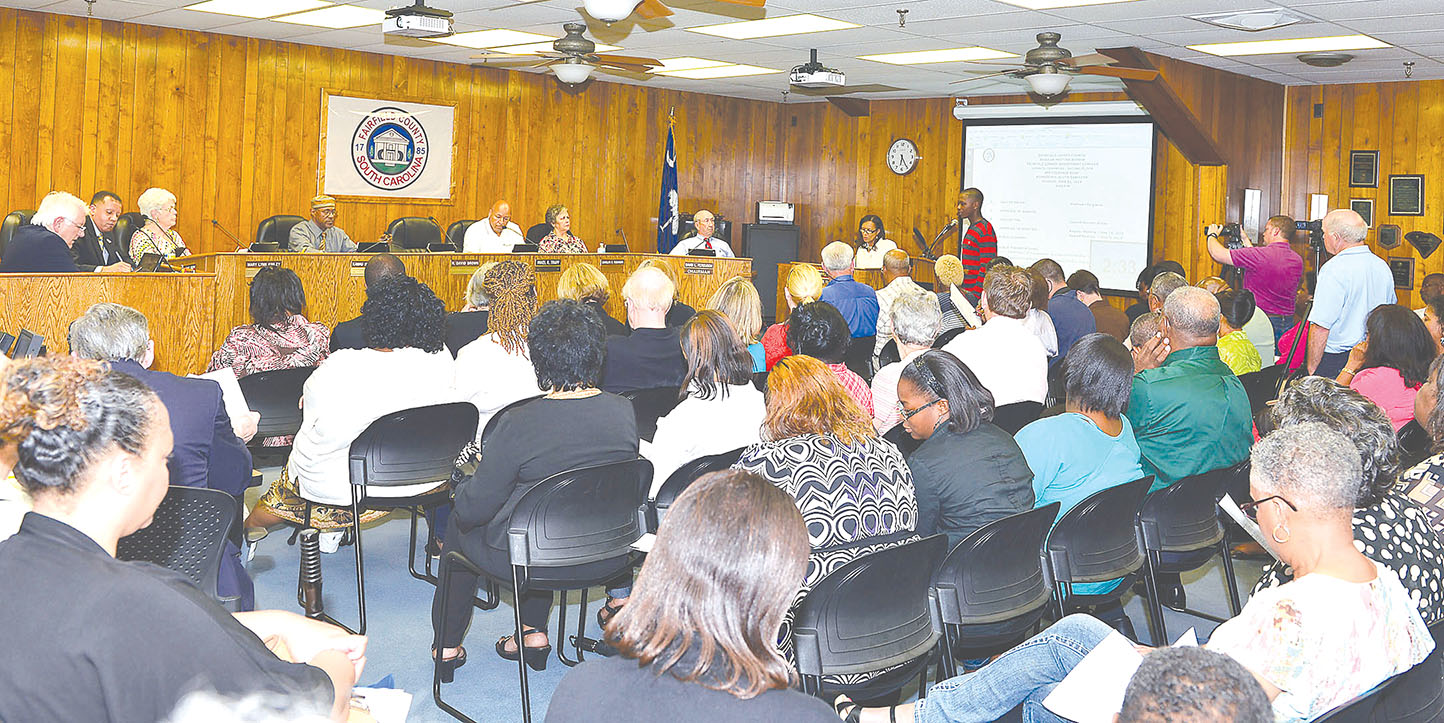
    Fairfield County residents packed Council chambers Monday night to express their dismay at what they perceived as lenient punishment for the County Administrator.

    FAIRFIELD – County Council drew a packed house Monday as the public leveed some harsh criticism over Council’s June 5 decision to sanction Phil Hinely, the County Administrator.

    “A pay cut doesn’t seem like much of a punishment,” said Christina Fair, referring to Council’s decision to reduce Hinely’s pay by 5 percent during a six-month probationary period. “Instead of going to work every day, looking at pornography, you get to take a paid vacation.”

    “I realize you would all like to have Mr. Hinely’s alleged reprehensible behavior go away,” said Bob Carrison. “The Administrator has violated the public trust and a moral code. How can we trust this man? The hypocrisy should be obvious to all of you. I would like you to reconsider your decision.”

    Hinely’s alleged emails, said Wanda Bright, put the County in a vulnerable position for sexual discrimination lawsuits.

    “Shame on all of you,” Bright said to Council. “It seems that many of you have forgotten who you serve. Phil Hinely should be setting an example of professional conduct, not of misconduct.”

    Brenda Miller offered what she called “The state of the County” in her remarks.

    “This statement is painful to me because, as individuals, I count Council members among my friends. But in recent years I have developed a lack of trust and lack of confidence in Council’s ability. As a Council, there’s a pattern of a lack of coordination between the County and the municipalities. Council has developed a ‘my way or the highway’ ideology. We have to have new, professional leadership. The County has the money to hire the best professionals available. If you’re not part of the solution, you’re part of the problem and you should resign.”

    William Coleman said he feared this mark on Hinely’s reputation would damage the County’s ability to attract industry and urged Council to revisit their decision. Near the close of Monday’s meeting, Council addressed the public outrage.

    “It’s amazing to me the feeding frenzy,” said Councilwoman Mary Lynn Kinley (District 6). “We didn’t vote earlier (to discipline Hinely) because we didn’t have all the facts. I still don’t know if we have all the facts.”

    Kinley said she was surprised at charges of being uncooperative, and said the County has never turned down a request from the hospital, tried to meet with the School Board on their recent bond issue to build a new career center and works well with Winnsboro and Ridgeway.

    Vice Chairman Dwayne Perry (District 1) said he was wary of the alleged emails circulating among the public.

    “I know how things can be Photoshopped,” Perry said. “I did not have the opportunity to speak with anyone at SLED (the State Law Enforcement Division, which opened a case file on the alleged emails in February and closed the file two weeks later after determining they contained no illegal content). I would like to know the legitimacy of the emails. As someone who lives in this county, I am still concerned with the legitimacy of all the information.”

    Council Chairman David Ferguson (District 5) said the Council had made its final decision on the Hinely matter and, in spite of the public outcry Monday night, would not be revisiting the issue. And the Council made their decision in their own time, Ferguson said.

    “We told the public we would withhold anything we were going to do until we got the whole story,” Ferguson said, “not because the public made us do anything. Threats don’t get us anywhere. Has Mr. Hinely made a mistake? Yes, he did. Did Council address it? Yes, we did. Is Council going to go back and readdress this? No, we’re not.”

  • Abbeville, Birthplace and Deathbed of the Confederacy

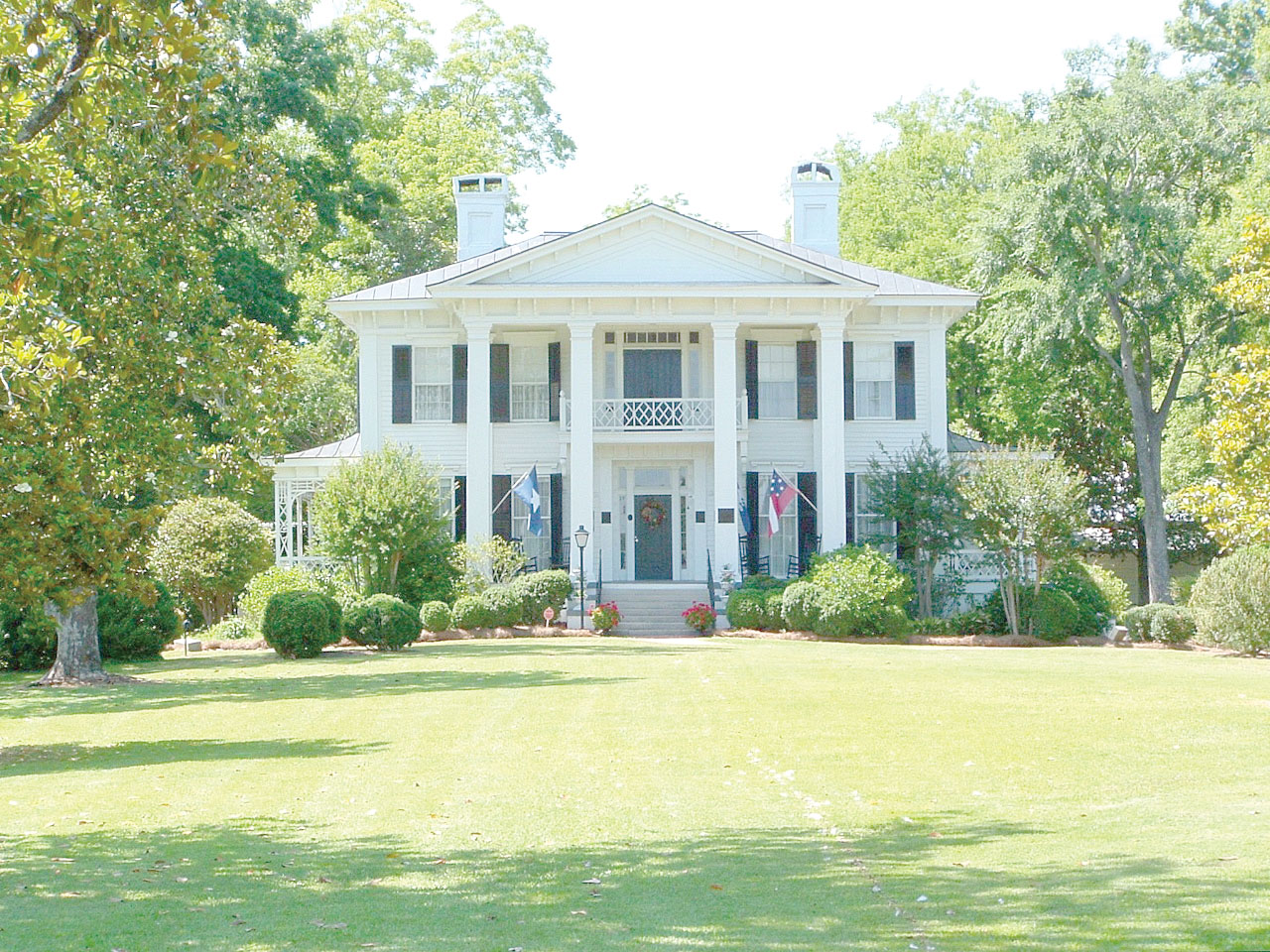
    The historic Burt-Stark Mansion in Abbeville.

    You don’t have to go to Gettysburg to see Civil War history. A two-hour drive west to Abbeville will lead you to a place where many say the Civil War began and ended. Abbeville’s Burt-Stark Mansion is Abbeville’s historical and architectural jewel. Known also as the Armistead Burt House, it’s the place where the last Council of War cabinet members of the Confederate government met.

    Abbeville is often referred to as the birthplace and deathbed of the Confederacy. The birth took place at Secession Hill when local citizens gathered on Nov. 22, 1860, to adopt the ordinance of South Carolina’s secession from the Union. Four and a half years later the Burt-Stark Mansion is where the will to fight left the Confederacy’s leaders.

    David Lesly, a prominent lawyer and planter, built this fine old mansion as a town house for his wife Louisa, circa 1840. It was built in the Greek revival style meant to impress and provide comfort. After Lesly died in 1855 the house went through several owners. In the spring of 1862 Armistead Burt purchased the house. Burt, a lawyer, planter and Congressman, had been friends with Jefferson Davis in Washington, D.C. That friendship brought a most historic event to Abbeville.

    Historian and tour guide Fred Lewis gives an account of the key moment at the Burt-Stark Mansion. “As the Civil War approached its end, President Davis left Richmond, Va. on April 2, 1865 heading southwest. He reached Chester where he was invited to Burt’s home for a time of rest. He arrived in Abbeville May 2 accompanied by 900 to 2,000 Confederates. He arrived at the old home around 10 in the morning. After ‘supper’ that evening he met with Secretary of War John C. Breckenridge, military advisor Braxton Bragg and five field commanders in the men’s parlor. His attempt to obtain support for another effort against the Union failed. Convinced not to pursue a guerilla war against the Union, Davis says, ‘Then all is lost,’ and the CSA dies.” Reportedly a shaken Davis had to be helped upstairs where he rested in a four-poster bed. Contrary to legend, Davis did not spend the night here. You can tour the home and see the very parlor where the Confederacy’s hopes were dashed and the bed where Davis contemplated all that had happened.

    For those who love history, architecture and antiques, this Southern home is a must see. Authentic Antebellum pieces fill the home. The grounds are splendid and have been referred to as a horticultural feast. See the old home’s kitchen out back. Get a close look at what a kitchen of the early 1800s looked like. Best of all, see where history took place.

    Abbeville is a beautiful Southern town. The town has a beautiful square with restaurants and more and the drive there takes you through rustic countryside.

     Learn more about Tom Poland, a Southern writer, and his work at www.tompoland.net. Email day-trip ideas to him at tompol@earthlink.net.

  • R2 Board OK’s $4,400 Raise for Brochu

    The Richland 2 School Board approved a 2 percent raise for all District employees during their Tuesday night meeting at Polo Road Elementary School. That increase means Superintendent Katie Brochu, who currently earns approximately $220,000 a year, will receive a $4,400 increase next year (not including benefits). A teaching assistant currently earning $15,600 will see an increase of $312. These increases will become effective July 1.

    Employee Climate

    Board Member Chip Jackson represented the finding of the Employee Climate Survey conducted in September. While Chairman Bill Fleming said the Board has had the initial results for quite a while, they are now being released to the public. In March of this year, K1 Insight, the consulting firm handling the initial survey, conducted focus groups to further ferret out their findings. The strengths of the survey were: a sense of belonging to the ‘Richland Family,’ employees who were products of the Richland 2 school system and abundant resources. Weaknesses were unequal allocation of IT resources, professional development that was not always constructive, lack of communication, widespread fear/mistrust and a stifling of expression if employee views differed from District. Oversight of the Climate Study began when Jackson was Chairman of the Board. Fellow members asked that he continue this work. He assured the community that the study will not sit on a dusty shelf and that weaknesses will be addressed.

    Common Core

    The third series of Common Core was presented by the Office of Academic Affairs. The focus was on how the students were to be assessed. Several Board members expressed concern about the preparedness of teachers in administering a test that is wholly taken on the computer and graded by both computer and human hand. South Carolina is one of 25 states using the education consortium Smarter Balanced, which is handling the assessments for each of the districts in our state. Student assessments or testing of their grasp on Common Core standards begins in the 2014-2015 school year. There will be practice assessments next year, as Richland 2 students will begin competing with students from across the country the following year. The logic of continuing with the professional development team of Schlechty, which had opposed anything but local decision for curriculum and standards, was questions by Board member James Manning. Common Core is a departure from that in that the standards are uniform across the country and determined at the national level with all students competing for the same standard. Schlechty has advocated for years that control must remain at the local community level because they know best what their students need. Schlechty is also opposed to standard assessments. Richland 2 continues its three-year relationship with the Schlechty Center.

    Vacancies

    In the last couple of weeks there have been several district departures from school’s key administration. In addition to planned year-end retirements, numerous teachers and administrators have chosen to continue their teaching profession in nearby districts. Currently, there are 102 employee positions open for the next school year.

    The next scheduled board meeting will be July 23 at Spring Valley High School.

  • Council Annexes, Rezones Broom Property

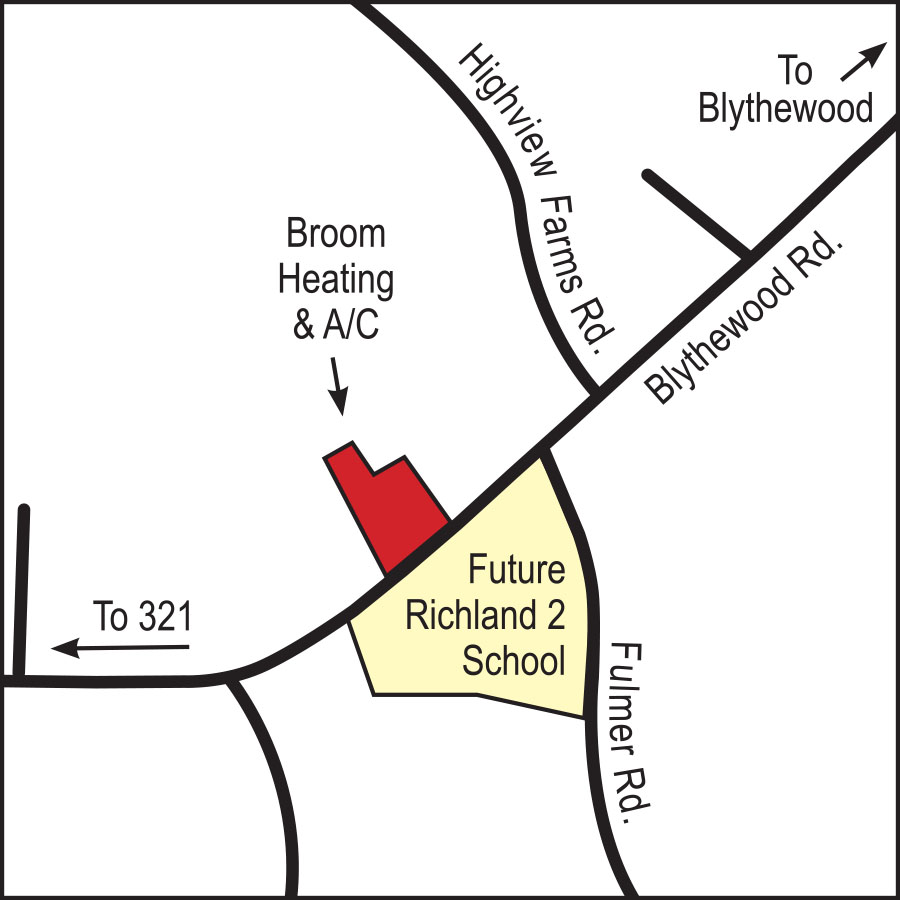
    BLYTHEWOOD – Town Council passed first reading Monday night to annex and rezone an 11.43 acre property at 1224 and 1232 Blythewood Road from Rural (RU) zoning to Community Commercial (CC) zoning. The property has housed Broom Heating & Air Conditioning for many years. Town Administrator John Perry told Council that the property is located near the intersection of Blythewood Road and Fulmer Road and across Blythewood Road from a future Richland 2 school site. He said the area surrounding the property being annexed is designated for commercial zoning in the Town’s Master Plan. Perry said Community Commercial, the equivalent to the Town’s former General Commercial zoning, is appropriate for the area. The second and final reading for annexation and zoning on the property will be held at Council’s next regular meeting at 7 p.m. on June 24 at the Manor building.

  • Militants Mar Web Site

    BLYTHEWOOD – The Town of Blythewood’s Web site was defaced over the weekend by ‘The Syrian Electronic Army,’ according to John Perry, Town Administrator. Perry said Mayor J. Michael Ross was called Sunday morning by the S.C. State Security Operations (SCSSO), which reported that the Town’s Web site had been compromised.

    Ross reported at Monday night’s Town Council meeting that he thought the call was a prank and went online to the Web site to see for himself.

    “It was awful,” Ross said. “It was a lot of Islamic-militant stuff, anti-Western civilization and anti-America. It was real.”

    Immediate execution of the Town’s Information Technology (IT) Incident Response Plan resulted in only a momentary defacing, not a ‘hacking,’ according to Perry. The FBI explained to Ross that hacking occurs when a cyber-intruder covertly gains access to a site and steals information from it. That did not happen in this case. Ross said when he went to the Web site he was redirected to a YouTube video.

    Ross said it took less than 15 minutes for the problem to be corrected – the Web page was taken offline, purged and re-established.

    Perry said he wanted all who frequent the Town’s Web site to know that it is not hosted on the Town’s servers and that only public information is contained on the site.

    “Please take note,” Perry said, “that absolutely no privileged information is stored on or entered through the Web site at any time. Through the wholesale cooperation and teamwork of the Town’s IT department, Richland County Sheriff’s Department, SCSSO, S.C. Law Enforcement Division and the FBI, valuable data has been secured to assist in pinpointing the methods used by the violators.”

    The Town’s Web site, www.townofblythewoodsc.gov, is now back to full normal operation.

  • Council Issues Sanctions Over Emails

    FAIRFIELD – In a special called meeting June 5, Fairfield County Council voted unanimously to sanction the County Administrator, Phil Hinely, for forwarding inappropriate emails from his County computer back in 2010. Hinely was placed on probation by Council, to be reviewed by the Chairman, Vice Chairman and County IT Director at the end of a six-month period. Hinely’s salary of $119,530 was reduced 5 percent by Council for the duration of the probationary period, and he will be expected to submit an official letter of apology to Fairfield’s local newspapers. Council also voted to include contract employees under the same policy manual as regular, at-will employees, except where the manual conflicts with the contract. In that case, Chairman David Ferguson said, the contract will prevail.

    Ferguson (District 5) said he was pleased with the outcome of the June 5 meeting and that Council’s decision would be the last word on the matter.

    “That was the consensus of the group after meeting with our attorney,” Ferguson said. “Everyone appeared to be satisfied. We’re not going back and massaging this thing again. We’ve got bigger fish to fry than this mess. The County Administrator agreed; he was very amenable. He realizes he made a mistake – we all do.”

    The State Law Enforcement Division (SLED) opened a case file in February on Hinely’s email activities after someone brought to them alleged emails containing graphic images of nude women that were asserted to have been sent from Hinely’s County email address. SLED closed the file within weeks after determining the images were not illegal and told The Voice that they never conducted an investigation to determine the source of the alleged emails. Hinely told The Voice that he forwarded emails for a short period in 2010 that, in hindsight, he considered inappropriate, but said he never sent anyone pornography and claimed the materials in SLED’s file did not come from his computer.

    “I did something stupid,” Hinely said after Council’s June 5 decision. “It wasn’t as bad as what I was accused of doing, but I should have known better. I regret that it’s caused anyone any embarrassment. I’m willing to do whatever Council asks of me. We’re in the middle of a lot of good things for Fairfield County. I think the punishment fit the crime.”

    Councilwoman Carolyn Robinson (District 2), however, said that in the business world the punishment would not have fit the crime. Still, she said, she accepted the majority decision.

    “That’s what the majority of Council felt was the right thing to do,” Robinson said. “As a Council, we have to be satisfied.”

  • New Ordinance May Kill Residential Zoning

    RICHLAND – For the past year or more, Richland County Council has leaned on the County Development Roundtable to make land development policy that could end up turning zoning throughout the county, as well as land development, on its head. It has to do with the County’s current Green Code that was developed in 2008 by an earlier Roundtable group. There is no history of what went into that ordinance and now the County is preparing to replace the Green Code with a less restrictive but much more complicated provision.

    The Green Code was little used until Tracy Hegler, the County’s current Planning Director, was hired. LongCreek resident Sam Brick currently has a lawsuit pending against the County, stemming from their application of the Green Code in the LongCreek Plantation subdivision. According to Brick, Hegler, in her Development Review Team (DRT) role, has focused on some Green Code ambiguities. To aid local developers, Brick said, she has determined in Green Code applications that residential zoning standards do not apply.

    Interpretation of Bonus Space

    Brick says this is in the face of specific provisions in zoning ordinances that reference the Green Code and its bonus provisions. Hegler’s interpretation is that the bonus provisions are not necessary because of a conditional provision to get to the bonus that says no minimum lot areas are required. This interpretation is before the Circuit Court along with another strained determination that, under the Green Code, the requirement for 50 percent pervious surfaces in buildable areas is only applicable if the developer uses such surfaces in sidewalks and driveways.

    “So, of course,” Brick said, “a developer will jump to abide by such a costly ‘green’ provision.”

    Since major land development is within the purview of the Planning Department and its DRT that makes final decisions on Green Code projects, Hegler’s interpretations are final.

    Roundtable Membership

    Because this issue has caused even the County Council to wince at some of these interpretations, Council has requested the Development Roundtable to suggest changes to the Green Code. A third of the members of the Roundtable are members of Hegler’s staff. The other two thirds are people she appoints from the development and conservation communities. There are no representatives for neighborhood zoning or property owner associations’ interests. Even though the Roundtable is an advisory body that drafts proposed ordinances regarding land development policy, its meetings, agendas, reasons for action, discussions, decisions, etc. are all done in secret. This may be a violation of the Freedom of Information Act, a matter that Brick is pursuing in the Court of Common Pleas next week.

    On April 22, the Roundtable presented its draft proposed ordinance in a work session with the County Planning Commission. The meeting was advertised seven days ahead of the meeting but the subject of the meeting did not mention the Roundtable – only that it would be a work session. The notice said the “topic will be open space design standards.” There was no mention of the Green Code, although the proposed ordinance would replace the Green Code. There was no mention on line in the Richland Web sites that such a meeting would occur and no notice by the Planning Department of the meeting to persons who had expressed an interest in the topic other than a personal email from Hegler to the Executive Director of the Columbia Home Builders Association. According to Brick, what the Roundtable presented to the Planning Commission is complicated, complex and internally inconsistent.

    The Open Spaces proposal

    The proposal is for a developer to set aside some lands as a conservation district or as an “open space,” in order to be free of the otherwise applicable zoning standards. According to Brick, it also forces property owner associations (POAs) to accept the open space and to maintain it in perpetuity. If the development occurs in an area covered by a property owner’s association with the association being under the control of a developer, as is the case throughout Richland County, that property owner’s association would pick up the tab for the management, the upkeep and the total care of the set-aside. The POA would have to maintain expensive storm water systems to include whatever low impact development techniques the developer might utilize.

    There is no evidence that Richland County POAs were involved in the preparation of this proposal. Even though the residential zoning standards would not be applicable, the change from their applicability would not be controlled by the County Council. Actually, there is no indication as to what the zoning would be in an “open space” development.

    Council would be no help

    Should a community want to complain about an open spaces development in its midst, it would not be to their County Council representative. Council would not be involved. It would be approved or denied in accordance with land development ordinances by Hegler and her Planning Department.

    “With the open spaces proposal,” Brick said, “a builder developing a parcel over 2 acres could set aside a front yard or such as an open space and build without any zoning standards.”

    The Columbia Home Builders Association testified that this would be great. In residential areas, they could build houses on concrete slabs right next to each other.

    The ordinance speaks to reduction of impervious cover being a purpose of the provision but the only mention of impervious surfaces is with regard to unenforceable suggestions for the mentioned low-impact techniques and restoration of some pervious surfaces made impervious by the developer. The current Green Code limits builders to 50 percent impervious surfaces in their buildable areas. The Roundtable eliminated this provision, which is standard practice throughout green code provisions all over the United States. While the open spaces purpose section speaks to preservation of green space, provision for recreation, protection of wildlife habitat and creation of community and pedestrian connectivity, there are no provisions requiring these purposes included in its terms. Such provisions are specified as requirements in the Green Code. Regarding pedestrian connectivity, the “open spaces” proposal allows pedestrian connectivity between neighborhoods but only with Planning Department approval. In the Green Code, pedestrian connectivity is required. The proposed changes provide enhanced authority for the Planning Department to make determinations regarding conservation issues. Yet, Richland County has its own independent conservation department currently run by a conservation professional at the doctorate level.

    The proposal sets forth a series of subjective constrained and unconstrained spaces of varying types and circumstances. It provides credits to be awarded by the Planning Department with complicated calculations, multipliers and bonuses. It considers lakes or open water as a constrained space that would qualify for a set aside bonus. When the builders were asked about this in the work session, they defended the practice by stating that the lake could be drained and they could then build on it. The proposal has never been discussed in a public setting.

    County Council, after flawed notice of its consideration of the proposal and first reading of the ordinance, quickly passed, the proposed ordinance during its May 28 meeting.


  • Revised Water Deal on the Table

    WINNSBORO – Just two months ago, it appeared as if any hope of a deal for additional water from the City of Columbia was dead, with Winnsboro Mayor Roger Gaddy walking away from negotiations visibly and publicly frustrated. But Tuesday night, Town Council voted to authorize Gaddy to sign a contract for just such a deal, which Council said was before Columbia City Council that very same night, awaiting their approval.

    The new deal, Gaddy said, increases the number of gallons Winnsboro can access from Columbia from the 400,000 a day agreed to in last summer’s deal to 1 million a day. Gaddy said the sticking points that had essentially killed previous negotiations – clauses that would have allowed Columbia to increase rates or decrease flow without notice, and that would have freed Columbia from water quality assurances or any maintenance responsibilities on their end of the line – had been removed from the current proposal.

    “We met with them yesterday and we’re comfortable with the changes that they made,” Gaddy said. “We can bring it across the County line and be able to supply water for the industrial park.”

    Gaddy indicated that State Sen. Creighton Coleman (D-17) played a significant role in bringing Columbia back to the table with a contract that Winnsboro could agree to.

    Earlier in the meeting, Council passed, at least temporarily, on a proposal from HandMade in America, grassroots volunteer organizers from Asheville, N.C., which made a pitch last month to help spark revitalization in and around downtown. HandMade’s services would have cost the Town between $6,000 and $9,500.

    Councilman Clyde Sanders said he felt Connie Shackleford, the Town’s Grants Coordinator, could accomplish much of what HandMade could with workshops to gauge volunteer participation and interest.

    “My personal opinion is before we spend the money we should try and see if we can do it on our own,” Sanders said.

    Ultimately, Council voted to seek proposals from organizations similar to HandMade to compare their services, costs and successes.