Category: News

  • Board Shines More Light on Travel

    FAIRFIELD – Fairfield County School Board Chairwoman Beth Reid (District 7) announced a new policy regarding travel during the Board’s regular meeting Tuesday night, one she said was aimed at bringing more transparency to large expenditures incurred by the Board. Reid said effective immediately, all intended travel by Board members should be brought before the full Board.

    “For several reasons,” Reid said. “One, for knowledge of other Board members, so we know who’s going and who’s not, who’s going to be in attendance and who can report back to us after attending a conference. Two, so we know we’re not stepping all over each other. We don’t necessarily need for all Board members to be at all conferences.”

    Reid said “Board Travel” would be added as a permanent item under the Board Chair’s Report in future agendas and Board members would be asked to report to the full Board after attending a conference and to bring any proposed travel to the knowledge of the full Board. Reid said the proposed travel would not necessarily be subject to approval by the Board, “but for knowledge of the entire Board, as well as the public, so that we can all be transparent on the expenditures going forward,” Reid said.

    Reid also reported that legal fees in the last fiscal year have dropped more than $138,000. Bills from the District’s main law firm, Childs and Halligan, fell from $246,772 in the 2011-2012 fiscal year to $128,210 in 2012-2013. Total fees from all firms employed by the District fell from $351,402 to $213,028 in the last fiscal year.

    “I think that’s significant and it speaks very highly of the leadership and the Board attitude,” Reid said. “You know what we can do with that money? We can hire folks and use it in instruction. That’s where it ought to be.”

    The Board also approved student fees and fines for Fairfield Middle School Tuesday night, but not without some minor discussion about ID cards.

    The $12 base fee represents no change from recent years, Superintendent J.R. Green said, and covers the cost of a student’s ID card and academic planner, as well as assembly fees and fees for student recognitions and rewards. There is also a $10 band fee and $5 fees for Family and Consumer Science and Industrial Technology. Students who lose their ID cards or their academic planners will have to pony up $5 for a replacement and late fees for library books will run 5 cents a day.

    “I just get caught up in these ID cards,” Board member Henry Miller (District 3) said. “I understand we want them to be responsible, but is there any way we can have ID cards where there’s no charge this particular time? Some children just can’t afford it.”

    Green said most principals use judgment when it comes to which students can and can’t afford to replace an ID card and the fine discourages student carelessness.

    “If you don’t have things in place so that students feel they need to be responsible for keeping up with their IDs, you’ll find yourself printing up IDs every day,” Green said, “because there will be no incentive to keep up with IDs.”

  • Recreation Debate Rages On

    FAIRFIELD – After a nearly three-hour executive session devoted to legal counsel Monday night, County Council once again tackled the issue of recreation; specifically, the long-promised, much-debated facility in the Dawkins community and how $3.5 million in recreation funds from this year’s $24 million bond issue can be used [see the July 12 edition of The Voice]. While the debate was intense, the result was the same as Council’s July 8 vote – another 3-2 defeat for the Dawkins facility.

    Councilman Mikel Trapp (District 3), one of two votes for his motion to allow each individual Council member to use their earmarked $500,000 of recreation funds in their districts as they see fit, walked out of the meeting shortly after the vote. Trapp’s exit came after Chairman David Ferguson (District 5) instructed Council to come up with a plan on how the recreation funds should be used and to do so within two months.

    Trapp, however, said he had no interest in taking part in another two months of debate.

    “I’ll have no discussion,” Trapp said. “I’m going to excuse myself, because it’s going to be another round of what we’ve been through the last however many years. Ya’ll have a good night.”

    So saying, Trapp departed.

    The debate, which raged for nearly an hour, was essentially a rehash of two votes taken during Council’s July 8 meeting – one to begin construction of the recreation facility (approved by Council in 2006) on 8.12 acres off Ladds Road and another to allow Councilman Kamau Marcharia (District 4) to use the $500,000 of earmarked recreation funds for the same project. Both votes failed, 5-2 and 3-2, respectively, with only Trapp and Marcharia, as during Monday night’s round two, voting in the affirmative.

    On July 8, Councilman David Brown (District 7) said putting up the proposed building in Dawkins would shortchange District 4 and suggested additional time to study the project. Vice Chairman Dwayne Perry (District 1) supported the idea of more homework on the project, something he reiterated Monday night. Perry added that he felt that expenditures of County funds, even if earmarked for individual districts, should be approved by the full Council.

    “I think any decision on how that money should be spent should come back before full council,” Perry said Monday night. “What I would like to be able to do is to hear from the folks who actually live in District 1. I would like to go back to them and have a community meeting. Maybe one or two. I’m not talking about a long time frame.”

    But Marcharia said his district was ready to move forward.

    “I think you should do that,” Marcharia said. “But why do you want to hold my project up? Are you willing to wait seven years? We’ve been waiting seven years or more. We have our plan. We had the blueprints drawn up. We’ve got people from the community out there (in the audience) right now with their children.”

    Trapp agreed, adding, “I don’t think it’s right to hold up other districts’ projects when they have already done their due diligence and got the surveys from their community to decide what they want in their community. Even if Mr. Perry doesn’t fully have his to the point where he wants to have it, we still can vote to allow the Council members who have got to the point where they can start to put recreation in their district.”

    Trapp also called Perry’s suggestion that Council get input from County Recreation Director Lori Schaeffer, “another stall tactic.”

    “Members who don’t want to spend the money for the people in their district, just leave it in the pot,” Trapp added, “but still, let’s vote on the members that are ready to proceed on recreation in their area.”

    Marcharia said that Schaeffer had indeed provided input when she presented Council with several options for the Dawkins site during the July 8 meeting – one for $895,000, one for $720,000 and one for $483,000.

    “Last week (Schaeffer) submitted a whole engineer’s price study, because we asked for it,” Marcharia said. “You (Perry) haven’t asked her to do anything for your district and you haven’t talked to her of your own volition, I don’t have anything to do with that, but she clearly looked at ours and gave feedback last week.”

    Councilwoman Carolyn Robinson (District 2) said the issue for her was not about recreation, but about how Council approves expenditures.

    “The worst thing that has happened this year as far as us voting on money was to pass that bond issue and to say $3.5 million was to go to recreation and that each district was to have $500,000,” Robinson said. “I don’t think one person was elected to spend that kind of money on their own. It takes a minimum of four to approve that, just like it takes four to approve if we’re going to put a new roof on a building.”

    Furthermore, Robinson said, “Even if we built that building tomorrow, we have zero money in this budget to even turn the lights on, let alone go in a deal with what we have to deal with in running a program in that building.”

    But Marcharia, as he had done during the July 8 meeting, said the project could be done in stages to accommodate the budget, as were many other projects within the county. And, he said, the community was willing to do their part.

    “We just built a commerce center (on Peach Road), and there’s no staff there,” Marcharia said. “No staff, but it was built for hundreds of thousands of dollars, and probably won’t even open for five or six years. The community is ready to roll up their sleeves and get involved with this. They’re not putting this all on the taxpayers.

    “I know there’s a serious issue around budget issues and whatnot,” Marcharia said, “but over the years other Council members have gotten exactly what they want in their districts. Hundreds of thousands if not millions of dollars. We just gave the hospital $1.5 million, with no interest. Just gave it. Four hundred thousand in loans. I don’t hear anyone object to that.”

    Robinson, Mary Lynn Kinley (District 6) and Perry ultimately voted against the measure. Brown left the meeting following the executive session and prior to the debate. Ferguson did not cast a vote, but said after the meeting that, had his vote been necessary, he would have voted against. He said he was skeptical of the ability of the Dawkins site to serve the most people in District 4 in spite of assurances by Marcharia during the debate that it would.
  • County Interviews Consultant for Temporary Top Spot

    FAIRFIELD – With the resignation of former County Administrator Phil Hinely three weeks old, County Council spent nearly three hours in executive session during a special called meeting last week to “interview a potential candidate for Interim County Administrator,” according to the July 11 agenda. Although County policy EP-1 requires that all job vacancies “will be publicized in a job vacancy announcement,” the County Administrator position has not, to date, been so posted. Monday night, following another marathon executive session, Council Chairman David Ferguson (District 5) said the Council’s bylaws provide for superseding County policy in emergency situations. Being without an administrator, Ferguson said, was just such a situation.

    “We’re juggling 50 things a day,” Ferguson said Monday night.

    Sources confirmed this week that Council interviewed J. Milton Pope, a principal with Parker Poe Consulting of Columbia, during the July 11 executive session for the Interim County Administrator position, but Monday night Ferguson said no more candidates would be interviewed. Instead, he said, Council has shifted its focus to bringing in a consultant to bridge the gap between the vacancy and hiring a full-time Administrator. Prior to making a full-time hire, Council plans to review their Administrator contract to “address some deficiencies,” Ferguson said. After the contract is reviewed, Ferguson said a national search would be conducted for an Administrator, “to get the best one we can for what we can pay,” he said.

    Council held a meeting Wednesday night, after The Voice had gone to press, to interview a candidate for “Interim County Administrator/Consultant,” according to the agenda.

    Ferguson also said that in spite of suggestions made during the public comments portion of the July 8 regular meeting, the public would not be involved in the hiring process for the next County Administrator.

    “That’s not the way the constitution’s written and that’s not the way our bylaws are written,” Ferguson said.

    Ferguson also responded Monday night to the July 8 revelation that State Rep. MaryGail Douglas (D-41) had, with the assistance of State Sen. Creighton Coleman (D-17), obtained an opinion from the State Attorney General’s Office indicating that Council’s policy of offering 100 percent tuition assistance to Council members, as well as their practice of paying supplemental health insurance premiums for certain Council members, was illegal [see the July 12 edition of The Voice].

    “Part of me said I needed to just go ahead on and get me a lawyer and deal with this, because you can’t do for some Council members what you’re not willing to do for other Council members,” Ferguson said. “They cut the supplemental (Carolina Cares plan) because it was so high. They made it sound like we were robbing the County. We were saving the County $500 a month.”

    Ferguson said that he and Councilman Mikel Trapp (District 3) had ceased taking the payments of $475 a month each as of July 9. Councilwoman Mary Lynn Kinley (District 6) became ineligible for the premium payout upon her retirement from Fairfield Memorial Hospital last month. All three had been receiving the payments since 2009. Trapp had also been, until last month, receiving tuition assistance for his pursuit of a business degree from Columbia College, to the tune of $26,806. Ferguson said that all of the funds in question were received “in good faith,” and that there were no plans to reimburse the County. The Attorney General’s opinion, meanwhile, stated that only a ruling by a judge could force them to do so.

    “I think I would have to hire a lawyer in that case,” Ferguson said.

    The bulk of Monday night’s meeting was consumed in executive session, where Ferguson said Council received legal advice concerning allegations brought to light during the July 8 meeting that the County had mishandled more than $5 million in Local Option Sales Tax (LOST) funds since 2006 [see the July 12 edition of The Voice]. While Ferguson said after Monday night’s meeting that Council needed more information from the Department of Revenue on how the funds should have been handled before making an official public statement, sources inside the County indicate that there may indeed have been some errors in how the funds were appropriated.

    Fairfield resident Maggie Holmes brought the issue to light during the July 8 meeting, and her attorney, Jonathan Goode, said last week a class action lawsuit may be in the offing if the County cannot rectify the situation.

    Voters in Fairfield County approved the tax in 2005, Goode explained last week, with 100 percent of the funds to be used for property tax relief.

    During this year’s budget session, Councilwoman Carolyn Robinson District 2) said $2.5 million in LOST funds enabled Council to lower the millage rate this year by nearly 9 mills.

    “We were told we were using half of that money this year and half next year,” Robinson said last week.

    But the money cannot accumulate from one year to the next, Goode said, according to what Fairfield voters passed in 2005.

    “We’ve got a little more digging to do,” Goode said, “but if the County can’t make this right, then we’ll file a class action lawsuit. There’s no money in this for us – only for property tax relief.”

  • In the Footsteps of History

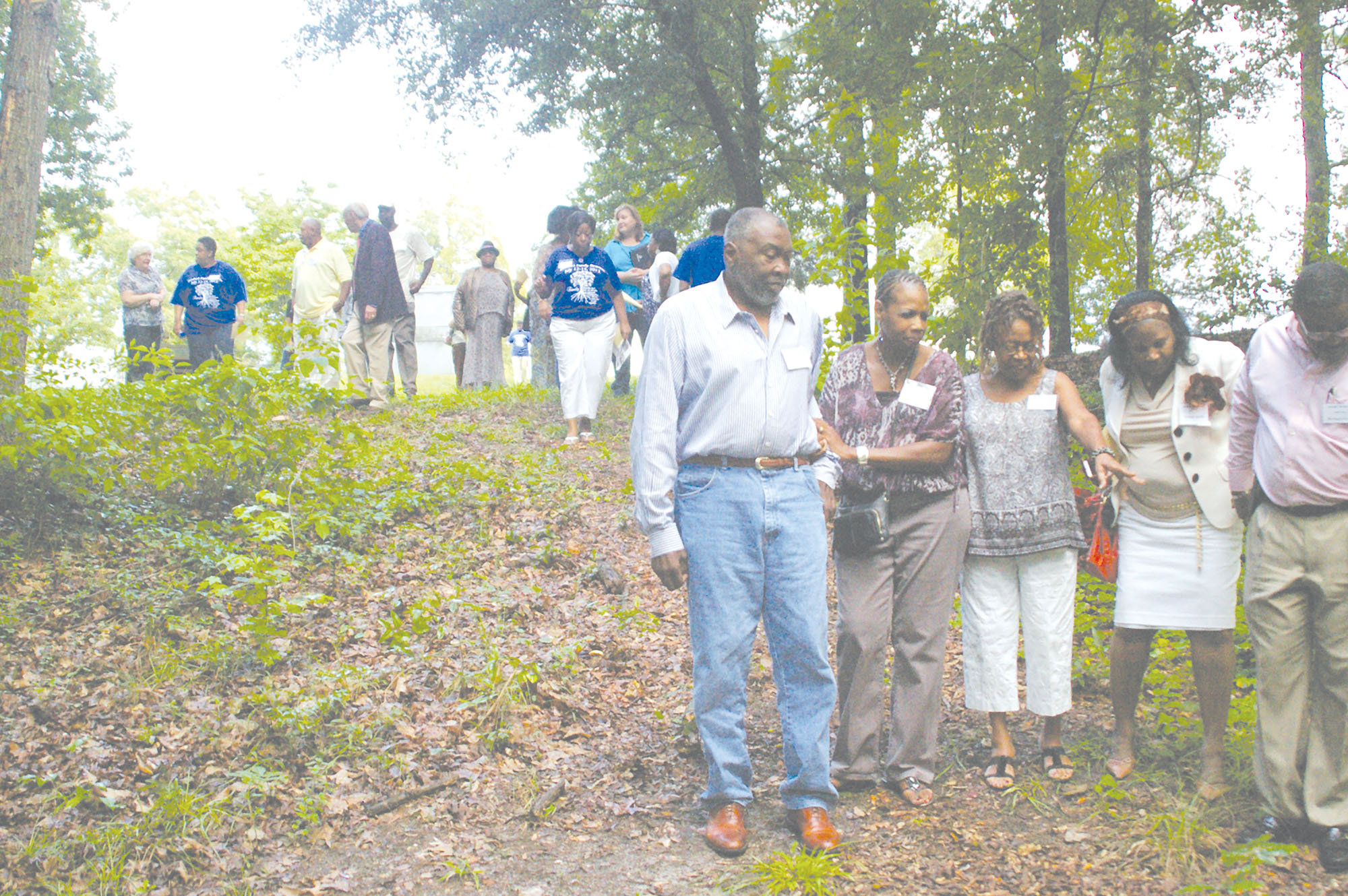
    Gerald and Carolyn Meyers of Blythewood, center, and other members of the Bookert family carefully walk down the hill behind Sandy Level Baptist Church, their ancestral church, to view the historic outdoor baptismal pool. Their ancestors, who were slaves, were among the first African-American members of the congregation, dating back to 1854.

    Family Traces Roots to Slavery

    BLYTHEWOOD – About 40 members of the Bookert family visited Sandy Level Baptist Church July 12 as part of their annual family reunion weekend in Columbia. The Bookerts can trace their roots back to several early black members of the church, dating back to 1854-1859, who held all rights and privileges of church membership. Those members were among the 60 slaves owned by Dr. Samuel W. Bookhart who famed more than 2,000 acres in the area now known as Blythewood.

    Current church members Bobby Loner and Hud McLean gave the Bookert family a short oral history of the church, then led them on a tour through parts of Sandy Level’s church cemetery where many headstones bear variations of the Bookhart and Bookert surnames, and then down a wooded path to the church’s historic outdoor baptismal pool. The visitors also toured the balcony seating that surrounds three sides of the sanctuary, which, according to published church history, was traditionally where the black members sat during worship services. Some of the visiting Bookerts climbed the steep stairs to the balcony and sat in the pews, retracing the same steps their ancestors made almost 160 years earlier.

    According to Wendy Washington, one of the reunion organizers, about 170 family members of all ages gathered in Columbia last weekend for activities that included tours of family history sites, a banquet and church services. Washington helped coordinate the visit with members of Sandy Level Baptist Church and the Blythewood Historical Society.

  • The Freshwater Coast

    South Carolina has two coasts. The famous one along the Atlantic and a surprising fresh water coast along the Georgia line. You’ll find lots of water to the west and some wonderful state parks. To get there you’ll negotiate 102 miles of backroads and state highways with a pinch of I-26 and US 378 thrown in. The drive will take about two hours and you’ll find that it takes you through some beautiful countryside. Let the journey be part of the destination.

    We seldom think of our fresh water coast. It’s there though. The Chattooga, Tugaloo, Lake Hartwell and Clark Hill Lake create an unbroken water wonderland from Modoc to Mountain Rest. The waters run the gamut from whitewater to pools, tributaries, rivulets and impoundments. One major impoundment, Clark Hill, is the third-largest manmade impoundment east of the Mississippi River. It and the surrounding area are today’s destination.

    Fishing, swimming and just floating on Clark Hill Lake entertain many a family come summer. Known to South Carolinians as Lake Thurmond, the lake’s traditional name is Clark Hill. Along its Palmetto State shores are several state parks: Calhoun Falls State Park, Hickory Knob, Baker Creek and Hamilton Branch Park. Just across the Georgia line is Elijah Clark State Park.

    You’ll find plenty to do. The area offers ample opportunity to view wildlife. Osprey and bald eagles wheel above, and don’t be surprised if you see seagulls too. Apparently they like the fresh water coast as well.

    Hickory Knob State Park provides the opportunity to golf along lakeshores. And then there’s the nearby Little River Blueway, which bills itself as “The Wild Side of South Carolina.” Over in McCormick County, Kirk Smith of Outdoor Initiative knows that people like the lake and Blueway for reasons not always obvious. Take mountain biking. The Wall Street Journal highlighted the Little River Blueway Adventure Area’s Forks Area Trail System as one of only two flow trails east of the Mississippi and the only trail in the Southeast. The Blueway offers bikers 156 miles of single track. And if you’d rather, you can tour the Blueway’s 50-mile scenic drive at daybreak.

    The Fresh Water Coast is a great place to visit. It has hundreds of beautiful campsites, skeet shooting and numerous historical sites. The Blueway even has a scenic 50-mile drive that takes you through the Heritage Corridor and Scenic Savannah River Highways, country roads and unpaved forest service roads. You’ll cross a few single-lane steel covered bridges along the way, throwbacks to the 1930s. The Scenic Drive will take you by several historical sites, including the Long Cane Massacre Site, Badwell Cemetery, Huguenot Worship Site and the Willington History Center, to name a few.

    History, beauty, wildlife, outdoor recreation and more are yours if you head west to South Carolina’s Fresh Water Coast. Escape the other coast’s clamoring crowds and congestion and enjoy serenity in a place where you set the pace.

    If You Go …

    • South Carolina Parks, Recreation, & Tourism

    State Parks 803-734-0156

    www.southcarolinaparks.com

    • Elijah Clark State Park

    Lincolnton, Georgia 706-359-3458

    www.gastateparks.org/ElijahClark

    Learn more about Tom Poland, a Southern writer, and his work at www.tompoland.net. Email day-trip ideas to him at tompol@earthlink.net.

  • Hamm Presents 4-Square Plan

    The new head of the Richland 2 School District made her public debut Monday night at the Board’s regular meeting at Spring Valley High School. The bulk of the meeting was executive session behind closed doors, and after appearing an hour later than originally planned, the Board moved to address the two public agenda items.

    First was the presentation by Interim Superintendent Dr. Debbie Hamm on highlighting the District’s priorities for the coming school year. The brief outline of her vision for the District was discussed in past weeks in meetings with teachers and school principals in a similar format. Hamm’s four square plan was enthusiastically embraced by the Board. She said it involves Learning, Community, Character and Joy.

    Learning involves honoring the new Common Core standards, teaching 21st century skills that are needed for our students and having the entire district seek ways to erode the obstacles that prevent student learning.

    Community brings the District’s external community into the internal Richland 2 community through partnerships and open communication. Community partnership with honest dialogue will also create the team feeling – a sense of family.

    Character. The notion of public education having a focus on educating the public body pre-dates colonial one-room schools. Besides academics, public schools are charged with mentoring character development that promotes the democracy we live in. One of the missions of public education, she said, is to prepare the public to be part of the public. The academic work continues to be the heart of the District’s purpose.

    The student must also understand their civic responsibility and recognize how their gifts might contribute. Respect of the law, voting during election and staying abreast of affairs, public behavior, and character development are parts of civic responsibility that can be modeled in the district and practiced by students themselves when in school.

    Joy. At recent meetings with teachers she told them teaching with joy and instilling joy of learning are critical. Happy people are best able to teach and learn, she reasoned. The satisfaction of work well done is the goal of both staff and student.

    Board member James Manning expressed his thanks for clear and easy to understand objectives. Board member Chip Jackson appreciated that Hamm was a “good listener” in translating the requests of District staff in last year’s Climate Survey to part of a workable plan. Chairman Bill Flemming felt the inclusion of “Joy” as a priority for students and staff was a recognition of the depth and width of the work that can be accomplished in the District when satisfaction for well done work is felt.

    The brief presentation of District priorities was followed by an even shorter announcement that the District has formed a committee to promote the Innovation Incubator that will be part of student learning and schools in the coming year. Hamm spoke of the significant number of resources in the community available as a resource. While still in the incubator stage itself, she expects the community to play a pivotal role in the Innovation Incubator. Details are vague with reports expected on a periodic basis.

    During Superintendent comments, Hamm thanked members of the community and District staff for their terrific support. She especially appreciated those who brought her up to speed on the nuances of the District’s projects so that she and the community would not be blindsided by issues and obstacles. While the role of Superintendent was not one she says she actively sought, Hamm successfully stamped her first Board meeting as Superintendent with an atmosphere of enthusiasm and collaboration for the coming school year.

    The next School Board meeting will be Tuesday, July 23 at 7 p.m. at Longleaf Middle School.

  • New Agency Reaches Out To Local Needy

    BLYTHEWOOD – A new service agency is coming to Blythewood and Ridgeway that will provide emergency aid to individuals and families in need. The Christian Assistance Bridge will open in September as a collaborative effort of local churches, individuals and support organizations. It will be located on Blythewood Road behind Trinity UMC, in the same building that previously housed The Cooperative Ministry, which ceased operation on June 17.

    The Christian Assistance Bridge will reach out to the poor by offering basic necessities and hand-up assistance. According to Trinity UMC senior pastor the Rev. Kathy Jamieson-Ogg, the faith-based organization will represent Christian values, discipleship and service.

    “We have had a fruitful 10-year partnership with The Cooperative Ministry, but feel that it’s time to ‘fly the nest’ and form our own non-profit to serve our community,” said Jamieson-Ogg.

    To meet the growing needs of the Blythewood community and to encourage local community and church partnerships, the Christian Assistance Bridge will offer emergency assistance, such as utilities, rent, food, medication and transportation when it opens in September, said Jamieson-Ogg. The office will be staffed by volunteers who will screen clients and offer budget counseling. Prior to the transition from The Cooperative Ministry, an average of 60 clients a month received assistance.

    The service area for The Christian Assistance Bridge will include ZIP codes 29016 (Blythewood), 29229 (in northeast Richland County) and 29130 (Ridgeway). Organizers hope to increase types of assistance as more funding is secured through churches grants and individual donors. Any individual, church or organization wishing to make tax-deductible contributions may send them to Christian Assistance Bridge, c/o Trinity UMC, P.O. Box 864, Blythewood, S.C. 29016.

    Planning for the new agency is being spearheaded by Trinity United Methodist Church, which is forming partnerships with churches in the Richland Northeast and Blythewood areas. A committee has been meeting for several months to evaluate how to best serve the needy in the community and to define the mission, vision and programs of The Christian Assistance Bridge. The group is working to establish by-laws, a governing board and tax exempt status.

  • BAR Reviews Sharpe Site

    BLYTHEWOOD – Shortly after convening for its regular monthly meeting at the Manor on Monday evening, the Board of Architectural Review and its audience took a 20-minute field trip to the backside of Larry Sharpe’s EXXON/Bojangles facility on Blythewood Road, which is undergoing what the meeting agenda termed Rehabilitation. The BAR has given conditional approval for a Certificate of Appropriateness (COA) for the rehabilitation of the building that houses the gas station and Bojangles restaurant. Members of the BAR have, for several months, been considering changes they would like Sharpe to make to the rear parking lot of his facility where they say 18-wheelers and smaller trucks pull into the lot off McNulty Road that runs behind the EXXON/Bojangles, often swerving across McNulty, causing unsafe driving conditions for other vehicles traveling along that end of McNulty Road.

    The point of interest of the field trip was to view and discuss the section of the parking lot along the curve of McNulty Road that fronts part of McNulty Plaza, Subway, the Comfort Inn and McDonalds. After some discussion at the site between the BAR members, Town Administrator John Perry, architectural advisor Matt Davis and Sharpe, it was decided that Sharpe would install a pair of 5-inch high, 18-inch wide, sloped rollover curbs that would delineate an island where the parking area meets McNulty Road. The five-inch high curbing outline would be filled with concrete, scored and tinted to emulate brick pavers.

    “Small trucks and automobiles will tend to avoid it (the raised curbing),” Perry speculated, and big trucks will follow the tracking of the curbing rather than swerve into the roadway. They will drive over the rollover curb as intended.

    Perry also discussed future possibilities for that section of the road to improve traffic flow and make it safer for vehicles and pedestrians, including resurfacing and making the road one-way with traffic turning left out of McDonalds, but he said that would be part of separate projects. Perry explained that one of the problems in moving forward on improvements to McNulty Road is that portions of the McNulty roadway are actually owned in fee simple by Sharpe and that he has some long-standing obligations to the Comfort Inn and McDonalds in terms of truck parking and traffic flow. There is a prescriptive easement for the town to use the road.

    Perry said the BAR could require the project to be completed in 120 days as a condition of the COA. The Board voted unanimously to grant Sharpe an unqualified COA, contingent upon Davis signing off on the project being built as designed.

    In other business, the Board discussed ‘Subcommittee Updates,’ for subcommittees that they say have not met. Bob Mangone, who chairs the Training Committee, asked members to submit training ideas they would like to see implemented. Dr. Michael Langston said he and Mike Switzer have talked about lighting and signage for the town. The Chair and committee member of the Interior Regulations for Historic Structures Committee were not present, but BAR Chair Langston led a discussion of needs for regulations for historic structures in the town.

    Three members of the Blythewood Historical Society, Karen Kuhner, Frankie McLain and Chris Keefer, asked to be added to the agenda. They expressed their concern about the upkeep and maintenance of the interior of the Hoffman House (Town Hall) should it ever be occupied by a group other than the Town government. They asked that steps be taken to preserve the historic nature of the building since it is on the National Registry.

  • Shaggin’ in the Street Postponed

    Tonight’s (July 12) Shaggin’ in the Street event in downtown Winnsboro has been postponed due to rain. The event has been tentatively rescheduled for July 26.

    Stay tuned for updates.

  • So, You Think You Can Dance?

    It’s the state dance, performed to beach music by fun-loving folks wearing khakis and penny loafers or deck shoes. And it’s loads of fun.

    We’re talking about shaggin’, of course. And the Town of Winnsboro and the Fairfield County Chamber of Commerce are bringing it back to Winnsboro on Friday, July 12 with the third annual Shaggin’ in the Street event. Everyone in Blythewood, Fairfield County and beyond who love to shag are invited.

    Winnsboro community development director Connie Shackelford said, “shaggin’ is a casual, easy-going dance style, and when you hear that music, it takes you back to the beach, the boardwalk and your youth.”

    If that’s the case, then Friday is for shaggers.

    “We have a new band, The Foundations, who will be performing this year,” Shackelford said. “This band brings with them a loyal following from out of town.” The Chamber has contacted local shag clubs and invited them to attend the event as well.

    The event will take place in front of the Town Clock, beginning at 6 p.m. with DJ Poppa Charlie providing street music to get people in the mood. The Foundations will take the stage about 8:30 p.m., and that’s when the real shaggin’ begins.

    Vendors will be selling food items such as wings, fish, chicken fingers and funnel cakes (all foods that I’m sure can be eaten while dancing), and the local merchants will be open in the evening for shopping.

    The evening’s festivities will include a shag contest, with first, second and third place prizes awarded to the best shagging couples. Prizes will be valuable gift certificates to downtown merchants. So line up for the electric slide.

    Shackelford said she believes the shag is so popular “because you don’t have to know how to do it well, just get out there and do your thing.

    “It’ll be a great night for folks in the Winnsboro and surrounding communities to come out and enjoy themselves,” Shackelford said. “It’s a free event that will bring people into town.”

    Keep your fingers crossed that we have some nice weather. But, don’t worry – if it rains, a rain date will be announced for a future time.

    The Town is planning other events like this during the summer, Shackelford said – maybe another music venue such as country music.

    With events like Shaggin’ in the Street and the increasingly popular Third Thursdays, Shackelford said the town and Chamber “have got some momentum going for downtown. We’re working with the merchants, who are excited about the events we’re having, and are putting forth some effort to stay open a little later and offer special sales,” she said.

    No one who knows me has ever seen me shag, but there’s always a first time, and it might turn out to be the show-stopper of the evening. So dust off those loafers, slip on your khakis and enjoy a night of good music, good food and great shaggin’. And don’t forget to check out the local merchants who are staying open late just for you. Enjoy one of those events that make downtown Winnsboro special.