Category: News

  • County Underestimated LOST Revenues

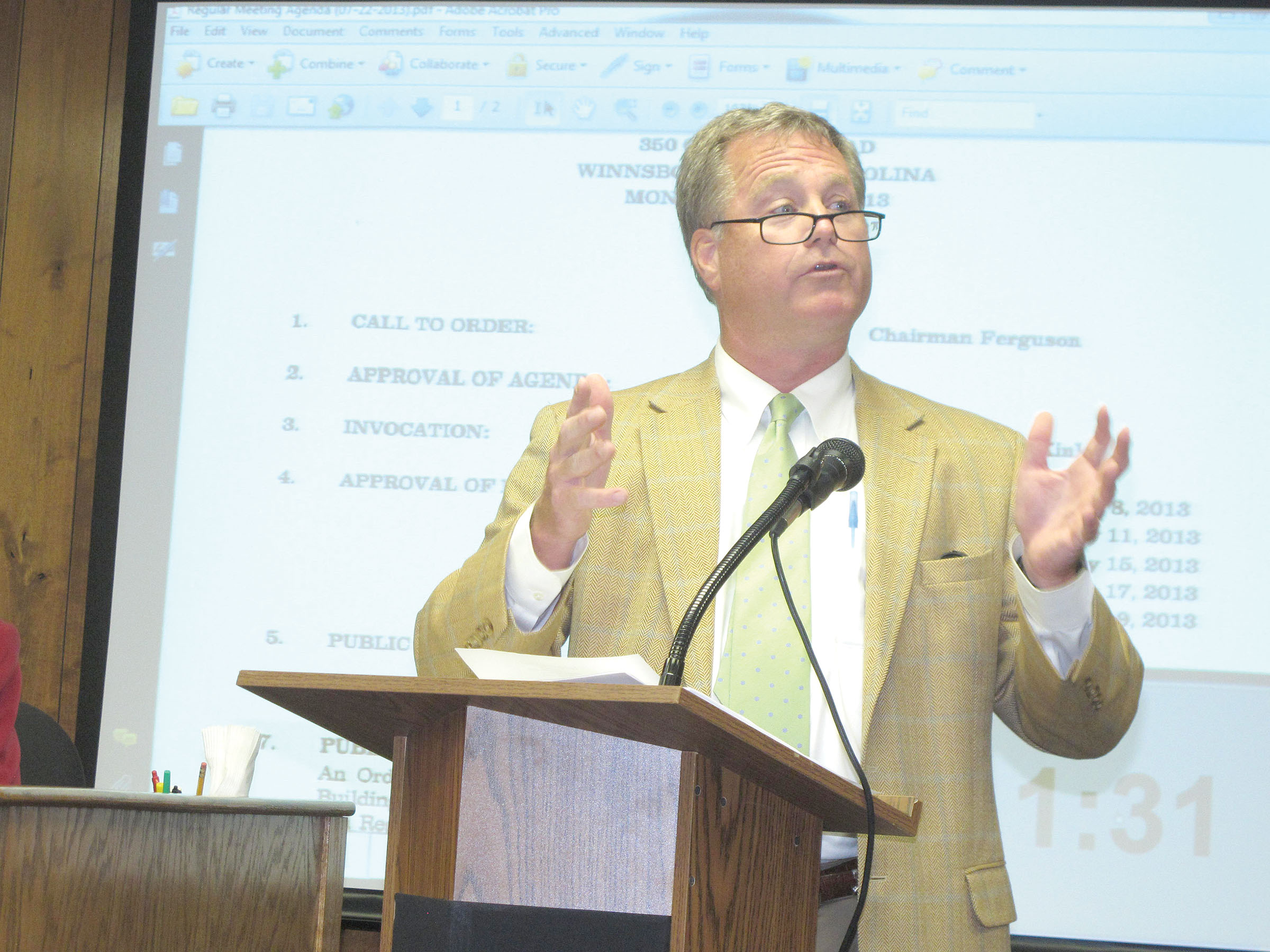
    FAIRFIELD – Council Chairman David Ferguson had promised that last Monday night’s Council meeting would dispel ‘the myth’ that the County had mishandled it’s Local Option Sales Tax (LOST) funds since it began collecting the tax in 2006. But, by and large, not much myth-busting occurred at that meeting. Instead, the public once again filled Council chambers to overflow and had many questions following a presentation by Ray Stevens, a partner with the Parker Poe Consulting firm and a former director of the S.C. Department of Revenue, and Michael E. Kozlarek, an attorney with Parker Poe who has been assisting Stevens in his examination of Fairfield County’s LOST practices.

    At issue was the county’s handling of the Local Option Sales Tax, a referendum passed by Fairfield County voters in 2005 earmarking 100 percent of LOST revenues for property tax relief. According to SC Statute 4-10-10, et. seq., the sales tax revenue is to be returned to property owners each year in the form of a credit on their property tax bills. These tax credits are given based on the county’s estimate of how much LOST revenue it expects to receive each year. Since the tax credit is applied prior to the County receiving the LOST revenue, to prevent a shortfall, any revenue in excess of the estimate is held back to be credited the following year. That excess revenue should be the first money credited to the county property tax bills the following year. The excess is not allowed to accumulate in the general fund from year to year.

    Stevens told the audience that he felt sure, “Based on all that I have seen, there’s no question that the LOST revenues are in fact being applied to property tax relief [in Fairfield County.] They’re not being used for something else.” Stevens was not able to answer questions from the audience as to how accurately and properly the county estimated it’s LOST revenue over the years and whether excess revenues carried over from previous years have been accumulating or credited entirely and in a timely manner to county residents’ tax bills. He said that information would not be available until the final LOST revenue checks for 2013 are received by the County in mid-August.

    The question of how the County has managed the LOST funds first came to public light during Council’s July 8 meeting when Maggie Holmes told Council she was concerned that the County had ‘knowingly allowed more than $5.2 million of [excess] LOST money to be withheld from the taxpayers of Fairfield County.’

    Since then, Holmes’ attorney, Jonathan Goode of the Goode Law Firm in Winnsboro, told The Voice that dollar figure ($5.2 million) may be less since further research has revealed the county had actually reduced the millage in October, then later applied a tax credit on property tax bills. Goode said the first ‘credit’( the reduction of the millage) came as a surprise and is not taken into account in the $5.2 million. That amounted to a double tax credit for property taxpayers since 2006, Goode said. “What’s most shocking about this,” he said, “is that even with a double credit, there was still, apparently, a large amount of LOST revenue in excess of the county’s estimate that was held in the County’s general fund. This shows how far off the county was on its estimates of how much money to hold back. If not for the double credit, the county would have been giving taxpayers credit for less than half what it received in LOST funds,” Goode said. “A difference of such a large amount between the estimated revenue and the actual revenue generated year after year shows a lack of good faith in the estimate. By estimating too low, a huge amount of excess is created. If that excess is not given back to the taxpayers in a timely manner in the form of property tax credits as required by law, this creates a gross influx of dollars to the general fund. “

    Goode said that by estimating low and not crediting the excess, the revenue piles up and the taxpayers don’t see the full relief they voted for when they passed the referendum.

    During a time designated for public comments and questions, Goode asked Kozlarek if the double credit was the council’s intent, an oversight or miss cue by someone in the County auditor’s office.

    Kozlarek replied, “I don’t know Council’s intent other than what the ordinance says–that Council intends to give back 100% of the LOST revenue as a tax credit.”

    Without alluding to whether or not the first ‘credit’ the County gave was intended or accidental, Stevens explained that the County has been crediting the LOST revenue in two phases– first, when the County sets its annual millage rate when preparing the budget, then again as a credit on property tax bills sent out in October.

    “From our point of view,” Stevens said, “that’s what’s happening.

    Monday night Goode asked Kozlarek if the County’s LOST estimates were indeed too conservative (low) and asked what would be the best method for calculating such an estimate in the future.

    “The best way to estimate is, of course, the most recent fiscal year, Kozlarek said. “That is, assuming you are in a rising economy. As long as LOST collections are going up and you use the prior year as your estimate, then you’re fine.”

    The problem, Kozlarek said, is estimating too high and finding oneself in a falling economy.

    “Since the time we’ve had this [LOST], have revenues generated from the LOST ever been less than they were the previous year?” Goode asked.

    “Not that I’m aware of,” Kozlarek said.

    Elizabeth Jenkins and others, including State Sen. Creighton Coleman (D-17), were uncomfortable with the fact that the LOST funds were included as part of the County’s general fund budget.

    “Should there or should there not be a separate escrow account for these moneys collected so that it doesn’t get mixed up with the general fund and used for something else?” Jenkins asked.

    While Kozlarek said there was nothing in the state statute governing LOST funds that required a separate account, Coleman asked if the Department of Revenue didn’t at least recommend a standalone account. Stevens said he was not aware of any such recommendation.

    William Coleman wanted to know if all of the LOST money, apart from the rollover, had in fact been used correctly. Interim County Administrator Milton Pope said that it had, but perhaps there could have been greater relief [for the taxpayer.]

    In discussing the County’s methodology for estimating LOST revenue and issuing tax credit for those funds to the taxpayers, Stevens made three recommendations for how the County should handle LOST funds in the future: 1) Grant the tax credit only at the tax bill stage; 2) Ensure that any excess revenues are provided as credits at the beginning of the following year; and 3) Refine the way the LOST revenue estimate is derived.

    Another meeting will be called when the County’s audit of the LOST funds is completed. Council Chairman Ferguson indicated that meeting might be held in the auditorium at Fairfield Central High School. He said the public would be notified of the meeting.

  • Secret Project Could Create 500 Jobs

    FAIRFIELD – County Council held a public hearing on July 17 and passed second reading on a number of agenda items they hope will pave the way for a $7.5 million economic development project that could bring 500 jobs to the county over five years. The project has been given a code name, Project Palmetto, by the S.C. Department of Commerce. Fairfield County Economic Development Director Tiffany Harrison said the project is a manufacturing operation.

    The vote authorized the execution and delivery of an infrastructure credit agreement between the County and Project Palmetto and the purchase of property adjacent to the I-77 Corridor Regional Industrial Park in Fairfield County. That property would be leased back to the company.

    County Council Chairman David Ferguson (District 5) explained that while the County owns a 75,000-square-foot spec building that is available, “It in no way is large enough to accommodate this company’s operations,” he said.

    Ferguson assured the audience that the citizens of Fairfield County would be pleased when the County could finally share with them more specific details about the company.

    As in previous weeks, a large crowd was in attendance, filling the Council chambers and spilling into an overflow room. As they addressed Council with much frustration over a number of hot button issues, several questioned why Council would not disclose more about the code-named project.

    “We’re running on a trust deficit,” said Bob Carrison. “There are ways to tell people things without letting all the data out.”

    Interim County Administrator Milton Pope explained that economic development laws in South Carolina are very specific regarding coded projects.

    “If certain confidential information is released, we could actually lose a prospect. After third reading and the contract is signed,” Pope said, “we will have full disclosure.”

    Pope also suggested that Council hold a work session in the near future to explain fully the confidentiality and constraints that are required of all governments regarding economic development issues.

    “We are following standard industry protocol,” Pope added.

    Councilwoman Carolyn Robinson (District 2) explained to the audience that the special called meeting was necessary because the County was on a tight timeline to get the project approved.

    Third and final reading on the project was held Wednesday, after The Voice’s press deadline.

  • North by Northwest

    Cool off at Issaqueena Falls.

    While the beach grabs a lot of headlines, our Northwest Corner pleases many as a destination, especially when flatter lands bake and sizzle. Not quite 3 hours and 135 miles will take you from 535 feet above sea level to over 1,000 feet and much cooler air, not to mention spectacular views. Strike out for the mountains. Here are six other reasons to drive northwest.

    The Cove Forest

    Nowhere else in the United States will you find as much tree and plant diversity as you will in a Southern mountain cove forest. Green and serene, South Carolina’s bowl-shaped valleys are damp and rich with nutrients. The resultant profusion of plants supports birds, amphibians and mammals. There’s no need to go to the tropics. Drive to the mountains above Walhalla to see green tropical splendor.

    Sunshine in a Jar

    The beehive — among the world’s most efficient factories — converts alpine nectar to honey. Along Highway 11, bees make honey from sourwood blossoms, blackberry vines, trees and flowers. Stop by a roadside stand along the Cherokee Scenic Foothills Highway and get a jar of mountain sunshine.

    Ram Cat Alley, Seneca

    Make the scene Thursday evenings at Ram Cat Alley, a place whose identity began with the cats congregating at the 1908 Fred Hopkins Meat Market. So many cats frequented the alley someone said, “You couldn’t ram another cat into the alley.” Mid-1990’s revitalization took an alleyway of pool halls, bars and meat markets and turned it into a pedestrian-popular place of boutique shops and restaurants. On Thursdays, restaurants and the city set up tables for “Jazz on the Alley.” Dine out in the mountain air and enjoy mountain music that’s a bit sophisticated.

    Majestic Falls

    Make the hike to Cove Falls. It’s a challenging journey but well worth it. You’ll find other falls, too, such as beautiful Issaqueena Falls just below Stumphouse Mountain. Other great falls are to be seen, such as Raven Cliff Falls near Caesars Head and Whitewater Falls where the North Carolina-South Carolina state line pass between the upper and lower falls. Upper Whitewater Falls, near Cashiers, N.C., drops over 411 feet, making it the highest falls east of the Rocky Mountains. Lower Whitewater Falls, located just across the line in South Carolina, drops another 400 feet.

    The Foothills Trail

    For the hardy, hiking is great in the Northwest Corner. Along the Blue Ridge Escarpment trails take hikers back to simpler times when pioneers made their way through mountain forests. Then as now distant views of horizons provided a barometer of how the trails thread through terrain, high enough to be moistened by cloud vapors.

    South Carolina’s Rooftop

    Want to go even higher? Atop Sassafras Mountain — Carolina’s rooftop — you can look over a rippling green land and smoky blue hills. As night draws nigh, wine, yellow, orange and cinnamon hues prevail until shadows reign supreme. (Note: Pinnacle Mountain, the highest mountain within South Carolina, is in Table Rock State Park).

    A trip to the Northwest Corner is sure to take more than a day. Plan an overnight stay. From rustic lodges, to state parks and bed and breakfasts, you’ll find beautiful accommodations. Take a good pair of binoculars, maps and sturdy walking shoes and beat the heat in the green, rolling Northwest Corner.

    If You Go …

    • www.upcountrysc.com

    Learn more about Tom Poland, a Southern writer, and his work at www.tompoland.net. Email day-trip ideas to him at tompol@earthlink.net.

  • Morrison Recovering from Car Crash

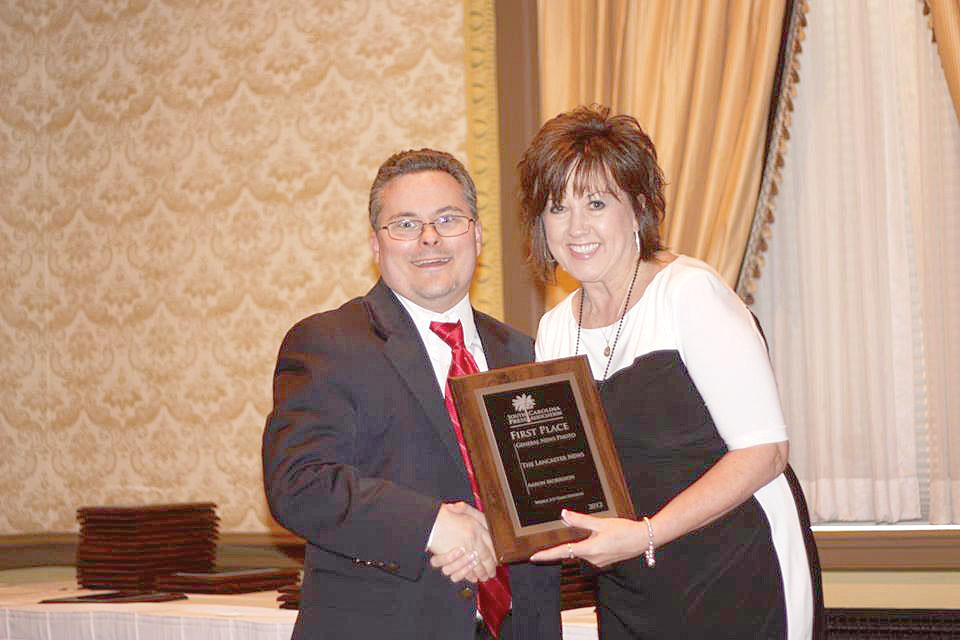
    Former Blythewood resident Aaron Morrison (left) at this year’s S.C. Press Association awards banquet with Susan Rowell, publisher of The Lancaster News. Morrison, a photographer for The News and former freelance photographer for The Country Chronicle, was critically injured in a car accident earlier this month near Ballantyne, N.C.

    CHARLOTTE, N.C. – Former Blythewood resident Aaron Morrison is recovering from serious injuries he received in a car accident in North Carolina on July 15. He is undergoing rehabilitation at the Carolinas Medical Center in Charlotte.

    Morrison, an award winning staff photographer for The Lancaster News, previously worked as a stringer for The Country Chronicle under its previous ownership from 2004-2005.

    The accident occurred in Ballantyne, N.C. when his 2011 Toyota RAV4 was rear-ended by a 2007 BMW driven by Nicholas Michael Borden, 31. Investigators say Borden was driving at a high rate of speed when he first struck another car. That violent impact veered Borden’s BMW into the left lane and into the rear of Morrison’s SUV, the N.C. Highway Patrol said.

    Medics responded to the scene and took Morrison by ambulance to Carolinas Medical Center for treatment of life-threatening injuries. The other two drivers sustained non-life threatening injuries. All three were wearing seat belts.

    According Morrison’s father, William Morrison, who lives in LongCreek Plantation in Blythewood, Aaron was returning from Ballantyne where he had attended a movie.

    “He was just driving down the road going home,” William Morrison said, “when a drunk driver rear-ended him.”

    After two weeks in intensive care, Morrison is now in rehabilitation at the hospital’s Neuro Brain Unit, his father said.

    “He’s not allowed visitors yet, because that gets to be too much stimulation for him. But he’s conscious now and is slowly making some progress,” William Morrison said. “He was very seriously injured and has a long road of rehab ahead. I spend most of my days here at the rehab center with him.”

    Morrison’s father said his son has many friends in the Lancaster community where he works, and that several hundred of them, including the Lancaster government officials, the entire Lancaster News staff and many from churches and schools that Aaron covered on his news photography beat, attended a prayer service for Aaron the Friday night following the accident.

    “Even the staff from the town’s Humane Society was there,” William Morrison said with a smile.

    “That outpouring of care and comfort for Aaron from his friends meant a lot to our family,” he added, “…the prayers, their presence. It let us know how much he is loved in the community he covers. And that sustains us right now.”

  • Lights On for ‘Night Out’

    WINNSBORO — Local law enforcement agencies are planning a special celebration to mark the National Night Out event.

    The National Night Out is actually Tuesday, Aug. 6, this year, but the Winnsboro Department of Public Safety and the Fairfield County Sheriff’s Office are sponsoring a special event on Saturday, Aug. 3, from 11 a.m. to 2 p.m. at Fortune Springs Park in Winnsboro.

    The weekend date was chosen, explained PCSO Francine Goins and Sgt. Angie Ingram, because they felt they would get more participation from the community on a weekend than a week night.

    “Lighting on a house is the number one deterrent against crime,” explained Sgt. Ingram.

    “The National Night Out is an event where law enforcement asks people to turn all their front porch lights during the evening, and we will be asking people on Saturday to turn their porch lights on during that Tuesday, Aug. 6.”

    Goins said the National Night Out event encourages a better community by giving neighborhoods a chance to form stronger relationships with each other, and with law enforcement.
    To celebrate National Night Out, the WDPS and the Sheriff’s Office have designed an event in the park with the help of several community organizations.

    There will be free blood pressure/health screenings provided by Fairfield Memorial Hospital, face painting and a comedy skit provided by the Pine Tree Playhouse, an on-the-half-hour Zumba demonstration by Fairfield County Recreation, and equipment displays by the S.C. Highway Patrol and the S.C. Department of Natural Resources.

    Local merchants Victoria’s Gift Boutique and Abba’s Sweet Treats will provide chances on gift certificates and a gift basket.

    Hot dogs and burgers will be served, Ingram said, and the event is free and open to the public. Parking will be in and around the Old Armory parking lot. If rain threatens, the event will be moved inside the Armory.

    The slogan that visitors to the Night Out event will see on the T-shirts is ‘Bringing Our Communities Together.’

    “The National Night Out (this is the fourth year that Fairfield County law enforcement has held such an event) gives all the communities an opportunity to come together and see that even though the Sheriff’s Office and the Department of Public Safety are two separate jurisdictions, we work together for a common goal — the good of our community,” Ingram said.

    The event is also an opportunity for law enforcement to distribute crime prevention materials, and just for members of the communities to get to know their local law enforcement officers in a casual and relaxed setting, said Ingram.

  • District Slips on State Assessment

    FAIRFIELD – The S.C. State Department of Education released its 2013 Elementary and Secondary Education Act (ESEA) data this week, indicating erratic swings in achievement numbers for the Fairfield County School District. While most Fairfield County schools showed either no change, or the declination of one letter grade, between 2012 and 2013, the dramatic shifts for Fairfield Middle School (from an A in 2012 to an F in 2013) and Kelly Miller Elementary School (from an A to a C), indicate a statistical anomaly, according to Superintendent J.R. Green, and a flawed system.

    “The system is not a valid and reliable system,” Green said. “I’m not just saying that now, I said that in 2012.”

    The ESEA is in its second year of a two-year run to temporarily replace the Annual Yearly Progress (AYP) data that was part of the No Child Left Behind act, which graded schools and districts as either Met or Not Met. The State Department of Education applied for and was granted a waiver for the AYP system last year. Green said that while AYP was a flawed system, ESEA may be even more so. The State report cards, he said, which showed the District go from Below Average to Average from 2011 to 2012, were a better indicator of student progress. So, too, were 2013 numbers from the Palmetto Assessment of State Schools (PASS) tests and the High School Assessment Program (HSAP) test, both of which showed progress for Fairfield County students (see next week’s edition of The Voice for PASS and HSAP scores).

    Half of the ESEA data, Green said, is pulled from numbers from the 2011-2012 school year. “So you can’t say it’s a snapshot of how a school is performing,” he said.

    Green said the 2013 ESEA data used the 2011-2012 high school graduation rate, for example. For 2011-2012, that number was just under 77 percent; but for 2012-2013, Green said, it was up to over 80 percent. The District’s End of Course scores for 2013, which had close to an 80 percent passing rate, are also not reflected in this year’s ESEA data. Geiger Elementary, Green said, has shown improvements in all areas, yet went from a C to a D under ESEA.

    “How can you improve and go from a C to a D in this system?” Green pondered. “Any time you see wild swings from year to year, it speaks to the reliability of a system at a statistical level. Last year I didn’t think the middle school was an ‘A’ school, and this year I don’t think it is an ‘F’ school.”

    Green said PASS scores showed growth across the board, but those numbers are not reflected in the ESEA ratings. And next year, he said he expects the District to have one school achieve Excellent status in the State report cards, while two others are expected to go from Below Average to Average.

    “There’s not a whole lot of correlation between ESEA and the State report cards,” Green said. “I’m not sure if we’ll be approved to use (ESEA) again next year, but it needs a lot of work.”

    2013 Elementary & Secondary Education Act (ESEA) ratings

    (2012 grades in parentheses)

    Fairfield School District D (B)

    Fairfield Middle School F (A)

    Kelly Miller Elementary C (A)

    McCrorey-Liston B (B)

    Geiger Elementary D (C)

    Fairfield Central High School D (F)

    Fairfield Elementary F (D)

    Fairfield Magnet A (A)

  • Town Eyes Infrastructure Growth

    BLYTHEWOOD – Town Council passed a resolution Monday night authorizing and directing Town Administrator John Perry to conduct a study and evaluation of the Town’s current potable water supply and future plans for expansion of water supply infrastructure. Perry is also to examine capital improvements needed to address future demands for water in the Town.

    The Town is currently receiving water from the City of Columbia via the Town of Winnsboro. The resolution states that the supply of potable water to current and future customers is a critical concern for the citizens and residents of the Town of Blythewood. Perry said the intent of the resolution is to plan for future needs and infrastructure expansions required to meet future demand for water.

  • Town May ‘Take’ Lot for Ball Fields

    BLYTHEWOOD – Bob Mangone, chairman of the Athletic Field Committee, reported to Town Council Monday evening on the Town’s continuing ball field dilemma. Mangone told Council that he learned two weeks ago that the Richland County Recreation Commission can now afford to build only two ball fields on the 8 acres behind Bethel-Hanberry Elementary School instead of the four fields Mangone’s committee had expected and felt they had been promised by James Brown, chairman of the Richland County Recreation Commission. Money for the field construction was to come from $523,000 earmarked for Blythewood by County Councilwoman Joyce Dickerson.

    But Mangone said Dickerson has directed the Commission to instead use the funds to refurbish the Town’s current ball fields on Boney Road. Dickerson told The Voice that the money was targeted for the refurbishing of current ball fields, not building new ones. Mangone said he hopes to talk with Dickerson soon to determine how much of the money might still be spent on constructing new ball fields. Mangone said Dickerson said she hopes to attend Blythewood’s August Town Council meeting to discuss the matter further.

    Mangone also suggested acquiring additional land for ball fields by ‘taking’ property adjacent to the current fields. He asked the Town attorney, Jim Meggs, to step up the process for a ‘taking’ of the lot, which includes two mobile homes. Mangone said he has been trying to find out who owns the lot.

    “That is a piece of property that should be taken,” Mangone said of the property.

    Mangone also said he would like his committee “to look at alternate funding for ball fields in the town, such as creating a capital campaign with local businesses to raise big money — not candy bar stuff — to fund some of the ball field projects.”

    In other business, Council appointed or reappointed several board and commission members. Perry recommended appointing both RCI (corporately) and Brian Blackwell (individually) as the Building Official of the Town of Blythewood. Duties will include residential planned review and code enforcement for the International Building Codes.

    Debbie McLean was named to the Board of Zoning Appeals. Buddy Price and Malcolm George were both reappointed to the Planning Commission; Dr. Curtis Brown and David T. Shanes were reappointed to the Board of Architectural Review and Ron Friday was reappointed to the Board of Zoning Appeals.

    Perry said he expects there will be a special called meeting of Council in August to discuss the construction of the playground in the park.

  • Brochu Walks Away with 6-Months’ Pay

    RICHLAND – Details of the separation agreement between former Superintendent Dr. Katie Brochu and the Richland 2 School District, obtained by The Voice through a Freedom of Information Act request, reveal a hefty payout by the District as well as the forgiveness of thousands of dollars in moving expenses, provided to Brochu as part of her original contract.

    The Richland 2 Board announced Brochu’s resignation during a special called meeting on June 13. According to the District’s Settlement Agreement and Mutual General Release documents, Brochu’s resignation took effect July 1, at which time she was to receive a final payout of $130,103; $20,000 of which was to have been paid to an annuity plan (or plans) of Brochu’s choice, with the remainder to be paid in one lump sum as wages.

    “Dr. Brochu agrees that the above-referenced payments constitute the payment in full of any and all money owed to her as provided for in her employment contract with the District and District policy and procedure,” the agreement states. Brochu’s employment agreement, which took effect March 23, 2010, does not, however, carry any severance provisions for voluntary resignation – only for discharge without cause. Under those conditions, Brochu would have been entitled to six month’s salary, or approximately $107,500. Brochu’s employment contract also provided her with up to $10,000 in moving expenses to relocate her from Dalton, Ga. to Richland County. According to that contract, “Should the Superintendent seek and be granted a release from her employment prior to June 30, 2014, the Superintendent shall reimburse the District for all moving expenses pursuant to this contract.”

    The District’s separation agreement, however, rescinded that clause and Brochu will not be required to refund that money to the District. The “Professional Liability” clause of Brochu’s employment contract, wherein the District agrees to defend the Superintendent in any legal claims brought against her in her capacity as head of the District, remains intact. Both Brochu and the Richland 2 Board agree, as part of the separation agreement, “not to make disparaging comments publicly about one another.”

    Brochu’s term with Richland 2 began July 1, 2010 at an annual salary of $215,000. Her employment contract also included $850 a month for automobile expenses and an annual contribution to Brochu’s annuity plan in the amount of 8.5 percent of her salary. Had Brochu stayed on until July 1, 2015, she would have been in line for a longevity bonus of $25,000.

  • County Feeling Heat from Angry Public

    State Sen. Creighton Coleman (D-17) slammed Council for not following up on the Santee-Cooper economic development plan.

    FAIRFIELD – The Fairfield County Council came under fire again Monday as citizens packed the meeting room and sounded off about board expenditures, economic development problems, recreation needs and local option sales tax questions.

    Adding to the turmoil was a report from State Sen. Creighton Coleman (D-17) that the negative news reports on former County Administrator Phil Hinely may not be over.

    Coleman said the State Law Enforcement Division (SLED), “had additional information that was found on Mr. Hinely’s hard drive” and had it sent to Sixth Circuit Solicitor Doug Barfield for review.

    “I called to see if he could expedite it and he said he had a full plate in court, and will get to it as soon as he can,” Coleman said.

    Hinely resigned from his post June 28 after reports surfaced that he used his email account to forward pornographic images three years ago. SLED opened a file on the case but took no action after Barfield determined that none of the alleged images violated state obscenity laws.

    In his three-minute presentation to Council, Coleman slammed the Council for failing to follow up on a $40,000 economic development plan submitted by Santee Cooper years ago.

    “We sat on it, sat on it, sat on it” he said. “I talked to the Chair two or three times trying to get movement from him. Nothing ever happened.”

    Some of the harshest comments came from Fay Sandow, who said she was “appalled” to learn that SLED met with the Council Chairman David Ferguson (District 5) Feb. 21 on the issues with Hinely, but that Council took no action until June, when it voted unanimously to sanction Hinely.

    Sandow said it was even more shocking to hear of the decision of a Council member to accept county money for college tuition and insurance reimbursements.

    “If that’s the truth, and I believe it is, I would like to ask those Council members what were they thinking?”

    The State Attorney General recently issued an opinion that the County’s policy of tuition assistance and health insurance reimbursements for Council members was unlawful.

    Some Council members were receiving a direct, monthly payout instead of receiving the health insurance coverage provided by the County. The County was also paying for Councilman Mikel Trapp (District 3) to take business courses at Columbia College.

    Sandow said it is her opinion that anyone who accepts money from the county for personal use is “stealing.”

    She called on those Council members who have been drawing the money to pay it back with interest, apologize to the county and submit their resignations.

    Some members of the audience started clapping at the conclusion of her remarks, but Ferguson pounded his gavel and threatened to have deputies escort out of the meeting anyone who claps.

    State Rep. MaryGail Douglas (D-41) called on the Council members who received payment of insurance premiums, estimated at around $24,000 each, to pay it back. She also called for the return of the $26,000 in tuition money paid to Trapp.

    Trapp has agreed to return the tuition money, but he said it would take some time to repay. He said he thought the total amount was $22,000, but added that he could be mistaken.

    Resident Beth Jenkins told the Council that residents are due better than “a Council that teeters on the brink of what appears to be nothing but wrong-doing from a disgraced resigned Administrator to health insurance double dippers…”

    Tuesday Ferguson reiterated his position to The Voice that he had no intention of reimbursing the County for the health insurance premiums.

    “I don’t feel like I’ve gone anything wrong, even though they’ve hung me out to dry,” Ferguson said. “Mr. Hinely told us we didn’t have any choice on that.”

    In other action, the Council recognized the County’s new interim administrator, Milton Pope, who officially begins his duties this week. Pope, who served as Richland County Administrator before his retirement, said he hoped to help the County with economic development, having worked with Midlands development projects in the past.

    The Council also gave second reading approval to revisions of an ordinance regulating abandoned buildings, manufactured homes and junked cars. The Council also approved an ordinance revising sections of the road paving program.

    The Council also agreed to purchase property for a mini park in District 3 on Road 99.

    Council met in executive session to discuss an economic development plan, but no details were announced.

    Council will hold a special called meeting July 29 to discuss the outcome of an investigation into allegations that the County had mishandled more than $5 million in Local Option Sales Tax (LOST) funds. The meeting will be held at the Fairfield Magnet School at 6 p.m.

    Ferguson said the County’s research indicates that the funds were handled correctly and a full explanation will be offered Monday night by a former director of the S.C. Department of Revenue and County auditors. Ferguson said members of the audience will also be able to submit written questions to Pope following the meeting and that Pope would provide answers on an individual basis at a later date.

     James Denton contributed to this article.