Category: News

  • SLED: No Criminal Violation in County Porn Probe

    Coleman: Emails Did Not Meet ‘Obscenity’ Threshold

    WINNSBORO – A final report issued by the S.C. State Law Enforcement Division (SLED) has closed the case against former Fairfield County Administrator Phil Hinely, who was accused last summer of disseminating pornographic images from his county computer. Sixth Circuit Solicitor Doug Barfield, who has been weighing SLED’s findings for months, told SLED in a letter dated Oct. 20 that Hinely had not violated the state’s obscenity laws and that, therefore, there would be no criminal prosecution in the case.

    “I examined the contents of the hard drive pursuant to Section 16-15-305 of the Code of Laws of South Carolina,” Barfield’s letter states. “That statute and its subdivisions first require that for the material to constitute a violation, the material must be obscene under very detailed and specific definitions. That statute also requires that the material be disseminated.”

    “To determine whether Hinely violated the (obscenity) statute, I needed to know whether Hinely disseminated any of the questionable items on the hard drive (seized by SLED on June 28) as that term is defined in the statute,” Barfield’s letter states. “I asked Agent (Britt) Dove to answer that question for me. He reexamined the files using another software program and responded to me that he could not find that Hinely sent the files to anyone else after he received them. Therefore, I conclude Hinely did not violate Section 16-15-305 of the Code of Laws of South Carolina by merely having this material on his computer.”

    This marks the second time SLED has closed the case file exploring questions of pornography being sent from Hinely’s computer. On Feb. 21, SLED also closed the case after receiving information on Feb. 5 that Hinely had been “disseminating pornography to a number of people via the Fairfield County computer system,” according to the original case file report. Barfield reviewed a collection of printouts, allegedly sent from Hinely’s computer, and determined then that the images were not illegal. A SLED spokesperson later told The Voice that SLED had not conducted an investigation into the accusations at that time, and that Hinely’s computer had not been examined, nor had anyone been interviewed in the case. That left the door open for rampant speculation and rumors in Fairfield County, and only a few short months later a second envelope of alleged email printouts appeared and began making the rounds throughout the county. During a June 24 County Council meeting, Kevin Thomas, Chairman of the Fairfield County Republican Party, publicly presented Vice Chairman Dwayne Perry (District 1) with what he said was a second set of pornographic emails sent from Hinely’s county computer.

    Perry later said the Thomas packet contained images more graphic than those in the original SLED packet, but that he was still unsatisfied with their authenticity.

    “The whole thing has become a wildfire,” Perry said last June. “People are taking these emails as gospel, as factual. I feel like I have an obligation to make a good decision and not be influenced by people in the room telling me what I should and shouldn’t do. I do want to know if he (Hinely) did it.

    On June 27, SLED, at the request of State Sen. Creighton Coleman (D-17), reopened the case and that afternoon agents were dispatched to the County’s Administration Building to interview Hinely and collect his computer hard drive. According to SLED’s investigative report, however, agents found that Marvin Allen, the County’s IT Director, had, under the direction of County Council, already removed the hard drive and had mailed it to Santa Maria, Cal., to be analyzed. SLED contacted the Post Office and had the package put on hold. Allen, meanwhile, was interviewed by SLED. Allen reported that he had never removed or deleted any files, including pornography, from Hinely’s computer, nor had he been asked by anyone to remove any files from Hinely’s computer.

    On June 28, Allen and a SLED agent met at the Post Office. Allen retrieved the package containing the hard drive and turned it over to SLED. That same day, another SLED agent met with Sen. Coleman, who provided SLED with a sealed envelope that Coleman reported “contained printed photos that were sent from Hinely’s work computer.”

    Barfield’s conclusions, however, based on the forensic examination of Hinely’s hard drive by Agent Dove, indicate that, while Hinely received “questionable items,” he did not forward those to anyone.

    But Coleman, reached for comment Tuesday morning, said Barfield’s letter only indicates that Hinely did not forward illegal material. Coleman maintains that Hinely did forward pornographic material, and noted that, in law, there was a difference between pornographic and obscene.

    “He sent stuff out,” Coleman said. “You know it and I know it.”

    Phone calls to Barfield, as well as to Capt. Tommy Robertson, who supervised the investigation, were not returned at press time. The Voice’s FOIA request for the full contents of the SLED case file is still outstanding.

    “If that’s the standard we’re using – the criminal standard – on whether or not to employ somebody, we’re in bad shape,” Coleman said.

    At a June 1 wok session, Council Chairman David Ferguson (District 5) announced Hinely’s resignation, effective June 28.
  • Receipts Required: Council OK’s New Reimbursement Policy

    WINNSBORO – County Council Monday night unanimously passed a revised policy governing how Council members would be reimbursed for mileage and other expenses.

    Prior to Sept. 23, when Council voted to rescind the policy that had stood since July 2010, Council members had been receiving a flat monthly allocation of $795 for expenses. Those expenses included $195 a month for their “computer fund,” $210 a month for mileage, $125 a month for office expenses and $265 a month for a “Blackberry allowance.” That monthly allowance was paid in addition to Council’s base salary of $15,000 a year (plus an additional $4,800 for the chairmanship and an additional $3,000 for the vice chairmanship).

    Monday night, Council adopted a new policy, which Interim County Administrator Milton Pope said would be based on receipts of actual expenses.

    Council members will be reimbursed directly for expenses incurred, Pope explained, with claims for payment submitted at the end of each month to the County Administrator’s office. Receipts, invoices and mileage logs must accompany the claim or payment will be delayed until such items are provided. Expenses submitted 90 days or greater after occurrence will not be eligible for reimbursement. One monthly check will be issued to each council member on the 15th of following month. Expenses covered under the new policy include:

    Communications, to include internet connectivity and smart phone, up to $175. Rates for internet service will vary based on where a council member lives, Pope said, as more rural areas incur a greater fee.

    Business miles logged in a Councilperson’s personal vehicle will be reimbursed using the IRS rate of 56.5 cents per mile. Miles to be recorded on a mileage log.

    Up to $75 a month for office supplies, to include ink, paper, envelopes, stationary, constituent non-political postage or other office supplies, with documentation.

    Council passed the measure 6-0. Councilman Mikel Trapp (District 3) was absent from Monday night’s meeting.

  • Mitford Case Gets Final Hearing

    COLUMBIA – Attorneys for the Fairfield and Chester county school districts made their final pitches Thursday morning before the highest court in the state in the battle between the district over which district should pay to educate the approximately 200 students living in the Mitford community in Fairfield County but attending Chester County schools.

    Armand Derfner, a Charleston attorney representing Fairfield County Schools, argued that the special legislation introduced and passed in 2010 mandating that Fairfield fork over tuition for the Mitford students (based on a formula of 103 percent of Chester’s per-pupil costs) was unconstitutional. That argument failed to gain traction in the lower courts, and in July of 2012, Fifth Circuit Court Judge J. Ernest Kinard ruled in favor of Chester County and released nearly $2 million in back payments.

    Derfner again made that argument before the State Supreme Court Thursday, and said a general law should be applied to the Mitford conflict, a law that would apply to every district in the state. But Derfner faced some hard questions from the five-judge panel.

    “Where do we draw the line?” Chief Justice Jean H. Toal asked. “We have school districts all over the state that are governed by special law. If we adopt your view, we’re going to interrupt a lot of long-term arrangements that have been in place for some time.”

    But, Derfner argued, the Mitford legislation was different than all of the other special laws that govern school districts in South Carolina.

    “No other statute that I know of sets tuition the way this one does,” Derfner said. “It may be a good idea, but it is a revolutionary idea and should be dealt with with a general law.”

    John M. Reagle, of the Childs and Halligan law firm in Columbia, also faced a tough cross examination from the judges in his argument for Chester and the validity of the law.

    “How is it appropriate to treat Fairfield differently than any other county in the state?” Justice Kaye G. Hearn asked.

    Reagle said the general law requires appropriate arrangements to be made between school districts in cases where a large number of students cross district lines. In the case of Mitford, those arrangements were not made between the Chester and Fairfield districts. In fact, an arrangement did exist between the districts from 1972 to 2007, during which time Fairfield paid Chester $25,000 a year. When those payments abruptly stopped under then Superintendent Samantha Ingram and then Chairwoman Catherine Kennedy, Coleman stepped in to negotiate a deal between the districts. In early 2010, an agreement had been struck to bring the payments up to date, but after sending $50,000 to Chester, Fairfield again ceased payments. Coleman then introduced local legislation to ensure the continuation of the payments. Coleman’s bill (S.1405) called for Fairfield to annually pay Chester 103 percent of Chester’s prior year per-pupil cost for each Mitford student enrolled in Chester schools.

    “Why should Fairfield pay to educate these kids?” Justice Donald M. Beatty asked.

    “Because it is the right thing to do,” Reagle answered. “This relationship was fostered for 40 years.”

    In his lower court ruling, Judge Kinard noted that Article III of the S.C. Constitution “generally prohibits special legislation where a general law can be made to apply,” but also said that “the prohibition of special legislation is not absolute, and special legislation is not unconstitutional where the General Assembly has a logical basis and sound reason for resorting to special legislation.”

    Kinard’s ruling stated that the Fairfield County School District “presented no evidence” that the General Assembly had abused its discretion in enacting this special legislation. The ruling also stated that the General Assembly did, in fact, have “a logical basis and sound reason” for enacting this special law.

    The Court recessed Thursday giving no indication of when a ruling would be forthcoming.

  • State Report Cards: Richland 2 ‘Excellent’ with Mixed Results

    BLYTHEWOOD – The Richland 2 School District maintained its second straight absolute rating of Excellent with a growth rating holding at Good, according to state report card data released last week by the S.C. Department of Education.

    The District’s attendance rate clocked in at 97.3 percent, compared to 95.7 percent in similar districts. Enrollment in Advanced Placement courses slipped somewhat to 23 percent in 2013 from 23.9 percent in 2012. The percentage of students seeing success in those courses was also down from 2012, to 67.4 percent in 2013 from 71.1 percent a year ago. The District’s dropout rate, meanwhile, held at 1.6 percent. The percentage of teachers holding advanced degrees grew slightly, to 71.9 percent in 2013 from 71.8 percent last year. The percentage of classes not taught by highly qualified teachers was down from a year ago, from 4.6 to 3.9 percent.

    The shining star among local elementary schools continues to be Bethel-Hanberry, which saw its absolute and growth rating hold at Excellent for the third consecutive year. Round Top also earned its third straight Excellent absolute rating, while its growth rating went from two years of Excellent to Good in 2013. Likewise, Lake Carolina Elementary showed its third absolute rating of Excellent in a row, while its growth rating also went form two years at Excellent to Good in 2013. Langford Elementary earned its second straight absolute rating of Good, still down from its 2011 rating of Excellent. Its growth rating slipped, however, to Below Average after two consecutive years at Good.

    Local middle schools showed some drop off in 2013, with Blythewood Middle School’s absolute rating falling from Excellent in 2011 and 2012 to Good in 2013, while its growth rating plummeted from Excellent in 2011 and 2012 to Below Average in 2013. Kelly Mill Middle School saw its absolute rating return to its 2011 grade of Average after having climbed to Good in 2012, while its growth rating fell drastically from two years of Average to At-Risk in 2013. Muller Road Middle School maintained its absolute rating of Average for the second year in a row (there was no data for the school in 2011), while its growth rating improved from Below Average in 2012 to Average in 2013.

    Westwood High School, only a year old, generated no overall report card from the Department of Education. However, the Department did have available the WHS graduation rate, which came in at 77.1 percent in 2013. That number compares favorably with similar schools, which turned in a graduation rate of 75.2 percent in 2013.

    Blythewood High School earned its third consecutive absolute rating of Excellent in 2013, with a growth rating that moved from two years at Good to Excellent this year. The high school’s passing rate of 94.5 percent, however, is less than the 96.1 percent of similar schools. The BHS on-time graduation rate came in at 87 percent in 2013, compared to 86.7 percent at similar schools.

  • Precincts 1 & 3 Swing Election

    BLYTHEWOOD – It only took about 320 voters to seat a new majority to the Blythewood Town Council last week. With 1,551 registered voters in the Town, that’s approximately a 21 percent voter turnout. While the exact number of votes cast for candidates in the election was certified, only an approximate number of total ballots cast in all the Blythewood precincts was available from the Richland County Election Commission at press time. Low voter turnout was the norm in Richland County last Tuesday with only a 12 percent turnout for the entire county.

    Blythewood’s two Town Council incumbents, Ed Garrison and Paul Moscati, both of whom reside in Lake Ashley, skimmed by their challengers Bob Massa and Tom Utroska in Garrison’s and Moscati’s home Precinct 2 with 64 votes for Garrison and 66 for Moscati. Massa with 61 votes and Utroska with 55, were not far behind. Ernestine Middleton, also a Lake Ashley resident who was vying for former Councilman Jeff Branham’s unexpired 2-year term, was the big winner in her Precinct 2 with 83 votes over Bob Mangone’s 46.

    But Massa, Mangone and Utroska sealed their wins with big numbers in Precincts 1 and 3. Precinct 1 consists mainly of voters in Cobblestone (Mangone’s and Utroska’s neighborhood) and the area along Syrup Mill and Muller roads. Garrison, Moscati and Middleton, respectively, took 14, 17 and 12 of those votes to Massa’s 60, Utroska’s 63 and Mangone’s 64.

    Precinct 3, consisting of Ashley Oaks, Dawson’s Pond, Dawson’s Creek and rural properties in those areas, heavily favored the winners with the following counts – Massa with 68 and Utroska with 66, approximately twice as many votes as Garrison with 27 and Moscati with 35. Mangone captured 63 votes over Middleton’s 40.

    Fairfield County residents eligible to vote in Town elections, and who live in proximity to Lake Ashley, cast 3 votes for Garrison, 4 for Moscati, 4 for Middleton and none for the other three candidates. No votes were cast by the several eligible voters along Rimer Pond Road, which is in the LongCreek Precinct.

    The following absentee votes were cast: Garrison, 5; Massa, 4; Moscati, 8; Utroska, 1; Mangone, 5 and Middleton, 4.

    Blythewood Precincts 1, 2 and 3 all turned down the $59 million library bond, but by small margins. Precinct 1 voted against it 81-57, Precinct 2 voted 108-101, and 3 voted 78-75. The LongCreek Precinct had no votes cast by Town residents.

    Blythewood’s three Councilmen-elect will take office during a swearing-in ceremony at the next regular Town Council meeting at 7 p.m., Nov. 25 at the Doko Manor. The public is invited.

  • Second Report Links Board Member to Coach

    Melinda Anderson

    BLYTHEWOOD – A second incident report from the Richland County Sheriff’s Department surfaced late last week, again linking Richland 2 School Board member Melinda Anderson to Westwood High School head football coach Rodney Summers.

    The report covers an incident of “intimidation” that took place on Oct. 30 at a Westwood High School football practice. According to the report, Anderson dispatched 69-year-old Clero Evans, of Rockingham Road in Columbia, to the football field to watch practice. Summers told deputies he felt threatened by Evans’s presence, the report states, and requested an official report for the record. Evans reportedly told deputies he had been sent by Anderson, and “after a verbal altercation” between Evans and Jason Nussbaum, the team’s trainer, Evans left the scene.

    “It was more like a conversation,” Nussbaum later told The Voice. “Eventually, the guy left when told to. We had great support from everybody, and we put it in the hands of the school board where it belongs.  We are here just to play ball.”

    Summers declined to comment, as he gets his Redhawks ready for this week’s road trip to Greer. Nussbaum, however, called the incident “disappointing.”

    “We were just looking out for our kids’ safety, as it were,” Nussbaum said. “We had a stranger in our presence. We didn’t know who he was, so we took the steps we would take with anybody.”

    Anderson, who in an Oct. 7 incident reportedly threatened the life of Summers, “was told to have no contact with coach Summers or his staff,” the most recent report states.

    According to the Oct. 7 report, Anderson was in a meeting at Westwood High School on Oct. 7 with Acting Superintendent Debbie Hamm and the District’s Human Resources Officer, Roosevelt Garrick Jr., to discuss the treatment of her grandson by Summers. Hamm, who filed the report, told the Sheriff’s Department that during the meeting Anderson said, “I’m so angry I just want to kill the coach, and I have a gun.” Summers was not present at the meeting.

    Anderson has since denied she made that statement, and last week told The Voice the alleged incident was nothing more than “some foolishness cooked up by certain administrators.”

    The Board issued a statement last week indicating that they had addressed the issue and that threats and harassment would not be tolerated. No charges were filed in either incident.

    Attempts to reach Anderson for comment on this most recent report were unsuccessful at press time.

  • Hamm Takes Top R2 Job

    Dr. Debbie Hamm

    Dr. Debbie Hamm, who had been serving as Interim Superintendent since the abrupt June 13 departure of former Superintendent Katie Brochu, accepted an employment contract valid thru June 2015 for an annual salary of $199,000. The motion to approve the terms was accepted 6-1 at the Richland 2 School Board meeting Tuesday night at Polo Road Elementary School. Board member Monica Elkins-Johnson voted nay on the grounds that the Board was moving hastily and did not go through a formal interview or national search. Assenting Board members cited longevity, understanding of Richland 2 culture, willingness to expand collaboration and the renewal of joy in the District as considerations for offering the permanent role to Hamm. At the end of the contract, a national search will be conducted and Hamm has the opportunity to put her name in the hat for continued consideration. Hamm told the audience that she is “grateful and it will be a privilege to serve as your superintendent.” She was met with a standing ovation from the audience.

    Board adopts plan for Lake Carolina Elementary

    A student assignment plan was decided for Lake Carolina Elementary and its newly built partner school just two blocks away, Elementary #19. All students living in the Lake Carolina neighborhood and students in the Ashland neighborhood will attend the two schools with Lake Carolina housing kindergarten through second grade and Elementary #19 housing the upper grades third thru fifth. Elkins-Johnson didn’t support the plan because, she said, she wasn’t comfortable that Lake Carolina teachers could adequately prepare children for third grade under this system. She also voiced concerns that “this establishes a private school in a public school setting.” Board member Melinda Anderson made no comment but also voted against the approved plan. Board member James Manning sees this decision as a new, modern tool for the District in making attendance choices. Board member Chip Jackson told the public that the principals for the two schools located just two blocks apart are proven academic leaders and the opportunity for deep collaboration is exciting for the students.

    Melinda Anderson in the news

    Perhaps what garnered the most discussion was what was not discussed at the Board meeting – the recent allegations in the news that Board member Melinda Anderson verbally threatened Westwood High School’s head football coach Rodney Summers. Jackson, in closing comments, alluded to this when he gave praise for Chairman Bill Fleming’s excellent leadership for the past month during turbulence within the Board. Prior to the meeting and after the meeting, the audience was expectant that the situation with Anderson would be addressed, but no mention was made. In the recent weeks, Anderson is alleged in a report filed with a Richland County deputy to have threatened to kill her grandson’s football coach and stating that she had a gun. Top executives in the District were present during the reported incident and identified as witnesses to the alleged comments. Anderson denies the comments and says it is beneath her to address such “foolishness.” More recently there have been news reports that a friend was sent by Anderson to the football field to witness Summers’ football practice. A scene allegedly ensued and the School Resource Office, who is also a Richland County deputy, was called to file a complaint report. The District’s students who make threats of bodily harm, meanwhile, routinely face stiff disciplinary action and even expulsion.

    The next Board meeting is nearly a month away, Dec. 10, at Blythewood High School.

  • New Route for Dec. 8 Parade

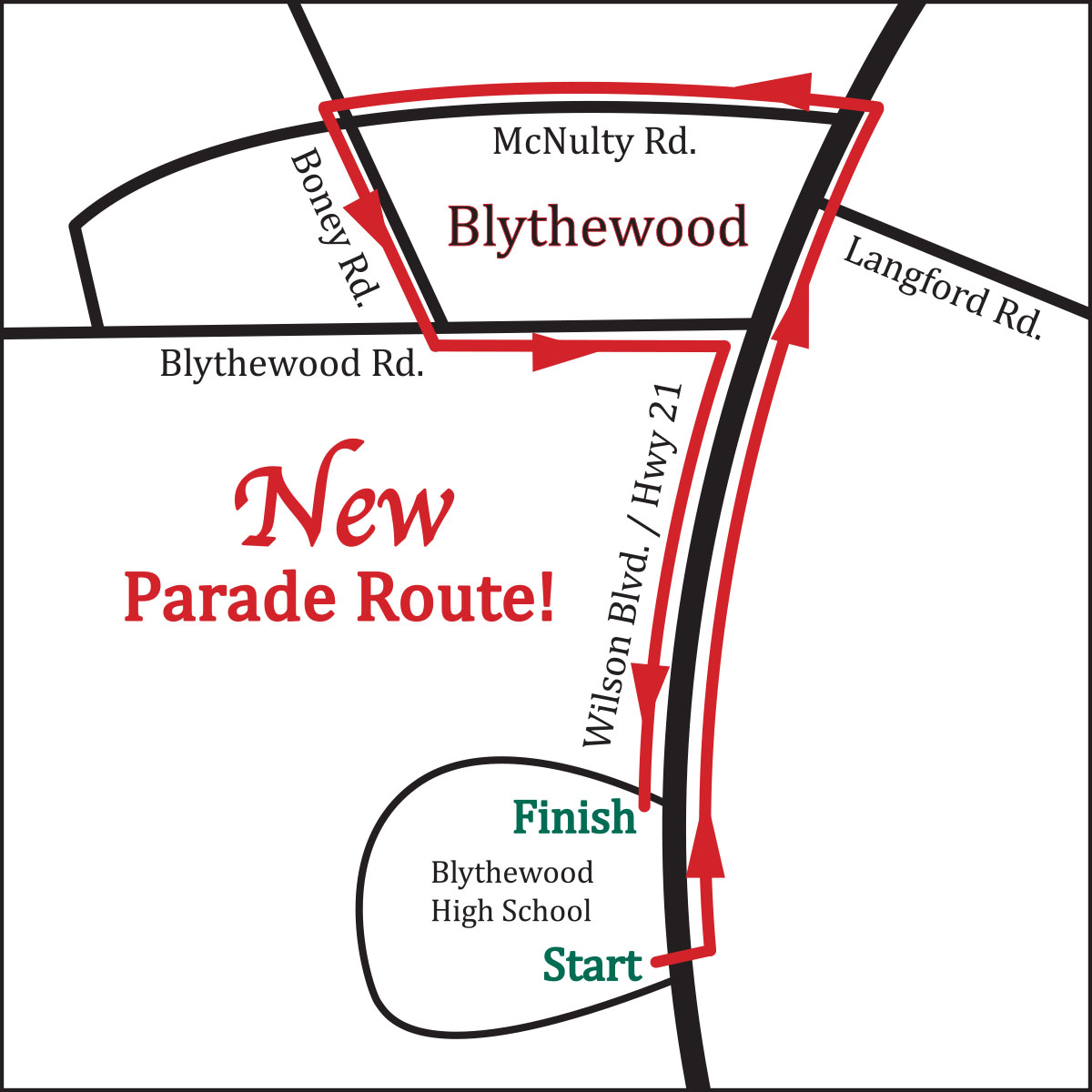
    BLYTHEWOOD – The Blythewood Christmas Parade is going to be held at 3 p.m., Sunday, Dec. 8. The parade, which is sponsored by The Blythewood Chamber of Commerce, will take a new route this year. Instead of leaving from the field behind Bethel-Hanberry Elementary School as in past years, it will start at Blythewood High School, progress north on Highway 21 (Wilson Blvd.), turn left onto McNulty Road, left onto Boney Road, left onto Blythewood Road and left onto Highway 21 and back to BHS.

    According to Parade Chairwoman Kristin Jewell, there is no entry fee to participate in the parade. But participants must register. Deadline for parade entries is Friday, Nov. 29. Both parade entry forms and sponsor forms are available at info@blythewoodchamber.com. All entries must have a seasonal decoration (bow, wreath, etc.) and must be approved by the Parade Committee.

    Emcee for the parade will be WIS-TV news anchor Dawndy Mercer and the Grand Marshall will be Joe Pinner.

  • Mt. Zion Vote Delayed

    WINNSBORO – While Town Council once again deferred to a later date any final decision on a proposal by the Friends of Mt. Zion Institute (FOMZI) for renovating the former Mt. Zion Institute property, a parade of FOMZI supporters lined up at the microphone Tuesday night to encourage Council to give the historic, yet beleaguered, Winnsboro landmark one last stay of execution and turn renovations of the former school over to the local citizens group.

    “I don’t want to be from the generation that let 200 years of history go,” Pelham Lyles told Council. Lyles was one of nine members of the public to address Council in favor of saving Mt. Zion Tuesday night.

    Pam Smith, who lives in the Mt. Zion neighborhood, said the building represented an “awesome opportunity” for the potential future home of the Dru Blair College of Art, and reminded Council of the campaign promises from last spring.

    “During the election, many of you said you wanted to save it,” Smith said. “Give FOMZI three years, just like you gave Red Clay (the N.C. development company that most recently had control of Mt. Zion’s future, but failed to even adequately maintain the grounds). They had no money, no plan. FOMZI at least has some money and people willing to work with them.”

    One of those willing to work with FOMZI was on hand Tuesday night to offer his help in restoring the windows on the old school house. John “Chuck” Herin, who 10 years ago restored the old Greenbrier School on Highway 269, offered up $26,000 worth of the aluminum materials that he used to restore the Greenbrier School.

    But after a one hour and 20 minute executive session to discuss handing over the Mt. Zion reins to FOMZI, Council emerged to make no decision other than to hold a work session in the next “week to 10 days,” Winnsboro Mayor Roger Gaddy said.

    “We only had three Council members here tonight (Stan Klaus [District 2] and Danny Miller [District 1] were absent) and I don’t want to make a decision on something this important with just the input from three of us,” Gaddy said. “I think the importance of the situation is such that we ought to have adequate representation from everyone.

    “We’ve all been dealing with this issue for a long time and we’re ready for it to be resolved,” Gaddy said.

  • Public, Private Money Lure Industry

    WINNSBORO – Documents made available to The Voice last week through a Freedom of Information Act (FOIA) request reveal the scope of financial incentives employed by Fairfield County and the State Department of Commerce (DOC) to lure a television manufacturing company to Winnsboro.

    Element Electronics, headquartered in Minnesota, announced plans on Aug. 22 to relocate manufacturing operations from China back to the United States, tapping the former Perry Ellis Menswear building in Winnsboro as their new home. Vlad Kazhdan, vice president of product for Element, said during the announcement that the new venture would create 500 new full-time jobs over the next five years.

    Purchase and Lease

    As part of the agreement, Fairfield County purchased the Perry Ellis building, at 392 Highway 321 Bypass N., from a Perry Ellis subsidiary for $2 million in a deal that closed on Oct. 14. But the County only ponied up $600,000 for the property, while the Department of Commerce, through an economic development grant, put up $1.25 million. Element, meanwhile, kicked in the remaining $150,000 for the purchase. An additional $50,000 in DOC grant money will go toward the cost of upfitting the building, transforming it from a clothing manufacturing center into a high-tech electronics plant. Fairfield Electric Cooperative and SCANA have also offered to reimburse Element $100,000 each for upfit costs.

    Element will lease the property from the County for $1 a year for 30 years. Element will have the option to purchase the property for $1 if, by Dec. 31, 2018, it has created at least 500 new, full-time jobs and has invested at least $7.5 million in taxable property; or, if by the same date, Element has created at least 350 jobs, invested at least $5.25 million, repaid a pro rata amount of the grant money and paid to Fairfield County an additional amount based on the following formula:

    400-499 jobs by Dec. 31, 2018 = $120,000;

    350-399 jobs by Dec. 31, 2018 = $200,000.

    Payments would be due to the County by June 1, 2019. Element may also continue to lease the property for $1 a year for an additional five years, but must have created at least 250 new, full-time jobs, invested at least $2.5 million by Dec. 31, 2018, and paid to the County $600,000, plus the pro rata grant amount. Failing to have met those conditions, Element may then lease the property at market value, but still must repay the County’s $600,000 investment.

    Fee in Lieu of Taxes

    Manufacturing property in South Carolina is taxed at 10.5 percent, while commercial and other property is taxed at 6 percent. To level the playing field and help attract industry, Tiffany Harrison, Director of Fairfield Economic Development said, local governments often offer as an incentive fees equivalent to the 6 percent rate that companies may pay instead of taxes. Such an agreement is known as a Fee in Lieu of Taxes, or FILOT. Perry Ellis, however, had no such agreement and their property at 392 Highway 321 Bypass N. was listed on the tax rolls. And once a property is on the books, Harrison said, it cannot be removed. Element, therefore, did not qualify for a FILOT on the property itself, but instead was offered by the County an annual tax credit of 42.8 percent for 30 years to bring their contributions to Fairfield County coffers down to the 6 percent level. Like the lease agreement, that tax credit is contingent upon Element creating at least 500 new, full-time jobs and investing at least $7.5 million over the next five years. Otherwise, the credit decreases by the following formula:

    If, by Dec. 31, 2018, Element has created less than 500 jobs, but at least 400 and invested less than $7.5 million, but at least $6 million, tax credit = 33 percent;

    Less than 400 jobs, but at least 350 and an investment of less than $6 million but more than $5.25 million, credit = 23 percent;

    If, by Dec. 31, 2018, Element has failed to create at least 350 new, full-time jobs and has invested less than $5.25 million, the credit agreement terminates and all property taxes shall be paid retroactively.

    Although the building does not qualify for a FILOT, equipment does, Harrison said, and for their equipment Element will pay a FILOT equivalent to the 6 percent property tax rate for 30 years, provided Element has met the 500 job and $7.5 million investment threshold. Otherwise:

    Less than 500 jobs, but more than 400 and less than $7.5 million, but at least $6 million = 7 percent;

    Less than 400 jobs, but at least 350 and less than $6 million but more than $5.25 million = 8 percent.

    If, by Dec. 31, 2018, Element has failed to create at least 350 new, full-time jobs and has invested less than $5.25 million, the FILOT terminates.

    Typical jobs at Element will pay about $12.50 an hour, on average, Harrison said. Element plans to create 250 jobs in the initial phase of start-up. An additional 250 jobs will be added over the course of five years. Element is a main supplier of electronics to Wal-Mart, as well as Target and QVC.