RIDGEWAY – A Ridgeway man died Friday afternoon of injuries sustained in a single-vehicle crash on Bellfield Road. According to Fairfield County Coroner Barkley Ramsey, 71-year-old William Loynes, of 97 Regatta Drive, was pronounced dead at Richland memorial Hospital at 4:18 p.m. Friday from multiple trauma. The S.C. Highway Patrol said Loynes was driving a 1990 Chevrolet pickup truck north on Bellfield Road, approximately 4.5 miles east of Ridgeway, when he ran off the right side of the roadway and struck a tree at approximately 3:08 p.m. Loynes was not wearing a seat belt at the time of the crash, the Highway Patrol said.
The cause of the accident was not known at press time. Ramsey said his office is awaiting the results of a toxicology test, while the Highway Patrol said the accident remains under investigation.
Advanced tickets for the State Championship Football game against Dillon will be sold at Fairfield Central High School on Tuesday, Dec. 3 through Friday Dec. 6, until 3:30 p.m. All tickets are $ 10. Parking passes can be purchased in advance for $10.
Game time is 8:30 pm at Charlie W. Johnson Stadium, Columbia.
WINNSBORO – Fairfield County Council nudged their recreational plan a little farther down the road Monday night, voting 6-0 (District 3 Councilman Mikel Trapp was absent from Monday’s meeting) to authorize administration to submit a Request for Qualifications (RFQ) for a consultant to review the wish lists of the seven individual district representatives. The consultant would provide “general site development information and cost estimates on the projects,” according to interim County Administrator Milton Pope.
“We’ve gone through a lot of discussion about the projects and some of the conceptual ideas that you have here (on Council’s master list of proposed recreation projects),” Pope said, “but we need to . . . know what it’s going to cost us, if we have to eliminate some things or add some things or have amendments to those, we need to have those hard costs before moving forward.”
Pope said the County would utilize all existing recreational planning information to help defray some of the costs associated with bringing the master list to life.
“There are several documents already that the County has in existence,” Pope said, “going back to a lot of the information that was used, that the County paid for, by the Central Midlands Council of Governments.”
Pope also recommended that if the more than one district planned to implement similar building projects, by using a single architectural drawing from which to construct each of the projects, the County could save considerable money.
As part of this year’s bond issue, Council dedicated $3.5 million specifically to recreation projects in the County, with $500,000 devoted to each district. The County has until April 2016 to spend the money. The RFQ, Pope said, would be a 45-day review process, and a selection and recommendation could be ready for Council’s approval by the end of January. From there, Pope said, a timeline to move the projects forward could be established.
“The entire list of projects is conceptual ideas at this point,” Pope elaborated. “Conceptual from the standpoint that we don’t have design drawing for any of these things. Some of things are just ideas and suggestions. Once we bring someone on board, there are going to be a lot more discussions that we’re going to have about the particular projects in order to associate those costs. One of the things we’re all limited by is that we all have a finite amount of dollars to work with.”
Councilman Kamau Marcharia (District 4) said there was still the question of what to do with the building the County purchased in 2008 but never pulled out of its packing crate. That building, which has been the subject of intense public scrutiny over the last six months, was destined for a plot of land in Marcharia’s district. Marcharia said his current plans for District 4 include a multi-purpose building, which the existing building is not. Marcharia asked if it were possible if the existing building could be cut up and repurposed, using some of the parts for the proposed new multi-purpose structure. Barring that, he suggested putting the old building up for auction, the proceeds from which would go to funding recreation in District 4, since, Marcharia said, that was where the original building was intended to go.
“I’m just throwing it out there for Council to contemplate,” Marcharia said. “My request would be that since that building was initially for the Fourth District and voted on and paid for that Council consider . . . that if any parts of that (old building) can be used, or if it’s sold, that it goes to the Fourth District.”
Pope said the County would examine the possibility of using the old building in the new plans for District 4. If it does not fit, Pope said, Council would then have to determine the fate of the old building.
Councilwoman Carolyn Robinson (District 2) questioned Pope about staffing costs at the proposed new recreational facilities. Pope said his staff was examining a number of angles, including grant funds from the office of the Lt. Governor.
WINNSBORO – An audit of the Fairfield County School District’s 2012-2013 budget, reviewed by the Board at their Nov. 19 meeting at the Magnet School for Math and Science, showed no significant findings. The audit did, however, show several instances where purchase orders had not been properly utilized.
“In our tests of the internal controls of the District, we noticed several instances where purchase orders were not being obtained before the purchases were made,” Eddie McAbee, of the Spartanburg-based McAbee, Schwartz, Halliday & Co. auditing firm, told the Board.
Board member Bobby Cunningham (District 5) questioned Superintendent J.R. Green about the matter, which Green assured the Board had been addressed.
“That is something we have constantly reinforced with our principals and department staff,” Green said. “Sometimes they get a little ahead of themselves and want to move forward, and they are under time constraints. We have reinforced that it is important that (we use) those purchasing orders properly before those purchases are made.”
McAbee also said the audit found that the Food Services department had failed to adequately complete federal and state applications in at least a half a dozen cases, but those omissions, McAbee said, “did not affect the determination of free and reduced (meals).”
“The state and federal government requires certain information on applications, and in some instances, six or seven out of the ones we looked at, that information was not complete,” McAbee said. “We just need to make sure those applications are correctly filled out.”
Food Services operated at a deficit of $136,000, McAbee said, which was made up by the general fund. The $136,000 transfer from the general fund to Food Services was down $700,000 from the prior year, when the District dumped $1 million into the department, most of which was to cover the cost of new kitchen equipment.
The audit also noted that the District’s total expenditures exceeded the 2012-2013 budgeted expenditures by $200,000. Kevin Robinson, the District’s Director of Finance, said that overage was caused primarily by a change in several state grants. Those grant changes, Robinson said, meant that money the District had planned to spend out of grant funds had to instead be spent with District dollars.
Audit Highlights
The District’s general fund balance increased by $1.4 million to $6.2 million in fiscal year 2012-2013. General fund revenue increased $900,000 to $33.6 million. Local revenue was up $600,000, while state revenues increased by $300,000.
The District’s net assets came in at $32,025,884, while its liabilities totaled $4,524,376.
WINNSBORO – During County Council’s second public comment portion Monday night, Fairfield resident Beth Jenkins took Council to task regarding their annual trip to Hilton Head to attend conferences, which, since 2009 she said, has cost taxpayers more than $20,000.
Jenkins said the Council members’ accommodations were “not acceptable,” and that Council has abused their position and that Chairman David Ferguson (District 5) was ultimately responsible for holding Council members accountable.
“I think that Mr. Perry (Dwayne Perry, District 1), in a two-bedroom, three-and-a-half bath with eight people; (Mary Lynn) Kinley (District 6) this year in a four-bedroom villa, is not acceptable accommodation,” Jenkins said. “I do consider them luxury. I do think this policy has been abused. It’s been going on for a long time.”
Jenkins said Council owed the citizens an explanation, as well as some reimbursement to the taxpayers.
“There is no reason for any of you to be in a villa with X-boxes, with two, three, four bathrooms on the lagoon or the golf course,” Jenkins said. “That is not acceptable and it does need to stop.”
Vice Chairman Perry admitted that he has taken his family with him to the Hilton Head conferences, and said that if there was money owed to the taxpayers for those trips, he should pay it.
“When we first started doing this, there was no intent,” Perry said. “I was perfectly comfortable going down the three or four days for the conference, but it was also told to me that the amount we were paying was actually more than we could have been paying if we stretched that timeframe out to five or six days versus three or four days. I was not aware that that was prohibited. If that had been prohibited, or if I had been aware of that, I would have been going right by the book. It is being reviewed right now and we’re just waiting to get feedback. If that’s something that’s owed, I feel like that’s something I should pay back.”
Kinley said she paid the “extra excess” for her Hilton Head stays.
“We were given totals, and Mr. (former County Administrator Phil) Hinely kept us at those rates,” Kinley said. “They are being looked at now, and nothing was deliberately done.”
Councilwoman Carolyn Robinson (District 2) said Hilton Head was not the most convenient place to hold these County conferences, and often Council members find that the only accommodations available are the multi-bedroom villas.
“I don’t know if any of you have been to Hilton Head in the middle of the summer,” Robinson said. “Everything down there is geared to be rented for a week. They have the one hotel at Palmetto, and they have to keep so many rooms blocked for their guests. That leaves condos as the only place you can go. They’ll rent them to you for three or four or five days, but they are going to be assured of getting their full week’s rent. That’s what we’ve been doing.”
Robinson said Council has a maximum of two conferences a year scheduled in the budget every year. Attending these, she said, is a benefit to Council members.
“I know the next thing we’re going to hear is ‘Well, just don’t go’,” Robinson said. “That’s the next thing that’s going to be coming from this crowd and from the citizens. You have no idea, unless you’ve never been involved. You take advantage of it. When you first start out, you go down and you start attending classes. Government 1 and Government 2, and you are introduced to almost every subject that will be facing us as an elected official. It’s Government 101, it’s Finance, it’s dealing with the elderly. You have to sit through those classes so you can be certified.”
Robinson said the contacts made at these conferences were invaluable. She said after the initial classes, the conferences offer updates every year, as well as workshops.
“So that you can keep up with those type things and not put us in a position that we’re going to be sued because we’re not doing the right thing,” Robinson said. “Folks, this is government. If we don’t keep up, we’re going to have that many more lawsuits brought against us.”
WINNSBORO – A proposal to implement a credit card style procurement method was tabled by the Fairfield County School Board at their Nov. 19 meeting at the Magnet School for Math and Science after a period of intense debate.
The program, put forward by Kevin Robinson, Director of Finance, and recommended by Superintendent J.R. Green, would replace the District’s current procurement practices requiring staff to fill out purchase orders and the District to cut checks. Robinson said the program would allow the District to utilize more local vendors when making purchases and said Wal-Mart, for example, consistently has difficulties processing the District’s checks. Robinson requested a card for each school, as well as one card for each of the District’s major departments. The District can put specific spending limits on each card, Robinson said, as well as control where the cards can be used. Using the cards for purchases would eliminate the costs associated with processing purchase orders, and the District would be eligible for cash rebates for using the cards.
The Bank of America Visa Purchasing Card program is approved by the State Budget and Control Board, Robinson said.
In their application to Bank of America, the District requested nine initial cards, with a request for 20 cards at full implementation. The types of purchases listed on the application were “supplies, equipment and travel,” with a first year anticipated spending volume of $600,000. At full implementation, that volume was expected to increase to $1.2 million, according to the application.
Board member William Frick (District 6) put the motion on the floor to accept the recommendation. The motion was seconded by Henry Miller (District 3). But Board members Bobby Cunningham (District 5) and Annie McDaniel (District 4) had serious questions about controls over the card, and McDaniel said the Board should craft a new policy governing the use of the cards before the program was approved. She also suggested a pilot program, authorizing a limited number of cards, to test the waters.
The procurement card debate came only minutes after Eddie McAbee, one of the District’s auditors, reviewed the 2012-2013 budget audit and told the Board that his firm, McAbee, Schwartz, Halliday & Co., had found problems within the existing procurement process. McAbee said the audit uncovered several instances where purchase orders had not been properly completed and submitted before the corresponding purchases were made. Green later told the Board that that issue had been addressed and that staff had been directed to complete purchase orders before making purchases.
With his original motion still on the floor, Frick moved to table the matter. That motion carried unanimously.
WINNSBORO – Last week’s quarterly Fairfield County intergovernmental meeting turned out to be more than just dinner followed by a few mild mannered reports from the various County/Town government representatives. Following the reports, County Council Vice Chairman Dwayne Perry (District 1) unexpectedly lit into State Rep. MaryGail Douglas (D-41) for how Perry perceived the County delegation (Douglas and State Sen. Creighton Coleman [D-17], not present) had piled on during County Council’s recent trials and tribulations. Following that, Winnsboro Mayor Roger Gaddy proceeded to set Perry and the County Council straight on a thing or two.
Following dinner and the last report, the meeting host Mayor Gaddy asked if there were any more comments. Perry turned his chair around to squarely face Douglas and addressed her.
“I’d like to go back to August when someone came up to me and said ‘Your County delegation must have it in for the County,”’ Perry said. “On TV you talked about the insurance issue and there were other comments about the Council. My impression was there’s a trust issue between the delegation and Fairfield County Council. I think we need to talk about this,” Perry challenged as Douglas listened.
“The Council was blasted on TV about not working with the Town and for stealing money from tax payers (in the form of) insurance payments,” he continued. In reference to an State Attorney General’s opinion solicited by Coleman last summer that was damaging to Council in regard to its policy of tuition assistance for Council members and their long-standing practice of health insurance reimbursements, Perry said, “The AG’s opinion brought in July, the prevailing opinion over 30 years, said the things being done were being done right, but it sounds like we were being unethical.”
Perry said he was looking at the way people outside the County saw Council. While Perry did not address the fact that both Douglas and Coleman were instrumental in bringing a lawsuit against Council members David Ferguson (District 5), Mikel Trapp (District 3) and Mary Lynn Kinley (District 6) over the insurance and tuition payment issues, he talked on for about 10 minutes blaming what he called a lack of cooperation from the delegation for much of the recent public criticism of Council concerning insurance and tuition payments and LOST (local option sales tax) money. Perry told Douglas that while he and County Council had a good understanding with Ridgeway Mayor Charlene Herring and with Winnsboro Mayor Gaddy, he did not feel that same relationship with the delegation.
Douglas said she agreed there are some issues of distrust but that the delegation “didn’t cause all of this.” Douglas told Perry that they “were not voted into office to like each other but to do the right thing for this County.”
When Perry finished scolding Douglas, Gaddy asked Perry if he was through, then addressed Perry.
“For a number of years the (County’s) tax structure has been very high compared to other counties of our size. (Council) was able to do more like take over the EMS and support the hospital . . . doing some things that other counties can’t do, (counties) that aren’t as fortunate as we are to have (tax money from) a plant like V.C. Summer,” Gaddy said.
“But when the people look around and see the number of new vehicles the County gets every two or three years, the amount of spending that’s going on, they get real frustrated,” he said. “This last turmoil is just another blip in a long, ongoing distrust of County Council where there appears to be reckless spending and more spending and not living within their means as well as they could. I don’t think it (tax money) is always spent in the most cost-effective way. I think the County is perceived by citizens as not keeping as close an eye on the dollar as if it was their dollar. I think the citizens finally got frustrated and now they’ve got a vocal group they never had before. Do I agree with all the Saving Fairfield Group is doing? No. I think they are sometimes overzealous. Do I think Council has room for improvement in how it does things? Yes.”
Gaddy said the current turmoil gives the Council an opportunity to correct some things, put those things behind them and start working together for the betterment of the citizens. He also said he felt the Town and County were beginning to work more closely together to bring jobs to Fairfield.
Gaddy pointed to the recent industry coming to the former Manhattan Shirt Factory building as the first time the County has ever come to the Town to say, “’What can you do for us water wise? What can you do for us with electricity?”
“It was also the first time the Town was willing to discount the cost of these things to try to attract the industry,” Gaddy said. “That’s a very positive step that should have been done all along. If you’re bringing in industry, what you want to know is, ‘What about utilities?’ The City can certainly supply water. You would think someone would have asked about water. That has now occurred on the last two industry recruitments. And,” Gaddy added, “we appreciate the County doing that. It shows a willingness to work together to bring industry in here, to do what’s best for the Community.”
Earlier in the evening, Gaddy called on each Board or government representative for the following reports.
Representative Mary Gail Douglas said she has been working with AT&T to bring internet access western Fairfield County. “They are prioritizing their schedule to help us with this,” Douglas said, “and the next 18-24 months is probably our best window of opportunity to get something done on this.” She said she had also been working to get funding from the S.C. Department of Commerce to enable Elite to upgrade to the point that it can meet the specifications to build circuit boards for Boeing. That, Douglas said, would bring some Boeing contracts and dollars to Fairfield County. She also reported that she had been successfully helping the Veteran Affairs office in Winnsboro to form a volunteer Advisory Board to help plan special events for the local Veterans Affairs office.
Milton Pope, Interim Administrator for Fairfield County, addressed several past, current and future issues, among which was Element Electronics. The general contractor, Hood Construction, has been onsite since Oct. 15 to complete the necessary renovations needed to Element to move into the building. The company hired Carl Kennedy, a Fairfield native, as the Human Resources Director. “Mr. Kennedy is working with Element management to finalize job descriptions, benefits package offerings and other critical items needed prior to beginning hiring,” Pope said. “The Company estimates that it will be in a position to begin advertising for jobs the first week in December. The equipment is on order and should arrive in Winnsboro mid-December.” Pope said that once the equipment has been installed, Element will bring the first wave of workers on board to begin training. He added that Element estimates that the 50 people needed to start up operations and run the first line will begin training in mid-January.
Beth Reid, Fairfield County School Board Chairwoman, reported that the Board elected officers last week. She was re-elected Chairwoman; Andrea Harrison, Vice Chairwoman and William Frick, Secretary. Reid praised the board and the District for improvements she said they are making. She reported that the Career Center expects to break ground in March or so. She also announced that both she and Superintendent J. R. Green have been invited by the S.C. School Board Association to present on the changes in the District at the Association’s annual meeting in February. “They want to know how our new relationship between the Board and Superintendent has brought improvements to the District. I’m excited to be a part of this change.”
J.R. Green, Superintendent of Fairfield County Schools, reported that “Things are going wonderfully in the District. Fairfield Magnet School has recently been named a semi-finalist for the Palmetto Finest Award. It also received an ‘Excellent’ report card rating from the state. The District received an ‘Excellent’ improvement rating.” Green said things are on track. “We’re looking at magnatronics, a new program we’re thinking of adding to our program that is aimed at education for advanced manufacturing.” Green also praised the District’s STEM early college academy. “What these kids are exposed to is about as rigorous as you’ll find,” Green said. He also heaped praise on the District’s football team, the Bow Tie Club and the Group Mentoring program. Gaddy told Green that he was pleased to see the change in the school system. “It means a tremendous amount to us,” Gaddy said.
Charlene Herring, Mayor of Ridgeway, reported on the many festivals and holiday events coming up including the Holiday Parade on Dec. 1; Christmas on the Ridge, Dec. 6; a very successful Pig on the Ridge earlier in the month and she had praise for the Fairfield County law enforcement that she said has helped the Town in so many ways including gang awareness and crime prevention. She praised the merchants for the good job they do to enhance the Town.
Roger Gaddy, Mayor of Winnsboro, reported that while the Town government had been focused on forming a water authority this last year, that project is now on the back burner since some of those that would be needed to form the authority have decided to drill more water wells to meet their community’s water needs. Gaddy discussed the current problem of manganese causing discoloration in the Winnsboro water system, but gave assurance that it posed no threat and should soon be taken care of. He proudly talked about the recent restoration of the Town Clock to its original look. He also reviewed that the Town is in the process of making an offer to the Friends of Mt. Zion (FOMZI) to take on the restoration/renovation of Mt. Zion School. “We’ve been around and around for eight years with this and this time we’re going to set some very strict codes and see if it can finally happen. If it doesn’t in a specified time period,” he said, “then it will come down.”
Drive 87 miles southwest to the little town of Olanta and you’ll see a landform some folks believe meteors created — Woods Bay. It’s not the only bay, though. Thousands of Carolina Bays stipple the landscape from New Jersey to Florida (Aerial laser technology confirms a million.) The most beautiful fleck North Carolina, South Carolina and Georgia. A bit like divots, most bays occur in the Carolinas, hence “Carolina” Bays. We’re lucky to have a state park that preserves Woods Bay, a great example of a large bay yet to be destroyed by man. Yes, a drive of about 110 minutes will take you to this fascinating place, rich with wildlife and botanical wonders.
We call places like Woods Bay “bays” because bay trees — magnolias and laurels — dominate many of these pockets. At ground level they look like, well, like swamps. Chances are you’ve driven by many a Carolina bay and didn’t realize it. From the air, however, they are elliptical depressions oriented from northwest to southeast and parallel to each other.
Recently I went back to Woods Bay. It’s so remote and isolated you’ll hear no evidence of man save a jet now and then from Shaw Air Force Base. If you stand still and listen you’ll hear what sounds like rain. Organic rain! Acorns, leaves and twigs fall continually.
I was glad to see Woods Bay hasn’t changed much; a good thing. Years ago I helped make a film that explored the bays’ origins and extolled them as wildlife oases. I often shot footage at Woods Bay. Serene and isolated. Those words still describe Woods Bay. No, three words — all with equal weight — serene, isolated and primeval. Once upon a time I captured ancient creatures on 16-millimeter film. An anhinga drying its wings. A gator gliding past water lilies. A stubby cottonmouth braiding through cypress knees. Turtles sunbathing on logs. Primeval denizens. I felt like I was in 1800s Botswana.
There was a boardwalk, too, from which I filmed birds. (Woods Bay always delivered a profusion of wildlife … osprey, carnivorous plants, wood ducks and otter.) Today a new and far superior boardwalk will take you past sunning snakes and turtles and all types of luxuriant plant life. It’s a great place to hone your wildlife photography skills.
Coming back may years later, my film days behind me, I still find Woods Bay to be as delightful as ever. As November’s autumn light lit up orange cypress needles their images danced across black waters. I too reflected. Woods Bay and its fellow bays are quietly doing what they’ve always done: controlling floods, purifying water, stockpiling carbon and giving man a place to sort out things. Add clean air, sediment retention and nutrient recycling to the benefits. And add two things that banish humdrum: beauty and mystery, especially mystery.
The origin of Woods Bay and other bays most likely is long-term wind and wave action that gradually shaped the bays and piled sand at their southeastern ends. Don’t let that rather bland theory keep you from seeing a miraculous place. Pack a picnic. You’ll find a picnic shelter there and don’t miss the adjacent millpond. It’s rich with wildlife and photo opps too! And when you drive in you can’t help but notice the snowy-white sand rim that is a beautiful hallmark of Carolina bays.
BLYTHEWOOD – A local business man is offering a reward for information leading to the conviction of those who have been using his car lot as their own personal catalytic converter vending machine. Mickey Dinkins, owner of Mickey D’s Car Lot at 11019 Wilson Blvd., made the offer after his lot was broken into between late-night Nov. 21 and early Nov. 22. It was, he said, at least the fifth time the fence around his lot had been breached and catalytic converters sawn from underneath cars on the lot. This time bandits made off with the converters from no less than nine vehicles on the lot, with each converter valued between $40 and $100.
Dinkins said he was offering a $300 reward for information leading to the conviction of those responsible.
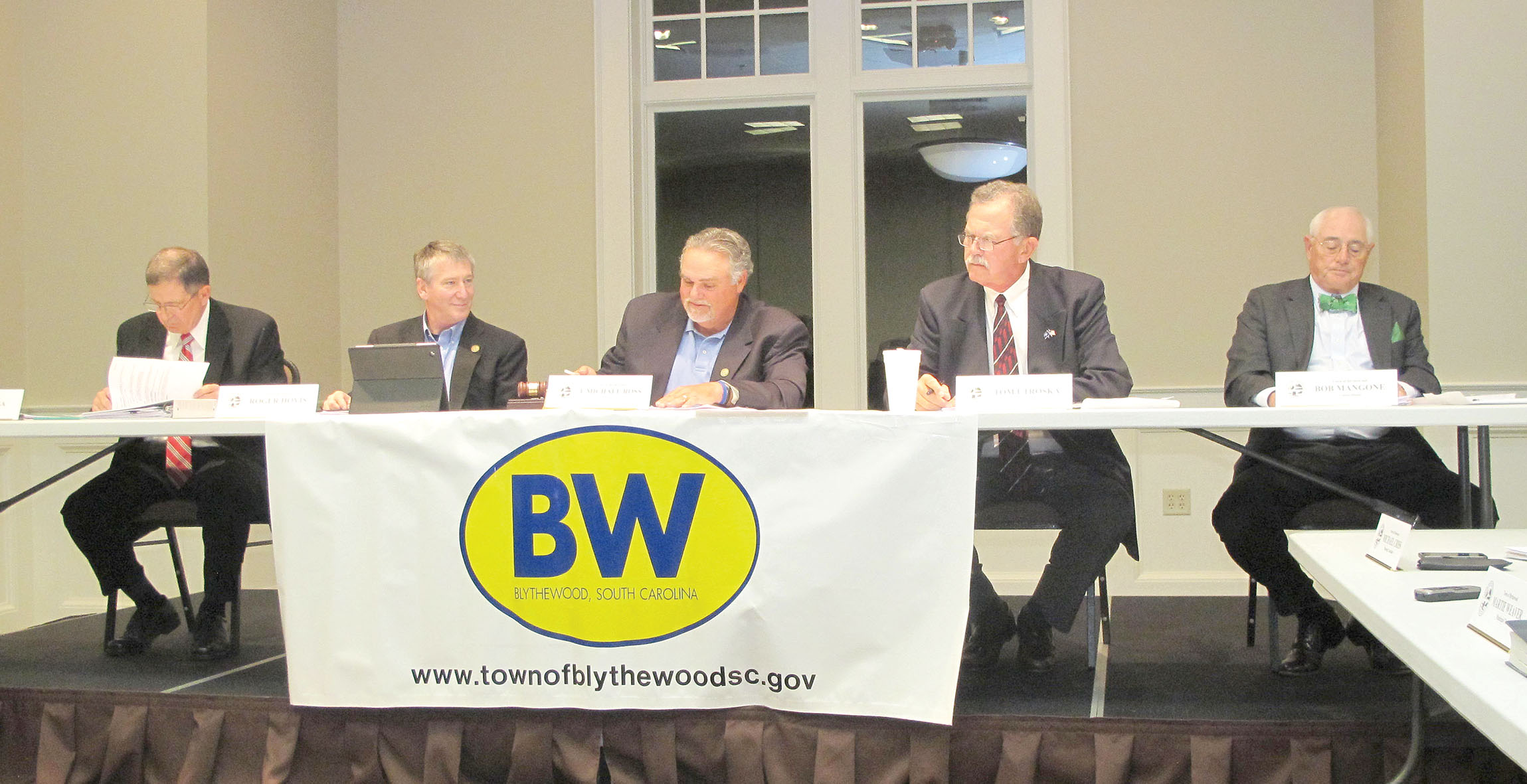
Blythewood’s new Town Council, Bob Massa, Roger Hovis, Mayor J. Michael Ross, Tom Utroska and Bob Mangone, sat for their first meeting Monday night.
BLYTHEWOOD – Just minutes after three new Town Council members took the oath of office and were seated Monday evening, it was apparent that a new balance of power had been elected. The three, Bob Massa, Tom Utroska and Bob Mangone, brought two agenda items to deferral until they could be looked into further.
The first item was the second reading of Ordinance 2013.16, which would have authorized a 10-year lease of the Depot Restaurant that the Town government has pledged to construct and lease to Jon Bazinet, owner of Sam Kendall’s restaurant in Camden. The Town is loaning itself more than $800,000 to construct the building that it will own once the loan is paid back. Bazinet plans to rent the building from the Town. The rental income will be used to help pay the loan back to the Town.
First reading of the ordinance was passed unanimously by the previous Council last month. That agreement included a guaranty of lease payments from both Bazinet (for five years) and his family’s corporation, Red Fox Development, Inc. (for the full 10 years). But newly seated Councilman Mangone questioned the guaranty.
“I believe we need a performance bond to protect the Town from some unforeseen problem in the future,” Mangone said. “There are too many issues beyond everyone’s control to allow this to just be on his signature. Ten years is a long time, and a lot of things can happen.”
Mayor J. Michael Ross, who voted to pass first reading, said he and Town Administrator John Perry had been trying to find a surety bond since the new councilmen had brought the subject up earlier this week. Perry said he contacted suretybond.com and they did not have a surety instrument to cover rental payment. Mangone suggested that it is Bazinet’s responsibility to provide a performance bond to protect the Town against the almost $1 million loan.
Councilman Utroska agreed, saying, “I’m concerned. I would like us to take another week to see if there isn’t a surety bond out there.” Utroska said that signing the ordinance was tantamount to gambling with the Town’s money. “This is a lot of money,” he said. “A week or 10-day delay won’t matter.”
Councilman Massa also agreed. “I don’t think we are going to find an instrument out there. (The Town) has set aside its own money, then locked it in so we can’t spend it on something else.”
When Utroska asked the Town’s attorney Jim Meggs what he would suggest they do, Meggs answered, “The financing for this was orchestrated by Parker Poe Law Firm. But until we get a briefing from Parker Poe, there are lawyers in my firm who will know the options available for Mr. Bazinet.” Meggs suggested the Council defer action on second reading until they could decide what to do about the surety bond, and the Council voted unanimously to do so.
The next item of business didn’t fare much better with the new Council members. The agenda called for the appointment of Jim McLean to the Board of Architectural Review and Joseph Richardson and Raymond Fantone to the Board of Zoning Appeals. The three seats had been filled by the three councilmen and had been vacated earlier that evening when they were sworn into office. Utroska noted that, because of the time frame, the appointments would not be made in accordance with the Town’s statute for either of the two boards.
The Statute (155.465 [G] for the Board of Zoning Appeals and 155.495 [E] for the Board of Architectural Review) states: If a vacancy occurs, the Town will advertise for candidates to fill the vacant seat in the manner in division (D) of this section. Town Council may make an appointment to a vacant seat at any Council meeting held not sooner than 30 days after the advertisement appears in the local newspaper.
Trying to explain to the Council that the appointments would be acceptable if made that evening, Perry said, “In April or May of 2013, the Town put an ad in the newspaper and these are the people who responded to that and they have been patiently waiting to serve and all three of the new Council members served on these Boards and created those vacancies.”
As the Mayor then prepared to call for a vote on the three proposed appointees, Utroska again questioned how that procedure met the requirement of the ordinance. Perry responded that, “we did do that (advertise) on an annual basis to give a buildup of candidates and we will do that again.”
However, this procedure has not previously been made known by the Town Council or Town Hall at a public meeting or in the newspaper.
“I’m a big believer in following the rules,” Utroska said.
“We don’t want to do anything that’s wrong,” Ross said, “but we advertised this (last spring) and did not get a response.”
When asked his opinion, Meggs said he would have to look at the chronology (of what has been done in the past).
Massa said the statute is predicated on an existing vacancy, of which, he said, there were none when the advertisement was posted last April or May.
“Maybe that is why no one applied,” he said, “because there was no vacancy. Who would go to the trouble to apply if there is no vacancy?”
“So,” Ross, said to the Council, “are we okay to make these appointments tonight?”
Massa said he would vote ‘no,’ “because we are not following our ordinance. We can’t selectively decide whether we want to follow the ordinance.”
Massa also suggested that in the past, those seeking appointments were expected to appear before Council in case Council members had questions to ask them. It was noted later in the meeting that only one of the three, Jim McLean, was present.
The Mayor made one more try, telling Council, “These three people said they were interested in the position and when the vacancies came open we called them and they agreed to take the positions.” Again, Ross asked Meggs if he had further comment. Meggs didn’t. Then Ross said, “We called these people and were assured by Mr. Perry that we are following what he believes to be the (right thing).”
Getting no support from Council, Ross hesitated, then called for the motion, which was to defer action on the item. The vote was unanimous.
In other business, Council voted to defer action on the Landscape and Tree Preservation Ordinance and voted unanimously to pass a Resolution for the South Carolina Municipal Insurance Trust (SCMIT) Worker’s Compensation Participation Agreement.
The next regular meeting is Monday, Dec. 16, but there was some discussion that a special meeting might be called for the several deferred motions.