Category: News

  • State OK’s HON Site

    Courthouse Move Clears Hurdle

    WINNSBORO – When Fairfield County Council’s ad hoc committee, tasked with securing a temporary site for the County Courthouse, met last month, all options for the relocation appeared both labor intensive and expensive. But as that meeting wound down on Feb. 20, the suggestion came to the floor that another option might be available. Monday night, Milton Pope, Interim County Administrator, told Council that that option – to move into the HON Building – was indeed on the table.

    The Fairfield County Courthouse is in desperate need of renovations, Deputy County Administrator Davis Anderson told the committee last month. An electrical overhaul is necessary to support updated technology; structural defects have to be addressed on the historic building; and mold and mildew is an ongoing concern – the culprit: an outdated HVAC system that will need to be entirely replaced, duct work and all. The entire process will take approximately one year, and while the work is being done, the offices within the courthouse will have to find a temporary home. That means moving more than 9,340 square feet of offices, including the offices of the Clerk of Court, the Tax Assessor, the Auditor, the Tax Collector, the Treasurer, the Public Defender and the court room and its associated offices.

    After contracting with the consulting firm of Mead & Hunt, Inc. of Lexington for $15,575 last fall, the firm offered up three options for the move: the former Food Lion grocery store and the adjacent former location of the Family Dollar at 133 Highway 321 Bypass S., and the former Elite facility at 900 9th St. in Winnsboro. The Food Lion/Family Dollar option totaled some 13,800 square feet, with a building cost of $866,708 and an upfitting cost of more than $1 million. The Elite facility weighed in at 25,000 square feet and came with a price tag of $822,708 for the building and $931,818 for the upfit. While Mead & Hunt identified mold and water issues, as well as hazardous materials and possible asbestos at the site, they ultimately recommended Elite as the best possible option.

    A third option to rent modular units from a Charlotte company for between $13,000 and $37,000 each was rejected.

    As the Feb. 20 meeting drew to a close, Pope and Council Chairman David Ferguson (District 5) suggested the HON Building, located on Highway 321 N. near Midlands Tech. The County currently owns the building, but has leased out most of it to the S.C. State Emergency Preparedness Office (EPO).

    Monday night, Pope told Council that the EPO had given their consent to the County for the move. While the costs associated with that move were not available at press time, Pope said the HON Building would require far less upfitting than either of the prior options and that the building’s square footage will allow for the entire courthouse and its functions, including actually holding court.

    “It really is a very workable space that we could use there,” Pope said, “assuming Council continues to support the move forward.”

    The proposal to move into the HON Building will now go back to committee for consideration, Pope said.

  • All Signs Point to SECTtitle . . .

    Equestrian Team Honored with I-77 Sign

    BLYTHEWOOD – As the top-ranked University of South Carolina equestrian team saddles up to host the SEC Equestrian Championships at One Wood Farm in Blythewood this weekend, the state will honor both the team and the town on Thursday, March 27, by installing a sign at Exit 27 on Interstate 77.

    The sign will indicate to interstate travelers that Blythewood is the proud “home of the University of South Carolina Equestrian Team.”

    “On behalf of the Blythewood community, we are proud to host the top-ranked USC equestrian team,” said State Sen. Joel Lourie. “With this sign on the interstate, we can now show our enthusiasm to the rest of the world.”

    “We congratulate coach Boo Major, her staff and the student athletes of the USC equestrian team on a fine season,” said J. Michael Ross, Blythewood’s mayor. “We’re proud the team considers Blythewood their home, and we hope to see these Gamecocks bring home the SEC championship trophy!”

    Sen. Lourie will present a smaller keepsake version of the sign to the town and the team on Saturday, March 29, during a social event at One Wood Farm that will close the 2014 SEC equestrian championships. During this two-day event, the University of South Carolina, Auburn University, University of Georgia and Texas A&M University will compete in preliminary rounds on Friday, March 28, with the consolation and championship meets on Saturday, March 29. Admission to all meets is free; One Wood Farm is located at 1201 Syrup Mill Road in Blythewood.

  • Former Bengal Ferrell Aims for NFL

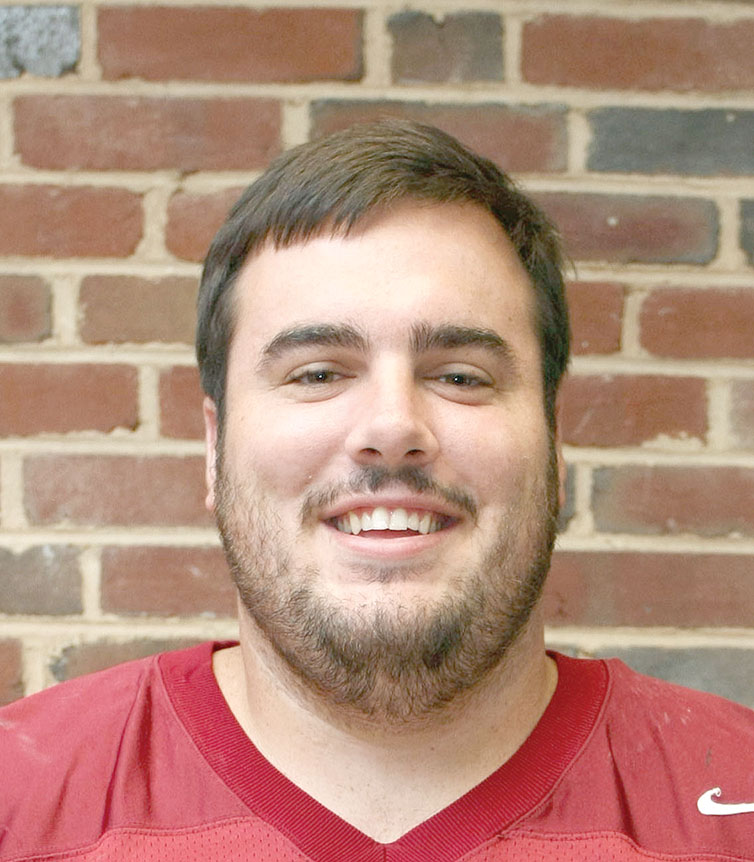
    Will Ferrell (18) in action last fall against Maryville College.
    Will Ferrell

    RICHMOND, Va. – Hampden-Sydney senior offensive lineman Will Ferrell from Blythewood, was one of two dozen local football prospects invited to the Pro Day at the University of Richmond last week.

    NFL hopefuls from Liberty, James Madison, Virginia State and Richmond joined the Tiger All-American in the workout. There were 19 NFL scouts on hand to evaluate the players.

    “I was pleased to have the opportunity. After my nerves settled down, I felt really good about my workout,” Ferrell said after the workout.

    Ferrell, the three-time First Team All-ODAC tackle, recorded the second strongest lift, benching 225 pounds 30 times. He also clocked in at 5.1 in the 40-yard dash. The former Bengal graduated from Blythewood High School in 2009.

    “Will’s career has been truly remarkable,” said offensive line coach Zeke Traylor. “He will graduate as one of the most decorated Tigers in our storied history, and I could not be more proud of what he’s accomplished while at Hampden-Sydney. I wish him nothing but the best as he moves to the next level.”

    Ferrell started in all 44 games of his career while helping the Tigers to three NCAA appearances, two ODAC Championships, and 32 wins. His accolades include: All-American in 2012 (AFCA); First Team All-ODAC in 2011, 2012, and 2013; the Offensive Lineman of the Year in 2012 and 2013 (Touchdown Club of Richmond); and Second Team All-Region in 2013.

    The NFL draft will begin on May 8 in New York City.

  • R2 Looks at Grants, Review

    Dr. Arlene Bakutes, District Grants Coordinator, and the principals’ benefiting from a grant presented at Tuesday night’s Richland 2 School Board meeting the merits of a nearly $4.5 million grant over a three year period to Killian Elementary, Longleaf Middle and Westwood High schools. Called “Full STEAM Ahead!,” this program is a science, technology, engineering, arts and mathematics focused curriculum designed to reduce minority isolation. A study by the National Endowment for the Arts shows that students from lower socioeconomic backgrounds who actively participated in the arts tended to score better in science and writing, and were more likely to aspire to college. A major purpose of the grant is to “provide the programs and resources to keep [students] at these magnet schools,” and to “slowly increase the diversity of the student body at Killian,” to “create a more diverse student body at Longleaf Middle School and Westwood High School,” the grant application states. At the end of the grant period, the district intends for schools to continue the programs with regular district funding.

    Review Team Findings

    Also on the docket Tuesday night was the Review Team of faculty and district staff that sifted through a district-wide survey to gather employee feedback on what should be funded in the district and concerns where funding is allowing them to reach optimum. Most notable was the impact of rising poverty rates severely curtailing field studies and purchasing of library books. Under the previous superintendent’s attempt to create equity in access to field trips, field trips are no longer funded by the parents. In the past, students who were unable to pay the fee were covered by a donation from another family, a PTO fundraiser or the principal’s discretionary budget. Currently, the school raises the funds or school’s discretionary fund is used. Discretionary funds do not have budgets to support multiple school field trips, so a school is currently in the position of selecting one class or one trip per year. Fundraisers can also contribute, but this has proven to be less successful in schools of high poverty. The Review Team asks that the way field studies are funded be uniform across the district and be recognized as a way to enrich the focus of hands on learning.

    Also, the Review Team noted that funding for the media centers was removed from the general budget several years ago. Again, the principals fund the purchase of books. As in the field trips, funding is inconsistent across the district. High poverty schools have a difficult time raising the funds to purchase supplies. Board Member Susan Brill mentioned that she had spoken with Media Specialists and has this request on her priority spending list when the Board meets to discuss budget.

    The Review Team also said that the work of Family Interventionists should continue to focus on the whole child and address the issues within the family – usually meeting outside of school setting as a family unit. This work has proven to be particularly effective with middle and high school students and their family units. The positive spillover has been improvements in behavior and academic performance.

    Prior to the next School Board meeting, Wednesday (new day), April 9 at Polo Road Elementary School, there will be the first of two hearings on the General Budget for the coming school year. The public is invited to attend at 5 p.m.

  • Art Deco & The Alamo?

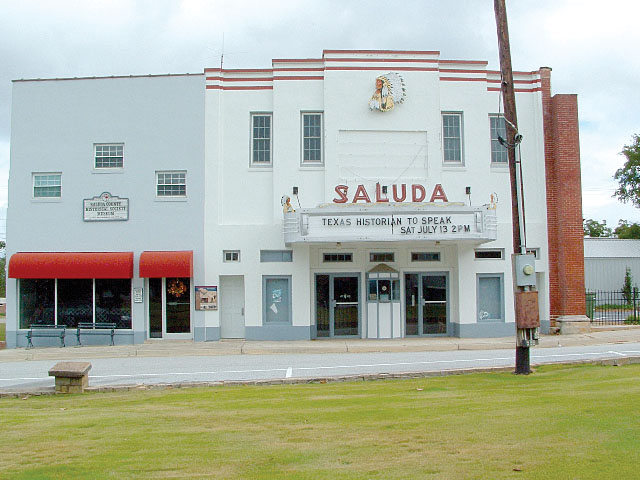
    A Cartoon, a Newsreel and a Talkie for a Nickel?
    No; but it is a very cool looking theater. Check it out – and more – in downtown Saluda.

    For many years I drove down Highway 378 to my family home in Georgia. The journey took me through downtown Saluda. There I noticed a handsome old theater, the Saluda Theater. I didn’t know much about it, but that changed in 1987 when I was working on a book for the University of South Carolina Press. When researching and writing “South Carolina, A Timeless Journey,” I wrote a chapter, “Highway 378,” in which I covered the Saluda Theater. What a great history this theater owns. Drive 60 miles southeast and you can see the handsome theater and its colorful sign.

    The theater, built in 1936, is 78 years old. Back when I interviewed Mary Parkman, then-executive director of the Saluda County Historical Society, she said the theater opened with Shirley Temple’s “Susanna of the Mounties.” Over the years the theater hosted Lash Larue, the whip-wielding cowboy, and other notables. When cable TV and the video rental explosion hit, the old theater’s days were numbered. It closed in 1981 after a 45-year run and gathered dust.

    It was a good day in 1987 when Saluda County bought the theater and donated it to the local Historical Society. Renovations followed and in August 1990 the ABC-TV miniseries used the theater as the set for a scene in “And Justice For All.”

    Back in its heyday, two old arc projectors that burned carbon rods stood side by side back of the balcony. Those old projectors put out a ton of heat and fire was a possibility. The small projection booth where they stood had two trap doors held open by cotton strings that ran across the lens housing. If the projectors overheated the strings caught fire, burned in two, and trap doors slammed shut, shutting off the supply of air, a rudimentary safety strategy.

    Today the theater is on the National Register of Historic Places. If you make the trip to see it you will see that it looks much like it did in 1936. Its art deco design supports the fact that it was built in 1936, a time when precise and boldly delineated geometric shapes and strong colors dominated architecture in small towns. Few theaters like the Saluda Theater exist in the United States today. Appropriately, a museum stands adjacent to the theater.

    Native American history is strong in Saluda County. When you go, be sure to check out the mural across Highway 378 that depicts Old Hop and other Cherokee chiefs ceding their territory to Governor Glen on July 2, 1755. As well Saluda County has ties to the Alamo. Native sons William Barrett Travis and James Butler Bonham were at the Alamo where both died in the Texas Revolution. Locals like to say “Saluda County is where Texas began.”

    Plan a drive over to Saluda and ask about other historic sites such as “Flat Grove” and the Marsh-Johnson House.

    If You Go …

    • Make your way to Highway 34 and follow it to downtown Saluda. The theater is adjacent to the courthouse at 107 Law Range.

    • Learn more about the Saluda Theater at www.saludacountyhistoricalsociety.org/saluda-theater/12-saluda-theater.html


    Learn more about Tom Poland, a Southern writer, and his work at www.tompoland.net. Email day-trip ideas to him at tompol@earthlink.net.

  • Ridgeway’s Race for Mayor: Bush Makes Her Case

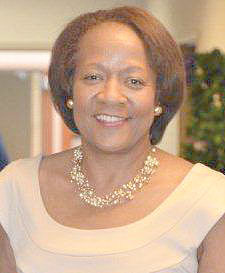
    Belva Bush

    Editor’s Note: Both Belva Bush, the challenger in the April 8 election, and incumbent Charlene Herring were invited to submit a personal essay for our readers. Mayor Herring did not respond.

    Belva Bush

    I was born and raised in Ridgeway and grew up in the community on Mood Harrison Road in Longtown. I am the daughter of Sarah Bush and the late Leroy “Pistol” Bush. I am an active member of the Mt. Pisgah Baptist Church of Ridgeway, located on Longtown Road. I attended the public schools in Ridgeway and Fairfield County and later attended Midlands Technical College and Benedict College.

    I am currently in my 21st year of employment with the Fairfield County School District where I serve as the Attendance Specialist, District Registrar and District Homeless Liaison. In past years I also served as Interim Director of Public Relations and as Director of the Parenting Resource Center. I am an advocate for homeless assistance and awareness in Fairfield County and served as Executive Director of HUGS, etc., a non-profit organization for the assistance to homeless and prevention of homelessness. Throughout the years, I have served as a member of numerous professional organizations and associations to include membership in the Order of Eastern Stars.

    I participated in the Palmetto Leadership Fairfield Institute in 2001. This 11-week training program was sponsored by Palmetto Leadership, Clemson University and the Fairfield County Chamber of Commerce. This was my first vision into the leadership roles of our local politicians and served as a blueprint on how I could possibly one day make my contribution as an elected official.

    In 2010, I was elected to the Town Council of Ridgeway after serving as Chairperson of the Town’s Public Relations Committee for several years. Since being on council, I have served as Chairperson of the Community Actions Committee. In 2013, the committee applied for and received a grant from Palmetto Pride that was used to enhance the landscape of Ridgeway’s Geiger Elementary School. I also served on the Pig on the Ridge and Christmas Parade Committees.

    My reason for seeking the office of mayor is that I believe that a term limitation for mayor should be established and limited to no more than two terms in office. I feel that it is important to establish a vision for the Town of Ridgeway that will make it a better place for residents, businesses and visitors by creating and enhancing the town in such a way that ALL people feel a since of pride and existence. We need to establish an open dialog and focus on communication with citizens of the town as well as our local businesses. I earnestly seek the support of the citizens of Ridgeway in the upcoming April 8 election.

  • Garden Party to Benefit FMH Foundation

    The romance of the English Garden has been around for centuries. It is practical, beautiful and fragrant. Learn more about the evolution and “secrets” of an English Garden at the entertaining program for Fairfield Memorial Hospital Foundation, Sunday, April 6, 3-4:30 p.m., at the historical St. John’s Episcopal Church, 301 West Liberty St., Winnsboro, presented by Sonya White.

    Music by Susan Douglass Taylor, composer/vocalist on guitar, will sooth the senses to add to the casual afternoon program.

    Fairfield County Master Gardeners will be in the garden to answer your plant and gardening questions. And Rhonda, with Hay Hill Garden Market, will have a variety of spring and summer plants for sale. Summer Day Gift Shop will have an array of unique items for purchase. Refreshments provided by The Cornwallis House Tea Company, who will also have their hand-crafted, custom-blend teas available.

    Registration/donation is $25. Mail checks to FMH Foundation P.O. Box 1156, Winnsboro, S.C. 29180. No tickets will be sent; registered names will be at the door. Reservations recommended, but also available at the door. Inquiries e-mail to foundation@fairfieldmemorial.com or 803.608.5510

    The daughter and granddaughter of farmers, Sonya White’s childhood in Northeast England literally revolved around planting, harvesting and a deep, practical appreciation for Earth’s bounties. She resigned from a 30 year career in Health Care and Clinical Development when she married her American husband in 2003 and moved to South Carolina in 2004. She now has the opportunity to indulge her passion for English gardening and the ancient meanings of plants and flowers. Sonya will take the group on a pictorial English garden tour of preserved early gardens from different eras in her homeland and offer suggestions for planning and nurturing your own garden in stages.

    As a 501(c) 3 tax exempt organization, donations to the foundation may be tax deductible.

  • Home on the Range . . .

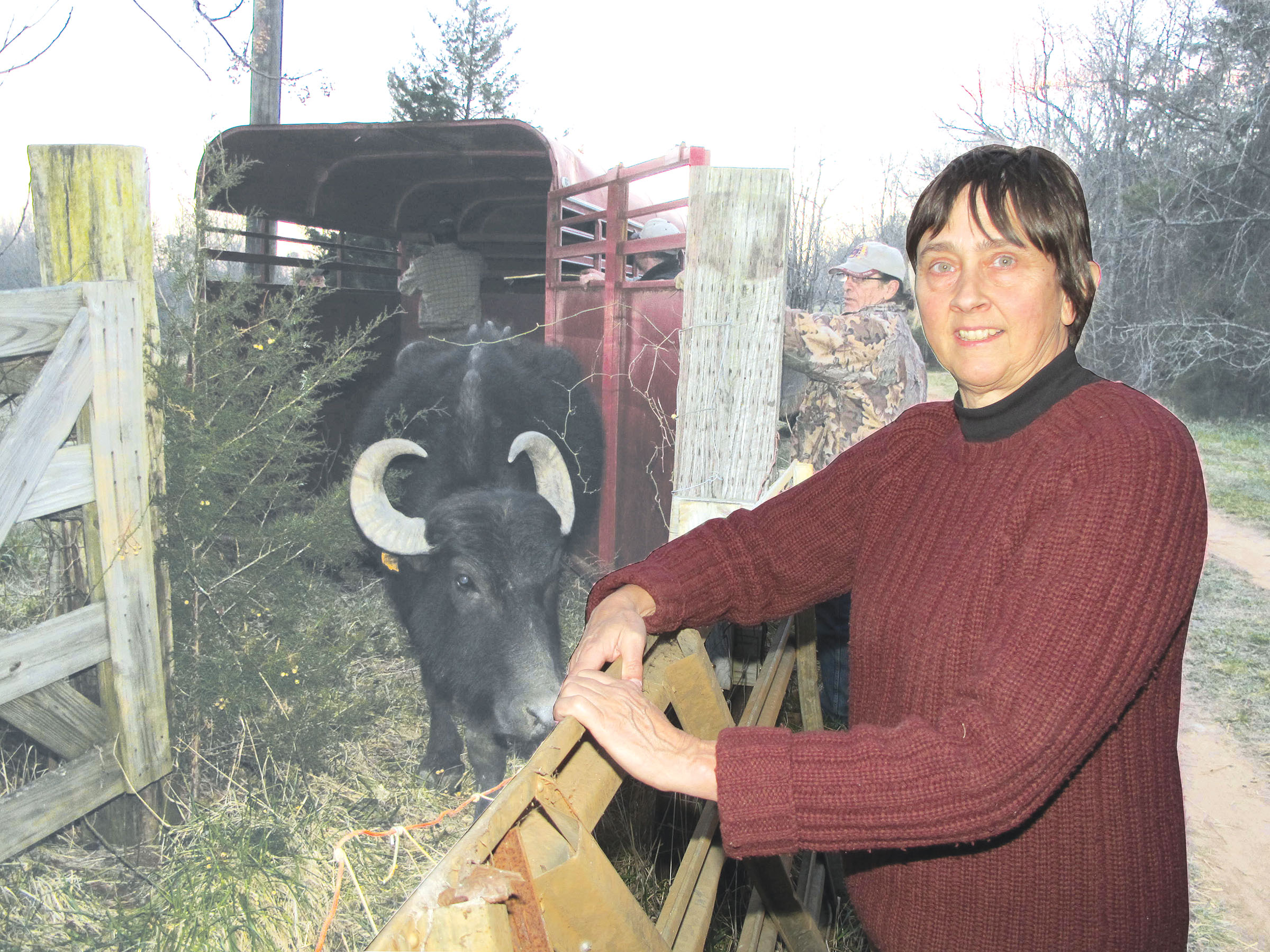
    Landowner Pelham Lyles stands outside the holding pen as the buffalo are unloaded from the trailers.

    Say Cheese: Asian Water Buffalo Find New Home in Fairfield

    Like an updated, gourmet-food version of the Oregon Trail video game, Alvaro Valle, 32, has journeyed with his herd of Asian water buffalo from Gainesville, Fla. to Fairfield County over the course of three years, in search of affordable grazing pasture within a short drive of fine dining restaurants. Since purchasing his first heifer from the herd of his former graduate advisor at the University of Florida, where Valle received his master’s degree in Ecology in 2009, he’s been on a mission to produce what the New York Times called the “great white whale of American cheesemaking” – the near-fabled mozzarella di bufala.

    In great demand by James Beard-awarded restaurants like Fig in Charleston, true Italian-style buffalo mozzarella is an artisanal cheese that can sell for $20-$30 per pound.

    “There’s only about a handful of guys in the U.S. that are trying it,” Valle said, “because making this cheese is so difficult. It’s very different from the ‘buffalo mozzarella’ you might see at Costco for $4.50 a pound.”

    He explained that there are three main requirements for making artisanal buffalo mozzarella – first, the milk has to be of the highest quality, which comes from the buffalo being as grass-fed as possible. Two, it needs to be eaten the same day it’s made, or within a day or two at the most. And three, it can’t be refrigerated.

    “And of course,” he adds, “it’s a high-end product, so you need to be in a place that can sustain that. That’s why I moved to Fairfield County, to get into the culinary culture in Charleston. In the last couple of years, I was ready to build a dairy and start milking, but I wasn’t able to get traction with the right land there.”

    Valle said he’s very pleased with the land that he’s now renting in Fairfield County from Pelham Lyles, a lifelong resident of Fairfield County and Director of the Fairfield County Museum. Valle said the location, just a few miles south of Winnsboro on Highway 34, is ideally located for working with restaurants in Charleston and Columbia.

    Lyles’ 250-acre farm is part of an 1,100-acre farm that her grandfather purchased in parcels during the 1930s and ’40s.

    “He ran a herd of 200 white-faced Herefords as a hobby,” Lyles recalled. Her father passed the land down to Lyles and her four siblings. “I had always dreamed of having a horse farm here on my farm, but I couldn’t afford the investment. I love the land. The opportunity to partner with Al has provided the ideal setting for his herd, and it provides me with a little income from my land.” Looking out across the open fields at the herd, Lyles added, “I really love having animals on the land again.”

    “Before I found the land on Ms. Lyles’ farm,” Valle said, “I just stashed the herd where I could around the state – some in Kingstree, some on John’s Island, some down near the Edisto River. Now I’ll be able to have all the buffalo together within the month, and they’ll be ready to start milking by summertime.”

    Valle was born in Nicaragua, but the family moved to the United States when he was a child. His parents, Alvaro and Lucia, live in Chattanooga, Tenn., where his father is a surgeon, and they are very supportive of Valle’s work with the buffalo.

    “My mom grew up on a farm, and my dad always wanted to farm,” Valle said. “This is kind of a family venture. We’ve put family resources into it, and my dad is often part of the day-to-day decision-making. If the business takes off, I can see them moving here and becoming even more of a part of it.”

    Valle’s mentor, the late Hugh Popenoe, was one of the foremost experts on water buffalo in the United States. He began importing them in the 1970s, and served as president of the American Water Buffalo Association.

    “I wanted to farm, and to make an impact doing something that nobody else was doing,” Valle said. “I found this niche with my advisor, and I’d always felt comfortable with cattle, so that’s why I got into it.

    “It’s hard work, but the buffalo are great to work with,” he said. “People sometimes think these are the same wild, fierce creatures you see on National Geographic, but the reality is that domesticated water buffalo are extremely docile. They’re also a great species for the southeast. Water buffalo have been in South Carolina since colonial times, and were used to farm rice fields in Charleston. They’re just more productive for this particular environment – they can subsist on lower-quality forage than a cow, and they gain more weight from the same amount of feed.”

    Valle said he’s developed a good working relationship with his water buffalo over the years.

    “My Australian Shepherd, Pipa, has a natural herding instinct with them, but they don’t need a lot of that yee-haw-ing,” he said with a smile. “They just come when they’re called.”

  • Council Gets Serious About Code Enforcement

    WINNSBORO – A year after considering, then tabling, an ordinance to provide for code enforcement in the Town of Winnsboro, Council revisited the issue at Tuesday night’s meeting with the prospect of voting on the ordinance at the next council meeting.

    “I think we have code enforcement officers in our budget this year,” said Councilman Jackie Wilkes, “and I think it’s time we implemented that position. We have this packet Billy Castles (Director of Building and Zoning) put together for us last year. It will be intense work concerning the ordinance, but it’s time we got started enforcing some of these codes.”

    Councilman Clyde Sanders made the argument to ask Fairfield County code enforcement officers to enforce codes in the Town.

    “It would be cheaper for us in the Town to pay the County than to bring employees in, provide vehicles and pay insurance and benefits for them than to go under the County. We’re part of Fairfield County. Before we jump into hiring somebody we need to talk to the County and try to get them to enforce in the town,” Sanders said. “They’ve got three or four officers.”

    “If you remember,” Wilkes said, “that was something we said last year, but no one ever talked to the County.”

    Mayor Roger Gaddy said Winnsboro’s Town Manager, Don Wood, would be the appropriate person to talk with Interim County Administrator Milton Pope.

    “If the County says ‘no,’ then it behooves us to have our own code enforcement officers,” Gaddy said.

    Wood reminded Council that, “Before we do any of that, you have to pass some ordinances to enforce. We spent months on this thing last year. The ordinance is ready to be voted on,” Wood said. “But you all will have to take some action to accept, reject or modify it before a code enforcement officer would have anything to do with it.”

    Gaddy urged Council to pass the codes, then go to the County and ask if they would be interested in enforcing the codes (for Winnsboro.)

    “They may not want to,” Gaddy said. “Then we need to make a decision about hiring our own.”

    The Mayor said he would put the item on the agenda for the April 1 meeting.

    In other business, Wood presented a draft ordinance to deal with animal complaints. The ordinance identifies any animal that is unrestrained, a persistent noise maker, odor causer, etc., as a public nuisance and subject to impoundment and issuance of a misdemeanor citation to the owner.

    The target of the ordinance is apparently a brood of chickens domiciled in the yard of a mobile home on Evans Street. A woman who said she lives in the neighborhood but did not identify herself told Council that, “we’ve had to tolerate chickens in our neighborhood for a long time. So please consider the new ordinance carefully and as soon as possible. We’re awakened by one to five roosters at 2 a.m., 3 a.m., 4 a.m. and 5 a.m. Chickens and ducks make noise all day and night and run loose in the yards. Town is not country.”

    Gaddy said the ordinance would be presented for first reading at the next council meeting.

  • Grants Part of BOMAG Deal

    WINNSBORO – BOMAG Americas, which announced plans to locate operations in Fairfield County’s new Commerce Center on Feb. 5, was brought into the county with the help of more than $2 million in grant monies, a Fee in Lieu of Taxes (FILOT) agreement and an infrastructure tax credit.

    BOMAG, makers of industrial construction machinery, received a $1.1 million grant from Fairfield County. A large portion of those funds are actually being passed through the County from grants it received from the State Department of Commerce, the Rural Infrastructure Authority and S.C. Electric and Gas, according to Tiffany Harrison, Director of Fairfield County Economic Development. Only $250,000 is coming directly from the County, Harrison said, and all of those grant funds will be used to develop the site at the Commerce Center. Another $1.1 million grant came to BOMAG directly from the Department of Commerce, with those funds also used for site development.

    The FILOT agreement locks BOMAG in to a 6 percent payment of the 403.5 millage rate for 30 years. In addition, for the first 10 years, BOMAG will receive a 60 percent tax credit on FILOT payments.

    All of those incentives do not come without strings, however. If by the end of their five-year investment period (calculated from the time BOMAG purchased the property) BOMAG’s property investment fails to meet at least 50 percent of its $18.2 million requirement, or if BOMAG fails to create at least 50 percent of its required 121 new full-time jobs, then the County may terminate the FILOT agreement and BOMAG would be responsible for all back taxes and repayment of grant funds.

    BOMAG joins Element Electronics among Fairfield County’s newest job creators to receive FILOT agreements. The two new nuclear reactors under construction at V.C. Summer in Jenkinsville also received a FILOT agreement with the County, with payments expected to begin in 2017. Unlike ad valorem property taxes, a percentage of which is predestined for the Fairfield County School District, FILOT agreements are paid only to the County. How much of those fees end up in the hands of the School District will be up to County Council.

    J.R. Green, Superintendent of Fairfield County Schools, said that, to date, no formal discussions have taken place between the County and the District regarding the allocation of FILOT funds.

    “I’m optimistic County Council will do right by the District,” Green said last week. “That’s a substantial amount of revenue coming in just from those reactors.”

    David Ferguson (District 5), Chairman of County Council, said that while the District was already well funded, Council would not leave them out in the cold.

    “With the school funding where it’s at, being near the top in the state, we’re not in bad shape as far as that goes,” Ferguson said, adding, “We will always look out for the District and we always have ever since I’ve been on Council. As those (fees) come in, we have to look at them accordingly and divide it up accordingly.”