Category: News

  • Winnsboro, Mid-County Strike Deal

    WINNSBORO – Disaster was averted Wednesday night as the Town of Winnsboro granted a six-week extension to Mid-County Water while the finishing touches are put on a new five-year water sale agreement between the two entities. The Town had been poised to cut off the flow of water to Mid-County, effective April 16 at noon, as negotiations between the two bogged down last month. A special meeting was held at Town Hall Wednesday night to rekindle the water talks.

    “We had a really good dialogue,” Herb Rentz, Mid-County’s manager, said. “We have a good understanding, and we’re going to meet more frequently – which is important for all water purveyors, to address growth and capacity needs.”

    While the new contract still has to be officially drawn up by Winnsboro’s attorney and ratified by the Mid-County Board of Directors, as well as the U.S. Department of Agriculture, Rentz said he was confident the deal was done.

    As talks on a new deal stalled last month, Town Council unanimously passed a resolution at the end of its April 1 meeting to close all valves supplying water to the Mid-County Water Company, effective April 16 at noon. The cutoff could have affect as many as 5,600 customers, as well as fire protection in the area. Kelly Miller Elementary School would also have been impacted by the decision, Rentz said, as would the Jenkinsville Water Company, which purchases a portion of its water from Mid-County. Rentz said that last month, Jenkinsville purchased 100,000 gallons from Mid-County and that over the years they have purchased millions more.

    The new agreement includes a rate increase, but not the increase originally stipulated in the Town’s proposal. Winnsboro had initially suggested an increase from $3.75 per 1,000 gallons to $5.83 per 1,000 gallons. Instead, that rate will be $4.52 per 1,000 gallons.

    “But we still have very reasonable rates,” Rentz said, “even compared to Chester.”

    Penalties for water use in excess of the contracted sale amount are still in place, but Mid-County did receive a capacity increase in the new proposed deal, from 5 million gallons a month to 8 million gallons a month. Details on the penalties were not available as this story posted to the Web.

  • Bravo Denials Ring Hollow

    State Fine Reduced, Not Dropped

    BLYTHEWOOD – In several news articles published in The Voice during February and March of this year, it was reported that Bravo Blythewood, the cultural arts arm of the Town of Blythewood, was sent a notification of fine for $2,000 from the S.C. Secretary of State’s office on Jan. 1, for continuing failure to register with and file its financial information with the agency’s Public Charities Division. The arts group was told it had 15 days to register.

    The group did not register until Feb.10, at which time, according to Shannon Wiley, Deputy General Counsel of the Secretary of State’s Office, Martha Jones, CEO of Bravo Blythewood, submitted a registration form but did not include the required financial report and Internal Revenue Form 990 EZ.

    In an email to The Voice, Wiley said the agency would not waive the $2,000 fine entirely for late registration, but would reduce the fine to $200 for administrative costs if Jones forwarded the financial report (990 EZ) and the $200 fine to her attention, again, within 15 days.

    In the minutes of the Feb. 17 meeting of the Blythewood Artists Guild that were forwarded, unsolicited, to The Voice by members, it was reported that Jones told the group that Bravo Blythewood had not been fined by the Secretary of State’s Office. In a letter published in the March 7 issue of The Voice, Bravo Blythewood vice president Buddy Price also refuted reports in The Voice that the group had been fined. Price stated that the group had not been fined by the Secretary of State’s Office. However, when his letter was forwarded to Wiley, she sent an email to The Voice stating that, “The organization did pay a fine of $200 for the late filing of the registration…”

    On Feb. 12, Wiley told The Voice that no financial records had been filed with the Public Charities Division for Bravo Blythewood since it was incorporated as a non-profit on Aug. 3, 2011. Jones was CEO of the group since that time. While Bravo Blythewood was registered as a non-profit corporation with the business filing division, Wiley said because it solicits money and is funded by the town government, it must also be registered with the state’s Public Charities Division and file an annual financial report and an annual registration form.

    According to the notice of fine dated Jan. 1, 2014, the $2,000 fine would have been dismissed entirely had the group filed the requested information in a timely manner, within 15 days.

    Bravo Blythewood received $17,750 in funding from the town government’s Hospitality Taxes from Nov. 30, 2011 – Dec. 20, 2013.

  • Sentimental Journey

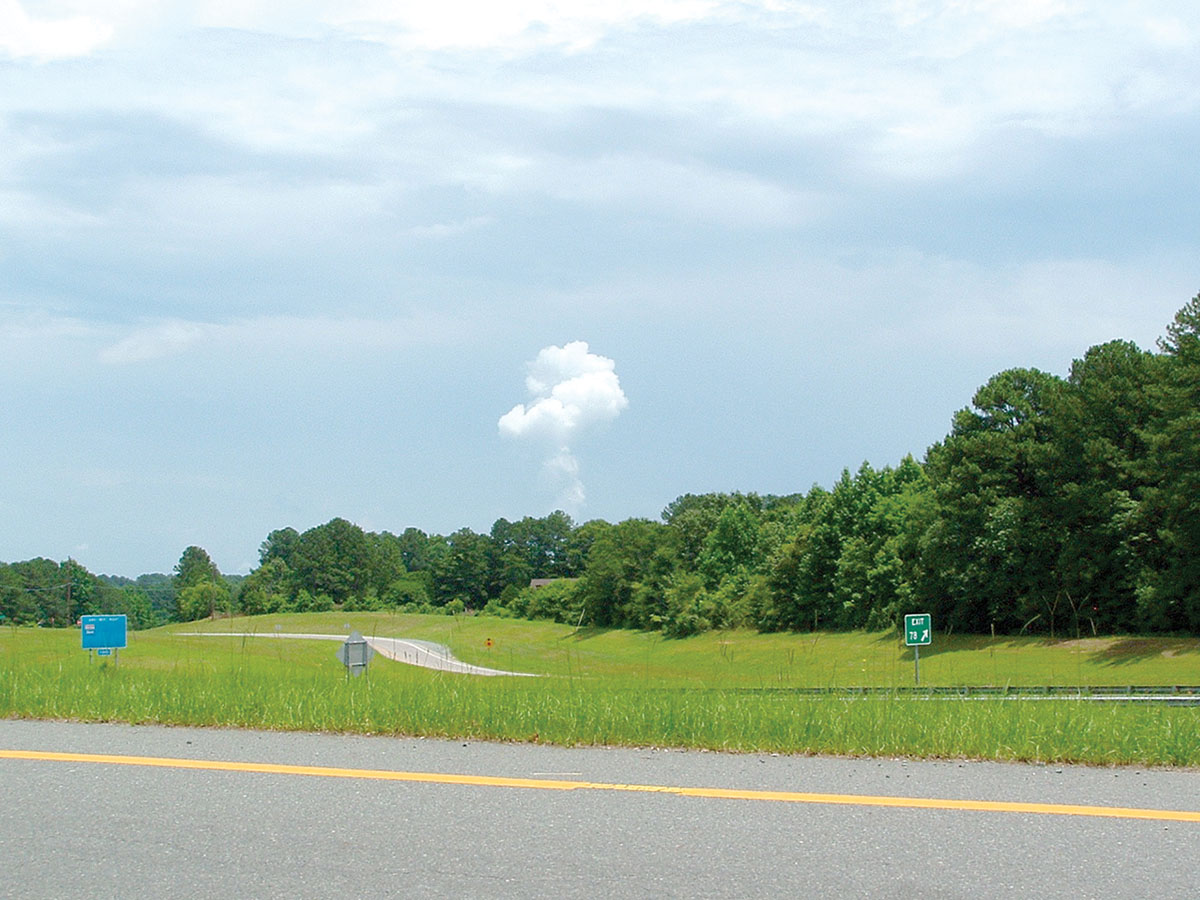
    Take Exit 78 to Hiroshima?
    Not quite. A little to the east, near Apex, N.C., where there is a nuclear power plant. And just ignore that cloud. It’s perfectly safe. Trust us.

    Want to take a trip down memory lane? Want to just drive with no particular place to go? Drive U.S. 1 north into the Tar Heel state. You’ll pass through many a small town, hailed as a place where values and virtues die with the greatest of reluctance. Mayberry comes to mind. It was a sleepy little town where good people and memorable characters lived.

    I avoid interstates when I can, so I pass through a lot of small towns and I can tell you small town America is dying, thanks in large part to interstate highways. See ‘em while you can. Last summer I drove from Raleigh to Columbia down a road once mighty, U.S. 1 South — the main road from New York City to Miami, once upon a time. It strung prosperous towns together like beads on a silver chain. Then I-95 came and tarnished the chain and the beads lost their luster. Today No. 1 runs past many an abandoned mom and pop store. All along its route, dust covers places that once thrived.

    In the glory days to have a business on the shoulder of U.S. 1 was to prosper. No more. It’s easy to spot forsaken diners and gas stations from the 1950s and 1960s. Dust can cover them but it cannot destroy their classic architecture’s lines. I urge you to drive this highway to see just how much our country has changed.

    Not far from Apex, N.C., you’ll see an odd white cloud ascending into the sky, a tornado of steam. It comes from a nuclear power plant. That’s how much things have changed.

    As for the old diners, stores and “filling stations,” what happened to the people who built and ran these places? Where did they go?

    Driving along I tried to summon up what it must have been like to see your livelihood destroyed by a monstrous freeway and the lure of saving time. Below Sanford I drove by a service station/grocery store covered in vines and suddenly it became easy. I imagined a thriving business with green-and-white hand-painted signs out front. “Fresh Vegetables.” “Red, Ripe Tomatoes.” “Cheap Gas.” And then I-95 snaked its way across the land and fewer eyes saw those simple advertisements.

    The hum of tires faded and the clanging of cash registers quieted. More than one owner I’m sure made it a habit to stand in front of his store, hand shielding the sun from his eyes, scanning the road.

    “No traffic. Well, not like it used to be.”

    In leveling forests and plowing up fields and God knows what else to build 42,793 miles of limited-access pavement, the interstates changed America in ways few could have imagined. In 2004 Forbes magazine published “The Great Paving,” which said, “The Interstate system was sold as a savior for both rural America and declining urban cores; instead it speeded the trend toward suburbanization at the expense of both city and country. It was heralded as an antidote to traffic jams; instead it brought ever more congestion.”

    You can still see vestiges of pre-interstate days. Work your way over to Camden and make a sentimental journey north on U.S. 1.

    If You Go …

    • Take a camera

    Learn more about Tom Poland, a Southern writer, and his work at www.tompoland.net. Email day-trip ideas to him at tompol@earthlink.net.

  • Rimer Pond Road Closes April 14

    The DOT will close a portion of Rimer Pond Road Monday as work begins on ‘Dead Man’s Curve.’

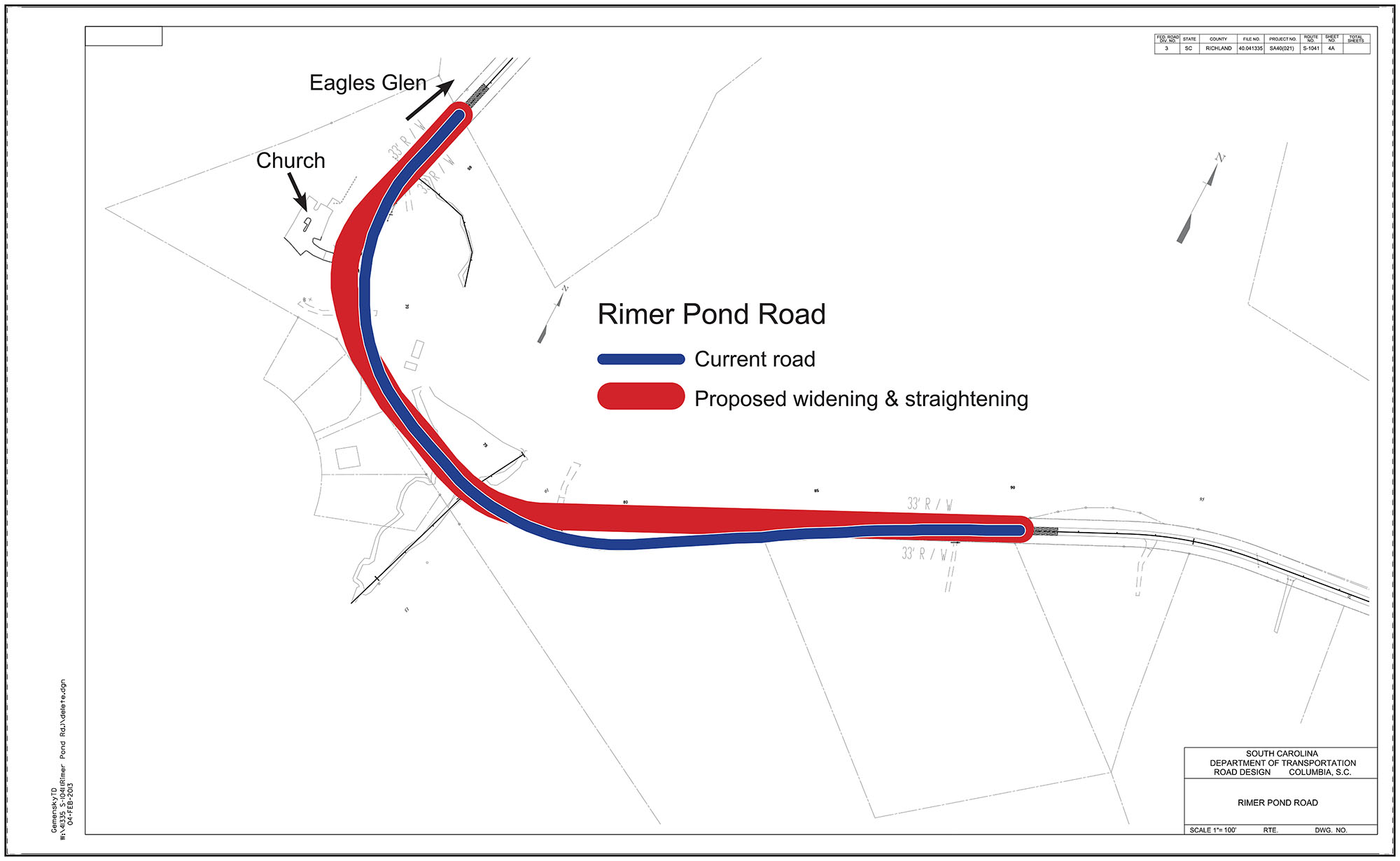
    BLYTHEWOOD – The S.C. Department of Transportation (SCDOT) will close Rimer Pond Road to thru traffic from April 14 until Aug. 31 while construction crews straighten and widen the road’s infamous curve, according to Allen Thompson, Resident Construction Engineer with SCDOT’s Richland Construction Department.

    The curve will be re-aligned starting between the entrance to Eagles Glen and Perfecting Faith Church and continue to a point near Round Top Elementary School. Traffic south of Eagles Glen subdivision will enter and exit Rimer Pond Road where it intersects with Highway 21 (Wilson Blvd.). Traffic north of the construction will be detoured via Round Top Church Road to Langford Road.

    Bryan Jones, District Engineering Administrator, released a statement on March 31 explaining that while schools in the area (Round Top Elementary and Blythewood Middle) would be impacted by the detours, the school administrations would be informed so they could reroute school bus traffic during the four-month construction period.

    When a statistical comparison was made a few years ago with other one-half mile sections of roads around the state with high crash incidents, the locally notorious curve on Rimer Pond Road easily met the qualifications for improvement – 29 crashes in four years with 12 of those being injury crashes, according to Joey Riddle, Safety Program Engineer for SCDOT.

    “To make the road safer,” Riddle told The Voice in early 2013, “we’ll be widening the two existing 10-foot lanes at the curve to 12-foot lanes with 2-foot paved shoulders beyond the white line on the edges of the road. This will make the road about 28 feet wide, from edge to edge.”

    Riddle said rumble strips would also be added to the road’s edges to warn drivers when they are departing from the road. He said that while rumble strips are expensive to install, a study of the road’s accidents showed that 23 of the 29 crashes were land departures.

    Thompson said that in order to eliminate some of the curve, the road will have to be moved as much as 8 feet in some places.

    A guard rail will be installed on both sides of the road at the low point of the curve where there are a couple of creeks alongside the road across from the Rimer Pond dam.

    Thompson said the road corrections should make the curve safer.

  • Planning Commission Split on Model Homes

    BLYTHEWOOD – Two members of the Planning Commission who live in Cobblestone Park voiced strong objection to 10 or so single-family model home lots proposed by builder DR Horton for the tennis court area of Cobblestone Park. According to a drawing presented by DR Horton, the lots will be located on a short cul-de-sac street that will run alongside Cobblestone Parkway where it intersects with Links Crossing Drive. DR Horton spokesperson Andrew Allen, Project Manager for the design group Thomas & Hutton, said the up front location of the models will help home sales in the Primrose section, which is located in the back area of Cobblestone.

    Randy Humphries, a member of the Commission, and Mike Switzer, Chairman of the Commission, both residents of Cobblestone, expressed concern that some of the homes in the 2.5-acre model home area, which would include smaller homes, would back up to Cobblestone Parkway, which is the primary entrance into the gated community. Their objection was that the back yards could be unsightly along that entrance road.

    The Town’s Planner Michael Criss suggested that Thomas & Hutton might be able to design appropriate screening for the homes. Humphries suggested that the builder reduce the number of models by as much as half, and situate them on the opposite side of the cul-de-sac road facing the Parkway. Still, he said he did not want the models built there. Humphries said he did not think fencing or a berm would sufficiently screen the homes from the entrance.

    Commissioner Ernestine Middleton suggested the builder meet with all of the Cobblestone homeowners to get their input on the proposed model homes section.

    To accommodate construction of the model homes, the Commission is being asked to rezone the Town Center District portion of Cobblestone Park to Cobblestone PUD zoning district.

    The number of Cobblestone Park residents who sit on the Commission (three of seven) and the fact that the Town Council is made up of a majority (three of five) of Cobblestone residents would not present a problem as they decide the fate of the zoning map amendment, according to Town Attorney Jim Meggs. He told the Commissioners that he had been informed by the S.C. Ethics Commission that the Cobblestone residency of Commissioners and Council members would not prohibit them from voting on the matter.

    The Commission deferred action on the matter pending new street-level drawings showing how the aesthetics of the entrance to Cobblestone Park would be affected. Switzer also suggested that DR Horton schedule a meeting to allow Cobblestone owners to give input on this proposal so the Commission would know better how to represent the people who would be affected by this decision.

    In another action concerning the Primrose section of Cobblestone Park, the Commission approved reducing the side setback for 220 lots owned by DR Horton from 5 feet and 12 feet to 5 feet and 10 feet as the Commission had previously approved on other lots last year near the same area in Cobblestone.

    Resident wants to remove trees

    Ashley Oaks property owner Frank Parks presented the Commission drawings and photos of five trees he would like to remove from his front yard because of erosion caused by the trees’ exposed roots. Parks said after the removal of the trees he planned to re-sod his yard.

    Commissioner Middleton said she had the same problem in her yard. Commissioner Marcus Taylor said he had no objection to the tree removal given Park’s erosion problem caused by the trees, and Town Planner Michael Criss agreed that tree roots do compete with turf grass. Switzer objected to the removal of the healthy, mature trees, saying his personal experience with sustainable design would favor keeping the trees and letting the yard grow into a natural area around them. Parks said he didn’t think the Ashley Oaks Home Owners Association (HOA) would approve of that. Switzer argued that leaving the trees would be more in accordance with the Town’s Master Plan goals of sustainable neighborhoods.

    Commissioner Malcom Gordge suggested he should recuse himself because he lives on the same street as Parks, and the Town Attorney agreed, saying he would supply Gordge with the appropriate forms for recusing himself following the meeting. However, Gordge continued to have input in the meeting, which is contrary to the requirements for recusal.

    The Commission voted unanimously to defer action on the matter to give time for them to visit the site with a landscape architect to determine if there are other remedies for Park’s problem.

    Landscape & Tree Preservation

    The Commission agreed to send Commissioner Gordge, Criss and Park Architect Rick McMackin to the Town Council work session on April 15 to address council’s questions regarding the new Landscape & Tree Preservation ordinance before Council takes it to second reading. Council approved first reading of the ordinance at its the March 28 meeting.

    Plan Review

    The Commission approved drawings for preliminary plat review for Holly Bluff’s subdivision near Ashley Oaks pending the developer’s revision to show sidewalks on at least one side of each street and a better visual marking on the drawing that show 100-foot setbacks.

  • Winnsboro Poised to Close Mid-County Water Taps

    WINNSBORO – With negotiations for a new contract at a stalemate, Winnsboro Town Council unanimously passed a resolution at the end of its April 1 meeting to close all valves supplying water to the Mid-County Water Company, effective April 16 at noon.

    The cutoff could affect as many as 5,600 customers, as well as fire protection in the area, according to Herb Rentz, Mid-County’s manager. Kelly Miller Elementary School would also be impacted by the decision, Rentz said, as would the Jenkinsville Water Company, which purchases a portion of its water from Mid-County. Rentz said that last month, Jenkinsville purchased 100,000 gallons from Mid-County and that over the years they have purchased millions more.

    The resolution to cut off water came as a surprise, Rentz said, as the two parties have been informally discussing a new agreement for the better part of a year and Mid-County has been operating under a two-month contract extension since February. While the Mid-County Board of Directors was scheduled to meet last week to finalize an agreement, Rentz said there were some delays in getting the Board together. Back-to-back severe winter storms, as well as coping with high manganese levels in Winnsboro’s water, diverted attention that otherwise would have been spent on finalizing a new agreement.

    John Fantry, legal counsel for water issues for the Town of Winnsboro, said that while informal talks are fine, Mid-County was notified by mail in January that the time had come for formal negotiations and that the situation was serious.

    “I would say we’ve had zero negotiations,” Fantry said. “It was languishing. We sent them a letter in 2012 letting them know that we wouldn’t just roll the same contract over. There was no attempt to do anything for nearly a year, until January. We received on March 31 the first real indication of things they didn’t like.”

    The major sticking points in the new proposed contract include a rate increase from $3.75 per 1,000 gallons to $5.83 per 1,000 gallons, as well as penalties for using more water than stipulated under the contract. Fantry said the existing agreement allocates a maximum of 5 million gallons a month for Mid-County. Over the last 24 months, Fantry said, Mid-County has purchased less than that maximum only once, with their average sitting right around 6.4 million gallons a month. Mid-County is seeking even more water in a new deal, Fantry said.

    “They presented what we would call an inappropriate wish list,” Winnsboro Mayor Roger Gaddy said. “Everybody’s rates are going to have to go up, there’s no doubt about it. That was one of the reasons we spent so much time and money trying to develop a water authority, so we could all be at the table when these decisions were made.”

    The Town of Winnsboro has an annual water budget of about $15 million, Gaddy said, and last year they made around $2,800 in water sales.

    The deadlock also puts the Fairfield County School District at the mercy of the negotiators.

    “We don’t really have a contingency plan,” J.R. Green, Superintendent of Fairfield County Schools said. “We are hopeful they will resolve the issue by the 16th. If not, there’s no way we could have school (at Kelly Miller) with no water.”

    Green said he was not aware of the stalemate until he received a phone call Monday from The Voice newspaper.

    “I have to take some responsibility,” Rentz said, “for not realizing that at the end of this two-month window if we didn’t reach an agreement they would actually cut our water off. We’ve been good customers for years. Paying customers.”

    Rentz said the Board was scheduled to meet this week in an effort to reach a consensus before the April 16 deadline. Meanwhile, Mid-County has asked for another extension on its existing contract for one month.

    “We’re going to make every effort to work with (Winnsboro),” Rentz said. “We’re going to get it done, and in a timely manner.”

    A special meeting between Mid-County representatives and Town Council was scheduled for 1 p.m. Wednesday.

    “It’s not dead,” Fantry said. “But there’s got to be a meeting of decision-makers. If there’s nobody there who can say ‘yes’ or ‘no’, then there’s no real proof we won’t be right back here seven months from now.”

  • Magnet School Makes History

    Magnet School principal Gale Whitfield hoists the school’s Palmetto’s Finest Award in a display of victory.

    FMSMS Earns Palmetto’s Finest Award

    WINNSBORO — Fairfield Magnet School for Math and Science (FMSMS) has achieved something never before done in the history of Fairfield County. The school is the winner of a Palmetto’s Finest Award, the state’s top honor given to five schools that offer excellent instruction and outstanding leadership. School District Superintendent J.R. Green said it was an exciting time in Fairfield County.

    “This is indicative of multiple things we have going on here in the district,” Green said. “We understanding we can do anything if we work together.”

    Each school goes through an intensive application process that includes self-evaluation, peer review and on-site examinations, and is evaluated on student achievement, instructional programs, professional learning communities and school culture.

    “This award has come about through hard work and dedication of the wonderful students, dedicated parents, teachers, administrators and staff,” Green said. “I am here to tell the community that this is a new day in Fairfield County.”

    Principal Gale Whitfield shed a few tears at the school’s win.

    “This prestigious Palmetto Finest Award validates that great leadership with exceptional teachers and dedicated parents results in students being academically successful,” Whitfield said, “and we earned the right to be a Palmetto Finest school.”

    Students cheered and weighed in on the excitement of winning, too.

    “Being a Palmetto’s Fines school feels awesome!” sixth-grader Dhvani Patel said. “I am very happy that we won this award for our school. The students, our teachers and our principal have worked very hard for this achievement. It is great to see our hard work paying off.”

    FMSMS is the recipient of the two consecutive Palmetto Gold awards and earned an absolute report card rating of Excellent.

  • Getting Around the Debt Limit

    Decoding Municipal Bonds

    WINNSBORO – When the members of Fairfield County Council wanted to borrow $24 million last year to finance the costs of designing, acquiring, constructing and equipping various projects (see list of Projects on page 6), they chose a somewhat controversial, albeit legal, method to avoid bumping up against the County’s constitutional debt limit.

    While revenue bonds do not need voter approval, they must be secured with a lien on a designated stream of revenue (not taxes) from county-owned revenue-producing entities such as a water plant or toll bridge, which Fairfield County does not have. General obligation bonds must be secured with ad valorem property taxes. Without voter approval, County Council can incur no more general obligation debt than 8 percent of the assessed value of taxable property in the County. For Fairfield County, that constitutional debt limit is currently $4.5 million, far short of the $24 million Council wanted to borrow.

    Unable to use either of these methods to borrow so much money, Council turned to an unorthodox financing scheme based on something called Installment Purchase Revenue Bonds (IPRBs.) This complex process of borrowing money involved the County first passing a resolution on March 25, 2013 to create a separate, nonprofit (501 c 3) corporation called Fairfield Facilities Corporation (FFC) that could legally issue $24 million in IPRBs that it, not the County, would use to design, acquire, construct and equip the County’s various projects.

    To make this happen, the County entered into various agreements with the FFC. A base lease agreement conveyed ownership of the County’s projects (to be improved) to the FFC. In an agreement between the FFC and Regions Bank (the Trustee for the FFC), the proceeds of the $24 million bonds were deposited with Regions to pay for the improvements to the projects. And a Purchase and Use Agreement between the County and the FFC gave the County use of the projects for the next 30 years and provided for the County to make annual lease payments to the FCC for use of the projects. Those lease payments paid for the principal and interest on the bonds. These annual payments incrementally buy the projects back from the FFC so that, at the end of the 30 years, the County will again own 100 percent of the projects and their improvements.

    Howard Duvall, retired Executive Director of the S.C. Municipal Association, put it simply, “In short, the Council set up a non-profit corporation to borrow the money to finance the County’s projects. This allowed the County to finance $24 million of improvements without exceeding its 8 percent debt limit and without having to get the voters’ approval. The County then pays the FFC back for the bond using whatever funds are available each year.”

    And the ‘whatever funds’ part becomes the rub.

    While general obligation bonds cannot be levied to pay for traditional revenue bonds, one characteristic of IPRBs is that, unlike traditional bonds, they can be paid for with any revenue stream, even a mock revenue stream created by ad valorem taxes. To that end, on April 15, 2013, less than a month after establishing the FFC, which issued the $24 million IRPB, the Fairfield County Council passed Ordinance 614 authorizing a general obligation bond that would create a de facto revenue stream for making annual payments on the $24 million bond.

    “The FFC issued the$24 million bonds and then Fairfield County can issue the general obligation bonds one year at a time to make the annual payments,” Duvall explained.

    But this plan was not spelled out for Fairfield County voters at Council meetings or in newspaper interviews. In addition, Ordinance 614 did not specify an amount for the bonds to be issued, a date of issuance or the number of bonds authorized by that ordinance. At the same time, at Council meetings and in newspaper interviews, former County Administrator Phil Hinely and members of Council further confused the issue, whether intentionally, inadvertently or negligently, by referring to the ordinance as authorizing the $24 million bond, not a general obligation bond that would be issued to make interest payments on the $24 million bond.

    Almost a year later, on Feb. 14, the first general obligation bond authorized by Ordinance 614 was issued in the amount of $769,177.88. Forty thousand dollars of that amount went to the County’s bond counsel, Parker Poe Adams & Bernstein, LLP, for bond issuance fees, and $5,900 went to BB&T (who purchased the bond) for unspecified fees. The remainder was applied to the first interest payment of $744,047 on the $24 million bond. The County will pay an additional $69,674.25 in interest on the new bond over the next seven years for a total payout of $838,852.13. It is not known if the County plans to issue similar general obligation bonds to make additional annual interest payments on the $24 million bond, but the sum of the annual principal and interest payments due in 2019 totals a little less than $4.5 million, which is the amount left on the County’s bonded debt limit. In other words, the County could issue annual general obligation bonds in that amount without asking voters’ permission. According to the payout schedule for the $24 million bond, the larger debt payments start in 2019 when the new property taxes from the second nuclear reactor at the V.C Summer Nuclear Station in Jenkinsville are expected to begin pouring in to cover the payments.

    While Fairfield County Interim Administrator Milton Pope has assured The Voice that no new tax will be levied to pay for the $769,177.88 general obligation bond, an official with the State Treasury Department who asked not to be identified said that, in reality, the tax payers are on the hook for not only the $838,852 payout of the $769,177.88 general obligation bond, but they are technically on the hook for the entire $43,200,664 payoff of the $24 million bond.

    “If anything should happen that the County did not have the revenue sources it’s planning to meet those debt obligations,” he told The Voice, “the fine print in the $24 million IRPB and the smaller general obligation bond says the County is obligated to levy ad valorem taxes to pay for the debt.”

    According to several state officials who were contacted by The Voice but who also asked not to be identified, these nonprofit corporations such as the FFC are shell corporations created solely for the purpose of evading the County’s constitutional debt limit. Explaining how Blythewood’s Town Council created the Blythewood Facilities Corporation (BFC) in 2010 as a way to issue a $5.5 million bond, the Town’s attorney, Jim Meggs recently told Council that the BFC “is a way to get around certain regulations and restrictions.”

    While IPRBs have been ruled to be legal by the Supreme Court, primarily because they are issued not by the County but by a separate nonprofit, they have been in the cross hairs of the General Assembly since at least 2006 when the Greenville School District ran up $1 billion in debt by financing school facilities in this manner. The General Assembly put an end to the practice by tightening up loopholes in the law that allowed this kind of high risk financing. In recent years, counties and cities having increasingly favored IPRB financing, which some state officials and legislators say is chicanery. In an attempt to stop counties and cities from financing with IPRBs, S.C. House Representative F. Gregory Delleney Jr. (R-43), Chairman of the House Judiciary Committee, sponsored House Bill 3105 in January 2013, to end IPRB financing, which he calls a rouse. He says the nonprofit corporation is a shell.

    “This (financing with IPRBs) is crazy,” Delleney said. “It allows counties and cities to escape a public bond referendum for enormous amounts of borrowing. If the people choose to take out that much debt, OK. But they should be able to vote on a bond referendum of that magnitude. Counties should be subject to the debt cap. The bonded indebtedness cap is intended to keep the tax payers from being left holding the bag.”

    Delleney said he had support for his bill from legislators, but was inundated with opposition from county and city governments. The bill, stalled in the House Ways and Means Committee, will likely die there this term. But Delleney said he plans to introduce it again next year.

    “Fairfield County did not think up the IPRB scheme,” a State Treasury Department official told The Voice. “It is frequently peddled to counties and towns, particularly smaller ones, by companies that specialize in selling the IPRB product. They provide financial advice and service, and put the transactions together, then go in and say, ‘Tell me what your needs are for the next several years.”

    But Duvall said, “Installment purchase revenue bonds cost about twice as much as if they were issued as straight general obligation bonds. And one of the problems with backing payments up so that little interest and principal are paid up front is that you are increasing the cost of issuance by probably half. “

    And Delleney asked the big questions – Does the county or town really need the stuff they’re funding with these IPRBs, and do IPRBs make it too easy for them to borrow large sums they could not otherwise borrow without the voters’ consent. Delleney said this kind of financing by counties and cities can ultimately spell trouble for tax payers.
  • Bill Fails to Fully Mend Rift in District 5 Lines

    WINNSBORO – Although a bill signed by Gov. Nikki Haley on March 4 successfully returned Fairfield County School Board member Bobby Cunningham to District 5, it was confirmed by The Voice last week that the legislation only applied to Cunningham’s school board districting – not his districting regarding County Council.

    “I am in District 5 for the School Board,” Cunningham said after receiving his new voter registration card last week, “and District 6 for County Council.”

    Following the 2010 census that showed a shift in racial demographics in areas of the county, County Council initiated a federally mandated redistricting process, which it completed in 2011. At that time, Cunningham, then in the middle of his four-year term on the Board, was inexplicably drawn out of District 5 and into District 6. That left the School Board without representation from District 5 and placed two representatives – Cunningham and William Frick – in District 6. Cunningham said he was not made aware of the change until he showed up to vote in the 2012 elections.

    In February, State Sen. Creighton Coleman (D-17) and State Rep. MaryGail Douglas (D-41) introduced legislation to put Cunningham back into District 5. When Gov. Haley signed the bill into law, Cunningham and the bill’s sponsors were confident the law applied to both the School Board and County districts, which since the passage of the Home Rule Act of 1975 have traditionally followed one another. But last week, that assumption was proven to be premature.

    “County Council has exclusive jurisdiction over drawing their lines,” Coleman said, “so I could only change the School District lines, not the County Council lines.”

    The main thrust of the legislation, to ensure the School Board didn’t later come under fire for actions taken without full representation, was successful Coleman said; but making the lines conform to one another would be up to County Council. Phone calls to David Ferguson (District 5), Chairman of County Council, were not returned at press time, so it was not known if Council would indeed be initiating such a change.

    Cunningham, meanwhile, said the divergent lines make no sense.

    “If I was in District 5 with County Council and the School Board before, why am I in two different districts now for two different offices?” Cunningham asked.

    As the bill to return Cunningham to District 5 reached the governor’s desk last month, the entire process that led to him being drawn out came under scrutiny.

    When redistricting becomes necessary, the State Budget and Control Board (BCB) provides county councils across the state with district maps for their consideration, according to Will Roberts of the BCB’s Office of Research. Residences of incumbents are clearly marked on the maps, Roberts said, “to make sure they don’t get drawn out.”

    Last month, Ferguson said he was not aware Cunningham had been drawn out of the district the two men share, nor was he aware of the legislation to return Cunningham to District 5 until the bill had already made it through both houses of the General Assembly. Ferguson also said he was not certain if the homes of incumbents were marked on the map provided to Council by the BCB.

    If he had known that Cunningham had been drawn out in the middle of his term, “I would have made every effort to get him back in his district,” Ferguson said last month.

    It was not known at press time if Ferguson would now make that effort.

  • Water Study Up for Review

    WINNSBORO – The continuing search for additional supplies of water enters its next phase in coming weeks, as the Town of Winnsboro and Fairfield County prepare to meet with the Army Corps of Engineers to discuss the Corps’s recently completed water supply study. The meeting is tentatively slated for April 16.

    The Corps first came to Fairfield County in September 2012 at a time when the Town of Winnsboro’s reservoirs were just under 50 percent full, a statewide drought was in full force and negotiations between the town and the City of Columbia for the purchase of water were running hot and cold. Since then, the environment has improved considerably. A wet winter in 2012, followed by an uncharacteristically wet summer in 2013, helped restore Winnsboro’s native water supply, while a deal with Columbia, inked in June 2013, secured an additional 1 million gallons of water a day.

    During the Corps’ initial visit, several ideas were kicked around for sources of additional water, including the Broad River, Lake Wateree and Lake Monticello, each with price tags soaring into the tens of millions of dollars. Local government leaders, however, who are still reviewing the more than 400-page study, said the Corps appears to be leaning toward recommending a status quo solution.

    “They feel the best way to go is to continue to get water from Columbia,” Winnsboro Mayor Roger Gaddy said last week. “But Winnsboro doesn’t want to be dependent on Columbia, or continue to pay the price for it.”

    County Council Chairman David Ferguson (District 5) said that was his impression of the study as well, but added that the study, which the County received in January, was in draft form and could change.

    “There are still some things that could change,” Ferguson said. “It is a draft. We’ll just have to see.”

    A water line out to Lake Monticello, Ferguson said, could run as much as $12 million to complete. After the April 16 joint meeting, Ferguson said, meetings would likely be scheduled with Rep. Mick Mulvaney’s office to seek out grants or low-interest loans to help fund such a potential project. But if such an ambitious project even ever gets off the ground remains to be seen.

    “We (the County) aren’t in the driver’s seat,” Ferguson said. “We’re going to more or less do what the Town of Winnsboro wants to do, as much as we can.”