Category: News

  • Reactor Money Talks Begin

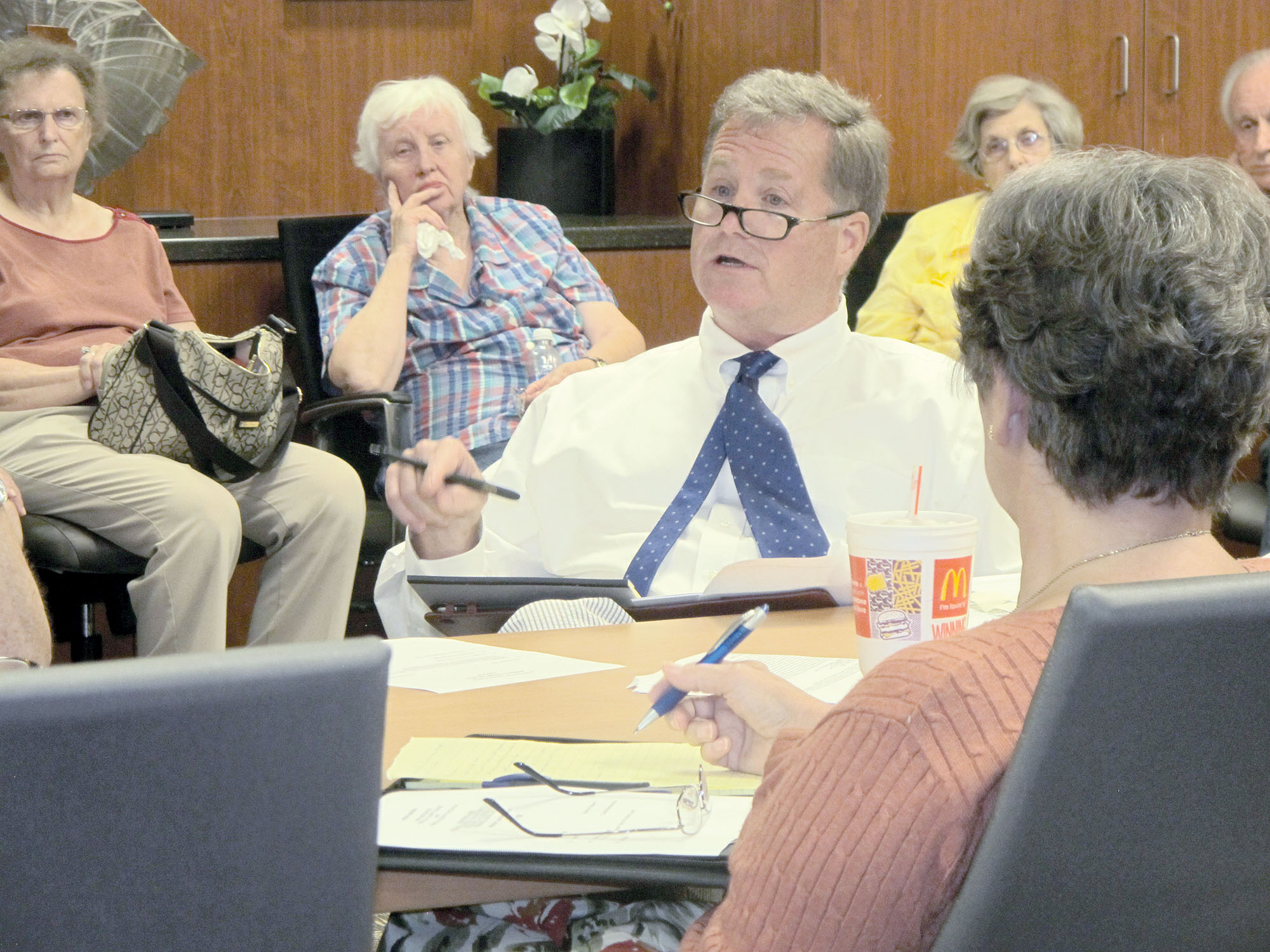
    State Sen. Creighton Coleman lays out rough ideas for the future allocation of V.C. Summer revenues. (Photo/Barbara Ball)

    Delegation Pitches Ideas to County

    WINNSBORO – In a meeting at the Midlands Tech QuickJobs center Monday night, six of seven County Council members sat down with Fairfield County’s legislative delegation to begin discussions about the future impact of expected revenues from two new reactors currently under construction at the V.C. Summer Station in Jenkinsville.

    It was the first of what Council Chairman David Ferguson (District 5) said would be a series of meetings with Fairfield’s various governing bodies, with future meetings to include the Fairfield County School Board and the towns of Winnsboro, Ridgeway and Jenkinsville. The talks would culminate in a joint meeting, Ferguson said, at which time it was hoped that the County would have acquired input from the Central Midlands Council of Governments (COG), with whom the County has recently contracted to perform long-range strategic planning.

    The meeting began with a recap of the County’s long-term economic development plan, beginning with its adoption by Council in 2009, the construction of the Midlands Tech facility, the construction of a speculative (spec) building at the Walter Brown II Industrial Park and the purchase and development of property off Peach Road, now known as the Fairfield Commerce Center. The recap also touched on 2013’s $24.06 million bond issue, the repayment of which relies heavily on the projected V.C. Summer fee-in-lieu of taxes revenues (estimated to be between $80-$100 million annually).

    “The purpose was to front-end load the money and plan when the new revenues will be coming in from the nuclear reactors coming on line, then make the decisions on how to pay those back and do things long term,” Interim County Administrator Milton Pope said.

    The bond also obligates some of the reactor money, acting as “another legal protection for those monies in case there were a raid to take away a portion of the money from Fairfield County,” Pope said, referencing bills circulating at the state capital designed to share that revenue with other counties.

    The Legislative Delegation

    Fairfield County’s representatives in Columbia, Rep. MaryGail Douglas (D-41) and Sen. Creighton Coleman (D-17) have been clamoring for a sit-down with County Council to plan for the reactor money since at least last spring, and at the June 16 intergovernmental meeting the issue came to a head. Over a long, tense exchange, the delegation and Ferguson engaged in heated spat over who had ignored who’s invitation to planning talks. Monday night, however, both sides were on their best behavior as Douglas kicked things off by suggesting a more comprehensive recreation plan.

    The 2013 bond allocates $3.5 million for the development of recreational facilities, with $500,000 to be spent in each of the county’s seven districts. Apart from Kamau Marcharia’s plan to erect a large facility in District 4, preliminary talks in the remaining district have thus far focused on smaller parks.

    “I want our vision for Fairfield County to be more than swing sets and walking trails and basketball courts,” Douglas said. “It’s got to be more than that.”

    Douglas also said the reactor revenues could also be used for property tax relief, as well as to address needs at, or alternatives to, Fairfield Memorial Hospital.

    “I’ve had a vested interest in that hospital for many, many years,” Douglas said, “but we have to be realistic. We can’t continue to operate a hospital in the current state that it’s in. We’ve got to have some kind of medical care, but the vision you could have with another type of medical care in the community could be done.”

    Coleman said infrastructure – primarily a secure source of potable water for both residential and future economic growth – was critical, as was property tax relief. Coleman also suggested that some of the reactor money could be devoted to scholarships for local students, while a portion could be returned to Fairfield County citizens as well as set aside for emergencies.

    “Just because we have this money doesn’t mean we have to spend it all,” Coleman said. “We need to save some money in case something happens out there (at V.C. Summer).”

    No date has been set for future planning sessions. Councilman Mikel Trapp (District 3) was not present at Monday night’s meeting.

  • Faulty Signal Delays Traffic

    BLYTHEWOOD – After receiving several phone calls from residents who waited up to 30 minutes on Monday for the light to change at the intersection of Langford Road and Main Street (Highway 21), Blythewood Mayor J. Michael Ross contacted the S.C. Department of Transportation (DOT).

    Barry Mattox, Assistant District Traffic Engineer for the DOT, told The Voice that a recent malfunction in the light system apparently caused it to occasionally not change properly for Langford Road.

    “Something wasn’t working correctly,” Mattox said, “so our Traffic Engineer, Brett McCutchen, spent some time out there on Monday and again Tuesday morning and got it cycling correctly. Clearly something wasn’t right, but we have it fixed now, but when school opens, we’re going to have to expect new delays even though the light is working properly, because all that traffic from Rimer Pond Road has to go through town until the road is opened back up. But it certainly shouldn’t be as bad as it was on Monday when the light was stuck.

    “We’ll keep an eye on it as school starts and make any necessary field adjustments to help the flow of traffic,” Mattox said. “But motorists are going to have to be patient, because with the detour still in effect and school starting, the traffic is going to be heavy at these intersections in Blythewood.”

  • Botanical Beauty

    Horticulture magazine praised it as “one of 10 gardens that inspire.” HGTV calls it “one of 20 great public gardens across America.” Well you don’t have to drive across America to see it. A 30-mile drive will take you to the Riverbanks Zoo Botanical Garden, across the Saluda River from the zoo proper.

    Now’s a good time to go, although something is always blooming at the garden. The gardens are so lush, so beautiful that weddings and other events often take place there. The gardens are themed too. There’s the Collection Garden where 100 different milk and wine lilies grow. There’s the Old Rose Garden where you’ll find the world’s largest collection of Noisettes. Kids love the Play Garden, which features a playhouse and secret play garden.

    The Walled Garden is a show stealer. This 34,000-square-foot garden features a maze of seasonal and themed gardens. Don’t be surprised if you go home with new concepts and ideas for your garden. It’s an inspiring place.

    At the West Columbia entrance you’ll see the Bog Garden with is large waterfall. See too the carnivorous pitcher plants and water lilies. The large boulders will give you a sense of being in the mountains too. In a corner of the Bog Garden you’ll find the Asian Garden. Built in 2009, the Asian Garden quickly developed into a lush and botanically diverse space. Here, a short boardwalk overlooks a small pool. You’ll find benches to rest on and listening to the soothing white noise of trickling water will put you at ease. See the Asian trees, shrubs, perennials and bamboo in this garden.

    The walk from the zoo proper across the brick span uphill can be taxing, but no worries. A tram can take you there with ease. Once you’re at the garden be sure to walk the nature trail. To me, trail highlights include the ruins of the old Saluda Mill ruins and its lonesome but winsome stone keystone arch, testaments to Sherman’s march through Columbia.

    Once your garden stroll is over you can always take the tram back to the zoo proper. Over 2,000 animals will keep you enthralled, amused and outright surprised. Between the zoo’s wildlife and the gardens flora, a day here is like a trip around the world.

    Each year I purchase a family membership to the zoo. I like to stroll through the gardens on cooler days, and I’m planning to go there with my laptop and work now and then. Seventy acres of botanical beauty makes for an inspiring place to write. And as for you? Well I have no doubts this place will bring out the gardener in you. It did in me and I have a themed garden of my own in my back yard as a result.

    If You Go …

    Riverbanks Zoo

    & Botanical Garden

    500 Wildlife Parkway

    Columbia, S.C.

    803-779-8717

    www.riverbanks.org/botanical-garden/

    Learn more about Tom Poland, a Southern writer, and his work at www.tompoland.net. Email day-trip ideas to him at tompol@earthlink.net.

  • Road Work Hits Snag

    Rimer Pond Road Delayed Until Fall

    BLYTHEWOOD – Rimer Pond Road may be closed for construction until the first part of October, according to a construction update from Jason Fulmer, the S.C. Department of Transportation’s (DOT) Project Manager for the construction.

    Fulmer told The Voice earlier this month that everything was on schedule and that he thought the work would be finished and the road paved by Aug. 31, the scheduled completion date. On Tuesday, Fulmer said the date may be pushed back as late as October.

    “We’re still waiting on some environmental permitting,” Fulmer said, “then we’ll be ready to start some of the preliminary work for paving on half the road.”

    He said crews were still moving dirt on the other half.

    “We hope to start on the (preliminary) paving work (Wednesday),” he said, “if we get some test results back in time and it doesn’t rain.”

    Fulmer said the delays were primarily due to delayed utility construction, environmental permitting and other unforeseen problems, including subsurface water discovered under the roadway across from a large pond.

    “When we started breaking ground, we discovered what appears to be a spring under the road, and that necessitated redesigning the whole system before work could progress,” Fulmer said.

    “We’re trying to get the road open for the schools as soon as we can,” Fulmer said, “to help ease traffic congestion after school starts.”

    The road was closed to through traffic on April 14 to realign a major curve on the road that has long been a high accident area. To accommodate moving sections of the curve as much as 50 feet from center line, DOT crews moved power, cable, gas and sewer lines. They also installed storm water pipes.

  • Blythewood Courts Capital City

    Mayor, Council Seek Columbia Water Service

    BLYTHEWOOD – As the dispute over the water franchise agreement between the towns of Blythewood and Winnsboro lingers unresolved, letters obtained by The Voice last week indicate a courtship of the City of Columbia for future water service is already under way.

    In a letter dated July 22 and addressed to Columbia Mayor Steve Benjamin and Columbia City Council, Blythewood Mayor J. Michael Ross wrote, “Town Council has concluded that our citizens will be best served by Columbia, and we respectfully request your assistance in making a transition from Winnsboro to your system as soon as possible.”

    In an Aug. 5 letter from Benjamin to Winnsboro Mayor Roger Gaddy and Council members, referencing a recent meeting between Winnsboro and Columbia, Benjamin said Columbia was ready to begin discussions concerning the acquisition of the Blythewood water infrastructure, as well as the water customers who come along with it.

    But any discussions regarding the sale of Winnsboro’s plumbing underneath the streets of Blythewood may be premature.

    “Mayor Gaddy has notified the principals that any decision with regard to the Blythewood portion of the Town of Winnsboro’s water system,” Winnsboro Town manager Don Wood wrote in an email to The Voice Monday, “is contingent upon arbitration of the water franchise agreement.”

    Gaddy indeed responded to Benjamin’s letter on Aug. 20, writing that Winnsboro considers any discussion regarding the sale of the Blythewood system “premature in that Winnsboro is demanding arbitration,” over the disputed termination of the franchise agreement.

    Gaddy also wrote that Winnsboro is currently “pursuing actions to obtain a sustainable source of water” that should “alleviate any water capacity issues within the Richland County and Town of Blythewood portions of the Town of Winnsboro Water System.”

    In a move last April that took the Town of Winnsboro completely off guard, Blythewood Town Council passed a resolution to terminate the franchise agreement that transfers approximately $13,000 from Winnsboro to Blythewood annually and gives Winnsboro access to Blythewood right-of-ways necessary to service and maintain water infrastructure within the Blythewood town limits. Severance of the agreement would, according to the contract, require Winnsboro to sell off that infrastructure at fair market value to Blythewood. John Fantry, Winnsboro’s attorney for utility matters, said after a Winnsboro Town Council meeting last month that another entity, such as the City of Columbia, could purchase and operate the system on Blythewood’s behalf.

    After the resolution passed, Ross told The Voice that Blythewood had “hit the panic button” after learning that Winnsboro was negotiating the sale of the Blythewood infrastructure to Ni America, LLC, a private firm that owns Palmetto Utilities in Elgin. A source close to that situation told The Voice last April that Ni America had made an $800,000 offer to Winnsboro, but Gaddy and Councilman Stan Klaus said Winnsboro was not, in fact, in negotiations for a sale.

    The termination resolution triggered a disagreement between the two municipalities over when such a termination may legally be made. Blythewood contends the contract runs out in 2016, and Ross told The Voice Monday that Council was, by passing the resolution in April, paving the way for a transfer of the water system.

    “It was the time to start that process,” Ross said, “eighteen months ahead of (when the contract runs out). And I think Winnsboro wants to get out of it as much as we want Columbia to come in.”

    Winnsboro, meanwhile, contends that the franchise agreement is binding until the year 2020, and copies of the contract provided to The Voice by Winnsboro support that claim. With the termination in dispute, Winnsboro Town Council voted at a July 17 special meeting to hire Robert Bachman as their representative in arbitration. According to the agreement, contractual disputes are subject to arbitration under S.C. law. As of press time, however, Blythewood had not hired an arbitrator to represent its side in the disagreement. At their meeting Tuesday night, Winnsboro’s Town Council flatly denied that they wanted out of the agreement.

    “We don’t like to go to arbitration,” Ross said. “It costs us money.”

    Winnsboro appears bent on arbitration, however, and Fantry told The Voice Tuesday night that he had notified Ross late last week that Winnsboro had retained an arbitrator. Blythewood now has 30 days, Fantry said, in which to secure its own.

    In Ross’s July 22 letter to Columbia, Ross said Winnsboro’s ability to deliver sufficient quantities of water had become “compromised” in recent years, putting on hold “a number of economic development projects” because of Winnsboro’s “inability to add taps.” Monday, Ross expanded on that, telling The Voice that the Doko Village development, as well as Red Gate on Muller and Blythewood roads, were both turned down for water by Winnsboro.

    Winnsboro is currently buying wholesale water from Columbia and piping it through their meters and selling it to Blythewood customers. Winnsboro’s agreement with Columbia provides up to 1 million gallons a day, but Ross said Winnsboro is only using about a quarter of that capacity at present.

    Water rates have increased somewhat this year, in part to help Winnsboro acquire the additional capacity from Columbia. Ross said he didn’t expect the rates to change dramatically with Columbia taking complete control, although a marginal increase would be worth the security of knowing water was available.

    “Our concern is more about having the water and setting the future for Blythewood and not having a concern of not being able to get water,” Ross said. “If that’s $1 more a month on my water bill, that’s worth it.”

  • Council OK’s Town Hall Barrier

    Restaurant Lease on Hold

    RIDGEWAY – At their Aug. 14 meeting, Town Council unanimously approved the expenditure of $1,200 for the construction of an earthen berm on the east side of the Century House to stop the flow of thru-traffic that has been causing damage to the lot. Council awarded the contract to M.C. Rowe, a Ridgeway company.

    Council also gave the final OK to an ordinance authorizing Mayor Charlene Herring to sing a lease agreement with a new tenant for the Old Town Hall restaurant. Herring did not, however, ink the deal.

    “We’ve agreed in principal to the terms and conditions,” Councilman Russ Brown said last week, “and we hopefully have an announcement next week.”

    The deal had not been finalized by press time.

    Rezoning Hearing

    Council will hold a rezoning hearing at Town Hall at 6:30 p.m. Monday for .82 acres situated in the fork at Highway 34 and Highway 321. The property is currently zoned as R1 (single family residential) and Brown, the property owner, is seeking to have it rezoned as commercial. Brown said he will recuse himself from discussions on the rezoning process.

  • PASS/HSAP: Little Movement in Fairfield Numbers

    WINNSBORO – Scores from last spring’s Palmetto Assessment of State Standards (PASS) tests, released last week by the State Department of Education, show numbers holding more or less steady across the board for Fairfield County students in grades three-eight. The District experienced some moderate gains on Writing test scores, while Math scores failed to meet the expectations of Superintendent J.R. Green.

    “We are going to launch a full-out assault on attacking math standards for next year,” Green said. “We are going to redouble our efforts to ensure students have a solid math foundation and conceptual understanding of the standards.”

    Last year, Green said he was shooting for Math scores in the 80 percent range. That did not transpire, as the percentage of students scoring Met or Exemplary ranged from 48.3 in seventh grade to a high of 65.3 in eighth grade.

    Fairfield Elementary saw upticks in the percentage of students scoring Not Met in Math in grades three-six, with the largest drop off coming between fourth-graders in 2013 (51.4 percent Not Met) and fifth-graders in 2014 (62.1 percent Not Met). Fairfield Magnet School for Math and Science, meanwhile, saw some improvements, with the percentage of students scoring Not Met decreasing somewhat between 2013 and 2014. Those numbers were marred, however, by the comparison between 2013 fourth-graders (2.6 percent Not Met) and 2014 fifth-graders (18.4 percent Not Met).

    “I set the bar high,” Green said. “(80 percent) was an aggressive goal and I don’t back off from that. We will continue to push for it.”

    Social Studies scores were also largely unmoved, with gains between 2013 fifth-graders (41 percent Not Met) and 2014 sixth-graders (23.3 percent Not Met) offset by losses elsewhere. McCrorey-Liston Elementary saw some of the biggest gains in the subject between 2013 third-graders (40 percent Not Met, 60 percent Met and Exemplary) and 2014 fourth-graders (5.9 percent Not Met, 94.1 percent Met and Exemplary).

    Overall, the District lost a few percentage points in English Language Arts (ELA), while Writing scores increased at every grade level.

    “Writing was one of our bright spots, across the board,” Green said. “We pretty much went up at every school.”

    District wide, the biggest gain came between fourth-grades in 2013 (56.7 percent Met and Exemplary) and fifth-graders in 2014 (73.8 percent Met and Exemplary).

    Science scores were also modestly improved across the board, with sixth-graders in 2013 (53.7 percent Met and Exemplary) performing much better as seventh-graders in 2014 (70.6 percent Met and Exemplary). Although Fairfield Elementary’s Science numbers took a hit between grades four and five , with 66.2 percent of 2013 fourth-graders scoring Not Met compared with 81.3 percent of 2014 fifth-graders scoring Not Met, the same transitioning class at the Magnet School saw their percentage of students scoring at Met and Exemplary go from 97.4 percent in 2013 to 100 percent in 2014.

    “We had a pretty big year in 2012,” Green said. “Of course, I would like to continue to see that kind of growth every year, but it’s not realistic to expect to be in a perpetual state of growth. We’ve set the bar high, but we have to be reasonable. We want to create substantial levels of achievement, and not just blips on the radar.”

    HSAP

    The District’s High School Assessment Program (HSAP) test scores also remained virtually constant with 2013 numbers. In ELA, the percentage of students scoring at Level 1 (did not demonstrate competence) was up by a decimal point, from 13 percent last year to 13.1 percent in 2014. The percentage of students scoring at Level 4 (exceptional) fell from 16.6 in 2013 to 14.1 this year, while the percentage of students meeting HSAP standards ticked downward from 87 percent last year to 86.9 in 2014.

    In Mathematics, the percentage of students scoring at Level 1 crept up from 33.2 in 2013 to 35 in 2014, while the percentage of students scoring at Level 4 dropped from 13.5 in 2013 to just 4.9 in 2014. The percentage of students meeting the HSAP standards also fell from 66.8 to 65.

    Green said the math scores represent a conundrum, as this is the first year in which the District’s End of Course (EOC) scores did not trail the HSAP scores. The District experienced significant gains in EOC scores in Algebra I, Green said (that data has not yet been made public by the Department of Education), and in years prior those gains have translated into even higher numbers on the HSAP exam. This year, however, that was not the case.

    “Our End of Course scores in Algebra I are good,” Green said. “For the same kids a year later to test 15 points lower on the HSAP is a problem.”

    Green speculated that some specialized math teachers may be teaching fewer HSAP standards and more standards specific to their particular branch of math – geometry, for example – during the year. The District will not get the opportunity to address that problem directly, however, as HSAP will be replaced next year by an as yet unknown assessment test, testing for an as yet unspecified set of standards.

  • Reactor Work Faces Delays

    Unit 2 Expected in Late 2018

    JENKINSVILLE – Construction on a pair of new reactors at the V.C. Summer Nuclear Station has hit another snag as South Carolina Electric & Gas (SCE&G) investors learned Monday that completion of the project will be delayed until at least late 2018. The news was revealed in a conference call between Steve Byrne, CEO of SCE&G, Jimmy Addison, CFO of SCANA Corp. and representatives from eight investment firms.

    “(T)he Consortium (Westinghouse and Chicago Bridge & Iron, or CB&I) began working on a full rebaselining of construction schedules for Units 2 and 3 at V.C. Summer in late 2013,” Byrne told investors during the conference call. “They recently provided us with a preliminary integrated project schedule, or IPS, indicating that they now expect the substantial completion of Unit 2 to occur in late 2018, or during the first half of 2019, with Unit 3 being substantially complete approximately 12 months later.”

    The cost of the delay was unknown at press time, since the consortium had not yet provided SCANA (SCE&G’s parent company) with updated cost data, a SCANA spokesperson said Tuesday. SCE&G, she said, has not accepted responsibility for any delay related costs, placing the blame squarely at the feet of the consortium. Whether the delay will translate into a request by SCE&G for a rate increase from the S.C. Public Service Commission (PSC) was also not known.

    “We will not be able to project rate-related impacts until the revised schedule and cost estimates are completed,” the spokesperson said.

    Byrne told investors he expects to get a cost estimate from the consortium before the end of the quarter.

    “What I anticipate,” Byrne said during the conference call, “is that the first number that I get from the consortium is going to be something I’m not going to like, and they’ll use that as one peg for negotiations. And we’ve seen that before.”

    Tom Clements, director of the nuclear watchdog group Savannah River Site Watch, said the delay comes as no surprise, and neither would rate hikes.

    “We have warned from the start of this risky project that it would face significant delays and cost increases so there is unfortunately no big surprise in SCE&G’s stunning news,” Clements said. “SCE&G rate payers, already facing seven rate increases to pay in advance for the nuclear project, will likely take it on the chin by the cost increases due to the announced delays.”

    SCE&G will have to go before the PSC to seek approval for the delay as it falls outside the 18-month delay period allowed by the PSC when it originally approved the project. Byrne told investors that the Base Load Review Act provides that the PSC would grant the request “as long as it is determined that the change is not the result of imprudence on our part.”

    The V.C. Summer project involves the construction by CB&I of two Westinghouse-designed AP1000 reactors, an experimental design never before built or operated. Key modules for the reactors are being built at the CB&I facility in Lake Charles, La., where chronic problems have brought it under the close scrutiny of the Nuclear Regulatory Commission (NRC).

    “From our perspective, the culprit on the delay so far has been the structural modules coming out of Lake Charles,” Byrne told investors.

    Byrne said the consortium is moving production of modules to other firms in Oregon and Virginia, but some sub-modules arriving on site now were manufactured at Lake Charles, which in recent months has been on schedule, he said.

    The next big module to come out of Lake Charles is the CaO-1, a large structural module that fits inside the containment vessel. “It will go around and form the cubicles for things like the steam generators or reactor vessel, the refueling cavity,” Byrne said, “those kinds of things.” Setting of the CaO-1 is not a milestone for the project, he said, but its installation is a hold-up for other major milestones.

    “We’ve got a module called CaO-3, which forms a large portion of the large water tank that goes inside the containment vessel,” Byrne said. “I cannot set the CaO-3 until CaO-1 is set. SO even if CaO-3 is on site and may be constructed and ready, I won’t be able to set it because CaO-1 will not be set. So that structural module, CaO-1, has been constraining other things.”

    Byrne said CB&I has recently undertaken an overall review of the project and has integrated those findings into the new work schedule it presented to SCE&G last week.

    “We should be beyond the Lake Charles obstacle shortly,” Byrne said.

    The schedule for the project was previously reworked in 2012, a SCANA spokesperson said.

  • County Bond Raises Questions

    No Answers for $1+ Million Issue

    WINNSBORO – Without a word to the public, County Council has issued another general obligation (GO) bond, this one in the amount of $1,156,000, half again as large as the one issued on Feb. 14 for $769,177.88 and almost three times as much as the County needs to make the Sept. 1 interest and principal payment on the County’s $24 million Installment Purchase Revenue Bond (IPRB) issued in the Spring of 2013. The newest bond was filed with the Fairfield County Clerk of Court on Aug. 7. Both bonds were issued for the stated purpose of making interest payments on borrowed money – the County’s $24 million IPRB. But the Aug. 7 GO bond was issued for $702,528 more than the $453,472 needed for the Sept. 1 payment. No information has been made available to The Voice by the County as to what the additional $702,528 will be used for.

    The issuance of the two GO bonds was made possible by Ordinance 614, passed by County Council on April 15, 2013. At the time, members of Council led the public to believe that Council was issuing the $24 million IPRB. But last spring, interim County Administrator Milton Pope told The Voice that the $24 million IPRB was not issued by the County, but by the Fairfield Facilities Corporation. A number of state and municipal officials have described such facilities corporations as non-profit shell corporations created as a way for local governments to borrow more money than they could otherwise legally borrow and without asking for the voter’s permission.

    A unique slight-of-hand feature of IPRB’s is that, with the passage of Ordinance 614, the County was able to create a mock revenue stream to pay off at least part of the IPRB by providing for the issuance of GO bonds that are then paid off with property taxes levied without voter approval. Ordinance 614 allows the County to continue to issue GO bonds without voter approval so long as the County’s total GO bond debt does not exceed the County’s legal debt limit, which is 8 percent of the County’s assessed property values. That amount was $4.5 million when the Feb. 14 bond was issued. The Voice has not been able to learn what the County’s current debt limit is after the issuance of the $1.156 million bond. But according to one County report acquired by The Voice, the assessed value of all taxable property of Fairfield County (as of June 30) for purposes of issuing GO bonds was $131,127,268.

    According to County records, it used the proceeds from the Feb. 14 bond to pay the March 1 interest payment ($443,472) on the $24 million bond; $40,000 in bond issuance fees, $5,000 for other fees and $285,706 to reimburse itself for general fund expenditures it made for an additional interest payment in the fall of 2013. In addition, the County will pay $69,000 in interest on that bond. But it is not known exactly what the new $1.156 million bond is to be used for or what it will cost the County in interest.

    The Voiced emailed County Administrator Milton Pope on Tuesday asking for details of how the bond would be used, but Pope had not responded by press time on Wednesday.

    Both the Feb. 14 and Aug. 7 bonds are to be paid back over seven years beginning in March 2015. The Voice learned from two sources with GO bond expertise that it is customary that GO bonds taken out to pay for debt are usually paid off within a year, and that the seven-year payout is unusual. Both sources speculated that County Council could be extending the payoff to seven years to avoid raising its millage rate. At this point, in addition to making the annual interest payments on the $24 million bond, which in 2015 will total $896,681, the County will also have to make payments of $1,195,197.68 on the new GO bonds beginning March 1, 2015.

  • Toy Company to Bring 151 Jobs

    Hiring Begins for Sept. Startup

    WINNSBORO – In an announcement made at the Midlands Technical College QuickJobs campus Thursday afternoon, Enor Corp., a manufacturer of toys and games, was introduced as the latest addition to Fairfield County’s growing economic base. The New Jersey based company will operate out of the former Ruff & Tuff building at 1 Quality Lane, off Highway 321, in Winnsboro, with limited operations expected to begin next month. Enor Corp. is a major supplier of plastic toys, outdoor games and junior sports items for Walmart stores.

    “The addition of Enor Corporation is another great win for the economy and workforce of South Carolina,” Fairfield County Council Chairman David Ferguson (District 5) said. “Fairfield County is excited to be a part of the continuous re-shoring initiative with Walmart’s supply chain and the Council is honored to have had the opportunity to work closely with Enor as they were searching for the right location to grow their business. The bounty of companies continuing to locate, build and grow within the borders of this state and in the central S.C. region is a testament to the opportunities and support available here to businesses.”

    The multi-million dollar investment is expected to create 151 jobs, with 100 of those jobs coming in the first year of operation. The majority of the jobs will involve injection-molding skills. The average salary of those jobs was not available at press time. Enor Corp. will begin hiring for the new positions immediately, with readySC.org assisting with the application process. Enor said it expects to accelerate production rapidly over the next nine months, transferring the majority of its off-shore production to the new facility in Winnsboro “as quickly as practical without disrupting supply.”

    “Today’s announcement represents our life-changing commitment to manufacture exclusively in the U.S. Our relationship with Walmart began more than 15 years ago, and this is a vital next step,” said Steven Udwin, CEO of Enor Corp.

    Enor Corp. was drawn to Fairfield County by an incentives package, the details of which have not yet been made public, but which included a fee-in-lieu of taxes agreement ushered through County Council recently under the code name “Project Leprechaun.” Enor Corp. also received a $300,000 Rural Infrastructure Fund grant from the S.C. Coordinating Council for Economic Development. Those funds will be used to retrofit the 78,000-square-foot building.

    The addition of Enor Corp. brings the total number of jobs introduced into Fairfield County over the last year to 800.