Category: News

  • RWA Ushers in First Hall of Fame Class

    WINNSBORO – Richard Winn Academy proudly announces the launching of an athletic Hall of Fame. The first annual Hall of Fame induction will take place during halftime of the home football game this Friday, Sept. 12, at Ruff Field. The kickoff for the football game featuring the RWA Eagles versus Charleston Collegiate will be at 7:30 p.m.

    The inaugural Hall of Fame inductees include Carol Caughman Turner, Beth Reid, Mike Robinson and Jena Barnett Johnson.

    Carol Caughman Turner was a member of the inaugural girls’ basketball team, playing from 1968-1971. Serving as team captain, she also was selected as Most Valuable Player. After graduation, she was one of the first Lady Eagles to go on to play basketball at the collegiate level, playing for Baptist College.

    Beth Reid began her high school basketball career as a seventh grader in the 1970-1971 season and was member of the inaugural softball team in 1973. She achieved numerous individual and team awards. Beth also continued her basketball career playing at the College of Charleston. After college, she returned to her Alma Mater to serve as teacher, coach and later as Head of School. In 1985 coach Reid led her basketball team to RWA’s first girls’ basketball state championship.

    Mike Robinson came to Richard Winn in 1978 as a teacher and coach. Over the years he served as head basketball coach for both girls and boys as well as golf and assistant football coach. Coach Robinson was a part of five state championships and three state runners-up teams while at RWA.

    Jena Barnett Johnson was a member of the varsity basketball program from 1980-1985 and a member of the softball team from 1980-1984. In basketball she was selected as All Conference for four years and Player of the Year for three years. During her high school career she scored 2,300 points and was named as an Honorable Mention All American. Jena went on to play basketball at Clemson University.

  • ACT Scores Inch Upward

    COLUMBIA – While statewide results in this year’s American College Testing (ACT) composite scores edged upward by a percentage point, graduating seniors in local high schools taking the test last spring produced varying results, according to data released last month by the S.C. Department of Education. While the benchmark scores in the subjects of English, Math, Reading and Science improved or stayed nearly the same among local test takers, only test takers at Blythewood High School, and only in one subject – English – met or exceeded the ACT benchmark numbers.

    The Benchmarks

    The ACT sets benchmark scores as a minimum required to indicate a 50 percent chance of earning a B or higher, or a 75 percent chance of earning a C or higher, in the college courses of English Composition, Algebra, Social Science and Biology. The corresponding ACT test subjects and their benchmarks are English, 18; Mathematics, 22; Reading, 22; and Science, 23.

    (2013 benchmark scores in parentheses)

    Blythewood High School

    BHS had 213 seniors take the ACT in 2014, compared with 180 a year ago. Test takers scored an average of 19.2 in English (19.8); 20.2 in Math (20.6); 20.8 in Reading (21); and 20.3 in Science (20.1), with a mean composite score of 20.2 (20.4). This was on par with Richland 2’s district-wide scores of 19.2 in English (19.3); 20.2 in Math (20.4); 20.7 in Reading (20.5); and 20.2 in Science (20), with an average composite of 20.2 (20.1).

    Westwood High School

    WHS tested 82 seniors in 2014, compared with 26 in 2013. Test takers averaged scores of 16 in English (15); 16.9 in Math (17); 17.6 in Reading (17.2); and 17.4 in Science (17.1). WHS senior test takers averaged a composite score of 17.1 (16.6).

    Fairfield Central High School

    The lone high school in the Fairfield County School District tested 70 seniors in 2014, down from 76 last year. Test takers averaged scores of 15.6 in English (14.2); 16.8 in Math (16.5); 17.1 in Reading (16.2); and 16.6 in Science (16.5), with an average composite score of 16.6 (15.9).

    National Averages

    State and local scores remain below the national averages in all four subjects. In 2014, those averages were: English, 20.3 (20.2); Math, 20.9 (20.9); Reading, 21.3 (21.1); and Science, 20.8 (20.7), with an average composite of 21 (20.9).

    “While South Carolina’s average ACT composite score was slightly under the national average, its proximity proves that we are making progress,” State Superintendent of Education Dr. Mick Zais said. “These are positive results that we can build on for the future.”

  • County Quiet on Bond

    WINNSBORO – After The Voice reported three weeks ago that the County had issued another general obligation (GO) bond on Aug. 7, little information has been forthcoming from the County about what much of the $1,156,000 bond is being used for.

    More than Enough

    The Payment Certificate related to the Aug. 7 bond states that it is earmarked to pay one or more installment payments to the Fairfield Facilities Corporation (FFC) (to be used toward pay off of the $24 million bond) and the costs of issuance. But the amount of the Aug. 7 GO bond far exceeds the amount of money needed for the Council’s $453,472 installment payment to the FFC that was due Sept. 1.

    So far, County Administrator Milton Pope has not answered The Voice’s emailed questions as to how, specifically, the remaining $702,528 is to be used, except to say that $20,000 of it was an issuance fee paid to the County’s bond consultant, Parker Poe. When pressed further, Pope referenced the County’s ‘Projects’ that are being constructed with the $24 million bond proceeds and wrote that an “upcoming presentation will give adequate detail to all aspects of the bond and therefore at least settle the factual discussion about the matter.” He said that presentation will be made at the Sept. 22 Council meeting.

    Lingering Questions

    The mystery surrounding the disbursement of the new GO bond is exacerbated by a number of issues. It appears the County never explained publicly or early on the details of the role of the FFC, the intricacies of the $24 million bond’s purchase/payment process or that the new semi-annual GO bonds were even coming down the pike. To justify the issuance of the $24 million bond, there have been revelations of late by County officials that the bond ‘almost’ obligates the future revenue from the two new V. C. Summer reactor units in case there were a raid (by other communities in the state) to take away a portion of those moneys from Fairfield County. And in response to complaints that the County has not been open about the entire bond process, Pope insists that the GO bonds were discussed at several meetings when Ordinance 614 (providing for the GO bonds) was on Council’s agenda in March and April 2013. However, while the ordinance is on file, there is so far no evidence that the particulars pertaining to the issuance of GO bonds to help pay off the $24 million bond were discussed in any detail so that the public would be fully informed on the matter. The Voice has filed a Freedom of Information request with the County for the digital recording of the March 25, 2013; April 8, 2013 and April 15, 2013 Council meetings in which Ordinance 614 and a Resolution establishing the Fairfield Facilities Corporation were passed.

    In an interview with The Voice on Aug. 18, County Council Chairman David Ferguson (District 5) complained that a news story about the bonds that appeared in the Aug. 15 issue of The Voice was not accurate, but he declined to clarify what in the story was inaccurate.

    Ferguson said he was not sure what the proceeds of the $1,156,000 bond are to be used for.

    “I’m not a mathematician,” he said. “You’d have to get that information from Michael (Kozlarek, the County’s bond consultant representing Parker Poe) . . . but he won’t talk to you. It’s not in his contract.”

    When one of Columbia’s top bond attorneys, who asked not to be named, was asked to speculate on how the new GO bond proceeds are possibly being used, other than to pay for the $453,472 installment payment on Sept. 1, he replied, “I can’t figure out what they’re doing.”

    While he said he would not presume there were any illegalities in the matter, he had a number of questions including why the two new GO bonds were being stretched out to a 7-year pay off instead of a standard 1-year pay off. He also said it looks like Council is trying to manage its debt millage so that it doesn’t go down or up “by staying within the tax burden that the people (property owners) already have.”

    A Misunderstanding

    At a special meeting between the Council and the Legislative Delegation on Aug. 18, Pope blamed what he calls a misunderstanding about the County’s bonds on the media.

    But the County’s critics say some of the County’s information about the bonds has been faulty. Following Council’s meeting on March 25, 2013, then County Administrator Phil Hinely was quoted in both Fairfield County newspapers as saying that the Council passed a $24 million bond. Pope has recently clarified that it was not the County, but the Fairfield Facilities Corporation that issued the bond. Hinely was also quoted in the newspapers as saying that the $24.06 million in bonds Council voted on aren’t necessarily ‘new’ bonds, but are a ‘rolling over’ of the 2009 bonds that kick-started the County’s 10-year economic plan. Therefore, he said, they don’t come with a tax increase.

    Asked to explain the ‘rolling over’ of the 2009 bonds, two of The Voice’s sources for bond information said that explanation did not make sense.

    The FFC has been described to The Voice by various government officials as a non-profit, shell corporation created by Council to borrow more money than it could otherwise legally borrow within its constitutional debt limit, which is equal to 8 percent of the assessed value of taxable property in the County. For Fairfield County, that limit as of March 2, 2013 was $4.5 million. That will decrease with each new GO bond issued unless the previous GO bond(s) are paid off.

    Bond Mechanics 101

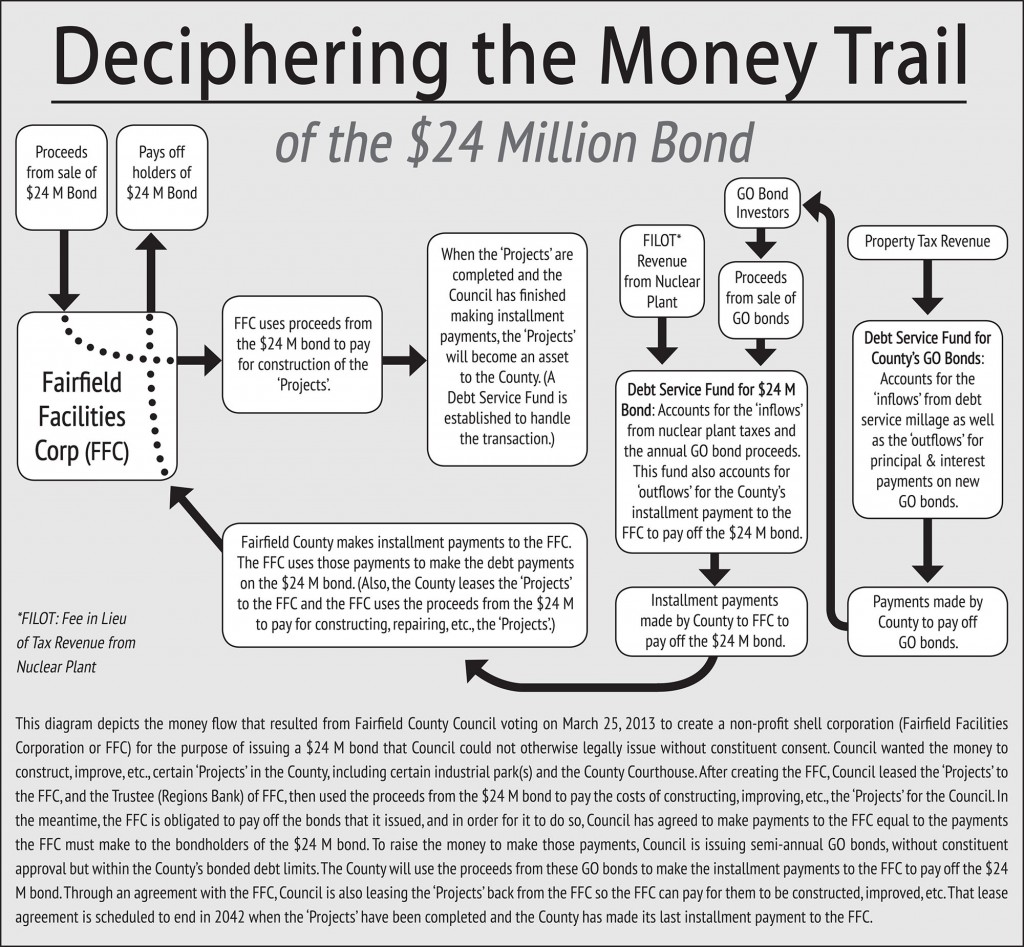
    The purchase/payment process set up through the FFC is convoluted on every level. According to the bond document, after the FFC issued the $24 million bond, it will use the proceeds to construct or renovate the ‘Projects’ (See box at right) for the County. The FFC retires the $24 million bond debt with the semi-annual installment payments it receives on March 1 and Sept. 1 each year from the County. Each of the County’s payments are equal to the amount the FFC pays to retire the $24 million bond.

    The Council has agreed to make those semi-annual payments with a portion of the fee-in-lieu-of-taxes (FILOT) it expects to receive from two new reactor units under construction at the V.C. Summers nuclear facility. At the time of the agreement, those units were scheduled to be placed into service in 2017 and 2018, respectively, with the first revenue from the units expected to materialize in 2019 according to the bond document. Since the County had to find an additional source to make payments until the FILOT revenue materialized, the installment payments from 2013 through Sept. 1, 2020 were kept low, at about $450,000 semi-annually or about $900,000 annually. On April 15, 2013, Council passed Ordinance 614 that would allow it to issue as many GO bonds as it needed (without voter approval) to provide for those installment payments so long as the amount of the GO bonds did not exceed the County’s bonded debt limit.

    In 2021 the annual installment payments jump to $1,670,106. Adding to the County’s financial burden, in 2019 it will be taking on other large bond related expenses including a payment of $1,670,106 to the $24 million bond’s Secondary Reserve Fund. And that same year it will owe the last payment ($102,919.41 plus interest) on the $769,177.88 GO bond issued Feb. 14, 2014 and the last payment ($139,305.05 plus interest) on the recently issued $1,156,000 GO bond.

    Many questions remain, like how is the County paying for the new GO bonds since Pope has said no new taxes will be levied to pay for them?

    While the County is counting on the FILOT revenue to start coming in before the larger installment payments on the $24 million bond are scheduled to begin March 1, 2021, there are no guarantees. It was recently announced that, because of construction delays, the first revenue from Units II and III has now been backed up to late 2020 or possibly early 2021.

  • Toys in the Attic . . .

    A Tale of the Grail –
    Dr. John Nicholson, Bobby Arndt and Rufus Jones proudly show off the Ridgeway High School state championship trophy that the school’s 6-man basketball team brought home in 1935. The trophy was recently found after it went missing in 1960. (Photo/Barbara Ball)

    Title Trophy Turns Up After 54 Years in Exile

    RIDGEWAY – The Ridgeway Cardinals, the former Ridgeway High School’s 6-man basketball team, made their town proud in 1935 when they brought home the state championship trophy for Class C schools.

    “It was the only time Ridgeway High School had ever won a state championship and the whole town was proud,” recalled Rufus Jones whose dad, Rufus Baxter Jones, played guard on the team.

    Indeed, the folks in Ridgeway were proud of their boys. And the sports reporter for the Winnsboro newspaper at that time, A. B. Fennell, was euphoric in his story about the game.

    “Displaying a brilliant-brand of basketball, the Ridgeway class C basketball team defeated Mt. Croghan at the University of South Carolina annual high school basketball tournament. The score was 39 to 23. The Ridgeway floor game was superior to that displayed by the Mt. Croghan team, and this was the biggest factor in their favor,” Fennell wrote.

    But when the Fairfield County schools were consolidated in 1960, and all the county’s students were sent to the new Winnsboro High School (now Fairfield Central High School), the prized trophy went missing and was never seen again, until recently when Ridgeway resident Sarah Arndt was cleaning out her attic searching for treasures to sell in the Big Grab Yard Sale this weekend.

    “She brought down this trophy and showed it to me and said, ‘What is this?’” her husband, Bobby Arndt, told The Voice.

    After examining the slightly battered pewter trophy, Arndt realized it was the missing 1935 championship trophy. His mother, Frances Arndt, a first-grade teacher in the Ridgeway School for over 30 years, had apparently saved it from being discarded when the school was abandoned after the consolidation and eventually packed it away. Upon her death, the trophy passed to her daughter Sarah among boxes of household items.

    Arndt immediately contacted Ridgeway brothers Rufus and Minor Jones to tell them that he had their dad’s trophy. Then he contacted retired Ridgeway dentist, Dr. John Nicholson, whose grandfather, A. R. Nicholson, had been both coach of the championship team and principal of the school in 1935.

    The players’ names were engraved on the trophy: brothers Lawton and Billy Harley, Robert Hinnant, Rufus Baxter Jones, W. D. Watson, Arthur Heins and coach A. R. Nicholson.

    Billy Harley, a cousin of Rufus and Miner Jones, is the only member of the team still living. He moved to Clemson several years ago where he lives with his son, Little Billy.

    Arndt, Nicholson and Rufus Jones recently met at Ridgeway’s City Gas & Oil Café (formerly Stevie D’s) to pose for pictures with the trophy and make plans for its future safekeeping.

    “As soon as the story about the trophy comes out in the paper,” Jones said, “Little Billy is going to drive down here and pick up the trophy and the newspaper and take them back to Clemson for his dad to see. Then he’ll return it and we’re going to put it in the Ridgeway Museum in The Century House where it can stay on display.”

    “It has a few dents in it,” Jones said, examining the trophy closely, “but otherwise it’s in good shape to be 79 years old.”

  • Ridgeway Inks Restaurant Deal

    RIDGEWAY – The Old Town Hall restaurant, vacant since July when Vesha Sanders closed up shop and moved on, will soon have a new tenant, a new menu and a new full-service bar.

    According to documents obtained last week by The Voice, a group of business investors from Lugoff, headed up by Mike Phelps, have inked a deal to open the new restaurant at its location on 140 S. Palmer St. Phelps told The Voice last week that he plans to open the restaurant for business the first weekend in November to coincide with the Pig on the Ridge festival under the name The Olde Town Hall Restaurant and Pub.

    “We still have a couple of things to do,” Phelps said. “There are a few minor repairs that need to be made before everything is 100 percent concrete. We’ve got a lot of equipment to buy.”

    Phelps said the menu would be simple, yet diverse, ranging from filet mignon to chicken wings, prepared by a chef he said was “locally known,” but whose identity he wished to keep under wraps, for now. Phelps operates a loan company in Lugoff and has never run a restaurant before; but his chef, he said, has 12 years of restaurant experience and will be the driving force behind the new venture.

    Phelps said he plans to be open Tuesdays through Sundays for lunch and dinner, with brunch offered on Sundays.

    According to the lease, signed Aug. 18, the restaurant will operate lease-free for six months, after which they will pay the Town $500 a month for the first year. If renewed, the rent goes to $600 a month for the following two years, and $700 a month for the following three years if renewed again. If renewed a fourth time, the lease would be $800 for years seven and eight, with an option to renew for a ninth and 10th year at $850 a month. Years 11-15 would be $875 a month. The lease also required a $1,000 security deposit.

  • Winnsboro Eyes Broad River

    Project Could Deliver 10 Millions Gallons of Water a Day

    WINNSBORO – Town Council took its first official, however tentative, steps Tuesday night toward bolstering Winnsboro’s water reserves, and those steps lead toward the Broad River.

    Council unanimously passed a resolution giving Town Manager Don Wood the authority to act on the Town’s behalf in coordinating the project, while also giving the OK to enter into contracts with three separate entities to help begin piecing the project together.

    Following an executive session of more than an hour during their regular meeting Tuesday, during which time Council discussed the project with Margaret Pope of the Pope Zeigler Law Firm, Council emerged and agreed to contract with SWS Group; Utility Advisors Network, Inc. (UAN); and the Willoughby & Hoefer, PA Law Firm to assist with the project. All three would work on an as-needed basis, charging hourly rates, Pope said. Those rates were not, however, available at press time.

    SWS, Pope said, would advise the Town on any bond issue that may be necessary to fund the project whose estimated costs range between $12 million and $13 million. UAN would advise the Town on the feasibility of the project and the sufficiency of water rates needed to pay for the project. If rates need to be adjusted, Pope said, or if certain fees, such as capacity fees for industry, needed to be put into place to cover the project, UAN would devise the formula for those rates and/or fees. Willoughby & Hoefer, meanwhile, would aid the Town in acquiring the necessary permits from the S.C. Department of Health and Environmental Control (DHEC).

    Councilman Jackie Wilkes said after the meeting that the project was still very much in its infancy, with the acquisition of land along the Broad River the first hurdle to clear. Wilkes said the Town was considering five different tracts and hopes to make an offer on its first option soon.

    Once the land is purchased, Winnsboro will have to go through the permitting process with DHEC. Preliminary engineering for the project would then have to be completed, giving the Town an idea of just how much money they will be looking for through bonds. Winnsboro last month freed up a considerable amount of debt with the final payment on a nearly $12 million bond that was issued for water treatment plant upgrades.

    The entire endeavor may take several years, and require around 9 miles of water lines, but once completed could pump as much as 10 million gallons of water a day from the Broad River into Winnsboro’s reservoir.

  • Many Hills to Climb

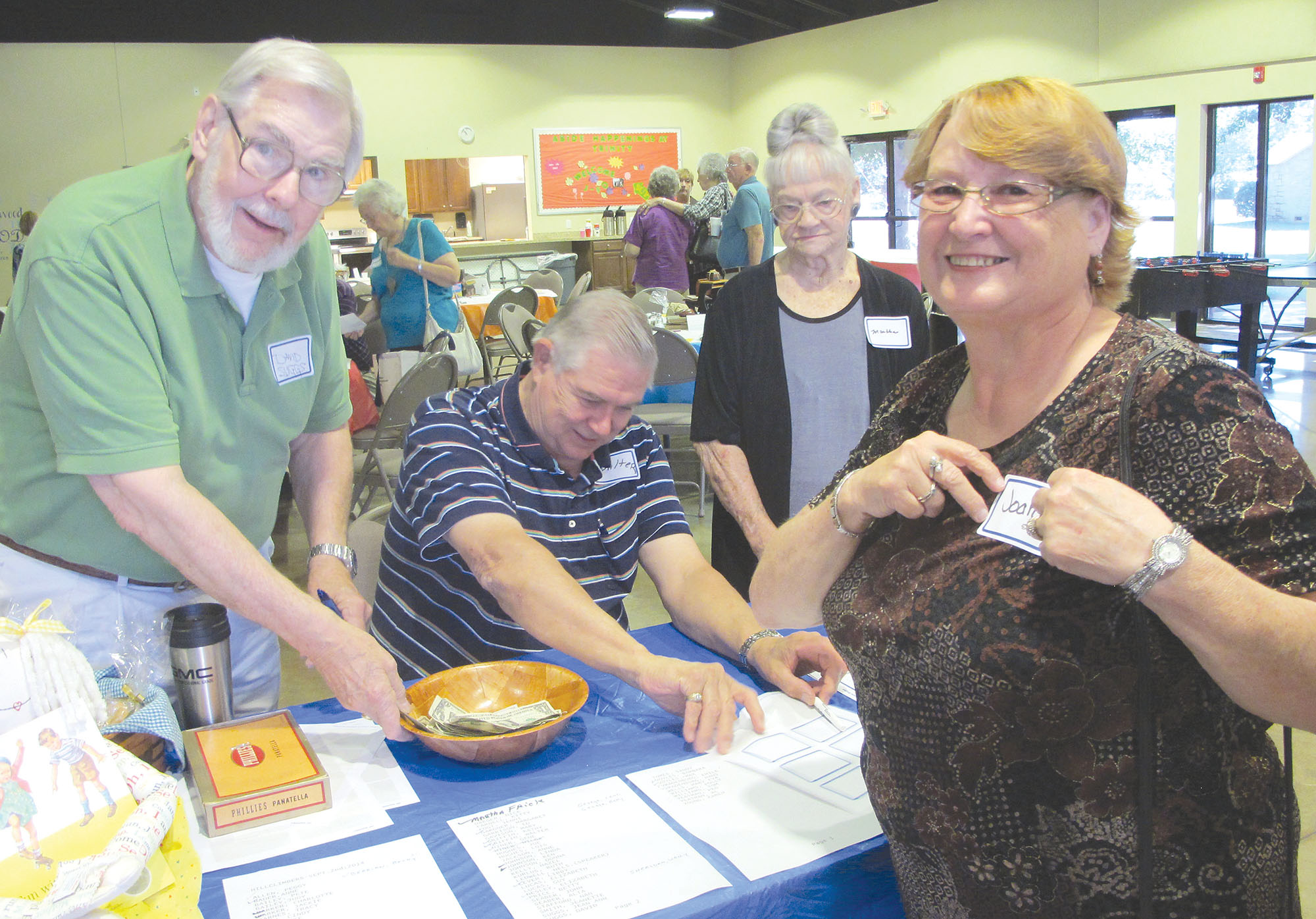
    Joanie Caudill of Willow Lakes takes a name tag as she arrives at the Hillclimbers luncheon on Tuesday. David Suggs, left, and Walter Griffin assist with registration as Martha Frick waits her turn.

    BLYTHEWOOD – If you’re a senior citizen looking for fun and fellowship, you’ll find it every second Tuesday at 11 a.m. at the Hillclimbers luncheon at Trinity United Methodist Church in Blythewood. After having the summer off, the 70 or so Hillclimbers and visitors spent a little extra time visiting and catching up on Tuesday at their first luncheon of the fall season.

    “But it’s more than lunch,” said Kathy Griffin, Trinity’s assistant pastor who oversees the group and organizes the programs. “It’s lots of fun. We have really interesting programs, and lots of fellowship.”

    On this day Trinity’s new pastor, the Rev. Nels Ledwell, was the speaker. Next month Grace Hamrick will talk about her new book, “Just Grace.” In November, Wayne Damoron will bring his collection of ‘Coins from the Bible,’ some of which are more than 2,000 years old. And in December, Trinity’s Oasis choir will perform Christmas carols.

    “There’s always something,” said Griffin. “It’s a very social get together. We used to bring covered dishes, but some of us are single now and don’t really cook a lot, so we now have the lunches catered,” she said, adding that the lunch price is only $6.

    While the Hillclimbers have met for years, it was not until Griffin took over two years ago that the numbers took off, increasing from about 20 in attendance to an average of 65 or 70. That necessitated a move from the old fellowship hall in the main church building to the new youth center across the campus.

    Griffin said the growth has come from interesting programs, good food at reasonable prices, “and now we have plenty of room,” she said. “And seniors from all churches are invited. I send notices to other pastors inviting their members to attend,” Griffin said. “After all, it’s not really about church,” she said, smiling. “It’s about having a good time. And we do.”

    For more information call 786-1637.

  • Old Man River

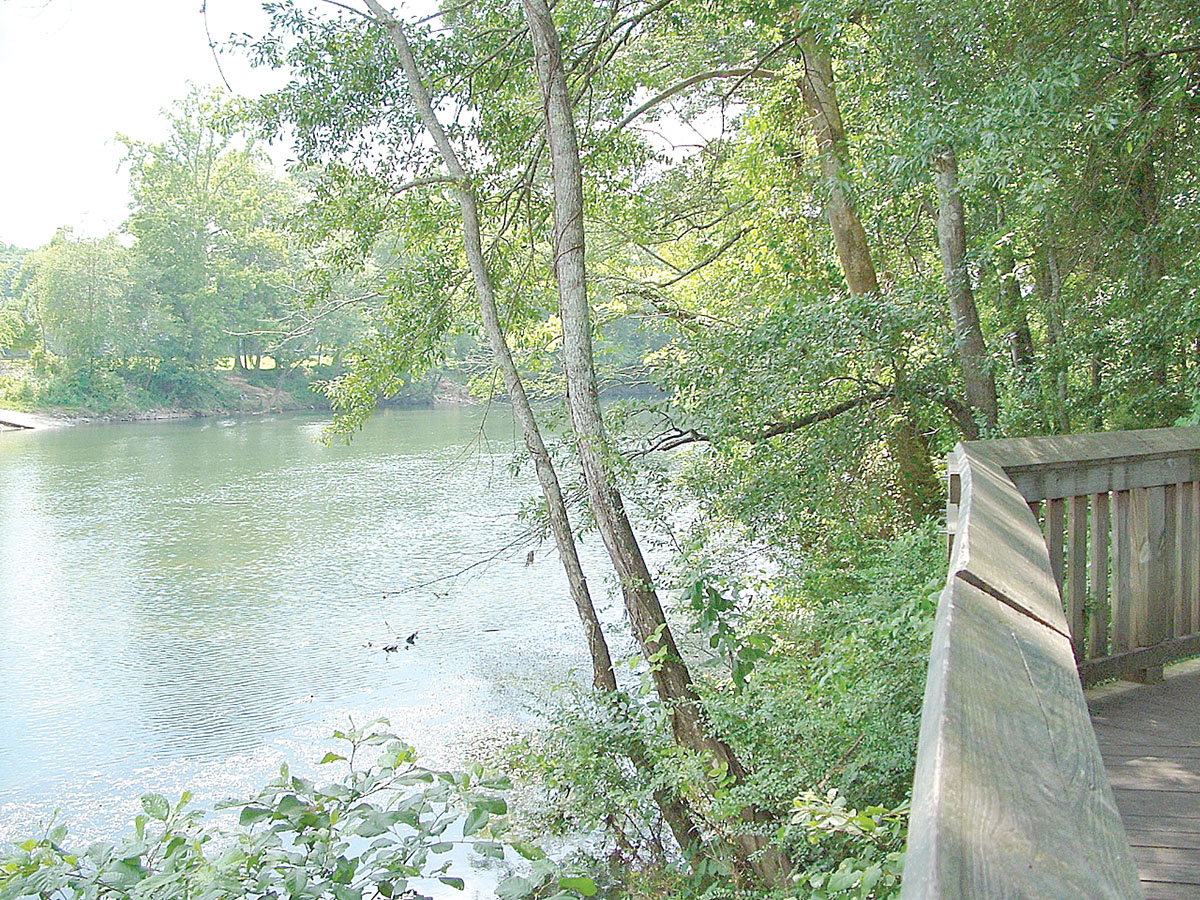
    The Saluda River, from one of the many stopping points along the trails at Saluda Shoals Park. (Photo/Robert Clark)

    Experience the outdoors. Enjoy nature. Fish. Kayak and canoe, and walk the nature trail. You can do this and more at a stretch of river that reveals how many Southern rivers used to be.

    In older days a lot of hardworking inland farm families vacationed by the banks of shoals. It was their Myrtle Beach. Less than an hour’s drive, about 35 miles, will take you to a river that none other than Robert E. Lee first suggested could be dammed: the Saluda. Just 1.5 miles from the Dreher Shoals Dam, the Saluda Runs free here and you can spend a relaxing day with Old Man River, unleashed as if no dam ever existed.

    Located along the banks of the Saluda River, the 350-acre Saluda Shoals Park features an 11,000-square-foot Environmental Education Center, Exhibit Hall, Auditorium, Classrooms and 3,776 square-foot outdoor deck. Miles of paved and unpaved trails provide wonderful places to walk and bike. You can rent bikes, canoes and kayaks here.

    A river observation deck provides a good place to watch the Saluda River run by. And know too that the South Carolina Department of Natural Resources has established the Saluda Shoals Park Fishing Pier off Old Bush River Road, between St. Andrews Road and Lake Murray, south of Irmo. This wooden fishing pier parallels the Saluda River bank. A paved sidewalk to the pier from the paved parking area provides easy access. A boat ramp and canoe and kayak launch points make it convenient for water enthusiasts. Guided horse trails exist for equestrian-minded people too.

    Families and organizations make good use of the picnic shelters and kids make good use of the playground. The River Center provides a good setting for receptions, meetings and other events.

    Got some nature lover in you? You’ll find the Saluda Shoals Wetland Preserve to be a tranquil sanctuary. The quiet waters and woodlands provide habitat for many species of birds, animals, and wetland plants. Down near the river you can feel the temperature — and stress levels — drop. It’s hard to imagine that you’re only minutes from Harbison Boulevard and all its accommodations.

    Saluda Splash is a good place to cool off on a hot summer day, and it’s a good place, too, to let the kids expend energy. Children love the interactive, zero-depth water playground, making it quite safe with no need to wear life preservers. Splash opened for the season on April 26, and closes Sept. 28. Pack a picnic lunch and enjoy it at one of six shelters, all equipped with ceiling fans, charcoal grills and conveniently located restrooms. Plan a mini-vacation this summer at Saluda Shoals Park.

    If You Go …

    5605 Bush River Rd.,

    Columbia, S.C.

    803-731-5208 / 803-213-2050

    Car or mini-van: $5

    12+ passenger van: $7

    Bus: $11

    Saluda Splash Wristbands: $3 each; Seasonal, Open 9 a.m.– 8 p.m.

    From Columbia, take I-26 west toward Spartanburg. Exit Piney Grove Road and turn left. Proceed approximately 1.5 miles to St. Andrews Road. Turn right, then left at the first traffic light. Saluda Shoals Park is 1.5 miles on your left.

    www.scgreatoutdoors.com/park-saludashoals.html

    Learn more about Tom Poland, a Southern writer, and his work at www.tompoland.net. Email day-trip ideas to him at tompol@earthlink.net.

  • Fall Basketball League Seeks Players, Coaches

    BLYTHEWOOD – The Regan Roberts Youth Basketball League is looking for players and coaches for its co-ed basketball league from first through 12th grades.

    This league fills up fast, so don’t delay. There are six age groups with four teams per age group. The first 32 players for each age group will be accepted.

    Practices are held one day a week, with games played primarily on Saturdays.

    The registration fee is $60 by Oct. 17; $65 after Oct. 17.

    First through eighth grades practice and play at Trinity United Methodist Church (beside Wendy’s).

    Ninth through 12th grades practice and play in the Bethel-Hanberry gymnasium.

    Tryouts for grades 1-8 begin Oct. 27. Tryouts for grades 9-12 begin Nov. 24.

    You must attend tryouts to be on a team!

    Practices for grades 1-8 begin Nov. 3, and for grades 9-12 on Dec. 1.

    Registration forms available at Trinity UMC and www.trinityblythewood.org.

    For additional information, contact Barry Mizzell at 803-603-3520, or bmizzell@richland2.org.

  • Reservoir Road Man Killed in Crash

    WINNSBORO – A Winnsboro man was killed Friday night in a single-vehicle crash on Reservoir Road.

    Fairfield County Coroner Barkley Ramsey said 39-year-old Stanley E. Owens, of 286 Reservoir Road, was traveling west on Highway 213 just before 9 p.m. Friday in a 1996 Dodge pickup truck. Owens turned left onto Reservoir Road where he ran off the left side of the road and struck a tree, approximately 2 miles west of Winnsboro.

    Family members heard the crash from the front yard of their home, Ramsey said, and raced to the scene, extracting Owens from the wreckage and transporting him to Fairfield Memorial Hospital. There he was pronounced dead from injuries sustained in the accident.

    The S.C. Highway Patrol said Owens was the only occupant of the truck and was not wearing a seat belt at the time of the accident.