Category: News

  • Trapp Files Appeal

    District 3 Dispute Goes to State

    ATTORNEY: NEW EVIDENCE MAY NOT BE ADMISSIBLE

    WINNSBORO – The battle for the District 3 County Council seat entered its next round Monday when the incumbent, Mikel Trapp, filed an appeal with the S.C. Election Commission of a Nov. 17 order for a new election by the County Election Commission.

    Trapp edged out challenger Walter Larry Stewart by just 4 votes, 489-485, in the Nov. 4 general election, but during the Nov. 17 protest hearing, Stewart’s attorney, Debra Matthews, successfully argued that five voters – two in Mitford and three in Monticello – had been presented with the wrong ballot style on election day and therefore were unable to cast a vote in the District 3 race for County Council.

    Trapp, who did not return phone calls seeking comment for this story, was not present at the Nov. 17 hearing, but sent in his stead Winnsboro resident Kadena Woodard. The County Commission did not allow Woodard to present an argument during the hearing, since she is not licensed to practice law.

    In Trapp’s appeal, filed just before the noon deadline Monday, Trapp’s attorneys cited the S.C. Supreme Court’s Taylor v. Town of Atlantic Beach Election Commission case, which according to the appeal documents states that election results will not be “set aside . . . due to mere irregularities or illegalities unless the result is changed or rendered doubtful.”

    “Not only did the County Board refuse to allow Councilman Mikel Trapp the opportunity to be heard on the protest, but it also employed a presumption against sustaining the election by ignoring that (1) two of the five challenged voters were registered in and had regularly voted in a different county council district without objection or challenge and without requesting a provisional ballot for this election, and (2) two of the other three disputed voters swore in written statements submitted to the County Board that they would have voted for Councilman Trapp if they had voted in District 3,” the appeal document also states.

    Trapp’s appeal documents include a pair of sworn affidavits from the voters in Mitford, who averred that while they did not indeed cast ballots in the District 3 Council race, if they had they “definitely would have voted for Council Member Mikel Trapp,” each of their sworn statements say.

    The affidavits are similar to documents Woodard attempted to have read into the record during the Nov. 17 hearing before she was barred by the Commission. The Commission’s attorney, Liz Crumb, said at the time that allowing Woodard to make a case for Trapp would be allowing her to practice law without a license. Matthews objected to the documents during the hearing, as they were not notarized, calling them “hearsay” statements.

    The Commission sustained the objections, but eventually accepted the documents as an “offer of proof,” to be left to the State Commission to determine their value. However, Matthews said Monday after seeing the affidavits, which had now been signed by a notary and dated Nov. 23, 2014, that the affidavits amounted to “new evidence,” which cannot be entered in an appeal.

    “I have received the appeal that was filed on behalf of Mr. Trapp,” Matthews said Monday, “which contains evidence and affidavits that were not presented in the first hearing, and in fact are dated Nov. 23.”

    Regarding the S.C. Supreme Court case referenced in the appeal documents, Matthews said, “The Supreme Court has not had a case where electors were given the wrong ballot or where an elector was put in the wrong district.”

    Trapp’s appeal documents also assert that the County Commission denied Trapp his “due process of law” because the Commission “rushed to a decision before Councilman Trapp could be present in person later that afternoon,” the documents state.

    Woodard informed the Commission during the Nov. 17 hearing that Trapp was at work, but suggested he might be available later in the afternoon. The Commission then took a brief recess to allow Woodard to contact Trapp by phone to determine if he would indeed be arriving later in the day. When the Commission reconvened, however, Woodard told the Commission that Trapp was not, in fact, coming to the hearing.

    The appeal will be heard by the State Election Commission Monday at 2 p.m. at 2221 Devine St., Columbia, in Suite 101. The appeal was filed on Trapp’s behalf by attorneys John C. Moylan III of Columbia and Wade S. Kolb III of Greenville.


  • Mayor Pushes to Relax Zoning

    Ross: Strict Rules ‘Not Blythewood’

    BLYTHEWOOD – Last month it was announced that Town Council proposed to ‘rethink’ its restrictive, or what many in the town consider progressive, sign ordinance that was passed in 2009. So far, the only corresponding groundswell of criticism of the ordinance is that it is not administered fairly by Town Hall and that the high rise interstate signs should not have to come down in 2020.

    On Monday evening, Mayor J. Michael Ross asked Council to reconsider possible revisions to the current Town Center District zoning regulations (Ord. 155.182) that support the Master Plan, which envisioned the future Town Center as a pedestrian destination for which a number of regulations were adopted.

    Town Administrator Gary Parker read from the ordinance: “The Town Center District is established and intended to encourage the development of the town center as the principal focal point of the entire community with a vibrant mix of retail, service, office, restaurant, entertainment, cultural, civic, government and residential uses that create a strong sense of place. The Town Center District is also established and intended to provide a public realm and streetscape with aesthetically pleasing architecture, landscaping, signage, lighting, utilities and other features especially inviting to pedestrians. The design of buildings in the Town Center shall be based on the architectural traditions of the Midlands and contemporary interpretations thereof. Accordingly, the architectural and other design standards of this section are applicable to all new land uses, new construction and major improvements within the Town Center District.”

    Parker said the Mayor would like to discuss in a work session those businesses that might come in the future who might not want this.

    “We were looking at some of the sketches,” Ross said. “There was so much comparison with us (Blythewood) looking like Davidson, N.C. and Baster. Folks, that’s not what Blythewood is.”

    Ross blamed the lack of economic development in the town on these stricter regulations.

    “We need to revisit this, to (embrace) something more practical than dream,” he said. “If we want to see good economic development, but with restrictions that are fair to the people, then I ask you to consider this.”

    A time for the work session was not decided.

  • Corrections Officer Jailed in Prostitution Sting

    Joe Wayne Gladney

    WINNSBORO – An employee at the Fairfield County Detention Center became a resident last week after an undercover sting nailed him attempting to solicit prostitution.

    Joe Wayne Gladney, 52, of Paper Road in Winnsboro, was arrested by Fairfield County Sheriff’s investigators on Nov. 11 in the parking lot of the CVS Pharmacy at 27 Highway 321 Bypass South.

    According to the Sheriff’s report, narcotics officers had received complaints about Gladney attempting to solicit prostitution from various females known to him through his duties as a corrections officer. A confidential source and an undercover officer reportedly agreed to meet Gladney in the CVS parking lot just after 8 p.m. on Nov. 11. Investigators recorded the meeting, during which Gladney reportedly discussed with the source and the undercover officer exchanging money in return for a sexual favor.

    Teresa Lawson, Director of the Fairfield County Detention Center, said Tuesday that Gladney had been placed on unpaid leave until the investigation is concluded. Gladney has been employed by the Detention Center for 10 years, Lawson said.

  • Town May Opt Out of Storm Sewer Plan

    BLYTHEWOOD – In a special called meeting last week, Town Council discussed its options regarding the Town’s recent designation by the S.C. Department of Health and Environmental Control (DHEC) as a Small Municipal Separate Storm Sewer System (SMS4).

    “That designation,” Town Administrator Gary Parker told Council at an earlier workshop in October, “means that we will be required to manage a Storm Water Management Program for Blythewood. That is a very difficult thing for a town this size with limited staff and budget to be able to devote the necessary time to do the work required by such a program.”

    At that time, Parker suggested the Town’s only feasible option was to take advantage of the opportunity to become a co-permitee with Richland County, which, Parker said, “does have the staff resources to conduct not only their county program but also the programs of municipalities within the county.”

    Such a partnership could cost the Town as much as $50,000 up front through an Intergovernmental Agreement with the County.

    More recently, however, Parker and Council members learned that they can apply for a waiver from DHEC to opt out of the program entirely. Councilman Tom Utroska questioned whether the SMS designation was too all-encompassing to include Blythewood at all.

    Town planning consultant Michael Criss showed Council a map with a green boundary around an urbanized area that did not comprise all of the town’s limits. But Parker pointed out that the whole town might still come under the requirements of the SMS4 designation.

    “It is possible that DHEC is considering the physically interconnected factor, which would require the inclusion of any small SMS4 located outside the urbanized area that contributes substantially to the pollutants loading into the physically connected SMS4,” Parker said. “That seems to be a hook DHEC can apply to the Town to bring all of the town into the area that is managed by the SMS4 water program, not just the urbanized area within the green boundary.”

    Utroska called the plan a bureaucratic boondoggle, saying, “It may not apply to us, but they’re going to make us participate anyway. While we may fall into this designation down the road, we may not be there now.”

    Mayor J. Michael Ross credited Parker’s research in determining that the creeks in and around the town mostly flow away from the town.

    “The Town was built high on a ridge,” Parker said, “so we have small headwater streams radiating out from Blythewood like a wagon wheel.”

    Parker said there is no doubt in his mind that, “we don’t want to take this on ourselves. It’s a comprehensive program that will cost much more than the $50,000 it will cost to join Richland County as a co-permitee.”

    He suggested applying for a waiver and, at the same time, start the process of applying as a co-permitee with the County in case the waiver is denied.

    The Town has until Dec. 1 to apply for a waiver. Once DHEC decides whether or not to give the waiver, the Town will have six months to submit a notice of its intent to DHEC.

    Bonded Plat Approved

    In other business, Council approved a bonded plat for the Holly Bluffs development near the intersection of Blythewood Road and Fulmer Road. The development was formerly called Summers Trace and the developer, Crowne Communities, was bought out by DR Horton last year. Approval of the bonded plat was recommended to Council for passage by the Planning Commission earlier this month.

    “The bonded plat is a commitment by the developer and the Town to be sure all the requirements such as unfinished roads, storm drainage, sewer system, etc. will be completed on time to serve the residents who will move into the project,” Criss told Council.

    Criss explained that if the projects are not completed by the developer in a set time, then the Town could use the bond money to finish the project. The time limit for completing the project is two years Criss said. The 61 single residential lots are being connected to Palmetto Utilities sewer system.

    The submitted performance Bond was inflated 125 percent over the estimated costs of completing the development’s infrastructure, Criss said.

    “That will take care of delays due to weather, inflation and other unexpected costs should, for any reason, the Town have to take over the project and finish it,” he said.

    The developer was represented at the meeting by Jordan Hammond.

  • Clarks Hill’s Shores

    Ain’t that a Dam Site –
    Clarks Hill Dam, creator of the third-largest man-made lake east of the Mississippi. (Photo/Tom Poland)

    At 71,535 acres, it’s as big a lake as you’ll see in this region. In fact it’s the third-largest man-made lake east of the Mississippi River, and it’s only 100 miles, about two hours, away. A mighty dam backs up the Savannah River creating more than 1,200 miles of shoreline. Along that shoreline are some fine state parks and great fishing and recreation opportunities.

    This watery wonderland came about from man’s need to control the raging Savannah River. For many years it flooded the region and in particular Augusta, Ga. Erecting a major dam provided a solution with the double bonus of providing hydroelectric power and recreation opportunities. Be sure to go to the Visitor’s Center to learn more about this major dam and reservoir.

    Clarks Hill Lake forms a vast border between Georgia and South Carolina along Abbeville, McCormick and Edgefield counties. The U.S. Army Corps of Engineers built it from 1946 to 1954 near the confluence of the Little River and the Savannah River. As names go, the lake has had its problems. Originally referred to as Clarks Hill Dam, the “s” in Clarks was left out by error and the dam project became known as Clark Hill Dam. In 1987, Congressional Representative Butler Derrick introduced a bill to rename the lake after Strom Thurmond. That didn’t sit well with Georgians. Georgia’s Legislature passed House Resolution No. 115 making “Clarks Hill” the official name for the dam and the lake. To this day no self-respecting Georgian refers to the reservoir as Lake Strom Thurmond.

    Each year, millions of people flock to the parks, marinas and campgrounds clustered around the lake to enjoy outdoor recreational experiences. Clarks Hill Lake is one of the 10 most visited Corps-built lakes in the nation. Both Georgia and South Carolina refer to the lake as their “fresh-water coast.” Largemouth, white, striped and hybrid bass, crappie, bluegill and catfish make the lake a fisherman’s paradise. Bass tournaments are common there.

    Nowhere as developed as many lakes are Clark Hill Lake’s wildlife is abundant. Wildlife Management Areas offer prime places to hunt and just enjoy nature. Just getting outdoors is fine too. State parks on the South Carolina side include Calhoun Falls, Baker Creek, Hickory Knob and Hamilton Branch. State Parks on the Georgia side include Mistletoe, Elijah Clark and Bobby Brown. You’ll find plenty of campgrounds and cabins to choose from.

    On the South Carolina side be sure to check out the Little River Blueway and its opportunities for canoeing and kayaking. You’ll find 51 miles of beautiful paddling trails here. Ample opportunities for mountain biking and hiking too. The Blueway area features 63 holes of golf, skeet shooting and numerous historical sites. Be sure to visit the Badwell Cemetery while in the area. There’s also a 50-mile scenic drive for those who choose to forego paddling and biking.

    Fall makes for a great time to head over to this major reservoir. Seeing the reflections of colorful leaves along a glassy shoreline is a treat. Whether you camp or stay in a cabin, fall is a fine time to visit the “Georgialina” freshwater coast.

    If You Go …

    • Consider making reservations at some of the fine cabins in South Carolina and Georgia’s parks.

    • Visit the S.C. State Parks website at www.southcarolinaparks.com/

    • Visit the Georgia State Parks Department website at www.gastateparks.org/

    • Visit the Little River Blueway website for more information www.littleriverblueway.org/

    Learn more about Tom Poland, a Southern writer, and his work at www.tompoland.net. Email day-trip ideas to him at tompol@earthlink.net.

  • Sign Debate Heats Up

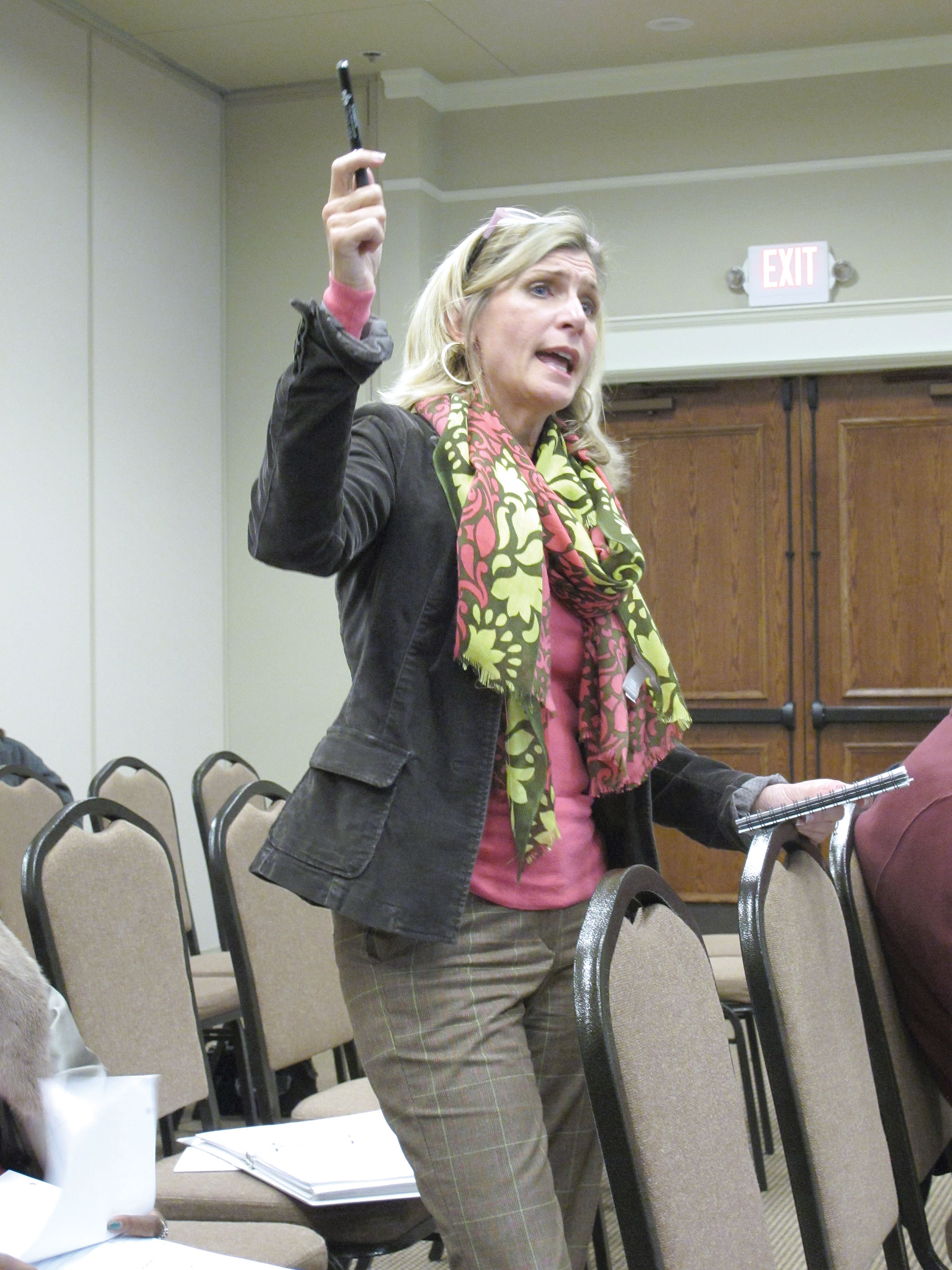
    Pat Littlejohn, Vice Chairwoman and a 12-year member of the Blythewood Board of Zoning Appeals, argues that changes to the BZA’s rulings by Town Hall leads to inequality in the application of the Town’s sign ordinance. (Photo/Barbara Ball)

    Planning Commission Pushes for Delay

    BLYTHEWOOD – In a surprise announcement at the October Planning Commission meeting, Chairman Malcolm Gordge reported that Town Council was rethinking the sign ordinance that was passed in 2009 that calls for the majority of non-conforming signs in the town limits to be replaced with conforming signs by Jan. 26, 2016. The high-rise signs along I-77 would have to comply with the ordinance by January 2020.

    He said the ordinance is “obviously going to cause some difficulties for local businesses. . . . What’s being proposed,” Gordge said, “is a work session with representatives of the Planning Commission, the Board of Architectural Review and the Chamber of Commerce to get some feedback to determine how the businesses perceive this requirement to comply with the ordinance . . . so that we have plenty of time to come to a compromise.”

    Gordge said the issue came to light as Town Hall began preparing to send notices out to businesses with non-conforming signs at least a year before the deadline when all signs (except the high rise interstate signs) in the town limits must to comply with the ordinance.

    That workshop was held Tuesday night with Gordge and his fellow panel members quickly laying the groundwork for postponing conformity for all signs in the town until 2020. Mayor J. Michael Ross was represented by J.B. Bishop who argued for an extension of the compliance, raising his voice that it was not fair to ask businesses to purchase new signs.

    Before inviting the opinions of any business owners in the audience, Gordge got the ball rolling by suggesting three options to the current sign ordinance, two of which call for an extension of the sign ordinance for four more years:

    Follow the ordinance as written with compliance required on Jan. 26, 2016 and, for high-rise interstate signs, January 2020.

    Extend the compliance order until 2020 for all businesses, but require a formal statement from the business owners that they would comply with the ordinance at that time.

    Consider some form of continuing license so that businesses could pay an annual fee to retain their grandfathered signs until Jan. 26, 2020.

    While only one business owner, Larry Sharpe of Blythewood Oil, and representatives of Trinity Unity Methodist Church had questions about their particular signs, there was no groundswell from the audience for changing the ordinance. And both the chairman and vice-chairwoman of the Board of Zoning Appeals (BZA), who were not on the panel, gave the panel a tongue lashing for allowing some business owners and churches a bye while others either agree, or are forced, to abide by the sign ordinance.

    Pat Littlejohn, vice-chairwoman of the BZA and a member of the board for more than 12 years, said “Ninety-five percent of our requests are for sign variances.”

    Addressing her question to Bishop, she asked, “How will you compensate those businesses who have complied with the sign ordinance regulations, who came here anticipating the 2016 deadline? I would argue that they have not been allowed to have the same advertising capacity as the other businesses who have non-conforming signs.”

    While Bishop, speaking for the mayor, talked about the drop-dead date of the ordinance and the recession, Littlejohn reminded him that he was not answering her question.

    “There are a lot of businesses out there who have complied. The Hardee’s was not allowed to put up a sign equal to McDonald’s, so if I were Hardee’s I would say these folks have gotten a bye. The same is true for the Days Inn who was made to comply,” Littlejohn said.

    She also pointed out that the town administration is “obviously changing the rules (for some businesses and churches) after they have been denied a variance from the BZA. I don’t know how Trinity (UMC) now has a sign that does not comply with the ordinance,” she said referring to a comment earlier in the meeting by BZA chairman Sabra Mazyck that the motion for a variance for Trinity’s sign was denied on Monday, May 5, 2008 according to the minutes from the meeting.

    Littlejohn recalled that “at one point, there was an effort for us to not look like Two-Notch Road. There are plenty of communities that do not have non-conforming signs. And they have plenty of business, so that’s an invalid argument.”

    Sharpe said he had no problems complying with the signs within the town, saying, “Everybody knew this date was coming (for compliance).”

    But, he said if he was made to take down his interstate high-rise BP sign, he would consider that a government taking.

    “If that sign has to come down, I think the Town will have to pay me for it,” he said.

    He said he erected the sign in 1978 when the town was only loosely formed and he didn’t feel it should have a date set to come down. He said he felt the signs brought business to the town and that the town government benefited from the business taxes he paid.

    “We bought that property because of the visibility on the interstate. Those issues will have to be decided in the courts,” Sharpe said.

    He said it would cost $150,000 to replace his high-rise sign and $50,000 to replace the Bojangles sign.

    “But I don’t have any problem conforming (my) other signs in the town,” he said. “That’s not an issue.”

    Several members of the panel mentioned that the town’s businesses needed more time to comply with the ordinance. Bishop suggested that they needed time to save up some money for new signs.

    But Littlejohn said she was surprised at the sudden amnesia.

    “Since 2009, every person who has come before us, we have informed them of the 2016 decision,” she said. “It’s frustrating that we have been very diligent to enforce the ordinance while trying to be pragmatic. If the rules keep changing, we will continue to have problems.”

    While one member of the panel seemingly dismissed her by thanking her for her service, Gordge stuck to his guns.

    “We aren’t going to please everyone, but we must reach a conclusion that will be fair to the majority,” he said. “The only mitigating circumstance is that we weren’t anticipating a recession in 2006, 7 and 8.”

    Town Councilman Bob Massa, a member of the panel, pointed out that the ordinance wasn’t passed until 2009 and that the committee that wrote the ordinance included many of the town’s business owners.

    When a representative of Trinity said he didn’t feel the Town was giving enough notice to comply with the ordinance, Town Councilman Bob Mangone, who was sitting in the audience, said, “You have been notified seven years ago. I have not heard anything in this room to make me believe that four or five more years is going to cause the business owners to have an epiphany and decide to plan ahead. We had seven years to plan for this and the BZA has worked their butts off to make the best decision based on the ordinance. And now, one and a half years before the deadline, we’re saying, ‘Oh, my. I didn’t know this was going to happen’.”

    Gordge sallied forth. “I’m hoping to get a consensus tonight that we make a recommendation to the Town Council to extend the deadline date from Jan. 26, 2016 to 2020. That seems to be the most popular response,” he said.

    “If that’s what is going to happen, then please don’t ask for any more variances from the BZA, because we’ll be acting on what’s currently written in the ordinance,” Littlejohn declared.

    Town Administrator Gary Parker spoke up from the back of the audience, cautioning Gordge, “I think it would be more appropriate to report information gathered at this meeting than to recommend to Council. Generally,” he said, “it’s only when a committee is appointed by Council and authorized to come back with a recommendation that that would be the case.”

    Town Council’s next meeting will be Monday, Nov. 25.

  • Voters Make it Official

    Will Montgomery, Sheriff-elect

    Montgomery Locks up Sheriff’s Race

    WINNSBORO – After a primary, a runoff and in the midst of an ongoing SLED investigation, voters in Fairfield County made it official Tuesday with the special election of Will Montgomery as Sheriff.

    Montgomery, who sealed the deal with 1,970 votes Tuesday, will fill out the remaining two years on the term of Herman Young, who stepped down in July because of health reasons.

    Montgomery comes from a long line of Fairfield County lawmen. His father, Bubba Montgomery, and his grandfather, S. Leroy Montgomery, both served as Fairfield County Sheriff for 12 years each. Montgomery is a shift supervisor with the Richland County Sheriff’s Department, where he has worked for the last 13 years.

    Montgomery defeated Chief Deputy Keith Lewis in a special Democratic primary runoff on Oct. 14 with 56.25 percent of the vote. As the only name on Tuesday’s ballot, Montgomery got much more than that in the special election, with 125 write-in ballots cast.

    Just days after the runoff, the S.C. Law Enforcement Division (SLED) confirmed reports that their agency had launched a preliminary investigation into allegations of vote-buying leading up to the runoff. SLED would not reveal details of the investigation, specifically who was allegedly paying who to vote for which candidate, but independent sources have since told The Voice that as much as $5,000 in cash was allegedly paid for votes.

    Tuesday afternoon, a SLED spokesperson confirmed that the investigation was still open and ongoing.

    Phone calls to Montgomery were not returned at press time.

  • Commission Orders New Election

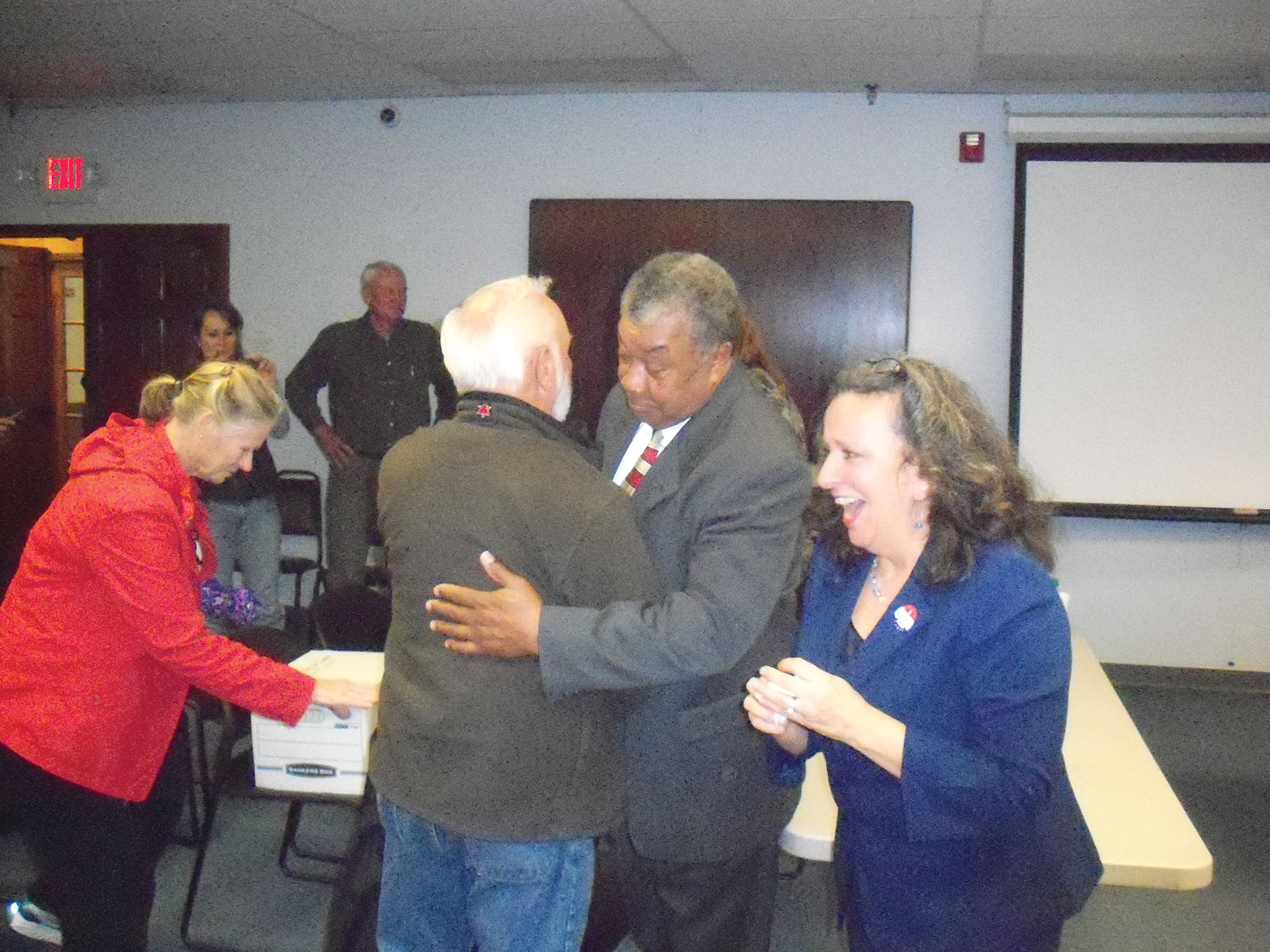
    Winnsboro attorney Debra Matthews (right) celebrates as District 3 challenger Walter Larry Stewart (second from right) receives congratulations from Vernon Plyant following the Election Commission’s ruling Monday that a new election would be necessary between Stewart and incumbent Mikel Trapp for the District 3 County Council seat. (Photo/James Denton)

    Battle for District 3 Seat Rages on

    WINNSBORO – The proverbial Fat Lady who has been waiting in the wings since Nov. 4 to perform her closing aria for the District 3 County Council race will have to go back to her dressing room, at least for the time being. Monday afternoon, the Fairfield County Election Commission unanimously upheld two of the three grounds for protest presented last week by challenger Walter Larry Stewart and ordered a new election between Stewart and incumbent Mikel Trapp.

    In results certified by the Election Commission following a recount on Nov. 7, Trapp edged out Stewart in the hotly contested race, 489-485. But irregularities found on absentee ballot envelopes by Stewart supporters, as well as reports of voters in District 3 receiving the incorrect ballot style at their polling places, prompted Stewart to file an official protest of the results last week.

    While the Election Commission overruled Stewart’s protest on the absentee envelopes, it agreed with the Stewart camp that five voters – two in Mitford and three in Monticello – had been presented with the wrong ballot style on election day and therefore were unable to cast a vote in the District 3 race for County Council.

    “This is democracy at its best,” Debra Matthews, a Winnsboro attorney representing Stewart at the hearing, said. “It’s a great day in South Carolina.”

    Trapp did not make an appearance at Monday’s hearing, instead sending as his representative Winnsboro resident Kadena Woodard. Woodard’s participation in the proceedings, however, was limited.

    As Woodard prepared to read a statement from Trapp to the Commission and offer two attached documents as evidence, Matthews objected.

    “There is a notary spot at the bottom of this which is not filled in,” Matthews said. “This is a hearsay statement and I’m going to object.”

    Liz Crumb, an attorney with the McNair Law Firm, retained by the Commission for the hearing, advised against Woodard making a case for Trapp at all.

    “She’s not counsel and that would be practicing law without a license,” Crumb told Commission Vice Chairwoman Carolyn Y. Prioleau.

    Prioleau chaired the hearing in place of Commission Chairwoman Betty M. Trapp, who recused herself from the proceedings and was not present Monday in the County Council chambers. She is related to Mikel Trapp by marriage to a Mikel Trapp cousin. Betty Trapp did chair the Nov. 7 recount and certification.

    “I am not counsel, but I do have the right to read a statement that (Trapp) sent to the (commission),” Woodard said. “I would be treated so unfairly not to be able to read it.”

    Woodard said she had in her possession a letter from Trapp apologizing for not being able to attend the hearing, but Matthews again objected.

    “This is a hearsay statement and I’m going to object to the entry of this statement,” Matthews said. “I hadn’t seen it previously. It is directed to the board. I don’t know if the board has seen it previously.”

    Both of Matthews’s objections were sustained. The Commission did eventually accept Woodard’s documents as an “offer of proof.” The documents were not reviewed by the Commission, but were instead sealed in an envelope and left to the State Election Commission to determine, in the event of an appeal, “whether or not the (commission) wrongfully kept you from making a statement,” Crumb explained to Woodard.

    The Arguments

    Matthews successfully argued that five voters had received the incorrect ballot style in the Nov. 4 elections, and therefore were prevented from casting a ballot for the District 3 Council race. Two of those voters were in the Mitford precinct and live at 202 Peay Ridge Road.

    According to the 9-1-1 maps, which Debbie Stidham, Director of Fairfield County Voter Registration and Elections, testified were the means by which her office verifies voting districts, all even-numbered addresses on Peay Ridge Road lie on the south side of the road. That orientation places the even-numbered addresses in District 2. But through the testimony of Randy Roberts, of the Fairfield County Assessor’s Office, who on the witness stand reviewed the County’s aerial map of the road, 202 is an anomaly. It is the only even-numbered address among a host of odd-numbers lying on the north side of the road. And, according to Stidham’s testimony, addresses on the north side of Peay Ridge Road are in District 3.

    Affidavits of the two voters living at 202 affirmed that they had both been given ballots for District 2 instead of District 3 on Nov. 4.

    Three voters in the St. Peters Church precinct in Monticello were also given the incorrect ballot style on Nov. 4, Stidham’s testimony confirmed. Voters from both districts 3 and 4 vote at the church, and based on the records from the voting machines, the three District 3 voters who cast ballots there on Nov. 4 had their votes counted in District 4.

    Trapp has until Nov. 24 to file an appeal, at which time the State Election Commission will make its ruling. A new election will not be scheduled until the State Commission sends their findings to the Governor’s Office and the election is ordered by Gov. Nikki Haley.

    Efforts to reach Trapp by telephone for comment for this story were unsuccessful.

    “We’re moving forward,” Stewart said after the hearing. “I’m going to need everybody’s support for this next step, in this next election. I need everybody’s support in this next election to make it a new day in Fairfield County, because we’re going to have to work hard to get there.”

  • Center Creek Park Hits Snag

    WINNSBORO – Plans by County Council to place, as part of their new sweeping county wide recreation plan, a mini park at the intersection of Shoemaker and Center Creek roads hit their first speed bump Monday night and may very well have become derailed as one member of the community there appealed to Council to kill the project before it had even begun.

    Don Quick presented Council Monday night with a petition of 33 signatures from 38 of the 61 households in the community that he said responded, all in opposition to the proposed park. Council passed first reading during their Oct. 27 meeting to purchase and develop 3.36 acres of property at the intersection for a new mini park.

    “You have to understand, guys, I live out in the country,” Quick said. “And I mean the country. Everybody’s got at least three and a half or more acres. Most of us have 10 or more acres. And none of us have grandchildren at home, so there are no youngsters and we don’t want or need a park because we have all the land we need.”

    The ordinance is scheduled for a public hearing during Council’s Nov. 24 meeting.

    “I want to thank Chairman Ferguson for bringing this park to our attention,” Quick said. “It wasn’t his fault that the neighbors didn’t say anything in the beginning. All of a sudden at the last minute they didn’t want it.”

    From Committee

    Council also gave formal approval to a slate of items recommended from the Administration and Finance Committee’s Oct. 27 meeting. Council gave the OK to $184,000 for Mead & Hunt to begin retrofitting the HON Building for use as a temporary Courthouse.

    “In order for us to renovate our Courthouse, we have to first renovate the HON Building in order to move those employees out of (the Courthouse) and into the HON Building,” County Administrator Milton Pope told Council Monday. “It also has to have a fully equipped courtroom for judicial purposes. This would be all of the design work to be able to get all of those things done.”

    Funds for the project will come from last year’s $24.06 million bond issue, Pope said at the Oct. 27 Committee meeting.

    Council also approved $87,844 for Davis & Floyd for additional repairs to the County Administration building. The repairs encompass the Fairfield County Sheriff’s Office’s evidence room in the basement of the building.

    “In order to turn the evidence over to the new Sheriff, SLED will have to sign off on the evidence itself,” Pope said. “The evidence is currently being stored in a storage unit in the parking lot of the Sheriff’s Office and there are several significant renovations that need to be made in the basement of this building in order to bring that material back in to have it certified and signed off on.”

    Funds for that project will also come from the bond money, Pope said on Oct. 27.

    Council gave the nod to $40,000 for aerial photography of Fairfield properties in order to update the Assessor’s Office database. Pope said the funds were already earmarked in this year’s budget, but could, if Council desired, be extended over two budget years.

    Council also approved the Committee’s recommendation to shell out $71,595.73 as a 5 percent match to more than $1.4 million in grant funds from the Federal Aviation Administration for runway safety improvements to the County airport. The State Aeronautics Commission is also chipping in a 5 percent match for the funds, Pope said. Council awarded the bid on the work to McLam & Associates.

    The purchase of 2.3 acres of property on Overlook Drive in Blackstock from Carolyn Boulware Salters also received approval Monday night. The property, which lies in District 3, was requested by Councilman Mikel Trapp, Pope said, to be used for recreational needs. Pope said during the Oct. 27 Committee meeting that the Assessor’s Office valued the land at $5,000. Monday night, Council followed the Committee’s recommendation and OK’d $7,000 for the purchase.

    Finally, Council approved a revised contract with Ken Simmons & Associates, the County’s recreation consultants, to combine the recreation projects with a new fire station in Ridgeway as well as a fire/EMS station in Jenkinsville.

    “Instead of separating those two things, we recommend that while we were going out for this combine all of this into one particular project so it could all be bid out at the same time so we could receive the maximum amount of savings for the projects,” Pope told Council. “It will allow the consultants to go ahead with the architectural design of those projects already approved by County Council along with the architectural design for the two public safety projects as well.”

    The bids for the actual construction of the projects, Pope said, would still have to come before Council for approval. Pope estimated that it may take as long as 30 days for the consultants to begin bringing bids back to Council.

  • Museum Gala Benefits Special Needs Board

    WINNSBORO – The Fairfield County Museum will host a Holiday Evening on Nov. 22, from 1 – 3 p.m., to benefit Fairfield’s Disabilities and Special Needs Program.

    The event will include heavy hors d’oeuvres (donated and catered by Norma and Eddie Branham), beautiful music provided by pianist Laurens Livings and both live and silent auctions that will feature such great items as beach get-aways, Dollywood tickets, a free golf resort outing, autographed sports memorabilia, cleaning and yard maintenance services, some rather elaborate home-baked goods and a $200 ad in The Independent Voice.

    Proceeds will go toward the payoff of the 48-residential facility’s $300,000 mortgage.

    “Approximately $32,000 of the Program’s $4 million budget comes from the County,” Board Chairman Shirley Greene told The Voice, “but much of our operating funds are provided through the State Department of Special Needs, grants and the several fundraisers we hold each year. We really need these funds to meet the needs of our residents.”

    Greene said the museum will be decked out in its finest holiday greenery and decorations for the occasion, and tours will be available for guests. Ticket donations: $25 each or $40 for two. RSVP’s are requested. For more information call 803-635-2154 or go to www.fairfielddsn.net.