BLYTHEWOOD – In its latest letter to the residents of Rimer Pond Road, the City of Columbia appears to be tightening the screws on the residents to comply with its request for a 20-foot wide easement across their properties that would allow the City to install a 4-foot diameter water main the length of the road.
Trey Sturkie and Hector Garcia, both Right-of-Way agents for the Real Estate Division of the City’s Utilities & Engineering Department, wrote in separate letters that the easement would run through “an area of your property which already has limitations as to what it can be used for.”
Asked about those “limitations,” Sturkie told The Voice via email, “The water main project has been strategically designed to be located within the legal setback on the property where buildings and other improvements are prohibited.”
The front setback for Rural zoned properties in the county is 40 feet. But a former Richland County Planner who asked not to be identified said that the interpretation in the City’s letter may be loose.
“You cannot build a home or structure in that 40-foot setback,” the source said, “but a fence and trees are another matter.”
“If the City were not able to acquire the easement from the residents along the road with its previous $1 offer,” another planning professional told The Voice, “it might decide to ‘take’ the properties, in which case it might be forced to pay the residents a fair market value for their property. The implication in the letter might be that since the area in the setback cannot be used for anything, its value is therefore reduced, thus reducing what the City would pay for the easement.”
While the letter plied the residents with what it called the benefits of public water as opposed to well water, which is the water source for most of the homes along Rimer Pond Road, it concluded, “The City has spent public dollars planning this project and at this time you are requested to cooperate with this public project that will greatly benefit your property.”
The letter informed recipients that they had 10 days from the date of the letter to address any concerns they might have regarding the details of the project. It did not say what the consequences were for not answering in the specified time limit.
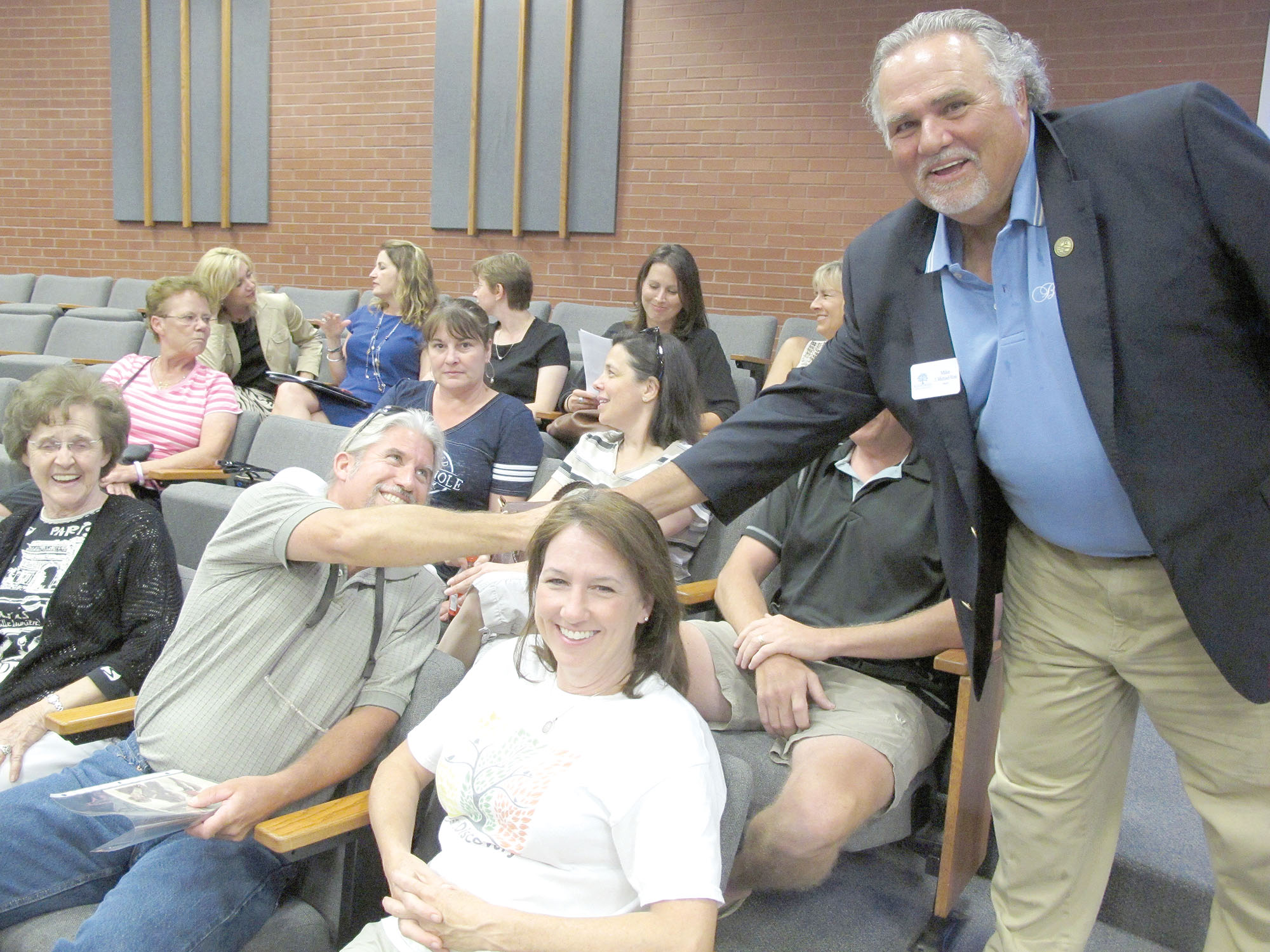
Blythewood Mayor J. Michael Ross greets Blythewood residents and shakes hands with Michael Watts as he arrives at Richland County Council chambers on Tuesday evening to support opposition to commercial zoning proposed on Rimer Pond Road. Seated in the front row, from left: Mary Lee, Micahel Watts and Joanna Weitzel.
COLUMBIA – After months of meetings and postponed meetings related to an effort by commercial real estate agent Patrick Palmer to rezone 5.23 acres on Rimer Pond Road for commercial use, many residents of Rimer Pond Road, LongCreek Plantation, Eagles Glen, Seton Ridge and Cooper’s Pond who opposed the rezoning breathed a sigh of relieve Tuesday night when Palmer officially withdrew his application.
Some Richland County Council members told residents in private prior to the meeting that Palmer did not have the votes he needed on Council. Palmer did not return phone calls from The Voice before press time.
The issue was scheduled for first vote by Council Tuesday night following a public hearing that was well attended by a crowd of residents opposing the rezoning. Among those who signed up to speak against it was Blythewood Mayor J. Michael Ross who had earlier in the day sent an email to all the County Council members asking them to “not compromise the residential areas around (Rimer Pond Road) and our middle school by allowing such uses as a gas station, pizza joint, etc. to locate there.”
“I know this is not in the Town of Blythewood,” Ross continued, “but if you go to the end of Rimer Pond Road, it is Blythewood. You may remember in our Master Plan that was developed about five years ago, we included a small commercial hub at the end (of Rimer Pond Road). Well, that went over like a lead brick and brought people from out of the woods on Rimer Pond Road,” Ross wrote. “We have since focused on our Town Center District, letting that be the Town’s primary commercial district and Rimer Pond remain residential.”
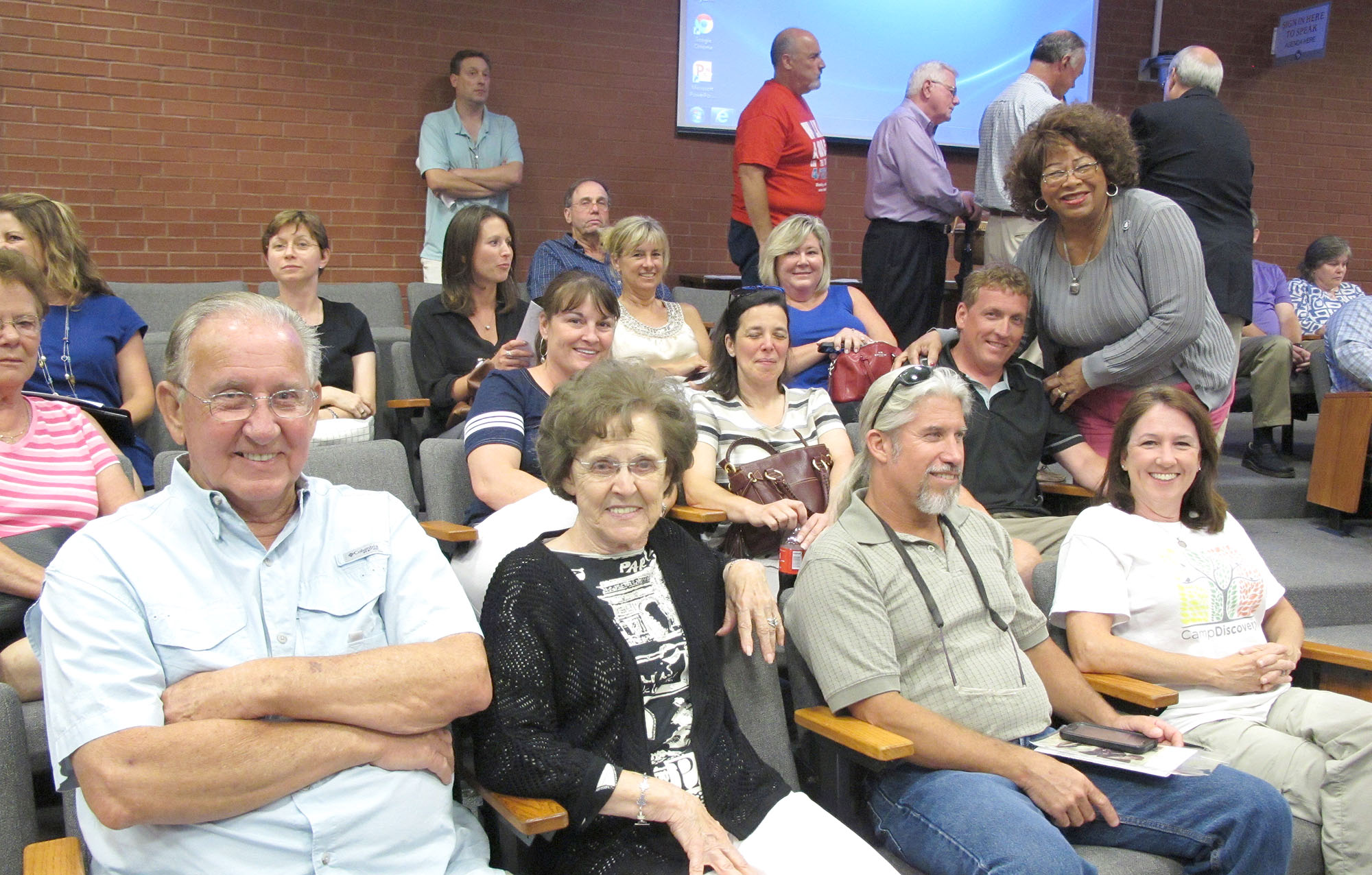
As the crowd of residents took their seats before the meeting started, several Council members, including Joyce Dickerson, who formerly represented the Blythewood area, stepped down from the Council platform and into the audience to shake hands and reminisce about previous trips the Rimer Pond Road group had made to Council chambers in recent years to oppose commercial zoning on the road.
Richland County Councilwoman Joyce Dickerson who formerly represented Blythewood on County Council visits with Blythewood residents who attended Tuesday night’s Council meeting to protest proposed commercial zoning on Rimer Pond Road.
According to Council rules, if Palmer wishes to bring his rezoning request back to Council he must start the process over by first bringing it before the Richland County Planning Commission. A major obstacle for Palmer in trying to get the 5.23 acres rezoned to Rural Commercial (RC) is the wording of the RC ordinance, which states that RC zoning is suited for the more isolated agricultural and rural residential districts and residents located beyond the limits of service of the municipalities.
The Planning Commission cited that wording as the reason they voted against recommending RC zoning for the 5.23 acres. Commissioner Beverly Frierson commented that the area in question was not isolated and not underserved.
Palmer, who is Chairman of the Richland County Planning Commission, placed on the Commission’s June 1 agenda for discussion the possibility of rewording the ordinance. That rewording is expected to be considered and voted on at the July 6 Planning Commission meeting to be held at 1 p.m. in Council Chambers, 2020 Hampton St. in Columbia. The agenda and meeting packet for that meeting will be available at richlandonline.com.
RIDGEWAY – Town Council was lukewarm during June 11 follow-up discussions on last month’s proposal by TruVista Communications to turn downtown Ridgeway into a Wi-Fi hotspot, suggesting upgrades would be required by the internet service provider before the Town locked itself into a contract.
“I’ve had complaints from several people downtown,” Councilman Russ Brown said, “(that) you can’t get work done because the internet is so inconsistent. I’ve been in the (Old Town Hall) restaurant when the TVs and computers are inconsistent over there. They can’t cash people out when it’s busy because it’s so up and down, it fluctuates so much.”
During Council’s May 14 meeting, Brannon Hough, a TruVista Business Solutions Specialist, told Council her company would be willing to waive any installation costs for the 5-meg Ethernet service, “providing that we are able to put up a Council-approved sign somewhere in the town that says it’s provided by TruVista.”
Hough said TruVista was proposing three access points within the town – one at the Century House and two on Main Street – that “will create a wireless network in downtown Ridgeway that can be used by anyone.”
Creating a downtown hotspot was part of Ridgeway’s initial long-range strategic planning talks led by Scott Slayton of the S.C. Municipal Association last September. During a follow-up planning session last November, however, free Wi-Fi failed to make the final cut of priorities; although Mayor Charlene Herring did indicate that Council would explore the possibility of doing so.
Randy Allen, a TruVista sales engineer, told Council during the May 14 presentation that the proposed wireless network could accommodate up to 15 network names with up to 100 users per network. The network also comes with a feature that would allow the Town and businesses to track the number of visitors to Ridgeway, whether they log onto a network or not.
The service would potentially cost the Town a little more than $498 a month, but would provide a free internet connection to users in the downtown area.
But last week, that proposal bumped into a Council concerned with the quality of service.
“I really would like to see some upgrades to that before we agree to a five-year contract at $500 a month,” Brown said.
Mayor Charlene Herring said she would present those concerns to TruVista for further discussion.
Sidewalk Repair
During her report to Council, Herring suggested exploring avenues of funding to repair a section of sidewalk on Highway 21 in front of the Post Office. The estimated cost to repair the sidewalk, she said, was $235,000. Herring said she would discuss the matter with State Sen. Creighton Coleman to determine if any funds were available through the County Transportation Committee.
Expenditures
Council OK’d $899 for the purchase of a bush hog to clear rights of way for the Water and Sewer Department. Council also discussed whether or not they may be able to recoup any of the $8,740 the Town recently spent repairing a fire hydrant on Dogwood Avenue. The hydrant was destroyed recently when a car crashed into it. Because the car was later reported stolen, Council said, the Town’s insurance company denied their claim.
New Kids on the Block
Council voted to extend a lease to Dr. Virginia Schaffer’s new venture, Health, Wellness and Education, at 128 Palmer St., the former home of Just Around the Corner. During her presentation to Council, Schaffer said the business will be devoted to the sale of nutritional products and health-related services.
Pelham Lyles, Director of the Fairfield County Museum, displays some of her artwork. She will be doing live sketching during this year’s Ag+Art Tour.
FAIRFIELD COUNTY – Looking for a great family outing this summer? Bring the kids along for a fun weekend in the countryside at the Ag+Art Tour, June 27-28 – rain or shine!
This year’s free, self-guided tour through Fairfield County includes six rural farm sites and will feature local artisans, farmers’ markets, barnyard animals, hayrides, history, food, music and lots of activities and events for the whole family. Be sure to bring a cooler along for toting the fresh produce and other farm stand treats available for purchase. The tour is open on Saturday from 9 a.m. – 5 p.m. and on Sunday from 1 – 5 p.m.
And don’t miss the Jazz & BBQ kickoff event at the Terrace Under the Oaks at Mission Ridge Retreat in Winnsboro on Thursday, June 25 from 6 – 8 p.m., featuring local art, craft and farm exhibits. Barbecue plates will be $10.
Fairfield County’s Ag+Art locations include Celtic Lane Farm in Winnsboro, a 1940s replica General Store featuring historical artifacts, a greenhouse, beehives and a solar panel demonstration at 1 p.m. on Saturday. On-site artisans will include Barbara Yongue, a Plein Aire artist, and Herman Thompson, a metal sculptor whose work incorporates white-out, wool and crayons.
And at Ee-oh-lay Farm in Ridgeway, kids can enjoy feeding and petting the farm’s free-range chickens (and checking out the colorful eggs!) while grownups peruse the handloom knits and home décor of Perfectly Imperfects.
Elder Farms is a sustainable family homestead in Winnsboro that produces homemade soaps and lotions from goats’ milk, and the farm also features an aquaponics watering system. Kids can swing on tree ropes and visit with the goats, ducks and miniature horse. Bring a picnic and blanket to enjoy lunch under a shade tree, then check out artist Pelham Lyles’ live sketching and Voice columnist Brenda Tobin-Flood’s organic pet treats, Ruby’s Natural’s.
The Fairfield County Farmer’s Market at the Town Clock in Winnsboro will offer locally grown vegetables, honey and herbs for purchase. Special activities on Saturday include a raised-bed garden demo at 10:30 a.m. and grit-grinding demos by Congaree Mills at 11:30 a.m. and 3 p.m. Fresh homemade ice cream will be also available for purchase on Sunday from 3-5 p.m.
Christy Buchanan’s lushly blooming art studio in Winnsboro is another fun stop. The She Garden at the Painted Picket is a sustainable herb, flower and vegetable garden highlighted by the “Bottle House,” a whimsically colorful structure built with glass bottles and topped with a living garden roof, one of the location’s many delightful artistic features.
And in Ridgeway, you can visit Royal Greens, a comprehensive and inviting hydroponic facility featuring a “living wall” of hanging gardens. Guided tours will be available of the hydroponic seeding process and the outdoor raised beds, and a variety of lettuces and other greens will be available for purchase. Painting and pottery by artists on the Fairfield Arts Council will also be on exhibit.
Check out the Ag+Art website at www.agandarttour.com for maps, schedules and other tour info. You can also check out facebook.com/agandartfairfield or call the Fairfield County Chamber of Commerce at 803-635-4242.
Tiffany Harrison (left), Fairfield County Economic Development Director, with Gov. Nikki Haley at last year’s BOMAG Americas, Inc. groundbreaking.
WINNSBORO – Tiffany Harrison, Fairfield County’s Director of Economic Development since 2006, announced her resignation last week, effective July 2. Harrison has accepted the Executive Director position with the Midlands Education Business Alliance in Columbia, an organization that fosters work-ready educational needs.
“It’s a great opportunity to support economic development from the workforce side,” Harrison said. “And I will continue to support Fairfield County.”
During Harrison’ tenure, Fairfield County broke ground on a new industrial park on Peach Road in 2011 and welcomed its first tenant in February of 2014, BOMAG Americas, whose assembly operation and showcase room for industrial machinery promises 121 new jobs. Prior to that, in August of 2013, Element Electronics announced 500 new jobs at its television manufacturing plant on the Highway 321 Bypass in downtown Winnsboro. In May of 2014, the Spanish manufacturer of elevators and lift systems, Hidral, announced a $1.5 million investment and 25 jobs for its new North American sales office in the Walter Brown Industrial Park. In August of 2014, toy and games manufacturer Enor Corp. announced 151 jobs at its new location on the Bypass.
“The county is in great position for growth and success,” Harrison said. “We have the building blocks in place so the next person coming in will be able to continue that success.”
County Council Chairwoman Carolyn Robinson (District 2) said the Administrator would initiate a search for Harrison’s replacement, but the County would miss Harrison’s easy demeanor.
“It’s going to be hard to fill that void for a while,” Robinson said. “She’s been with us nine years. She has come to know our county, know our product and work well with the Department of Commerce and the alliances, and we have seen growth. She has been easy to work with as the liaison to the County. But she has a good opportunity and I wish her well.”
Harrison said none of the county’s recent economic success would have been possible without the support of County Council. Now, Harrison said, she is looking forward to helping ensure Fairfield County and the Midlands have the workforce to meet future economic needs.
“Sixty-five to 70 percent of jobs in this county and the state require something less than a four-year degree, but something more than a high school diploma,” Harrison said. “The Midlands Education Business Alliance will help grow the workforce businesses need.”
Rimer Pond Road Residents Put Developer on the Spot
BLYTHEWOOD – No minds were changed after a June 8 neighborhood meeting at Round Top Elementary School between 50 or so residents opposing a request for the commercial zoning of 5.23 acres on Rimer Pond Road (across from Blythewood Middle School) and two Richland County government officials: Torrey Rush, County Council Chairman and representative of the district surrounding the 5.23 acres and Geonardo (Geo) Price, Richland County Zoning Administrator. Also present was the applicant for the commercial zoning request, Patrick Palmer who is the broker in charge of the sale of the property as well as Chairman of the Richland County Planning Commission that recommends zoning for the property. Palmer is also son of the owner of the property.
Palmer has listed the property for $350,000 per acre, but that price is dependent on the County rezoning it for commercial use. Palmer said at the meeting and later told The Voice that a 9,000-square-foot building is planned for the property. Asked by The Voice to verify or deny a rumor circulating that a Dollar store is planned for the site, Palmer said he didn’t know. The 5.23 acres is part of a larger 31.23-acre parcel zoned Medium Density Residential (MS-RD).
Price opened the June 8 meeting by saying he did not want to throw anyone under the bus, then proceeded to say members of the Richland County Planning Commission had not given a good enough reason at their April 6 meeting as to why they voted against staff’s recommendation that the 5.23 acres should be zoned commercial. But Suzie Haynes, Boards & Committees Coordinator for Richland County Planning & Development Services, told The Voice that the only reason the Commission is asked to give a reason for their decision when going against staff’s recommendation is so Council can better understand the Commission’s position on the issue.
“There was really nothing substantial from the Planning Commission to make us (staff) go back and look at this area,” Price insisted, pressing on. “I was not comfortable (with their reasons). It was not clear as to why they should oppose staff’s recommendation (for commercial zoning).
The Commissioners said they voted against the request because the Zoning District Summary in the zoning ordinance for Rural Commercial District (RC) was antiquated in that it stated, among other things, that the RC district was best suited for isolated agricultural and rural residential areas and so that residents located beyond the limits of service of the municipalities can receive convenience merchandising and services. Commissioners concluded that RC did not apply to the area around the 5.23 acres.
When later asked whether the Commission’s reason for recommending denial of commercial zoning on the 5.23 acres was valid, the County’s Planning Director, Tracy Hegler, said the Commission’s point was, indeed, a valid reason for voting to deny staff’s recommendation for commercial zoning.
The residents repeatedly told Rush and Price that the Rimer Pond Road area was neither isolated nor underserved and therefore the RC zoning district was not suitable for the area.
“Nobody out here asked you to bring a Papa John’s or anything else to us,” Rimer Pond Road resident Ken Queen told Palmer. “We don’t want them here.” He then turned to Rush. “If the residents, your constituents, don’t want it, that’s what counts.”
Other residents chimed in in agreement.
One unidentified resident said, “What we’re saying is that we have enough conveniences. This zoning change does not fit our area. Services are very convenient to us now – the bank, grocery store, etc.”
“But we look at how this area should grow,” Price countered.
When one resident replied to Price, “But we don’t want it,” the audience applauded.
Palmer told residents that he had been on the Planning Commission for 12 years and that he was part of the community and lived in the area. But he later recanted that statement, saying instead that he lived in the Northeast when pressed by a resident as to whether he actually lived in Blythewood.
“This is not about community,” Queen said, “It’s about greed. With all due respect, Mr. Palmer, the rest of the property (besides the 5.23 acres) is zoned Medium Density Residential. There’s plenty of money in that.”
Queen reminded Rush that Palmer had succeeded in getting the entire 31.23-acre parcel rezoned from Rural (RU) to Medium Density Residential (MS-RD) in 2011.
“None of us wanted that,” Queen said. “You (Council) voted for it in spite of the residents’ objections. Now we have to live with that. Now Mr. Palmer has changed his mind and wants zoning (on the 5.23 acres) for commercial that creates even more traffic problems and is less palatable than what he asked for in 2011.”
Price assured the group that the 5.23 acres of commercial would be limited to that intersection.
“It’s not designed to spread down the road. It will stay at the intersection,” Price said.
But Rimer Pond Road resident Michael Watts told Rush that, “If you zone one parcel commercial on this road, then the property owner beside it will want commercial too. You say you can stop it, but you can’t. The person owning the next property will go to court against you (to get commercial).”
Palmer’s rezoning request is the first item on the agenda for the Tuesday, June 23 Public Hearing to be held at 7 p.m. in Council chambers located at the corner of Harden and Hampton streets. The public hearing is the only time residents will be allowed to speak to the issue. Those wishing to speak should arrive 10-15 minutes early to sign up. To request an email of the agenda packet, call Suzie Haynes at 576-2176 or email her at HAYNESSU@rcgov.us.
JENKINSVILLE – A 30-page report, issued by the Nuclear Regulatory Commission (NRC) last week, classifies two findings associated with the accidental damage in February of the nuclear containment vessel under construction at the V.C. Summer Nuclear Station as “non-cited violations,” calling both findings “of very low safety significance.”
The report did, however, note a breakdown in communication between Chicago Bridge & Iron (CB&I) workers, field engineers and construction supervisors, as well as a lack of training and oversight, all of which contributed to the damage.
Between Feb. 5 and Feb. 10, a CB&I crew was removing several pieces of vertical rebar inside the containment vessel prior to pouring additional concrete inside the vessel. While doing so, workers inadvertently drilled into rebar within the existing concrete, damaging the metal bowl of the structure. The containment vessel houses the nuclear reactor.
CB&I did not report the damage to SCANA, which operates the site, until Feb. 16, the NRC said.
The damage, which the report states has been corrected, was the end result of a chain of events that began on Jan. 9. According to a time line laid out in the report, it was then that CB&I surveyors and carpenters marked out on layer two of the concrete floor of the containment vessel a line to be used as a reference point for locating three embedded plates. That line was off by one foot because several vertical rebar dowels protruding from the concrete interfered with the chalk line.
A second crew of carpenters, not realizing the center line was offset, later came in and marked what they thought were the locations of the plates.
On Jan. 20, CB&I field engineers identified that there were rebar dowels in the second layer of concrete that interfered with the planned installation of pipe in the yet to be poured third layer. This interference would require a new dowel hole to be bored. On Jan. 23, a field engineer identified that the rebar dowels interfered with the marked locations of the plates. Referencing a drawing showing the location of the dowels, the engineer identified the dowels as type 3A and 3G vertical dowels.
“This was an error,” the report states. “The correct drawing . . . shows that the interfering dowels were actually type 3B and 3L vertical dowels.”
The correct drawing also noted the actual location of the dowels, the report states.
A Westinghouse Electric Company (WEC) engineer provided repair instructions and engineering justification, but did not recognize that the plates were in locations that could not potentially interfere with type 3A and 3G dowels.
“A comparison of CV (containment vessel) drawings would have revealed the error,” the report states. “Had the responsible engineer correctly identified the locations of (the embedded plates), he would have realized that the interfering dowels were type 3B and 3L vertical dowels.”
The WEC engineer specified that the bore holes be a minimum of 25-inches deep, which could accommodate type 3A and 3G dowels, but not 3B or 3L dowels. The oversight also escaped the eyes of a second WEC engineer on Feb. 3, and a CB&I field engineer marked the spot for the new bore holes on layer two of the concrete, holes that corresponded with the erroneously marked embedded plates. Two days later, drilling began.
Carpenters discovered the mistake in the marking of the plate locations on Feb. 9 and laid out new center lines. A field engineer then marked three new holes to be drilled, while also determining that three of the previously drilled holes could not be used and required filling with grout and replacement dowels.
By Feb. 10, CB&I had 10 holes, seven of which were to have new dowels and three useless hoes that required grout and replacement dowels. When the 10 holes were filled with water for pre-soaking, one of the holes would not hold water. Two days later, an investigation was under way to determine why the hole designated as R1 would not hold water. Borescope photographs revealed that the containment vessel had been exposed during the drilling.
Sections of nine concrete cores from the drilling were recovered from a dumpster and it was discovered that structural rebar had been cut in at least two sections of the cores.
Among the report’s findings were a lack of supervision (“Field engineers made key decisions without input from their supervisors.”); a communication breakdown (“Field engineers failed to communicate problems with the core-drilling activities . . . to their supervisors”); and problems with work management (” . . .oversight was not provided to avoid errors. . . . work instructions did not contain adequate precautions to avoid damaging these components.”).
The report also noted training issues (“Neither craft nor field engineering personnel received training at the site on core drilling operations, and they were not knowledgeable of the appropriate procedures governing core drilling.”); a failure to “challenge the unknown” (“Field engineers did not stop core drilling when structural rebar was encountered.”); and a failure to adequately plan (“Craft personnel held pre-job briefs prior to core drilling, but the briefs only included industrial hazards and personnel safety issues. Craft personnel did not discuss potential adverse impacts on structures, systems or components. Field engineers did not attend the pre-job brief with craft personnel.”).
According to the report, the failure to implement procedures for coring concrete and post installing anchors was a “performance deficiency” that was “more than minor.” Coring was not stopped when rebar was contacted, the report states, and neither the field engineer nor the construction superintendent contacted the engineer for approval or to report the nonconformance of the impacted rebar, as required by procedures. Prior to grout placement on two core locations, neither the field engineer nor the construction superintendent verified the rebar was not cut.
The report also classified as a ‘more than minor performance deficiency’ the failure to verify that a design change did not adversely impact the containment vessel. “Had it been recognized that the interfering dowels were actually 3B and 3L type dowels,” the report states, “then the potential for impacting the CVBH (containment vessel bottom head) would have been more apparent.”
RIDGEWAY – Town Council gave final reading May 14 to a $222,840 general fund budget and a $364,636 water and sewer fund budget for the 2015-2016 fiscal year, passing the budget without dissent. As a companion piece to the upcoming budget, Council also passed final reading of an ordinance raising water rates $1 per 1,000 gallons across the board.
The rate increase roughly corresponds with what Councilman Doug Porter said was a 98 cent per 1,000 gallon increase being levied on Ridgeway from the Town of Winnsboro, their single supplier of potable water. However, as Winnsboro’s Assistant Town Manager Lorraine Abell pointed out to The Voice last month, Winnsboro’s rates did not go up quite so much.
According to a March 31 letter to Ridgeway from Winnsboro Mayor Roger Gaddy and Town Manager Don Wood, Winnsboro’s rates, effective July 1, are going up only .098 cents – less than a dime – per 1,000 gallons.
Ridgeway Mayor Charlene Herring said this week that she did not know if Council would pass a new ordinance to adjust the rates, or merely let stand the rates passed last week.
According to the ordinance passed unanimously May 14, Residential water customers inside the Town limits will see their rate for the first 1,000 gallons go up to $16, and will pay $6.07 for each additional 1,000 gallons. Residential customers outside the Town limits will be paying $21 for the first 1,000 gallons and $7.32 for each additional 1,000 gallons.
Commercial water rates inside the Town limits are going up to $19 for the first 1,000 gallons and $6.07 for each additional 1,000. Those rates outside the Town limits will be $24 for the first 1,000 gallons and $7.32 for each additional 1,000 gallons.
Residential sewer rates for customers inside the Town limits will increase to $13 for the first 1,000 gallons and $5.42 for each additional 1,000 gallons. Outside the Town limits, those rates are going up to $14 for the first 1,000 gallons and $6.57 for each additional 1,000 gallons. The flat rate for residential sewer customers will now be $26.
Commercial sewer rates inside the Town limits are increasing to $17 for the first 1,000 gallons and $5.57 for each additional 1,000 gallons. Outside the Town limits, those rates are going to $20 and $6.57, respectively.
Winnsboro increased its wholesale water rate to $4.618 per 1,000 gallons, according to the March 31 letter from Winnsboro to Ridgeway.
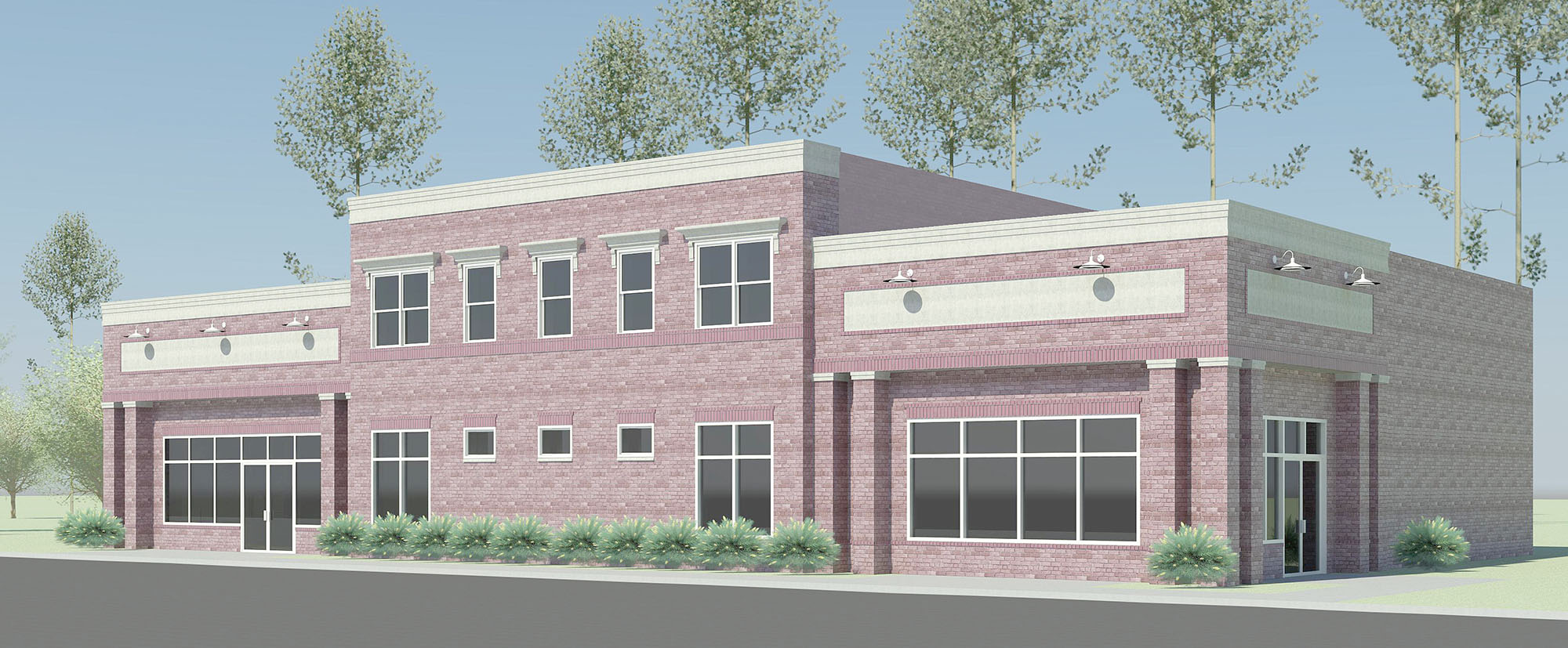
An architect’s rendition of a proposed new medical office at 121 Blythewood Road.
BLYTHEWOOD – The Town’s Architectural Consultant, Matt Davis, stepped out of that role on Monday evening during the Board of Architectural Review meeting to represent the applicants for a medical office to be located at 121 Blythewood Road, across from Companion Animal Hospital.
Designed to be shared by two private medical practices, a pediatrician and an ophthalmologist, the 7,085-square-foot building is a combination of a two-story center section with one-story wings.
Because the Town Center zoning ordinance requires all new commercial buildings to have multiple stories, the BAR voted to give the applicants a variance for the two one-story wings. And because the Department of Motor Vehicles requires that driveways (entrance/exits) must align with driveways across the street, the Board also voted to allow a shift of the building toward the east lot line to allow for that driveway match up.
The BAR voted unanimously to give partial approval for the architecture and building location. Additional architectural details (materials, colors, etc.) and the final site plan with landscaping, lighting and signage will be submitted to the BAR at the July 20 meeting for the balance of the approval.
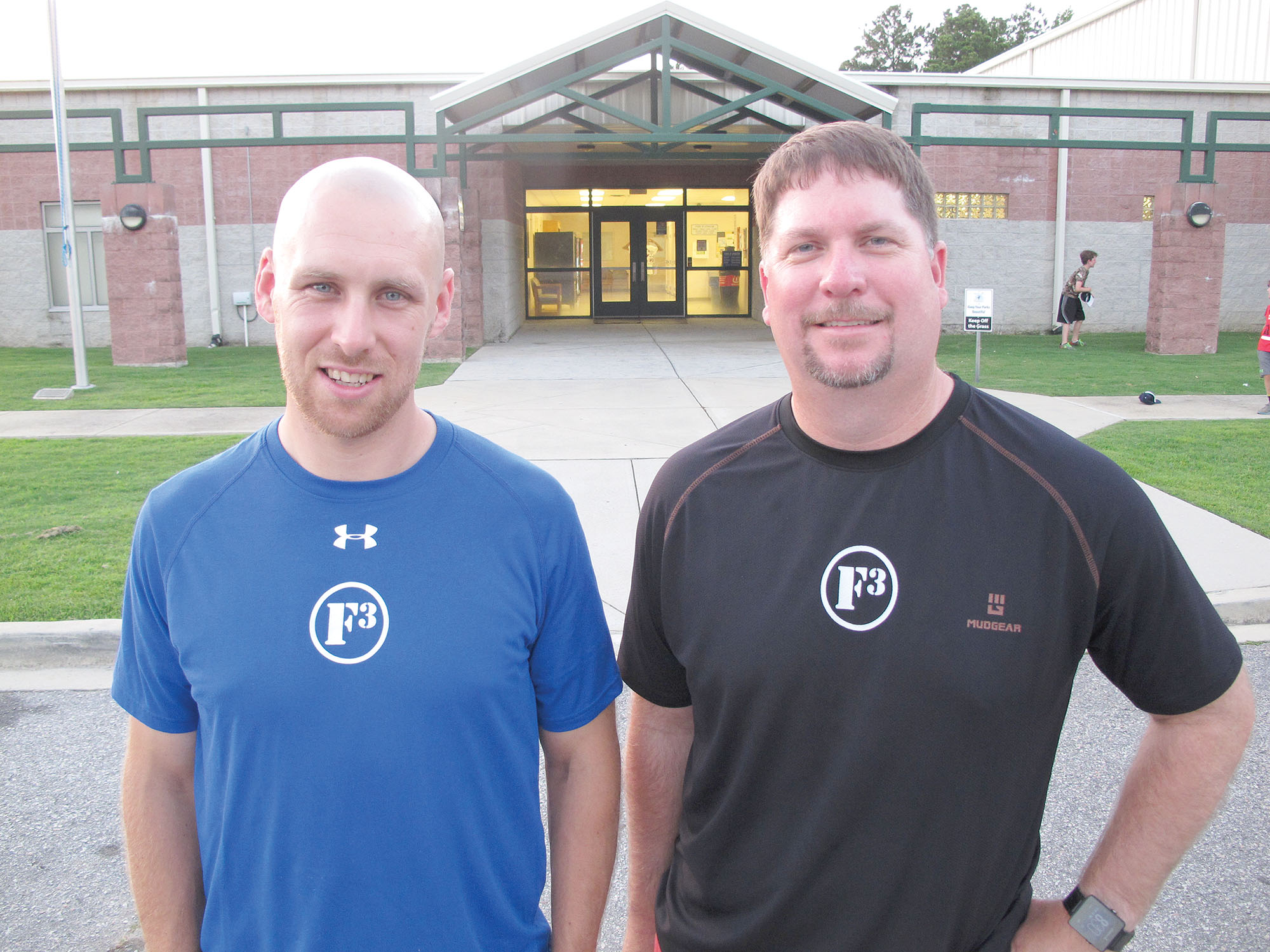
Daniel Hayes and Craig Rummel outside the Blythewood Recreation Center on Boney Road. Saturday, they launch the Blythewood chapter of F3 Nation, a free workout and fellowship program for men.
BLYTHEWOOD/WINNSBORO – It begins in the predawn darkness, when first light is but a rumor. The morning’s fist birds are warming up in their arboreal alcoves, the air not yet filled with their flitting chorus. As the sunrise splits the horizon and spills its first rays, painting the landscape in an ethereal glow, the shadows appear on the grounds of the park.
The shadows, vague at first, begin to take form, the shapes of men rising before them. Men from all walks of life, of all ages, shapes and sizes. Men of all faiths and convictions. And they are all here for the same reason – to be better than they were the day before.
That is, essentially, the bottom line of F3 (Fitness, Fellowship and Faith) Nation: to improve from day to day.
Born in Charlotte on the first day of 2011, the men-only workout and fellowship group has grown to include chapters across the Southeast. In 2013, a group was formed at The Sandlot on Clemson Road; last month, at Fortune Springs Park in Winnsboro. And, beginning this Saturday, Blythewood Park on Boney Road will host its first workout.
The Saturday workouts are the “late” workouts, beginning at 6:30 a.m. and lasting about an hour, but that doesn’t make the boot camp style sessions any less challenging. Especially if it’s your first time.
“My first exercise was awful,” said Blythewood resident Daniel Hayes, 27. Hayes, an N.C. native who moved to Blythewood in 2013, helped spearhead F3’s presence in Blythewood along with Craig Rummel.
“I didn’t finish anything,” Hayes said of his first workout in Finlay Park in Columbia in 2013. “I almost threw up. It was a very humbling experience.”
Humbled though he was, Hayes was hooked, he said, and began attending the boot camp sessions three days a week at The Sandlot, where participants go through a series of “body weight” exercises – pushups, sit-ups, jumping jacks, etc. – eventually finding his way to one of the running groups that meet two to three days a week.
“I was never much of a runner before F3,” Hayes said. “I used to actually make fun of long-distance runners. But I just completed my first half-marathon in Columbia last March.”
Since joining F3, Hayes said he has dropped about 30 pounds from a body that was “a mess” and years beyond the shape he was in as a three-sport high school athlete.
But like many other F3 participants, Hayes found something besides just improved physical health. The husband and father of three girls found the second F – Fellowship.
“I was out of shape,” Hayes said, “but I was also looking for something more than the four females I live with. I don’t get a lot of male interaction much, besides at work. I don’t get to goof around and be a guy in my house. Now I get up early in the morning and workout with other guys, cracking jokes, having fun while getting stronger along the way.”
The fellowship augments the fitness, according to F3 organizer Jason Reynolds, a 35-year-old Citadel graduate from Columbia. F3 provides a setting where men can get together with other men, share their stories, their struggles and remind each other what it means to be a Man.
“What the founders in Charlotte (Tim Whitmire and David Redding) discovered was that as they got older, they had fewer and fewer male friends,” Reynolds said. “They had the husbands of their wives’ friends, fathers of their children’s friends, men they saw at church; but these were only by-name, in-passing acquaintances. They weren’t really close friends. There weren’t a lot of guys they could really talk to about their trials and tribulations.”
But through the shared experience of the workout, Reynolds said, men form a real, lasting bond. And in this boys-only environment, men can talk freely and openly.
The third F in F3 Nation – Faith – is a little more subtle, Reynolds said.
“F3 is not an evangelical group,” he said. “The Faith aspect lies a little below the surface. We’re not affiliated with any specific religion. But we’ve found that when you fellowship with other men in these workouts, you realize we’re here for a purpose – to be a good father, a good husband, a good friend, good employer or employee. You realize you have responsibilities and expectations to live up to.
“We’re 100 percent inclusive,” Reynolds added. “We’re open to all men of any fitness level and all faiths.”
For Hayes, the F3 experience has strengthened his faith, he said.
Each workout ends with a huddle-up as the workout leader (assigned on a rotation from among the participants and designated as “The Q”) offers a prayer, inspirational words of encouragement or a scripture reading. When it came his turn as The Q, Hayes found himself in uncharted waters.
“I had never prayed in front of a group of people before,” Hayes said. “It made me uncomfortable. I wasn’t strong enough in my faith to do that.”
Before long, however, the experiences of the workout had transformed him more than just physically.
“Now, for me to have the courage, the faith and the mental capacity to lead a devotion to a group of guys, 95 percent of whom are older than me, that’s a huge change,” Hayes said.
If You’re Ready
The Winnsboro group holds boot camp workouts Tuesdays and Thursdays, 5:15 – 6 a.m., and Saturdays 7 – 8 a.m. at Fortune Springs Park. The run group meets Monday and Wednesdays at 5:15 a.m. at the Town Clock.
Blythewood’s group holds its inaugural meeting this Saturday at 6:30 a.m. at Blythewood Park, 126 Boney Road. Additional boot camps are slated for Tuesdays and Thursdays, 5:30 – 6:15 a.m., also at the park.
Hayes suggests that first-timers invest in a pair of lightweight latex gloves, as workouts incorporate the surrounding environment and may include hefting the odd cinder block or pushups or other activities against picnic tables or the curb of the parking lot. And, Hayes said, be prepared to be challenged.
“It’s going to hurt,” he said. “The type of exercises we do, you’re engaging muscles you don’t normally use. I’ve seen CrossFit guys show up and not be able to finish the workout.
“But the point is to keep moving, keep doing something,” Hayes said. “The point is to make yourself get better, and the only way to get better is to keep coming back.”