Category: News

  • Second Horse Dead; County Defends Animal Control

    Third Account of Feeding Offered

    Documents May Be Missing From FOIA Request

    WINNSBORO – A second horse that spent nearly a month in the custody of the Fairfield County Animal Shelter died last week. The approximately 5 ½-month-old colt, transferred from the County to Big Oaks Rescue Farm in Greenwood on June 16, had been adopted by a volunteer staff member after about a week in their care.

    According to Dr. Lindsey Wilkins, an equine vet at Creek Run Veterinary Hospital in Pendleton, “The colt was brought in to the clinic about 10:30 p.m. Sunday, July 5 by its owner. The owner said the colt had become lethargic earlier in the day and as it became weaker, he brought it to the veterinary hospital where it died about 4 the next morning.”

    The cause of death was not able to be determined, Wilkins said. The colt’s mother, suffering from starvation and tape worms, died just two days after its arrival at Big Oaks (see the July 10 edition of The Voice).

    Addressing questions raised by The Voice’s July 10 article about the treatment of the mare while in the County’s custody, Interim County Administrator Milton Pope defended the actions of the Animal Control staff before County Council Monday night.

    Pope said the horses were taken from their Blair farm on May 18, and not May 19 as reported in The Voice – and as David Brown, the County’s Animal Control Officer in charge of the shelter, told The Voice two weeks ago.

    Contradicting himself, Pope later told Council, “The horses were taken into custody on the 19th and the surgery (on the colt) was performed within hours of when we brought it to our facility.”

    Pope also told Council that the feeding of the mare was per instructions to staff from Dr. Robert Chappell, a small animal vet used almost exclusively by the County. Pope said feeding consisted of “up to a half a bale of hay per day. We also provided Maintenance horse feed, Timothy grass pellets, Safe Choice feed and also the horse was given sweet feed.

    “The owner’s family provided information to the Animal Control staff that the mare would not eat unless you used sweet feed,” Pope added, “and what the Animal Control staff did was mix the sweet feed mixture in the food to get the mare to eat.”

    But Pope’s account marks the third different explanation of the mare’s feeding schedule reported by the County.

    In initial discussions with Brown shortly after the mare’s death, Brown told The Voice the mare was fed “sweet feed and adult horse feed” in “small amounts in three applications a day,” while hay was left in the holding pen at the shelter.

    A week later, Brown said the mare had been fed sweet feed four times a day in 3-quart portions. At no time did Brown tell The Voice the mare was fed grass pellets or that a mixture of sweet feed with any other kind of feed was used.

    According to records obtained by The Voice through a Freedom of Information Act (FOIA) request, Dr. Chappell paid for “the majority of the food costs.” The County’s only feed purchase, records state, was for two 50-pound bags of feed, indicated on a receipt from Tractor Supply Co. as Producer’s Pride 12 percent sweet feed and Nutrena SafeChoice feed. Two 50-pound bags each of the exact same feed were also donated to the shelter on May 27, according to the records.

    Pope also told Council that “The horses were watched daily by Animal Control staff and were under watch of the veterinarian. We have daily logs of that.”

    But The Voice’s FOIA request, dated June 26, specifically asked the County for (among other things) “all records associated with the rescue, surgery, housing, feeding, surrender by owner and relocation of the mare and foal . . .” If the County does in fact have a daily log of the vet’s and Animal Control staff’s care, it failed to provide it under The Voice’s FOIA request, placing the County in violation of the state’s open records laws.

    Pope suggested that the County adopt an animal cruelty ordinance, as well as retain an equine vet to have on call for potential future situations.

    “I think we definitely need to have an equine vet on call that can tend to big animals,” Councilman Marion Robinson (District 5) agreed, “because it is a completely different deal than dealing with a dog and cat. A horse is a lot more complicated person.”

    Councilman Billy Smith (District 7), who ultimately made the motion to send an animal cruelty ordinance into committee, said feeding a starving horse sweet feed was inexcusable.

    “When I first heard about the sweet feed to a horse that’s in this condition, I thought that would be like taking a human who was in that type of condition to a barbecue joint,” Smith said. “I looked up on Google and I typed in today ‘starving horse’ and ‘sweet feed,’ and every result that came back said don’t give a horse in that condition sweet feed.

    “We had the horse for about 30 days,” Smith said. “I wonder if we ever contacted an equine vet. That’s a pretty simple question. I don’t know if we did that or not, but I wonder that if we (had) would that have maybe had changed the course of events.”


  • Comprehensive Plan Winding Down

    BLYTHEWOOD – Amendments to the Town’s Comprehensive Plan are winding down and it is expected the Planning Commission will recommend them to the Town Council at the Commission’s next meeting on Aug. 3.

    Gregory Sprouse of the Midlands Central Council of Governments has been working on the project with members of the Commission both in regular meetings and individually for the last two months. State law requires that the Plan be updated every 10 years. Its purpose is to provide the Town’s officials guidance in planning and zoning.

    On Monday evening, the Planning Commission discussed changes that included updating the maps for water and sewer lines and information about the adoption of a capital improvement plan by Council. Sections on air quality and future availability of water were put in a more favorable light. New emphasis was placed on economic development and industrialization in the town as well as suggestions to provide incentives to developers who actively work to implement the visions of the Town. Another objective of the new plan will be to determine gaps in the town’s economic market and take steps to encourage development to fill those gaps.

    A new section was added that lists the town’s strengths, weaknesses, opportunities and threats as determined by the Planning Commissioners and Town Council members at recent meetings. Under the heading of Transportation, there are future plans to construct a park-and-ride lot and bus waiting area on the land just west of I-77, adjacent to the former community center. Future plans also include construction of a multi-model transportation center and parking lot.

    Chairman Malcolm Gordge announced that the terms of commissioners Marcus Taylor and Michael Switzer will end Sept. 30, and that Switzer will not reapply for appointment to the Commission. Taylor, who has served two terms on the Commission, told Gordge that he would like to continue serving. Residents of the Town who would like to apply for a vacant Commission seat should contact Town Hall at 754-0501.


  • Remains ID’d as Missing Blythewood Man

    BLYTHEWOOD – Richland County Coroner Gary Watts Wednesday afternoon identified the human remains found near Blythewood Sunday morning as those of Stanaland Keith Dixon, 51, of 11143 Wilson Road. Dixon had been missing since June 28.

    Deputies searching for Dixon discovered the badly decomposed body Sunday morning deep in a wooded area off I-77, just south of town. Lt. Curtis Wilson of the Richland County Sheriff’s Department said the body had apparently been there for some time and was in a state of advanced decomposition, making immediate identification difficult.

    On Wednesday, Watts said dental records were used to identify the remains as those of Dixon. An autopsy performed on Tuesday showed no signs of trauma, Watts said; however, final toxicology reports are still pending and may not be completed for several weeks. Watts said the death will likely be ruled natural or accidental once all testing is complete.

    According to the Sheriff’s Department, Dixon was last seen riding with a friend off-road in a pickup truck underneath the power lines off I-77 on June 28. When the truck became mired in mud, Dixon elected to walk back to Blythewood for assistance. He had not been seen or heard from since, the Sheriff’s Department said.


  • Horse dies after weeks in County’s custody

    WINNSBORO – The death of a 7-year-old mare and a second round of surgery on her 4-month-old colt just days after they had been shipped to a rescue farm in Greenwood after spending nearly a month in the custody of the Fairfield County Animal Shelter has raised some serious questions about how the County cared for the animals.

    The mare was emaciated and weak when she and her colt left the shelter for Big Oaks Rescue Farm in Greenwood, where the mare went down the day she arrived and died two days later. The founder of Big Oaks, Joe Mann, said the mare was suffering from starvation and the worst case of worms he’d ever seen. The colt, he said, was suffering from a surgery performed by a small-animal vet at the Fairfield Animal Shelter that left the colt in pain and unable to walk properly.

    While David Brown, the County’s Animal Control Officer in charge of the shelter, told The Voice that the mare was in much worse condition when she was brought to the shelter four weeks earlier, he has not presented any documentation or photos of her condition upon arrival, has not identified or brought charges against the owner, has not explained to The Voice why the horses were kept in inadequate conditions at the shelter for such a long period of time and why an equine veterinarian was never called to check on them.

    The mare and her colt were both taken from a pasture in Blair on May 19, according to Brown, who said Animal Control received a call that day from the daughter of the owner of the horses saying the colt had sustained serious injuries after becoming entangled in barbed wire. The owner, Brown said, was out of town at the time of the incident.

    Instead of contacting an equine veterinarian, Brown said he contacted the shelter’s regular veterinarian, Dr. Robert Chappell, a small animal vet whose offices are in Richburg and Fort Mill. Brown said Dr. Chappell was met by a Fairfield County junior Animal Control Officer at the Blair farm. Chappell described the colt as not more than a week old when it was injured. But Minge Wiseman, a respected local horsewoman and vice president of the Hoof and Paw Benevolent Society, a group of volunteers who work with the County Shelter and Adoption Center to protect neglected animals, put the colt’s age at 4 months when she first saw him a month after the injury occurred.

    After the colt had been freed from the barbed wire, Chappell transported him to the Fairfield shelter. Chappell said that because the colt was still nursing, he also brought the mare in. Both animals were housed in a small pen behind the Shelter where they were subsequently held for a month. Brown said the colt needed immediate surgery for his wounds, which Chappell performed, and the mare was badly undernourished. In spite of the condition of the mare and colt, Brown said no criminal charges are pending against the Blair owner.

    “When they release (the animals) to us, we won’t normally prosecute anything,” Brown said.

    But it is not clear why he did not bring charges since the owner did not actually release the mare and colt until they were discovered at the shelter by members of Hoof and Paw on June 13, almost four weeks after the horses were removed from the Blair farm.

    Brown told The Voice that he had notified Hoof and Paw members about the mare and colt after the horses had been at the shelter for about a week. But members of Hoof and Paw said Brown only relayed to them at a June 1 luncheon that he was holding a mare and foal until their owner paid Dr. Chappell $1,800 for the surgery Dr. Chappell had performed on the foal. They said Brown did not inform them about the mare’s emaciated condition. Wiseman said it was not until several Hoof and Paw members were helping with a fundraiser at the Adoption Center on June 13 that they learned the mare and foal were still at the shelter and walked over to see them.

    The mare was “pretty emaciated,” Wiseman said, and both animals were “in a very small holding pen . . . not designed to keep horses for any length of time.”

    Wiseman said she asked Brown if he needed help with the horses, urged him to move the mare and colt to foster care immediately and offered to find a place for them. Wiseman posted a plea for foster care on Hoof and Paws’ Facebook page, and Mann responded. After two more days, Brown told Wiseman that he had gotten an official release from the owner and gave Wiseman and Hoof and Paw president Deborah Richelle permission to use the County’s horse trailer to transport the mare and colt to Big Oaks the next day, June 16.

    Wiseman said when she arrived at the shelter, she noticed that the colt was “gimpy” in the hind end at the trot. She also reported that when loading, the mare buckled to her knees and went down trying to step into the trailer, which was about a foot off the ground. Wiseman said the mare didn’t seem strong enough to lift herself into the trailer and that the two women managed to get the mare back on her feet and into the trailer with her colt.

    Shortly after arriving at Greenwood that afternoon, the mare went down again, according to Mann, and equine veterinarian Dr. Alexandra Tracy was called. While Dr. Tracy has not returned calls from The Voice, Meg Francoeur, a hoof trimmer from Aiken who volunteers at Big Oaks, wrote in an email to The Voice that she was with Dr. Tracy at Big Oaks until 6 p.m. on June 17 while Dr. Tracy continued to give fluids, steroids and pain meds to the mare. But the life-saving effort failed, and Mann said the mare succumbed and died early the next morning, June 18.

    Francoeur also wrote that Dr. Tracy checked the mare’s colt and “found a large lump where he had been injured. She sedated the (colt) to check to see what it was, and ended up having to cut away adhesions on the colt so that he would be able to open his legs and walk normally.”

    “Our vet had to re-do everything (Dr. Chappell) did,” Mann, who witnessed the second surgery, said. “He had (the wound) sewed to one of his hind legs. Every time (the colt) moved his leg, he was in agony. I’ve never seen anything done like that before. It was unbelievable.”

    From his perspective, Dr. Chappell told The Voice that the colt had severely lacerated the inner portion of a hind leg near its stomach while struggling to free itself from the barbed wire. The cut was very deep, Chappell said, exposing the bone, and the wound was bleeding profusely.

    Once the animals were moved to the shelter, Chappell said he sedated the foal and was ready to begin surgery outside on the ground. Rain then began to fall, he said, and the foal was moved back inside the horse trailer for the procedure.

    Chappell, who is not an equine vet, said that prior to the surgery he had telephoned his uncle, Dr. John H. Chappell III, an equine vet in Rock Hill, to ask him to take the foal. His uncle did not have stall space available, Chappell said, but did advise him on how to proceed with the surgery.

    “Most doctors probably would have put that foal down,” Chappell said. “He was bleeding so bad.”

    Chappell said he had to trim some of the muscles, then mend the arteries.

    “I moved some scrotal tissue to cover the wound,” Chappell said. “Horse skin doesn’t heal very well. There were blood vessels exposed and I couldn’t leave them open, so I covered them with some excess tissue from the scrotum.”

    Within 45 minutes of coming to, the foal was up and nursing, Chappell said.

    But Big Oak’s version of the surgery does not match the happy ending Dr. Chappell described.

    Francoeur, who said she has more than 30 years’ experience working with horses as a trainer, a hoof trimmer and generally caring for them, said that, “In most cases, an injury (like the colt’s) would have had repair to the muscle but the external tissue would have been left open to heal from the inside out. (Horse) wounds generally heal cleaner if left to heal slower.”

    Francoeur also noted that Dr. Chappell had used non-dissolving sutures to close the wound and that they were still in the wound when it was opened on June 17, nearly a month later.

    After reading an account in another local newspaper in which Brown praised Dr. Chappell for his surgical efforts, Francoeur wrote, “Brown may have been impressed with the surgery, but the folks at Big Oaks were not. The amount of work that had to be done to undo all the damage was extensive, but I don’t really blame the other vet. He’s not experienced with horses, which was obvious in that he thought the (colt) was only days old.”

    The second surgery was successful, Mann said, and the colt is now on its way to a full recovery. It has since been placed in foster care. The mare, however, was another story.

    While Mann said the mare died of starvation and worms, Chappell said he de-wormed the mare a month before, and Brown said he and his staff had implemented a feeding schedule.

    “The doctor (Chappell) said not to overfeed her,” Brown said, “because that could be fatal.”

    Brown initially told The Voice that the mare was being fed “small amounts in three applications” a day, but he later revised that, and said hay was left in the pen, while the mare was given approximately 3 quarts of sweet feed four times a day. While Brown said the mare was eating well and putting on weight, a photograph of the mare taken the day it arrived at Big Oaks indicates a severely undernourished horse.

    Dr. Chappell placed responsibility for the mare’s death at the feet of Big Oaks Rescue Farm.

    “They overfed her the first night and she died, which was stupid” Chappell said. “We had her putting on weight. We de-wormed her. She was gaining weight. I don’t know if it was the stress of being moved or what. I think they overfed her.”

    Mann, however, said it was actually Fairfield County’s Animal Control staff, and not Big Oaks, that was overfeeding – and not even with the correct feed.

    “I’m not criticizing the people at the shelter,” Mann said. “Obviously, their vet didn’t have a clue about what he was doing, so he couldn’t advise them well. A horse in that state of starvation needs a small amount of fluid and a small amount of food over a period of time and you gradually increase it.”

    Mann said he would have recommended 1 quart, five to six times a day, of “good mare-and-foal feed.” But, according to Brown, the mare was being fed twice as many quarts a day of sweet feed at the Fairfield County Animal Shelter.

    “Sweet feed and hay won’t do them any good,” Mann said. “We would not have given her sweet feed. It has a lot of artificial fillers. You need good quality feed, a proper feeding schedule, a good living environment, water and some hay.”

    But, Mann said, the mare was still riddled with parasites, which were consuming any nutrients that might have been supplied to her.

    “For a starving horse, you have to stabilize the horse, then you have to kill the tapeworms, and a vet needs to be involved,” Mann said. “The mare was full of some of the largest tapeworms we had ever seen. I don’t know what he de-wormed her with.”

    What is also unclear is why the County, with the resources and expertise of an organization like Hoof and Paw at its fingertips, never brought them into the picture and why Brown kept the horses at the shelter for a month without ever contacting an equine vet to check on them.

    “We thought we did what we could do for her while she was here,” Brown said, “but I guess it wasn’t enough. I learned from that. I would do it differently next time. I would let Hoof and Paw know immediately.”

    The Voice submitted a Freedom of Information Act request on June 26, seeking, among other things, records related to the animals. Although the County still had more than a week to respond to the request, Brown told The Voice on June 29 that he would be providing the newspaper with his notes from the case the next day. As The Voice went to press July 8, Brown had not done so.

    Mann, meanwhile, said that had the horses been transferred into the care of Big Oaks sooner, both animals might still be alive.

    “We got her just a little too late,” Mann said. “The (colt) is going to be fine, but it was almost like the mother hung in there until she realized her baby was going to be taken care of and then she gave up.”
     

  • JWC Plans Water Plant

    JENKINSVILLE – Anticipating future potential growth in western Fairfield County, and in an effort to free themselves from the yoke of Mid County Water, the Jenkinsville Water Company has applied for a grant from the U.S. Department of Agriculture’s (USDA’s) Rural Development Program to help construct a water treatment plant.

    In a special meeting with water company shareholders on June 25, Georgiana Graham of HPG Engineering, who is assisting the company with the grant, said that while it was too early in the process to know how much of the nearly $5 million requested the USDA would be willing to fork over, the company qualifies for and has requested the maximum 75 percent in grant funds. The remaining 25 percent ($1.25 million) would have to come from low-interest loans, she said, typically at an approximate 3 percent interest rate.

    Graham said the initial cost estimate covers the construction of the plant, the property on which the plant will sit and the equipment to operate the plant. The plant would allow the company to draw a half million gallons a day from the Broad River, she said, with additional water available as demand rises.

    Gregrey Ginyard, president of the water company’s board of trustees, said he ultimately hopes to pull as much as a million gallons a day from the river to supplement ground wells and end the company’s reliance on Mid County Water. At one time, Ginyard said, the company was paying as much as $80,000 a year to Mid County for additional water, but with the addition of new wells, that cost has gone down to $7,000 a year. Still, he said, the Jenkinsville Water Company is obligated by contract to buy 100,000 gallons a year from Mid County, whether they used it or not. With their own treatment facility, Ginyard said, it would be possible for Jenkinsville to eventually turn the tables and sell water to Mid County.

    Mid County currently buys water from the Town of Winnsboro and sells that to Jenkinsville. Ginyard said Jenkinsville could, with the new treatment plant, potentially sell water to Mid County for less than what Mid County is paying Winnsboro, while also reducing Winnsboro’s need to purchase water from the City of Columbia in order to supply the Blythewood area.

    “We’re looking for options to have good, potable drinking water, and if we have growth and businesses that want to come in, we’ll have the infrastructure for them,” Ginyard said. “We all know there’s no growth without infrastructure.”

    Graham told shareholders that it could be several months before the USDA brings an offer back to the company, which the board would have to vote to accept. If the board does accept, she said, the project could take as long as four years to complete.

    The Town of Winnsboro, meanwhile, has embarked on a similar project. Last April, the Town received a permit from the Department of Health and Environmental Control (DHEC) to draw up to 8 million gallons a day from the Broad River and pump it back into the Town’s reservoir. The Winnsboro project is estimated to cost as much as $13 million and has a completion date of 2017.

    Winnsboro Mayor Roger Gaddy, fielding questions about the project at last month’s intergovernmental meeting, said that if he were a Jenkinsville Water Company customer, he would be concerned with bearing the costs of that company’s plan.

    “One of my concerns would be if I were a Jenkinsville Water customer,” Gaddy said during the June 15 meeting, “and they had to put a lot of money in infrastructure, new pump stations, etc., and even if there’s 500 people there, that’s not a whole lot of people to spread the costs over. They may find it cheaper to buy it from us than it is to put in a system. I don’t know. That’s their bailiwick. Whatever works for them is certainly fine.”

    But Ginyard told The Voice this week that the Jenkinsville Water Company had approximately 900 customers to date, who he said could support the cost of the low-interest loan.

    “If we don’t build it,” Ginyard said, “there’s no way our water rates won’t go up because we’ll have to keep paying Mid County.”


  • Oakhurst Gets OK for Water

    More Upgrades for Martin Park

    WINNSBORO – Town Council Tuesday night gave the initial approval for water for phase two of a Blythewood subdivision, as well as OK’d improvements for one of the Town’s parks.

    Oakhurst Subdivision

    Developer Robert Wilder told Council that Oakhurst Subdivision, on Boney and Oakhurst roads in Blythewood, was ready to roll out its second phase, adding 100 new single-family homes in two phases of 50 homes each. While originally asking for 400 gallons per home per day, Wilder said Tuesday that request had been revised to 300 gallons per home per day, for a total of 30,000 gallons per day.

    Wilder said water for the first 50 homes will be needed within the next eight to nine months.

    Council gave unanimous approval, contingent on their acceptance of the developer agreement, a condition that has become standard in all developer water requests.

    Martin Park

    While Billy Castles, Director of the Building, Zoning, Streets & Sanitation Department, told Council that $4,400 in improvements had been made to Martin Park, and while Council had previously approved a total of $10,400 for park renovations, Castles and Councilman Danny Miller agreed that what the park really needs is another $19,050 of work.

    Miller said the asphalt paving on the parks two basketball courts is cracked, uneven and riddled with potholes, making play unsafe. Miller also said he had concerns about some of the playground equipment, which he also said was potentially dangerous and could make the Town liable for any injuries to children playing there.

    Castle said some rubberized mulch had been spread around the swings, but he was about 3 tons – and $1,900 – shy of what would be considered up to state Parks and Recreation Development (PARD) code. Castles also said 240-feet of fencing had been erected around the large playground, but an additional 8-feet of fencing was needed around the smaller playground, for a cost of $2,300. Miller also requested park benches, totaling $650.

    Once the courts are paved, Castles said, the Electric Department will not be able to bring in large work trucks to service the lighting, since Council had budgeted for inch-and-a-half instead of 3-inch asphalt. To remedy that, William Medlin, Director of the Electric Department, plans to rework the lighting system so it can be serviced elsewhere, adding $2,500 to the cost.

    When Councilman Clyde Sanders suggested applying for a PARD grant to cover the additional work, Miller recoiled.

    “Why we didn’t see if we qualified (for a PARD grant) for Fortune Springs Park?” Miller asked. “One thing we talked about . . . was trying to make sure we bring our parks up to speed. That’s all of them.”

    But Sanders said funding for the parks was discussed and approved during the budget process. The additional work on Martin Park, he said, was over and above what was approved.

    Mayor Roger Gaddy, meanwhile, said he was concerned about spending so much money on improvements that may only be temporary.

    “Martin Park has a long history of vandalism. We’ve put things in there and they’ve torn them up and torn them up,” Gaddy said. “We’ve had park benches torn up, we’ve had fences cut, we’ve had goals pulled down. It would be nice to have a nice park in that neighborhood, but by the same token, that community can’t just come here and say they’d like a nice park and then walk away from it. My question to you is, do you think the people wanting these improvements, are these people dedicated? Will they police the area and their community and call Public Safety when they see abuses down there?”

    Miller said he felt the community was indeed dedicated to helping maintain the park, which he said hadn’t had any improvements since its inception more than 20 years ago.

    “If you look at how the park has been kept over the last 20-25 years,” Miller said, “most of them probably feel like, the Town of Winnsboro doesn’t care anything about it, why should we care about it?”

    But, Miller added, “The community has changed. What we have to do is try to empower them to take ownership of that park.”

    Council ultimately agreed to spend $6,000 to resurface the basketball courts, as well as $2,500 for the lighting alterations and $1,950 for the mulch. The Town will apply for a PARD grant to cover the remaining improvements. If they do not qualify for the funds, Council agreed to revisit the matter and draw the money from the Town’s general investment fund.


  • Horse Dies After Weeks in County’s Custody

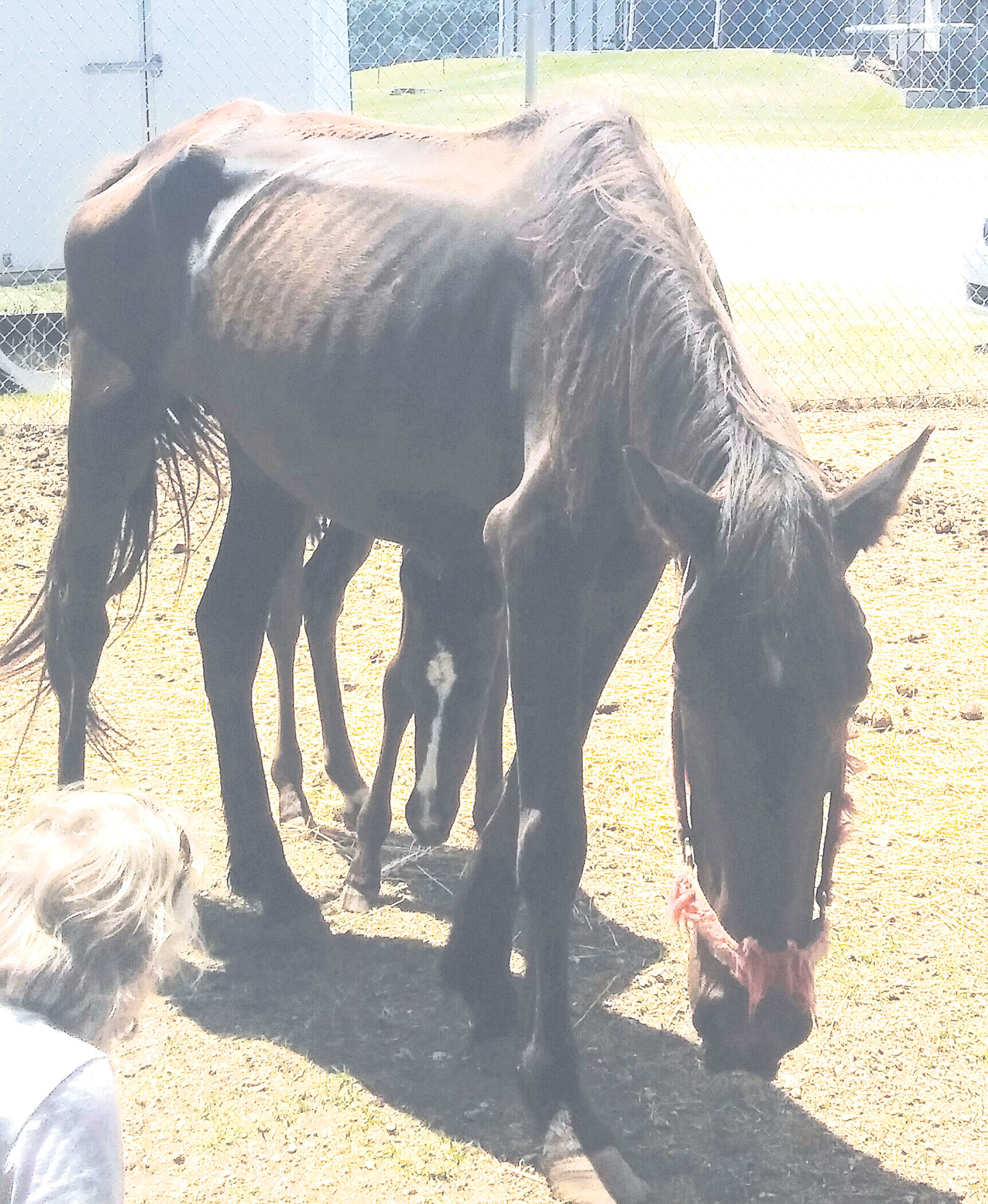
    An emaciated mare and her ailing foal, just minutes after their arrival at a Greenwood rescue farm. Both had spent more than three weeks in the care of Fairfield County Animal Services. Two days later, the mare was dead.
    An emaciated mare and her ailing foal, just minutes after their arrival at a Greenwood rescue farm. Both had spent almost four weeks in the care of Fairfield County Animal Services. Two days later, the mare was dead.

    WINNSBORO – The death of a 7-year-old mare and a second round of surgery on her 4-month-old colt just days after they had been shipped to a rescue farm in Greenwood after spending nearly a month in the custody of the Fairfield County Animal Shelter has raised some serious questions about how the County cared for the animals.

    The mare was emaciated and weak when she and her colt left the shelter for Big Oaks Rescue Farm in Greenwood, where the mare went down the day she arrived and died two days later. The founder of Big Oaks, Joe Mann, said the mare was suffering from starvation and the worst case of worms he’d ever seen. The colt, he said, was suffering from a surgery performed by a small-animal vet at the Fairfield Animal Shelter that left the colt in pain and unable to walk properly.

    While David Brown, the County’s Animal Control Officer in charge of the shelter, told The Voice that the mare was in much worse condition when she was brought to the shelter four weeks earlier, he has not presented any documentation or photos of her condition upon arrival, has not identified or brought charges against the owner, has not explained to The Voice why the horses were kept in inadequate conditions at the shelter for such a long period of time and why an equine veterinarian was never called to check on them.

    The mare and her colt were both taken from a pasture in Blair on May 19, according to Brown, who said Animal Control received a call that day from the daughter of the owner of the horses saying the colt had sustained serious injuries after becoming entangled in barbed wire. The owner, Brown said, was out of town at the time of the incident.

    Instead of contacting an equine veterinarian, Brown said he contacted the shelter’s regular veterinarian, Dr. Robert Chappell, a small animal vet whose offices are in Richburg and Fort Mill. Brown said Dr. Chappell was met by a Fairfield County junior Animal Control Officer at the Blair farm. Chappell described the colt as not more than a week old when it was injured. But Minge Wiseman, a respected local horsewoman and vice president of the Hoof and Paw Benevolent Society, a group of volunteers who work with the County Shelter and Adoption Center to protect neglected animals, put the colt’s age at 4 months when she first saw him a month after the injury occurred.

    After the colt had been freed from the barbed wire, Chappell transported him to the Fairfield shelter. Chappell said that because the colt was still nursing, he also brought the mare in. Both animals were housed in a small pen behind the Shelter where they were subsequently held for a month. Brown said the colt needed immediate surgery for his wounds, which Chappell performed, and the mare was badly undernourished. In spite of the condition of the mare and colt, Brown said no criminal charges are pending against the Blair owner.

    “When they release (the animals) to us, we won’t normally prosecute anything,” Brown said.

    But it is not clear why he did not bring charges since the owner did not actually release the mare and colt until they were discovered at the shelter by members of Hoof and Paw on June 13, almost four weeks after the horses were removed from the Blair farm.

    Brown told The Voice that he had notified Hoof and Paw members about the mare and colt after the horses had been at the shelter for about a week. But members of Hoof and Paw said Brown only relayed to them at a June 1 luncheon that he was holding a mare and foal until their owner paid Dr. Chappell $1,800 for the surgery Dr. Chappell had performed on the foal. They said Brown did not inform them about the mare’s emaciated condition. Wiseman said it was not until several Hoof and Paw members were helping with a fundraiser at the Adoption Center on June 13 that they learned the mare and foal were still at the shelter and walked over to see them.

    The mare was “pretty emaciated,” Wiseman said, and both animals were “in a very small holding pen . . . not designed to keep horses for any length of time.”

    Wiseman said she asked Brown if he needed help with the horses, urged him to move the mare and colt to foster care immediately and offered to find a place for them. Wiseman posted a plea for foster care on Hoof and Paws’ Facebook page, and Mann responded. After two more days, Brown told Wiseman that he had gotten an official release from the owner and gave Wiseman and Hoof and Paw president Deborah Richelle permission to use the County’s horse trailer to transport the mare and colt to Big Oaks the next day, June 16.

    Wiseman said when she arrived at the shelter, she noticed that the colt was “gimpy” in the hind end at the trot. She also reported that when loading, the mare buckled to her knees and went down trying to step into the trailer, which was about a foot off the ground. Wiseman said the mare didn’t seem strong enough to lift herself into the trailer and that the two women managed to get the mare back on her feet and into the trailer with her colt.

    Shortly after arriving at Greenwood that afternoon, the mare went down again, according to Mann, and equine veterinarian Dr. Alexandra Tracy was called. While Dr. Tracy has not returned calls from The Voice, Meg Francoeur, a hoof trimmer from Aiken who volunteers at Big Oaks, wrote in an email to The Voice that she was with Dr. Tracy at Big Oaks until 6 p.m. on June 17 while Dr. Tracy continued to give fluids, steroids and pain meds to the mare. But the life-saving effort failed, and Mann said the mare succumbed and died early the next morning, June 18.

    Francoeur also wrote that Dr. Tracy checked the mare’s colt and “found a large lump where he had been injured. She sedated the (colt) to check to see what it was, and ended up having to cut away adhesions on the colt so that he would be able to open his legs and walk normally.”

    “Our vet had to re-do everything (Dr. Chappell) did,” Mann, who witnessed the second surgery, said. “He had (the wound) sewed to one of his hind legs. Every time (the colt) moved his leg, he was in agony. I’ve never seen anything done like that before. It was unbelievable.”

    From his perspective, Dr. Chappell told The Voice that the colt had severely lacerated the inner portion of a hind leg near its stomach while struggling to free itself from the barbed wire. The cut was very deep, Chappell said, exposing the bone, and the wound was bleeding profusely.

    Once the animals were moved to the shelter, Chappell said he sedated the foal and was ready to begin surgery outside on the ground. Rain then began to fall, he said, and the foal was moved back inside the horse trailer for the procedure.

    Chappell, who is not an equine vet, said that prior to the surgery he had telephoned his uncle, Dr. John H. Chappell III, an equine vet in Rock Hill, to ask him to take the foal. His uncle did not have stall space available, Chappell said, but did advise him on how to proceed with the surgery.

    “Most doctors probably would have put that foal down,” Chappell said. “He was bleeding so bad.”

    Chappell said he had to trim some of the muscles, then mend the arteries.

    “I moved some scrotal tissue to cover the wound,” Chappell said. “Horse skin doesn’t heal very well. There were blood vessels exposed and I couldn’t leave them open, so I covered them with some excess tissue from the scrotum.”

    Within 45 minutes of coming to, the foal was up and nursing, Chappell said.

    But Big Oak’s version of the surgery does not match the happy ending Dr. Chappell described.

    Francoeur, who said she has more than 30 years’ experience working with horses as a trainer, a hoof trimmer and generally caring for them, said that, “In most cases, an injury (like the colt’s) would have had repair to the muscle but the external tissue would have been left open to heal from the inside out. (Horse) wounds generally heal cleaner if left to heal slower.”

    Francoeur also noted that Dr. Chappell had used non-dissolving sutures to close the wound and that they were still in the wound when it was opened on June 17, nearly a month later.

    After reading an account in another local newspaper in which Brown praised Dr. Chappell for his surgical efforts, Francoeur wrote, “Brown may have been impressed with the surgery, but the folks at Big Oaks were not. The amount of work that had to be done to undo all the damage was extensive, but I don’t really blame the other vet. He’s not experienced with horses, which was obvious in that he thought the (colt) was only days old.”

    The second surgery was successful, Mann said, and the colt is now on its way to a full recovery. It has since been placed in foster care. The mare, however, was another story.

    While Mann said the mare died of starvation and worms, Chappell said he de-wormed the mare a month before, and Brown said he and his staff had implemented a feeding schedule.

    “The doctor (Chappell) said not to overfeed her,” Brown said, “because that could be fatal.”

    Brown initially told The Voice that the mare was being fed “small amounts in three applications” a day, but he later revised that, and said hay was left in the pen, while the mare was given approximately 3 quarts of sweet feed four times a day. While Brown said the mare was eating well and putting on weight, a photograph of the mare taken the day it arrived at Big Oaks indicates a severely undernourished horse.

    Dr. Chappell placed responsibility for the mare’s death at the feet of Big Oaks Rescue Farm.

    “They overfed her the first night and she died, which was stupid” Chappell said. “We had her putting on weight. We de-wormed her. She was gaining weight. I don’t know if it was the stress of being moved or what. I think they overfed her.”

    Mann, however, said it was actually Fairfield County’s Animal Control staff, and not Big Oaks, that was overfeeding – and not even with the correct feed.

    “I’m not criticizing the people at the shelter,” Mann said. “Obviously, their vet didn’t have a clue about what he was doing, so he couldn’t advise them well. A horse in that state of starvation needs a small amount of fluid and a small amount of food over a period of time and you gradually increase it.”

    Mann said he would have recommended 1 quart, five to six times a day, of “good mare-and-foal feed.” But, according to Brown, the mare was being fed twice as many quarts a day of sweet feed at the Fairfield County Animal Shelter.

    “Sweet feed and hay won’t do them any good,” Mann said. “We would not have given her sweet feed. It has a lot of artificial fillers. You need good quality feed, a proper feeding schedule, a good living environment, water and some hay.”

    But, Mann said, the mare was still riddled with parasites, which were consuming any nutrients that might have been supplied to her.

    “For a starving horse, you have to stabilize the horse, then you have to kill the tapeworms, and a vet needs to be involved,” Mann said. “The mare was full of some of the largest tapeworms we had ever seen. I don’t know what he de-wormed her with.”

    What is also unclear is why the County, with the resources and expertise of an organization like Hoof and Paw at its fingertips, never brought them into the picture and why Brown kept the horses at the shelter for a month without ever contacting an equine vet to check on them.

    “We thought we did what we could do for her while she was here,” Brown said, “but I guess it wasn’t enough. I learned from that. I would do it differently next time. I would let Hoof and Paw know immediately.”

    The Voice submitted a Freedom of Information Act request on June 26, seeking, among other things, records related to the animals. Although the County still had more than a week to respond to the request, Brown told The Voice on June 29 that he would be providing the newspaper with his notes from the case the next day. As The Voice went to press July 8, Brown had not done so.

    Mann, meanwhile, said that had the horses been transferred into the care of Big Oaks sooner, both animals might still be alive.

    “We got her just a little too late,” Mann said. “The (colt) is going to be fine, but it was almost like the mother hung in there until she realized her baby was going to be taken care of and then she gave up.”

  • Council Sets Grass Height, Skips on Reverse 9-1-1

    BLYTHEWOOD – At its regular meeting on June 29 Town Council passed first reading to sets the height limit of overgrown weeds in the town at 12 inches.

    “In July of 2011, the Council adopted by reference the entire International Property Maintenance Code,” Town Administrator Gary Parker told Council members.

    Section 302.4 of that Code, which addresses weeds and other overgrown plants, states that the local jurisdiction should insert the number of inches in height that the locality wants to set as the height threshold for such overgrowth.

    Parker said the Town Hall staff proposed that the limit be set at 12 inches, which, Parker said, is the typical height found in municipal code sections that address the height of overgrown grass and weeds. After some discussion, Council voted unanimously to amend the code. The second and final reading will take place at the July 27 Council meeting.

    Reverse 911

    Council has discussed at its last two meetings the possibility of implementing a reverse 911 system for the town that would notify residents and businesses in case of emergencies. Parker suggested that such a system would be more appropriate for larger municipalities such as Columbia that have fire and police departments that respond to emergency situations. He said he felt Blythewood would be better served using another system such as email blasts.

    “We would mainly be interested in sharing with the public the fact that there is an emergency or some other matter like a boil water alert,” Parker said. “Then, in the case of an emergency, it would be up to the public safety organization or public utility to advise its public information office of the incident so that information could be relayed to citizens.”

    Councilman Eddie Baughman, who is a former firefighter, said that in case of an emergency in Blythewood, Columbia or Richland County is authorized to send out alerts at no cost to the Town. Council is expected to further discuss the issue at the July 27 meeting.


  • Jenkinsville Man Dies from Motorcycle Crash Injuries

    BLAIR – A Jenkinsville man involved in a motorcycle crash on July 1 succumbed to his injuries Monday night, shortly after being taken off life support at Palmetto Richland Memorial Hospital.

    Fairfield County Coroner Barkley Ramsey said Anthony Raynard Boykin, 25, of 15776 State Highway 215 S. in Jenkinsville, was pronounced dead at the hospital just before 10:30 p.m. Monday. Boykin had been on life support since the July 1 accident, in which he suffered a severe head injury, Ramsey said.

    Ramsey said Boykin, who did not have a motorcycle license, had borrowed a 1998 Suzuki motorcycle on July 1 from Robert Martin, of Straight Shot Road in Jenkinsville. Boykin was driving the motorcycle west on Meadowlake Road in Blair when, at approximately 1:30 p.m., he ran off the left side of the road in a curve. The S.C. Highway Patrol said the bike struck a ditch, and Boykin was thrown from the motorcycle. Ramsey said the motorcycle traveled approximately 230 feet off the road before coming to a stop. The accident occurred in the 900 block of Meadowlake Road, approximately 4 miles north of Jenkinsville, the Highway Patrol said.

    Boykin was not wearing a helmet at the time of the crash, Ramsey said. Boykin, who was knocked unconscious in the crash, was airlifted from the scene to the hospital. He died without ever regaining consciousness, Ramsey said.


  • County Must Restart CTC Engineer Search

    WINNSBORO – The search for a new firm to provide engineering services for County Transportation Committee (CTC) projects will have to start anew, Interim County Administrator Milton Pope told The Voice Tuesday, because of a flawed selection process.

    Dan Dennis, owner of Dennis Corp., an engineering firm that was in the running for the contract, brought his concerns over the process to the County during Council’s June 22 meeting. One of six firms to submit proposals in response to the County’s March 30 Request for Qualifications (RFQ), Dennis Corp. ultimately lost out to I.C.E. (Infrastructure Consulting & Engineering, formerly Coleman-Snow Consulting), whom a three-member selection committee recommended to Administration.

    Also submitting qualifications were Davis & Floyd, Inc.; HDR ICA Engineering; Vaughn & Melton Consulting Engineers; and Weston & Sampson. I.C.E. is also the current holder of the two-year contract.

    “I’m not here because I’m a sore loser and Dennis Corp. was not selected as your County CTC engineer,” Dennis told Council during the second public comment portion of the June 22 meeting. “To my knowledge, I don’t believe proper procurement was followed.”

    Dennis later told The Voice that the County’s selection committee had failed to interview candidates, as stipulated by the RFQ as advertised, prior to making its recommendation. Dennis said the S.C. Department of Transportation (DOT), which administers the funds for CTC projects, also requires that candidates be interviewed, in accordance with the state’s Consolidated Procurement Code.

    Section 11-35-3220 (4) of the Code states, in part, that “. . . the agency selection committee shall hold interviews with at least three persons or firms who respond to the committee’s advertisement and who are considered most qualified . . .”

    Pope said the contract, which is re-advertised every two years, had not yet been officially awarded and that all Administration had to date was the recommendation from the committee. The selection committee, Pope said, consisted of two members of the CTC and one member of the County’s Public Works Department. The committee met last month to review the RFQs and scored each based on five criteria.

    Those criteria were: Past Performance/Related Experience on Similar Projects (25 points); Ability of Professional Personnel (25 points); Demonstrated Ability to Meet Time and Budget Requirements (20 points); Location of Firm (15 points); and Recent, Current and Project Work Load (15 points).

    Although interviews with the top candidates were to follow, the CTC component of the committee “said ‘we don’t need to interview’,” Pope said, even though the County’s Procurement staff brought the necessity of the interviews to the committee’s attention.

    Pope said Procurement staff then brought the matter to his attention. Dennis, who received his rejection from the County in a letter dated June 2, also brought the matter to the attention of Pope and Council.

    “Unless I am provided with additional information,” Dennis’s June 16 letter to Pope, copies of which also went to Council, states, “I will have no choice but to file a formal protest of this selection . . .” The letter then noted the County’s failure to conduct the interviewing process.

    Pope said Tuesday that the County was going to re-advertise the RFQ as quickly as possible.

    “That’s good news,” Dennis said this week after learning of the County’s reversal. “It needs to be done right. Of course, my name is probably going to the bottom of the list now, but you’ve got to stand up for what is right.”