Category: News

  • County puts EMS Contractor on notice

    WINNSBORO (Aug. 11, 2016) – County Administrator Jason Taylor informed the Administration and Finance Committee last month of significant problems with a contract signed recently with Ken Simmons and Associates for two county projects – the EMS stations at Jenkinsville and Ridgeway.

    On Monday evening, Council voted 6-0 to rectify the problems and asked County attorney Jack James to write a letter notifying Ken Simmons and Associates that the company will be held responsible for any cost overages relating to the problems.

    “We have three issues,” Taylor told Council members. “The first has to do with a change order the County requested for $45,984 to change out the asphalt for concrete on the apron in the front and back of each fire station.”

    Taylor said the change is necessary because of the way the tires of the heavy fire trucks turn coming in and out of the driveway of the stations.

    “The asphalt would have had a life span of about 10 years while concrete will have about a 25-year life,” Taylor explained.

    “Second, there was a discrepancy between how the engineer designed the project and how it was bid out,” Taylor told Council. “The engineer designed the project with a certain amount of asphalt, but he bid it out for a lesser amount of asphalt. The cost difference between what was designed and what was bid is approximately $39,000. The Committee recommends that Ken Simmons and Associates be responsible for covering that overage.”

    Third, Taylor told the Committee last month, the engineer delayed requesting S.C. Department of Transportation (DOT) encroachment permits for the project, and that delay caused the project to be shut down by the DOT.

    Taylor said the County had been told by the engineer that all encroachment permits needed from DOT had been applied for (by Ken Simmons and Associates) and that the permits would be issued that week.

    “But we verified with S.C. DOT that the applications for the permits had not even been submitted and that there could be a delay of up to 30 days, which could be costly to the County,” Taylor said. “I am proposing to have our attorney send a letter to Ken Simmons and Associates saying, ‘If there is any cost associated with these delays, we expect you to cover them.’”

  • Car Chase Ends in Chester

    CHESTER (Aug. 11, 2016) – A Blythewood man was arrested last week and charged with unlawful conduct toward a child and failure to stop for blue lights after leading Richland County deputies on a three-county chase along I-77 North.

    According to the Richland County Sheriff’s Department, Harrison Prince, 38, kidnapped his 3-year-old grandson from a home on North Pines Road in Blythewood and left in a 2016 Toyota Corolla. A Richland County deputy on patrol in the area spotted the Corolla and attempted to make a traffic stop, but Prince fled at a high rate of speed and pulled onto I-77 North.

    Prince led deputies across the Richland County line and into Fairfield County where Fairfield County deputies joined in on the pursuit. Prince eventually crossed into Chester County where deputies there entered the chase and attempted to stop the Corolla. When Chester deputies endeavored to make the traffic stop, Prince reportedly crashed his Corolla into a Chester squad car and came to a halt in the median of I-77.

    Prince leapt from the Corolla and fled on foot, but was captured a short distance away. Prince’s grandson was located still inside the Corolla and was unharmed.

    Prince was transported to the Alvin S. Glenn Detention Center.


  • Blythewood Feeling Growth Spurt

    BLYTHEWOOD (Aug. 11, 2016) – The latest housing boom is on. In Blythewood, at least, where Town officials say building permits for single-family homes are at a five year high.

    “The whole calendar year is higher than in prior years,” Town Administrator Gary Parker told The Voice last week. “The economy has improved. We’ve finally gotten over the real estate crash. And this particular town and this particular area is attractive to people. A lot of people are interested in relocating to a community that is right outside a major metropolitan area.”

    And, Parker added, the school system doesn’t hurt either.

    So, how fast is Blythewood growing?

    “Per capita, Blythewood is growing at a faster rate than Fort Mill,” Kirk Wilson, Director of Permits and Licenses for the Town of Blythewood, said. “We’re one of the fastest, if not the fastest, growing municipalities in the state.”

    The numbers tell the tale.

    Just six years ago, in 2010, Blythewood issued a modest 19 building permits for single-family homes. Since then, the growth has been steady and largely consistent. In 2011, the Town issued 34 building permits. A year later, that figure nearly doubled, to 58 permits. In 2013, permits more than doubled, with Blythewood stamping 123 for approval. There was a small dip in 2014, as the number of building permits decreased to 120. But last year, they were up again, to 175.

    Through July of this year, the Town has already issued 93 permits.

    “It’s not going to be slowing down anytime soon,” Wilson said.

    The growth is mainly west of I-77, Parker said, with the expansion of Cobblestone Park and the Oakhurst subdivisions. Ashley Oaks, phases 8 and 9, and Abney Hills, phase 2, are also likely to add to the number of building permits before the year’s end, Wilson said.

    But while growth is a promising sign for the economy, it can also put a strain on services, particularly in a small town like Blythewood.

    “We’re experiencing that,” Parker said. “We’ve taken a couple of steps to meet the demands. We’ve added additional personnel to our Town staff, and that will only increase if it continues to grow.”

    The first area to feel the strain of increased growth, Parker said, is in parks and recreation.

    “When you have more children, there’s a greater need for parks and recreational programs,” Parker said. “We have to think about it (growth) coming here and think about developing services, particularly in parks and recreation.”

    The local streets and roads, Parker said, will also feel the first symptoms of rapid growth.

    While proposed streetscaping projects will certainly make Blythewood’s roadways more attractive, to keep the traffic moving more practical and ambitious projects are going to have to get under way. The planned widening of Blythewood Road, Parker said, as well as the installation of traffic circles – particularly near the entrance to the Food Lion shopping center – should help alleviate some of the traffic headaches that often come hand-in-hand with rapid residential growth.

    “The Master and Comprehensive plans address some aspects of growth, foremost of which is traffic,” Parker said. “We’re working with the County and working with the Penny Tax folks to address that.”


  • County Council Races to Put Sunday Alcohol Sales on Ballot

    WINNSBORO (Aug. 11, 2016) – If County Council passes by Sept. 9 an ordinance allowing the Sunday sale of alcoholic beverages in Fairfield County, that will put it on the Nov. 8 ballot as a referendum for the people to decide if they want Sunday alcohol sales, County Administrator Jason Taylor told members of the Public Affairs and Policy Committee Monday evening.

    And with that, the Committee fast-tracked Ordinance 672, sending it to Council where members passed first reading by title only at their regular meeting less than an hour later.

    For the ordinance to be passed by Sept. 9, Taylor said Council would have to call some special meetings. Second reading is scheduled for Aug. 22, a Public Hearing on Aug. 25 and third and final reading on Aug. 29.

    The issue came to Council’s attention last month when Lake Wateree resident David Waters brought before Council a petition with about 1,000 signatures calling for Sunday alcohol sales in Fairfield County.

    The petition outlined the following reasons for Sunday sales – that Fairfield County businesses are losing sales to neighboring counties and that the increased sales tax would lower property taxes and provide funds for road paving in the County. But Committee member Carolyn Robinson said the sales tax from alcoholic beverages does not go to property tax or road repairs and that neighboring Kershaw and Lancaster counties do not have Sunday alcohol sales. She said only Newberry County currently has Sunday sales and that Chester County will have it on the Nov. 8 ballot.

    “I would also like to make it clear that this ordinance is only going to apply to the unincorporated areas in the County, not the towns like Ridgeway and Winnsboro,” Committee Chairwoman Mary Lynn Kinley told the Committee. She said the towns would have to pass similar ordinances if they want Sunday sales.

    “I’m not concerned with what folks around us are doing,” Committee member Billy Smith said. “As far as Council is concerned, we’re just offering citizens the opportunity to choose. It’s not about us (Council) choosing when it’s a referendum.”

    Taylor noted that the ordinance, as it reads currently, is a model ordinance that will need some tweaking for clarification before second reading.

    The ordinance also provides for the issuance of temporary permits for the Sunday sale of alcoholic beverages for non-profit events and for on-premises consumption, as well as beer and wine at permitted off-premises locations.

    Smith said the particulars of the ordinance will be spelled out in the posted referendum.


  • A-Tax Committee Reverses Course on Band, Chamber

    BLYTHEWOOD (Aug. 11, 2016) – The Town’s A-Tax Committee was publicly chided by Mayor J. Michael Ross at a special called meeting of the Committee on Aug. 3 for tabling last month a $10,000 funding request from Band Director James Barnes for Blythewood High School’s Band Tournament and for voting against recommending $3,000 for what the A-Tax meeting minutes referred to as salaries for the staff (Executive Director Mike Switzer and his assistant Kitty Kelly) of the Blythewood Chamber of Commerce for their work with the upcoming Big Grab yard sale.

    At its July 6 meeting, the A-Tax Committee took into consideration several reasons for tabling the Tournament’s request – the $31,000 profit from last year’s event, that half of the $31,000 goes to Ridge View High School, which is outside the Blythewood community and that the profits went to fund operations in the school’s band program to pay for such things as private lessons for students rather than being plowed back into the event.

    As for the vote against recommending the Chamber’s $3,000 funding request, the Committee questioned whether it should be funding salaries at all.

    In his remarks, the Mayor pressed the Committee to disregard profits when making recommendations. He also offered revised information, that the $3,000 for the Chamber would go to outside advertising for the Big Grab, not salaries for Switzer and Kelly. Following Ross’s remarks, Barnes and Switzer again made pleas to the Committee for funds.

    This time, the Committee, without discussion, voted to reverse both votes, recommending the full funding requested by the two applicants.

    Immediately following adjournment of the meeting, long-time Committee member George Sensor announced his resignation from the Committee.

    “It’s a long drive over here for me,” Sensor told the Committee and Town officials.

    The A-Tax Committee is only a recommending body and Town Council makes the final decision on awarding A-Tax funds. Council is not required to vote in favor of the A-Tax Committee’s recommendations. But instead of Council voting on the two issues at its regular meeting on July 25, Council asked the applicants, Switzer and Barnes, to resubmit their requests to the A-Tax Committee.

    “I think we need the A-Tax Committee to understand they need to reconvene and look at what is being resubmitted,” Ross said at the July 25 meeting.

    Opening that special called A-Tax Committee meeting on Aug. 3, Events and Conference Center Director Steve Hasterok, who facilitates the A-Tax Committee meetings, announced that there would be changes to the Committee’s meeting format, specifically that the meetings should be open to the public. While the meetings were never closed to the public, applicants frequently waited outside in a hallway while the Committee discussed and voted on funding. Hasterok was more specific in an interview with The Voice, saying that all applicants should know they are allowed to stay in the meetings throughout the Committee’s decision-making process.

    In a related issue, The Country Chronicle newspaper in a recent article appeared to take issue with the Committee addressing questions to a representative of The Voice who was sitting in the room during the July 10 meeting. However, Hasterok told The Voice that the Committee is welcome to direct questions to anyone in the audience, but said he would like for the person answering the questions to do so from the podium.

    At the Aug. 3 meeting, Ross emphasized his objection to the A-Tax Committee basing funding on whether an event made large profits or if it was used to pay salaries.

    “We have guidelines,” Ross told the Committee. “The Architectural Review Board, the Planning Commission all work under guidelines from ordinances, regulations and standards. Looking at the last (A-Tax Committee) minutes, I see there’s a lot of discussion revolving around profits an event might make, and a concern that if they make $31,000, why do they need our money.”

    While Ross later insisted that, “I’m not here to tell you what to do,” he added, “I just want to warn you that I don’t think anywhere in our guidelines – and it’s never been a concern of Council – what the profit margin might be. If the event brings people to eat at our restaurants, puts heads on pillows and buys gas at Larry Sharpe’s stations, then that’s what we want. But I don’t want to not have a function or event that might have been beneficial to not come because they made a profit, because they did real good, because they have other means or used their money. They still might need the seed money to have that event and be successful,” Ross said, warning the Committee a second time about funding an event based on its profit margin.

    At the July 25 Council meeting Ross said he didn’t care how much profit the rodeo makes if those people have a good time and spend money in the town.

    While there are no guidelines in the state statute to suggest the Committee should consider profits or salaries, there are also no guidelines to suggest that they should not.

    In later comments to the Committee, Town Administrator Gary Parker said, “There’s nothing in the state statute that requires (the Committee) to consider profit of an event they are asked to fund,” but he also allowed that consideration of profit, “could be a factor that the Committee wants to consider.”

    Parker said the statute basically just outlines the fact that when the community receives a certain level of funds from accommodation and hospitality tax revenues, that a committee be formed to represent the hospitality industry – hotels and restaurants. But Parker said the statute does not address terms. He said if the Committee wants to have bylaws, policies and procedures to follow, he would be happy to have the town attorney review them and send them to Council for approval.

    Supporting the notion that there are few guidelines to tell the Committee specifically what it should and should not consider when making decisions regarding funding, Damita Jeter, Director of the Tourism Expenditure Review Committee (TERC) at the S.C. Department of Revenue, wrote in an email to The Voice that, “Until funds are spent and reported to TERC we have no authority to comment on these expenditures. Our role is simply oversight; therefore, (until) funds are spent and the report is remitted to us (October of each fiscal year) and the public has (raised) questions/complaints regarding the expenditures, we cannot really say whether or not certain applications should (or should not) be considered.”

    Switzer has, since his original funding request, said both publicly and in an email to The Voice that the $3,000 the Chamber staff receives for salaries for their work on the Big Grab will be covered by the sale of $50 sponsorships, not A-Tax funds. An email storm subsequently erupted between Switzer and some business owners who said they oppose selling sponsorships to pay salaries to Switzer and Kelly who are the only two members of the Big Grab committee in Blythewood, Ridgeway and Winnsboro who receive salaries for their work.

    In an email to Big Grab Committee members that was provided to The Voice, Switzer said, “The Blythewood Chamber is a professional business support organization whose revenues (from all sources) go to cover the costs of the organization which understandably includes staff.”

    In addition to funds raised through sponsorships, the Blythewood Chamber is collecting revenue from Big Grab vendor rentals at the Blythewood Community Center where it is renting 10×10-foot indoor spaces for $80.12 and 15×30-foot outdoor spaces for $43.19.
     

  • County Puts EMS Station Contractor on Notice

    WINNSBORO (Aug. 11, 2016) – County Administrator Jason Taylor informed the Administration and Finance Committee last month of significant problems with a contract signed recently with Ken Simmons and Associates for two county projects – the EMS stations at Jenkinsville and Ridgeway.

    On Monday evening, Council voted 6-0 to rectify the problems and asked County attorney Jack James to write a letter notifying Ken Simmons and Associates that the company will be held responsible for any cost overages relating to the problems.

    “We have three issues,” Taylor told Council members. “The first has to do with a change order the County requested for $45,984 to change out the asphalt for concrete on the apron in the front and back of each fire station.”

    Taylor said the change is necessary because of the way the tires of the heavy fire trucks turn coming in and out of the driveway of the stations.

    “The asphalt would have had a life span of about 10 years while concrete will have about a 25-year life,” Taylor explained.

    “Second, there was a discrepancy between how the engineer designed the project and how it was bid out,” Taylor told Council. “The engineer designed the project with a certain amount of asphalt, but he bid it out for a lesser amount of asphalt. The cost difference between what was designed and what was bid is approximately $39,000. The Committee recommends that Ken Simmons and Associates be made responsible for covering that overage.”

    Taylor said the discrepancy was caught by Fire Chief Tony Hill.

    Third, Taylor told the Committee last month, the engineer delayed requesting S.C. Department of Transportation (DOT) encroachment permits for the project, and that delay caused the project to be shut down by the DOT.

    Taylor told the Committee last month that the County had been told by the engineer that all encroachment permits needed from the DOT had been applied for and that they would be getting the permits that week.

    “But we verified with S.C. DOT that the applications for the permits had not even been submitted, so there could be a delay of up to 30 days, which could be costly to the County,” Taylor said. “I am proposing to have our attorney send a letter to Ken Simmons and Associates saying, ‘If there is any cost associated with these delays, we expect you to cover them.’”


  • Jenkinsville Man Killed in Crash

    LITTLE MOUNTAIN – A Jenkinsville man was killed this week in a single-car accident on R. Stoudemeyer Road in Little Mountain.

    Richland County Coroner Gary Watts said Nelson Robichaux Peach, 59, of St. Barnabas Road, Jenkinsville, was pronounced dead at the scene of the accident at 11:45 p.m., Aug. 2.

    According to the S.C. Highway Patrol, Peach was driving a 2013 Nissan in the 1200 block of R. Stoudemeyer Road near Broad River Road when the car ran off the left side of the road and struck a tree. Peach was wearing a seat belt at the time of the accident, the Highway Patrol said.

    An autopsy performed Aug. 3 indicated that Mr. Peach died from blunt force injuries to his neck and chest, Watts said.

    The accident remains under investigation by the Highway Patrol.


  • Community Pitches in for RWA Facelift

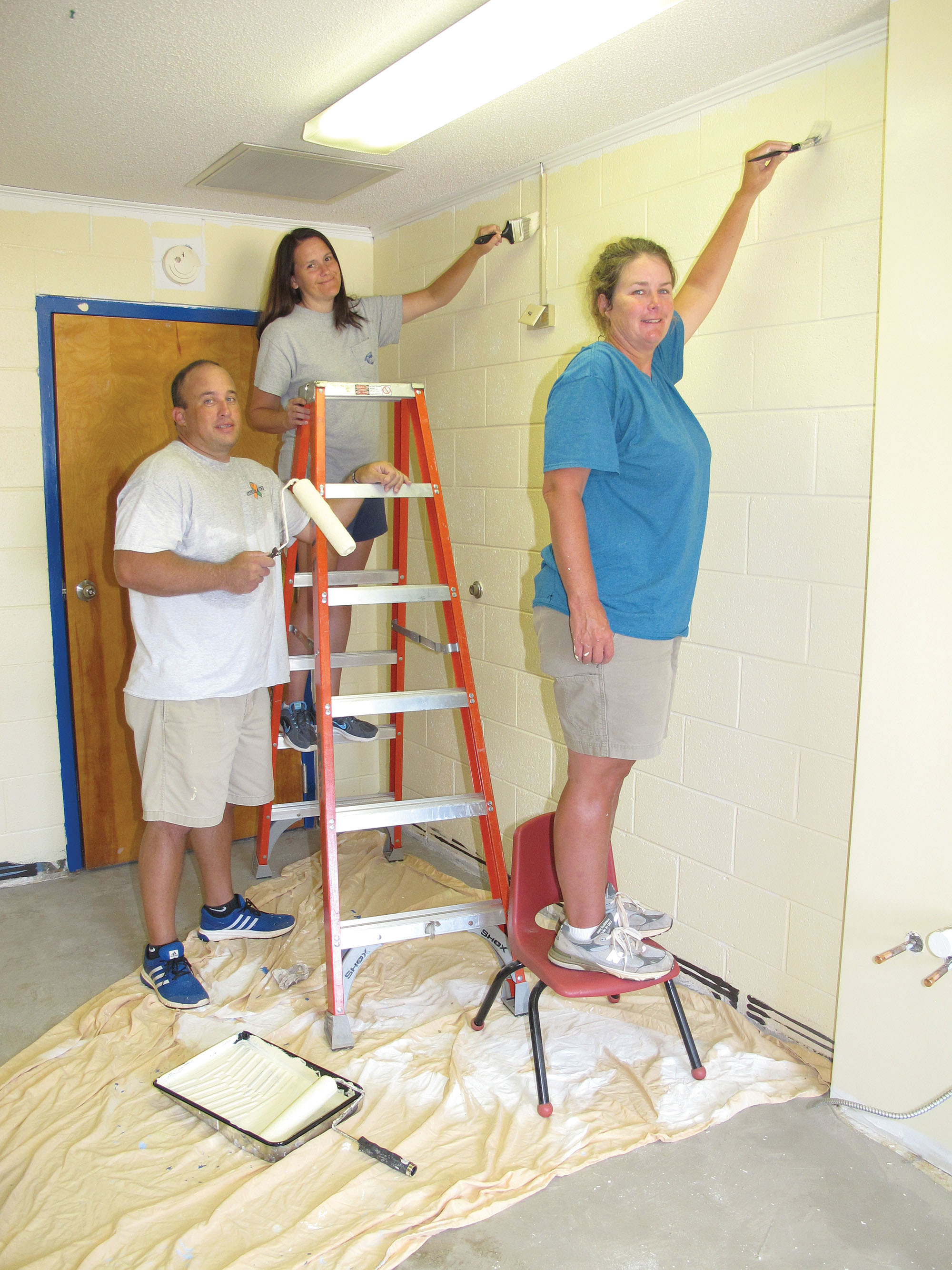
    Volunteer painters Jeff and Allison Spires and Rhetta Taylor put the finishing touches on a classroom at Richard Winn Academy. (Photo/Barbara Ball)
    Volunteer painters Jeff and Allison Spires and Rhetta Taylor put the finishing touches on a classroom at Richard Winn Academy. (Photo/Barbara Ball)

    WINNSBORO (Aug. 4, 2016) – Already sporting a new head football coach, new girls’ basketball coach and a new head of school, the Richard Winn Academy building itself is going to have a new look when classes start Aug. 11.

    Since accepting the job as Head of School in the spring, Brandy Mullennax has thrown herself into a two- month whirlwind of overseeing a major renovation of the school, which consumed the better part of June and July. But oversight was just one part of the job. Mullennax also pulled together volunteers, donors and rolled up her own sleeves to get the job done before the start of the new school year and under budget – way under budget.

    “In addition to our actual costs, we would have had additional expenses of about $20,000 had the RWA community not stepped in to paint, repair and donate money, equipment and supplies,” Mullennax said.

    “We couldn’t have done this without those volunteers and donors. It’s been seven days a week for the last two months. We’ve painted most of the interior of the school and brought the school colors in to brighten the hallways. Everyone has pitched in to do something. K4 student Avery Warren was up here painting hallways alongside her parents Todd and Reid,” she said.

    Some teachers painted their own rooms while RWA family, friends and students painted and fixed up other areas including the administrative offices, hallways, classrooms, gym and outside areas. There’s also a new awning at the entrance to the school.

    “We’ve renovated some locker rooms and restrooms, made major roof repairs, replaced air conditioning units, added an Early Learning Center with infant and toddler rooms, added fencing to the playground . . . the list is long,” Mullennax said with a weary smile. But she said there is more to do – more painting, more air conditioners to be replaced, the back side of the gym roof needs replacing and more restrooms need to be renovated. Mullennax said some of these needs will have to wait, however, until she can come up with more funds.

    “It’s been an extraordinary effort,” she said. “These people (volunteers) are tireless.”

    “But it was Mullennax who planned and guided the project and provided the energy behind it,” RWA staff member Martha Ladd told The Voice. Indeed, Mullennax recruited volunteers from near and far, including her Lugoff neighbor, Glenn Smith, who donated over $1,000 in labor to patch drywall and repair ceilings.

    With all the tearing out, painting and replacing over the summer, the school was a mess by mid-July. Workers and visitors could hardly get through the hallways to their work stations. But Mullennax said she is confident the building is going to look great when the students arrive for the new school year.

    “The renovation was truly a community effort,” Mullennax said. “It’s amazing how they transformed the school on a shoestring budget in such a short time. And we at the school are grateful.”


  • Board Awards Stipends

    WINNSBORO (Aug. 4, 2016) – The Fairfield County School Board voted 6-1 during their July 19 meeting to award stipends district wide for certified, classified, athletic and band staff. Paula Hartman (District 2) was the dissenting vote and explained that she voted against the stipends because she had asked Superintendent J.R. Green a year ago for a job description of the Board’s clerk who receives a stipend of $7,000 for  assisting the Board. Hartman said her request was never answered.

    At the District level, the Board approved $3,500 stipends for an Induction Coordinator, $2,500 for mentor teachers and $7,000 for the Board’s Administrative Clerk. In the Student Services Department, the Board approved $3,500 for the Data Manager/Medicaid Supervisor and $2,500 for the Lead Social Worker.

    Academic Supplements

    • Fairfield Central High School stipends: $2,000 each for department heads in English, Mathematics, Science, Social Studies, World Language, Electives, ROTC and Business; $1,500 for an Academic Challenge Team Lead; $1,000 each for a Beta Club Advisor and a Student Government Advisor; $2,500 for a STEM Lead Teacher; $2,000 for Yearbook; $750 for Junior Class Sponsor/Prom; $375 each for Sophomore and Freshman Class Sponsors.

    • Fairfield Middle School: $1,150 each for department heads in ELA, Science, Math and Social Studies; $1,050 each for Special Services and Related Arts; $1,155 each for six Academic Team Leaders; $900 for an Academic Team Coach; $2,500 for STEM Early College Academy Lead Teacher and $1,050 for a PBIS Coordinator.

    • Fairfield Elementary: $3,750 each for Curriculum Chairs for grades K-3, 4-6, Related Arts and Special Services.

    • Magnet School: $2,500 each for Curriculum Chairs, grades K-3 and 4-6.

    • Geiger and McCrorey-Liston: $2,500 each for Grade Level Chairs, grades CD-2 and 3-6.

    • Kelly Miller: $2,500 each for two Curriculum Chairs.

    • Career Center: $2,500 each for two Department Chairs; $1,500 for a Robotics Team Leader.

    Athletics Supplements

    The Board approved $15,000 for the Athletic Director and $3,750 each for two assistant A.D.s.; $8,000 for the Recruiting Coordinator; $5,500 for the Head Strength Coach.

    • Football: $8,000 each for the Offensive and Defensive coordinators; $6,500 for the Special Teams Coordinator; $5,500 each for four assistant varsity coaches; $6,000 for the head JV coach; $4,500 each for four assistant JV coaches; $5,000 for the head middle school coach; $2,500 each for three assistant middle school coaches; and $2,000 each for two filming coordinators.

    • Tennis: $3,000 each for the head boys’ and girls’ tennis coaches. Volleyball: $3,000 for the head varsity coach; $1,500 for the assistant varsity coach; $1,500 for the head JV coach; and $2,000 for the head middle school coach. Golf: $3,000 for the head coach.

    • Basketball: $8,500 each for the head boys’ and head girls’ varsity coaches; $3,000 each for assistant varsity girls, assistant varsity boys, head JV girls and head JV boys coaches; $2,000 each for the B-team boys’ and girls’ coaches; $1,500 each for the middle school boys’ and girls’ coaches; and $800 each for the assistant middle school boys’ and girls’ coaches.

    • Wrestling: $3,000 for the head coach; $1,500 for the assistant coach. Track: $3,500 each for the head girls’ and boys’ coaches; $1,500 each for assistant boys’ and girls’ coaches. Cross Country: $3,500 for the head coach.

    • Softball: $3,500 for the head varsity coach; $2,000 for the assistant varsity and the head JV coaches. Baseball: $3,500 for the head varsity coach; $2,000 for the assistant varsity and the head JV coaches; $1,500 for the assistant JV coach. Soccer: $3,000 each for the head boys’ and girls’ coaches; $2,000 for head JV boys’ and girls’ coaches.

    Academic coaches: $3,000 each for two positions. Band: $10,000 for the Band Director; $4,000 each for the Percussion Instructor and the Auxiliary Coordinator; and $2,000 each for the Woodwind Instructor. Cheerleading: $5,000 for the head varsity cheerleading coach; $2,500 for the head JV coach and $2,000 for the head middle school coach.


  • Council OK’s Shell Bid

    BLYTHEWOOD – A second round of bids on the Town’s proposed shell building has turned up a winner. Lyn-Rich Contracting Co., Inc. was the lowest of three bidders with a base bid of $379,850 or, with options, $388,100.

    Council voted to take the five options, which included some walkways, a section of decking requested by the Board of Architectural Review, additional insulation, special fire protection equipment and a $12,000 credit resulting from switching from wood to fiberglass entrance doors.

    The second round of bids eliminated a number of interior specifications that were included in the original bid package. Ralph Walden, the Town’s architectural advisor for the shell said the second bid eliminated HVAC but kept the roughed in plumbing. Also eliminated were: interior doors and ceiling tiles, connection to water and sewer and all walkways. Finished siding was substituted for primed siding and paint. Specifications were changed for deck and rail materials, windows, doors and shingles.

    “We left everything finished on the exterior,” Walden told Council. “It will be a finished look from the outside.”

    The Town still holds $325,916 of the original $456,881 utility grant from Fairfield Electric Co-Op.
    Town Administrator Garry Parker told Council that the balance of the costs of the shell building can probably be taken from Hospitality Tax revenue.

    Ed Parler, Economic Development consultant for the Town, told Council that revenue from the sale of the shell will belong to the Town government and can be used however Council sees fit.

    “The contracts are in the process of being executed with the contractor and the permits have already been reviewed and issued, so the next step will be to begin construction.” Parler said. “We will have a sign going up on the property soon to let folks know that the shell is finally being built and to acknowledge Fairfield Electric for the grant that made all this possible.”

    The other bids including options were submitted by M. Dillon Construction, Inc. ($413,215) and Solid Structures, LLC ($411,688). Circle H. Builders bid on the project but did not come to the bid opening.