Category: News

  • Traffic Circle Talks Continue

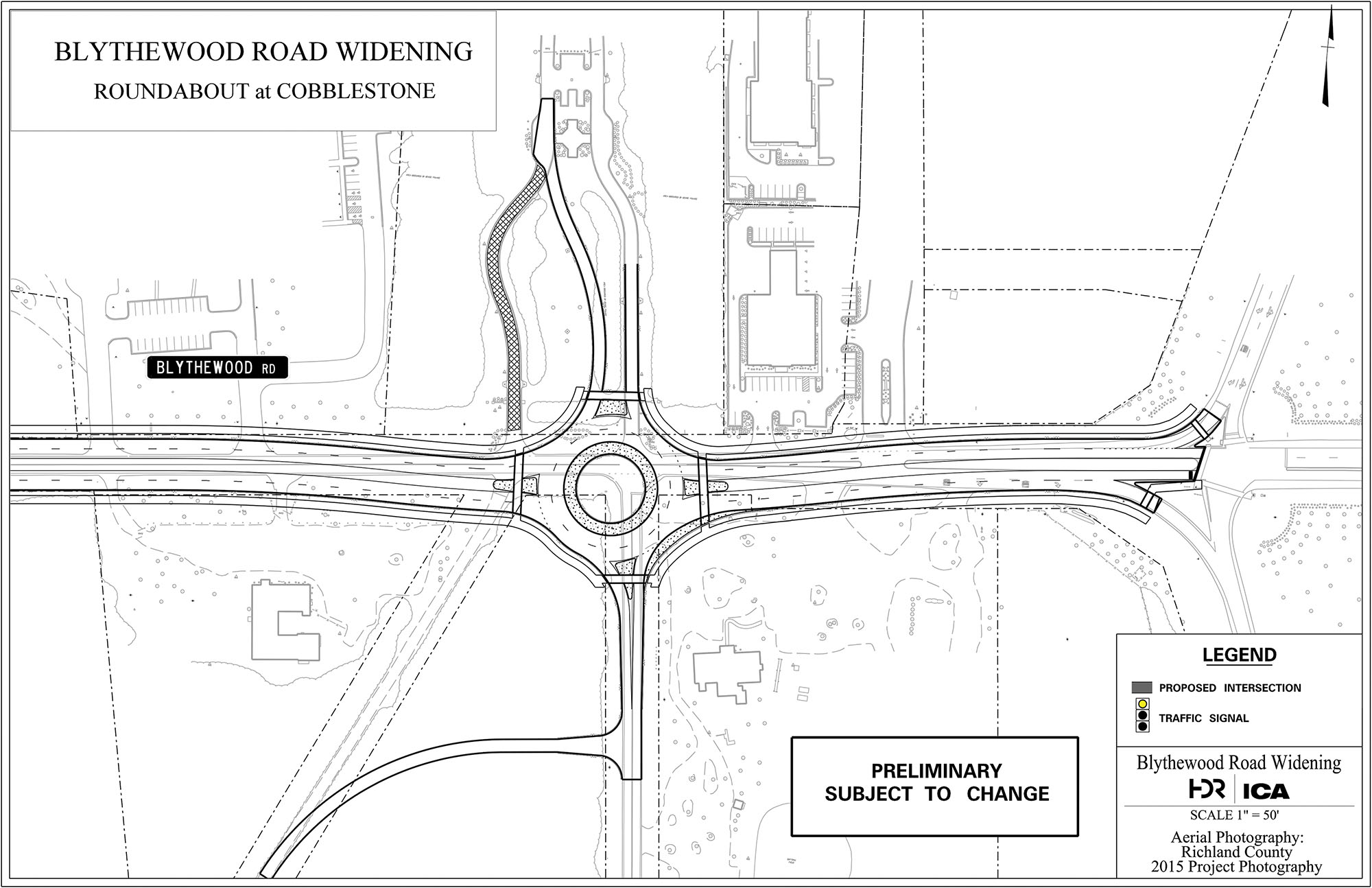
    BLYTHEWOOD (Feb. 16, 2017) – At the outset of Town Council’s Jan. 30 meeting, Councilman Malcolm Gordge reported that he had attended as an observer that morning a meeting between Chamber of Commerce members and Ben Lewis, Project Engineer for the Richland County Penny Sales Tax Ad Hoc Committee, the purpose of which was to discuss the double-lane traffic circle slated for Blythewood Road near the entrance to Cobblestone Park.

    Facilitated by the Chamber, approximately 14 Chamber members and a handful of guests met with Lewis in the Cobblestone Park Golf Club conference room.

    “At this point, there appears to be about a 50-50 split between the property owners regarding a traffic light vs. a traffic circle,” Mike Switzer, Chamber Director, told The Voice recently. “This was our first meeting and I don’t think anybody is ready to commit to a preference until all their questions are answered. We have a follow-up meeting scheduled for Feb. 27, 10 a.m. at the same location.”

    Switzer said that the properties near the proposed traffic circle are owned by Chamber members, while member businesses located in the University Village shopping center would also be affected by the circle.

    “Therefore the Chamber has initiated this effort to bring these parties to the table with the planners so that our members’ voices can be heard before the planning gets too far along,” Switzer said. “The County planners are estimating that their second public meeting (the first was last October) will be this summer to show their final proposal and so we wanted to make sure they received our input well before then. This was a very positive meeting. It was very beneficial for these Chamber members, property owners, developers, agents, engineers and county reps to meet each other, see more details about the project, ask questions face to face, etc.”

    Members want to know, Switzer said, if a traffic circle will actually perform better than a traditional four-way stop with lights. Affected property owners and businesses, he said, want to know if they will be reasonably compensated for any detrimental effects of either a circle or a four-way stop.

    “All of the affected parties are wanting what is the best balance for the community and their own business interests,” Switzer said.

    Lewis reported to Council at their Dec. 19 meeting that the roundabout was a go and that an executive summary of plans for the project had been given the OK by Richland County Council on Dec. 13.

    But after hearing from Chamber members at the Jan. 30 meeting, Lewis and the Committee have some additional convincing to do.

    “The roundabout was part of a 2012 referendum,” Lewis said, “and it is in the Town’s Master Plan. It has been evaluated in a traffic report and shown to operate efficiently.”

    Nevertheless, Lewis said a comparison plan was being drawn up to be presented to Chamber members at the Feb. 27 meeting. That alternate plan – a traditional four-way stop with traffic lights – has already been studied, Lewis said, and rejected in favor of the traffic circle. However, such a plan has not been presented to the public in a mock-up, which will be the focus of the Feb. 27 meeting.

    A traffic light set-up, Lewis said, “doesn’t seem to fit DOT (Department of Transportation) standards.” A roundabout, on the other hand, does.

    “This section of Blythewood Road has had 80 percent of Blythewood accidents over a three-year period,” Lewis said. “DOT studies say that a roundabout reduces accidents by 80 percent. And it keeps traffic moving – there is no stoplight.”

    Switzer said Chamber members hope to see a graphic and video comparison of a traffic circle vs. traffic lights at the Feb. 27 meeting. Members also hope to see estimations, he said, of the effects on nearby properties of the circle and stoplights.


     

  • BAR OK’s Sign, Nixes Column

    BLYTHEWOOD (Feb. 9, 2017) – The Board of Architectural Review (BAR) on Jan. 23 gave retroactive approval for a digital sign erected last month outside the BP gas station at 231 Blythewood Road.

    “That sign was put up a few months ago mistakenly without permit,” Michael Criss, the Town’s consultant, told the BAR, “so you’re dealing with an after-the-fact approval and certificate of appropriateness for a digital sign in the Town Center District.”

    BAR Chairman Jim McLean noted that the new sign was “very similar” to other signs that had already received approval by the Board.

    “Similar style, design and operation,” Criss agreed. “In fact, you could argue that the revised digital sign regulations were written specifically for this kind of sign where we have a modest amount of digital signage – static display and a single color, and of course in the case of the gas station, displaying usually the price of gasoline.”

    The BAR OK’d the sign without dissent. Board member Pam Dukes recused herself from the discussion and left the chambers until after the vote.

    Brick Column

    The BAR also reconsidered a move from September’s meeting in which they had required a brick column to be placed at the head of a chain-link fence separating the back lot of The Pointe apartment complex and property at 413 Main St., owned by Elizabeth Boney Kinard.

    The issue standing in the way of the column, McLean told the Board, was a large pecan tree.

    “We had approved the fence and what we asked her to do at the end of that fence is put a brick column out of the same brick that was done with the apartments,” McLean said. “The fence terminates at the tree, and I think upon further consideration that maybe the brick column itself . . . we might want to rethink the requirements of the fence for the brick column.”

    The proposed brick column, McLean said, that would ideally have been placed where the tree stands, would now have to be placed out in front of the tree, away from the end of the fence.

    “It looks like to me that it (the brick column) is going to look out of place,” McLean said, “and I think it just makes a bad situation worse.”

    The Board voted to accept the fence as it is, without requiring the brick column.

    “It sure looks awful,” Board member Cindy Nord said, looking over a photograph of the site, “if it looks like that in real life.”

    Criss said part of the landscaping plan for The Pointe would entail vegetation to grow on and through the fence over the next “three to five years and nicely hide it,” he said.

    Technical Advisor

    The BAR unanimously approved Ralph Walden as the Board’s Technical Advisor. Although the position is an unpaid one, the Board contemplated changing that in the future.

    “Mr. Walden has agreed to do it basically at this point for free,” McLean said, “but I do think at some point in time that some appropriate compensation should be considered.”

    Town Administrator Gary Parker said that if the Board was going to consider paying Walden for the post, the proposal should be made to Town Council before Council begins budget discussions in May.

    McLean asked Parker if he would research what other BARs in other towns pay their technical advisors so Blythewood’s BAR could use those pay scales as a model for their own.

    “Actually, what my research has revealed is that there are no technical advisors (in other towns),” Parker answered, “so we’d have to come up with our own formula.”

    An hourly rate, Parker suggested, would be the most reasonable option.

    Election of Officers

    Finally, the BAR elected new officers for the 2017 session. Dukes, nominated by McLean, was unanimously tapped for Chairwoman. McLean, nominated by Dukes, was voted in as vice chairman.


  • Report: Manor Revenue Up

    BLYTHEWOOD (Feb. 9, 2017) – Doko Manor is on the move, Steve Hasterok reported to Council during their Jan. 30 meeting.

    Hasterok, Director of the Manor, told Council that through the first three quarters of fiscal year 2017, revenues have outpaced the previous fiscal year by $45,000. The third quarter of 2017 alone has greatly outpaced the third quarter of FY 2016.

    In FY 2016, Hasterok said, the Manor brought in just $16,600 in the third quarter. The third quarter of FY 2017, he reported, has generated $40,050.

    While February turned out to be a slow month, with just $8,993 in revenue, January was a big money maker, with a haul of $18,148. March, which has six weddings booked at the Manor, is on pace to bring in $12,908.

    “And I’m going to tell you,” Hasterok said, “April through June, this place is going to be packed. We have weeks where we’re doing weddings Thursday, Friday, Saturday and Sunday.”

    Independence Day

    Hasterok also suggested that the Town hold its Independence Day celebration event on July 3 – a Monday. Doing so would mean moving the start time for the event back to later in the evening, which would probably eliminate the professional wrestling feature. Council agreed and voted to hold the event on July 3.

    Earlier in the evening, during the citizens comment segment of the meeting, Daune Walker asked Council to give some thought to parking for events such as the Independence Day celebration.

    Walker, who owns the properties at 208 and 212 Main Street, said parking for Blythewood events had created a nightmare for her lots.

    “Where do these people park? In any available business parking lot, open or closed,” Walker said. “We have blocked the entrance to the business – we put up sawhorses, they pick up the sawhorses and move them. One lady told me she had a right to park there because she lived in Blythewood and she had been to this even (July 4) since its inception. We had people almost run us over. They park anywhere in the lot and in the field. So what do we do? Do we charge these people to park? In consideration, when you invite people to Blythewood for events, I would like you to provide adequate parking. They park on the railroad right of way, all up and down. It’s a hazard.”

    Mayor J. Michael Ross said Council would keep parking in mind when planning future events.


  • Arrest Made in Break-Ins

    Rahmon Loyal

    WINNSBORO (Feb. 9, 2017) – A Columbia man was arrested last week and charged with a string of break-ins dating back to last September.

    The Fairfield County Sheriff’s Office said Rahmon Loyal, 27, of Bailey Street, Columbia, was arrested Feb. 2. At press time, Loyal was still being held at the Fairfield County Detention Center after his bond was set at $90,000.

    Loyal is charged with the Sept. 12 break-in at the A-1 Save and Go at 1913 Highway 321 N. in Winnsboro. According to the report, Loyal allegedly broke out a window near the front door during the early morning hours and stole 34 cartons of cigarettes and other items worth $2,330. The damage to the window was estimated at $1,160.

    Loyal is also charged with the Sept. 18 break-in at the Lebanon Mart at 6058 Newberry Road. Loyal allegedly broke in the glass front door causing $1,500 in damage and stole cigarettes and other items worth $1,800.

    On Dec. 15, Loyal allegedly returned to the Lebanon Mart for a second round, smashing his way in to the tune of $1,015 in damage while stealing cartons of cigarettes worth $4,040.

    The Sheriff’s Office said Loyal may also be connected with similar break-ins in neighboring counties. He faces three charges of second-degree burglary.


  • Council Tables Park Rules

    BLYTHEWOOD (Feb. 9, 2017) – Following the lead of the evening’s first ordinance, Town Council during their Jan. 30 meeting also postponed first reading on new regulations on uses of the Manor and Doko Meadows Park. Earlier in the evening, Council had postponed a similar vote on an ordinance regulating mobile vendors (see our Feb. 2 edition).

    Mayor J. Michael Ross noted that some of the prohibitions in the ordinance should be re-worded to allow for exceptions; specifically, the ban on pedaling on park grounds.

    “Certainly someone would have to come in and get a permit for that,” Ross said. “It brings up such things as the farmers market and Big Grab, and we would not want that to mean it was excluding them.”

    Reading from the ordinance’s playground rules, Ross joked, “you can’t have horseplay, pushing or running or shoving. It looks like you’re not going to have a lot of fun in our park.”

    Councilman Larry Griffin, pointing out the prohibition against fires, grilling and open flames, asked about a designated area for grilling. Mayor Ross answered that Council had discussed designating a grill-friendly zone, but had not finalized a specific area for cooking out. Such areas would likely require picnic tables, and Jim Meggs, the Town’s attorney, noted that picnic tables had also not yet been purchased for and placed in the park. The addition of picnic tables, Meggs said, would ultimately add to the cost of upkeep in the park. A picnic and grilling area, he said, generates trash, which would mean adding trash cans as well as receptacles for the disposal of ash and used charcoal and the Town would have to hire someone to police the grounds and empty the bins.

    “We might need to change the name from ‘park’ to something else,” Griffin said. “You just took everything out of a ‘park.’ You can’t build fires, you can’t have picnic tables.”

    Meggs offered to prepare for Council’s Feb. 27 meeting another draft of the ordinance that included the changes in the language that would allow for certain exceptions. Council voted unanimously to postpone first reading until the next meeting.

    Audit Report

    Gary Bailey, of Love Bailey Associates, told Council that his firm had issued an “unqualified opinion” on the Town’s fiscal year 2015-2016 audit.

    “It is a clean opinion,” Love said. “We had no issues.”

    Bailey said the Town’s net position grew by $560,000 from the previous year to $6.2 million in “government activities.” The Town’s balance sheet, he said, grew by $160,000.

    The Town’s income, he said, increased $558,000, compared to an increase of $258,000 in the last fiscal year. Part of that growth, Love said, was from construction fees, which grew by approximately $200,000 to $419,000 over last year’s $217,000.

    “That certainly helped your bottom line,” Love said.


  • Charges Being Upgraded in Dog Starvation Case

    WINNSBORO – Charges against a woman accused of starving her pit bull to the point that the County was forced to euthanize the animal are in the process of being upgraded, the Sixth Circuit Solicitor’s Office said this week.

    Katera Latrice Alexander, 28, of Forest Hills Drive turned herself over to police on Jan. 29. She was initially charged with a misdemeanor of cruelty to animals, first offense. Alexander was later released on a $1,000 personal recognizance bond and was scheduled to stand trial in Municipal Court at 11 a.m. on Feb. 20.

    But the Solicitor’s Office said Monday that the charge against Alexander will be upgraded to a felony and the trial will be moved to General Sessions Court. A time and date for the trial had not been scheduled at press time.

    Under the lesser charge, Alexander faced the potential of not more than 60 days in jail or a fine of not less than $100 and not more than $500, or both, if convicted. Under the felony charge, however, Alexander could face jail time of between 180 days and five years, and a fine of $5,000 if convicted.

    According to Chapter A of the state’s ill-treatment to animals statute, “Whoever knowingly or intentionally overloads, overdrives, overworks, ill- treats any animal, deprives any animal of necessary sustenance or shelter, inflicts unnecessary pain or suffering upon any animal, or by omission or commission knowingly or intentionally causes these things to be done, for every offense is guilty of a misdemeanor . . .”

    According to Chapter B of the same statute, “Whoever tortures, torments, needlessly mutilates, cruelly kills, or inflicts excessive or repeated unnecessary pain or suffering upon any animal or by omission or commission causes the acts to be done for any of the offenses is guilty of a felony . . .”

    On Jan. 13 a Public Safety officer responded to a call of a malnourished dog tied up on the front porch of Alexander’s home. The female pit bull was, according to the incident report, so badly emaciated that vertebrae, ribs and hip bones could be seen pressing through the skin. No food or water was available for the animal. Instead, there was a milk jug containing what appeared to be milk with a layer of grease floating on top.

    While Alexander reportedly told the officer that the dog had been ill for more than a month, she said she had not taken the animal to a vet because she could not afford to do so. Because of the dog’s illness, she said, the animal would not eat; however, the dog immediately consumed two packages of crackers offered to her by the officer and drank a large amount of water once the officer filled her bowl.

    Worming medication had failed to help the dog, Alexander reportedly told the officer, so the milk and grease was provided as a home remedy. According to the report, the dog had not consumed any of the concoction. Alexander had no food for the dog, the report states, but had been feeding the animal table scraps.

    Alexander allowed Fairfield County Animal Control to pick up the dog and take it to the Adoption Center, but according to Bob Innes, Director of Animal Control, the dog’s physical condition was beyond recovery.

    “We did all we could,” Innes said. “We had the vet (Dr. Robert Chappell) come out, we gave it medication. We gave her a blood transfusion – her blood count was in terrible shape. When an animal is that malnourished, it affects the internal organs. In the end, we had to put her down.”

    The County euthanized the pit bull on Jan. 15. According to Maj. John Seibles, acting Chief of Public Safety, Dr. Chappell’s report that the dog suffered from “obvious animal neglect,” and was “severely anemic” as a result of malnutrition.


  • Planning Commission Splits on Rimer Pond Road

    While the vote ended in a tie, the residents left Monday’s Planning Commission meeting jubilant. (Photo/Barbara Ball)

    COLUMBIA (Feb. 9, 2017) – A Richland County lobbyist who said he was hired by Hugh Palmer, the father of Richland County Planning Commissioner Patrick Palmer, addressed the Commission Monday afternoon to convince members to vote to recommend Rural Commercial (RC) zoning on 5.23 acres on Rimer Pond Road. The property is owned by Hugh Palmer. About 70 Blythewood community residents tuned out to beseech the Commissioners to spare their neighborhood from that rezoning. With Patrick Palmer recusing himself, the vote ended in a tie, which means the rezoning request will go forward to County Council without a recommendation for either approval or denial. The residents left the meeting jubilant.

    Richland County Council will convene on Feb. 28 to take the first of three votes on the contentious rezoning issue that has been simmering for the better part of three years.

    That simmer turned into a boil at times Monday as 34 of the residents streamed to the microphone for more than an hour to voice their opposition to the rezoning.

    Lobbyist Boyd Brown of Tompkins, Thompson, Brown Government Affairs in Columbia spoke for Hugh Palmer. Brown, a former member of the S.C. House of Representatives, representing Fairfield County, said he was speaking as one who is familiar with the County’s land use plan for that area.

    “We feel as though this (parcel) is tailor-made for Rural Commercial (RC) use,” Brown said. “If you were to take the definition for Rural Commercial (zoning) in the Richland County Land Use Plan, you would feel like it was written primarily for this specific parcel. Rural Commercial zoning was designed to help communities like this.”

    Some residents, having boned up on the County’s land use plan during their three-year battle against the Palmers, mocked Brown’s assessment of the land use plan for the area.

    “We feel? Who is ‘we’? We are here and we don’t feel,” resident Steven Greenburg shot back at Brown’s comment.

    “Contrary to Mr. Brown’s statement, Rural Commercial zoning is not tailor-made for this area,” said resident Jay Thompson. He said county staff seems to be of the opinion that the requested zoning is in compliance with the objectives for commercial uses.

    “That’s not correct,” Thompson said. “I hold in my hand a map of future land use and priority investments. If you look at this map, this neighborhood is shown as medium density, not rural. That directly contradicts this proposed zoning for Rural Commercial. It does not fit.

    ‘The staff reports that the requested rezoning would not be out of character with the existing surrounding development and zoning districts. I would ask staff, anyone, to find another property in this area zoned Rural Commercial,” Thompson said. “You will not find one in any direction.”

    Asked by Commissioner Ed Greenleaf if Thompson was correct, Planning Director Tracy Hegler, who participates in the staff report which called for approval of the rezoning request, said, “Yes, that is correct.”

    Another common target for residents was the County’s zoning district summary that states that RC zoning is needed to provide commercial services for residents in more isolated agricultural and rural areas.

    The Palmers have said the RC zoning is designed for businesses such as pizza restaurants and dry cleaners for the convenience of surrounding residents.

    Almost every speaker repeated the crowd’s mantra – “We are not isolated.” “This area is not underserved by commercial.” “We do not need it.” “We do not want it.”

    “Within a four-mile radius of my home, there are four pizza restaurants, three dry cleaners, a Dollar Store, a Dollar General, three large grocery stores and at least five service stations,” said LongCreek Plantation resident May Vokaty. “There are plenty of commercial resources available to this area.”

    Resident Stacey Young said she had to take time off from work just to be at the afternoon meeting. “It is that important to me.  We don’t need this commercial. I have five boys, and we can order pizza any time of the night. We are not going to go hungry without the proposed commercial.”

    “If you have pizza delivery, you are not beyond commercial services,” resident Joe Johnson reminded the Commissioners who, along with the audience, responded with a laugh during an otherwise tense meeting.

    On a more serious note, Johnson questioned, “Is the staff who keeps approving this venture familiar with the land use plan?

    “And I think Mr. Palmer has made some mistakes with this property which has got him in the position he is in,” Johnson said.

    Residents repeatedly reminded Commissioners that nearby commercial zoning would bring crime, congestion, more traffic and commercial lighting that would affect the environment and dark skies they enjoy in their rural neighborhood.

    “You are slowly taking away from us what we moved here for,” said Nanette Howerin of Longcreek Plantation.

    They also addressed the safety of students who would cross a very busy Longtown Road West to the commercial area from Blythewood Middle after school.

    Trey Hair of Rimer Pond Road pointed out that there is no commercial zoning anywhere on the road.

    “The only beneficiary to this zoning change will be the applicant who stands to make a large sum of money from the property. We’re asking you to stand with the people you serve. Stand with the community. We’re highly opposed to this zoning and we continue to show up in large numbers to protest. Being rural is our choice,” Hair said.

    “The Palmers are the ones who came to Rimer Pond Road 10 years or so ago and changed this parcel from Rural to Residential Medium Density (RS-MD),” Rimer Pond Road resident Ken Queen said. “We didn’t want that, but the Palmers wanted it. They didn’t even come out and meet with anyone in the neighborhood and they have not this time. There is nothing they can put on that property that we don’t already have within five or six miles.”

    “We do not want Rimer Pond Road to be anything other than rural residential with schools, homes and churches,” Rhett Sanders told the Commissioners. “The Planning Commission is tasked to oversee the strategic growth of our County to keep the big picture in mind and not make decisions based on personal requests that are not in the interest of the community.”

    “I bought my property in 1982” Benny Solton told the Commissioners. “That a single person is doing this to a neighborhood is unbelievable.”

    “It’s in your hands now to decide if you’re going to stick up for the people or for a developer, which won’t look good for you. We hope you’re with us,” Adams Road resident Michael Watts told the Commissioners.

    While Commissioners Beverly Frierson, Ed Greenleaf and Wallace Brown Sr. did vote with the residents, three Commissioners, David Tuttle, Chairman Stephen Gilchrist and Christopher Anderson, did not. Another three Commissioners were absent.

    While there was criticism of staff for its approval of the zoning request and for what residents said was staff’s lack of understanding of the zoning applicability to the land, Commissioner Tuttle took staff’s side saying, “We should not impugn staff. I commend staff.”

    “We are to look at this as planners. It (RC) meets our guidelines,” Commissioner Anderson said.

    Council will hear the rezoning request at 7 p.m. in Richland Council chambers on Feb. 28.

    (Note: An earlier version of the story said the lobbyist said he had been hired by Patrick Palmer.)


  • JWC OK’s Unknown Water Hike

    JENKINSVILLE (Feb. 9, 2017) – The Jenkinsville Water Company is passing along a rate increase to its customers from the Mid-County Water Company . . . but as of Monday night’s meeting (and vote), the company doesn’t know exactly what those new rates are.

    The JWC board of trustees voted 5-1 Monday night to pass along Mid-County’s rate increases, but without providing any numbers for the public. Board member the Rev. Leon Thompson voted against the rate hike.

    “Mid-County has passed it, but we just didn’t have the paperwork in front of us to actually call out a certain number,” board president Gregrey Ginyard said after the meeting. “We’re going to look at the number from Mid-County and it will come out. So we voted to actually look at what the numbers are with Mid-County and stuff to try to keep pace of them.”

    According to the water operator’s report delivered to the board Monday night by James Green, the JWC purchased 1,840,000 gallons of water from Mid-County last month. Green also reported a total loss of 265,269 gallons of water. Total demand, Green reported, was 5,307,070. Total gallons billed were 5,041,801.

    The water company produced 3,459,070 gallons from local wells, Green told the board.

    JWC trustees also voted 5-1, again with the Rev. Thompson dissenting, to seek a loan for construction of a well on Highway 215.

    “We had a test well done and it was doing 400 gallons a minute,” Ginyard said, “but it had radium in it, so we have to put a filtering system on the radium to clean the radium out of it before it’s made drinkable, potable.”

    During the open discussion segment of the meeting, JWC customer David Melton asked Ginyard if the company was allowing water trucks to fill up at fire hydrants supplied by JWC water. While Ginyard answered that some trucks had filled up at JWC hydrants in the past, none were doing so currently.

    “We have had some before,” Ginyard said. “No. We don’t have any now, if that’s what you’re asking.”

    In response to a follow-up question from Melton on the subject, Ginyard said the hydrants were metered and any water moved through them is noted on the operator’s report.


  • Transcending Racial Boundaries

    LongCreek Bids Farewell to Minister

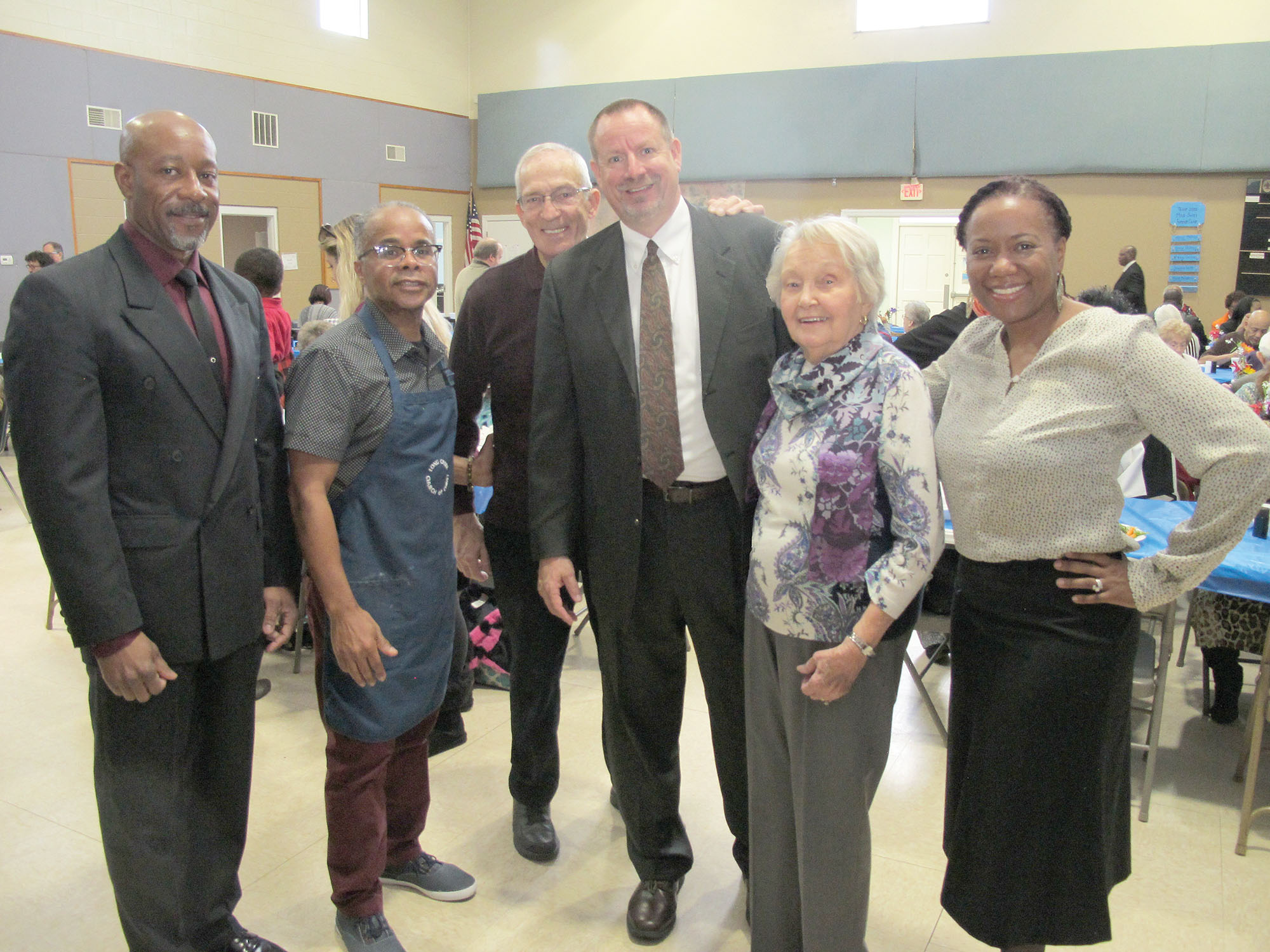
    Bidding farewell to the church’s pulpit minister, David Hamilton, center, are from left: Dan King (family life minister), Dr. Gary Bell, (deacon, who doubles as the church’s chef), member Leon Philpot, Hamilton, member Jane Farley (whose late husband, Jim, built the church building) and member Valissia Palmer. (Photo/Barbara Ball)
    Bidding farewell to the church’s pulpit minister, David Hamilton, center, are from left: Dan King (family life minister), Dr. Gary Bell, (deacon, who doubles as the church’s chef), member Leon Philpot, Hamilton, member Jane Farley (whose late husband, Jim, built the church building) and member Valissia Palmer. (Photo/Barbara Ball)

    BLYTHEWOOD (Feb. 2, 2017) – As issues over racism and racial equality have swept anew across some parts of the country recently, there are many places where racial tensions are not a topic, not an issue, not a worry. One of those places is the LongCreek Church of Christ in Blythewood.

    The church’s 180-plus membership of all ages is somewhere close to a 50/50 split between white and African American members, and the congregation has been integrated since the doors opened more than a quarter century ago when the church moved from downtown Columbia to the edge of Blythewood 29016. And members say the racial mix has worked well over the years as the church grew.

    “This is a very peaceful, unified, loving group of people,” said one of the church leaders, Gil Potter, who is white. “In the Church, we are all one. In the Churches of Christ, there is no overall hierarchical organization. Each local congregation is overseen by Shepherds or Elders selected from among the members.”

    At the LongCreek Church of Christ, the Elders include both black and white members. There are both black and white song directors who lead the congregation in a capella singing. David Hamilton, the pulpit minister, is white. Dan King, the family life minister, who also fills in regularly in the pulpit, is black. The two ministers have different styles of preaching, and the differences are wholly embraced by the congregation.

    Our different styles have never impeded the congregation’s unity, Hamilton said.

    “There is no strife here. No power struggles between the races. We don’t divide along racial lines. We are all Christians who come together for one reason, to worship God. We are brothers and sisters in Christ. We don’t just get along,” King said. “We truly love each other.”

    About the only unhappiness among the members occurred recently when Hamilton, who also writes a weekly column for The Voice, announced his retirement from the ministry. For family reasons, including his mother’s declining health, Hamilton and his wife, Kim, are returning to their roots in Kentucky. Sunday was Hamilton’s last day to preach at the LongCreek church. Following services, members gathered in the church’s family life building for an emotional farewell luncheon honoring and thanking the Hamiltons for their eight years of service to the congregation and the community.

    Potter said he expects King and, perhaps, other men of the congregation will fill the pulpit as the church searches for another minister. The church is located at 720 Longtown Road, just south of LongCreek Plantation subdivision.


  • Council OK’s Sewer Line Bid

    WINNSBORO (Feb. 2, 2017) – In a meeting that spanned an entire two minutes, Town Council on Jan. 17 officially accepted the winning bid on the McCulley Creek sewer line project.

    Upon the recommendation of the project’s engineers, AECOM, of Columbia, Council unanimously accepted the $1,092,902 bid from McClam & Associates, of Little Mountain. McClam was the lowest of five bids, which ranged from a high of $1,530,308 from State Utility Contractors, Inc., of Monroe, N.C., to a second-lowest $1,101,613.25 from LAD Corporation of West Columbia.

    According to the recommendation letter from project manager Keith B. Cannon of AECOM, the recommendation is contingent upon Winnsboro receiving additional funding from the S.C. Department of Commerce. During their Jan. 3 meeting, Cyndi Gawronski, CDBG Manager for the Central Midlands Council of Governments, told Council that the Department of Commerce was willing to kick in an additional $185,589 for the project, provided the Town could come up with 10 percent in matching funds. Council agreed to apply for the extra funding.

    The project will replace smaller, aging sewer lines near the Town’s water treatment plant.

    Mt. Zion Park

    Council also approved a $4,700 bid from Palmetto Earthworks to seed the banks at the Mt. Zion greenway park in order to prevent erosion. The project will be tackled in two phases. Phase one is slated to begin by the end of the month and will entail the tilling of the soil and the planting of rye grass seed. A shallow diversion trench will also be cut above the planted area.

    Phase two, which should begin between the middle of April and early May, will involve spreading lime and mulch, followed by the planting of Bermuda grass seed.