FAIRFIELD COUNTY – The Fairfield County Coroner’s Office along with the South Carolina Highway Patrol, are investigating a pedestrian fatality which occurred at 17895 Highway 34 West in Fairfield County at approximately 12:48 AM, on November 19, 2017.
Coroner Chris Hill states that Tavares Deantonio March, age 33, of 1517 Chappelltown Road in Winnsboro died from injuries received when he was struck by an oncoming vehicle.
The incident remains under investigation by the Fairfield County Coroner’s Office and South Carolina Highway Patrol.
WINNSBORO – Three candidates have filed for the special school board election to fill the District 7 seat previously held by Beth Reid, who died last month following a long battle with cancer.
The candidates are Lisa Brandenburg, Darreyl Davis and Herb Rentz.
Brandenburg, who is employed as Coordinator of Intervention in special services for the Fairfield County School District, has been employed by the district for more than 30 years, serving as a teacher, assistant principal and principal.
“I feel I’m the candidate most qualified to fill the vacancy,” Brandenburg said.
Darreyl Davis, who works in environmental health and safety at Isola, is president of Believers and Achievers, is a past chair of the Fairfield Elementary School Improvement Council and is the current president of the Fairfield Elementary PTO. The father of six children, two of whom are enrolled in Fairfield County School District schools, Davis said he has a passion to help kids as well as the community.
Herb Rentz, manager of Mid-County Water Company, said he is hoping to continue the work of Reid, his late wife.
“I feel a calling to take on her work,” Rentz said.
The election will be held Jan. 23, 2018.
The Voice will have more information about the candidates in a later issue.
BLYTHEWOOD – Planning Commissioners were briefed at their November meeting on proposed changes to the Town’s subdivision ordinance designed to give developers greater certainty about the Town’s subdivision review and approval process. Sketch plan approval would be given to the Commission rather than being optional.
Currently, the town’s planning consultant and administrator approve sketch plans. By the PC doing it instead, before developers commit to expensive engineering and to drafting a preliminary plat, they’ll know that their project’s basic design is acceptable to the Commission with regard to zoning conformance, lot count and layout, road geometry, utility services, sidewalks, trails, open space, tree preservation, etc .
The Planning Official will prepare a report and recommendation on the sketch plan to the Commissioners when the PC first reviews it.
Under State Code 6-29-1130. the Commission will make a recommendation on the proposed changes to Council, who has already had first reading on it.
PUBLISHER’S NOTE: For more than two years now, Blythewood investigative journalist Ron Aiken has kept Richland County residents informed with approximately two in-depth investigative pieces per week, and he published them on his website, QuorumColumbia.com. Some of those have been reprinted in The Voice. They covered everything from the University of South Carolina to bingo rackets to school boards to local government. Along the way, reporting from this site has led to 11 indictments (so far) regarding hospitality-tax fraud, the removal by the governor of an entire board of commissioners (Richland County Recreation Commission) and positive changes to work conditions including pay and benefits for first responders to cite just a few examples of impact.
But recently, Aiken was offered and accepted a full-time position that will mean he no longer will be able to produce Quorum. More’s the pity. While Aiken told The Voice he is looking forward to his new venture, he regrets that the end of Quorum could be another nail in the coffin for open government. Below is Quorum’s farewell.
BLYTHEWOOD – Local media matters, and it’s dying before our eyes as cut after newsroom cut mean there is no longer a reporter (and hasn’t been for a long time) at every municipal, school board or even county council meeting, much less the zoning, work session and committee meetings of each.
With fewer and fewer reporters to do the same amount of work and more, it’s no wonder that investigative journalism has gone by the wayside in many cases because bodies simply can’t be taken off what few beats are covered well to dive into deeper issues that require significant outside research time, often take weeks or even months to complete and require skill sets honed over years of professional experience. And, sadly, those veteran reporters were among the first targeted by industry cuts because they carried the highest salaries, and they have since all but disappeared from newsrooms that have no choice but to rely on young reporters hired as cheaply as possible.
When I started at The State in 1999, we had six writers in the sports department alone with more than 30 years experience — Bob Cole, Bob Gillespie, Bob Spear, Ernie Trubiano, Blythewood’s Pat Robertson and Bill Mitchell. Now there are only four writers total in that department, with only one having been there more than three years. The same story exists in every other department of the paper.
What we’re losing — institutional knowledge, deep local connections, decades of experience — is irreplaceable. Journalism is the public’s insurance policy against corruption, and at present it is a weakened, shaken and dizzied creature.
I hope sites such as Quorum can help spark a recovery, because the role of investigative journalism — holding government and elected officials accountable and exposing corruption and fraud — is critically important not just to the safeguarding of our rights but to the rule of law and the future of a free press.
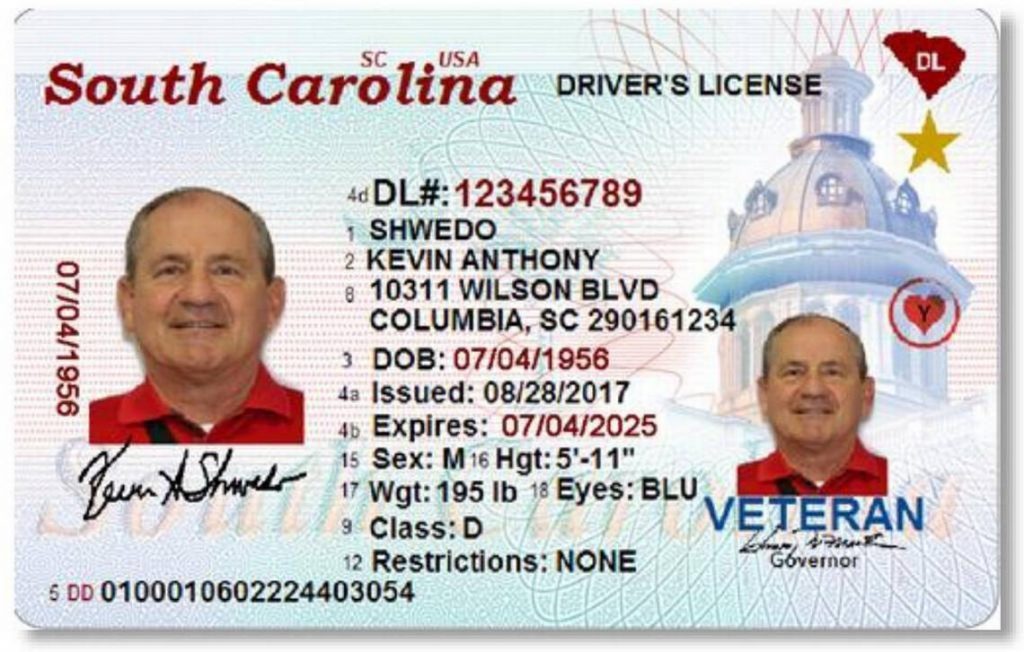
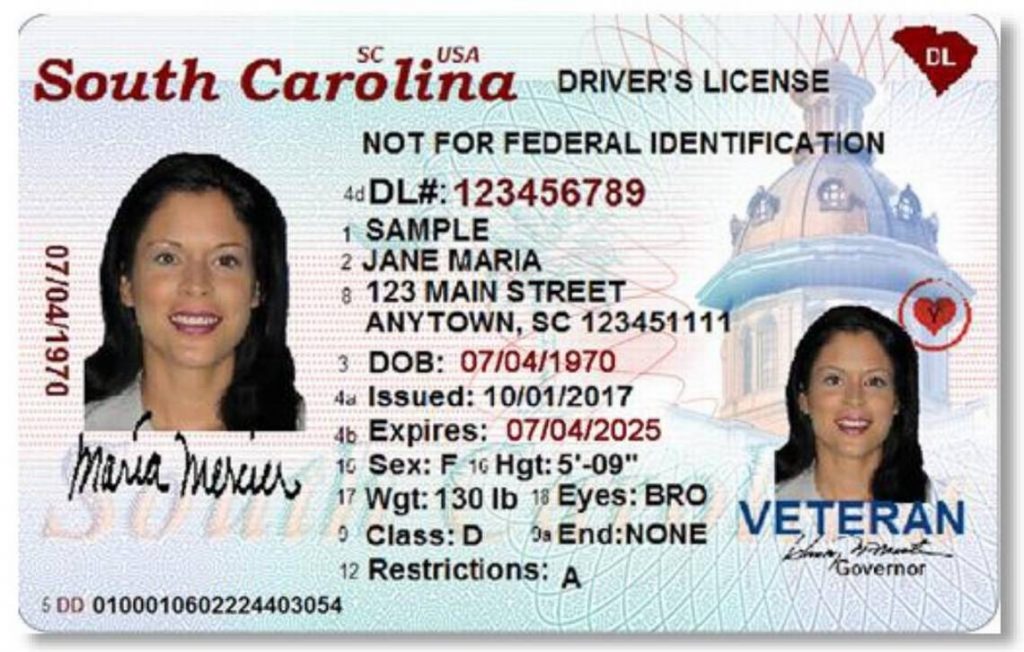
BLYTHEWOOD – While testing continues on the state’s new secure driver’s licenses and identification cards, the South Carolina Department of Motor Vehicles (SCDMV) has released the images of the new REAL ID and non-compliant cards residents will begin seeing in the first quarter of 2018.
Compliant Card
The state’s new REAL ID driver’s licenses and identification cards will be compliant with the federal REAL ID Act of 2005. These cards may be used as identification to pass security at airports nationwide, enter secure federal buildings and visit military installations.
Instead of a REAL ID license or ID, a valid US Passport or other federally accepted identification may be used for the above activities in the future and is still required for international travel.
Non-compliant Card
The state’s new non-compliant licenses and IDs will say “Not for Federal Identification” across the top. Beginning Oct. 1, 2020, non-compliant and current SC licenses and IDs, will not pass security at airports nationwide, secure federal buildings or military installations. Individuals with this card or the state’s current card must present a different form of federally accepted identification, such as a valid US Passport or military ID, for the above activities.
Changing your current card and purchasing a REAL ID is voluntary, but you must have a REAL ID or other federally approved identification in the future for the federal activities above. People who will not be passing airport security or visiting federal facilities do not need to take any action besides renewing their current card as normal when it expires.
The cost is the same for a REAL ID or a non-compliant card.
The new cards will be available to the public in 2018. To get a REAL ID, you can begin the process now of changing your current driver’s license. For a REAL ID, the SCDMV must have all of the following documents on file:
Proof of identity (government-issued birth certificate or valid US passport)
Proof of Social Security number
Two proofs of current, physical SC address
Proof of all legal name changes
You may bring these documents to the SCDMV now. If you have a Class D, E, F, G, M, or any have a Class D, E, F, G, M, or any combination of those license and are a US citizen, you may be able to buy your new REAL ID license online in 2018 with a valid credit card. Your driving privileges must be in good standing for you to be eligible for online ordering and your last renewal cannot have been by mail.
All unexpired SC driver’s licenses and identification cards will be valid to pass airport security, enter secure federal facilities and visit military installations until Oct. 1, 2020. For more information, visit www.scdmvonline.com. For questions about REAL ID, please email REALID@scdmv.net or call 803-896-5000.
RIDGEWAY – One of Mayor Charlene Herring’s agenda items at last week’s Ridgeway Town Council meeting brought attention to Council’s new habit of earmarking or spending money (more than $113,000 since June) from a capital improvements fund that does not exist. Another such expenditure popped up last week.
Ridgeway, SC
“When we made our capital improvements list this year, Mr. Porter reminded us that the exterior of the teacherage needs painting,” Herring told Council members. But she said the painter said repairs must be made before he could paint.
The only bid for repair work on two porches came in at $5,675 which would include repairing and replacing the beadboard ceilings, repair doors, windows and trim and replace screen and lattice on both porches.
“We have the funds in capital Improvements…or whatever,” Herring assured Council, dismissing the fact that the town has no capital improvement fund. “So do we have a motion to approve this?”
“We talked last summer about holding back on expenses until we get our water system right,” Councilman Don Prioleau said. “Let’s get our finances in order, then think about something like this.”
“If you look at our budget, we have money for this,” Herring insisted.
As Prioleau tried to make his point, both the mayor and Councilman Doug Porter interrupted.
“We have the funds,” Herring insisted, “based on the (bank) account and on the consultant we brought in. We have more money than we thought we had.”
Councilman Heath Cookendorfer agreed with Prioleau.
“You’re talking about spending money on something that’s cosmetic,” Cookendorfer said, questioning whether the Town should fix up the exterior of the building without knowing how much it would cost to restore the interior.
“It’s like putting lipstick on a pig,” Cookendorfer said. He then guesstimated at the cost of the restoration.
“Ten years ago, we were told it would only cost $35,000 to restore the inside,” Porter said.
“Do you have a report saying that?” Cookendorfer asked.
“That’s what I’ve been told,”
Porter said.
At Prioleau’s suggestion, Council voted to table the item until more information could be gathered.
The current spending spree stems from the June, 2017 Council meeting when Herring brought in Larry Finney with Greenwood, Finney & Horton Certified Public Accountants to prepare the Town’s budget for fiscal year 2017-18. Finney OK’d taking the $400,000 that Ridgeway received from an insurance settlement and another $200,000 in savings from other sources and transferring $175,000 of the roughly $600,000 into the general fund and $200,000 of it into the utility fund for a rainy day. The slated projection, he said, would be $185,000 left in unrestricted funds. With $60,000 budgeted for Pig on the Ridge and the Arts Festival, that $185,000 would be trimmed down to $125,000 along with $104,000 in the utility fund. The total, $229,000 is what Finney said the Town would have available to spend, but he stipulated that those funds should be spent on one-time purchases.
While Finney conceded that would cause the Town to be in a much tighter financial condition, he suggested the Town could rebuild its savings by raising water and sewer rates as well as business license fees and millage rates. Those rates and fees were subsequently raised.
Since June, the Town’s financial reports document that, of the $229,000, Council has made more than $113,000 in purchases/earmarks, leaving a balance of $116,000 available to spend.
The purchases/earmarks since June include Town Hall painting ($4,700), Town Hall shutters ($3,150), railroad purchase/survey/legal fees ($40,000), legal services associated with removing Town Clerk’s dog from town hall ($6,022.91), security cameras ($6,900), maintenance building ($30,000), welcome center air and desk from H-Tax funds ($4,000), Christmas events from H-Tax funds ($2,000), Town Hall deck maintenance ($450) and part-time administrator David Hudspeth ($16,000 for 30 days of work).
“There are some things you’ve approved since you did the budget that were not included in the budget,” Hudspeth reminded Herring in addressing the above list. During the Nov. 9 Council meeting, Hudspeth suggested Council would need to amend the budget at the December meeting to reflect this spending.
WINNSBORO – Cambio Academy in Greenbrier has been the source of numerous complaints from neighbors and, earlier this month, four juveniles from Cambio were arrested for breaking into Greenbrier United Methodist Church. During the Nov. 13 Council meeting, County Administrator Jason Taylor updated citizens on the County’s recent meeting with Cambio Academy Director Pamela Wood concerning the Academy’s mounting problems.
According to Taylor, Wood said several female teens had been inappropriately placed at Cambio. Wood identified 8-10 juveniles that she said would be better suited for a facility with a more intense level of care.
“DSS has a need to place some of these difficult clients and that’s what happened,” Taylor said. “They’re inappropriately placed at Cambio as a path of least resistance, and they probably should have been placed somewhere else.”
Currently, Taylor said he was told the doors at Cambio Academy are not kept locked. He said County officials and Wood explored ways to make the facility more secure. They looked at fencing, but according to Taylor, they were not comfortable with the placement of a barbed wire fence.
The County’s new interim fire marshal, Greg Gerber, is slated to visit Cambio to find out if a lock system or an alarm system could be the answer for the security issues. Council has a follow up meeting with Wood later this week.
“We will follow up with Mrs. Wood with a list of these things,” Taylor said. “And, hopefully, attach a time frame as to when we can hope to see improvements.”
Council Chairman Billy Smith issued a stern warning.
“I’ll just say I hope the concerns and the things that are going on now can be curtailed and corrected,” Smith said. “Because otherwise I just don’t see where we can allow that facility, without trying to do anything, to keep operating in that community in the way that it is right now.”
Cambio has not only been a source of ire for citizens, but it has created a massive workload for the Fairfield County Sheriff’s Department. Sheriff Deputies have responded to over 100 incidents at Cambio in its five-month existence, something that Councilman Douglas Pauley addressed in an editorial in the Oct.26 issue of The Voice.
“Another concern is how time consuming it has become for the Fairfield County Sheriff’s department to respond to these calls. It diverts them from other matters within the County that need their attention as well,” Pauley wrote. He said he understood that the Academy, which opened in May, 2017, was supposed to be a private residential treatment and rehabilitation center for troubled female teens ranging in age from 13 to 18.
Sheriff Will Montgomery told The Voice last week that his deputies have answered more than 100 calls related to Cambio in the last five months.
WINNSBORO − The tipping point for Blue Granite Medical Center and for Caring Neighbors, Fairfield Memorial Hospital’s home health business, may have occurred during the Finance and Audit Committee meeting Halloween night.
Agenda items that evening included profitability reports, Blue Granite Medical Center and Home Health, but FMH Board of Trustees Chair Catherine Fantry requested discussion of these items be moved into executive session since it would encompass “personnel and contractual matters.”
After another executive session during a special called meeting Nov. 7, announced to the public with only a notice on the front door of the hospital, the full Board voted to close Blue Granite Medical Center along with the FMH home health business and its cardiac rehab program.
According to information provided in response to questions from The Voice in September, on average 162 patients per month are seen at the Blue Granite Medical Center, and there is a case load of 48 patients in Caring Neighbors Home Health.
A week after the vote to close the three departments, The Voice was told that hospital CEO Suzanne Doscher was too busy to meet with The Voice staff to answer questions about the impact of closing these services until after the newspaper’s publication deadline. The Voice learned from reliable sources that Doscher planned to inform 11 or so hospital employees of their pending layoff on Tuesday.
In spite of the apparent haste of the special called meeting and vote, the writing has been on the wall for some time. Month by month, Blue Granite and the other hospital programs have shown declining gross patient revenues and were seen by some board members to be large contributors to the hospital’s overall negative position.
“If it wasn’t for Blue Granite and home health, we would not be under water with EBITDA (earnings before interest, taxes, depreciation, and amortization),” Trustee Randy Bright said during the FMH September Finance and Audit Committee meeting. “If we would have taken the suggestion to close those at the beginning of the year, we would now have a positive EBITDA.”
The detailed service line reports reviewed each month by the Board show why. For Blue Granite Medical Center, at the beginning of the prior fiscal year (Oct.1, 2016 – Sept. 30, 2017), the hospital had hoped for $286,908 in gross patient revenues (what the hospital bills for services, not what it actually collects), but it grossed only $164,303 or almost 75 percent less budgeted. Even though expenses for the medical center were reduced, it still cost about $250,000 to operate the center.
Similarly, for its cardiac rehab program, the hospital grossed only $78,916 last year, 136 percent less than what it had expected. While FMH’s home health business took in $479,505 or 74 percent more than expected, the cost of providing home health services, $655,840, far exceeded what the hospital had budgeted. It still lost money on that service.
Chief Finance Officer Timothy Mitchell also noted during the September finance meeting that in the 2017-2018 fiscal year budget, home health and home care were projected to lose about $437,000.
In spite of this, hospital management had included Blue Granite and home health in the current 2018 budget, which runs from Oct. 1, 2017 through Sept. 30, 2018, and were optimistic about the future of Blue Granite, at least. During the hospital’s September budget meeting, Mitchell said that increases in patient volume and revenues at Blue Granite Medical Center were expected because the staffing had finally stabilized.
Unfortunately, that hope of stability lasted only one month. Doscher reported at the Oct. 24 meeting that the full-time nurse practitioner would be leaving Blue Granite and the center would be open only two days a week.
Throughout its budget deliberations and policy setting, FMH has proceeded as if all departments would remain open in the near future and that it would, at some unspecified time, begin looking at what services it will close and what it will keep. The hospital also hired an outreach coordinator his past summer whose job is to promote outpatient services to the community and gain more visibility – and patients – for the facility. In addition, the medical center and home health services have been characterized by Board members as services the hospital has to keep because of need in the community.
While FMH has developed an employee retention plan with bonuses and an overall strategic plan to guide the hospital for the current year, there has been no indication to date that the hospital has a transition plan in place for those programs it intends to shut down.
Hospital management and the Board of Trustees have been reluctant to publicly state what Fairfield Memorial will look like once the inpatient hospital fully shuts down and Providence Hospital builds a new stand-alone emergency room. The closure of Blue Granite, home health services and cardiac rehab, leaves the other rehabilitation services (physical therapy and respiratory therapy), imaging services, and diabetic education as the core services around which a reconstructed FMH could be formed.
BLYTHEWOOD – After more than a year, the Blythewood Board of Zoning Appeals held a meeting on Monday evening to elect a new board chair after the death last February of longtime board member and chair Sabra Mazyck.
Veteran board member and vice chair Pat Littlejohn of Cobblestone Park was elected chair. Derrick Pugh of Abney Hills neighborhood, who was appointed to the board two months ago, was elected vice chair. It was also announced that board member Joseph Richardson has moved out of the town and has resigned his position on the board. Other board members are Ray Fantone and Sharron Pickle, both of Lake Ashley.
The board, which is a quasi-judicial board, conducted no other business during the meeting.
Following the election of officers, the town’s planning consultant Michael Criss conducted a 90-minute class as part of the requirements for certification for members.
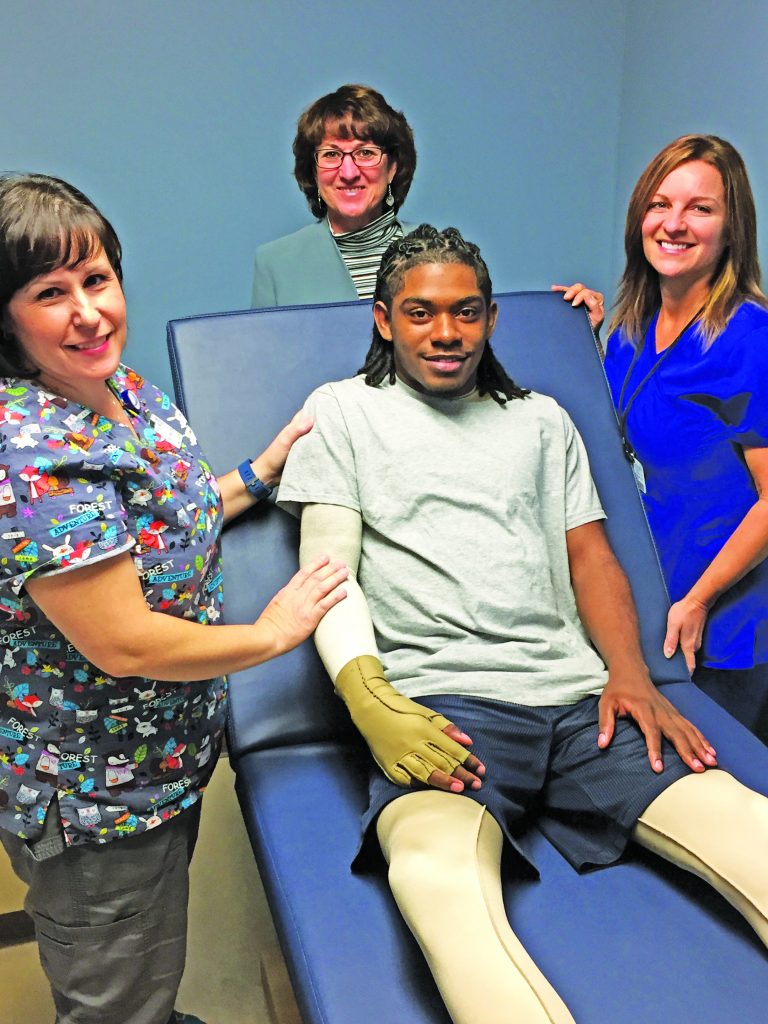
Fairfield Memorial Hospital Foundation has been awarded a $4000 grant from AFLAC for a powered adjustable Hi-Lo treatment table for FMH’s Outpatient Rehabilitation Department. Burn victim Jaykwan Gibbs, 20, center, receives four physical and four occupational treatments at FMH twice a week. Tonja Oliphant, Certified Occupational Assistant, Suzie Doscher, FMH CEO, and Laura Willingham, Director of Rehabilitation Services. One of greatest benefits of the hi/lo table is the patient can get on and off the table easier because the table height can be adjusted to the patient’s specific needs.


 “DSS has a need to place some of these difficult clients and that’s what happened,” Taylor said. “They’re inappropriately placed at Cambio as a path of least resistance, and they probably should have been placed somewhere else.”
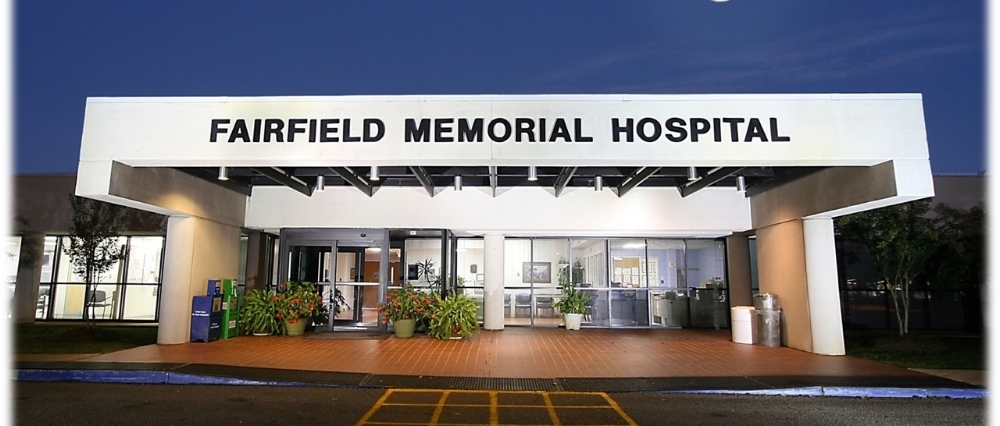 After another executive session during a special called meeting Nov. 7, announced to the public with only a notice on the front door of the hospital, the full Board voted to close Blue Granite Medical Center along with the FMH home health business and its cardiac rehab program.