Category: News

  • Auditor: Town’s books were a mess

    Council Advised To Hire Competent Accountant

    BLYTHEWOOD – Before presenting the audit for the town government during Monday night’s town council meeting, Gary Bailey, with Love, Bailey Auditors of Laurens, S.C., spoke plainly about the condition in which he found the town’s books when he was called to audit them last November.

    “The books were really in a mess,” Bailey said.

    During the May town council meeting, Mayor J. Michael Ross announced that the town’s books were not in order and hadn’t been for some time. He said the town “has not even commenced the annual audit process for the 2016-17 audit.”

    To that end, the town hired the CPA firm of Sheheen, Hancock and Godwin of Camden to bring the town’s books up to the level that they could be audited. That audit was presented just seven days before the July 30 deadline when, by state law, the state could begin to withhold state funds from the town.

    “It appears this situation has resulted from management’s failure to properly transition to the new accounting software system which was recommended to this council by professional public administrators who then failed to attain implementation,” Ross stated during the May council meeting.

    Ross credited the town’s newly hired administrator, Brian Cook, for detecting the deficiency very early in his service to Blythewood. Cook was hired last February to replace Gary Parker who retired. Assistant administrator Chris Keefer left her position in June.

    By Monday night, however, all appeared to be well.

    “[Sheheen] did an excellent job,” Bailey told council. “After they took hold of your books, we didn’t find any major issues. The town is in a very strong position.”

    Bailey gave the town a stern warning, however, going forward.

    “You can see the alternative of not having a qualified person in place [to do the town’s accounting.] Hiring someone without expertise cost you way more than just outsourcing for a fraction of the time that was needed [to get the books in order],” Bailey said.

    Hitting the highlights of the audit, Bailey said the town’s total general fund increased by $173,000 to $1.562 million and, of that, only $359,000 was restricted to debt service. The other $1.2 million was unassigned.

    “The general fund cash balances increased to $1.2 million in fy 2016, but dropped a bit to around $800,000 in fy 2017 because you have a lot of projects going on and transferred a good bit over to capital projects,” Bailey said.

    The unassigned fund balance of $1.2 million represented about 87 percent of the fy 2017 expenditures which, Bailey said, was very strong.

    “Most town’s push to have a 25 percent minimum fund balance. Yours is 87 percent, so that’s really strong,” Bailey said.

    Bailey reported that the town’s general fund expenses were $1.38 million for fy 2017 based on operating cash, not restricted cash, which gave the town almost 10-1/2 months of cash flow.

    “If you didn’t bring in a single dollar for 10-1/2 months, you’d have enough to continue funding the town. That’s very strong even at June 30, 2018,” Bailey told council.

    Bailey reported that while the overall general fund revenue did decrease by about $65,000 from fy 2016 to fy 2017, it was mostly isolated to building fees and permits.

    Expenditures, Bailey said, also went down about $10,000 in fy 2017 due primarily to payroll being up about $9,000.

    “You had about $14,000 in capital outlays within the general fund, but all other expenses decreased $33,000 from the previous year,” Bailey said.

    The good news, Bailey said, is that the town’s revenue was $64,000 more than was budgeted and expenses were $168,000 below what was budgeted.

    “You spent a lot of money in fy 2017 and wrapped it up in fy 2018,” Bailey said. “Overall capital outlay in fy 2017 was $865,000, mostly for two projects: the amphitheater for $416,000 and the Doko building for $408,000.

    The audit showed that Doko Meadows is becoming a bright spot instead of a blight on the town’s financial picture. Revenue increased from $135,000 in fy 2016 to $175,000 in fy 2017 The unadjusted fy 2018 numbers have the revenue at $212,000. Bailey also pointed out that the Doko Meadows losses decreased from $77,000 in fy 2017 to $35,000 in fy 2018.

    The outstanding balance on the bond that was used to construct Doko Meadows is $4.4 million.

    Going forward, Cook said the town is evaluating how it wants to reconfigure staffing to handle the town’s accounting. He said the 2016 transition from outsourcing the town’s accounting to an in-house system bogged down.

    “We’re thinking about hiring a qualified accountant and doing it ourselves, now, but with oversight from Sheheen. We have some controls in place and we’ll continue to have a CPA check up on us, maybe monthly at first and less frequently over time,” Cook said. “It’s going to take a little time to get set up.”

    Cook said he expects the town’s books to be ready for the fy 2018 audit to begin in October and Bailey said that audit is on track to be presented before Christmas.

  • County taps into water authority

    WINNSBORO – Fairfield County is looking to tap into the water and sewer business.

    The county, though, says it’s merely looking to work with other water providers, such as the Jenkinsville Water Company, and has no plans to force the JWC and other water companies into any agreements.

    At its regular meeting Monday, County Council voted unanimously on a resolution authorizing it to proceed with creating a joint water and sewer system.

    “It doesn’t immediately affect the water companies that are in the county,” County Administrator Jason Taylor said in response to a question from Councilman Mikel Trapp.

    “What it does is it sets up the framework that the county can provide water and sewer services,” Taylor continued. “We can work with these companies. Once we get into the creation of it, we’ll look at various engineering.”

    Taylor said toward that end, the resolution references a memorandum of understanding the county recently reached with the Town of Winnsboro, the county’s largest water provider.

    State law authorizes two or more cities or counties to develop a joint water and sewer system. In the case of Fairfield County and Winnsboro, it would be called the Fairfield Joint Water and Sewer System.

    According to the resolution, the commission would start with at least seven members. If additional partners join the commission, Fairfield County and Winnsboro would maintain equal membership and represent a majority of votes on the commission.

    The county and town would be empowered to appoint commissioners by resolution. In the event of a disagreement over an appointee, “the decision shall be resolved by the flip of a coin,” the resolution states.

    “There’s a lot of ability now with this new ordinance to reach out to the individual companies and offer to assist them or work with them in providing water services more comprehensively than in the past,” Taylor said. “It doesn’t force anything upon anybody. It gives us the ability to move forward and provide water and sewer services.”

    Monday ’s vote follows a discussion of the agreement the county’s public works committee held last Thursday. At that meeting, Taylor said the purpose of the agreement is to establish a foundation that would allow the county and town to solicit grant money to help subsidize startup costs.

    “This is just to set up the legal framework so we can have an authority that has the authority to execute these kinds of agreements and then accept money,” Taylor said.

    In related business, the council also approved a new sewage disposal agreement with the Town of Great Falls, replacing the previous one county officials say was never entirely fulfilled.

    Per the agreement, the county agrees to purchase 250,000 gallons of sewage capacity for $517,000. Plus the county pledged to spend $52,800 in engineering services for a new sewer line.

    Taylor said Great Falls and the county previously had an agreement to provide sewer services in the Mitford area in the vicinity of I-77 and S.C. 200.

    “It was anticipated there was going to be a lot of development in that area so we wanted to bring in sewer [services] to facilitate that development,” Taylor said. “Unfortunately the growth in that area never occurred. It never was fully realized. Great Falls took essentially a big hit on this thing because they only got like 11 customers.”

    The $517,000 spent on added sewer capacity covers about $234,000 in costs that Great Falls incurred in providing sewer services, and buys out $230,000 that Taylor said the county should have paid the town, but never did.

  • FC animal abusers rarely jailed

    WINNSBORO – Chances are good you won’t go to jail for abusing animals in Fairfield County.

    Time after time, persons charged with animal abuse-related offenses were allowed to plea for reduced punishment and received probation. Even felony charges were typically plea-bargained to misdemeanors. Many times, charges were dropped altogether, according to court documents.

    In some instances, offenders were more likely to spend time behind bars for nonviolent offenses, such as trespassing, open container of alcohol or gambling violations, documents show.

    Further, the Fairfield County Public Index lists jail sentences for at least two defendants for the offense of “dogs running at large.”

    Two others charged in grisly animal abuse cases – one in which a cat was methodically tortured and killed and another in which a dog was dragged – served no time in prison after their trials.

    Sixth Circuit Solicitor Randy Newman Jr. couldn’t be reached for comment.

    County Council Chairman Billy Smith said he thinks the problem rests primarily with enforcement.

    “I don’t think the problem has been so much the laws in place. I think the laws in place are sufficient to prosecute the cases,” Smith said. “Why those cases are allowed to be pled is something I wish I knew the answer to.”

    By the numbers

    A review of the County Public Index, a database that lists criminal cases filed in the County, found at least 13 animal-related abuse or neglect cases adjudicated since 2015.

    The review included cases handled by the Sheriff’s Office and the Town of Winnsboro Police Department. It didn’t include pending animal abuse cases, nor did it include incidents that didn’t result in criminal charges.

    Four animal abuse cases, all of which were deposed in 2016, were nolle prossed, or non-criminal disposition of a criminal case, as defined by S.C. Judicial Department.

    Court records list indictments for all four defendants.

    Indictments are court documents stating that there is sufficient evidence present for a criminal case to move forward.

    But the cases do not move forward. They are settled with little punishment.

    In perhaps the most glaring example of leniency granted to an animal abuser, a Ridgeway man facing up to five years in prison for torturing and killing a cat received probation in 2017.

    The solicitor allowed the case to be pled and the court sentenced then 18-year-old Christopher Pauley of Ridgeway to three years, suspended to three years of probation. The penalty was inclusive of a second charge of intimidation later plea bargained to assault and battery, second degree, court records show.

    Pauley did, however, spend several months behind bars before his trial.

    Court records state he was arrested Dec. 27, 2016 on the animal abuse charge and posted $5,000 bond on Feb. 27, 2017.

    On March 14, 2017, he was charged with intimidation of court officials, jurors, or witnesses, and jailed again until the June 1 trial date, court records show.

    At Pauley’s sentencing hearing, the prosecution said that according to a witness, Pauley said he beat the cat, set it on fire and hung it from a tree in a garbage bag over the span of several days.

    That witness did not appear in court.

    “To be accurate, the officer found a black trash bag with maggots and fur inside. She also found a lighter and an ax with fur on the blade,” assistant solicitor Croom Hunter told the court.

    State law defines the felony offense of animal cruelty as when a person, “tortures, torments, needlessly mutilates, cruelly kills, or inflicts excessive or repeated unnecessary pain or suffering upon an animal or by omission or commission causes these acts to be done.”

    A person convicted of this offense, “must be punished by imprisonment of not less than one hundred eighty days and not to exceed five years and by a fine of five thousand dollars,” the law states.

    Despite what’s written in state law, Pauley was still allowed to plead to the lesser misdemeanor charge of ill treatment of animals, even with prior conviction in his record.

    More mercy for abusers

    Pauley’s case, though one of the most graphic, isn’t unique in terms of animal cruelty offenders receiving plea agreements

    Brian Smith, 41, of Winnsboro, faced 180 days to five years in prison for a felony charge of ill treatment of animals/torture after he shot a dog in March 2016.

    Smith claimed he shot the dog because he thought it was the same animal that had attacked his mother’s dog, but no evidence of that was ever presented in court.

    In the end, Smith was sentenced to 90 days, suspended to 90 days of probation and fined $1,500 at a hearing in May 2017.

    One of the last photos of the Alexander pit bull. The dog, approximately 3- to 4-years old according to Animal Control estimates, was malnourished and emaciated beyond recovery and later euthanized by the County. (Fairfield County Photo)

    Katera Latrice Alexander of Winnsboro also eluded prison after she was allowed to plead guilty to a misdemeanor ill treatment of animals charge, also in May 2017.

    Alexander, 29, also received a 90-day suspended sentence. Her only other punishment was to perform 25 hours of community service, court records state.

    The then 28-year-old Alexander left a dog chained to the porch, starving it to the point that the dog later had to be euthanized.

    In another instance, a man charged with dragging a dog dodged prison time.

    Billy Ray Huskey, 41, of Great Falls, was charged with the felony charge of ill treatment of animals in general/torture charge, but was allowed to plead guilty to a misdemeanor charge of ill treatment of animals.

    According to police records, witnesses said Huskey dragged a nine-month-old dog for about a mile on the highway behind his Dodge Ram pickup truck Dec. 13, 2015. Huskey pleaded guilty in July 2016. He was sentenced to 90 days, suspended to three years of probation, which expires 12 months from now.

    These cases and others like them resulted in penalties often far less severe than non-violent offenses.

    Court records list a 10-day jail term for a Winnsboro woman pleading guilty in 2017 to a “dogs running at large” violation.

    The same “dogs running at large” offense fetched a 15-day sentence or fine for a Winnsboro man found guilty in a July 2017 bench trial, documents state.

    In 2015, a Rebecca Boulware, 52, of Chester, was sentenced to 30 days with credit for time served on a charge of gambling/unlawful possession/operation of slot, video, vending machine or gambling device, according to Fairfield County court records.


    This story is part 1 of a 3-part series.


    Related: No additional time, no fine for cat abuser, RW man charged with torturing cat,  Felony Dog Abuse Case Awaits TrialAgain, no time, no fine for County’s animal abuses,  Woman Charged in Dog Starvation, Charges Being Upgraded in Dog Starvation CaseCharges pending in dog starvationDog Abuser gets 25 hours,  Arrest made in Dog Dragging Case, Hearing Scheduled in Dog Dragging CaseDog Abuse Case DelayedDog Case Returned to Fairfield‘A Horrible Thing’,


  • Lightning struck twice in Drawdy Park

    Heyward Mattox, left, Jeff Mattox, back center, Dee Mattox, front center, and Russell Price. | Darlene Embleton

    WINNSBORO – July 19, 1993.  Winnsboro resident, Dee Mattox recalled that day 25 years ago when lightning struck twice in the same place.

    “I remember it vividly,” Mattox recalled, “even the smell of burnt flesh.  My family and I were attending an All Star Little League game at Drawdy Park being played between Winnsboro and Mullins. The game had to be called because a violent thunderstorm had moved in.”

    According to a story printed in the Herald Independent, witnesses reported that a flash of lightening hit a large oak tree near a car belonging to the Gasque family from Mullins. Dale Gasque, his wife and daughter Amy were sitting in the car at the time.

    “We heard a loud noise when the lightning hit,” a witness who asked not to be identified, was quoted in the news article. “I think the three in the car were scared when the lightning hit so close, so they got out of their car.”

    Heyward and Dee Mattox and their son, 11-year-old Jae, were sitting in their car not far away when they saw the lightning strike.

    “My first memory after the initial strike is seeing Russell Price run over to the car to check on the family parked beneath the tree,” Jae recalled in a Facebook post last Thursday, the anniversary of the strike.

    Mattox said some who were at the park reported that Gasque, who was outside of his family’s vehicle surveying the situation, commented that he was safe because lightning never strikes the same spot twice.

    Just minutes later, the second lightning strike hit a tree in the same area.

    Already a nurse of 15 years, Dee jumped from her car and ran to the scene.

    “They were all unconscious,” Dee recalled.  “But I could smell the burned flesh and Dale’s skin was blue and purple.  He was not breathing and he had no pulse.  I immediately started CPR,” recalled Mattox, who was also an American Heart Basic Life Support Instructor then and now.

    Right there in the pouring down rain, with lightning and thunder still rampant, Mattox is credited with saving Gasque’s life.

    “There were many heroes that day and it would never have worked without everyone working together,” Mattox said.  “Jeff Wade (a SC Highway Patrol Trooper) assisted with the CPR. Jeff Mattox took care of the other members of the family, someone called 911, Russell Price and many of the men there carried Dale to a place where we could do more effective CPR. Many people in their own way were heroes that day. I do believe God put us all there for a reason,” Mattox said. “It was 15 or 20 minutes before the ambulance came but it felt like forever.”

    The Herald reported that the other occupants of the car, Beverly Gasque and her daughter Anna, regained consciousness and were driven to the hospital by Jeff Mattox.  In a Facebook post, Jeff said he remembers that their shoes were smoking. Beverly Gasque, responded that, indeed, she still has the tennis shoes with the insides melted and holes burned in them.

    Dale Gasque survived the ordeal, as did the whole family.

    “We actually stayed in touch with them over the years,” Dee said.  “I understand their daughter Anna became a nurse as a result of being influenced by the event.”

    Anna Gasque Johnson said she felt her family was blessed with a true miracle that day in Dee Mattox and that she (Mattox) was the reason she and her brother, Luke, still had a daddy and her children had a Papa.

    As fate would have it, sons from both families, Jae Mattox and Luke Gasque, attended the Citadel at the same time. Dale and Beverly Gasque still live in Mullins, SC, and now have three grandchildren.

    “God works in mysterious ways,” Mattox said.  “I recently got a text from Anna Gasque Johnson, that she was able to ‘pay it forward’ when she performed CPR on a stranger at a Clemson ball game.”

    Mattox said she encourages everyone to take a day to learn CPR.

    “It works,” she said. “I don’t think there would be anything worse than to stand by and watch someone die who could have been saved. And that someone may be someone you love. God put us here to take care of each other.”

    And that is exactly what she and others did 25 years ago, in the pouring rain and violent lightning at Drawdy Park.

  • Ribbon Cutting

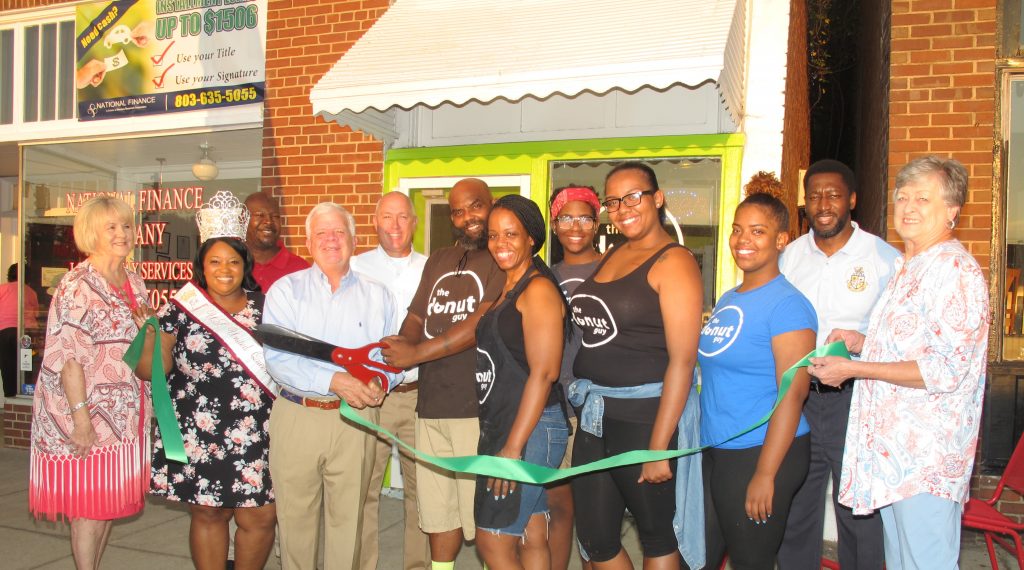
    WINNSBORO – The Donut Guy owners, Shaun and Crystal Paulk, held a grand ropening Monday morning for their donut shop, located at 149 S. Congress Street. The Fairfield Chamber of Commerce celebrated the occasion with a ribbon cutting. The shop opened in January, 2017, but the Paulks say they have just now settled into regular hours and are open six days a week: Tuesday, Wednesday and Saturday, 7-4; Thursday and Friday, 7-7 and Sunday, 12-5.

    Besides donuts and other sweet treats, they offer off-site catering, breakfast and a food truck for special events. Mayor Roger Gaddy and the Paulks, center, snip the ribbon assisted by, from left, Terry Vickers, chamber president; Shameika Sims, Darryel Davis, Gaddy, Douglas Pauley, the Paulks and their three daughters, Shauntae, Genesis and Imani; Dr. J. R. Green and chamber secretary Susan Yenner.

  • Golf Club of SC in foreclosure

    Crickentree residents fear plan to replace entire golf course with 450 homes

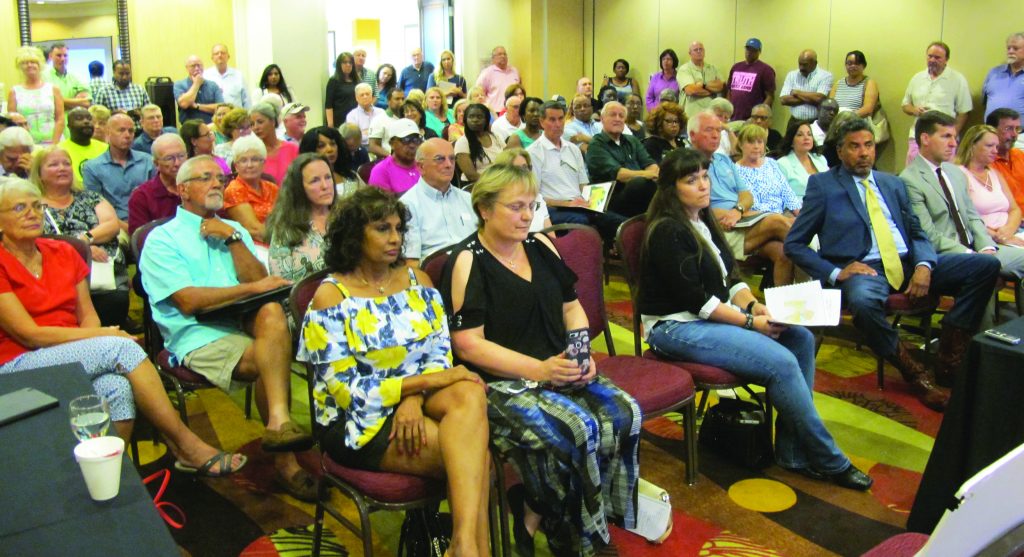
    Crickentree residents heard E-Capitol’s presentation on Monday. | Barbara Ball

    BLYTHEWOOD – After years of struggling financially, the Golf Club of South Carolina closed last week. The Club is entered off Langford Road and much of the golf course borders the Crickentree subdivision, which is accessed off Kelly Mill Road. One side of the golf course is the back yard to many of the 145 expensive, uniquely-designed Crickentree homes that boast large lots, some up to two acres in size.

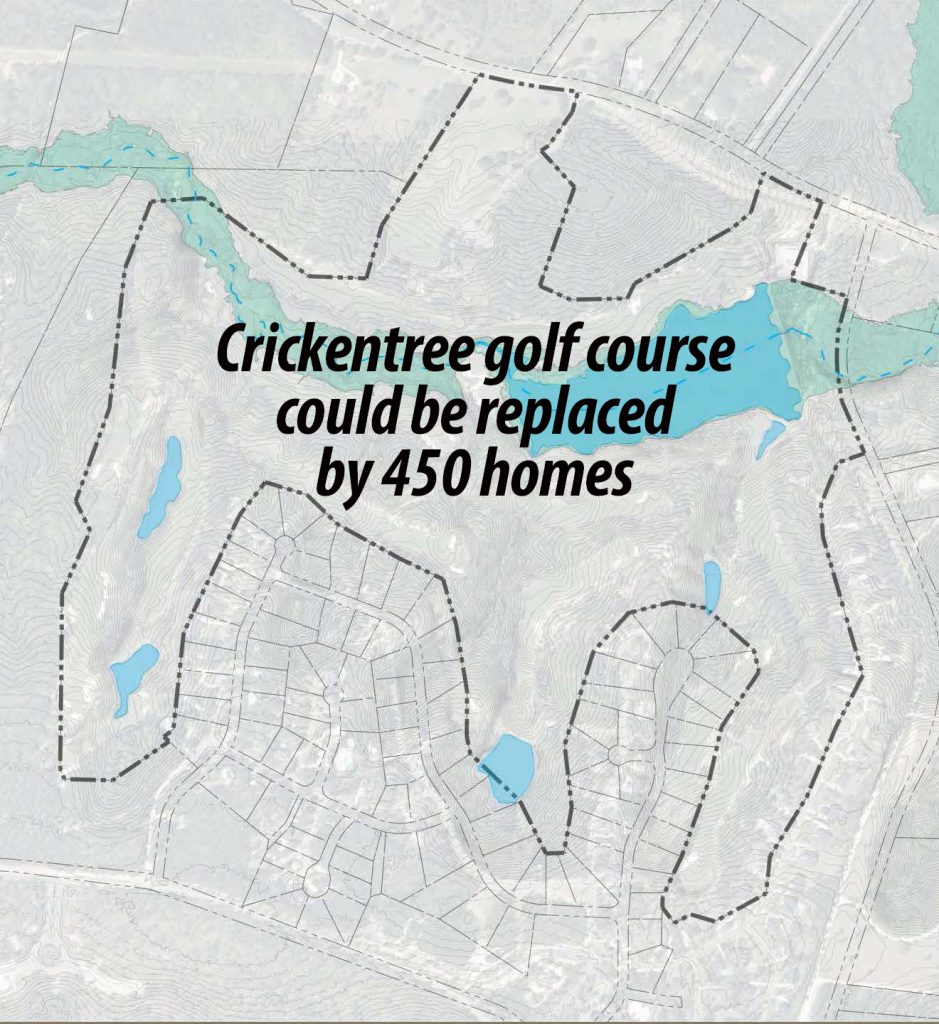
    A Texas investment company, E-Capitol, which holds the note and mortgage on the golf course property, initiated foreclosure proceedings on the course in March. Once the foreclosure is complete, E-Capital expects to purchase the course and build about 450 homes on it.

    450 homes could replace Crickentree Golf Course.

    This is not sitting well with the 75 or so Crickentree residents who showed up at the Hilton Garden Inn on Farrow Road Monday night to hear E-Capitol’s attorney Jake Barker, with Gaybill, Lansche and Vinzanti, explain his client’s plans for the golf course

    property if they, indeed, become the purchasers.

    “Once my client owns the property, they will pivot from the foreclosure process to the development process,” Barker said. “They will sell the property to a developer who will then develop it.”

    But Barker was careful to explain that the golf course will be developed as residential property, not a golf course. To make that transition would require a rezoning from the current TROS (Traditional Recreational Open Space) zoning classification to a residential zoning classification.

    That rezoning is where the residents feel they have a foothold to stop the development of hundreds of homes on small lots in their backyards.

    The TROS zoning classification dates back to 2007 when the planning commission added a zoning classification to the Richland County land use plan to protect golf course communities throughout Richland County from becoming the victims of rampant residential development.

    The question is, now, will county council vote to change the zoning to protect E-Capitol’s investment and satisfy the developer or keep the current zoning in place to protect the Crickentree property owners’ investments and quality of life they say they moved there for.

    “Before the rezoning process begins,” Barker told the homeowners gathered at the Hilton Garden Inn, “we want to get feedback from the Crickentree neighborhood as to what you would like to see. The golf course was not meeting its obligations and could not continue on,” Barker said. “I understand none of this is ideal for you, but we want to have a discussion with you. We want to work with you.” Barker said.

    The course, outlined in black, is partially bordered by Crickentree subdivision.

    While the anxious crowd of homeowners vowed to fight any rezoning effort that would result in smaller lots and a crowding of hundreds of homes onto the golf course, as the hour-long meeting continued, Barker suggested the possibility of building fewer homes on larger lots with a buffer as wide as 100 feet separating the golf course homes from the current homes.

    “That’s all possible,” Barker said. “These drawings are our initial, conceptual plans to develop it. We want feedback. We want to hear from you,” Barker insisted.

    Asked about the pricing and size of the homes that would be built on the golf course, an engineer representing E-Capitol’s interest said he didn’t know. He said that would be determined by the eventual developer.

    Barker said there is no timetable for the actual foreclosure and purchase of the golf course, but that it would take place in Richland County circuit court, and had been referred to Judge Strickland, the master of equity for Richland County.

    “Once the foreclosure process is finished,” Barker said, “the property will be sold at auction, and any third parties can come and bid at that sale.”

  • Blair’s Hodges is global hero

    THAILAND – A Blair favorite son, Major Charles (Charlie) Hodges, has been in the news around the world the last two weeks, and for good reason.  As the U. S. Mission commander for the 353rd Special Operations unit for the Air force, Hodges served as commander in the daring, seemingly impossible, but totally successful rescue of 12 young soccer players from deep within the bowels of a water filled cave in Thailand last week.

    Hodges’ friends, family and strangers in Fairfield County have followed the news of the boys’ rescue and Hodges’ and the other rescuers’ fete on every major news outlet in the country, albeit in the world.

    The Richard Winn graduate has been interviewed on Good Morning America, CBS This Morning, the Today Show and was the subject of stories in the New York Times, Post and Courier and other local, state, national and worldwide news sources.

    While The Voice was not able to talk with Hodges, here are some excerpts from his interviews.

    Today Show: “I felt like I was being optimistic when I told the governor of Chiang Rai that, in my mind, the potential chance of success was anywhere from 60 – 70%, we were fully expecting casualties.”

    “We knew that if we acted soon, we had the potential to rescue them, but we didn’t have the option to wait.”

    CBS This Morning: “We also understood, though, we didn’t have the option to not attempt this…even though the odds seemed impossible. What I’ve always been taught is to take risks and be bold when the situation calls for it, and this situation absolutely did.”

    “We’re not trained to do cave dive rescue missions, so at the end of the day you just have to rely on the training that you’re given, how we approach problems methodically and logically, try to push away any emotion and look at it from the lens of ‘what are the circumstances and what do we absolutely need to do to make this a success.’”

    “It took every single one of us, putting our heads together and pushing aside any sort of political or cultural differences, and doing our best to find a solution to do this. What I take away from this is how much can be accomplished from teamwork, because it was pretty impressive seeing all those entities working together.”

    New York Times: “I don’t know of any other rescue that put the rescuer and the rescuee in so much danger over a prolonged period of time, unless it is something along the lines of firefighters going into the World Trade Center knowing that the building is on fire and is going to collapse.”


    Interview and article links:

    SC man who helped in Thai soccer team rescue has a proud former teacher back home (WIS TV)Citadel graduate involved in Thai cave rescue describes dramatic operation (Post & Courier) US Mission Commander reacts to successful Thai rescue (Good Morning America) ‘We were fully expecting casualties’: Thai soccer team rescuers describe harrowing mission (Today Show)Air Force commander describes Thai rescue (CBS This Morning)‘Still Can’t Believe It Worked’: The Story of the Thailand Cave Rescue (The New York Times)

  • CPA: Visitor Center funds funneled to Chamber

    BLYTHEWOOD – After reviewing The Greater Blythewood Chamber of Commerce’s financial documents that were requested by council for fiscal year 2017-18, a certified public accountant concluded that the documents were “confusing, lacking in detail and sometimes impossible to follow and understand.”

    He also concluded that much of the $18,500 accommodation tax (A-tax) money council awarded to the chamber in June, 2017, to pay for a dedicated visitor center employee, was not spent on that employee. Instead, it was funneled directly to the chamber to pay one quarter of the chamber’s annual operating expenses, an unauthorized use of A-tax money, according to the CPA, and an arrangement the council never agreed to when it allowed the chamber to take over the management of the visitor center in June 2017 and awarded the chamber the funds for a visitor center employee.

    Those documents were acquired by The Voice from members of Town Council after the chamber’s executive director, Mike Switzer, turned them over to council on June 13, more than a month after council requested them. The documents included several untitled, undated budget reports along with others with partial dates. Many of the entries on budget ‘actuals’ do not match annual profit and loss statements for the same time period.

    Former Town Councilman Bob Massa, a CPA and former treasurer for the Blythewood Chamber, said the financials that were presented to council and passed on to The Voice do not meet professional accounting standards even though the chamber’s May 31, 2018 actuals reflect $2,730 for ‘professional account fees.’

    When council allowed the chamber to take over management of the visitor center in June 2017, it gave A-tax funding for a dedicated employee for the chamber, but did not approve that A-tax money for the chamber’s operating expenses as part of the arrangement.

    However, a report in the chamber’s financial documents, titled ‘Visitor’s Center Report: January 2018”, showed that during the first six months, after being awarded the $18,500 for a visitor center employee, the chamber charged one quarter of its operating expenses to the visitor center’s $18,500, producing an artificial deficit of $4,885 for the first half of the fiscal year and projecting an artificial deficit of $2,758 for the upcoming second half of the fiscal year.

    Switzer presented that report to council and, with no discussion as to why a quarter of the chamber’s operating expenses had been charged to the visitor center, which is, according to Massa, an unauthorized use of A-tax funds, voted to give the chamber another $7,643, the full amount of both artificial ‘deficits.’

    Massa also pointed out that at least some of the chamber’s operating expenses charged to the visitor center appeared to be inflated, thus artificially increasing the amount of the deficit. One example is a $626 charge for one-fourth of the chamber’s annual insurance cost which, multiplied by four, comes to $2,504 total for the year. But the chamber’s profit and loss statement and the actuals of a budget for that same time period listed the chamber’s annual insurance costs at $1,491.72, not $2,504. Council did not question the difference before voting to give the $7,643 to the chamber.

    “It’s difficult to tell what is going on with the chamber‘s and visitor center’s revenue and expenses from these documents. It’s a mess,” Massa said.

    While members of the audience at the June 25 council meeting questioned and criticized the chamber’s financials, council, without asking any questions about the requested financial documents, voted 4-0 to award another $9,250 to the chamber for the visitor center for the next six months, even though it also voted to discontinue all funding for the visitor center as of Dec. 31, 2018. Council did not outline any expectations for the visitor center operations or how the $9,250 is to be spent.

    “The A-tax money is intended to be used to promote tourism to the town, to bring visitors,” Massa said. He said it can also be used to pay an employee for a visitor center or to fund events, such as The Big Grab, that have the potential to bring visitors to Blythewood.

    “Council has a fiduciary responsibility to the residents. A-tax money is for specific things. It is not for funding the chamber’s operating expenses, but it would appear that it is being laundered through the visitor center to do just that.”

    $17,500 Grant

    A state official also had concerns about an economic development grant council awards each year to the Greater Blythewood Chamber, a practice that Massa said should be frowned upon by the residents since it does not appear to meet the criteria for a grant. This year, council’s grant to the chamber is $17,500, a $2,500 increase over last year’s award.

    “Who else is eligible to receive this grant? It’s not a grant if only one entity is eligible to apply and receive it,” the official, who asked not to be identified, said. “Grants must have criteria to which an entity has to adhere to and meet in order to apply and receive funds. Public funds must be spent for a public purpose. A service must be provided in exchange for these funds. The grant has to be open to anyone who meets the criteria. Businesses in the town could apply for this grant. There should be an expectation on the town’s part that there is a return on that investment. A contract is involved when a grant is awarded,” the official said.

    But the only ‘contract’ for the grant between the town and the chamber is a letter stating that the chamber must provide the town a $2,500 premier sponsorship and that Ed Parler, the town’s appointee to the Chamber board, must have a vote on the board.

    The state official said that is not a return on the town’s investment of $17,500.

    Other inconsistences in the chamber’s financial bookkeeping and reporting has to do with the A-tax funds awarded to the chamber by council for events organized by the chamber. For the last three years, council has funded the chamber with A-tax funds to organize The Big Grab in September, a glorified yard sale that includes Blythewood, Ridgeway and Winnsboro.  Last year, the Chamber also received A-tax funds to organize the community’s Solar Eclipse event.

    But Switzer’s reports on the chamber’s revenue and expenses for the two events came up short on transparency. Of the $8,750 A-tax award for The Big Grab, the chamber staff paid themselves $4,618 on top of their chamber salaries. Of the  $12,750 A-tax award for the Solar Eclipse event, the chamber staff paid themselves $7,475.25. This was compensation in addition to what the staff is regularly paid by the chamber for chamber activities.

    After each event, the chamber is required to submit a report to the A-tax committee on its revenue and expenses for the event.  Those reports, with few details, led to questions of how the money was actually spent.

    Solar Eclipse reports

    Switzer reported to the A-tax Committee that its total revenue for the Eclipse event (A-tax and other sources) came to $19,455.94. However, the annual profit and loss statement he presented to council for 2017-18 and the budget/actual for the year listed total revenue for the Eclipse at $24,625.98, a difference of $5,170.04.

    Switzer reported to the A-tax committee that the chamber’s total Eclipse expenses were $20,838.03.

    The chamber’s profit and loss statement for 2017-18 and the budget actual for 2017-18 showed expenses of $22,565.79, for a difference of $1,727.76.

    Big Grab reports

    While both the A-tax report and the profit and loss and budget/actual for 2017-18 Solar Eclipse revenue matched at $13.547.00, expenses for the event were off on the same reports. Switzer’s final report to the A-tax committee reported expenses of $12,114.23. His profit and loss for 2017-18 and the budget/actual for the year listed Big Grab expenses as $7,402.12; a difference of $4,712.11.

    In other reports for the events, there is little information about revenue and expenses for what Switzer said were lucrative t-shirt sales, vendor sales, sponsorships and other areas of revenue.

    “The chamber needs to explain these discrepancies,” Massa said. “They are playing fast and loose with numbers and the council is apparently going right along with them. When you’re making decisions to dole out town money, you’re accountable to know what the numbers really are.”

    Other financial reporting

    The reporting of the chamber’s total operating revenue and expenses also vary from one document to another for the same time period in documents presented to council. The last documents were presented on June 22, 2018 prior to the June 25 council meeting where council voted to extend funding to the chamber for the visitor center in the amount of $9,250 through Dec. 31, 2018.

    The total revenue listed under ‘actuals’ dated May 31, 2018 is $92,806.05. Total revenue listed on the chamber’s profit and lost statement for May 31, 2018 is $133,442.10, a difference of $40,636.05.

    The total operating expenses listed under ‘actuals’ dated May 31, 2018 is $114,639.52, Total operating expenses listed on the chamber’s profit and lost statement for May 31, 2018 is $86,907.35, a difference of $27,732.17.

    While the total revenue for the visitor center is reported on the May 31, 2018 actuals and on the May 31, 2018 profit and loss statement to be $40,616.05. It jumps to $67,342.76 on the June 22, 2018 profit and loss statement even though there appears to be no income activity for the visitor center in those 22 days.

    Total visitor center expenses are listed at $8,157.31 on the ‘actuals’  and the profit and loss statement for May 31, 2018, but they jump to $30,842.07 on the June 22, 2018 profit and loss statement, again, with no significant expenses documented for those 22 days.

    For his part, Switzer has maintained that the chamber is above board financially and that council has long approved of how the chamber has conducted its business and spent its money.

    “I just want to say thank you to the council for the vote of confidence with the increases that you’ve proposed for the upcoming budget,” Switzer said at a May 2018 budget workshop. “We appreciate your vote of confidence in the work that we’re doing and we’re looking forward to continuing to grow that work.”

    “Despite the very misleading and sometimes often outright false statements that were put out there, we are completely  of the upmost integrity at the chamber, and I think a good testament to that is that the town has had a representative on our board for many years,” Switzer said. He said the mayor, himself, had served as that representative for a year before Ed Parler, the town’s economic development consultant, took the role.

    “He (Parler) attended every single board meeting where our treasurer’s report is given out and all our financials are laid out,” Switzer said. “The $4,500 increase [$2,500 to the chamber and $2,000 to the visitor center] that you have in the budget for us will cover three-quarters of our rent increase of $6,000,” Switzer said.

    The chamber rents space for $24,000 a year in a building in McNulty Plaza that Mayor J. Michael Ross and a partner own. According to chamber documents acquired by The Voice, annual rent for the chamber was $600 in 2015/16, increased to $12,000 in 2016/17 and $18,000 in 2017/18. The increase of $6,000 will bring the annual rental fee for the chamber to $24,000. Ross said that increase went into effect July 1.

    On Wednesday, shortly after The Voice went to press, Switzer was to appear before the A-tax committee to request $10,000 in funding to organize and manage the next Big Grab event to be held in September.

  • Man busted for ‘shake & bake’ meth lab

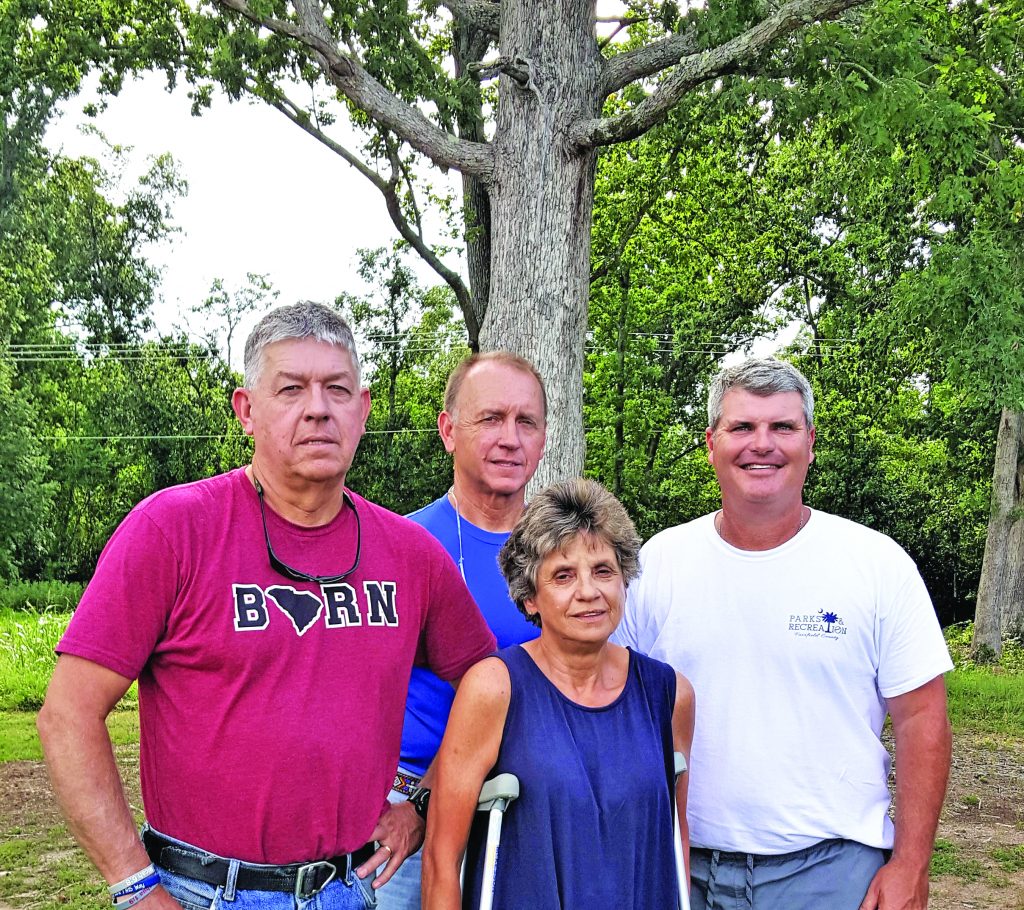
    WINNSBORO – A Winnsboro man was arrested after Fairfield County Sheriff’s deputies discovered he was manufacturing methamphetamine in the back seat of a car in the Bi-Lo parking lot.

    Sanders

    Bradley Alson Sanders, 48, was charged with using a motor vehicle without consent to manufacture methamphetamine in what deputies described as a ‘shake and bake’ lab.

    Sheriff’s deputies said they were notified a little after 1 p.m. on Tuesday that a man wearing a blue button up shirt and carrying a blue book bag had been seen in the Bi-Lo grocery store parking lot for “a couple of weeks” and was “going to people’s cars.” The report said the suspect was also seen in the back seat area of a Bi-Lo employee’s car without permission.

    The suspect was identified by the employee, the report stated. The incident report also stated that officers were familiar with Alston from previous methamphetamine related drug charges.

    When a deputy arrived at the Bi-Lo parking lot, he was told the suspect had been seen walking into the woods after the Bi-Lo employee told the suspect he had been reported to law enforcement. While looking for the suspect, the officer called for backup, then returned to the parking lot to find what he determined was an active meth lab in the back seat of the car.

    The county’s narcotics unit as well as the South Carolina Law Enforcement Division (SLED) arrived and a methamphetamine cleanup crew was brought in to collect, remove and clean up the mobile lab area.

    In the meantime, sheriff’s deputies located Sanders in the wooded area off of Columbia Road near Bi-Lo. Deputies reported Sanders’ book bag and several syringes (needles) that were located in the area and believed to be associated with Sanders, were turned over to the narcotics investigators.

    Sanders was arrested and warrants were obtained for manufacturing methamphetamine 3rd offense, manufacturing methamphetamine 3rd offense within one-half mile of a school and use of a vehicle without permission (unlawful use).

    Bond information was not available to The Voice at press time.


    Related: Sheriff investigates meth lab at Bi-Lo

  • Council offers FMH $1.6M

    WINNSBORO – Fairfield Memorial Hospital has accepted Fairfield County’s offer of $1.3 million to buy three parcels, with an option to acquire a fourth for an additional $285,000.

    The vote came at the end of a special meeting of the hospital’s board of trustees Tuesday, one day after Fairfield County Council approved presenting the deal to the board.

    Hospital board members were very complimentary of the county’s work in assembling the proposed deal.

    “They really did a good job to pull this off in a timely manner like they did,” said board member James McGraw. “Hats off to Fairfield County.”

    Board member Randy Bright agreed.

    “That’s a continuation of the great job they did working with the state, Providence [Health] and us in pulling Providence into here so that we have a continuation of medical care in the county,” Bright said. “This council has done a great job in moving us forward.”

    The motion the hospital board approved states the hospital “agrees to accept the county’s draft offer, including purchase price, pending legal review by the hospital’s attorneys.”

    Billy Smith, chairman of Fairfield County Council, was pleased to see such a quick turnaround.

    Smith noted the council thought it was important to release details of the deal after first reading, even though deals of this nature are typically kept confidential until third reading.

    “It is a big deal and a big number,” Smith said. “We wanted folks to look at that and give any feedback.”

    Fairfield County is offering $1.3 million to buy three parcels from Fairfield Memorial Hospital, with an option to buy a fourth for $285,000, according to a proposed contract the county released Monday.

    Two parcels consist of medical office buildings. Portables occupy the third parcel, though Smith said the county was interest in that piece of property to improve access to the office buildings.

    The property with the option is the rehabilitation center.

    Smith has said the intent behind purchasing the properties is to preserve the general practitioner offices and rehabilitation center. He still hopes a private provider can step in and operate the rehab center.

    “The purpose was not to be a real estate baron,” Smith said. “It’s to provide services in the county. We’re hoping we can get a user in there, a good provider for the citizens.”

    At Monday night’s council meeting, the council approved a motion authorizing Smith to present terms of the deal to the hospital.

    The council also approved first reading of an ordinance authorizing the purchase of hospital property “for public use or other uses deemed fit by the council and other related matters,” according to the measure approved Monday night.

    Two more readings, as well as acceptance by the hospital, are required to finalize the deal.

    Terms of the deal have been hashed out over the past several months in executive session. Monday night’s presentation of the proposed contract was the first public disclosure of the deal.

    Both votes were unanimous. Council members Mikel Trapp and Douglas Pauley were absent.

    Fairfield County has been discussing for months the possible purchase of property from Fairfield Memorial Hospital, which has been struggling financially. The hospital is in the process of closing.

    In addition to listing a purchase price and option, the proposed deal also contains a stipulation that the county pay $250,000 to Fairfield Memorial Hospital within 10 days of execution of the agreement.

    Funds would be credited toward the purchase price and used by the hospital to cover day-to-day operational expenses, the document states.

    Fairfield County would pay an additional $10,000 upfront, with the money going into an escrow account. The county would pay the remaining balance to the hospital by the closing date, though that date isn’t specified in the proposed document.

    In May, Fairfield County voted to begin negotiations with the hospital to purchase some of its properties. At the time the parcels appraised for about $1.6 million, and $1.9 million with the rehab center included, Smith said.

    County Council approved a memorandum of understanding a month later. In that document, the council voted to purchase some or all of the property. It added a stipulation that a $400,000 lien against the hospital be satisfied before any sale could take place.