Category: News

  • Voters reshuffle R2 school board

    Garvin elected to replace McEachern

    COLUMBIA – Voters in the Richland Two school board race returned three of the four incumbent candidates to office on Tuesday and seated a political newcomer who received more votes than two of the incumbents, ousting one in the process.

    In the at-large race, the top four vote getters are seated. Those are Amelia McKie, James Manning, Teresa Holmes and Cheryl Caution-Parker.

    Current board chair Amelia McKie took the lion’s share of the vote with 22,427 votes (20 percent) to win a second term. McKie, a Richland Two parent, was elected chair of the board during her first term, campaigning on her many years of supporting the district through service on numerous parent/teacher/student organizations and School Improvement Councils.

    James Manning, also a Richland Two parent, was elected to a third term on the board with 18,768 votes (17 percent).

    In an upset, newcomer Teresa Holmes came in third with 17,528 votes (16 percent), over Blythewood incumbents Cheryl Caution-Parker with 16,570 votes (15 percent) and Craig Plank with 15,049 votes (14 percent). Those numbers left Plank, who was first elected in 2014, out of the mix.

    $476M bonds approved

    Voters in Richland School District Two approved two separate questions for bond referendums totaling $476 million for school projects. The first question asked for approval of $381.9 million for upgrades to security, technology and other improvements. That money would also go toward building new facilities for district schools including Bethel-Hanberry Elementary.

    The second question provided funds for upgrading athletics facilities at several schools including separate stadiums for Ridge View High and Richland Northeast High schools and creating a district performing arts center.

    House race

    In a statehouse race affecting Blythewood residents, Richland County voters sent newcomer Kambrell Garvin (D) to the House (Dist. 77) with 12,390 votes (84 percent) over opponent Justin Bishop who took 2,284 votes (16 percent). Voters in Blythewood favored Garvin over longtime incumbent Joe McEachern in the Democratic Primary.

    Richland showed a notably higher voter turnout in 2018 compared to previous election years. The 51.22 percent in 2018 for the county was five percent higher than 2014.

  • Historical Society sets veterans event

    1942 Dodge WC 54 Ambulance

    BLYTHEWOOD – The Blythewood Historical Society and Museum will host the community for a Veterans Day Celebration at the Langford-Nord House on Sunday, Nov. 11.

    The program will include guest speaker, Blythewood resident Lt. Col. (Ret.) Jim Lechner who has over thirty years’ experience in military and security operations.  He was active in counter insurgency, counter terrorism, intelligence and law enforcement.

    Also included in the program are former Mayor, LTC Keith Bailey; current Mayor, J. Michael Ross, and Jim McLean’s unveiling of a proposed military memorial to be built on site.

    Vance and Jeannie Sharpe will entertain with patriotic songs.

    Guests will have an opportunity to pay tribute to a family member who served or is presently serving in the Military.  Doors will open at 2 p.m. to view TV outdoor personality Bob Redfern’s vintage Military vehicles. The program will begin at 3 p.m.

    This free family event will honor the five branches of the military, as well as those who are serving or have served our country.

    Light refreshments will be served. The Langford-Nord House is located at 100 McNulty Street. For more information call 803-333-8133 or email blythewoodhistoricalsociety.sc@gmail.com

  • JWC suit heads to court Dec. 3

    JENKINSVILLE – One of two pending lawsuits against the Jenkinsville Water Company and some of its directors appears headed for trial in less than a month.

    Dec. 3 has been set as the trial date of the suit filed more than five years ago by Broad River Campground.

    Mediation has been scheduled for Friday, Nov. 9 in Columbia, though both sides say the case likely won’t end there.

    “It’s more than likely we’ll be ending up in court,” said Greg Ginyard, president of the Jenkinsville Water Company.

    Ginyard’s remarks came prior to the water company’s monthly meeting Monday, which was canceled due to a lack of a quorum. Only three members, including Ginyard, were present.

    Although the meeting never convened, Ginyard provided an informal update on the lawsuit, which alleges breach of contract over water services provided to Broad River Campground.

    Ginyard declined further comment after the meeting, instead taking issue with The Voice’s coverage of the water company.

    Dee Melton with Broad River Campground, who filed the suit, said he feels “extremely confident” as the Dec. 3 court date draws near.

    In addition to the 2014 suit, Melton also has individually sued Ginyard and vice-chairman Joseph McBride. A circuit judge ruled over the summer that the two suits could be combined.

    Both lawsuits allege violations of the S.C. Unfair Trade Practices Act, or SCUTPA, according to Fairfield County court records.

    Broad River Campground states in its suit that JWC is contractually obligated to provide additional water capacity, citing a letter from the JWC as proof that a contract existed between the parties.

    According to the letter, the JWC stated it could commit to 8,050 gallons per day. The campground has said that even with the extra water, it falls below the 8,050-gallon threshold.

    “The water company will consider increasing our commitment, but only if that can be done without negatively impacting other customers of the water system,” the letter states.

    The water consumption suits are in addition to a third lawsuit Melton filed in 2016, which alleges the JWC routinely violates the state’s Freedom of Information Act. That suit is still pending.

    Attorneys for the JWC have denied the allegations in that lawsuit as well.

    On Oct. 24, the water company filed a motion for summary judgment in the water consumption case, which restated the JWC’s previous position that it never entered into a contract with Broad River Campground.

    “The alleged ‘contract,’ which Plaintiff attached as Exhibit 1 to the original Complaint, lacked mutual assent to indispensable and essential terms such as price, time of performance, and JWC’s specific obligations, if any, thereunder,” the motion states.

    The motion further infers that even if a contract does exist, it should be dismissed on semantic grounds.

    “It (the contract) only required the Company to ‘consider’ increasing its commitment to Plaintiff, and the undisputed evidence showed that JWC did so,” the motion continues. “Therefore, according to the plain language of the alleged contract, JWC complied with its obligation.”

  • Pig on the Ridge festival soars

    Ervin Brazell, Jr. and his dad, Ervin, Sr. sell kettle corn to Felicia Elliot and Charlie Ray.

    RIDGEWAY – Pig on the Ridge lived up to the hype last weekend as it does almost every year, with great weather and a large, hungry crowd.

    “Probably one of the best Pig on the Ridge events we’ve cooked! Looking forward to next year!” Tony Crout of Doko Smoke Barbecue in Blythewood posted to his Facebook page. Crout placed in the top 10 professional cookers.

    Dwight Robinson of Ridgeway has cooked all 20 festivals. A popular pit master, he sold 40 butts before noon.

    Some of the best professional and amateur pit masters in the state were attracted to the festival by more than $3,500 in cook-off prize money. Winnsboro’s Tyler Gregory of Raww Hawggin brought home the first place trophy and $500 for amateur cookers. Tutored by George King, the barbecue king of past Pig on the Ridge cook-offs, this was Gregory’s first time to enter the competition.

    Gene Culbertson of Backwood Bar-B-Cue won top prize, $1,000 for the professional group.

    On Friday ‘no pigs allowed’ night, cookers offered a smorgasbord of non-pork dishes. Winnsboro’s Keith Green of Big Boyz BBQ captured the trophy and $500 for selling the most of the dish his cookers prepared.

    Chandler Cook took first place in hog calling for the 12 and under group. Haley Autry took second place. Kevin Lynch took first place for the 13 and up group, and Keeon Watkins took second place.

    The owners of classic and antique cars and trucks showed off their wheels in the crowd-favorite cruise-by, and vendors lined the streets Friday night and Saturday selling jewelry, baked goods, bird feeders, outdoor solar chandeliers and more.

    “We couldn’t be happier with our turnout, our cooks, our judges, our venders and other participants, our merchants, our volunteers and the great weather. I don’t know when we’ve enjoyed such pretty weather,” Pig on the Ridge steering committee member Rufus Jones said. “Had a little rain going into Friday night, but it cleared off and was perfect the rest of the weekend. I think everybody had a good time.”

    That sentiment was not shared, however, by Town Councilwoman Angela Harrison who called for a boycott of the festival by posting an anonymous letter on her Facebook page 10 days prior to the festival and her own message just two days prior. Her call, however, had little affect on attendance.

    In her post, Harrison said she could not attend the event because, as she claimed, the Pig on the Ridge committee promotes division in the town. She also accused the committee of having no stated purpose for its funds for the festival and accused the committee of not donating adequately to charity.

    “The committee continually promotes the festival as one that gives back to the community,” Harrison said. “If you looked at the books, you would know that’s just hot air. They give a little to make it look good,” Harrison said, “then hoard the rest.””

    “The town presents Pig on the Ridge as a town festival, organized by the steering committee,” Town Clerk Vivian Case said, “But it has always donated a large portion of the revenue from the festival to charity and to things the town needs. It buys lifesaving equipment for the town’s fire department and a lot of things like that to benefit the community. I don’t believe the festival revenue was ever intended to all be donated to charity.”

    Case said the committee does not make expenditures or take in revenue.

    “None of them actually ever touch any of the money. All the Pig on the Ridge money goes through the town government and always has,” Case said.

    Case said the financials for Pig on the Ridge are open and available to the public – how the money is spent, how much is given to churches and other charitable causes in the community and how much is held by the town for future use on big ticket items and rained-out festivals.

    “A Freedom of Information request is not required to look at this information,” Case said. “It’s available to anyone.”

    “From the beginning, we have put some money back for a rainy day,” Steering Committee member Tom Connor said. “And sometimes we save up to buy expensive things for the community that the revenue from one festival will not provide. That money is in the town’s possession at all times. If our festival gets rained out, we are stuck with all the expenses but bring in no revenue. We try to plan so that we don’t miss a festival for any reason,” Connor said.


  • RW puts lipstick on the Pig for 20th time

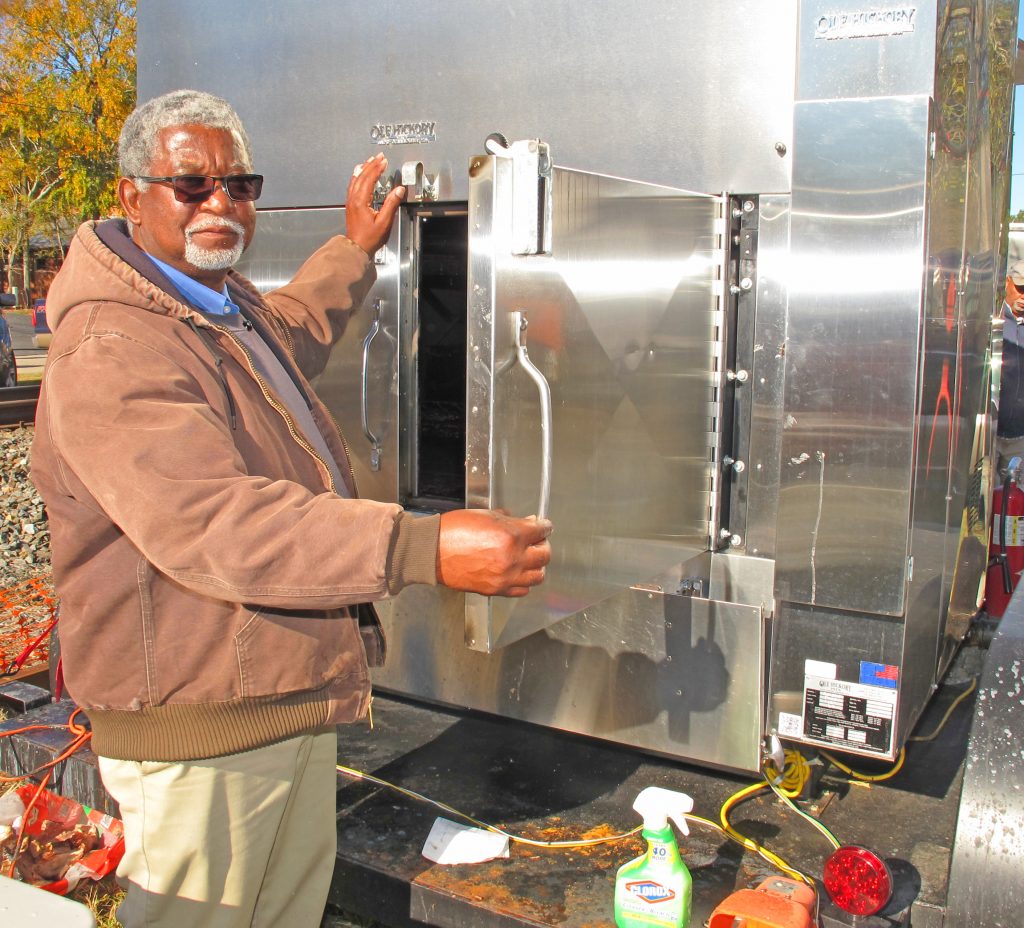
    RIDGEWAY – More than 800 Boston butts will be cooking, and over 60 S.C. Barbecue Association certified judges will be judging this weekend at the Annual Pig on the Ridge festival in Ridgeway…just as they have for the last 20 years.

    Despite an announcement last month that the pig might not get over the stile this year after it was reported that some residents would boycott the festival as an expression of their dismay with the town government, volunteers from 14 churches and others in Ridgeway stepped forward last week to offer their services, assuring that the show would go on.

    As a result, come dawn on Saturday morning, the aroma of roast pig will once again waft through the Cotton Yard as festival goers invade the tiny town to buy barbecue from some of the top pit masters in the Southeast, as well as shop for gifts and gadgets from 50 or so street vendors.

    POR is still the largest of the S. C. Barbeque Association’s events.  And, even though the price of pork has gone up, POR tickets have not.

    Organizers say it looks like it’s going to be as big as ever substantially adding to the $200,000 worth of benefits that POR has raised over the years.

    “We originally started the barbeque festival to celebrate Ridgeway’s 200th anniversary,” Tom Connor, Ridgeway resident and one of the festival founders said.  “We wanted to provide an opportunity for people to come together to renew old relationships and make new ones – a family friendly festival.  We are especially proud of what the people in our community have made it possible for us to accomplish over the years,” Connors said.

    “The financial income from the festival has helped our community groups buy toys for kids who might not otherwise have received any toys at Christmas,” Connor said. “And 20 years later, that is still what we are all about.”

    “Our church partners have come together to raise money to directly support efforts to care for those who need their help,” Connor added.

    In addition to the funds made available directly to each participating church, POR has made donations on behalf of the festival to the Ridgeway Fire Department for both uniforms and tools to help increase safety in our community. We have financially helped to supply fire extinguishers and smoke alarms to over 100 homes where needed. POR was the largest donor to the restoration of the Century House which created a historical landmark as the Town Hall, and it has made donations annually to support the Vacation Bible Schools in the Ridgeway area as well as helping fund the Fairfield County Arts Council’s Arts on the Ridge festivals.

    POR funds were used to purchase and install the “Welcome to Ridgeway” signs, helped finance the restoration of the Arch at the Ridgeway Park and were used to purchase the ball field bleachers and picnic tables for the town park.

    “On behalf of the Pig on the Ridge volunteers, we were able to provide an outreach donation to the American Red Cross for the Flood Relief Drive for survivors of the recent disaster in Columbia,” Connor said proudly.

    The festival kicks off Friday evening, Nov. 2, at 6 p.m. with ‘No Pigs Allowed!” – a smorgasbord of entree samples made from ‘anything but’ pork that will excite any appetite. Pork is, of course, reserved for Saturday.

    There will be children’s activities, craft sales and the evening will culminate with music and dancing on Dogwood Dr., with DJ Papa Charlie.

    Beginning at 9 a.m., Saturday, Nov. 3, the barbecue judging begins and sales begin.

    “You need to come early, though. It goes fast,” Connor said with a laugh.

    Seventy-five or so of the town’s volunteers help expedite serving the hungry festival goers.

    Most of the cookers, primarily from North and South Carolina, return every year. They typically offer three types of sauce – low country pepper vinegar sauce, the midlands mustard sauce and the Piedmont tomato base barbeque sauce.

    Both days include children’s activities and lots of arts and crafts vendors.  Saturday’s festival is also enhanced with a classic/antique car display on Dogwood Drive, on-stage entertainment by the Geiger Elementary and other students, a hog-calling contest and a “cruise-by” at noon with an emergency/public safety salute and a parade of the classic/antique cars and bikes.

    Awards are presented at 1 p.m.

    Tom Connor, Rufus Jones, Donald Prioleau and Henry Dixon have kept the festival on track for many years.  Councilman Dan Martin has recently joined the Steering Committee.  This year’s children’s activities are being coordinated by Karen Siegling, the Classic Car display is organized by Minor Jones and the Media Relations and Best Booth judging by Patsy Palmer.

    Come early. Even 800 Boston butts can be gone long before lunch time at Pig on the Ridge.

  • BHS in top 20% of SC SAT test takers

    BLYTHEWOOD – While Blythewood High School seniors taking the SAT hovered just below the state average, the school ranked near the top in the number of test takers.

    Blythewood High placed in the top 20 statewide at 71.1 percent, ranking 16th out of 230 schools, with 335 of 471 seniors taking the test, according to S.C. Department of Education figures released last week.

    Other Richland 2 schools reported high percentages, ranging between 46 and 56 percent tested.

    “Students in the Class of 2018 and their parents decided whether or not to take the SAT,” Richland 2 spokeswoman Libby Roof said via email. “We don’t have any data that would indicate why a greater percentage of students in one school chose to take the SAT than in another school.”

    Blythewood seniors averaged 1,048, scoring a point shy of the state average. The school also shed 10 points from last year’s tally of 1,058, data shows

    Blythewood’s tally this year was the second highest in Richland 2. Spring Valley High School led the district at 1,098.

    Westwood High, meantime, struggled. The school averaged 970, creeping up four points from 966 last year.

    “As the district’s total score is below the state average, we recognize there is room for growth and are committed to helping our students better prepare for this assessment,” Roof said. “That being said, these assessments don’t provide teachers with the standard or strand-level results that are needed to make informed instructional decisions.”

    Slightly less than half – 168 of 342, or 49.1 percent – of seniors took the test, data shows.

    “We avoid using SAT scores as a measure to compare our schools to each other,” Roof said. “The SAT is designed to gauge a student’s readiness to perform college level work. It is used by colleges and universities to compare the academic readiness of students and to make admission decisions.”

    In tabulating SAT data, the Department of Education counted individual students only once, regardless of how many times they took the test. The most recent score was counted, figures show.

    Accurate data comparisons to 2016 and before were not possible because the College Board, which administers the test, changed the format in 2017.

    In 2017, the College Board, which administers the SAT, revised the test to score in two critical areas – evidence-based reading and writing, or ERW, and math, according to the Department of Education website.

    The ERW portion replaced the English/Language Arts and Writing sections, which gave the SAT three components, the website states.

    The test became a two-part test in 2017, broken down into Evidence-based Reading and Writing and Math.

    While Richland 2 saw high percentages of test takers, the number of Fairfield County seniors taking the SAT continued to sag.

    Only one in five Fairfield County seniors took the SAT in 2018, and those who did take the test averaged more than 80 points below the state average.

    Fairfield Central High School climbed from 922 to 983, with 41 of 198 seniors – or 20.7 percent – taking the test, about the same as last year, state data shows.

    Fairfield’s performance still fell 81 points behind the state average of 1,064. The national average was 1,049.

    Dr. J.R. Green, district superintendent, couldn’t be reached for comment Tuesday.

    In a prior interview with The Voice about the impact of per pupil revenues on student achievement, Green said that rural districts like Fairfield, where poverty tends to be high, tend to struggle academically.

    He also noted student achievement is measured in more ways than how students score on standardized tests.

    “The reality is there are students who can be successful, but not at a four-year institution,” Green told The Voice. “It doesn’t mean these kids aren’t sufficient. Poverty has an adverse effect on a kids’ ability to be successful academically.”

  • Trapp murder trial ends in mistrial

    Public defender William Frick confers with attorney Kay Boulware during jury selection for accused murder suspect Rondell Trapp. The four-day trial ended Thursday, Oct. 25. | Barbara Ball

    WINNSBORO – A Winnsboro man’s murder trial ended in a mistrial last week after the jury failed to reach a unanimous verdict.

    The defendant, Rondell (Buddy) Trapp, 34, was charged with murder in the death of R. J. Gadson in October, 2015. The four-day trial was heard by Sixth Circuit Judge Brian Gibbons. The jury was charged by Gibbons to reach one of three verdicts – guilty of murder, guilty of voluntary manslaughter or not guilty.

    In November, 2015 Trapp was arrested by Winnsboro Public Safety Department officers in Sampson, North Carolina and brought, along with his brother, Troy (nicknamed Black), back to Winnsboro.  The pair had fled immediately after Trapp shot Gadson in the left thigh, causing him to bleed to death, according to authorities.

    During opening statements last week, Solicitor Riley Maxwell said Gadson died following an altercation between him and the Trapp brothers that occurred about 9:30 p.m., Oct. 8, 2015, on Crawford Street in Winnsboro where a group of friends and neighbors had congregated.

    “Earlier, before this [altercation] occurred, R. J. had a dispute over a $10 bill with the Trapp brother’s sister’s boyfriend who lived at the same address as [Buddy] Trapp and his mother on Crawford Street,” Maxwell said.

    “After the altercation ended, Buddy and Black took up for [their sister’s boyfriend] and words were exchanged between R.J. and the brothers,” Maxwell said. R.J. left the scene, but returned to Crawford Street about 15 – 20 minutes later with his nephew, and as they approached the apartment where Buddy Trapp lived with his mother, a confrontation ensued between the brothers and R. J. outside the apartment, Maxwell said.

    “Black was armed with a firearm and the first blow is Black hitting R. J. in the head and causing a skull fracture,” Maxwell said. “The confrontation lasted about two minutes and, during that fight, witnesses see different things.”

    Maxwell described how the gun went off when it struck R. J. in the head. The fight continued and as Buddy approached the two men fighting, he picked up something from the ground, pointed it at R. J., there was a gunshot, and R. J. fell to the ground saying, “I’m shot, I’m shot,” according to Maxwell.

    “After that, nobody sees Buddy and Black until they are brought back in handcuffs over five weeks later,” Maxwell told jurors. Maxwell said the gun, which was never recovered by investigators, was probably somewhere between Sampson, North Carolina and Crawford Street.

    Public defender William Frick alleged that while there was no physical evidence – no gun, no fingerprints – there was also no other evidence to tie Buddy Trapp to Gadson’s death, blaming what Frick called, “the worst secured crime scene I’ve ever seen.”

    “The crime scene was not secured through the night and they [officers] came back the next morning. That is a contaminated crime scene,” Frick said. “Whatever they found out there is useless because they can’t prove it ties to this case.”

    Frick said it was indicative of the investigation in the case that one witness gave two statements and that the witness’ signatures on them were in different handwriting.

    Maxwell said the most credible evidence in the case was R. J. Gadson’s dying declaration, “Buddy shot me,” to an emergency medical technician who did not know Gadson, the Trapp brothers or anyone else on the scene, and would not otherwise have known Buddy’s name.

    “Take all this into consideration, but apply and use your common sense,” Maxwell told jurors. “Put it all together to come to a verdict and deliver justice.”

    Maxwell closed his arguments, saying that while R. J. Gadson came looking for a fist fight, “His actions do not excuse the actions of Buddy and Black.”

    After six hours of deliberations on Thursday, Oct. 25, the jury notified Gibbons that they could not reach a unanimous verdict, causing Gibbons to have to declare a mistrial.

    Referencing that “tensions are high in the community right now,” Gibbons denied a request from Frick to revisit Trapp’s bond, saying he would set a bond hearing after about two weeks.

  • Grace Coffee FB post stirs up community

    BLYTHEWOOD – “The Town Government is shutting us down,” Matt Beyer, the owner of Grace Coffee posted on Facebook Thursday, Oct. 25. “Give the Mayor a call and let him know how the people of Blythewood feel about Grace Coffee,” Beyer posted along with Mayor J. Michael Ross’ personal cell phone number.

    “My cell phone immediately blew up with calls from angry people,” Ross said. “I was shocked that someone would post my cell on the internet without my permission, and then post that the Town had shut his business down. We didn’t even know he had moved until an electrician came to Town Hall to get a permit to install an electric pole on the Community Center property for Grace Coffee,” Ross said.

    “It is my understanding that Mr. Beyer left his current location in the parking lot of Bits and Pieces Consignment store after he chose not to sign a lease and start paying rent to the new owners,” Ross said. “That’s not the same thing as the Town shutting down his business. The move was between him and the property or store owners. We had nothing to do with it.”

    Beyer posted a video on Saturday backing off his initial post that the Town had shut him down.

    “The Town did not tell us to move off the Main Street property,” Beyer confirmed in the video. He said, however, that his comment about the Town shutting Grace Coffee down, was in reference to the Town not approving a permit for a new power pole at the Community Center property the day after he moved from Bits and Pieces.

    “The other way they shut us down is they are clinging to the ordinance that we are a temporary vendor but they treated us for the last two years as a permanent business that is non-conforming,” Beyer said.

    “Before he moved on Wednesday, Oct. 24, I think it was, we explained to him that if he moved, he would no longer be protected by the grandfather clause that Grace Coffee had enjoyed for the last two years,” Town Administrator Brian Cook told The Voice.

    “It’s as simple as that,” Ross said. “He is welcome to set up in town just like the peanut man and all the other vendors, but he will now have to move every night and live by the same rules the other temporary vendors live by,” Ross said. “Those vendors can’t have permanent gas, water and electrical hookups.”

    In an interview on Tuesday, Oct. 30, Beyer told the Voice that the Town has never told him that he was grandfathered in on that property and that he would no longer be grandfathered in if he moved. He said the town hall has never provided him documentation with that information.

    According to Kristen Benini, the current owner of Bits and Pieces Consignment, Beyer operated in the store’s parking lot rent free for the last two years, with free storage and utilities, paying electricity only when it spiked, and then only for the spike.

    “I don’t think it’s too much to ask for him to pay rent and utilities like every other business in town,” Benini said.

    “I wish Matt all the luck in the world, but I wish he had thought of the consequences of his actions before he pulled his coffee wagon off the lot where he was protected by a grandfather clause,” Ross said. “He has turned himself into a temporary vendor that has to operate under the regular vendor rules.”

    “We did not want to move,” Beyer posted on Facebook, “but there are new owners of Bits and Pieces Consignment, and they are not allowing us to be there anymore.”

    In an interview with The Voice, Beyer said Annette Wilson, the new owner, did push him off the property.

    Beyer said he received a rental agreement from the new owners Tuesday, Oct. 16.

    “But before I even got a chance to talk to them, Friday morning I got a text saying they wanted to retract it, that they didn’t want us there, so we needed to be out by Oct. 31,” Beyer said.

    Emails and texts obtained by The Voice from Wilson appear to contradict those claims.

    Wilson, who took ownership of Bits and Pieces on Nov. 1, said she met with the owners, renters and Beyer in late July to discuss the transition of ownership and that Beyer was told by the property owner at that time that he would be expected to begin paying rent under the new ownership.

    “Mr. Beyer and I discussed the contract for several weeks in phone conversations before we drew it up,” Wilson said. “I scheduled a meeting with Mr. Beyer on Oct. 4 to go over the rental agreement, but he cancelled the day before, saying he was too busy to meet.”

    After that, from Oct. 7 until Oct. 16, both parties say they exchanged emails and talked on the phone about the contract.

    “On Oct. 17, I emailed the contract to Mr. Beyer. He texted me that he received it and he asked me to remove the landscape clause. I told him I would. I then texted all involved (property owners, current renters and Beyer) to schedule a time for us all to meet and to finalize my lease agreement with Mr. Beyer,” Wilson said.

    “The earliest I can meet is Friday,” Beyer emailed back. “I will know my schedule better after tomorrow (Thursday). I will be back in touch.”

    “But we never heard anything else from him,” Wilson said.  “By Friday, when we hadn’t heard from him, and it was the second meeting he had missed to discuss or sign the lease agreement, I had to assume that he was not that interested. After all our communications, I felt he just kept putting us off. It was getting close to Nov. 1, and I didn’t have a signed agreement. So I emailed him what I thought was apparent, that this was not a good fit for either of us and I withdrew the lease,” Wilson said.

    “After our initial meeting in late July, I never was able to meet with him again,” Wilson said. “We never said to him that we did not want him there. We tried. We changed the lease to his specifications, everything. He could have stayed there. All he had to do was sign the lease. Even without signing it, he could have stayed until Oct. 31.”

    Beyer pulled up stakes on Wednesday, Oct. 24 according to Benini. He got permission from Larry Sharpe to set up on the Community Center, which Sharpe owns, that same day. But because his grandfathered status did not extend to that property, Beyer could not obtain a permit for an electrical pole because he was, at that point, a temporary vendor and no longer grandfathered as a permanent structure.

    On Wednesday, Oct. 31, Sharpe told The Voice that Beyer had informed him that he (Beyer) would be moving the coffee trailer that day.

    Beyer told The Voice on Oct. 30 that he did not know where he would set up next.

    “I’m not going to debate the town government, but I am going to allow the community to speak up and if they want us, the government has an opportunity to step in and ask, ‘How can we make this happen?’” Beyer said.

    History of Grandfathering

    When Grace Coffee rolled into town in December 2016, it was considered a mobile vendor. Beyer initially removed the trailer every night as he had agreed to do when he was allowed to set up shop. But as the business became successful, Beyer refused to remove the trailer at night.

    Next, Beyer wanted a Certificate of Appropriateness (COA) which is only given to brick and mortar buildings.

    The Board of Architectural Review (BAR) met on April 17, 2017 to consider Grace Coffee’s request for a COA for its location in the parking lot of 208 Main Street.

    Under what one board member described to The Voice as ‘pressure’ from Town Hall, the BAR reluctantly granted Grace Coffee a temporary COA for a period of one year. According to the Town’s former administrator, Gary Parker, the Town had no ordinance in place to address the vending stand, but the Town’s Planning Consultant (at that time) Michael Criss, who, during government meetings championed street vendors, interpreted it to be a structure.

    The temporary COA was intended to allow the Town time to review and create regulations to address vending stands.

    On April 24, an ordinance that superseded the temporary COA issued by the BAR a week earlier, made Grace Coffee a non-conforming use, Town Administrator Brian Cook wrote in a memo to the BAR. This also gave Grace Coffee the same zoning protections of brick and mortar buildings, something none of the other vendors enjoyed. But the non-conforming status was only applicable at the 208 Main Street address.

    “I really have a struggle with the fairness of this,” Jim McLean, Co-Chair of the BAR said at the time.  “Are the brick & mortar stores being undercut?  They have made a hard investment in the town and are abiding by the regulations and restrictions.  The caveat of unfair competition needs to be addressed.”

  • FCHS gains 60 points on SAT, lags behind SC

    WINNSBORO — Fairfield Central High School saw a noticeable increase from 2017 in its SAT results, leaping more than 60 points, according to figures released last week by the S.C. Department of Education.

    Only one in five Fairfield County seniors, however, took the SAT in 2018, and those who did take the test averaged more than 80 points below the state average.

    In 2018, Fairfield’s average SAT score rose from 922 to 983. Forty-one of 198 seniors, or 20.7 percent, took the test, about the same as last year, state data shows.

    Fairfield’s performance still fell 81 points behind the state average of 1,064. The national average was 1,049.

    Dr. J.R. Green, district superintendent, couldn’t be reached for comment Tuesday.

    In a prior interview with The Voice about the impact of per pupil revenues on student achievement, Green said that rural districts like Fairfield, where poverty tends to be high, tend to struggle academically.

    He also noted student achievement is measured in more ways than how students score on standardized tests.

    “The reality is there are students who can be successful, but not at a four-year institution,” Green told The Voice. “It doesn’t mean these kids aren’t sufficient. Poverty has an adverse affect on a kids’ ability to be successful academically.”

    Fifteen miles away at Blythewood High School, students averaged 1,048, scoring a point shy of the state average, but also shedding 10 points from last year’s school tally of 1,058.

    Blythewood’s tally this year was the second highest in Richland 2. Spring Valley High School led the district at 1,098.

    At nearby Westwood High School, seniors averaged 970, creeping up four points from 966 last year, state data shows.

    “As the district’s total score is below the state average, we recognize there is room for growth and are committed to helping our students better prepare for this assessment,” district spokeswoman Libby Roof said via email.

    Roof said schools plan to use test results to assist in instructional planning.

    “That being said, these assessments don’t provide teachers with the standard or strand-level results that are needed to make informed instructional decisions,” she said.

    “Additionally, we avoid using SAT scores as a measure to compare our schools to each other,” Roof continued. “The SAT is designed to gauge a student’s readiness to perform college level work. It is used by colleges and universities to compare the academic readiness of students and to make admission decisions.”

    In one statistic of note, a large percentage of Blythewood seniors took the SAT.

    Blythewood High placed in the top 20 statewide at 71.1 percent, ranking 16th out of 230 schools, with 335 of 471 seniors taking the test, figures show.

    “Students in the Class of 2018 and their parents decided whether or not to take the SAT,” Roof said. “We don’t have any data that would indicate why a greater percentage of students in one school chose to take the SAT than in another school.”

    In tabulating SAT data, the Department of Education counted individual students only once, regardless of how many times they took the test. The most recent score was counted, figures show.

    Accurate data comparisons to 2016 and before were not possible because the College Board, which administers the test, changed the format in 2017.

    In 2017, the College Board, which administers the SAT, revised the test to score in two critical areas – evidence-based reading and writing, or ERW, and math, according to the Department of Education website.

    The ERW portion replaced the English/Language Arts and Writing sections, which gave the SAT three components, the website states.

    The test became a two-part test in 2017, broken down into Evidence-based Reading and Writing and Math.

    In 2016, Fairfield averaged 1,306 on the three-part test while the state averaged 1,484.

  • Candidates speak out

    WINNSBORO – Fairfield voters had an opportunity to find out what candidates had to say earlier this week during two candidate forums sponsored by the Fairfield County Chamber of Commerce.

    Candidates for County Council Districts 1, 3, 5 and 7 answered questions on Monday evening, and candidates for the School Board of Trustees Districts 1 and 7 answered questions on Tuesday evening. Both forums were held at the Woman’s Club in Winnsboro.

    The forums can be viewed on The Voice’s Facebook page: The Voice of Blythewood and Fairfield County.