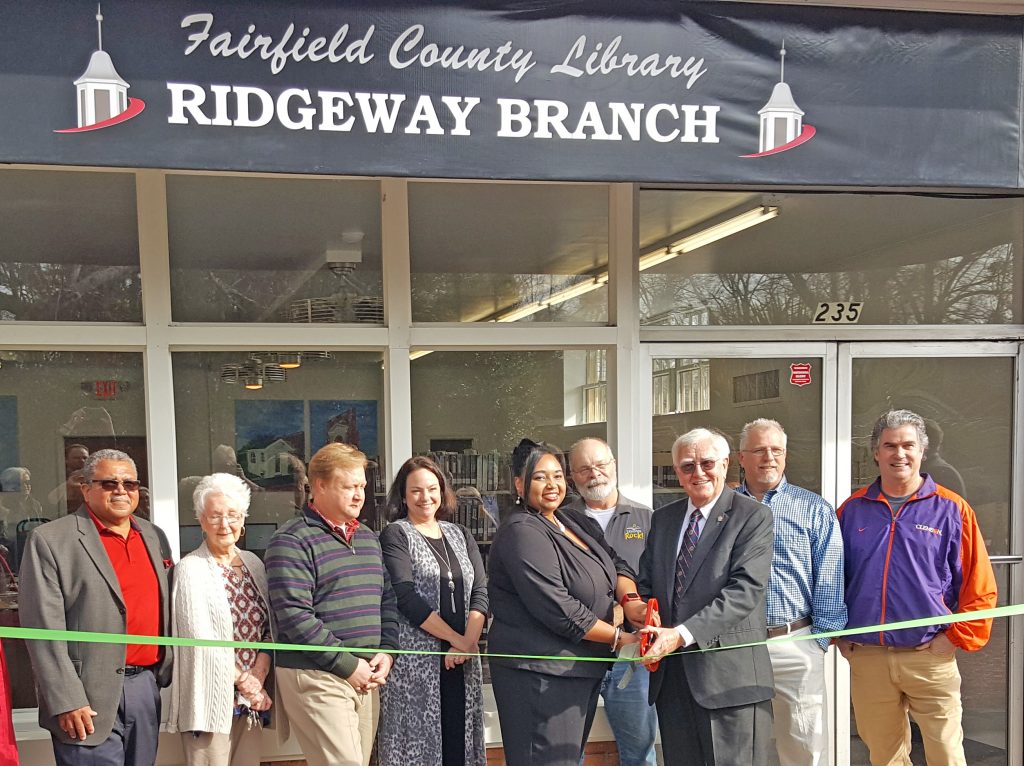
County Councilman Moses Bell, Board Member Polly Phillips, County Administrator Jason Taylor, Circulation Manager Beth Bonds, Branch Manager, Chrishonda Gaither, Assistant Library Administrator Mike Poole, Board Chairman Paul Dove, Town Councilman Dan Martin and former County Councilman Dan Ruff | Darlene Embleton
RIDGEWAY – A new Ridgeway branch of the Fairfield County Library opened on Wednesday with a ribbon cutting and open house hosted by the Friends of the Library at the new 235 S. Palmer Street location. According to Fairfield County officials, the location will serve the community until a more permanent location can be found at a later date.
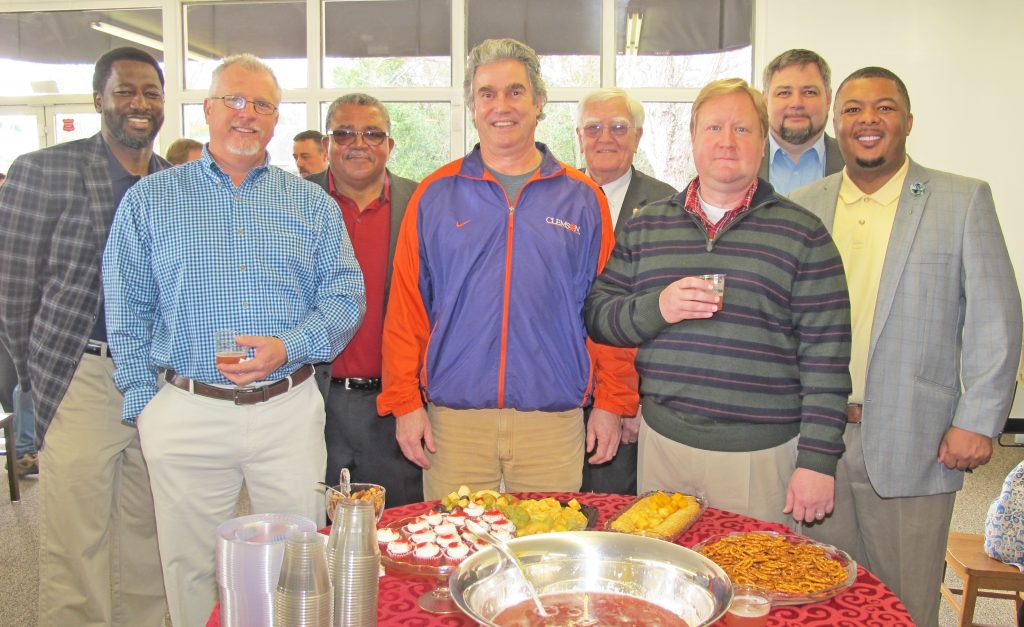
Superintendent Dr. J.R. Green, Town Councilman Dan Martin, County Councilman Moses Bell, former County Councilman Dan Ruff, Board Chair Paul Dove, County Administrator Jason Taylor, Chamber Director Chris Stephenson and County Councilman Neil Robinson.
“This new branch, is nearly twice the size of the prior Ridgeway location and can accommodate nearly twice the number of books and computers,” said Fairfield County Library Director Eric Robinson. “Our services include resources duplicating those at our main library. We can provide access to SCLENDS, a 20-library consortium that shares books through a lending program (accessed at fairfieldcountylibrary.com), on-site printing, copying and scanning,” Robinson said. Color printing is not yet available at the branch.
There will be seven computers for accessing library resources. Four offer Microsoft Office and three have internet access. Wi-Fi is available.
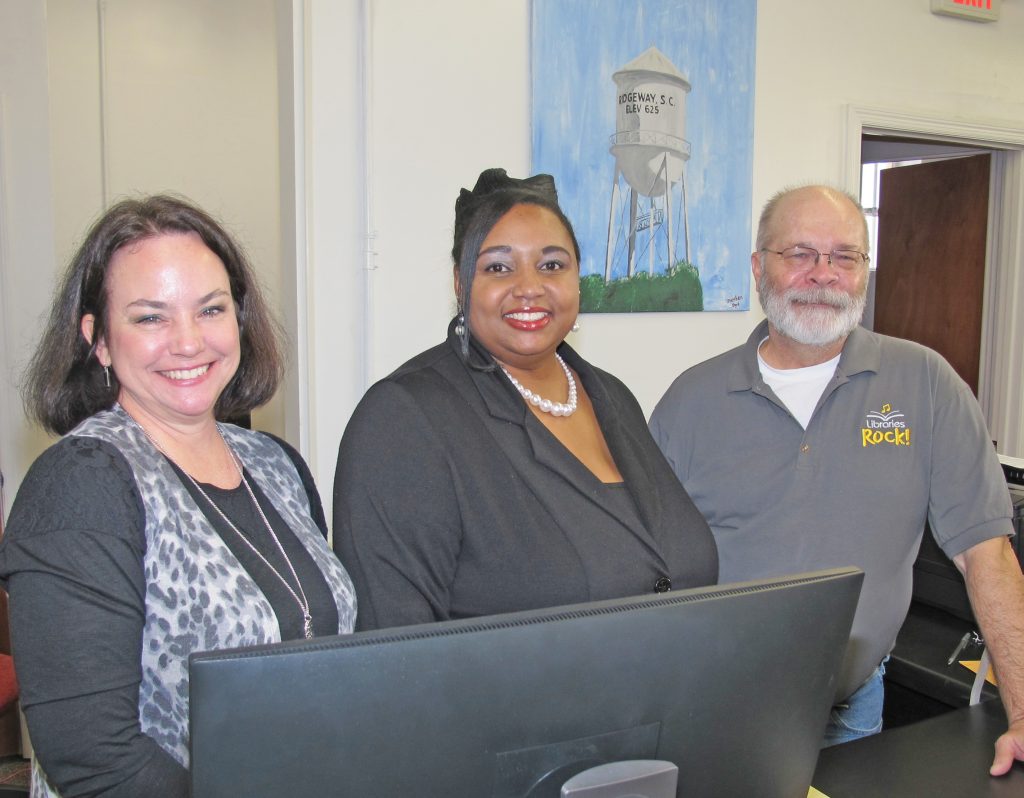
Circulation Manager Beth Bonds, left, Branch Manager Chrishonda Gaither and Assistant Library Administrator Mike Poole. | Barbara Ball
Chrishonda Gaither will be the Branch Manager for Ridgeway. Branch hours will be Monday and Wednesday from 9 am to 1 pm and Tuesday and Thursday from 2 to 6 pm. The Bookmobile will continue to serve Ridgeway on an as-needed basis.
“The Library Board would like to thank Fairfield County for the refurbishing and getting us up and running,” Robinson said. “We would also like to thank the Ridgeway Town Council and former County Councilman Dan Ruff for helping us secure this site. We are very happy to once again be able to conveniently serve the people in the Ridgeway community.”
The new location has on-site parking. For more information, call 803-337-2068 or fax 803-337-0529.
That was the question driving a discussion of the Fairfield County School District’s annual audit at last month’s board meeting.
Andrew Dobson, an accountant with McAbee, Schwartz, Halliday & Co., the financial firm that conducted the audit, was on hand to present the audit. He praised the district for maintaining a higher than standard fund balance.
Dobson said the district’s fund balance of about $10.5 million represents 27.6 percent of the annual budget. He called that ratio “excellent,” noting the typical district’s fund balance to budget radio is 16 to 18 percent.
“That gives you three months of short-term funding if something were to happen,” Dobson said. “You have your fund balance perfectly placed for any state cuts, unanticipated events, or any additional spending you might want to do in the future.”
The presentation soon dovetailed into a discussion about debt.
Superintendent Dr. J.R. Green touted what he characterized as relatively low long-term debt that’s tied to the Fairfield Career and Technology Center.
“For the district to have only $7 million in long-term debt is almost unheard of,’ Green said. “When you look at our debt relative to other districts, we have relatively low debt.”
Audit documents actually list the district’s total long-term debt as closer to $8.49 million.
The district owes $7,010,000 in general obligation principal and $353,053 in capital lease principal, but also owes $1.24 million more in interest.
According to audit documents, the district anticipates spending between $1.15 and $1.17 million annually on principal and interest. The final payment in 2024-2025 is a little more than $2.3 million, documents show.
Board member Paula Hartman thought it would be more prudent to accelerate debt payments so the district could be debt free sooner.
“For anybody from families to companies, if you don’t owe on it, it’s better,” she said. “That’s the better situation.”
Green responded by expressing his desire to maintain a rainy day fund.
“I feel a little better about having more in the bank, just in case,” Green said.
“I’d feel better if we weren’t in debt for anything,” Hartman responded.
As of June 30, the district’s debt limit had a borrowing capacity of about $3.8 million, according to the audit.
State law sets a school district’s credit limit at no more than 8 percent of all assessed value within the district.
The audit says the district’s assessed property valuation is $146.5 million for debt service. Eight percent of the assessed value works to $11.7 million, the audit states.
WINNSBORO – A major talking point Fairfield County education leaders have been making about the 2018 state report cards is that no Fairfield school rated Unsatisfactory.
“We were competitive,” said Dr. J.R. Green, district superintendent, said of the results at a recent Board of Trustees meeting. “Virtually every district that adjoins Fairfield County had at least one unsatisfactory school.”
That ratio is actually closer to 50-50 for the six surrounding districts, with three districts reporting no Unsatisfactory schools and three others reporting at least one Unsatisfactory school. Union, Newberry and Lancaster counties didn’t report any Unsatisfactory schools, according to report card data. Chester, Kershaw and Richland Two reported at least one Unsatisfactory school.
Additionally, Green’s comparison includes some districts substantially larger than Fairfield County, which has seven schools, excluding the state-run Midlands Stem Institute which has two schools.
Chester has 13, Newberry has 14, Kershaw has 18 and Lancaster has 20. Richland Two is the largest adjoining district with 32 schools.
Fairfield
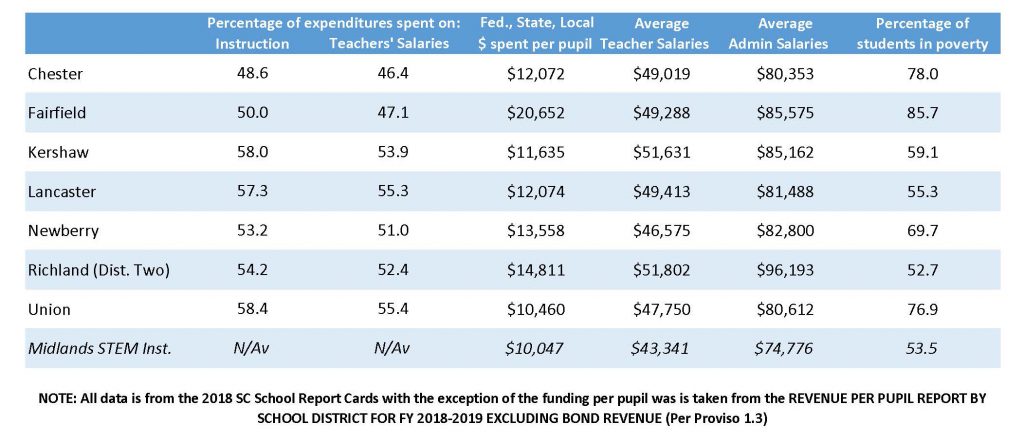
With the highest federal, state and local funding per pupil ($20,652), the highest percentage of students in poverty and the smallest average number of students per teacher ratio, Fairfield County had one school rated as Excellent, and another received a Good rating on the 2018 SC school report card. Three others were rated Average and two were rated Below Average. None were Unsatisfactory, the lowest rating.
Here’s a breakdown of how each school performed:
Fairfield Magnet School for Math & Science (Excellent)
Kelly Miller Elementary (Good)
McCrorey-Liston Elementary (Average)
Geiger Elementary (Average)
Fairfield Central High School (Average)
Fairfield Middle (Below Average)
Fairfield Elementary (Below Average)
Chester
Chester, with the highest average student to teacher ratio (25.4 students per teacher), second highest percent of students in poverty (78.0) and third lowest average teacher salary ($49,018), struggled the most among the seven districts. Chester had one Excellent school, three Average schools, six Below Average schools and three schools receiving the state’s lowest rating of Unsatisfactory.
Kershaw
Aside from reporting one Unsatisfactory school, Kershaw’s 18 schools performed well, with five schools earning Good ratings, nine rated Average and three rated Below Average.
Lancaster
In Lancaster County, eight schools scored either Excellent or Good. Seven were rated Average and five received a rating of Below Average. Lancaster had no Unsatisfactory schools.
Newberry
Newberry County, with the lowest average pay for teachers ($46,575) of the seven districts, and the fourth highest percentage of students in poverty (69.7), reported three schools with Excellent ratings, five schools with a Good ranking, five schools with an Average rating and only one school with a Below Average rating, report card data shows. Newberry had no Unsatisfactory ratings.
Richland Two
In Richland Two, about one-third of schools (11) scored Good or Excellent on the report cards. Of the nine Blythewood area Richland Two schools, six were among the 11 top schools:
Langford Elementary (Excellent)
Round Top Elementary (Excellent)
School for Knowledge Elementary – housed in Muller Road Middle (Excellent)
Bethel-Hanberry Elementary (Good)
Sandlapper Elementary (Good)
Blythewood High (Good)
Westwood High, Blythewood Middle and Muller Road Middle (grades 6 – 8) schools received an Average rating,
The Center for Achievement elementary magnet school housed in the Kelly Mill Middle school, is the only Blythewood area school to receive an Unsatisfactory rating. Two other Richland Two schools also received Unsatisfactory ratings.
Union
Union County, which has eight schools, reported one Excellent school, six Average schools and one Below Average school. Union has the third highest percentage of students in poverty (76.9) and allocates the highest percentage (55.4) of its expenditures to teacher salaries which, at an average of $47,750, are the second lowest of the seven districts.
Midlands Stem Institute
The report cards list the Midlands Stem Institute, or MSI, of Winnsboro under the S.C. Public Charter School District. The state issued two report cards for the K-8 school – one for elementary grades and one for middle school grades:
MSI, elementary (Below Average)
MSI, middle (Average)
The school added ninth grade last fall which was not included in the 2018 ratings. MSI receives $10,047 in federal, state and local funding per pupil, about half the amount the Fairfield District receives and the least of any of the other seven comparison districts.
Comparing the seven districts
In 2018, the state revamped the report cards into two main categories: Academics and School Environment. There are six subcategories under Academics and four under School Environment.
At the Dec. 18 school board meeting, Green stated that the new report cards create a “forced distribution” of schools.
According to the model, only the top 15 percent of schools are rated Excellent. The next 20 percent receive a Good rating, while the middle 35 percent receive Average ratings.
Below Average schools make up the next 20 percent while the bottom 10 percent are Unsatisfactory.
“This system has negatively impacted all kinds of districts with all kinds of populations,” Green said at the meeting. “It creates a ‘Hunger Games’ mentality. Everyone is scrambling to the top and to reach the top.”
Class sizes
Fairfield County’s student to teacher ratio of 16.9 to 1 is the smallest [number of students per teacher] ratio compared to the six districts surrounding Fairfield.
Richland Two has the next lowest ratio at 19.7 to 1. Chester has the highest at 25.4 to 1.
Teacher Retention
Statistically speaking, teacher retention appears to be an issue for Fairfield, according to report card data.
Fairfield’s percentage of teachers on continuing contract is lowest (63.2 percent) of the seven districts. The six surrounding districts range between 75 percent and 81.6 percent, with Union County leading the pack even though it has the third highest percentage of students in poverty and the second lowest average teacher salaries according to report card data.
Fairfield falls in the middle in average teacher salaries at $49,288. Richland Two leads at $51,802, followed by Kershaw at $51,631.
Newberry trailed all seven at $46,575 despite its schools receiving comparatively high ratings.
Other average salaries by district include: Union, $47,750; Chester, $49,019; and Lancaster, $49,413.
RIDGEWAY – The Carolina Anglers Team Trail will hold its first Lake Wateree bass tournament on Sat., Feb. 16 at Clearwater Cove Marina in Ridgeway. Entry fees are $80 with no entry deadline.
“Entry fees can be mailed in ahead of time or pay at the ramp. Teams can just show up and pay,” tournament director Brett Collins said. “We’ll be fishing from safe daylight until 3 p.m., and after the tournament, we throw the fish back in.”
Collins said he expects 23 – 30 boat teams.
For more information about the tournament, call Collins at 803-413-7521. For information about the spring schedule, go to cattteamtrail.com.
2019 Review: New Industries Brought Jobs, Investment to Fairfield County
WINNSBORO – A year
and a half ago, a Lowcountry newspaper lamented Fairfield County’s double digit
unemployment. What a difference a couple of years has made.
Today, the county’s unemployment rate has shrunk to 3.1
percent and, according to County Administrator Jason Taylor, industrial
prospects over the last couple of years have accounted for the creation of more
than 700 new jobs and a $70 million impact.
In fact, Fairfield County has completed one of its busiest
years on record, with county leaders tackling a flotilla of projects and inking
a number of important deals. The new year saw the opening of the Providence ER,
complete with additional outpatient services. The transformation saves the
county some $600,000 annually over the previous funding of the former Fairfield
Memorial Hospital.
Economic development, infrastructure improvements and
revitalization highlight a laundry list of accomplishments that followed in
2019, and county officials say they plan to continue growing that list in 2020.
County Council Chairman Neil Robinson said while much was
accomplished in 2019, he predicted that 2020 could be a breakout year. He
credited Taylor, who was hired a little over two years ago, for guiding the
council’s directives to fruition.
“His vision and knowledge of where we should be and how we
get there surprises me every day,” Robinson said. “If Fairfield’s 2019 could be
summed up in one word, it’s jobs.”
Taylor agreed.
“Between the various projects, it’s been a very good year
for us,” Taylor said. “One of our responsibilities in local government is to
improve the quality of people’s lives. A job is critical to someone having a
good quality of life.”
Taylor, council and county employees have taken that
responsibility seriously and the results are popping up in various ways, not
the least of which is a new, cooperative relationship between the county and
the Town of Winnsboro – a far cry from the rancor that had for years stymied
progress for the two governments.
Bringing employment to the county is a trend county leaders
hope to continue in 2020 as the result of groundwork laid the past couple of
years in revitalization, water and sewer infrastructure and the acquisition of
new industry.
To that end, the county is working to expand its newly
created Fairfield County Water Authority as well as construct a major
wastewater treatment facility to serve the I-77 corridor and megasite,
something Robinson says is vital in landing major industry on the order of
Boeing, BMW or Mazda.
Here’s a summary of the major projects Fairfield County
tackled in 2019, as well as the forecast for 2020.
Economic Development
Mattresses move along a conveyor belt where they are inserted into mattress covers, then rolled up by another piece of equipment and packaged for shipping.
MLILY, Pharmacy Lite Packaging and Sea Pro Boats are the
latest industries to have commenced or announced operations in Fairfield County
in 2019. More job announcements are anticipated in coming weeks, according to
Robinson.
“Landing MLILY was a major accomplishment,” Robinson said.
“You’re talking about a $48 million investment into the county. That’s a lot of
tax money coming to us.”
Ty Davenport, Director of Fairfield County Economic
Development, said Pharmacy Lite Packaging, which is launching operations in the
former Wal-Mart building, represents a $2.9 million investment, though he
thinks that figure will grow to $3.5 million in time.
“It’s expected to create 33 new jobs, which we think in
coming years will get up closer to around 100,” he said.
Just before Christmas, the county authorized an agreement
with Victory Boats, LLC, which is expanding to Fairfield County. Located in the
former Fazio building on Hwy 34 near the Highway 321 bypass, the company brings
with it a $3 million investment and 135 new jobs.
“We also did a lot of work to save and help expand both
Element and MEKRA Lang,” Taylor said.
“If we continue to target industrial growth opportunities,
commercial and residential growth should follow,” he said. “We were at 14
percent (unemployment) not too terribly long ago,” Taylor said. “The problem is
a lot of people are driving outside the county to work. We have to have
opportunities for people to work here at home. When people stay at home, they
invest and shop here.”
Water and Sewer Infrastructure
Heavily linked to economic development is the improvement of
the county’s infrastructure. Water and sewer are a top priority.
In March, the county formed the Fairfield County Joint Water
and Sewer Authority Commission. So far, the membership is made up of the county
and the Town of Winnsboro.
The authority is vital to the funding and construction of
the wastewater treatment plant, which is seen as needed infrastructure by
industry looking to relocate to Fairfield County.
In 2020, the county hopes to place a sales tax referendum on
the November ballot to help generate additional funds for the plant.
“We’ve been working hard in conjunction with the Town of
Winnsboro and the State of South Carolina to secure funds for the plant,”
Taylor said. “Water and sewer are critical to our future development.”
Over the past two years, the state has provided about $3.8
million to Fairfield County to cover costs associated with engineering and
studies for the new plant.
Robinson said council looked all across the county before
securing a site off Syrup Mill Road for the plant. Piping would funnel
wastewater from the megasite to the plant. It would then be discharged into Big
Cedar Creek.
Once we complete the wastewater treatment facility, that’s
when we’re going to land that big deal,” Robinson said. “Those (deals) could
mean hiring 1,500 to 2,000 employees.
Accommodations, hospitality taxes
The proposed local option sales tax referendum is separate
from the county accommodations and hospitality taxes enacted in 2019.
Expected annual revenue of about $250,000 from these taxes
will be paid primarily by tourists. The revenue can be spent in a number of
ways to benefit the town and county and their businesses. It can also be used
to construct public meeting facilities, other enhancements and tourism services
as well as entertainment events and capital projects that will attract tourist
dollars to the town and county.
The accommodation and hospitality tax revenue can also be
used to pay indebtedness issued by the County for public purposes.
In December, the Town of Winnsboro adopted a resolution
allowing the two taxes to be collected (by the county) from businesses in the
town as well.
“We’ve overcome the last obstacle to implementing the
accommodations and hospitality tax, and that will move forward shortly,” Taylor
added.
Airport upgrades
An especially valuable commodity in the county’s economic
development toolbox is the Fairfield County Airport, located off Hinnants Store
Road in Winnsboro. But it was not always so before Taylor hired pilot Denise
Bryant as director of the airport in 2017. Until then, the airport was
deficient in many areas. The previous fuel farm technically didn’t comply with
regulations set by the S.C. Department of Health and Environmental Control
(DHEC).
“We found that our fuel farm and our tanks were not what
they should be,” Taylor said. “They weren’t even licensed by DHEC. We have
taken measures to remediate all of that.”
During the last two years, Bryant has overseen the
construction of a new state-of-the-art fuel farm that was completed in
December.
“The fuel farm is very attractive, well-done. It’s something
to be proud of now,” Taylor said.
Two, 12,000-gallon fuel tanks were installed. With the extra
capacity, the airport can take in more fuel deliveries, which translates into
lower costs.
In addition, the pumps feature a card reader display and a
second screen display large enough for pilots to view, even when they’re
fueling their planes from the opposite side of their craft.
“You can actually go to the other side of your plane to fuel
and you can see the dollar amount of what’s going into your plane,” Bryant
said.
Bryant has also overseen other major upgrades including
lighting and signage. The facility boasts a 5,000-foot runway and parallel
taxiway, a modern terminal building with upgraded furnishings, a laser grade
testing center, a pilot’s shop, flight instruction and new T-Hangars.
In 2020, the county plans to resurface all of the airport’s
ramps, taxiways and runways. The work is expected to start sometime in March or
April, and take about a month to complete.
Bryant said the federal government is covering 90 percent,
or about $320,000 of the project. The county and state are each picking up 5
percent, or about $16,800 for their respective portions.
“Upgrang and modernizing the airport is important because
the facility is often the first impression CEOs of prospective industries have
when they fly into Fairfield County,” Bryant said.
“There’s a lot of general aviation traffic that comes into a
community first, especially in the corporate world,” she said. “The general
aviation airport in Fairfield is extremely important in putting down the
welcome carpet.”
Mt. Zion renovation
Fairfield County spent much of 2018 putting together a plan
to revitalize the former Mt. Zion Institute building to serve as a new
Fairfield County government center in downtown Winnsboro.
In 2019, the county devoted considerable efforts to working
with the developer, 1st and Main, a North Carolina firm, to secure the
financing for the renovation.
More than half of the funding of the $11.5 million project
would come from state and federal tax credits associated with the property.
Fairfield County plans to buy the building via interest free
annual lease payments of approximately $4.9 million over seven years. At the
end of those seven years, the county will make a final payment to purchase and
take ownership of the property from 1st and Main.
“We got all the
financing we were hoping we would get and a little more, actually. And all the design
work is done,” Taylor said.
The actual construction is slated to start in January 2020
and is expected to last 16 months, with a projected opening sometime in Spring,
2021.
Market Building
The launching of the Fairfield County Market building has helped
increase foot traffic in downtown Winnsboro, which county officials hope will
spill over to existing shops and restaurants.
Opened in May, the Market is located in a renovated former
county building located on East Washington behind the Town Clock. With a
kitchen, classroom, restrooms and a large, open market room, the building can
be used not only by the farmer’s market on Saturdays but for weddings,
receptions and other large community or family gatherings.
Zion Hill Revitalization
During 2019, the county and Town of Winnsboro cooperatively
undertook the revitalization of the Zion Hill and Fortune Springs Park
neighborhoods, with input from the residents of the area. It is a major step
forward in bringing this area back to its Glory days, county officials say.
In November, the county landed the first of several planned
grants to help pay for the project. The initial $488,000 Community Development
Block Grant (CDBG) will be augmented by a 10 percent ($48,900) local government
match, giving the county more than $536,000 at its disposal to begin Phase I of
the revitalization effort.
That work will include the demolition and clearance of
approximately 40 dilapidated and vacant structures, according to the Central
Midlands Council of Governments’ (CMCOG) planners who are working with the
county and town to guide and supervise the revitalization.
The demolition work made possible by the bond will begin
this spring and must be finished in two years. Both the town and the county are
eligible to apply for two $500,000 bonds each year.
At a community meeting in July, Gregory Sprouse, a planner
with the CMCOG, said he hopes the Zion Hill project represents the beginning of
more broad revitalization work in Winnsboro neighborhoods.
“We want this [Zion Hill] to be a starting point for how we
can move similar types of projects into other areas of the town that need the
same type of commitment,” Sprouse said. “CDBG funds must be spent to benefit
low to moderate income populations based on census data, and Zion Hill and the
Fortune Springs Park area fit that criteria.”
Broadband
County officials ended the year in new pursuit of broadband
expansion in the county – a pursuit that, in the past, has been futile.
“On broadband, I will just say we are exploring potential
opportunities that may be available that could assist us in working with our
existing local providers to expand the service,” Taylor said. “Like other
infrastructure that we are working on, we realize that for the county to grow,
improving our broadband service is critical. In today’s world, people expect
service to be widely available and fast.”
BLYTHEWOOD—Administrators are making more and teachers are making less in the Richland Two School District.
In 2017-18, the average teacher salaries dropped from $52,092 to $51,802, while average administrator salaries rose from $95,003 to $96,193, the South Carolina Department of Education Report Card data shows.
A similar trend occurred in Fairfield County School District.
In 2017-2018, average administrator salaries were $85,575, up from $84,833 the year before, according to report card data.
Average Fairfield County School District teacher salaries, however, declined from last year, falling from $49,504 to $49,288.
At the Dec. 18 Fairfield County School District meeting, Dr. J.R. Green, superintendent of Fairfield County schools, said in the past year he’s forgone receiving a pay raise.
However, when board member Paula Hartman asked Green to state his salary, Green said he didn’t know the figure. The Voice has filed a Freedom of Information Act request for that information.
In Fairfield County, the inverse relationship between administrator and teacher pay comes as district leaders continue pressing for the creation of a Teacher Village, a proposed subdivision catering to educators.
Affordable housing, they say, is key to recruiting and retaining teachers.
“People who live in a home are going to stay longer than in an apartment,” said Dr. Sue Rex, chairwoman of the Fairfield education foundation, which is working with the district on the Teacher Village project.
Fairfield County lags behind Richland Two in most teacher retention categories.
Richland Two reported 86 percent of teachers returning from the previous year, compared to 82.6 percent in Fairfield. Richland Two (86.6 percent) also leads Fairfield (81.3 percent) in teachers returning – three year average, according to report card data.
Finally, only 63.2 percent of Fairfield teachers are on a continuing contract, compared to 75 percent in Richland Two.
At the Fairfield County School District’s October meeting, the board voted to appropriate $1 million from its $3.5 million surplus for salaries.
However, the money won’t be budgeted until 2018-2019 and it includes all district employees, not just teachers. The remaining $2.5 million was earmarked to fund facility needs.
WINNSBORO – Instead of attacking school report cards, the Fairfield County School District leaders should be tackling ways to improve student achievement, according to a leading state education official.
“Rather than complaining about the system, the best thing we can do is think about how we can improve the outcomes for kids,” said Melanie Barton, executive director of the S.C. Education Oversight Commission, which develops the annual report cards with the S.C. Department of Education.
In a telephone interview Friday, Barton said report cards are designed to help identify how schools can improve, not to punish or embarrass them.
“What I would tell board members is spend your energy focusing on where we can improve,” she said. “Not every school can be excellent. That just defies common logic.”
Barton’s remarks came three days after the Fairfield school board members and staff blasted the report card methodology, calling them unfair and punitive.
Dr. J.R. Green, district superintendent, disputed what he termed as a “forced distribution,” meaning a percentage of schools will always be rated unsatisfactory, regardless of performance.
“It creates a model where one school doesn’t want to help another,” Green said. “I have a problem with a system when you have to have winners and you have to have losers.”
Barton said Green’s assertions erroneously portray the purpose of the report cards.
“To think of it as a competition, I just don’t see educators doing that,” she said. “If they do, they’re not serving children.”
School districts sound off
Fairfield County is not alone in voicing frustration over the report cards. Other superintendents have voiced concerns as well, said Ryan Brown, spokesman for the S.C. Department of Education.
Brown deferred comment on report card methodology to the EOC, but he noted the Department of Education has some concerns of its own regarding the updated report cards.
One issue, he said, is that standardized tests comprise 90 percent of an elementary school’s report card score, while the ratio is less for high school ratings.
He said the Department of Education and other stakeholders hope to hash out any differences at a meeting next month. The meeting is slated for Jan. 28, and any revisions need to be finished by March 1 for U.S. Department of Education signoff.
The new report cards were rolled out Nov. 29 following a two-week delay due to errors in reporting from a vendor, a Department of Education news release said.
The report cards maintain previous ratings of Excellent, Good, Average, Below Average, and Unsatisfactory. What’s new is that only certain percentages of schools fit into each category.
In 2017-2018, only the top 15 percent of schools were rated Excellent. The next 20 percent of schools were considered Good, while the middle 35 percent of schools were classified as Average.
Below Average schools made up 20 percent while the bottom 10 percent were automatically rated Unsatisfactory. There were 116 schools that fit into this category.
No Fairfield County school was rated Unsatisfactory. Two schools – Fairfield Elementary and Fairfield Middle – were rated Below Average. While Fairfield Central High School was rated Below Average in Academic Achievement and Prepared for Success, the Good rating for Graduation rate, Average rating for College and Career Readiness and Excellent rating for School Quality (subjective ratings by students, parents and teachers concerning such areas as school safety)brought the overall average for the school to Average.
At Tuesday’s board meeting, Green likened the state report card system to “The Hunger Games,” a science fiction movie about a dystopian future in which teenagers fight to the death on live television.
“This system has negatively impacted all kinds of districts with all kinds of populations,” Green said. “It creates a ‘Hunger Games’ mentality. Everyone is scrambling to the top and to reach the top.”
Board chairman William Frick described the report cards as “rigging the game,” saying 30 percent of schools in the state are destined to score either Below Average or Unsatisfactory.
“We’re rigging the game by saying 30 percent of the schools, 30 percent of the teachers, 30 percent of our students have to be below average or unsatisfactory,” Frick said. “I just don’t understand it. I, for the life of me, don’t understand why we want to continue to say our schools are bad in South Carolina.”
Board member Carl Jackson was more blunt.
“It’s almost as though somebody’s getting a kickback to make this thing look bad,” Jackson said.
Comparing area high schools
Earlier at the Dec. 19 meeting, Dr. Claudia Avery, deputy superintendent of academics for Fairfield County schools, detailed report card highlights for the board.
Green interjected several times during the presentation to express his disapproval of various aspects of the report card system.
“All schools can’t experience growth,” Green said. “Even if everyone does a good job of moving kids, everyone can’t receive positive points.”
Barton said the purpose of the report cards is to identify schools that are struggling, and to develop ways to help them improve. For that to occur, she said, report cards need to be transparent and frank.
“The point of the system is to identify what we’re doing well and what we’re not, and get the resources needed to change it,” Barton said. “We’re not where we need to be in the state.”
In her presentation, Avery said the district exceeded the state average in graduation rate (86.2 percent vs. 81 percent). She also noted the district’s percent of English Learners making progress toward proficiency (57.7 percent) outpaced the state (48.6 percent).
In addition, Avery said the district was represented well on student survey questions.
Nearly 89 percent of parents agreed or strongly agreed that their child feels safe at school. Another 78.4 percent thought school staff prevents or stops bullying.
Report card data, however, reported several noteworthy statistics in the report card’s “unsafe incident” table.
For example, the district reported seven incidents of “sexual assault (not rape).” There were also eight incidents of “physical attack without weapon,” and 45 threats of physical violence to Fairfield Central High School students, report cards state.
Academically, Fairfield County still lagged behind the state in several key areas.
Only 27 percent of students (303 of 1,121) met or exceeded criteria on SC Ready-English/Language Arts. Statewide, the figure was 41.7 percent. On math, only 31.2 percent of Fairfield students met or exceeded the criteria compared to 44.6 percent at the state level.
Fairfield also trailed the state in SCPASS Science and SCPASS Social Studies, as well as in end of course tests for Biology and U.S. History and Constitution.
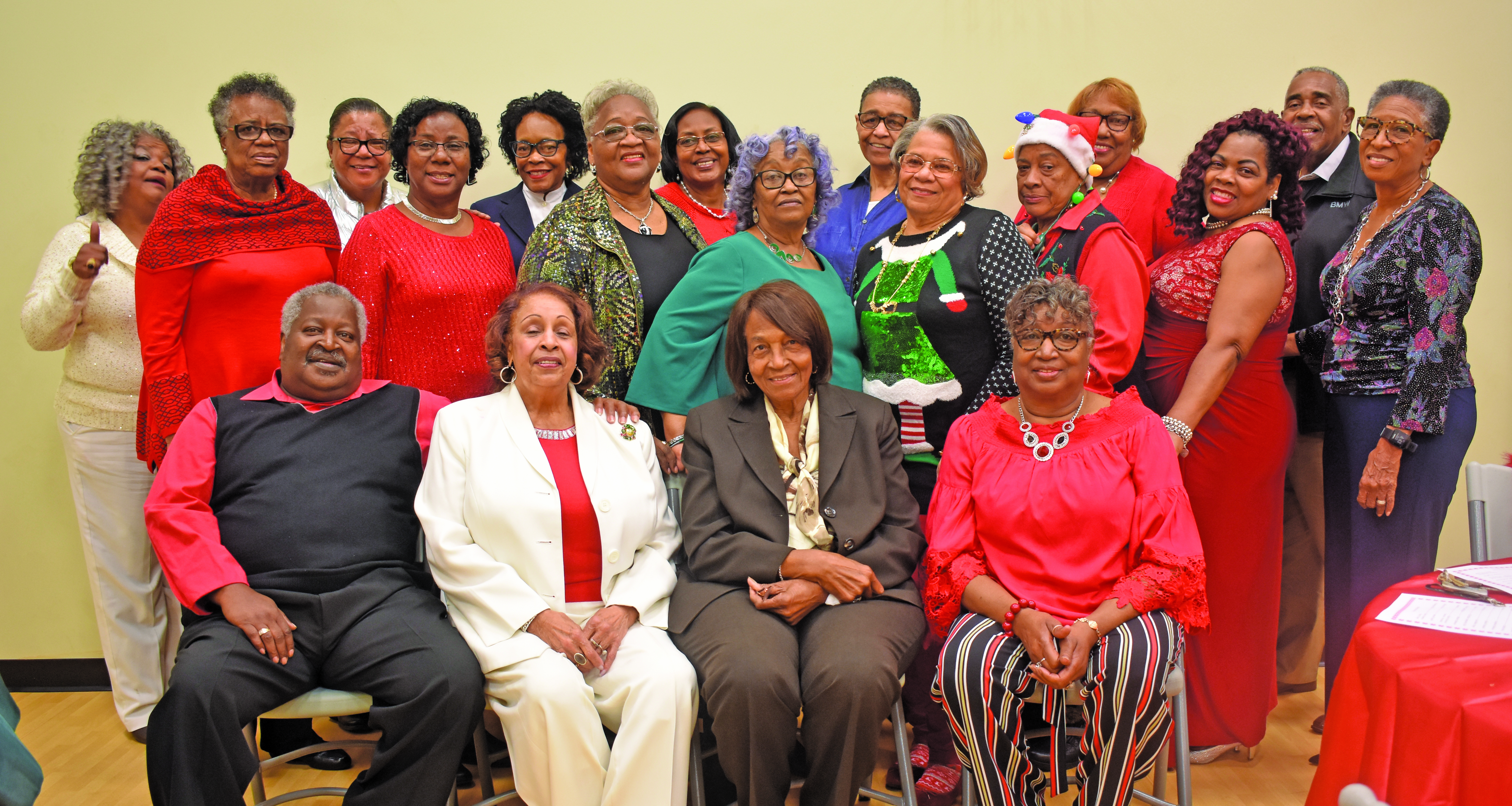
Members of the Blair Sympathy Club who met during the club’s regular Dec. 8 meeting included, from left (front row): Samuel English, Gladys Hardy, Hattie Brice and Judy Camack; (second row): Lula Robinson, Essie McConnell, Hattie Edwards, Jean Robinson, Diane Copeland, Beverly Feaster, Glenda Woodard and Shirley Greene and (third row): Tangee Jacobs, Ruth Lyles, Gail Worthy, Geraldine Trapp, Josephine Robinson, Deborah Hopkins and Charles Mickey Edwards.
BLAIR – The Blair Sympathy Club in Fairfield County is a fun-loving, energetic community group with the mission of bringing aid and comfort to one another during times of illness or other serious problems, the late Eugenia Wilson, president of the club at the time, told The Voice in 2015.
At that time, the club had about 50 members, Wilson said, most of whom lived in Fairfield County, but a few hailed from Union and Chester Counties.
“When we first started back in the ‘60’s,” Wilson recalled, “we used to meet at people’s homes – a different member’s house each month. But the group got so large that now our monthly meetings are held at member’s churches – Little River, Hassion Hill, Weeping Mary, Gethsemane, and so on,” she said.
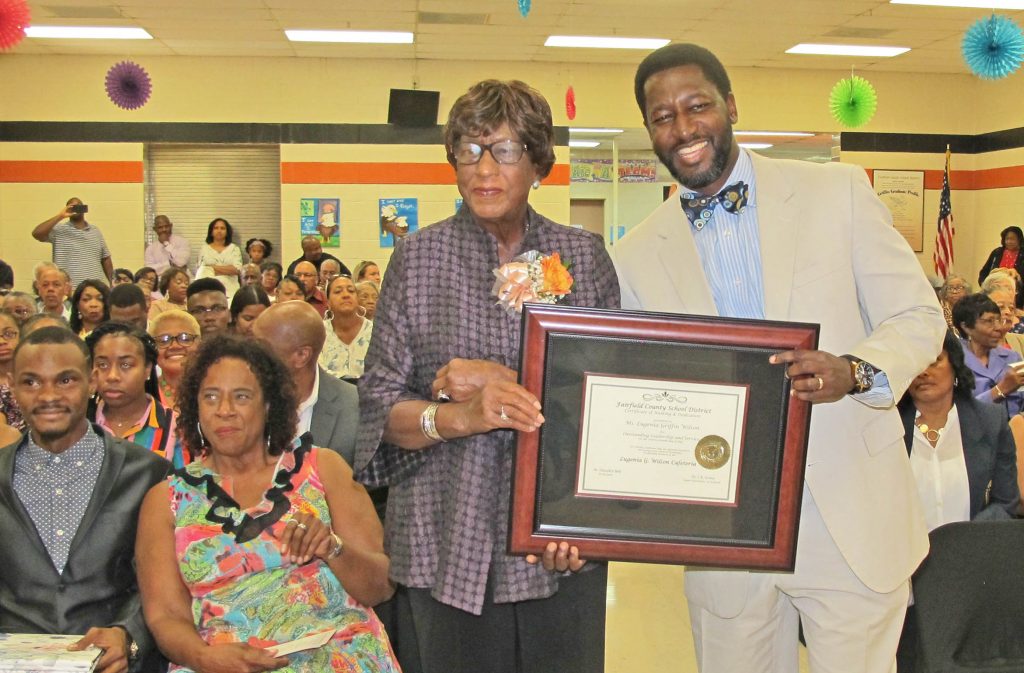
Eugenia Wilson accepts a plaque from Superintendent Dr. J.R. Green, recognizing the naming of the cafeteria after her. | Barbara Ball
Known for springing into action when one of their own (or someone in the family) becomes very sick or has to go to the hospital, members make time to visit and will also bring a donation from the club’s treasury, which is funded by the $40 annual dues and a $1-per-missed-meeting fee.
The group also enjoys social get-togethers, especially chartering a bus for day trips that are also open to non-members.
“Oh, we’ve been to just about every little town in South Carolina,” Wilson said, laughing. “Charleston, Hilton Head, Myrtle Beach, Beaufort… we’ve been up to the Biltmore house and to Charlotte museums. The list just goes on and on. Mountains, apple orchards – I just can’t name them all,” she said.
“And if someone in our group dies,” Wilson said, “we do flowers and prepare food for the day of the funeral.”
And so it was when Wilson died last Nov. 8, at the age of 86.
On Dec. 8, during the club’s regular meeting at the Jenkinsville Recreation Center, the members once again brought aid and comfort to each other as they remembered Wilson, their former leader and dear friend and what she meant to the club, the community and to McCrory Liston School. They recalled her service in many capacities, not the least of which was Food Service Supervisor at McCrory Liston. Wilson retired in 2006 after 40 years of service to the school district which honored her last summer by naming the school’s cafeteria after her.
“It’s both aspects of the Club – the fun times and the solace it offers – that give the group an enduring sense of purpose,” Wilson said, prophetically, in 2015.
“We just have a wonderful time together,” she said with a smile.
BLYTHEWOOD – The Blythewood Town Council is hoping to reprioritize some road improvement projects set for development in the near future under Richland County’s Penny Sales Tax program.
During the Dec. 18 council meeting, Mayor J. Michael Ross opened a discussion on the Penny Tax-funded road projects, which included a debated traffic circle proposed on Blythewood Road adjacent to the entrance of Cobblestone Park.
Specifically, council discussed reprioritizing the current first four of the Blythewood Penny Tax projects:
the traffic circle and widening of Blythewood Road on west side of I-77
Widening of Blythewood Road on east side of I-77
Improvements on McNulty Road
Extending Creech Road to Main Street (parallel to Blythewood Road)
Ross suggested moving McNulty Road (3) up to the second slot, moving the Creech Road extension (4) up to the third slot, and moving the widening of the east side of Blythewood Road (2) back to the fourth slot.
Council is expected to vote by resolution at the January meeting to confirm these changes.
The Creech Road Extension would begin at the cul de sac on the end of Creech Road near the Holiday Inn Express and run parallel to Blythewood Road, tying in to Main Street (Hwy. 21) somewhere yet to be determined between St. Mark’s Church and Blythewood High School.
“We (the council) believe that if we could get a Creech Road extension that would empty onto Hwy. 21, that would relieve a lot of the traffic stress and problems we are having in that area,” Ross stated.
Council member Malcolm Gordge said the prioritized list discussion had come up at the last council retreat, with the decision to table the item until council could meet with one of the engineers on the projects. That meeting, Gordge said, might happen as early as the Thursday after the Council meeting. Gordge said the meeting would allow the council to review traffic studies and have an updated discussion to see where SCDOT is and make them aware of the council’s proposed changes to the list.
BLYTHEWOOD – In addition to $15,000 that Blythewood Town Council appropriated earlier this year to Bravo Blythewood for a spring concert series, it voted unanimously last week to approve an additional $2,360 from Hospitality Taxes (H-Tax).
Four concerts will be held April 27, May 3, May 10 and May 17, 2019 at the Palmetto Citizens Federal Credit Union Amphitheater in Doko Meadows Park at a cost of $46,000.
Mayor J. Michael Ross said Bravo Blythewood will raise the remaining $28,640.
Revenue Sources
A budget sheet for the event presented to council by Martha Jones, president of Bravo Blythewood, listed those additional revenue sources as: sponsorships, $11,000; food vendors, $1,500; beer/wine sales, $14,560 and non-alcoholic beer sales, $1,634.
“You have made a real commitment in what you’re saying you’re going to spend, and how you’re going to raise it and how you’re going to get sponsorships,” Ross said, addressing Jones. “In looking through this, it looks really good, and I can’t wait for it,” Ross stated.
Expenses
The group will spend $9,000 on an event project manager, $9,500 on the headline band, $4,290 on beer and wine, $3,000 for the amphitheater, $1,200 to ‘volunteers,’ and Bravo Blythewood will keep $4,000.
Nineteen hundred and twenty dollars will go to Sheriff’s patrol, $1,700 will go to family entertainment and $1,200 to Freeway Music opening band.
Newspaper advertising will include $1,800 to The Country Chronicle, $400 to The Voice, $1,101.60 to Northeast News and $1,250 going to social media and web advertising, $500 for signs, $35 for posters and another $5,000 + for décor, rentals, graphics and other items.
Camp Discovery
Council also approved a one-time donation of $750 to Camp Discovery.
The donation came at the request of council member Malcolm Gordge, who sits on the camp’s board. Last month, Gordge invited the leaders of Camp Discovery to give a presentation to the council in consideration of the camp’s ongoing efforts and their funding needs in order to continue their operations.
The camp relies on donations from the public and various foundations to keep its gates open, which Gordge called “challenging” at times. Before the official decision, Gordge had asked the council if a donation in the range of $500 to $1,000 would be possible.
Ross recommended the donation be made out of the town’s promotions fund.