Category: Government

  • County Issues 3rd GO Bond

    Mills Chart color Sept 19 copyWINNSBORO – Fairfield County Council has issued a new general obligation (GO) bond in the amount of $306,000, according to records in the Fairfield County Clerk of Court’s office. The bond was filed July 22, but at press time The Voice had no information as to how it was distributed or the cost of issuance. Interest on the bond over a six-year period is $46,100.18.

    This is the third GO bond Council has issued since February 2014. In March 2013 County Council created a shell corporation (Fairfield Facilities Corporation) for the purpose of borrowing $24 million to pay for certain County properties and projects. To have use of these properties and projects, Council agreed to make semi-annual installment purchase payments to the shell corporation in the same amount as the payments the shell corporation was making to pay for the $24 million bond.

    Since Council did not have the revenue to make those payments, it passed an ordinance on April 15, 2013 that allowed the County to issue an undisclosed number of GO bonds, without permission of the taxpayers, to make those installment payments. Those bonds are then paid back with property tax revenues.

    Howard Duvall, retired Executive Director of the S.C. Municipal Association, put it simply.

    “This (shell corporation) allowed the County to borrow more money than it could afford to pay back,” Duvall said, “and to levy taxes on the residents to pay off that debt without getting their permission to do so.”

    While a 60-day window allowed the voters of Fairfield County to initiate a petition to stop the GO bond ordinance from going into effect and thus stop the issuance of the GO bonds, the plan was not spelled out for Fairfield County voters at meetings or in newspaper interviews. While the title of the ordinance was read aloud in Council chambers each time it was voted on, it was not discussed or explained and did not specify an amount for the bonds to be issued, a date of issuance or the number of bonds authorized by that ordinance.

    At the same time, at Council meetings and in newspaper interviews, former County Administrator Phil Hinely and members of Council further confused the issue of what exactly had been voted on, whether intentionally or negligently, by wrongly referring to Council’s vote for what was actually the GO bond ordinance, as a vote for the $24 million bond.

    A year later, on Feb. 14, 2014, the first GO bond authorized by the ordinance was issued in the amount of $769,177.88. By then the 60-day window for initiating a petition to rescind the bond ordinance had closed.

    The Voice also quoted Hinely and the County’s then Director of Economic Development, Tiffany Harrison, as saying the $24 million bond would not increase taxes. But a chart distributed last year by the County’s administration showed that it is the GO bond debt (which was levied to make the interest on the installment purchase payments on the $24 million bonds) that keeps the county’s debt millage at an elevated level of approximately 10 mills (or about $1.27 million) each year from 2020 until about 2042, at which time it will begin to decrease, reaching zero by 2047. From 2013 – 2019, approximately 1 mill per year is levied to pay for GO bond debt initiated by this ordinance. The Council is currently issuing GO bonds at a rate of two each year. The total property taxes needed to pay the interest on the installment purchase revenue payments over 39 years is approximately $30 million.

    While making an explanation about the payoff of the $24 million bond during a County Council meeting last year, the County’s Interim Administrator, Milton Pope, said it was planned from the beginning to make the interest payments on the $24 million bond with property tax revenue from these GO bonds. He said the interest payments do not depend on income from the V.C. Summer nulear plant.
  • Council OK’s New Water Rates

    RIDGEWAY – With little fanfare and no discussion, Town Council passed first reading on Aug. 13 of an ordinance to amend water and sewer rates that had jumped more than 10 times as high as necessary last June.

    “I don’t mind admitting there was a mistake made,” Councilman Russ Brown told The Voice in June. “It was an honest mistake. It’s only fair to be consistent with what Winnsboro does.”

    Brown’s comments came on the heels of the revelation in the June 19 edition of The Voice that Council’s across the board rate increase of $1 per 1,000 gallons dramatically exceeded the .098 cents per 1,000 gallons increase passed onto Ridgeway by the Town of Winnsboro.

    During their July meeting, Council voted 3-1 to revise those rates to make them consistent with Winnsboro’s increase. Councilman Doug Porter, who was absent from the Aug. 13 meeting, cast the lone dissenting vote.

    “We have reluctantly raised (water and sewer rates) when we have had to,” Porter said during the July 9 meeting. “Most of our city revenue comes from water and sewer. And we have capital projects we need to address. I think we would have asked a little bit more than that. We are losing ground to (water supplier Winnsboro).”

    According to the ordinance, which will get its second reading Sept. 10, minimum monthly residential water rates inside the town limits will now be $15.10 for the first 1,000 gallons (as opposed to $16 approved in June) and $5.17 for each additional 1,000 gallons (vs. $6.07 approved in June).

    Residential water customers outside the town limits will be charged a monthly minimum of $20.10 for the first 1,000 gallons (vs. $21 in June) and $6.42 for each additional 1,000 gallons ($7.32 in June).

    Commercial water customers within the town limits will now face a minimum monthly charge of $18.10 for the first 1,000 gallons ($19 in June) and $5.17 for each additional 1,000 gallons ($6.07 in June). Commercial water customers outside the town limits will pay a minimum monthly charge of $23.10 for the first 1,000 gallons ($24 approved in June) and $6.42 for each additional 1,000 gallons (vs. $7.32 approved in June).

    Residential sewer rates for customers inside the town limits would now be $12.10 for the first 1,000 gallons (vs. $13 approved in June) and $4.52 for each additional 1,000 gallons (vs. $5.42 in June). For residential sewer customers outside the town limits, those rates would be $13.10 for the first 1,000 gallons (vs. $14 in June) and $5.67 for each additional 1,000 gallons (vs. $6.57 approved last June).

    Commercial sewer rates inside the town limits would be amended to $16.10 for the first 1,000 gallons (vs. $17 in June) and $4.67 for each additional 1,000 gallons (vs. $5.57 in June). Outside the town limits, those rates would now be $19.10 for the first 1,000 gallons ($20 in June) and $5.67 for each additional 1,000 gallons (vs. $6.57 approved in June).

    According to the ordinance, the new rates would take effect in September.


  • Career Center Canopy Debate Stalls

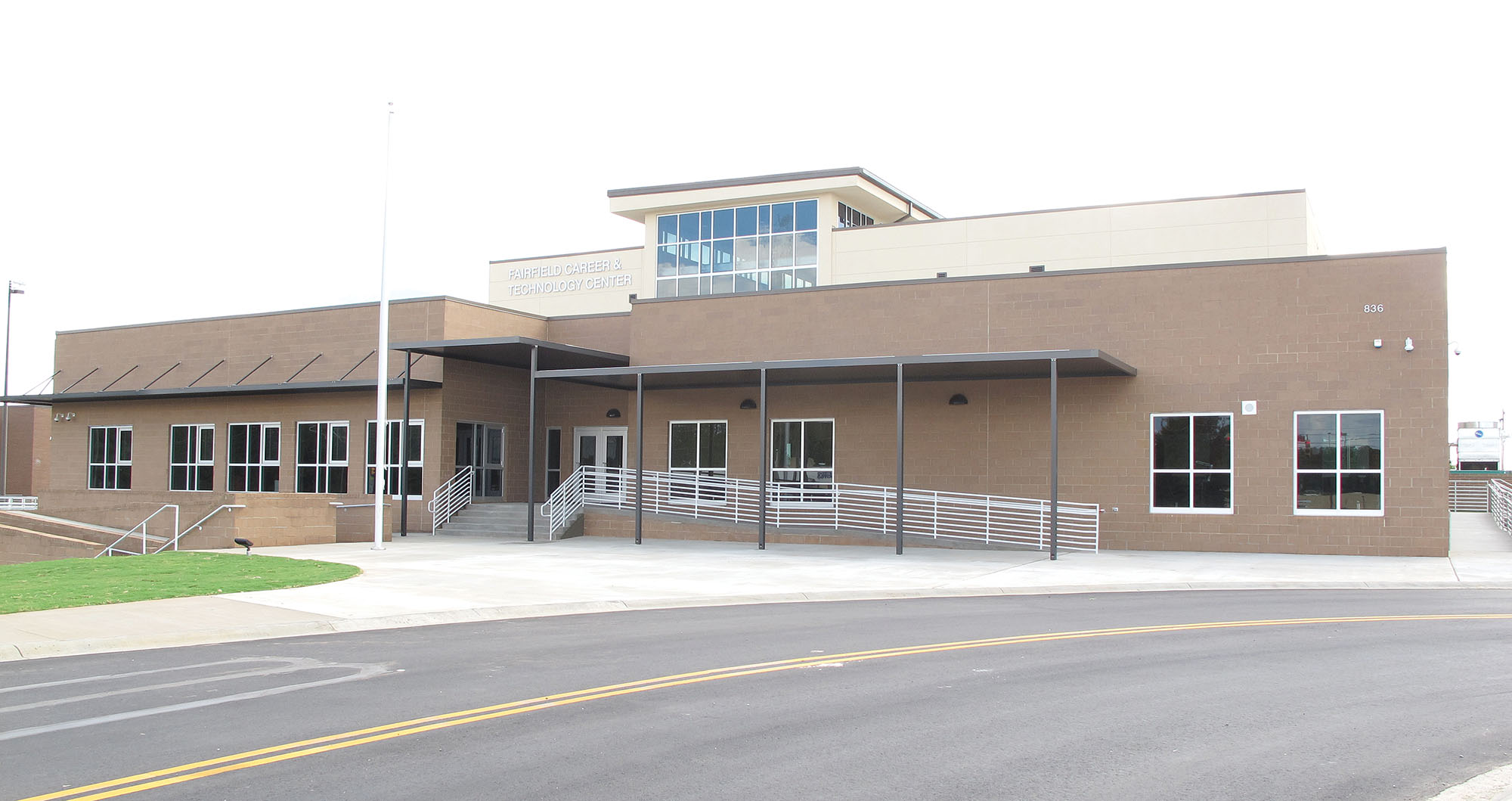
    The new Fairfield County Career & Technology Center.
    The new Fairfield County Career & Technology Center.

    WINNSBORO – Discussion by the Fairfield County School Board Tuesday night about whether or not to construct a covered walkway between the Middle School and the new Career and Technology Center veered off course momentarily into money spent on security systems and the Superintendent’s contingency fund, but ultimately settled with the Board tabling the matter.

    Dr. J.R. Green, Superintendent of Schools, presented the Board with an array of options for the canopy, ranging from $79,000 to $186,000 (see the Aug. 14 edition of The Voice), but said his concerns involved the effectiveness of a canopy that would have to be approximately 17-feet high in order to accommodate bus traffic, as well as the how the late addition would affect the overall look of the facility.

    “If the canopy is 17-feet tall, unless you get a rain that is coming directly down, will it provide much coverage?” Green said, adding, “They did such a good job constructing a facility we can be proud of, I would not want to put something that is gaudy that crosses the road that really takes away from the facility.”

    An option, Green said, would be to construct a covered walkway along the sidewalk of the Middle School, and a second covered walkway along the Career Center sidewalk, leaving the 24-foot span of driveway uncovered. That option, which Board member Henry Miller (District 3) put on the floor as a motion, would cost the District $79,000, according to the bid submitted by Ventilated Awnings Corp. William Frick (District 6) seconded the motion.

    But Board member Annie McDaniel (District 4) did not like the sound of that alternative.

    “By not ensuring our children do not get wet in their transition from the Middle School to the Career Center, how does that affect our students?” McDaniel asked.

    When Miller answered that a 17-foot-high covered walkway spanning the drive would not, in fact, ensure that students remained dry, McDaniel asked, “Are we saying the children coming from the high school are more important than the children coming from the middle school?”

    “We don’t want to phrase it that way,” Miller said. “We want to make sure that any time we spend our money that it’s spent in the right way. If we’re going to build something and it doesn’t make sense and they’re still going to get wet, why throw away that money? Let’s make rational and smart decisions. That’s all I’m saying.”

    McDaniel then blasted Dr. Green for his $40,000 contingency fund, “to do whatever he wants to do with and doesn’t have to bring accountability back,” she said; and the board for spending $180,000 on a security system. When Chairwoman Beth Reid (District 7) tried to steer McDaniel back onto the topic of the canopy, McDaniel concluded, “but we don’t want to spend the money for our babies so they don’t get wet?”

    “If we spend money on this and it’s 17-feet high and the kids still get wet,” Miller said, “somebody is going to look at us and say that was pretty foolish.”

    At Frick’s suggestion, Miller withdrew his motion and Frick followed by withdrawing his second. Frick then moved to table the discussion until all four companies bidding on the project could bring architectural renderings back to the Board for review.

    In the meantime, Green said, the District had purchased 25 umbrellas, which are kept at the Middle School and used by students walking from there to the new Career Center in inclement weather. Green said there were never any more than 21 students moving back and forth between the two buildings at one time.

    “And I’m proud to say, Ms. McDaniel, that I took that money out of that superintendent’s contingency fund to purchase those umbrellas,” Green said. “So it is being put to good use.”

    During the canopy discussion, McDaniel also revealed that she had called the architects to question them about the canopy. After the canopy matter had been tabled, Reid asked individual Board members to refrain from calling the architects, and instead to rout their questions through District channels.

    But McDaniel refused.

    “That’s a violation of First Amendment rights,” McDaniel said. “If I want to call the architect or anybody else that’s doing business in this district, I will call them, so you and all the board members will know that.”


  • Public Hearing Slated for Rezoning

    BLYTHEWOOD – A public hearing will be held on Thursday night, Aug. 20, prior to Town Council’s second and final vote on whether to rezone 636 acres along Community Road for industrial use. The new zoning classification, Light Industrial-2 (LI-2) was requested by Richland County for an industry it says is interested in the site. No discussion, opposition or questions were raised during first reading at the June 29 Council meeting.

    While the LI-2 zoning district will allow a wider variety and greater intensity of manufacturing uses than the Town’s current Limited Industrial District (LI), Town Administrator Gary Parker said LI-2 supports Council’s new focus on economic development policies in the Town’s proposed Comprehensive Plan. That plan is currently moving through the Planning Commission and should go to Council for a vote in September.

    Ed Parler, the Town’s consultant for economic development, has said the LI-2 zoning will help the Town establish a regionally significant industrial site.

    Fees for Tree Removal/Park Use

    Thursday evening’s Town Council agenda includes a proposed ordinance that will add several fees to the Town’s fee schedule. Under that ordinance, a landscape/tree removal fee will be charged for the Town to review such projects. These fees would be established at $25 for residents for an individual lot review, $500 for a commercial lot review and $1,000 for a subdivision review.

    New fees are also proposed for those who bring plans before the Board of Architectural Review that are subject to review by the Town’s consulting architect.

    “According to our consulting architect, a fair design review fee for a plan would range between $500 and $1,000, depending on the type of plans and number of changes to be reviewed,” Parker said. “We therefore recommend setting the fee at actual cost of the architect charges up to $1,000.”

    The current charge for appearing before the Board of Architectural Review is $100.

    The ordinance would also reduce the zoning map amendment fees to cover only the cost of ads, posting the property and mailing of notices. Parker suggested that could reduce fees from about $500 to $250.

    There will also be a separate proposal to set fees for the rental of various facilities in the town park. A $30-per-hour fee for residents ($35 for non-residents) is proposed for the amphitheater and soccer field and $25-per-hour fee for residents ($29 for non-residents) is proposed for the multi-purpose field.

    Budget Amendment

    A final vote will be taken on an ordinance amending annual capital, operating and enterprise fund budgets for the Fiscal Year 2015-2016.


  • Council OK’s Water Transfer, Considers Security Measures

    WINNSBORO – Town Council during their Aug. 4 meeting voted unanimously to transfer the water agreement for Holly Bluffs subdivision in Blythewood from S.C. Pillon Homes, Inc. to D.R. Horton-Crown, LLC.

    John Fantry, the Town’s utilities attorney, said Council originally agreed to furnish 24,800 gallons per day to the prospective 62-home subdivision in 2011, when it was known as Summer Trace and owned by the Bessinger family of Columbia. The agreement passed to S.C. Pillon Homes when the Bessingers sold out to the Georgia developers in 2013. S.C. Pillon Homes sold to D.R. Horton-Crown last year.

    The transfer of the water agreement gives D.R. Horton-Crown the green light to start building on the property, located on Blythewood Road.

    Security

    Councilman Clyde Sanders proposed that Council should invest in a security system for Town Hall and the Town’s annex building on W. Washington Street.

    “We watch the news at night and people are walking into places and shooting people,” Sanders said. “Everybody says that can’t happen in Winnsboro, but it happens everywhere. We’re spending money on parks and recreation and everything else, and we’ve not had anything happen in the town of Winnsboro; but do we have to wait for something bad to happen in order to say that we need to provide security? I don’t think so.”

    Town Manager Don Wood said Council had budgeted $14,000 this year for a security system, and Sanders moved to put that money to use. Councilman Stan Klaus seconded the motion, which passed 3-1. Councilman Jackie Wilkes voted against the measure.

    Following executive session, Sanders amended his motion to cap the expenditure at $10,000.

    STEM Institute

    In a presentation to Council, Wanda Carnes, Vice Chairwoman of the Midlands STEM Institute, made an appeal for assistance with utilities heading into the 2015-2016 school year. Carnes said the school has recently added three modular buildings to accommodate an enrollment that has increased from 72 children last year to 155 in grades K-6 this coming year.

    “We are in need of water, sewer and power for these three modular (buildings),” Carnes said. “Specifically, per the plans, we need 1,200 feet of 2-inch PVC pipe, and 350 feet of 4-inch PVC pipe.”

    Carnes also asked Council if the Town could waive the sewer tap fee. She also said the school would provide the Town with a letter waiving any liability if the Town would perform the installation work.

    Council took no action on Carnes’s request, but after the meeting confirmed that the Town does not provide similar utilities assistance for other schools in the county.


  • Board Mulls Career Center Change

    WINNSBORO – While the Fairfield County School District officially cut the ribbon Wednesday on their new Career and Technology Center (CTC), when the state of the art facility opens for students later this month, those making the trek from the adjacent Middle School will have to do so in the elements.

    Fairfield Central High School students attending the CTC will be able to reach the facility under the shelter of a covered walkway, approximately 8- to 10-feet in height. But between the CTC and the Middle School lies a major access road for buses and other large vehicles, such as service trucks and emergency vehicles.

    As Dr. J.R. Green, Superintendent, pointed out at the School Board’s June 9 meeting, the original design for the CTC did not include a covered walkway to the Middle School and the addition of one would constitute a change order that would add to the cost of the project.

    “That really should not be a change order,” Board member Annie McDaniel (District 4) said during the June 9 meeting. “They (Brownstone Design, LLC and MBAJ Architecture) should have to eat that. That should have been part of what we bid out. If they failed to bid it out, that should be their problem and not ours.”

    Green told McDaniel that the guaranteed maximum price of $17,710,982, approved by the Board on a 4-2 vote (McDaniel and District 2 member Paula Hartman voted against) during their May 20, 2014 meeting, was based on drawings that did not include a covered Middle School walkway. Green would, he said, ask M.B. Kahn, the project’s construction manager, to explore such an addition.

    During the Board’s July 21 meeting, from which McDaniel was absent, Green reported an initial quote of $115,057 for the addition from Ventilated Awnings Corp.

    Green said the quote was significantly higher than he had expected, but added that the estimated height – at least 17 feet – necessary to accommodate large vehicle traffic made the addition an expensive proposition. Furthermore, he said, with the walkway reaching that high into the air it may be money wasted.

    “Unless you’re getting rain coming straight down,” Green said, “it really provides very little benefit.”

    While Board member Carl Jackson (District 5) echoed McDaniel’s June 9 sentiments, calling the absence in the original design of a walkway “short-sighted,” Green said even had one been planned from the beginning, it still would have had to reach a height great enough to accommodate bus traffic.

    “It really is a consequence of where (the CTC) is located,” Green said.

    The Board held off on a final decision on the walkway, asking Green to explore additional quotes.

    Last week, Green shared with The Voice a list of four quotes for the canopy, including a revised quote of $105,400 from Ventilated Awnings.

    Peachtree Construction offered the next lowest quote, at $118,500; followed by Creative Protective Covers, at $135,500; and Mapes Construction, at $186,815.

    Future Former Career Center

    The Board did take action on renovations to what will soon be the former Career Center, unanimously approving a $1,669,500 bid by Weber Construction Co. Weber’s bid was the lowest of five offers that included Pyramid Contracting ($1,770,500), FBI Construction ($1,790,000), Metcon Commercial Construction ($1,838,250), and Southern Builders of York County ($1,847,000).

    Weber’s bid includes $32,500 for the replacement of the electrical system and $92,000 for the replacement of the lighting system for the entire facility.

    Once renovated, the facility will house the District’s alternative school, Gordon Odyssey Academy, as well as the Transportation and Maintenance departments.


  • Master Plan Moves Forward

    WINNSBORO – County Council Monday night unanimously gave administration the green light to broker a $303,163 deal with T.Y. Lin International to develop the Strategic Community and Economic Development Master Plan – a framework for how to put to use the tens of millions of dollars in revenues expected from two new reactors under construction at the V.C. Summer Nuclear Station in Jenkinsville.

    Interim County Administrator Milton Pope said the plan would entail the revitalization of Winnsboro, Ridgeway and Jenkinsville, and would include an investment in infrastructure.

    “That means roads and other infrastructure,” Pope said. “That means water and sewer.”

    Speaking during the meeting’s first public comment session, prior to the presentation and vote on the plan, Ridgeway resident Randy Bright said each of the County’s previous strategic plans had included a call for the development of water and sewer infrastructure, but that those elements had never been implemented. It was time, he said, to not only have a good plan, but to follow through with it.

    “The County of Fairfield is not the official provider of water and sewer in this county,” Pope answered in a preamble to his presentation of the Plan. “The Town of Winnsboro does control water and sewer.”

    A larger, countywide water strategy, Pope said, could not be implemented by the County unilaterally, but instead had to be done in conjunction with Winnsboro and the county’s other smaller water providers.

    The four phases of the Master Plan, Pope said, would include a project set-up, a County assessment of existing plans, a community development action plan and an economic development action plan. The latter, he said, was already under way through the I-77 Alliance.

    “After we became a member of the I-77 Alliance, there was a regional economic development plan that was procured and has already been adopted by the I-77 Board,” Pope said. “All four members of the I-77 Alliance are updating their individual economic development plan, so we’re doing that on a parallel track. That will be folded into this process by the end of it.”

    Addressing the use of elements of the County’s existing plans, David Gjertson of T.Y. Lin said finding out what is still useful in those plans will be the trick.

    “A lot of these plans you mentioned, they’re gathering a little bit of dust,” Gjertson said. “That doesn’t mean there isn’t anything in them that isn’t meaningful. All of those documents will be included. The idea is to take that information and create a combined plan, a master plan.”

    Pope said the plan will include “extensive public involvement” through community meetings and workshops, as well as through meetings with the county’s other local governing entities.

    The process could take as long as a year to complete, Pope said; although Council could extend that with additional meetings, if necessary.

    “Just make sure that you don’t forget other population centers – Mitford, and we have the 321 corridor that includes White Oak and Blackstock,” Councilman Walter Larry Stewart (District 3) said, “and Jenkinsville. Make sure they’re included in the data collection process.”

    Stewart also asked that the plan be “implementable.”

    “Not something that’s going to be put on the shelf and get lost, that we can’t implement and we have to hire another $100,000 consultant to come in and interpret it for us,” he said.

    “Unlike some of the other studies you might have done, the public involvement process is very comprehensive,” Gjertson said. “We want to cover the whole county. Ultimately the goal of this master plan is not just to provide a master plan, but to provide an implementation program that is meaningful.”

    With the approval, Pope said staff would now work with the County’s attorney to produce a contract, which would be brought back to Council on Aug. 24 for a final OK and an official start date.


  • ‘Project USA’ Incentives Clear Second Reading

    WINNSBORO – With the matter breezing through its public hearing without any member of the public signing up to speak, Ordinance 652 unanimously cleared second reading during County Council’s Monday night meeting.

    The ordinance, pending a final reading on Aug. 24, puts into place a Fee-in-Lieu-of-Taxes agreement (FILOT) for the economic development project code named “Project USA,” which Interim County Administrator Milton Pope said at Council’s July 27 meeting would require the company to invest $125 million in the project over five years and create 75 new jobs.

    The company would be taxed at a 6 percent assessment ratio, Pope said last month, with real property not subject to reassessment. Pope also said the County would be partnering with the Town of Winnsboro to extend a natural gas line to the undisclosed project site at no cost to the company. The company would also be seeking to rezone 180 acres of the proposed project site, Pope said.

    Council also gave the third and final OK to an ordinance to rezone 0.75 acres of land at 67 Rocky 1 Road in Winnsboro from Rural Residential District (RD-1) to Rural Commercial District (RC).

    Councilman Billy Smith, whose district (7) includes the property, said the rezoning will allow the residents there to continue to operate their home daycare business in the face of new regulations from the Department of Health and Environmental Control (DHEC).

    Also approved by Council was an expenditure of $35,261 for the purchase of a replacement patrol car for the Sheriff’s Office. The expenditure was recommended to Council by the Administration and Finance Committee on July 27. The 2014 Chevrolet Caprice replaces a car that was totaled last month after striking and killing two cows while responding to an emergency call.

    “At least it wasn’t a horse,” District 3 Councilman Walter Larry Stewart quipped.

    Regarding the mare and colt who died last June after spending a month in the custody of the County’s Animal Control services, only one citizen made comment Monday night.

    Beth Jenkins (District 2) suggested Council enact a moratorium on large animals until regulations governing their care could be tightened.

    “I realize that an ordinance or some sort of laws need to be done, and that takes time,” Jenkins said during Monday’s second public comment session. “I think immediately (Animal Control) should not be allowed to take in large animals and that Hoof and Paw should be called in immediately, so no more animals are treated the way that they were and the horrific deaths that they went through.”

    Reviews on how Chairwoman Carolyn Robinson (District 2) handled a third and final outburst of applause during the July 27 meeting (see the July 31 edition of The Voice) were mixed Monday night.

    While Rockton Thruway resident David Brandenburg called the incident, in which Robinson cleared the chambers, a “fiasco of epic proportion,” he also said he thought the Chairwoman was set up to look bad.

    “It was a ruse, all planned,” Brandenburg said. “You (Robinson) got a lot of Facebook playtime on that. I’m sad to say, I think you fell for it hook, line and sinker.”

    Darlene Johnson of Greenbrier, meanwhile, said she was “outraged” by Robinson’s decision to clear the chambers.

    “I am certain that Roberts Rules of Order does not foster the interjection of personal privilege as was done during the Council meeting of July 27,” she said. “Too long has personal privileged been imposed on every citizen of Fairfield County.”

    While Dawkins resident Jeff Schaffer said he missed the July 27 meeting, he said he hoped Council could improve its relationship with the citizens.

    “Leaders don’t intimidate young children,” Schaffer said. “Leaders don’t act like dictators. Leaders don’t spew racial innuendoes. Leaders don’t incite the general public.”

    Schaffer went on to criticize Council’s senior leadership, telling them, among other things, “It’s obvious to all of us you don’t know what you’re doing, why you’re up there. And sadly, you’ve been elevated beyond your authority to function.”

    Responding during County Council time, District 4 Councilman Kamau Marcharia, who represents the Dawkins community, asked for specific, constructive suggestions.

    “I’ve heard a lot of grandiose ideas about how we’ve failed and what we did do and what we don’t do,” Marcharia said. “I would like for these folks to give me a structural analysis of what they mean by moving forward, attach a budget to it and bring it to us and we’ll take a look at it and maybe we can move forward.”


  • Absences Delay Comp Plan

    BLYTHEWOOD – Without a quorum, the Planning Commission on Aug. 3 was restricted to discussing items on the agenda without taking any votes. Four of the seven members of the Commission, Robert Cappadona, Marcus Taylor, Mike Switzer and Ernestine Middleton, did not attend the meeting.

    With the final draft of the Town’s Comprehensive Plan on the table, it was expected the Commission would forward it on to Town Council with a recommendation for approval. Instead, Commission Chairman Malcolm Gordge reviewed the finalized updates to the Plan that were made by Greg Sprouse of Central Midlands Council of Governments.

    The major change in the Plan made economic development a top priority for the Town, Gordge said.

    “This was the principal thinking that came out of the Council’s retreat last March,” Gordge said. “Another focus, I think, is that we have essentially eliminated duplication of the previous plan, mostly concerning the environment. Environmental concerns took up a large portion of the Plan. So we cleaned this up to achieve clarity.”

    Sprouse also included a map of the town’s water and sewer lines in the proposed plan and updated several text issues and demographic numbers. Gordge concluded that the changes will make the plan more readable now.

    The purpose of the Plan is to provide guidance for planning and zoning. It is required by state law to be updated every 10 years and can be updated as frequently as every 5 years. It was last updated in 2010. The Plan is expected to be recommended to Council by the Planning Commission at its Sept. 6 meeting and then be discussed by Council at its September workshop.


  • Medical Office Seeks Final OK

    BLYTHEWOOD – A medical office designed to be shared by two private medical practices in downtown Blythewood is expected to seek final approval from the Town’s Board of Architecture Review (BAR) Monday night. The project received partial approval from the BAR in June. Architect Matt Davis represents the project and is also the Town’s architectural consultant.

    The 7,000-square-foot, two-story building, to be located on Blythewood Road across from Companion Animal Hospital, will house the offices of Dr. Jim Ellis, an optometrist, and Dr. Frank Dorn, a pediatrician.

    The request for a certificate of approval met with several obstacles when it came before the Board in June. Because the Town Center zoning ordinance requires all new commercial buildings to have multiple stories and meet a height requirement of 24 feet, the BAR voted to give the applicants a variance for the two one-story wings, allowing them to be limited to a height of 16 feet. And because the Department of Motor Vehicles requires that driveways (entrances/exits) align with driveways across the street, the BAR also voted to allow a shift of the building toward the east lot line to allow for that driveway match up.

    Additional architectural details (materials, colors, etc.) and the final site plan with landscaping, lighting and signage are expected to be submitted on Monday evening for the balance of the approval. The meeting will be held in The Manor at 7 p.m.