Category: Government

  • Board Approves 26 Field Trips Costing $175,000

    WINNSBORO – The Fairfield County School Board approved 26 out-of-state and overnight student field trips at its regular called meeting Tuesday, Oct. 20, despite the concerns of two dissenting board members that the board lacked adequate information and justification for its actions. The trips will take selected Fairfield County middle- and high-schoolers to the Bahamas, Puerto Rico, New York City, Orlando, Myrtle Beach and other venues. Of specific concern was the cost of the trips, estimated at more than $175,000.

    The trips were listed on eight spreadsheets, one for each school, showing the planned trips, date and destination, number of students and adults traveling, curriculum standards the trips would address and cost for each trip. The discussion focused on the information – and lack of it – presented in the spreadsheets.

    Hartman questioned the cost of the Orlando trip – $33,810 for 45 students and three chaperones – and about a planned Bahamas trip two months later for 40 students and six chaperones, at a cost of $27,140, both for Chorus, Theater and District Honors students. Green stated that it would be some of the same students going on both trips.

    “The information I have asked (you) in the past to be clear on,” Hartman persisted, “is what exactly are the students getting from this trip, education-wise?”

    Green replied, “It gives them the opportunity to perform.”

    The curriculum standard to be addressed by both trips, as listed on the spreadsheet, is: “Perform learned accompaniment patterns for selected songs, using appropriate dynamics and timbre and a steady tempo.”

    Green stated that the students have “fundraised and contributed their personal resources each year. I think the district supported that last year to the tune of, off the top of my head, about 10 or 12 thousand dollars …it wasn’t as if the district funded the entire trip.”

    Hartman also pointed out that a planned trip to Puerto Rico for 10-12 history students listed the entire trip as costing $2,000, when last year that same trip cost about $22,000. Green said the $2000 figure was an error and should have been shown as a per person cost. That clarification added approximately $28,000 to the cost of the trip.

    “What I am hearing now is that these requests are not the totality of what the district is being asked to fund,” McDaniels said. “So exactly how much is the district being asked to fund?”

    Green replied, “There is no total and at this point in time, most of these groups are hoping they can raise enough funds so that the board would not have to approve any additional funding.”

    McDaniel stated that, “Now I am not going to address ‘hope’ with you, Dr. Green…but if you want the Board to approve, it’s kind of deceptive, that we have amounts before us, but you are now saying that these are not the amounts the board is being asked to approve.”

    Green stated that at this time he wasn’t asking the board to approve the money, just the field trips.

    Hartman asked Green the purpose of the Puerto Rico trip for history students.

    “A cultural experience, the opportunity to witness the Puerto Rican culture first hand, the cuisine, the climate, the dress, the weather…” Green stated.

    Hartman was not satisfied, saying he was not making it clear what the students are getting out of this trip.

    Green replied that, for example, the Puerto Rico trip would address curriculum standard 7-6 which says the “student will demonstrate an understanding of the significant political, economic, geographic, scientific, technological and cultural changes as well as the advancements that have taken place throughout the world.”

    Hartman continued to point out that it was not clear how much the trips will actually cost nor what amount will be fund-raised.

    Board member William Frick (District 6) said he recalled similar discussions about field trips in the past in that there was a lack of uniformity in filling out the forms. “Could we have the total amount put in there in the future?” he asked.

    Hartman asked if those forms could also show how much of the costs the Board is expected to pay.

    “In the future we’ll do that,” Green said.

    When the issue finally came to a vote, it passed 4-1 with Hartman voting no and McDaniels abstaining. Board member Andrea Harrison (District 1) was not present.

    Following the meeting, Hartman told The Voice that she voted no because there seemed to be no clear explanation as to how much money the students are expecting to raise or how much money the school will be paying.
  • Griffin, Gordge Join Council

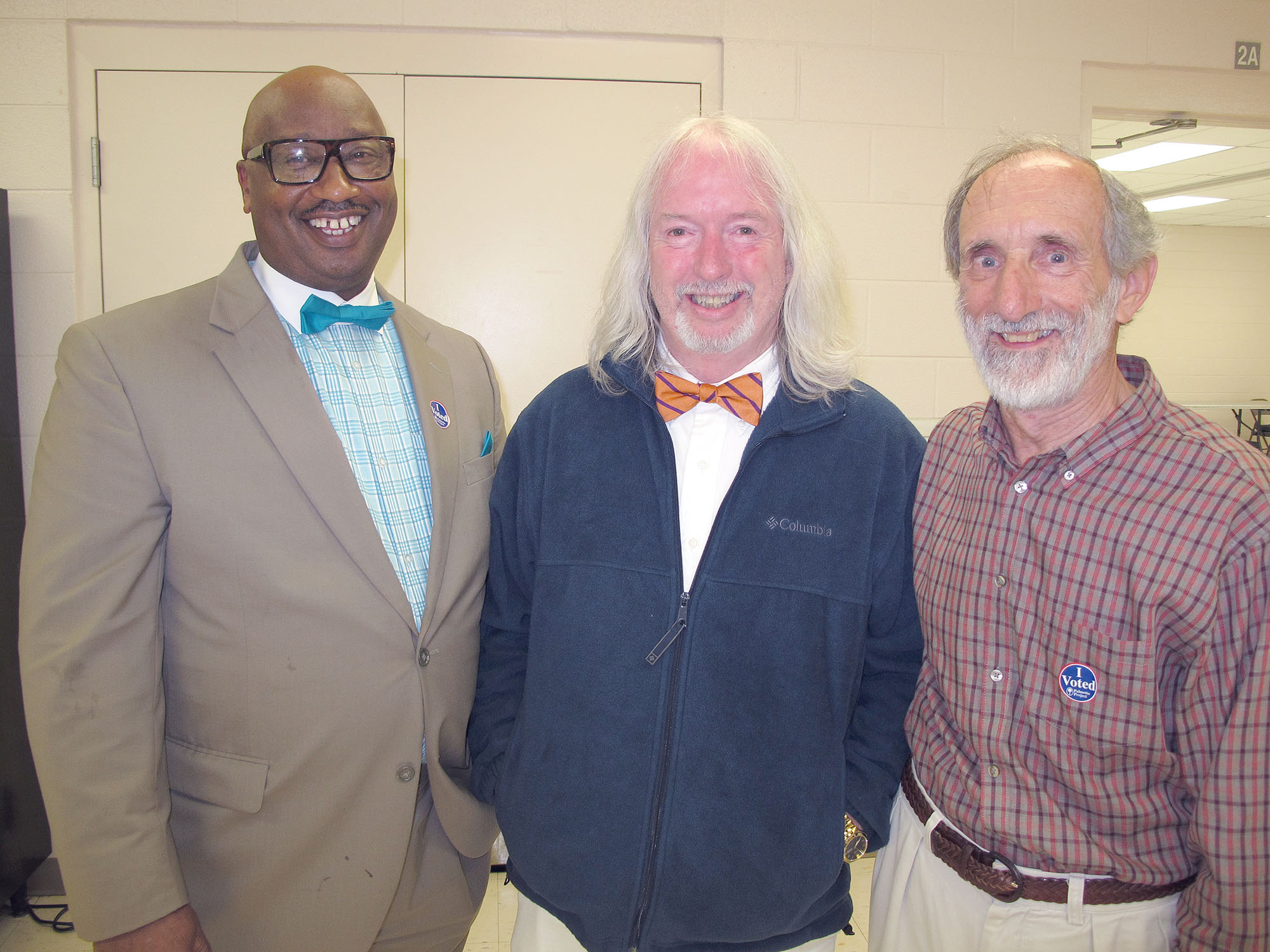
    Larry Griffin, Eddie Baughman and Malcolm Gordge came out on top in Tuesday’s municipal elections in Blythewood. (Barbara Ball)
    Larry Griffin, Eddie Baughman and Malcolm Gordge came out on top in Tuesday’s municipal elections in Blythewood. (Barbara Ball)

    BLYTHEWOOD (Nov. 3, 2015) – Even though the balance of power was at stake in the Blythewood municipal elections Tuesday evening, not much change in policy or vision is expected on the five-member Town Council. During a candidate forum, the candidates generally agreed that problems resulting from growth – traffic, rezoning and the need for better infrastructure – are the hot button issues facing the town.

    Incumbent Eddie Baughman and the Town’s Planning Commission Chairman, Malcolm Gordge, came away with victories over newcomers to Blythewood politics, Bryan Franklin and Robert Rue, for the two four-year terms. Blythewood native Larry D. ‘Griff’ Griffin, in his first run for office, was the clear winner over Blythewood newcomer Michelle Kiedrowski for the two-year, unfinished term of Bob Massa who moved out of the area last June.

    Griffin’s election held historical significance as he followed in the footsteps of his late aunt, Elizabeth Hagler, who served two terms on Council from 1996-2004 as the first African-American elected to public office in Blythewood.

    With a low turnout of approximately 16 percent, the winning candidates had their home precincts to thank for putting them over the top. Baughman, who lives in the Lake Ashley area, drew 84 votes or almost half his total 178 votes from Blythewood Precinct 2 where residents of the Lake Ashley area vote. Griffin, who lives on Langford Road, but whose family roots run deep in the Boney Road/Lake Ashley area, took 87 votes in Blythewood Precinct 2. Gordge, who is secretary of the Ashley Oaks neighborhood, received 85 votes, the lion’s share of the 193 votes cast in that area’s Blythewood Precinct 3.

    While 304 voters signed in to vote, only 302 votes registered. Election officials said the discrepancy will be accounted for before Thursday when the election is certified.

    Baughman, Griffin and Gordge will be sworn into office at the regular Nov. 30 Town Council meeting that will be held at The Manor.


    Final Vote Tally

    4-year term

    Eddie Baughman: 178

    Malcolm Gordge: 147

    Bryan Franklin: 119

    Robert Rue: 53

    2-year term

    Larry Griffin: 164

    Michelle Kiedrowski: 111


  • Noise Ordinance Stalls at Second Reading

    WINNSBORO (Oct. 30, 2015) – County Council’s revised noise ordinance, which has been in the works since last April, was derailed Monday night before second reading, forcing the Chairwoman to call for a special work session.

    “Nobody I have talked to wants this ordinance passed,” District 5 Councilman Marion Robinson said during Monday’s meeting.

    Robinson said he was concerned that the revised ordinance would hinder private skeet shooting and other sport shooting on private property. But Councilman Billy Smith (District 7), who serves on the Public Affairs and Policies Committee that worked up the new ordinance, said the new law contains ample exemptions to allow for firearms and other exceptions.

    “The exemption there (for clay sporting) says ‘noise associated with legal operation of any firearm at any shooting club, range, business, hunt club, clay sporting location or event,’ so ‘event’ does away with the notion or the thought that it’s only a business,” Smith said. “An ‘event’ can be me and a couple of buddies in my back yard. It doesn’t have to be a sanctioned event.”

    Robinson, however, said the ordinance should contain a definition for ‘event,’ “because I sure did not get that out of that.”

    “I do not think in any way, shape or form I could understand that an event is me and a couple of my buddies going and doing that,” Robinson said.

    District 1 Councilman Dan Ruff agreed and said he did not want to see Council make things “too governmental and too strict.”

    “I would like to see us maintain noise by our officers talking to people and dealing with issues as they come up,” Ruff said. “I don’t think we need to make things so complicated.”

    But leaving noise complaints solely to the discretion of Sheriff’s deputies, Smith said, was the principal weakness in the previous ordinance.

    “What this ordinance does is put a decibel level in place so we actually have a definition of what is too loud or isn’t too loud,” Smith said. “There are exceptions in here; there are also definitions in here.”

    The Committee, chaired by District 6 Councilwoman Mary Lynn Kinley, worked closely with Sheriff Will Montgomery to craft the language in the new ordinance to make noise levels enforceable.

    “The Sheriff said he had to have something that the magistrates could charge,” Kinley said. “Before now, they had nothing really concrete they could charge a fine for.”

    “This is a balanced approach,” Smith added, “that protects the person in their home who’s trying to sleep as well as the person outside shooting their gun in a sensible manner. With this ordinance, I believe you have a less chance for getting cited for something; however, when you get cited for something, it will be something the court will be able to rule on and uphold, which was not the case with our prior ordinance.”

    The Committee last April tacked on measurable decibel (dBA) levels to the previous ordinance, and extended the period of time covered under the ordinance to include 6 a.m. to 10 p.m. The previous ordinance covered the 10 p.m. to 6 a.m. time period, but with no dBA levels, Montgomery said the law was difficult to enforce and convictions were all but impossible.

    “The reason for the decibels is for mainly court purposes,” Montgomery told the Committee. “If we don’t have that, we don’t have anything to show the judge that the noise reached this level.”

    The impetus to strengthen the ordinance came, Kinley said during the April 6 Committee meeting, after an incident in the Lake Wateree area involving an individual racing a loud ATV and firing a high-powered rifle near a residence.

    “We’ve talked about this before and I didn’t hear any of these concerns,” Kinley told Council Monday night. “I want you to think about the reasons we are doing this. It was not just to change the noise ordinance. It wasn’t to prevent folks from having events. It was not to keep folks from doing what they do on their property. The reason we were going to change this was to protect citizens, some of whom couldn’t even stay in their homes.

    “You have to have a complaint to pursue a noise ordinance,” Kinley added. “You’re not going to have people out there running around listening to people skeet shoot.”

    Chairwoman Carolyn Robinson (District 2) asked Council to send the ordinance back to committee for yet another look, but Kinley said a work session with the full Council was necessary.

    “We met, I think, four times,” Smith agreed. “We let citizens come in and speak three times. This thing has been worked beyond exhaustion.”

    A date had not been set at press time for the work session.


  • Pellet Plant Sparks Opposition

    Aerial shot of Enviva wood pelleting plant in Ahoskie, N.C., a facility similar, according to Emily Zucchino of Dogwood Alliance, to the plant proposed in Winnsboro. (Photo/Dogwood Alliance)
    Aerial shot of Enviva wood pelleting plant in Ahoskie, N.C., a facility similar, according to Emily Zucchino of Dogwood Alliance, to the plant proposed in Winnsboro. (Photo/Dogwood Alliance)

    WINNSBORO (Oct. 30, 2015) – A proposed wood pelleting facility ran into its second snag Monday night in its bid to construct a plant on more than 180 acres it plans to purchase on Cason Road, and this time it wasn’t because of the weather.

    Record rains and flooding scrubbed County Council’s slated first reading on Oct. 5 of an ordinance to rezone two parcels for AEC Pellet 1 USA from RD (Rural Resource District) to I-1 (Industrial District). Although Council finally got first reading in during their Oct. 12 meeting, Monday night a different kind of storm disrupted the process.

    “This company is going to get tax breaks out the ying-yang,” Darryl Harbour told Council during Monday’s public hearing on the rezoning proposal. “We, however, are probably not going to get any tax breaks, even though our home values are fixing to plummet, our land values are fixing to plummet.”

    Harbour was one of 10 neighboring landowners who signed up to speak out against the ordinance that would rezone 2.01 acres owned by Rosezenna Cason White at 137 Cason Road, and 180 acres owned by Wateree Holdings LLC c/o Forest Investment Associates also on Cason Road.

    “For them to say they’re coming in here and investing $125 million, that is false,” Harbour said. “They are going to build a building. They are going to buy land. They’re going to buy a huge investment in equipment and that equipment is going to be made overseas. That’s where the millions of dollars of money is going to be going. And then it will be transported over here, put into effect and we get to live with the results of it.”

    According to documents on file with the S.C. Department of Health and Environmental Control (DHEC), the facility would have an annual production rate of 530,000 tons, with a minimum hourly production rate of 71 tons.

    “Breaking that down in sheer weight alone,” Harbour said, “that would be 26,500 truckloads up and down the highways in Winnsboro a year.”

    Rail traffic also presents a problem, he said, in a community accessed by one-way streets.

    “They plan to unload 22 cars,” Harbour said. “Twenty-two railcars at 60-feet long is about 1,300-feet long. We’re used to that railroad car zooming through; it’s going to be a whole different ballgame when they come to a screeching stop and start transferring 22 cars at a time. If you happen to be someone back in the neighborhood trying to get physical help, having a heart attack, that ambulance comes and you ask that train that’s at least 3,000-feet long to hurry up and move out of your way – it’s not going to happen.”

    Council announced the tentative arrival of AEC Pellet 1 during their Aug. 24 meeting, when they also passed third reading and disclosed the details of the company’s incentives package.

    Interim County Administrator Milton Pope said during the Aug. 24 meeting that the terms of the Fee-in-Lieu-of-Taxes (FILOT) agreement included a $125 million investment by the company, as well as the creation of 75 new full-time jobs. AEC Pellet will be assessed at a ratio of 6 percent, Pope said, and will pay a fixed millage rate of 423.3 mills for their first 30 years. They will also receive a special source revenue credit of 60 percent per year for the first 10 years.

    But in 10 years, there may be no market for what AEC Pellet 1 produces, according to Emily Zucchino, a campaign organizer with the Asheville, N.C. environmental advocacy firm Dogwood Alliance.

    “This market is based on European policies, which we know with working with policy makers in Europe will change in the next 10 years,” Zucchino told Council. “The wood pellet industry is an extractive export market to feed power plants in Europe, and is in a transitional market until these power plants switch to wind and solar. So my question for you is what happens to Winnsboro in 10 years when there are no longer subsidies in the market for these wood pellet facilities?”

    Pollution is also a concern with wood pelleting plants, Zucchino said, with facilities generating fine particulate matter into the atmosphere. In N.C., she said, communities living near similar facilities have seen increases in respiratory illnesses, bronchitis and asthma.

    According to DHEC documents, and as first reported in The Voice on Aug. 29, emissions generated by the facility would include particulate matter (less than 10 micrometers in diameter and less than 2.5 micrometers in diameter), nitrogen oxides, carbon monoxide, sulfur dioxide, Volatile Organic Compounds (VOC) and Hazardous Air Pollutants (HAP). The notice states, “a federally enforceable facility-wide limit of less than 250 tons per year” of the particulate matters, the carbon monoxide and VOC “would be established, thereby enabling the facility to be below Prevention of Significant Deterioration (PSD) major source thresholds.”

    Federally enforceable limits of 10 tons per year would also be established “of any single HAP, or less than 25 (tons per year) of total HAPs,” the documents state.

    An air quality permit (permit number 1000-0039-CA) was issued to AEC Pellet on March 16, DHEC said.

    “I have asthma,” area resident Sylvia Beaver told Council. “I have all kinds of health problems. If they block the railroad, I can’t get out if I’m having an asthma attack or any other kind of health issues.”

    Kerry Matthews, who lives near the proposed plant site in White Oak, said the factory would destroy the rural residential character of the community.

    “We have set up zoning regulations particularly for this reason, to protect the rural areas and communities,” Matthews said, “and it is unconscionable to me that anyone would consider putting a plant with this magnitude impact on a community in an area like White Oak. Fairfield County has industrial parks.”

    Toatley Road resident Robert W. Davis said Fairfield County can afford to be more selective about what kind of industry it brings into the county.

    “Don’t get me wrong; we are for economic development,” Davis said, “but Fairfield County is in a position whereby we don’t have to accept anything and everything that comes along just because they say they’re going to bring economic development to Fairfield County.

    “Over the next year and a half to two years, we are going to have funds coming into this county from the western side of Fairfield County,” Davis continued. “Those funds will be more than enough to sustain Fairfield County for years to come. What this will do is hurt our community. Hurt is greatly.”

    When second reading finally came to the floor, Council gave it a unanimous approval – but not without strings attached.

    “The citizenry that has talked to me, some are for it some are against it,” District 3 Councilman Walter Larry Stewart said. “But we need more detailed information concerning the air quality and all the other issues citizens from District 3 have raised tonight. I think we need to delay the process, collect the rest of the data and allow the citizens to give any additional input and then move forward.”

    Pope recommended that Council pass second reading, but delay third and final reading until additional information could be collected from Zucchino and area residents. Pope also suggested another public hearing on the matter.

    While Stewart and Mary Lynn Kinley (District 6) also suggested the possibility of a work session, District 7 Councilman Billy Smith’s motion to officially include a work session into the process failed to garner a second.


  • Developer takes another stab at Rimer Pond Road rezoning

    BLYTHEWOOD (Oct. 29, 2015) – Unsuccessful in swaying residents in the LongCreek Plantation and Rimer Pond Road area to accept commercial zoning on a 5.23-acre parcel on Rimer Pond Road (across from the Blythewood Middle School) last summer, commercial realtor Patrick Palmer withdrew his rezoning request at the June 23 Richland County Council public hearing. But last week a new sign went up on the property requesting once again that Richland County rezone the property for commercial use.

    The request, which was made by Hugh Palmer, Patrick Palmer’s father, will be heard by the Planning Commission at 1 p.m., Thursday, Nov. 5. Members of the public are allowed to speak at this meeting, but must sign the speaker’s list (for or against the rezoning) before the meeting begins. Palmer is asking for the property’s current Residential (RS-MD) zoning to be changed to Rural Commercial (RC) zoning.

    Patrick Palmer, whose family owns the property, is Chairman of the Planning Commission that will be hearing and voting on the issue. Because of that conflict, he is required by law to recuse himself from taking part in the discussion and from voting on the issue.

    Last week Patrick Palmer met with three residents in the area seeking their support for the commercial zoning. He did not reveal, however, that a request for rezoning of the property would be on next week’s public hearing agenda.

    Although the RC Zoning Dostroct allows such intense uses as service stations and grocery stores, Patrick Palmer told residents last spring that he envisioned such businesses as a Papa John’s, a dry cleaners and a dance studio as end users. Last week Palmer told the residents he met with that he did not know what businesses would go on the property and that he had not had any offers.

    While the County’s administrative planning staff recommended the rezoning for commercial use last April, the Planning Commission, voted against it, saying the Zoning District Summary in the zoning ordinance for the Rural Commercial District (RC) was antiquated in that it stated, among other things, that the RC district was best suited for “isolated agricultural and rural residential areas and so that residents located beyond the limits of service of the municipalities can receive convenience merchandising and services.” Some Commissioners and residents argued that the Rimer Pond Road and LongCreek areas are neither isolated nor underserved and therefore this RC zoning was not appropriate for the area.

    The zoning public hearing is set for 1p.m., Thursday, Nov. 5, in County Council chambers located at the corner of Harden and Hampton streets. For information and updates about the rezoning (including meeting agenda and information packet), ‘like’ the Facebook page KEEP IT RURAL For information from the county, email Suzie Haynes at HAYNESSU@rcgov.us.


  • Candidates Politely Make Their Cases

    Blythewood, on Tuesday you vote here: Blythewood Recreation Center, 126 Boney Road.
    Blythewood, on Tuesday you vote here: Blythewood Recreation Center, 126 Boney Road.

    BLYTHEWOOD (Oct. 29, 2015) – Last week’s Town Council candidate forum, sponsored by the Blythewood Chamber of Commerce at The Manor, was a low-key exercise in polite comments when compared to the heated debates in past years that featured unretouched questions from the audience and candidates who took out after each other as well as the non-candidate members of Town Council and Council members from past years who were no longer even in office. At the end of those two hours, there were no misunderstandings.

    Leading up to the Oct. 20 forum, questions were submitted by citizens online to the Chamber whose members first narrowed them to six, then, according to one chamber member, massaged the six queries before posing them to the candidates.

    Chamber board chairman Ed Garrison, a former member of the Town Council, momentarily upstaged the candidates as he opened the forum by lobbying for the establishment of a millage in the town and expressing frustration that state law (Act 388) has virtually precluded the Town from being able to levy a property tax since a previous Town Council abolished the Town’s millage more than 10 years ago. The resulting formula, Garrison said, amounts to ‘new millage x 0 = 0 millage’.

    Once the introductions and lobbying ended, the questioning began, moderated by Blythewood High School students Ansley Hagenbarger and K.J. Mack. Patrick Kelly, BHS AP government teacher, served as official time keeper.

    Candidates for the single two-year vacancy are Larry D. Griffin, a native Blythewoodian, and Michelle Kiedrowski, a newcomer. Candidates for the two four-year seats are incumbent Eddie Baughman; longtime Blythewood resident Bryan Franklin who is retired from the Army; Malcolm Gordge, a 12-year Blythewood resident who serves as the Chairman of the Town’s Planning Commission and Robert Rue, an Army veteran who moved to Blythewood about a year ago.

    Asked what they considered to be the two or three key issues facing Town Council, each candidate offered some combination of problems caused by increased traffic, increased growth and the critical need for infrastructure prior to any further increase in traffic and growth.

    Two-year candidates

    Griffin said growth and the lack of infrastructure are key. “I’m proactive, not reactive. I look at situations before they happen and try to make sure we have a solution to the problem. Our government has a plan in place but COG (Central Midlands Council of Government) issued a report that said we are going to have 1,500 houses built in the next couple of years. Growth has to be structured. Blythewood is looking to the Penny Tax to provide funds to restructure the roads. Whatever our plan looks like, we need to be looking at that situation right now and see where we’re going and structure those funds that are going to be coming to us to make it happen.”

    Kiedrowski agreed that growth is the number one issue. “My concern is that we need to grow with the future in mind. It’s important to respect history and the historical society, but we also need to grow and create a history for those yet to come and create a place for them to thrive. People can grow and find their place. We need to build a community. If I’m going to be on Town Council I want to know what you are all thinking. I want to know how to hear back from the constituents. How do you feel? I feel there’s not a whole diversified population that’s always expressing their opinions. I think it’s super important that communication between everyone in the town needs to be considered.”

    Four-year candidates

    Baughman named infrastructure or the lack of it and the lack of storm water management in the town as prime concerns. “The state and SCDOT are working on this, but we have to address it. We also need to look to the economic development of the town. We’re sitting on some of the best property in the county. We need to use it to attract more businesses that will fund improvements to our town. But as growth and more homes and businesses come, we need to look at how we can protect our town’s investment and how to protect your investment as a home owner. Right now we’re dependent on Richland County for our services, so it’s important that we be a better partner with Richland County. We need to make this happen for you.”

    Franklin emphasized the importance of cautious growth and preserving the rural character of Blythewood, calling traffic, rezoning and annexation the top three issues for the town. “Traffic. We don’t control road funds here in the town. The state allocates those to the county. So it’s all about collaboration, speaking with the voice of Blythewood to our officials at the county and state level. We need to improve our roads and utilize such things as traffic circles at places like the Food Lion, Community Road and on Blythewood Road. We must work closely with our representatives to make this happen. Rezoning. We all moved out here to have a farm and a garden and now a new subdivision moves in your back door. We need to listen to the people who are affected by the rezoning before we allow it. Annexation. Absolutely no more annexation unless the property owners say they want it.”

    Gordge said the top three issues are: 1) the needs of the town, 2 the needs of the town and 3) the needs of the town. “There is a raft of things to take care of and we need to find a way of prioritizing them. There are the immediate issues of the day that need to be addressed. The next level of issues are those you can plan and address in meetings, committees, etc. The third level is long term projects where you’re planning for the major objectives that might take several years to complete. The Council needs to be agile so it can make decisions quickly as well as be sure the long term goals are achieved. Growth is unavoidable. Because Richland County owns the surrounding land, that growth will come whether we like it or not.”

    Rue said he sees expansion, fiscal responsibility and education as the three top issues in Blythewood. “This is a great place, but there are a lot of homes going up. You can’t have it both ways. We need an infrastructure plan to manage the growth. We need to be fiscally responsible. We need to look at how we’re spending the Town’s money, watch what we take in and what we do with it once we take it in. Myself (if elected) and other council members will make the decisions on how that’s handled. And we must place a priority on education, how we’re assisting with the education of our children and how we as a council can influence the powers that be who educate our children.”

    The election for three new Town Council members is 7 a.m. – 7 p.m., Tuesday, Nov. 3 at the Blythewood Recreation Center, 126 Boney Road, Blythewood.


  • Council Kills Flat Roof Ban

    BLYTHEWOOD (Oct. 29, 2015) – On Monday evening, Town Council put the nail in the coffin on a proposal that would have prohibited flat roofs on new single-story buildings in the Town Center District. It was a win for Ed Parler, the town’s economic development consultant, who opposed the proposal.

    Parler has said repeatedly in public meetings the last couple of months that prohibiting flat roofs on single story buildings and requiring parapets that conceal flat roofs on multi-story buildings in the Town Center District would deter business from coming to Blythewood. Council’s unanimous vote Monday evening paved the way for flat roofs on all buildings and removed the requirement for parapets to shield flat roofs on multi-storied buildings. It also repealed the multi-story requirement for new structures in the Town Center District.

    Council also adopted an ordinance to allow the Town to participate in a program offered by the Municipal Association of South Carolina (MASC) which would authorize MASC to collect debts on behalf of the Town.

    “While we don’t have many outstanding debts,” Town Administrator Gary Parker told Council, “we do have a few outstanding obligations owed to The Manor.”

    Through the MASC debt collection program, the Town might be able to recover debts by attaching the debtor’s tax refund. While there is a small charge to the Town for MASC’s assistance in collecting the debt, that charge is paid by the debtor as part of the collection process.

    After members of the Builder’s Association objected to a second reading last month of a proposed amendment to the Town’s Schedule of Fees Ordinance and the adopted Landscaping, Buffer Yards and Tree Preservation Ordinance, town officials met with the Association’s builder representatives David Tuttle, Eddie Yandle, Shane Alford and John Covert on Oct. 13 at Town Hall. The meeting resulted in two changes to the earlier proposed fee schedule amendment.

    “One change is to make the plan review fee for commercial lots the actual cost of the review up to $500 and the fee for subdivision plan review the actual cost up to $1,000 as opposed to flat fees of $500 and $1,000,” Parker said.

    Another proposal added a $25 fee for review of undeveloped lot plans. There will be no fee for occupied residential lot plan reviews for any proposed cutting down of trees on private occupied residential lots. The ordinance amendments passed unanimously.

    Council also adopted new hourly fees for the sole use of these areas of Doko Park: Soccer Field and Amphitheater – $30 for residents and $35 for non-residents; Multi-Purpose Field – $25 for residents and $29 for non-residents.

    Council passed a resolution authorizing Town Hall to sell surplus personal property via advertising for sealed biding. The items include a laptop and its software (value, $600), a commercial duty feed chipper for limbs and brush ($1,200), several tables and dollies ($1,400) and other items.

    Council also approved appointment of Schweta Jani to the Town’s Accommodation Tax Committee. Jani and her father, Hitesh Jani, own and manage the Comfort Inn in downtown Blythewood.

    In a final action, members of Council passed first reading of an ordinance to zone a 4.56-acre property at 121 McLean Road as Multi-Neighborhood Commercial (MC). MC zoning does not allow as intense development as the Town Center District, Parker said.

    “Given the wetlands in the southeast corner of the property, approximately two acres will not be developed, providing a substantial buffer to the park and adjacent residents,” Parker added.

    A public hearing and second reading on this ordinance will be held at the Nov. 30 Town Council meeting.


  • Committee OK’s Expenditures

    WINNSBORO – County Council’s Administration and Finance Committee recommended forwarding to full Council more than $1 million in budgeted capital expenditures on Oct. 12, including repairs to the Detention Center roof and a plan to relocate the Sheriff’s Office evidence room.

    Detention Center

    The Committee, chaired by Carolyn Robinson (District 2) and comprising Mary Lynn Kinley (District 6) and Marion Robinson (District 5), gave their approval to a $26,295 bid from Wilson Refrigeration & A/C Service to replace a cooler/freezer at the Detention Center. Interim County Administrator Milton Pope said the County was currently spending $1,200 a month to rent a temporary unit.

    Repairs to the Detention Center roof, meanwhile, will cost the County a little more than half of what they anticipated. Council budgeted $500,000 last spring to repair or replace the roof. A second assessment of the roof, Pope said, put that estimate at just under $270,000. The Committee voted unanimously to recommend Council put the project out for bid, not to exceed $269,088.

    Data Servers

    While the Detention Center roof came in under budget, the cost to replace the County’s data servers came in slightly higher. Marvin Allen, Director of the County’s Information Technology (IT) Department, told the Committee that the County is currently using several different servers, all of which are outdated and need to be replaced. Allen proposed replacing the County’s various servers with a single piece of hardware, consolidating the County’s data. Council had budgeted $246,000 for the upgrades, but Allen said that price only bought them one year of product support. The three years of support that Allen preferred upped the ante to $247,676. The difference will be made up with an adjustment to the department’s operational budget, Pope said.

    Evidence Room

    Although the County only in recent years renovated a portion of the bottom floor of the County Office Building to expand the Sheriff’s Office evidence room, already those renovations are no longer meeting the Sheriff’s needs. Council budgeted $295,000 to make renovations to the Sheriff’s Office training facility at 5509 Airport Road, where some evidence is already stored, in order to relocate the entire evidence room there, with the intent to take those funds from one of the economic development general obligation bonds, approved in 2012. Monday, however, Pope asked the Committee to forward the item to full Council for approval with the additional stipulation that Council would ask the Administrator to develop a plan for funding the move. The Committee approved, and Pope said savings from the Detention Center roof, as well as from other areas, could be used to fund the project.

    Vehicle and Equipment

    The Committee also forwarded to full Council the purchase of a lowboy trailer for the Public Works Department, for the budgeted price of $55,000; and the purchase of a Dodge Charger for $37,700 and two Chevrolet Caprice patrol cars for $68,820 for the Sheriff’s Office. The patrol cars came in under the budgeted $75,400.

    A roll-off truck approved by the Committee for the Solid Waste Department also came in under its $175,000 budget at $148,761. The truck will replace the current 2007 vehicle that has racked up more than 261,000 miles and is in need of a new engine that would cost the County $50,000.

    The Committee’s recommendations will be presented to the full Council during their Oct. 26 meeting.


  • Council Sets Millage Rate, Names PAC Members

    WINNSBORO – County Council during their Sept. 28 meeting set the 2015-2016 millage rate at 181.8 mills, which is down from last year’s rate of 186.6, Interim County Administrator Milton Pope said. The value of a mill, he said, is $135,504.

    Project Advisory Committee

    Council named the members of the Project Advisory Committee (PAC), which will act as a steering committee and work with consultants in the development of the County’s new strategic plan. Those members, approved by Council on Sept. 28, are: Moses Bell, Randy Kelley, Wanda Carnes, Jonathan Bell, Donald Quick, Sonya Kennedy and Sam Arnette Jr.

    World War II Memorial

    Council also received an update from Bill Haslett, chairman of the committee that raised funds for and unveiled a World War II memorial last May in Mt. Zion Park. Haslett said the committee has approximately $7,309 left in funds, of which around $5,300 is allocated for benches, corrections and additions to the memorial. An additional 14 names are being added at the bottom of the monument to include Fairfield County residents who died in the war but who were not officially classified by the federal government as Killed in Action.

    Haslett said he hopes to turn the monument’s management over to the Chamber of Commerce, who as a 501(c)3 will be able to raise more money from corporate donors.

    “We’ve got another $38,000 I’d like to put into this park,” Haslett said. “I think we can get a substantial amount of money from (corporate) contributors once we turn it over to the Chamber of Commerce. They want to give where they feel like they can have a tax write off. We’re more than willing to do that. I welcome to do that. I’m sort of tired of fooling with it, to be honest with you. It’s been an honorable project, but it’s been long enough and I’m ready to turn it over to them.”


  • Council OK’s Restaurant, School Ordinances

    WINNSBORO – County Council gave the final OK on Oct. 12 to rezoning ordinances that will pave the way for a restaurant near the V.C. Summer Nuclear Station in Jenkinsville and a special needs school in Ridgeway, while also approving more than $400,000 in capital expenditures forwarded by the Administration and Finance Committee.

    Council unanimously approved final reading to rezone from RD-1 (Rural Residential) to RC (Rural Community 3 acres at 631 Longtown Road in Ridgeway. Owned by Tom Brice Hall, the property will be the site of the Barclay School for special needs students. A similar ordinance to rezone 3 acres at 16482 Highway 215 S. also passed without dissent, but not without comment from Councilman Kamau Marcharia, in whose district (4) the proposed restaurant would be.

    The property is owned by Anne F. Melton. The applicant for the rezoning is D. Melton, who operates the Broad River Campground at the same address. D. Melton told The Voice after first reading of the ordinance last month that he plans to drill a well on the property in order to meet the needs of the restaurant. With a well, Melton would not have to go through the Jenkinsville Water Company to acquire water, a company with which he is engaged in a lawsuit over providing additional water to his campground.

    “There’s a lot of opposition to this in my district,” Marcharia said, “a lot of opposition, even though people haven’t come here. There’s also some support for this. I believe there’s a conflict of kind of invading another water provider’s territory. But that’s not up to us; that’s up to DHEC and the courts if they get into a fight about that.”

    Marcharia, who voted in favor of the first two readings of the ordinance, also voted in favor of final reading Monday night. His vote, however, was a matter of parliamentary procedure, he said.

    “If I didn’t vote for it, I would have no more say-so if the issue became relevant,” Marcharia said. “So if I need to ever bring this motion back up again, by me voting for it I can do that. You probably need to know that.”

    While no one representing Melton spoke at Council’s Sept. 14 public hearing on the ordinance, one neighbor of the campground took to the podium in opposition.

    “We’d like the community to stay as it is, and not have so much going on across the road,” Carol Keever told Council. “He (Melton) knew when he put that campground over there, there wasn’t anything close by for the people to go to. The people living in the area do not want it rezoned for a restaurant there.”

    Expenditures

    Council gave approval to the purchase of a 2015 Dodge ambulance package for the County’s EMS Department at a cost of $180,364, slightly under the $190,000 Council had original budgeted.

    Two brush trucks and two service trucks for Fire Service, at a cost of $157,296, also received Council’s approval. The trucks came in at $10,266 more than budgeted, which will require some cuts to the department’s operational budget. One brush truck and one service truck are slated for the Greenbrier department, with another service truck earmarked for Ridgeway and another brush truck for Lebanon.

    Council also approved the purchase of a backhoe for the Public Works Department for a cost of $68,706 – less than the $80,000 budgeted for the item, and a Chevrolet Colorado four-wheel drive pickup truck to replace a Ford Taurus station wagon for the Tax Assessor’s Office at $24,033. The A&F Committee OK’d the purchase at their Sept. 28 meeting, at which time the Colorado appeared to have exceeded its $26,000 budget by $126. Monday night, Interim County Administrator Milton Pope told Council an alternate pickup truck had been found.

    Administrator Search

    Following executive session, Council voted unanimously to hire the Waters and Company Administrator Search Firm to assist the County in finding and hiring a permanent full-time County Administrator. Milton Pope has served as Interim Administrator since July 2013, following the resignation of Phil Hinely.