Category: Government

  • Council, Developer No Closer to Terms

    BLYTHEWOOD (Nov. 26, 2015) – Town Council members and Town attorney Jim Meggs continued, after a year of wrangling with DR Horton, to wring their collective hands and retreat into executive session to discuss what they say is the failure of Horton, a Cobblestone property owner and builder, to acknowledge a section of an ordinance amending Cobblestone Park’s Planned Development District (PDD) that was passed by Council last April.

    That section requires Horton to acknowledge the terms of the amendment that require the builder to make traffic related improvements that may be prescribed or recommended by a Traffic Impact Study/Signal Warrant Analysis on sections of Syrup Mill and Blythewood roads.

    But according to information provided to Town Hall by the S.C. Department of Transportation (S.C. DOT), no traffic related improvements were required after Horton commissioned both a preliminary traffic study and a Traffic Signal Warrant Analysis in July for the specified locations, Town Administrator Gary Parker told The Voice.

    “S.C. DOT has confirmed that they are satisfied that at this time that nothing needs to be done about either a traffic signal or road improvements on Syrup Mill and Blythewood roads in connection with traffic impact on Cobblestone Park due to Horton’s development of the Primrose neighborhood,” Parker said. “However S.C. DOT has asked DR Horton to commission a second TIS (Traffic Impact Study) and Traffic Signal Warrant Analysis after the builder has completed 200 homes, built from mid-2015 forward in the new Primrose section of single-family homes.”

    The homes Horton is currently building in older sections of Cobblestone Park are not affected by this traffic study requirement.

    Even though the ‘acknowledgement’ required of DR Horton in the amended ordinance may now be moot, since no traffic related improvements are required, Council still wants Horton to acknowledge in writing that the company will follow through with S.C. DOT’s requirement that Horton commission the second studies after building 200 homes in Primrose, Mangone told The Voice.

    Three of the Town’s five Councilmen – Bob Mangone, Mayor J. Michael Ross and Tom Utroska – live in Cobblestone. Over the past year, heated conversations have broken out in Council chambers with DR Horton representatives as negotiations were hammered out regarding Horton’s development of the property which has generally not been welcomed by the neighborhood.

    Residents in Cobblestone have complained that the homes built by Horton could lower their home values and suggested that the additional homes might cause traffic congestion at the neighborhood’s egress and ingress on Syrup Mill and Blythewood roads. Council approved the PDD zoning only after Horton agreed to commission the TIS/Signal Warrant Analysis and make any required improvements.

    When the matter came up at last week’s Council work session, Meggs told Ross, Utroska and Mangone – the only council members in attendance – that he was going to discuss that information with them in executive session.

    “(There are) two positions,” Meggs said. “We don’t have any acknowledgement (from Horton) and there’s been some dialog between the attorneys for DR Horton and myself. That would be the subject of the executive session.”

    Utroska asked Meggs if there had been any more discussions with Horton.

    Speaking in muffled tones that were not entirely picked up by the recorder, Meggs told the three Council members, “That’s right. There are some developments.”

    Asked by The Voice before the executive session how the state’s Freedom of Information Act provided for Council to discuss the PDD acknowledgment issue in private, Meggs replied that he would be giving legal advice.

    Asked if there was a pending legal matter, Meggs replied, “No.”

    Pressed further, Meggs said the executive session was a matter of attorney/client privilege. He said there was a disagreement with DR Horton.

    When councilmen Utroska and Mangone were asked to comment about the legality of the executive session, Mangone replied that he follows the Town attorney’s advice. Because he lives in proximity to the Primrose section of Cobblestone Park, Ross recused himself from the discussion, voting and from the executive session as required by law.

    Council’s next regularly scheduled meeting is Monday at 7 p.m. at The Manor. After conducting old business, the three newly elected councilmen will be sworn in. The public is invited to attend.


  • Board Members Loses Battle With Cancer

    Andrea Harrison copyRIDGEWAY (Nov. 24, 2015) – Fairfield County School Board member Andrea Harrison lost her long-running battle with breast cancer last week, passing away on Nov. 18.

    “We are deeply saddened by the passing of Ms. Harrison,” Dr. J. R. Green, Superintendent of Fairfield County Schools, said. “She worked meticulously to achieve the goals of the district. Ms. Harrison placed service above self and was a true steward of education. She served the district with dedication and devotion. Ms. Harrison brought great value and warmth to our district and will be greatly missed.”

    Harrison, 45, was first elected to the School Board in 2010, and won her second term just last year. A memorial service was held Sunday at Fairfield Central High School.

    A special election to fill Harrison’s District 1 seat will be held Feb. 16. Filing opens at noon on Dec. 4.


  • Repairs Raise Money Questions

    RIDGEWAY (Nov. 20, 2015) – Town Council during their Nov. 12 meeting approved just under $4,000 from the water and sewer fund for repairs to the town’s water tank, sparking a brief discussion about how the cash-strapped town could inject more life into its budget.

    The $3,884 will go toward replacing leaking rivets on the tank, as well as cables on top of the tank. Currently, the leaks in the tank limit it to 50 percent capacity. Once the rivets are replaced, the tank can be filled to its standard 80 percent capacity.

    “We keep spending money and spending money,” Councilman Donald Prioleau said. “We keep cutting and cutting, starting with the trash. I’ve been here 16 years in April and we’ve never raised taxes, which is good. We cut the Police Department. Somewhere down the line we have to find some revenue.”

    Were it not for the large insurance settlement the town received after the roof on the old Ridgeway School collapsed years ago, Prioleau said, the town might very well be in the red today. Part of the answer, he said, might be to expand the size of the small town.

    “I brought this up once before: we’re going to have to move our town limit signs and annex,” Prioleau said. “We’re 1-mile long by a half-mile short, and the funds are running out. If we’re going to stay a small town like this, in order to make the budget, we’re going to have to raise taxes, and I don’t want to do that. I don’t really want to annex. But it’s something for us to think about. We’ve got to find ways of trying to generate some funds coming into our budget.”

    Mayor Charlene Herring said annexation and other budget-boosting ideas might be a good topic for a future work session.

    Police Station

    With no interest from the Sheriff’s Office in utilizing the Palmer Street police station as a substation, Council is one step closer to relocating the department into the Century House. But with the back room reserved for event rentals and the three other first-floor rooms occupied, the question is where?

    “I’d like to move the Council room into the back room,” Councilman Heath Cookendorfer said. “If Charlene (Herring) would like, move the Mayor’s office to this front room, and move the police station into the existing Mayor’s office.”

    The back room has only rented one time this year, Cookendorfer said, for $250. Herring said she would consider the move.

    Audit

    Herring reported that the Town had received a clean audit report, with no instances of non-compliance and no deficiencies in internal controls.

    Rent

    Council also reduced the rent for the vacant building at 128 Palmer St. from $300 to $250 a month.

    Vacancy

    Council’s Nov. 12 meeting marked the first meeting since the resignation of Russ Brown, who has moved from the town limits. Herring said there would not be a special election to fill Brown’s seat. The seat will instead be up for grabs during the town’s April 5, 2016 election, where Prioleau’s and Doug Porter’s seats are also up for re-election. Filing opens in January.


  • Council Continues Support for Shell Building

    BLYTHEWOOD (Nov. 19, 2015) – A shell building that Town Council hopes to construct and sell for a profit is picking up steam with three members of Council, Mayor J. Michael Ross, Tom Utroska and Bob Mangone, nodding in support of the project at a Town Council workshop on Tuesday. The project does not have to be voted on until the building is sold. Councilman Eddie Baughman was absent and the fifth seat remains empty until the newly elected Council members are sworn in Nov. 30.

    Since last summer, Ed Parler, the Town’s Economic Development consultant, has urged Council to construct the shell building on the Town Park grounds with what’s left of two grants totaling $456,881 awarded to the Town five years ago by Fairfield Electric Cooperative to construct a high end restaurant in the same location. Parler said if the Town doesn’t spend the grant on an economic development project in a designated business park owned by the Town, the money will have to be refunded with interest to the Cooperative. The spec building would occupy about an acre of the 2 acres across from the front of Town Hall that were designated for the business park when John Perry was Town Administrator.

    “If we turn the grant money back to Fairfield Electric,” Utroska pointed out, “then we’re going to be on the hook for the interest and penalties, which could come to more than $100,000.”

    Of the original $456,881 grant, only $342,490 remains, Parler said. He estimated the proposed shell will cost $429,581 to construct. To make up the difference, Parler said the Town will have to kick in $105,991 – $18,900 for architectural and engineering fees and a shortfall of $87,091.

    “It is my belief that we will not only recover the $105,991, but that we will be looking at a surplus from the sale of $100,000 plus,” Parler said.

    Council has contracted with E. Ralph Walden and Associates for architectural plans which, Parler said, should be completed in early December.

    “At that point we will have the plans reviewed by the Board of Architectural Review and bids will be solicited by mid-January,” Parler said.

    Last summer he told Council he anticipated awarding the construction contract at the November Town Council meeting, but those plans are running behind by a couple of months pushing the expected award of the construction bid back to Feb. 1. Parler said he also expects to issue a Request for Proposals for sale of the building by early February as well. He said he expects the Town will be awarding a purchase contract on the building by the end of February and, thus, closing out the grant.

    “We should have occupancy of the building by mid-May 2016,” Parler told Council.

    “I think we still need to have a conversation about whether we’re going to sell or lease the property,” Utroska said. “The premise is that we’re going to sell it, but we need to come to some agreement about this.”

    Instead of selling the building through traditional real estate advertising, Parler said the Town will issue an RFP.

    “This will give us some latitude in being able to choosing the purchaser we think is right for the location, Parler said. But he said the Town would not enjoy such protection with subsequent purchasers of the property when the Town was not involved in the sale.

    Parler emphasized that the shell building will not be of the quality that the previously proposed restaurant would have been.

    “We will use an exterior HardiePlank system and common wood framing,” he said. “Decks and railings will be No. 1 treated lumber, with limited outdoor seating. Windows and doors will be standard design and quality.”

    The walk-in cooler/freezer, if provided by an end user, will sit outside the building alongside the rear. The ‘box,’ Parler told the Council last summer, will be painted to match the building color.

    Parler said that because the building will be built on a raised floor system instead of a slab as was planned for the restaurant, the stockpile of dirt that was dumped on the premises two years ago will no longer be needed and he invited anyone who would like to pick up all or part of it at no charge to contact the Town Hall at 754-0501.


  • Rimer Pond Road Faces 5th Challenge

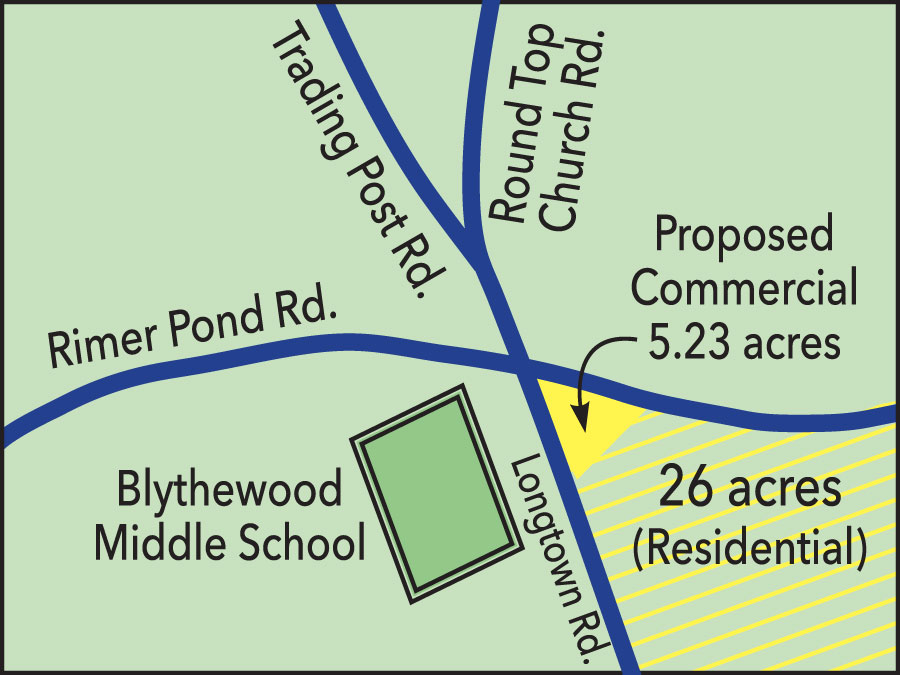
    BLYTHEWOOD (Nov. 19, 2015) – For the fifth time in seven months, residents of Rimer Pond Road, Long Creek Plantation and other nearby large-acre properties will try to convince Richland County to spare them from a rezoning request for commercial use on Rimer Pond Road that they say will change the character of their rural area. If passed by County Council, it would be the first commercial zoning on Rimer Pond Road. The target of the request is a 5.23- acre parcel at the intersection of Rimer Pond Road and Longtown Road East.

    “If this rezoning on Rimer Pond Road is approved, it will open the flood gates for commercial zoning on the rest of the road,” resident Trey Hair told the County Planning Commission earlier this month.

    The rezoning is being requested by Hugh Palmer whose family owns the property. Palmer is also the father of Patrick Palmer, the longtime Chairman of the Richland County Planning Commission, which is the recommending body to Council for zoning changes. But the Commission, which has twice heard the rezoning request, has not approved it either time. With Palmer recusing himself, as required by law, the first vote was 4-1 against recommending the rezoning and the second was 4-4, with no recommendation going forward to Council.

    In a meeting with residents in the area, Patrick Palmer said he wanted to rezone the property out of a desire to bring commercial conveniences closer to the residents. He said he had in mind such businesses as a Papa John’s, a dry cleaners and a dance studio. But the commercial zoning his father is requesting would allow Palmers or any future owners to also locate more intense commercial uses on the property such as service stations and a grocery without seeking further approval.

    Patrick Palmer, a commercial realtor with NAI Avant, had the property listed for $350,000 per acre last summer. But that sale is dependent on the property being zoned commercial. This week, Palmer notified The Voice that he no longer has a specific price on the property.

    Hugh Palmer told the Planning Commission on Nov. 5 that he wanted the parcel rezoned for commercial use because a cell tower and an access road on the property made it unsuitable for residential use.

    “This piece of property really has no residential value,” Hugh Palmer said. “No one will want to live there with these limitations.”

    Rimer Pond resident Ken Queen said the Palmers, in 2008, asked for residential zoning on the 5.23-acre parcel, which then included 26 adjoining acres as well as the cell tower. The zoning was granted.

    “They have now sold the 26 acres for residential use,” Queen said. “They asked for residential zoning on this (5.23-acre property) and now they need to live with it.”

    Commissioner Heather Cairns agreed that while the cell tower may impact the parcel’s usefulness, “that does not mean the whole area should have commercial zoning put upon it because of that limitation.”

    After failing to garner enough support from the Planning Commission and Council last summer for commercial zoning, the Palmers withdrew their application in September just hours before it was to be voted on by Council. Had Council voted against the application, it could not, by statute, have come back before them for another year.

    The public hearing for the rezoning is scheduled for 7 p.m., Tuesday, Nov. 24 in the County Council Chambers at Hampton and Harding streets in Columbia. It will be the first of three votes Council will take on the issue and the only one of the three meetings where the public is allowed to speak.

    To speak for or against the rezoning, the public must arrive early to place their names on the sign-in sheet. To receive an agenda and a complete packet of information on the rezoning request by email, contact Suzie Haynes at haynessu@rcgov.us or at 803-576-2176.


  • Dickerson Will OK 375 Homes for Heins & Langford Roads

    BLYTHEWOOD (Nov. 19, 2015) – Residents along Heins and Langford roads in Blythewood say they do not feel they have the support of their County Council representative as they prepare to attend a public hearing at Richland County Council chambers on Tuesday to protest a rezoning request. The request, made by the Drapac Group, an Australian real estate developer with offices in Atlanta, Ga., could allow as many as 529 homes to be constructed on 202 acres in the middle of their farms and rural large acre residential properties.

    In a recent exchange of emails, the County Council representative for the area, Joyce Dickerson, explained to residents that she had a responsibility to the developer as well as to the residents, and that she had decided against a promised second community meeting before the  Nov. 24 public hearing to be held by County Council on the issue.  When residents asked Dickerson in a subsequent email to explain her responsibility to a developer who did not live in her district or in Richland County, Dickerson replied via email, “I do not have a responsibility to the developer. It’s about having the rights and privileges to do business in the county based on the comprehensive plan.”

    According to the Comprehensive Plan on the County’s website, the Plan serves as a guide for future zoning but does not require a particular zoning. Zoning decisions are made by the County Council.

    At a community meeting on Oct. 1, Councilwoman Dickerson, said she would not approve more than 500 homes in the proposed Drapac development.Residents asked the developer’s representative, Joel Tew, if Drapac would hold the number of homes at 250.  Tew said he was looking at between 223 and 500 to make the project financially feasible. Other than that, Tew was vague.

    “We don’t have that silver number yet,” Tew said. “(The developer’s) philosophy is that everyone in business has to have a reasonable return on their investment. “

    Drapac representative Robert Fuller told the audience, “We are here tonight to tell you that, at the end of the day, we will tell you what we do intend to do.”

    He did not at the end of that day.

    Before adjourning the meeting, Dickerson told the developer’s team that she wanted them to get back to her with a final number of homes very soon so she could schedule another meeting with the residents and relay that information to them before the rescheduled Oct. 27 meeting. Due to severe flooding that meeting was subsequently postponed until Nov. 24.
    Residents now say that after waiting for more than a month for Dickerson to schedule that second meeting between them and the developer for the purpose of learning how many homes the developer plans to build and to have input on that decision, they received an email from Dickerson dated Nov. 13 with news that set them back.

    In that email Dickerson said she supported the developer’s rezoning request and would approve up to 375 homes on the 202 acres, concluding that she felt that would be in the best interest of all parties.

    “Even if the developer asks for 375 homes,” resident Carol Ward told The Voice, “if he is given the rezoning, he can change the number of homes to over 500 without getting any further approval from Council.”

    “After careful consideration regarding the proposed Heins Road development,” Dickerson wrote in the Nov. 13 email, “I have concluded that given the facts according to the statistical data in regards to the proposed development that it is advantageous that all the surrounding communities work with the developer to ensure that the quality of the community is protected.

    “I recently met with the developer to find a comprehensible balance,” Dickerson continued. “It is my belief that if the developer decides to develop the property under its current (Rural) zoning, the community would have very little input on the quality of the development.”

    Dickerson went on to say that while she was concerned about the anticipated traffic, a traffic study is required for this development and it will identify any specific traffic concerns that may arise.

    After receiving Dickerson’s email in support of the rezoning and 375 homes, several residents responded, saying they were disappointed in her support of the rezoning, and that they felt misled.

    “You said, repeatedly, at the Oct. 1 meeting at Doko Manor that a second community meeting would be scheduled with residents before Council voted,” Carol Ward wrote in an email to Dickerson, an email that echoed similar sentiments from the community. “That meeting did not occur. Instead, we received notice of a compromise (you) worked out with the developer less than seven business days before (County Council’s) scheduled vote.”

    Dickerson responded on Nov. 16, “As I stated in my letter, the property is going to be developed with or without my vote. As for the traffic, SCDOT is the one to make that call. The traffic study depends on the discrepancy of SCDOT. As for the timing of my letter and your feeling that I misled you comes as a surprise to me. I informed you that I would not support 500 homes (I am not). I also informed you that I would keep you informed of my decision. I do not recall providing you with a definite date and time.”

    The public hearing for the rezoning is scheduled for 7 p.m., Tuesday in the County Council chambers in the County building at Hampton and Harden streets in Columbia. It will be the first of three votes Council will take on the issue and the only one of the three meetings when the public is allowed to have input.
    To speak for or against the rezoning, arrive a few minutes early to sign in.

    Those who want to speak for or against the rezoning must arrive a few minutes early to place their names on the sign-in sheet. An agenda and a complete information packet explaining the rezoning can be obtained by email from Suzie Haynes at haynessu@rcgov.us or call her at 803-576-2176.


  • One More Hurdle for Recreation Plan

    WINNSBORO (Nov. 13, 2015) – While County Council approved at their Oct. 12 meeting a leaner, meaner recreation plan that included combining resources to construct a community center to serve districts 2 and 3, internal divisions over where, exactly, to place that facility have since put Council members at odds with their leadership, sources told The Voice last week.

    “She (Chairwoman Carolyn Robinson, District 2) originally came up with the proposal to put it (a community center) in Mitford,” District 3 Councilman Walter Larry Stewart confirmed Tuesday. “Then for some reason at the last minute she wants to move it 8-9 miles down the road toward Lake Wateree.”

    During Monday night’s Council meeting, a member of the Mitford Community Club proposed erecting the center just off Highway 200 on the site of the old Mitford Community School, which the club has owned since 1950. The Club converted the school into a community center shortly after purchasing it from the County, and leases portions of the property back to the County for the Mitford Volunteer Fire Department and a County mini park, each for $1 a year. The property sits on the boundary between districts 2 and 3.

    “We have over 2,100 citizens living within a 5-mile radius of this point (the old school),” Carol Turner told Council Monday. “Yet the only problem comes because of the way things (voting districts) had to be divided. This community is divided, and as you know there’s just not enough money to do everything for everybody. Neighbors living across the road are competing for services, which is unnecessary.

    “If it is possible to build a community center at this location to serve all of these citizens of Mitford, the Community Club, which still owns the property, potentially could make it very economically feasible in a lease agreement to build,” Turner concluded. “For citizens services, for logical location and for fiscal feasibility, the community center needs to be placed right here at the old Mitford School site.”

    Councilman Billy Smith (District 7) noted that the Oct. 12 vote to build a facility to serve the two districts was “contingent upon finding a location,” and asked Stewart if Turner’s presentation indicated that the County was closer to finding that location.

    “We’ve got the location,” Stewart answered, “and they said they would lease it to us very economically. We need something there where we can hold community meetings, family reunions, programs for our seniors, after-school programs for our kids, summer programs for our kids. We’ve got roughly 2,000 people up there within a 5-mile radius on that boundary where we’re looking at putting this facility.”

    Minutes from the Oct. 12 meeting, however, state that the community building is “contingent upon purchase of land,” not lease of land. The minutes also make no specific mention of placing the facility in the Mitford community.

    Robinson was absent from Monday’s Council meeting for reported medical reasons and Stewart said the Chairwoman also failed to show at a community meeting in Mitford last week. Phone calls to Robinson were not returned at press time.

    Interim County Administrator Milton Pope, in his report to Council Monday, said County staff should have the official documentation for the recreation projects finalized this week. The only thing Council had left to decide, Pope told The Voice Tuesday, was the physical location of the districts 2 and 3 community center. Should the Chairwoman persist in her push to locate the facility closer to Lake Wateree, Stewart said there was a backup plan.

    “I am 99 percent certain this center is going to get built (in Mitford),” Stewart said. “I have $500,000 that was allocated to my district. Two other council members have money they did not use. If she (Robinson) pulls her money, I have been assured they will put their money in.”


  • Split Decision in Rimer Pond Road Rezoning

    COLUMBIA (Nov. 12, 2015) – For the second time in six months, the Richland County Planning Commission voted last week on whether to recommend commercial zoning for a property on Rimer Pond Road. After hearing from many residents on the road who spoke in opposition to the rezoning, followed by a heated 45-minute debate by its own members, the sharply divided Commission returned a split (4-4) vote on Nov. 4 that translated into no recommendation at all being sent to County Council concerning the rezoning.

    The focus of the vote is a 5.23-acre parcel, located at the intersection of Rimer Pond Road and Longtown Road West/Round Top Church Road, that is for sale for commercial use by Hugh Palmer for $1,830,500, or $350,000 per acre. But that sale is dependent on the property being rezoned from its current Residential Medium Density (RSMD) zoning to Rural Commercial (RC) zoning. Of significant concern to residents who oppose the rezoning is the fact that Palmer’s son, Patrick Palmer, is the longtime Chairman of the Richland County Planning Commission, which is charged with making a recommendation on the rezoning to County Council. By law, Patrick Palmer was required to recuse himself from all discussions and voting on the rezoning.

    The residents protesting the Palmer family’s continued efforts to rezone the property against the wishes of the neighborhood have expressed concern about the influence that Patrick Palmer’s position on the Commission might wield. That fire was fanned last week when Hugh Palmer, the applicant, was called on by the vice chairman, David Tuttle, to present the closing argument for the rezoning after those protesting the rezoning had finished speaking. It is usual practice, according to one Commissioner, for applicants before the Commission for a rezoning issue to be called first to speak. No one other than the applicant spoke in favor of the rezoning.

    Residents speaking against the rezoning rested their case primarily on the effect commercial zoning could have on already increasing traffic congestion in the area and the domino effect it could have on future zoning of other properties in the area.

    “If this property is rezoned commercial,” said Rimer Pond Road resident Trey Hair, “the domino effect down the road will eventually destroy our rural area.”

    Others spoke to the increasing traffic that they say now regularly grinds to a standstill, slowing both commuters and school buses for long distances on the two-lane roads.

    “My son at Blythewood High School texted me at 9:05 a.m. this morning and said the bus was not yet at school,” LongCreek Plantation resident Angela Finch said. “The traffic in this area is complete gridlock much of the time. Please don’t let this happen to our community.”

    “We are not talking about a high intensity of traffic (on Rimer Pond Road),” said Commissioner Christopher Anderson, who favored the commercial zoning request. “There might be heavy traffic around the schools twice a day.”

    Referring to a 2014 Annual Average Daily Trips (AADT) traffic count by the S.C. Department of Transportation (DOT), Anderson said the road has a “level A” traffic count.

    The County’s planning staff also recommended commercial rezoning based in part on that traffic count, which staff members said was conducted in 2014 at Station No. 705 on Rimer Pond Road and at Station No. 713 on Longtown Road East.

    But when contacted by The Voice as to exactly when and where on the road those counts were conducted, Angela Hance, Assistant Chief of Road Data Services in the Traffic Engineering Department of DOT, replied in an email that there were no actual traffic count numbers, just an estimate.

    “The count at Station No. 705 was conducted between May and October 2014, when Rimer Pond Road was closed for repairs and, therefore, we did not use the data collected,” Hance said.

    Hance said DOT instead estimated an AADT of 3,500 trips for 2014, 200 less than the actual count of 3,700 in 2013. Hance said the 2014 count taken on Longtown Road East was an actual count, but she did not say when it was taken. The Voice followed up for that information but had not received it at press time.

    In his appeal to the Planning Commissioners, Hugh Palmer said he wanted the parcel rezoned for commercial use because a cell tower and an access road on the property made it unsuitable for residential use.

    “This piece of property really has no residential value,” Hugh Palmer said. “No one will want eventually to live there from a residential perspective with these limitations.”

    Rimer Pond Road resident Ken Queen said the Palmers came before Council in 2008 asking to have that same 5.23 acres and an adjoining 26 acres rezoned from RU to RSMD for the purpose of residential use.

    “They were given the zoning they asked for,” Queen said. “They have now sold 26 acres of the property for residential development. They asked for RSMD zoning on this property and now they need to live with it.”

    Commissioner Heather Cairns agreed that while the cell tower may impact the parcel’s usefulness, “that doesn’t mean the whole area should have commercial zoning put upon it because of that limitation.”

    Both Cairns and Commissioner Beverly Frierson pointed out that the County’s zoning district summary describing the purpose of Rural Commercial zoning is flawed and not applicable to the Rimer Pond Road/LongCreek Plantation area.

    That summary states that RC zoning is designed for areas within Richland County where residents of the more isolated agricultural and rural residential districts and residents located beyond the limits of service of the municipalities can receive convenience merchandising and services.

    “Even in this description,” Cairns said, “it refers to isolated areas and this is not an isolated area.”

    “This is not an area where another convenience is needed,” Frierson said. “This area is not beyond the limits of services of a municipality. This is not an area where we need to put more traffic, more congestion or a strip mall-type development.”

    Anderson said he couldn’t understand why the Commission was having a difficult time approving commercial rezoning.

    “It fits like a glove to the Comp Plan (the County’s 2014 Comprehensive Land Use Plan),” Anderson said, noting the Comp Plan recommends that commercial zoning in rural areas should be limited to intersections. “Here we have a traffic light and an intersection. I’m having a hard time wrapping my head around a denial on this.”

    “I have a hard time saying that because two roads intersect and there’s a traffic light, that we should look at this as a place to stick commercial,” Cairns said. “Are we to expect every intersection should become commercial? It seems wrong to go into a totally residential area and establish commercial development.”

    While Anderson continued to argue that the Comp Plan designated that the Rimer Pond Road intersection is exactly where commercial zoning should be established, LongCreek Plantation resident Jerry Rega reminded the Commission that the Comp Plan had actually designated ‘activity centers’ at certain intersections in the County specifically for commercial land use.

    “This area is not in one of those designated ‘activity centers,’” Rega said. “Within five minutes of this area, there are three strip malls with a 50 percent vacancy,” he added. “So we’re talking about another strip mall in an area with an already low occupancy rate?”

    “We’ve been coming down here for 25 years, consistently telling you we want our area to remain rural,” said Michael Watts who lives off of Rimer Pond Road. “We’re here again asking you to look out for us. This is a beautiful rural area, and we have all the conveniences we need within five minutes.”

    David Poole, a LongCreek Plantation resident, said the Palmers would be the only ones to benefit from the property being rezoned commercial. He said it would not benefit the residents who live around it.

    Although the zoning level that the Palmers are requesting allows such intense uses as service stations and grocery stores, Patrick Palmer told residents last spring that he envisioned such businesses as a Papa John’s, a dry cleaners and a dance studio as end users. But in October, he told three residents he met with about the rezoning that he did not know what businesses would go in there, that he had not had any offers.

    After failing to garner enough support from the Planning Commission and Council last summer for their bid to establish the first commercial zoning on Rimer Pond Road, the Palmers withdrew their application in September just hours before it was to be voted on by Council. Had Council voted against the application, it could not, by statute, have come back before them for another year.

    Next stop for the rezoning application and those opposing it is a public hearing to be held by Council at 7 p.m., Tuesday, Nov. 24, at the Council Chambers at Hampton and Harding streets in Columbia. It will be the first of three votes Council will take on the issue and the only one of the three meetings where the public is allowed to speak.

    Those who want to speak for or against the rezoning must arrive a few minutes early to place their names on the sign-in sheet. An agenda and information packet about the rezoning can be obtained by emailing Suzie Haynes at haynessu@rcgov.us or call her at 803-576-2176.



  • P.C. Rejects Housing Project

    ‘Will of the People’ Supersedes Ordinances

    BLYTHEWOOD (Nov. 12, 2015) – What was expected to be a short, one-agenda-item Planning Commission meeting Monday evening ended with 1) a scramble by Town officials to first calm, then eject a member of the audience who became emotional while protesting a proposed affordable housing project in the Town Center District, and 2) a senior development manager threatening to bring a legal action against the Town after the Commission voted against approving a site plan for the proposed housing project.

    The purpose of the regular monthly meeting was to consider a group development site plan approval for The Pointe, a 56-unit apartment campus planned for downtown Blythewood on 4 acres fronting on Highway 21 behind the Langford-Nord House. The developer of the project is Prestwick Companies of Atlanta, represented by Mark Bincz, Vice President of Engineering with Site Design, Inc. of Greenville and Jody Tucker , CEO of Prestwick.

    During the public comment section at the beginning of the meeting, five members of the community spoke against the project which, according to the company, is affordable housing but not Section 8 housing.

    “It’s clear that our roadways cannot handle increased traffic and why current zoning would even permit, let alone encourage it, defies all logic,” resident Cynthia Shull told the Commission. “According to the 2015 Congestion Management Plan on the SCDOT’s (Department of Transportation) website, the section of road that would be immediately impacted by the addition of the 56 apartments currently has a grade of ‘E’ (on an A-F scale), which indicates the roadway is significantly congested,” she said. “Adding 56 apartments would only exacerbate this problem.”

    Residents: Traffic is the Problem

    Danielle Andes and Irene Shepard also spoke about the negative impact of the development on traffic in the town.

    Janice Miller spoke passionately and at length about the negatives the development would have on the town’s traffic and pedestrian safety, especially children. She said the Town laws and ordinances should be reviewed to limit this sort of development.

    “My main concern,” Miller said, “is multi-family housing on Main Street in the Town Center District. Just because it’s zoned for R-5 housing doesn’t mean we have to develop it for R-5 housing. We need planned development here. We need to do what’s best for Blythewood. We need to go back and amend our zoning ordinances. Go back to our Master Plan.”

    Planning Commission Chairman Malcolm Gordge pressed on to discuss concerns brought forward from the October meeting about traffic, storm water management and an incidental question about the qualifications for people obtaining housing at The Pointe.

    DOT: Traffic is Fine

    Addressing the question about traffic congestion, Binsz told Commissioners that the he had met with representatives of DOT who, he said, made a visual inspection of the site and were OK with the driveway location onto Main Street.

    “DOT said a traffic study would not be required and that traffic on the road is currently about 3,600 cars a day, much less than the road can handle,” Binsz said. “DOT is not requiring turn lanes, or improvements of any kind.”

    Town Planner Michael Criss read an email from Carol Hamlin, an engineer with DOT that stated, “With regard to potential turn lane improvements along Main Street, we have considered the existing traffic patterns and the scale of the current proposed 56-unit apartment development. It does not appear that any significant delay or safety concerns will be generated by this development.”

    Commissioner Ernestine Rogers questioned when, exactly, the visual inspection of the traffic was made. Binsz said he thought it was at peak time of day.

    Commissioner Don Sanders spoke up, thanking those who came to speak out on the proposed development.

    “You make some excellent comments, but the only statement that was made that I don’t agree with is: ‘You all are just sitting there making decisions that don’t affect you and don’t bother you.’

    The Will of the People

    That’s incorrect,” Sanders said. “I’m here for one reason only. To look out for the Town of Blythewood and its best interest. Having said that, I know that zoning changes. Traffic changes. But one thing that does not change is the will of the people. And the will of the people was heard loud and clear here tonight. I’d like to make a motion for denial of approval of the site plan and call for a vote on this,” Sanders said.

    After a long pause, Gordge said he wasn’t sure whether the Commission was in a position to deny the project and said he would like legal guidance. Gordge asked what the grounds would be for denial.

    “Not being an attorney,” Sanders said, “I would say grounds would be the will of the people.”

    Tucker rushed to the podium.

    “I understand what the Town of Blythewood has planned. It planned (the zoning of) this property well before I got here. You created the ordinance. I didn’t. You can’t look at me as the bad guy. These folks have great comments,” Tucker continued, “and they’re not wrong. But we’ve done nothing wrong. Our project should not be penalized for (the zoning) you planned previously. Going forward you can change your zoning and put overlays in. You can change things. But Greenville tried to change it on us in the middle of us submitting permits. What happened? They went to a lawsuit and it didn’t work out for Greenville.”

    Tucker reviewed the company’s various projects (around the country) and said the Mayor of Greenville eventually became a big supporter of the project after it was finished.

    Mayor Ross Supports Project

    “Mayor Ross of Blythewood wrote a letter of support for this project,” Tucker said. In that letter, Ross said ‘we are committed to working with non-profits and the private sector and support diversified workforce multi-family housing options.’

    “You can’t turn us down for something that was done before we got here,” Tucker told the Commission. “We’re willing to work with you to make this happen. I’m asking you to make a decision on what’s right and what the law says.”

    Commissioner Buddy Price said he wanted to clarify the Commission’s duties.

    “We are to determine if this project and any other projects that come before us meet the criteria established for us,” Price said. “Meet those requirements; that’s what we’re here to determine. Not whether it’s appropriate (for the project) to be there or not.”

    At that point Miller, who had spoken against the project earlier, began chastising Price and Gordge specifically and the Commission in general to the point that several Commissioners first asked her to be seated, then to leave.

    “You are here for the Town of Blythewood,” Miller shouted back a number of times as she was leaving the meeting room. After leaving and then returning, Miller said, “Thank you Mr. Gordge and Mr. Price for not serving Blythewood,” before leaving a final time.

    Town Administrator Gary Parker advised the board, “If the project meets storm water, traffic and other requirements, then you would have no basis for denial.”

    “The will of the people overrides any zoning, any time,” Sanders insisted, “and I will vote against anything that’s not the will of the people because this is what’s good for the Town.”

    Referring to the developer’s representatives, Sanders said, “These are not bad people. Greenville is a great town and everything is done correctly there, but the people in the Town of Blythewood have said ‘no’ and I’ll vote ‘no’.”

    The audience applauded and the Commissioners voted 3-2 to deny approval of the site plan, with Gordge and Price voting against denial.

    Re-vote Next Month?

    Turner told The Voice after the meeting that the developer would probably ask to meet with the Blythewood Mayor and the Town’s attorney about the matter.

    “The City needs to let us know if that was a valid vote,” Tucker said. “If it wasn’t, then we’ll be back at the December Planning Commission meeting for another vote under the terms of what the law allows versus the will of the people. We met all the requirements.”

    Tucker said he had no interest in seeking legal remedy.

    “I’m interested in the Town of Blythewood following its ordinances and voting based on what they’ve already approved,” Tucker said.

    The Planning Commission will meet at 6 p.m., Monday, Dec. 7 at the Manor.


  • School Board transfers $2.25 million

    WINNSBORO – Fairfield School District Superintendent J.R. Green asked the School Board during their Oct. 20 meeting to approve a transfer of $2.25 million from the general fund to the capital projects fund for the 2014 -2015 fiscal year, which ended on June 30.

    “The funds will be used to pay for various technology, equipment and facility needs in the District,” Kevin Robinson, the District’s Director of Finance, told the Board.

    Later in the meeting, Board member William Frick (District 6) asked the superintendent to give the Board some idea, beyond new technology and other improvements, of what the $2.25 million transfer would be used for.

    Green replied, “This is something I’m going to bring back to the Board eventually, but there are a few things we’re looking at. We’d like to get a couple of new activity buses…we need to refresh some Chromebooks…and we have an issue with the cooling tower at the high school and we think we’ll eventually have to replace it.” Green said he would also like to embark on renovations that will allow the removal of portables behind the middle school and at Kelly Miller.

    “For me, the elimination of the portables would be the priority,” Green said, “but I say that in context of not knowing what that would cost, so I can’t say this is something we can move forward on.”

    Robinson explained that after the transfer of the $2.25 million from the general fund balance (now estimated to be $11 million), the general fund balance would be approximately $9 million at the end of the 2014-2015 school year.

    This generated a discussion about the district’s fund balance and an expected surplus from the 2014 – 2015 fiscal year.

    According to Robinson, the general fund surplus, estimated at $4.5 million, is the result of an anticipated $2.8 million increase in revenue due to an increase in property tax, with the remaining $1.7 million resulting from savings in expenditures. These expenditure savings include a $1.4 million decrease in expenditures on salaries and benefits and a $300,000 savings from not having to transfer money into the food services program last year as had been anticipated.

    Board member Annie McDaniel (District 4) cautioned that the Board should wait before approving any fund transfers until the annual audit of the District, due in November, is published. She questioned how Green could be confident of such a large surplus, since the District had a much smaller fund balance the previous year. The District’s annual financial statement for the previous fiscal year (FY 2013-2014) showed a general or unassigned fund balance of $6,565,658.

    Concerned about the savings of $1.4 million in salaries and benefits, Frick said he saw that as a significant expenditure savings.

    “Am I reading that correctly?” Frick asked. “Do we have any kind of explanation about that? That seems rather significant.”

    Robinson said this savings came about because several positions that were in the budget were not filled or filled for only part of the year. He said the District also hired teachers with less experience to replace some retiring teachers who were paid at a higher rate, and that the District was also able to transfer a little more of salary costs into the special revenue fund than had been anticipated.

    McDaniel asked if the Board could see the projected schedule from the auditors that shows the $4.5 million increase in the fund balance.

    “It’s strange that we are asked to vote in October before we have (seen) the audit in November. The audit will reflect exactly what’s happening,” McDaniel said.

    Frick asked, “With an anticipated $9 million in the fund balance (after transferring out $2.25 million), and considering that each year we’re looking at about a $6 million TAN (Tax Anticipation Note), are we potentially anticipating next year not having to do a TAN?”

    Robinson replied that the District would probably still issue a TAN but not in the amount of $6 million; “In theory, we’d have to do less of a TAN,” he said.

    “We have money in the capital project fund, I would say about $1 million, that is obligated,” Robinson added. “But some of that is accounted for by the on-going project with the old Career Center. We do have projects that come up during the year that have to be done. The purpose of transferring the money now is to give us the flexibility if we have any unforeseen facility needs, and also to give us the ability for other things that need to be done, which we don’t anticipate having enough money for once we get done with the old Career Center.”

    “One of the things that get people in the most trouble with money is not being up front and transparent,” McDaniel again cautioned. “So with capital projects, you should take time to discuss, plan and know what you want to spend. There is no reason by the time you transfer the money that you aren’t specific about what you want to spend the money on.”

    “Normally,” McDaniel continued, “with capital projects, there is specific planning for these projects, with an estimated cost beforehand. You don’t say ‘you propose, you might, you’d like…’ You come back later when you know what you want to spend it on. When you know what the total is, you request that we move it. We should not be voting arbitrarily.”

    Hartman asked if the money could be pulled out at a later time.  Green answered that it  could.

    The Board passed the transfer on a 4-2 vote, with McDaniel and Hartman voting against.

    “Madam Chair,” McDaniel said, “I would like the record to reflect that I am voting against this because, in my opinion, it is reckless to vote now knowing that the audit is coming up next month.”

    Hartman said she voted against the transfer since the funds can be transferred at any time.

    “The Board should not pull the funds out until we know what it will be used for,” Hartman said.