WINNSBORO (Feb. 26, 2016) – County Council, during their Feb. 15 meeting, passed first reading on an ordinance to purchase the final piece of property in their recreation plan. The purchase would also end the debate on how best to serve district 2 and 3 under the plan.
“It’s going to be a good deal,” District 3 Councilman Walter Larry Stewart said. “The next step is to get a permanent EMS station there.”
The 5 acres at Camp Welfare and Wateree roads will be the site of what Stewart called a “community center.”
“It’s not a recreation center,” he said. “The emphasis will be on a community center, not so much a recreation center. It will be designed mainly for community functions, to get things going for seniors, and as a meting facility for clubs and organizations.”
But Interim County Administrator Milton Pope said after the meeting that the building could be used for recreational purposes.
No price was disclosed in first reading of the ordinance. Pope said the purchasing price would be disclosed at the next meeting (March 14).
According to County tax map records, the property is currently owned by Morris W. and Brenda Worthington, with a total market value of $27,500.
Pope also told Council that a similar facility slated for land on Ladds Road near Lake Monticello had hit a snag. The County leases the property there from SCANA for recreation; however, Pope said, permitting issues with federal regulators would have pushed construction back at the site as much as six months. Instead, Pope said, the County is moving the facility to Monticello Park, also known as Overlook Drive Park.
The move will generate a cost savings, Pope said, as a walking trail and outdoor basketball courts – planned for the Ladds Road location – already exist at Monticello Park.
FMH
Council also passed first reading on an ordinance to amend their 2015-2016 budget to account for nearly a half million dollars for Fairfield Memorial Hospital. Pope said the hospital was requesting $146,250 for a wellness works implementation fee, as well as $305,523 to catch up on their CT and MR maintenance agreement.
The requests would require an amendment to the budget, Pope said. Council met in executive session during a work session on Feb. 17 to discuss the payouts. They will take the matter up again during their March 14 meeting.
RIDGEWAY (Feb. 26, 2016) – Intergovernmental meetings have a reputation of being either mundane, elbow-rubbing affairs, or fur-flying cat fights between elected officials. Last week’s meeting at the Century House found a middle ground.
With the focus of the Feb. 18 meeting on economic development, particularly in the wake of last month’s closing of Walmart in Winnsboro, State Sen. Creighton Coleman (D-17) set the tone.
“I think this is a time to unite,” Coleman said, then told County Council officials, “I’m excited about the (strategic) plan that y’all are doing. I think it’s time the County and City sit down and try to work together jointly on Winnsboro, the town of Winnsboro, to make it a viable entity in our county.”
Fairfield County is at a critical state, Coleman said, and the County holds the purse strings.
“Let’s face it: Winnsboro’s got a little bit of money, the County’s got a lot of money, going to have a lot of money coming in the future,” Coleman said. “I don’t mean to be casting stones and don’t want to, but sometimes I think the County doesn’t want to help downtown because it’s downtown. I know y’all do the Courthouse and Town Clock, but to me there’s more to it than that. Correct me if I’m wrong.”
Interim County Administrator Milton Pope said he was not aware of any request for assistance from the Town of Winnsboro that has not been honored. However, he added, the respective roles of the elected bodies were “terribly misunderstood.” There is a mindset, Pope said, that the County has all the money and should therefore “be able to do anything and everything.”
“To a certain degree that is reality,” Winnsboro Mayor Roger Gaddy interjected. “The County does have all the money. We are the richest poor county in South Carolina. Because we get all this money from V.C. Summer we have tremendous amount of expectations from the county, and I think sometimes you can fulfill those and sometimes you can’t.”
But, Gaddy said, he did not know of anything the County had not helped Winnsboro with when Winnsboro had asked.
“I think that the shortcoming between the Town and the County is in economic development,” Gaddy said. “There has been little or no communications between the County and the Town on economic development. The Town has been totally left out of it and we’re the ones who provide the utilities.”
Terry Vickers, President of the Chamber of Commerce, said there were plenty of opportunities for businesses in the county, but the trick was promoting and selling Fairfield. That is difficult to do, she said, when even the leadership cannot get on the same page.
“We shoot ourselves in the foot every day,” Vickers said. “I was absolutely mortified at the social media comments that went online when Walmart made their (closing) announcement. I have never been so put out and disgusted with the citizens of Fairfield County that were so negative. Even leaders who have people who look up to them, talking so negative about leadership, about taxes, about theft. And of course, everything on the street was that Walmart closed because of a theft issue. That was not the major reason and that came straight from Sen. Coleman who had met with the executives from Walmart. But still we have people in a position where they are looked up to and they talk about theft in our community. I’m sorry folks, that’s not how you attract tourists or businesses, developers or housing. Nothing.”
Vickers said businesses are looking at space in downtown Winnsboro, but the buildings that are available are in such disrepair – some costing as much as $300,000 to upfit – companies are reluctant to settle here.
“When they look at the upfitting, the rent and property taxes,” Vickers said, “are they willing to take a chance on Winnsboro that just lost a Walmart to come in here? Those are the things we need to look at. If we truly want to attract business in this community, we need to be an attractive community.”
Vickers said Ridgeway was thriving with only one block of merchants. Winnsboro, meanwhile, has three blocks, she said, with two restaurants, a gift shop, two consignment shops and a thrift store. Taking up one of the largest spaces on Congress Street, she said, was a building filled with antiques that, sadly, were not for sale.
“If the paper would come out of that window, if that door could be unlocked, that would be the hook for Winnsboro’s success,” Vickers said. “There would be interior designers from all over the east coast that would come to Winnsboro to shop, that’s how fantastic they are. But no, it is a warehouse for a hoarder. How did that happen?”
Vickers said if Downtown Winnsboro and the county at large is to survive in the wake of Walmart’s closing, businesses need their local governments behind them.
“We have got to change our communication, we have got to change our reputation, we have got to change our outlook,” Vickers said. “The businesses need the support of the decisions that elected bodies make. I have seen so many opportunities missed because we could not come together and agree.”
WINNSBORO (Feb. 26, 2016) – Opponents of a proposed granite quarry off Rockton Thruway may have gained considerable concessions from the Mining Council’s Board of Appeals, following hearings before the board last week.
The Council has 30 days in which to issue a written decision, and the S.C. Department of Health and Environmental Control (DHEC) would not confirm those concessions in an email to The Voice last Friday. Dorothy Brandenburg, community liaison for the quarry opponents, also would not confirm what concessions her group achieved, instead saying citizens wanted to wait on the official written document.
“The citizens are happy,” Brandenburg said Monday, “but that’s about all we can say.”
However, a source who attended the hearings in Columbia but wished to remain anonymous said the Mining Council is requiring DHEC to remand the permit for Winnsboro Crushed Stone, LLC until concessions are made. Those concessions include the installation of monitoring wells, which must be operational in time for construction to begin on the quarry. The company will also be required to construct berms along areas close to neighboring properties, the source said.
According to the source, the Mining Council has also mandated the metering of the water flow in nearby Horse Creek. Winnsboro Crushed Stone will also have to present a plan for funding neighborhood wells that may run low or dry as a result of mining, including a plan for furnishing emergency water and replacing wells.
Properties near the site that have not yet given leases and mining rights to the company must do so before mining can begin, the source said.
Winnsboro Crushed Stone intends to mine granite on 365.8 acres of a 923.2-acre tract off Rockton Thruway. Residents of the area appealed DHEC’s mining permit in hearings held in Columbia Feb. 16-19.
Councilman Larry Griffin questions Tyler Clark of the DOT on Blythewood road improvements. (Photo/Barbara Ball)
BLYTHEWOOD (Feb. 25, 2016) – Enticed by free Chick-Fil-A sandwiches and super food salads at a Chamber meeting on Tuesday at The Manor, a large crowd of Blythewood Chamber members and guests lunched and learned what’s in the Richland County Transportation Penny Program for Blythewood 29016.
Bob Perry, Transportation Director of Richland County and Tyler Clark of the S.C. Department of Transportation explained that Blythewood transportation penny improvements, totaling $29 million, will include a myriad of projects – road widenings, bikeways, sidewalks, intersection improvements, paving of dirt roads and resurfacing.
The crown jewel of the Blythewood improvements is the widening of Blythewood Road from I-77 to Highway 321. The first phase of that project will widen Blythewood Road to five lanes from I-77 to Syrup Mill Road at a cost of $10,519,000, not to include preliminary engineering costing $300,000 slated to begin this year. Right of way acquisition is expected to begin in 2017 and construction in 2018.
The second phase of Blythewood improvements includes the following:
-Widen Blythewood Road to five lanes from I-77 to Main Street.
-Widen Blythewood Road to three lanes from Syrup Mill Road to Fulmer Road.
-Widen McNulty Road to three lanes from Blythewood Road to Main Street.
-Construct traffic circles at Blythewood Road and Creech Road and at Blythewood Road and Cobblestone.
-Extend Creech Road to Highway 21 with a three-lane road.
When asked where on Highway 21 Creech Road would exit, Town Councilman Malcolm Gordge told The Voice that consideration was being given to two exit areas: 1) the road would run behind the IGA and on out to Highway 21 or 2) Creech Road would extend down to run Firetower Road and then exit Firetower Road out to Highway 21.
While Perry said there is no prioritization for the phase two projects at this time, the preliminary engineering is anticipated to begin in 2019 at a total cost of $21,911,000 for right of way acquisition and construction costs and $2 million for preliminary engineering.
While paving has been completed on five dirt roads in the Blythewood 29016 zip code – Overlook Drive, Annie Entzminger Court, Dunes Point, Peafowl Road, Elton Walker Road and Entzminger Road – 13 more roads in Blythewood 29016 are in the design phase and another 11 are in the planning phase.
Roundtree Road has been resurfaced and 12 more roads are in the resurfacing construction phase.
Bikeways planned for Blythewood Road from Winnsboro to Main Street have not begun.
Perry told the audience that the most important of 14 prioritization factors for completion of the Blythewood projects are public safety, potential for economic development, right of way obtained, design work completed and dedicated funds.
For updated information on the road improvements in the Blythewood community, go to www.RichlandPenny.com, email info@richlandpenny.com or call 1-844-RCPENNY.
BLYTHEWOOD (Feb. 25, 2016) – The Wall that Heals, a traveling scale replica of the Vietnam War Memorial in Washington, D.C. destined for Blythewood May 26-30, is going to cost the Town a lot more than the $7,500 reported last month.
During Monday night’s Town Council meeting, Town Administrator Gary Parker told Council that the cost of hosting the exhibit now looks to run as much as $12,000.
“When I asked a question a month ago, my real thought process was this is probably going to cost us between $12,000 and $15,000,” Councilman Tom Utroska said. “We’re all in favor (of bringing in the exhibit), but the real issue I have is transparency. I don’t think we need to sit here and tell people we’re going to spend $6,500, then $7,500 and then somewhere down the road it’s like, Jeeze, you said it was going to be $7,500, now its $14,000. Let’s go ahead and put all our cards on the table, this is what we think it’s going to cost. I just want to be straightforward with the people we represent.”
Parker said the $7,500 was just the upfront cost of bringing the exhibit to town. Hosting the exhibit around the clock for five days will bring additional costs, including, he said, electricians ($200); rope and posts for barriers ($625); electrical power ($200); a pair of deputies for security ($240); two portable outdoor rest rooms ($900); water for volunteers ($100); and promotion and advertising costs ($400). An opening ceremony at the Manor would also add $250-$300 to the price tag, Parker said.
If one were to factor in the man-hours spent on the exhibit by Town staff, Parker said, the cost would be between $11,000 and $12,000.
Mayor J. Michael Ross said the Council was being transparent, presenting the rising dollar figures to the public as they came to Council. Councilman Eddie Baughman said the initial price was only an estimate, and there may be some areas where Council could trim some of the cost. Still, he said, it may cost the Town $2,500 a day to host the exhibit.
“This is a good thing for community,” Parker said. “And we shouldn’t lose sight of the fact that this is a solemn patriotic event that goes beyond dollars and cents.”
Shell Building
Costs are also up somewhat on the speculative building Council plans to construct on the grounds of Doko Park. Ed Parler, Blythewood’s Economic Development consultant, told Council Monday night that the original contract with E. Ralph Walden & Associates, Inc. for $18,900 only took the Town through the bid and selection of a contractor. Parler asked Council for an additional $3,900 to contract with Walden for construction management of the project, as well as an additional $5,500 for a civil engineering contract with Crescent Engineering, LLC.
“The $3,900 I thought was included for construction management in the original contract, but it wasn’t,” Utroska said. “I think we were all remiss on that.”
Council voted unanimously to accept the additional fees, which brings the cost of the project up to $28,300, Parler said.
WINNSBORO (Feb. 24, 2016) — President Bill Clinton will stump for his spouse and Democratic hopeful Hillary Clinton at a Get Out the Vote Rally Thursday at Fairfield Middle School, 728 Highway 321 Bypass, at 7:45 p.m. Doors for this public event open at 7 p.m. It will be one of several stops in S.C. for the president leading up to Saturday’s Democratic Primary.
“I have spent the last five days working with the Clinton campaign to get former President Bill Clinton to visit Winnsboro in the run up to Saturday’s Democratic Primary,” Winnsboro native Boyd Brown said. “Now, it’s official. President Clinton will be at Fairfield Middle School tomorrow evening for a voter rally. Please sign up for this historic event by following this link (below), where you will also find additional information on the event. Feel free to share with anyone you know!”
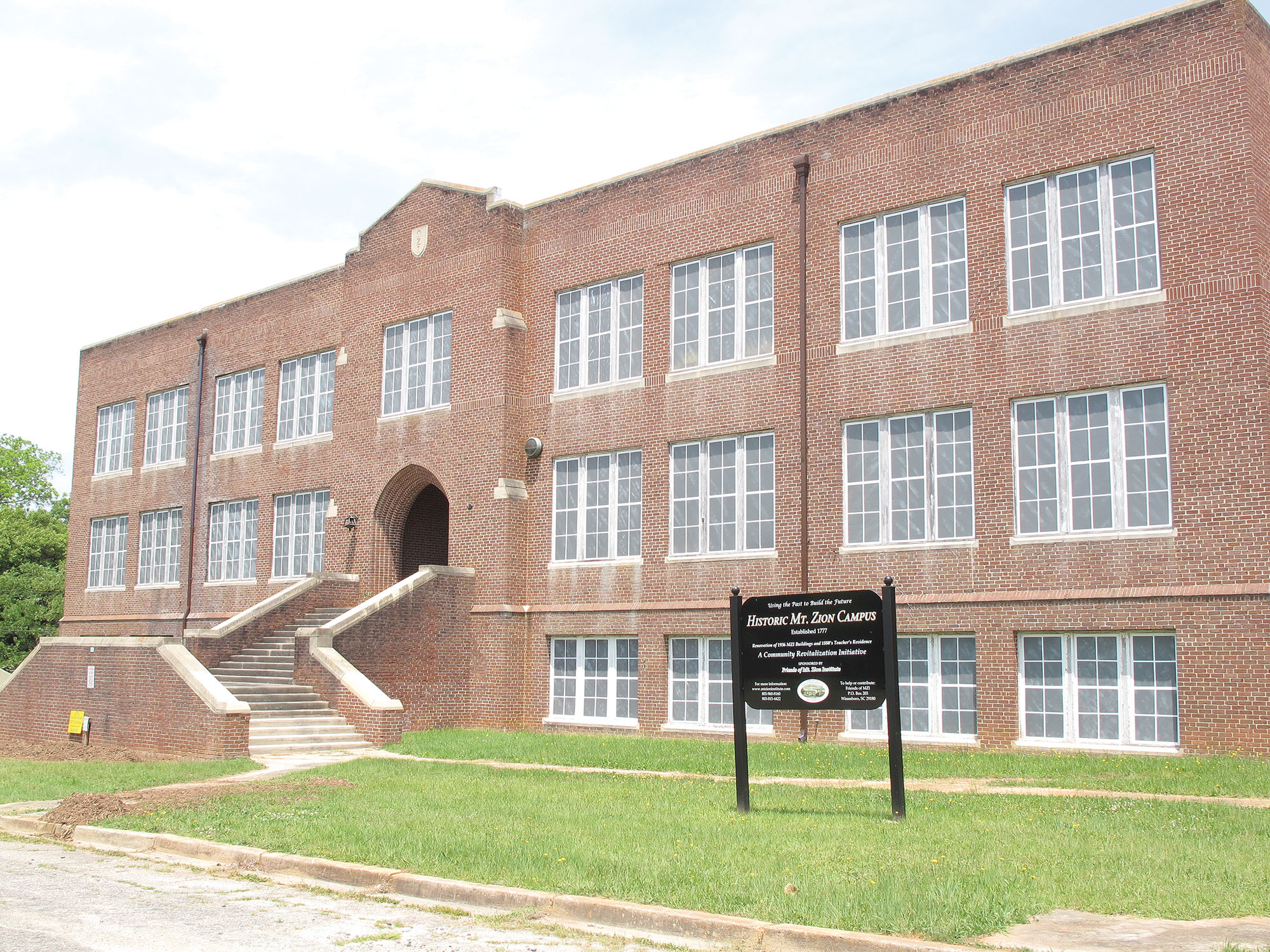
The faux windows went up last summer, but Tuesday night the debate was less about Mt. Zion’s exterior and more about what – or who – could be residing in its interior.
WINNSBORO (Feb. 19, 2016) – Emotions ran high Tuesday night as residents spilled out of Town Council chambers and into the hallway for what may have been the last appeal for the life of Mt. Zion.
Leading the charge for demolition was Marie Rosborough, who presented Council with what she said was a survey she conducted last week of neighborhood residents pitted with the question of whether or not they favored a plan to convert the old school building into senior living apartments. All but two respondents, she said, were flatly opposed to the notion.
“We don’t want apartments,” Rosborough said. “It needs to be torn down. We ask Town Council to please close this issue, tear the building down and move on to some more pressing issue you have. You’ve done everything you can do.”
Boyd Brown, who delivered to Council last Friday a letter of intent from developer Rob Coats, did his best to quell fears that Mt. Zion, even if intended for market-level senior living apartments, might end up as a low-income housing project.
“This is not low-income housing. I’ve heard that from about three or four people today,” Brown told Council. “The Banyan Foundation (Coats’s non-profit organization) does do low-income housing projects – fact. This project does not score in the H.U.D. database to qualify for the 4 percent tax credits for low-income housing, nor does it score the other tax credits for low-income housing.”
Mayor Roger Gaddy, however, subjected Brown to intense interrogation on the potential use of federal money on the project. Brown said that, as far as he knew, there would be no federal loans or grants, but that federal and state historic tax credits may be applied.
“One of the Council’s concerns is if there’s any federal money involved,” Gaddy said, “any taxpayer money involved and the market-value apartment – it’s not even zoned for that now – if that were to occur and it not be successful and the federal government wants their money back, then they tell you you’re going to open it up to low-income housing. Council is not interested in even talking to anybody that’s going to use any federal money that’s going to put that neighborhood at risk.”
Brown acknowledged Gaddy’s concerns, and said that federal historic tax credits were different than loans and grants.
“We can do a workshop on federal tax credits and state tax credits,” Brown said, “and explain how that is what is driving all this growth in Columbia and even places like Edgefield and Lake City.”
Dina Borda, an attorney living on Bratton Street, countered Brown’s claims by producing articles of incorporation for a company called The Peaks at Raleigh, Inc., filed in N.C. in 1998. The Peaks later became the Banyan Foundation, she said, and according to the articles was almost exclusively involved in low-income housing projects.
“I am not saying I am against any kind of development,” Borda said. “I would just like to know the scope and method of execution before any contract is executed so that we can make an informed decision as to what’s going to occur. But I am absolutely against low-income housing.”
Brown rebutted later, noting the date (1998) and the name on the articles, but said Coats does represent some of the people named in the articles.
“These article of incorporation are from North Carolina. They are now in Alabama. This is dated,” Brown said. “You can Google search anything and you’re going to find all sorts of information. But I am here to tell you this is not going to be low-income housing. During the due diligence period if you want to go so far as to put that in the contract, if we ever get to that, I’m sure he will be just fine putting it in the contract.”
But Gaddy said a contract means nothing if the federal government is involved.
“I’m telling you the federal government is not going to loan him a dime for this project,” Brown said.
“I don’t want any association, period,” Gaddy replied.
“The council is going to have to have significant reassurance – I mean significant reassurance – that there would not be one iota of a chance and there would be some ramifications liability-wise if that would occur,” Gaddy continued. “I think that certainly is a major concern when you tell us the Banyan Corporation is the one doing it, from my standpoint, and the (articles) say that (low-income housing) is their sole purpose.”
Vickie Dodds, Chairwoman of the Friends of Mt. Zion Institute (FOMZI), said she agreed with opposition to low-income housing. But what she didn’t understand, she said, was the feeling from those who “just want it torn down for the sake of tearing it down.”
Responding to a point made by Faye Johnson, that the buildings were not historic buildings, Dodds said the old school had been approved for submission of placement on the National Historic Register.
“All we have left to do it is finish the editing of the actual application,” Dodds said, “which cannot happen unless they (the Registry) qualify it as permissible to be on there. They consider anything over 50 years to be historic.”
Betty Gutschlag also spoke up for Mt. Zion, saying it was an opportunity for retiring seniors to stay in their community. But when Rosborough spoke up again, she made it clear that it made no difference to the majority of respondents to her survey what type of apartments Banyan has in mind.
“The residents who signed it (her survey) said ‘No, we don’t want Mt. Zion turning into apartments’. No conditions,” Rosborough said.
Rosborough was interrupted by shouts from the back row.
“Do you speak for everybody in the community?” Pelham Lyles asked. “The whole town?”
Gaddy lowered the gavel and Rosborough attempted to continue, but Lyles interrupted again, shouting, “You didn’t put it in everybody’s mailbox!”
When Gaddy called Lyles out of order, she exited the chambers.
“We would hope you would consider what the community wants,” Rosborough finally concluded. “We’ve been talking about this for 15 years, at least. Now you want to add some more of this same over and over. You need to put an end to this because it will never end if you don’t.”
Brown asked Council for 180 days for Coats to perform his due diligence on the project.
“I’m not going to be unrealistic about this,” Brown said. “If there comes a point during that 180-day due diligence period where we just realize it cannot be done, we’re going to call you that day and tell you.”
Gaddy said after the meeting that Council would consider Brown’s request.
WINNSBORO (Feb. 19, 2016) – Fairfield County Council has issued its fifth general obligation (GO) bond in barely more than two years, this one in the amount of $306,000.
The new bond, like the four previous GO bonds, is being issued to pay off the County’s $24 million bond debt.
In a circuitous arrangement, County Council created a shell corporation in March 2013 that enabled the County to borrow $24 million for specific economic development projects. A month later, on April 15, 2013, Council passed an ordinance that allowed the County to issue GO bonds to pay off that $24 million debt. The GO bonds would provide funds from property taxes to make installment purchase payments to the shell corporation which it (the shell corporation) would use to pay off the $24 million debt.
After the first GO bond was issued Feb. 12, 2014, surprised residents complained that the County’s scheme to make payments (to the shell corporation) to pay off the $24 million bond debt with a string of GO bonds had not been explained to the public by Council in open meetings. And the GO bond ordinance was short on specifications as to the amount of the bonds to be issued, date of issuance and the total number of bonds authorized by the ordinance.
So long as the bonds issued did not exceed the County’s eight percent debt limit, Council could issue bonds without the voter’s permission. Even so, the state statute provided a 60-day window that allowed the voters of Fairfield County to initiate a petition that could have forced a referendum on the GO bond ordinance, effectively halting the issuance of the GO bonds altogether. But elected officials and newspaper accounts may have derailed any such petition effort by wrongly referring to the ordinance passed on April 15, 2013 as the $24 million bond, not the GO bond ordinance which was subject to the initiative petition.
Adding further confusion, then County Administrator Philip Hinely and then Director of Economic Development Tiffany Harrison, were quoted in The Voice as saying the $24 million bond would not increase taxes. But a chart obtained in 2014 from the County showed that it is actually the GO bond debt (that is continually levied to make the installment purchase payments on the $24 million bond) that keeps the County’s debt millage at an elevated level of approximately 10 mills (or about $1.27 million) each year until about 2042, at which time the debt millage will begin to decrease steadily, reaching zero by 2047.
While the County borrowed $24,690,000 to pay for economic development projects, it will repay $43,200,663 for just the principal and interest on that bond debt, according to the bond document.
Although County officials have long aligned the payments for the $24 million bond debt with the dates the County would realize additional income from the second and third units at V.C. Summer nuclear plant, the County’s Interim Administrator Milton Pope, noted during a joint meeting of the Fairfield County Council and the Fairfield County Legislative Delegation in 2014, that the semi-annual installment purchase payments on the $24 million bond do not depend on income from the V.C. Summer nuclear plant. He said it was planned from the beginning to pay off the $24 million bond with property tax revenue from GO bonds.
RIDGEWAY (Feb. 18, 2016) – The sidewalk near Ridgeway’s Post Office has been a sore spot – and an eyesore – for Town Council for several years. Worse than that, it has been a hazard; and repairing it is an expensive proposition.
With the State Legislature still scrambling to find money just for bridges and roads, sidewalks are not even on the back burner. Repairing Ridgeway’s broken stretch between the Lopez house and the Post Office on 290 S. Palmer St. could run the Town as much as $200,000, according to Ridgeway Mayor Charlene Herring.
But during Council’s Feb. 11 meeting, Herring said local resident Dwight Robertson had volunteered his labor and if the Town can come up with the approximately $5,000 to cover material, grading and removal of the old concrete, the sidewalk could soon be on the mend.
Council voted unanimously Feb. 11 to cash in one of their Certificate of Deposits (CDs) to fund the project, provided the Town has a CD that is nearing maturity. The project will also need the approval of the S.C. Department of Transportation (DOT), which legally owns the sidewalk.
Herring said she had recently sent a letter to the DOT and was awaiting a response. Once the DOT provides specifications for the project, Town Clerk Vivian Case said this week, and a firm dollar amount was established, the Town would tap into a CD.
Police Department
Relocation
Council also scheduled the relocation of their Police Department from 160 S. Palmer St. to the Century House at 170 S. Dogwood Ave. for Feb. 27. Still in question, however, is how Council will secure their current chambers once it has been converted into a police station.
Installing a gated door on the room could cost the Town around $800, Councilman Heath Cookendorfer said during the Feb. 11 meeting. But a pair of cipher locks, he said, could be installed on the existing doors for less than $100. Cipher locks use a digital code for access instead of a key, and Cookendorfer suggested officer Christopher Culp and the Town Clerk have a code for the office.
“The only problem with that is you can’t have a bunch of codes floating around,” Culp told Council. “When you start issuing keys and codes, everybody’s responsible for what’s in here. You can’t issue keys and codes out to people who aren’t in the police department. If you have people coming in, you have evidence (in the office), you’re all subject to subpoena to court based on did you have a key to this office or a code to this office.”
Storing evidence is another upgrade Council will have to consider. Culp told Council that the evidence locker currently in use is not a “proper evidence locker,” and the Town should invest approximately $130 in a new one.
Councilman Donald Prioleau, who supervises the Police Department, said the Ridgeway P.D. was outdated and not in compliance with state guidelines. The department desperately needs to be modernized, he said, and the move to the Century House was a good opportunity to begin some of that modernization.
“How long have we been operating in that police station (on S. Palmer Street) with no issue?” Cookendorfer asked. “How long?”
But just because the department has skated by in the past, Prioleau said, was no reason to skate into the future.
“This police department is so far behind, we’re not in compliance. So what we need to do is revisit this and make sure we’re in compliance with the state statute,” Prioleau said. “We’re behind on everything. It’s been all right, but is it right?”
Herring said an inspection of the department by SLED, were it conducted today, would likely leave Ridgeway facing a fine for non-compliance with standards on storage of evidence and vital records. Cookendorfer called that “speculation,” but said that he would research the law to determine who could and could not have access to the department.
Meanwhile, Council agreed to advertise for the rental of the soon-to-be formal police station on S. Palmer Street. Council set the rent for the building at $600 a month, utilities not included. Council will also have to obtain permission from Norfolk-Southern Railway, which owns the property on which the station sits, to lease the building. Half of the rent would also have to be paid to the railway, as well as a one-time fee of $750.
RIDGEWAY (Feb. 18, 2016) – Filing for the 2016 Ridgeway Town Council election closed at noon on Feb. 5, with five candidates lining up to vie for three of the five seats.
Sitting Councilman Doug Porter, whose four-year seat is in play this cycle, is not seeking another full term on Council. Instead, Porter has filed to fill out the remaining two years on the seat left vacant by Russ Brown, who resigned from Council last fall after moving to Winnsboro.
Also making a run for the two years left on Brown’s term is former Ridgeway mayor and ex-Councilman Rufus B. Jones Jr.
Three others have filed for the two four-year terms open this year. Longtime Councilman Donald Prioleau is seeking reelection to his seat, while Tina Johnson, owner of Over The Top Boutique, and Angela Harrison are also making runs for the seats currently held by Porter and Prioleau.
The election is April 5, with voting held at the Ridgeway Volunteer Fire Department, 170 S. Palmer St. To be eligible to vote in the April 5 election, voters must be registered by March 7. To register, contact the Fairfield County Board of Voter Registration at 315 S. Congress St., Winnsboro; or call 803-635-6255.