Category: Government

  • Bus Lot Bid Sparks Debate

    WINNSBORO (April 22, 2016) – A proposed bid of a little more than $1 million for a school bus parking lot to house 50 buses set off a lively discussion during the Fairfield County School Board’s regular meeting last week.

    Based on a motion by Board secretary William Frick (District 6), the Board was asked on April 5 to approve a base bid award of $967,185 to AOS Specialty Construction in Lexington; however, the total cost of the bus parking lot is projected to be $1,165,237. In addition to AOS’s base bid, as well as sidewalk replacement costing $10,320, this amount includes site lighting, fencing, security beams, inspections and testing at $176,242, and technical costs of $11,480 for architectural and engineering work.

    Muddying the water of what was eventually voted on by the Board, acceptance of the AOS bid appeared to mean tacit Board approval for a 66 percent increase in an earlier cost estimate for the parking lot.

    Dr. J. R. Green, Superintendent, said that when the project was first presented to the Board back in 2013, it was approved at an estimated cost of $700,000. However, Green said, modifications to the original plans needed approval from the S.C. Department of Health and Environmental Control (DHEC) as well as other agencies, which increased the initial proposed cost.

    Boomerang, an N.C. engineering firm, was hired by the District to do the engineering and specifications for the project. Green said he was looking to “supplement the $700,000 with additional funding from the capital account to make up the difference, which will be approximately $400,000.”

    However, the motion was never amended to reflect the total project amount or to ask for the additional funds, before it was passed on a 5-2 vote.

    The goal of this project, Green said, would be to move all the buses from their temporary parking space behind Fairfield Middle School to a new, fenced-in lot at the District’s Transportation Office.

    In an email to The Voice last week to answer follow-up questions, Greg Twitty, Purchasing Supervisor for the District, said the project had been bid out previously. However, Green told The Voice following the meeting that this is the first time the project has been put out for bid.

    Annie McDaniel (District 4) voiced her concerns about the award to a non-county vendor, saying that she was aware of “three very capable contractors in the county for paving,” and wanted to know why none of the three had bid on the project.

    “What efforts were put in place to ensure that persons in the country that do paving were aware that we had this project up for bid?” McDaniel asked.

    Twitty stood up in the audience and said, “We did send a packet out to some of the local vendors in the area.”

    When asked which local vendors were sent the bid packet, Twitty told the Board he sent it to “Washington” (Washington Trucking and Paving in Winnsboro).

    However, in his follow-up email to The Voice, Twitty provided additional information that contradicted his statement to the Board. Twitty’s email listed 12 contractors who were sent bid documents for the bus parking lot, but Washington Trucking and Paving was not among them. The email stated that Washington and two other contractors had been contacted but they “did not request copies of the bid documents.”

    In his email, Twitty said four contractors submitted bids and that the advertisement for bids ran in The Herald Independent, South Carolina Business Opportunities and The Voice.

    “I could understand if we didn’t have anyone capable in the county,” McDaniel said, asking that the Board amend the motion and have the project rebid to make sure the package gets to all three of the vendors in Fairfield County.

    “What if we do that and they still don’t bid?” Frick asked. “I agree, I want our local vendors to participate – it’s their money, it’s our money, and putting it back into the community has a multiplier effect. But if it was advertised, and they are not bidding, how do we make them bid?”

    McDaniel said her amendment would just re-start the bidding process.

    “We have waited this long, and another month should not give us any heartburn to make sure we have considered local vendors,” she said.

    But Green spoke out against rebidding, saying it would add at least 45 to 60 days to the project. He added that the sooner they can move the buses off the parking lot, the sooner the District can start other renovations at the Middle School.

    The amendment to the motion failed with Paula Hartman (District 2) and McDaniel voting yes, and the other five Board members opposed.

    The Board then passed the original motion for approval of $967,195 for the bus parking lot construction award to AOS Specialty Construction.

    McDaniel asked the Board to ensure that, “when we put contracts out, we are making a concerted effort to contact the vendors in this county that perform the work.”

    AOS has sub-contracted the paving project to Armstrong Construction in Blythewood.
     

  • County Weighs Salaries

    WINNSBORO (April 22, 2016) – One of the main drivers behind a recommended $335,051 increase in 2016-2017 general fund expenditures, Interim Administrator Milton Pope told County Council last week, is bringing the salaries of County employees up to minimum standard levels based on a recently completed classification and compensation study.

    Also contributing to that increase, Pope said during the April 12 work session, is a proposed 2 percent cost of living increase for all County employees and the retirement system benefits and tax contributions that come with it.

    Deputy County Administrator Davis Anderson told Council that according to the study, completed by The Archer Company of Rock Hill in January, the salaries of 218 of the County’s 309 eligible employees fall between the study’s recommended minimums and maximums for their respective positions and will not have to be adjusted. Nineteen employees, he said, are currently paid above the study’s recommended maximum.

    That leaves 72 employees, Anderson said, who are currently being paid too little when compared to surrounding counties with which Fairfield competes for labor.

    According to Archer’s letter to the County dated Jan. 18, the company used as comparison data from Lancaster, Richland, Lexington, Horry, Chester, Marlboro, Kershaw, Laurens, Greenwood and Newberry counties, as well as surrounding water and sewer authorities, schools, libraries, housing authorities and some private sector employers.

    Of the 72 salaries falling below the recommended minimum, 50 positions are in what Anderson called “safety sensitive jobs.”

    “The impacted employees,” Anderson told Council, “are mostly correction officers, EMTs, safety sensitive employees.”

    Should Council adopt the plan, bottom-end EMTs currently making $27,419 would see their pay increase to $29,187. Correctional officers earning $27,391 would see their salary rise to $29,184. Sheriff’s deputies earning $29,500 would see their pay increase to $30,650. Telecommunications employees below the minimum at $23,108 would see their salary increase to $29,184.

    Bringing these employees up to the minimum recommended by the study, Pope said, will add $156,023 to 2016-2017 general fund expenditures. The 2 percent cost of living increase, which Pope said was the same figure currently being considered for state employees, will cost the County $256,481.

    “If we’re going to call it a ‘cost of living’ increase, maybe that should be tied to something like the CPI (Consumer Price Index),” District 7 Councilman Billy Smith said. “That’s just a thought.”

    Smith said he tended to favor merit-based salary increases, which Pope said could be an option – but not before the County’s lowest-paid employees were brought up to minimum basic standards.

    “If we want to go to a straight pay for performance, and I’ve been a part of those, I think the first thing you have to do is just to have everybody in the plan to have a viable plan,” Pope said. “If you want to do something with the 2 percent, that’s a debatable issue.”


  • DOT to Replace Fulmer Road Bridge

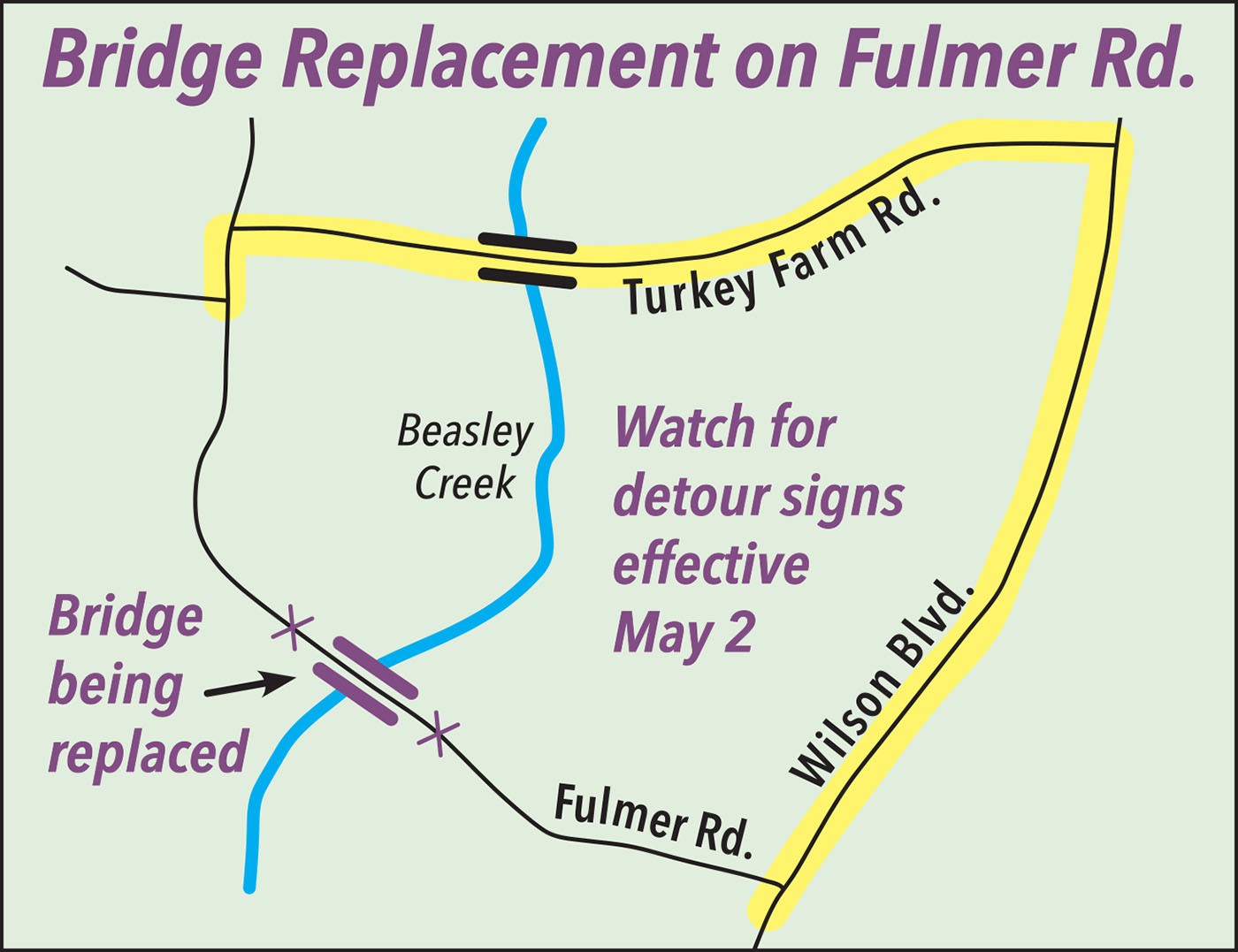
    Bridge Map April 22 copyBLYTHEWOOD (April 21, 2016) – A bridge on Fulmer Road in Blythewood is scheduled to be taken out and replaced beginning Monday, May 2, according to a letter of notification to Blythewood Town Hall from Robert Dickinson, Acting District Engineering Administrator with the S.C. Department of Transportation.

    Replacement of the bridge, which extends over Beasley Creek, is necessary because of structural deficiencies, Dickenson said. It will be replaced with a 110-foot pre-stressed concrete bridge.

    The bridge is expected to be closed for 11 weeks. Detours will be set up on adjacent roads, including Turkey Farm Road and Wilson Boulevard, during construction.

    “Pending any delays due to weather conditions and fabricator problems, the new bridge should be reopened to traffic by July 15,” Dickinson said.

    “Because of the relatively low traffic volumes, and in order to minimize the construction time, cost and impact to property owners in the area, the road will be closed and traffic detoured during construction,” Dickenson said. “The current plan is for the detour to use roads U.S. 21 (Wilson Boulevard) and Turkey Farm Road.”

    Dickenson said no major businesses will be impacted by the road closing. For more information about the road closing, Dickinson can be contacted at 803-737-6660.


  • To Grill or Not to Grill?

    Council Mulls Cooking Regs at Park

    BLYTHEWOOD (April 21, 2016) – During its monthly work session Thursday morning, Blythewood Town Council again confronted the need for policy to guide the use of grills, bounce houses and mechanical rides at Doko Meadows Park.

    Town Administrator Gary Parker emphasized the need for guidance and decisions from Council regarding the use of the park, and asked that it be put on the agenda for a vote in the near future. He said the Town is being hit with multiple inquiries about the use of grills, bounce houses and mechanical rides from businesses wanting to use the park for corporate events and from families wanting to have birthday parties and reunions.

    Parker also asked Council’s opinion about designating an area for picnics, noting that most of the larger state and county parks had designated areas for picnics and outdoor grills. He also said that from his perspective, bounce houses were just a liability for the Town and should not be allowed.

    Parker noted that folks are already picnicking and using barbecue grills at the park, and that there needs to be a designated picnic area where the Town can set up picnic tables and people can set up grills. He pointed out on a plat map a place already designated for a large picnic area. Another decision Council would have to make is whether people would bring their own grills or the Town would install fixed grills.

    Councilman Larry Griffin asked how it would work if two groups wanted to use the picnic area at the same time, thus highlighting some of the complexity in developing a comprehensive park use policy.

    “We are talking about two areas (for picnics),” said Cecil Moseley, lead maintenance engineer for the Town. “It’s a big field over there.”

    Parker said in his previous experience as a manager of a city where there was a park with picnic shelters that included tables and grills, people would reserve a picnic shelter. However, this was with a larger park operation with staff available seven days a week, and if there was a conflict (over use of the picnic areas), there was staff there to resolve it.

    “We are not there yet,” Parker said.

    Sitting in for Mayor J. Michael Ross, who could not attend the work session, Councilman Tom Utroska suggested that until the Town can come up with a policy and a designated area for picnics, groups can come and picnic, but it should be first-come, first-served with no reservations and no grilling allowed. Utroska was also opposed to bounce houses, largely due to the liability they would present for the Town. His concerns were echoed by Parker and other Council members as well.

    Councilman Eddie Baughman suggested allowing only gas-fired grills to avoid the mess and potential fire hazards caused by charcoal grills. He noted that the Park is a public park and he didn’t want to be so restrictive as to hinder the ability of groups to cook and serve food.

    When it looked like the group was leaning toward prohibiting grilling until a policy could be developed, Griffin interjected: “When I hear no grilling, are we talking just no charcoal grills? It’s really difficult to come into a park and have fun if you are having to cook food somewhere else and bring it to the park. . . . When you say park, when you say picnic or a cook-out, that’s grilling. There is no sense in me coming to the park if I can’t grill.”

    Finally, Council agreed that in the interim, until a comprehensive policy can be developed, Parker, when asked by groups interested in using the Park, would say “no” on allowing a bounce house, other inflatables, or rides and “yes” on the grilling.

    Signs and Hot Spots

    Council reviewed the recommended placement of new directional signs for Blythewood. One new sign will be placed at Blythewood Road and Boney Road, and the second sign will go at Blythewood Road and Main Street. Each will cost $1,000.

    Council also briefly discussed the expansion of Wi-Fi hotspots in the town, coming to the conclusion that it is not the role of the Town to provide Wi-Fi and internet to the community. Parker reported that after meeting with a representative of AT&T about providing hot spots, his sense was that “this is not something really the Town should be engaged in and providing to the community — this is something that is more under the authority of the individual businesses themselves if they want to provide a hotspot in their restaurant or motel.”

    Painting the White House

    Parker presented three bids he received for painting the Hoffman House. The painting bidders came from a list of contractors recommended by the Sherwin Williams store as having experience in painting 100-plus-year-old houses. However, the three bids were widely apart: $9,700; more than $47,000; and $19,500. Parker said the medium-priced bid was the one the Town will proceed with, especially since it was closely based on the specs that were done by a “professional in this field” and was slightly below the original estimated budget of the project. He said the work will start in a couple of weeks.

    Security System

    Council deferred further discussion on a security system for the Manor, Park and Hoffman House. While the Town has already received two proposals for a security system, given the number of options available and the diversity of the proposals and the costs, Parker said he has set up a meeting with the Richland County Sheriff’s Department to first get some input from law enforcement as to what their experience is with various systems.


  • Plan Update Puts Leadership on Notice

    WINNSBORO (April 15, 2016) – As consultants continue their work on Fairfield County’s newest set of long-range plans, County Council during their March 28 meeting received a word of advice during an update on their Economic Development Plan: officially get behind the next Strategic Plan.

    “I will point out that that 2010 Strategic Plan was never formally adopted by County Council and that was a real obstacle to implementation,” Crystal Morphis, of Creative Economic Development Consulting, LLC, told Council during her presentation last week, “so one of the key recommendations for this update is for you to adopt it and endorse it and pass it on to your staff to implement it. Without that endorsement from Council, staff and the department was able to move forward really on a limited basis. They accomplished some things in the Strategic Plan, but they really needed the endorsement of this Council.”

    Morphis and her firm are working on an update to the County’s Economic Development Plan, while T.Y. Lin International is preparing an updated countywide Strategic Plan. Council voted in 2014 to launch the planning process to help prepare the County for the influx of money expected from fees-in-lieu-of taxes on two new reactors at the V.C. Summer Nuclear Station, the first of which may come online in 2020.

    Fairfield County has some things going for it, Morphis told Council last week. Unemployment is down, she said, and wages are growing. Home values are also growing, she said, while at the same time home prices are competitive when compared to the region.

    On the downside, she said, Fairfield County’s population is declining, and with it the labor force. Income is stagnant, while overall education attainment remains low.

    “That (education attainment) is a key factor for companies that are considering moving to the area,” Morphis said, “because they want to find a skilled and trained workforce.”

    SWOT

    Reviewing her firm’s SWOT (Strengths, Weaknesses, Opportunities and Threats) analysis, Morphis said the county’s key strengths are its location in relation to transportation access (I-77), and in relation to larger metropolitan areas (Columbia and Charlotte). Utilities in the county are also competitively priced, she said.

    Key weaknesses, she said, included a lack of direction and overall consensus, which she said an updated Strategic Plan should help address. And while the county is conveniently located near a major interstate highway, she said, the development of additional railway sites would be a “key advantage to this community.”

    Long-term poverty, Morphis added, was also a significant weakness in Fairfield County.

    “That (long-term poverty) is something that we find in other rural communities,” she said, “but it’s concentrated here and that’s why this economic development strategic plan is very important.”

    The projected revenue from the nuclear reactors, Morphis said, presents the county with a golden opportunity.

    “You have the opportunity with new revenue to create economic transformational projects,” Morphis said, “and the leadership on this Council is going to be critical in making key investments, especially in infrastructure and economic development.”

    The declining population and the difficulty in keeping youth in the county topped Morphis’s list of threats.

    “The millennials are now the largest part of the workforce and communities that do a really good job of retaining and attracting those young people will be the communities that are successful going forward,” she said. “Companies go where they can find a trained workforce.”

    Morphis also reviewed the county’s “product inventory,” or available buildings for prospective industry. The County has one spec building at present, she said, and recommended that the County consider adding at least one additional building.

    “Communities that have quality buildings are those that are getting looked at by companies,” she said. “You do have one building, but it would be good to have more than one, so we do recommend that you take this model that you have started with the spec building and carrying it forward.”

    There remain, she said, “a few due diligence items” at the Walter Brown 2 Industrial Park “that would really make that park stand out.” A virtual spec building, she added, should also be added to the County’s Economic Development website.

    Target Sectors

    Morphis identified four “target sectors,” upon which the County should focus its economic development plans.

    “When we talk about ‘target sectors,’ these are the sectors where you would focus your marketing dollars and where your regional alliance, the I-77 Alliance, is focusing its marketing dollars,” Morphis said. “That doesn’t mean you would not accept and welcome other companies, but this is where you’re focusing your marketing dollars.”

    For Fairfield, she said, those sectors are: Energy (services that can be provided to V.C. Summer); Advanced Material and Transportation Equipment (to serve the state’s aviation and automotive industries); Chemicals and Food Products (industries strong in Fairfield and Chester counties, she said); and Business Financial Services/Life Sciences (industries with a presence in Richland and York counties, she said).

    The 2010 Plan

    Reviewing parts of the 2010 Strategic Plan, Morphis said the County, which is still searching to fill the position of Economic Development Director, should also consider creating an Assistant Director for that department.

    “It is more work than one person can implement,” she said.

    Morphis also said that while the County had budgeted for product development, for incentives and for other economic development spending, “there was no funding in the department for things like marketing or existing business programs,” she said.

    Morphis recommended budgeting for marketing, including a business retention and expansion program.

    “In a small community like Fairfield, you cannot afford to lose even one company, because it is so hard to recruit a new company,” she said. “I believe that this has been a missed opportunity in this community when you have relied on others for your business retention and expansion program.”

    She also suggested that Council consider additional product development funds “to be put in the budget for engineering studies and additional due diligence on sites.”

    “I know that you do have some other product development money for long-range planning,” she added, “but this would be for studies that could quickly support projects.”

    Morphis also recommended expanding the Economic Development Committee to include more private-sector members, as well as upgrading the office of the Economic Development Department.

    “It has been my experience that companies will not invest in communities that do not invest in themselves,” she said.

    Internal Marketing

    Morphis said the County may also want to consider marketing itself to itself, to combat what she said was the County’s negative image within Fairfield County.

    “In everyone that we talked to, there is an undercurrent of negativity internally in this community,” Morphis said. “All of you (Council) present a very positive image to the outside, but internally there’s some public relations work to do.”

    That can be accomplished, she said, for little cost using social media and marketing tools. Internal marketing, she said, could be one of the roles for the Assistant Director of Economic Development.

    Next Steps

    “I would encourage this Council to adopt this strategic plan,” Morphis reiterated. “That was a shortcoming of the last strategic plan. It’s hard for you as leaders to hold your staff accountable to an economic development plan without adequate funding, support and your endorsement and leadership in the plan.”

    Morphis urged Council to work with an expanded Economic Development Committee, and to expand the staffing of the Economic Development Department and budget the funds for that department.

    But the tallest hurdle, she said, was leadership.

    “The main difference in communities that are successful and those that aren’t is leadership,” Morphis said. “I have worked in communities that have inherent assets and they should be prospering, but they’re not because leadership is not pulling in the same direction. And I have worked in communities that have lacked in significant assets and they’re making progress because their leadership has consensus in the community and they’re pulling in the same direction.”


  • Public Shows up at Meeting, Councilman Calls Cops

    Kamau Marcharia
    Kamau Marcharia

    RIDGEWAY (April 15, 2016) – During a special called meeting of Fairfield County Council last week at the Fairfield Commerce Center on Peach Road, Councilman Kamau Marcharia called 9-1-1 when three members of the public showed up for the meeting which was, in fact, open to the public.

    Macharia’s call was placed just before 2 p.m., before the April 6 public meeting was called to order and before Council had voted to enter executive session for the purpose of interviewing candidates for the County Administrator’s position.

    “We’re holding an executive session,” Marcharia told the 9-1-1 dispatcher, “and folks from the Saving Fairfield County, and, even though we haven’t started in our meeting, (are) asking questions. They have threatened me before. We need an officer down here now!”

    Marcharia went on to say, “They’re intervening in the process, even though we haven’t gone into executive session. They’re in there questioning us and demanding information and they need not be here.”

    Bob Carrison, who along with Jeff Schaffer and Elizabeth Jenkins had showed up at the meeting, characterized their presence and behavior differently. And none of the Council members who were present when the three arrived reported them being threatening demanding or intervening.

    “Obviously that Council member (Marcharia) has a limited understanding of democracy and the Freedom of Information Act,” Jay Bender, a First Amendment attorney in Columbia who represents the S.C. Press Association, said. “If an elected representative is threatened by a citizen’s question on a public matter, that representative doesn’t deserve to hold office.”

    Bertha Goins, who lives in Marcharia’s Council district and is running against him in the November elections, agreed and made her feelings known at Monday night’s Council meeting during the public comment time.

    “Our community can no longer survive under weak, frivolous, childish nonsense such as using our law enforcement as a scare tactic against the very people you represent,” Goins said in a prepared statement.

    Carrison said he asked members of the Council when the three arrived at the Commerce Center if Council had entered executive session.  When Council told him the public meeting had not yet been called to order, Carrison said, “We sat down and told them we were here because we want them to know how important this is to us.

    “We talked a little more,” Carrison said. “I would call it a reasonable dialogue. There were no threats. No yelling. Jeff said nothing. Beth said nothing,” Carrison added. Carrison’s “reasonable dialogue” was conducted with Chairwoman Carolyn Robinson (District 2).

    After Monday night’s regular Council meeting, Robinson similarly characterized the conversation she had with Carrison, calling it “respectful.”

    It was during that conversation at the Commerce Center that Marcharia reportedly packed his things together and left, making the 9-1-1 call from the parking lot.

    “Kamau came in with Sgt. Mull,” Carrison recalled. “Another deputy arrived as Carrison, Schaffer and Jenkins were leaving, and according to the Sheriff’s report, all three left without incident. In a WIS-TV news story the following day, Jenkins said she left feeling intimidated by the 9-1-1 call. Also in that news segment it was reported that Fairfield County Sheriff Will Montgomery said no one was arrested and that he did not plan to arrest anyone.

    Explaining to The Voice on Monday why he called   9-1-1, Marcharia said “I wanted the police there. They were supposed to be there. They were running late. I didn’t want them (the public) to compromise our executive session.”

    Meetings of public bodies like the one at the Commerce Center are open to the public, according to the S.C. Freedom of Information Act. Provisions of the law allow public bodies to conduct portions of meetings in executive session, out of public view, but not before first calling the public meeting to order and voting openly to enter into the closed session.

    Members of the public can be removed from meetings if they are being willfully disruptive; however, both Carrison and Robinson said this was not the case. Councilman Billy Smith (District 7) agreed.

    “I did not see a reason that would necessitate 9-1-1 being called,” Smith said Monday.


  • County Floats Loan to Hospital

    WINNSBORO (April 15, 2016) – Fairfield Memorial Hospital got a shot in the arm Monday night as County Council agreed to loan the healthcare facility more than $400,000; albeit, with strings attached.

    The loan of $423,092.38 comes less than a month after Council voted to OK the early release of $366,750.54 in quarterly budgeted hospital funds, and was the culmination of Ordinance 661, which amended the County’s 2015-2016 budget in order to accommodate the financing.

    “Fairfield Memorial Hospital provides care to thousands of residents a year, many so critically ill that they couldn’t make it to another hospital,” Sue Doscher, the hospital’s CEO, told Council during Monday night’s public hearing on the ordinance. “If that was your family, cost is not an issue. Spare no expense in saving the lives of our loved ones.”

    Doscher was one of 10 people – Council’s maximum – to speak during the hearing and urge Council to pass the ordinance.

    The hospital’s original request, made on Feb. 15, was for $451,773. Interim County Administrator Milton Pope told Council during the Feb. 15 meeting that $305,523 of the requested funds was targeted for a CT and MRI maintenance agreement. The remainder, he said, was to cover the implementation fee of the new Wellness Works program, for which the hospital at that time had already signed up.

    Radiology generates about two-thirds of the hospital’s revenue, Harry Palmer told Council last night. A radiologist with Fairfield Memorial, Palmer said the hospital performs approximately 20-25 CT scans a week, to the tune of $40,000, and five to nine MRI scans a week, for about $14,000 – if the aging machines are up and running. If the CT or MRI machine goes down, he said, the hospital is not only faced with a loss of revenue, but also the expense of paying out of pocket for replacement parts, which can range between $100,000 and $300,000.

    “We as a board have worked many many hours trying to make sure that we do everything possible to keep that hospital open,” James McGraw, Chairman of the hospital’s board of directors, said during the public hearing. “Neighboring hospitals are closing around us, we have a challenge before us. But believe me we are almost there.”

    Prior to the hearing, during the first public comment portion of the meeting, two members of the public questioned Council’s process in how they went from the original $451,773 request to what Pope said in previous meetings was a “placeholder” figure of $200,000 in the ordinance to what the ultimate number would be by the end of the evening.

    “I was told that the figure of $200,000 was more or less just a place-keeper,” Bob Carrison said, “that at tonight’s meeting when the ultimate number comes out we’ll all know exactly what’s happened as far as the discussions and what requests were made and what decisions Council had made to try and help the hospital.”

    Carrison said he wanted to see the hospital succeed, but that he would “like to see an explanation of your thought process and what you guys decided to do in executive session and how you came up with the numbers and whether or not you considered taking money, making a budget amendment taking money from the general fund that was left over from perhaps the fuel or some other line item and moving it into this item,” he said, “which could have been done through a budget amendment the same way as the $200,000. It’s just a little bit confusing to us.”

    Beth Jenkins echoed Carrison’s sentiments, asking Council to vote against an ordinance that was “not transparent” and “not specific” until a breakdown of the funding and where it will go could be made public.

    Strings Attached

    When Council brought the ordinance to the floor, Billy Smith (District 7) amended the motion to approve, turning the $200,000 placeholder figure into a $423,092.38 loan. The loan carries the following contingencies, which must be met by the hospital before Council will consider any future funding requests:

    The funding shall be based upon a two-month period beginning May 1 and ending June 30, 2016. At the end of this period, Fairfield County (all Council members) shall be provided a written ‘term sheet’ of contractual expectations by Fairfield Memorial Hospital and any potential real affiliates(s) or partner(s).

    Fairfield County (all Council members) shall receive a copy of Fairfield Memorial Hospital’s application for S.C. DHHS ‘Transformation’ Funding.

    Fairfield County (all Council members) shall receive a copy of the regulatory requirement guidelines which must be met for an application to be granted by SC DHHS ‘Transformation’ Funding.

    The Fairfield County Council Chairperson or its Council member designee(s) shall be invited to attend all Executive Session or merger/Acquisition Meetings of Fairfield Memorial Hospital.

    Fairfield County (all Council members) shall be granted direct access to an potential or real affiliate(s), partner(s), consulting firm(s) or legal representative(s) of Fairfield Memorial Hospital to gather information regarding any potential requests to or financial commitments of Fairfield County (Council).

    Fairfield County (all Council members) shall be provided written monthly updates on the financial and operational status of Fairfield Memorial Hospital.

    Fairfield County (all Council members) shall be provided a written plan of action on any potential improvements or discontinuations regarding any Fairfield Memorial Hospital departments or services continually operating at a loss for the past three months or longer.

    Council passed the ordinance facilitating the loan unanimously.


  • Park Tops Workshop Agenda

    BLYTHEWOOD (April 13, 2016) – Choosing a security system for the Park and Manor and placing restrictions on the use of grills and bounce houses in the Park will be two of several topics discussed by Town Council at its monthly workshop on Thursday, April 14, at The Manor.

    “We expect to have several proposals for security systems available at the workshop,” Town Administrator Gary Parker told The Voice.

    Council has, for a couple of months, been discussing the purchase of a security camera system for the Town Park, Hoffman House and Manor.

    “Staff has felt that some kind of security system should be installed given the vandalism in the park and other potential issues,” Parker said. “Such a system would cover most of the Town Complex.”

    Council is considering a system that will record footage of all activity around Town Hall, Doko Manor, the public restrooms, fields behind Doko Manor and several other locations around the property as well as record the license tags of all cars entering and exiting the complex from Langford Road.

    Grills and Bounce Houses

    In a workshop preview packet, Parker noted that he felt it was time Council addressed the increasing number of inquiries the Town is receiving about the use of grills and bounce houses for private events in the park.

    “Most parks that allow grilling of food have a designated area with picnic shelters and tables,” Parker said. “If we establish a designated area, possibly with fixed-in-place grills, that may be fine. But it’s probably not a good idea to let people bring their own grills and cook food anywhere they have rented some space for their event. I have misgivings about that Park area getting messy with spilled grease or ashes. There is a reason that states, counties and other municipalities have established picnic areas,” Parker added.

    Parker said the Town had budgeted for and picked out picnic tables.

    “But we have not designated a picnic area,” he continued. Parker said the Park’s picnic area should probably be away from the playground, ball fields and amphitheater.

    Bounce Houses

    As for bounce houses at private events in the park, Parker suggested Council consider some of the tragic news stories about the inflatable play houses. He said the Town’s Municipal Association of South Carolina Risk Management team recommends against the Town allowing the use of bounce houses in the park.

    “There have been several incidents over the year, becoming more frequent with more frequent use of these, in which windy conditions caused them to blow over and, in rare cases, actually become airborne causing serious injury and fatalities,” Parker said.

    During the workshop, Council is expected to address whether to allow the use of mechanical rides at private events in the Park such as train ride and hay rides.

    Also on the agenda are discussions about the placement of way finding signs in the downtown area, increasing the number of Wi-Fi ‘hot spots’ in the town and painting the Town Hall.

    The workshop is set for 9 a.m., Thursday at The Manor and is open to the public.


  • Fee Waivers Under Fire

    WINNSBORO (April 8, 2016) – A request by the U.S. Nuclear Regulatory Commission (NRC) for the Fairfield County School Board to waive building use fees for district facilities came under fire at the School Board’s March 15 meeting.

    Kevin Robinson, Director of Finance, presented several requests from outside organizations asking that the board waive the fees for use of school buildings. The NRC asked for a fee waiver for the use of McCrorey-Liston Elementary School for a public meeting on the V.C. Summer Nuclear plant; Gethsemane Church and Sunday School union asked for fees to be waived for use of McCrorey-Liston for six days for Vacation Bible School; V.C. Summer asked for a fee waiver for use of the track at Fairfield Central High School for a physical fitness test for its security response team; and the Fairfield Salkehatchie service group asked for fees to be waived for using the high school to house mission volunteers for a week.

    Board member Annie McDaniel (District 4) noted that the school district could be reimbursed from governmental agencies for the use of the schools.

    Board chairwoman Beth Reid (District 7) replied that the motion was that the fees be waived.

    McDaniel said she would like to amend the motion under consideration by the board, “that we not waive the fees, because we can get reimbursement for the use of the facilities.”

    “Why would we not want to waive fees for an agency that contributes mightily to our budget every year and for whom we have waived the fees for who knows how many years?” Reid asked.

    McDaniel said that waiving the fees should be based on need.

    “Why should we waive the fees (for V.C. Summer) when we have students in that area who have been complaining because, when we first built that high school in the area, we promised those parents that we would pay for those students’ (transportation to) extracurricular activities,” McDaniel said. “We have not been truly honoring that except for some athletic events. Please help me understand why we would not want the money back when we could get reimbursed?”

    Contacted by telephone after the meeting, McDaniel told The Voice that it was her understanding that when the district had closed McCrorey-Liston and Winnsboro high schools and consolidated them under Fairfield Central, the parents in the outlying county areas were assured that the district would pay for transportation for the students for extracurricular activities at the school.

    She said this was still an on-going issue in the poorest and most remote areas of the county, and in fact had been raised at a recent town hall meeting held by Superintendent Dr. J.R. Green at McCrorey-Liston School of Technology.

    During this meeting, the parents were told that the district doesn’t have the money to help the students attend extracurricular events. Her frustration, McDaniel said, is that she talked with an (NRC) representative who said the NRC would not have problems paying an invoice for the use of the school facilities.

    “Why would you want to give to the wealthy and not give to those in need?” McDaniel asked, stating that she did not have a problem waiving the fees for Salkehatchie because students in that organization use their own money to buy materials and renovate houses in the community.

    Reid said the board does not determine the use of facility but determines only if there will be a fee waiver.

    Board policy on the use of school facilities by non-school groups states, the “board restricts the use of these facilities to recognized non-profit community organizations…. City and county activities may use some school facilities for activities on a non-profit basis without a facilities charge. The district will charge these groups for utilities, security, and custodial services.”

    The policy further states that, “When school facilities are used by non-school persons, a school employee must be present while the facility is in use. The group using the facility will pay for the employee’s services.”

    Also, administrative rules for the district state, “The board requires the administration to also establish a facility fee schedule for the areas deemed appropriate for community use as part of this policy. Consideration is given to school-related and non-profit organizations and lower fees are charged in an effort to encourage community use; however, it is the intent of the board to recover any direct expense incurred as a result of such usage. Requests for fee waivers will be referred to the board. Any organization may request a fee waiver.”

    Responding to a question from Paula Hartman (District 2), Superintendent Green responded that the cost to use school facilities would vary depending on the event, but estimated that for a couple of hours it would “probably be a couple hundred dollars.”

    Hartman said the use of the school facilities seems to be growing more and more, and she would like the board take a closer look at its policy.

    McDaniel asked Green if the Democratic Party had paid any fees recently when they used the middle school. Green said they had not. McDaniel further pointed out that the school board was not even presented with a fee waiver request from the Democratic Party and that it was not reviewed by the board. Under further questioning by McDaniel, Green also conceded that he had allowed another church, the House of Prayer, to store equipment at one of the schools without completing a facility usage request.

    Henry Miller (District 3), who earlier had stated that since the NRC gives the district “$21 million” a year, said he wasn’t going to fight them on the issue of fees and pronounced the “school is community … we are one,” and that the board should encourage the community to come to the district: “I would wish that we had more churches, more businesses to come to our schools.”

    The board voted on McDaniel’s amendment — that Dr. Green invoice the government entity (NRC) so the district can be reimbursed for the use of the school facilities. The motion failed 5-2. The board then passed the original motion, that the fees be waived for use of the McCrorey-Liston School of Technology by NRC, 5 (Reid, Miller, and Board members William Frick – District 6, Sylvia Harrison – District 1, and Carl Jackson – District 5) to 2 (McDaniel and Hartman). The board also approved the fee waiver request for Gethsemane, with 5 voting yes, Hartman voting no, and McDaniel abstaining, and unanimously approved the two fee waiver requests for the use of Fairfield Central High School.

    When The Voice asked Robinson after the meeting whether the fee waiver meant that the organizations would also not have to pay for the costs of utilities, security and custodial services for the use of the schools, he stated that if the waiver is approved, any fees the district would normally charge would be waived, and the organization would not have to pay anything to use school facilities.


  • IGA Coming to Winnsboro

    State Sen. Creighton Coleman outside the future home of the IGA grocery store in Winnsboro. (Photo/Barbara Ball)
    State Sen. Creighton Coleman outside the future home of the IGA grocery store in Winnsboro. (Photo/Barbara Ball)

    WINNSBORO (April 8, 2016) – When Walmart closed up shop at the end of January, it took with it more than just Fairfield County’s largest retail outlet. It also left Bi-Lo as the only grocery game in town.

    That monopoly is now over.

    This week, State Sen. Creighton Coleman (D-17) announced that IGA (Independent Grocers Alliance) will soon be moving into the site once occupied by Food Lion in Fairfield Square, 133 Highway 321 Bypass S. The Food Lion closed its doors in 2012, leaving shoppers with only Walmart and Bi-Lo to choose from for their grocery needs.

    “Negotiations have been going on for some time with IGA,” Coleman said, “but I didn’t think it was proper to say anything until the contract was signed. It’s signed. They’re coming.”

    The effort to bring a second grocery chain into Fairfield County was a joint one, Coleman said. State Rep. MaryGail Douglas (D-41) joined forces with Coleman to help lure the IGA, and Coleman said the County government and the Town of Winnsboro worked together to get the deal done.

    “After Walmart left, MaryGail and I started looking around and IGA was the logical choice,” Coleman said. “They came about two weeks ago and we met with them and the realtor at the store and looked at the site. And we contacted the Town and the County and asked them to look at incentives, and both were willing to sweeten the deal until IGA could get their feet under them. Everyone worked together.”

    Once Coleman and Douglas had established the contacts, Coleman said, the legislators stepped aside and allowed the realtor, the County and the Town work through the details.

    “We’re just elated they’ve decided to come,” Douglas said. “They’re coming at a really good time.”

    Milton Pope, Interim County Administrator, said IGA was capitalizing on an incentives deal the County had floated after Walmart’s exodus. In an effort to attract new retailers, the County shortly after the Walmart closing committed up to $100,000 in marketing and incentives to bring in business. IGA, Pope said, was offered $50,000, paid out in two annual installments of $25,000 each.

    “I also asked Council if they would direct me to reach out to the Town to get them to offer things,” Pope said. “There was a very positive response from the Town.”

    Winnsboro Mayor Roger Gaddy said Tuesday night that the Town offered some concession to IGA on building permits and inspection fees to aid in the grocer’s transition.

    It was not known at press time when IGA planned to open for business, and efforts to reach the company and the realtor involved in the deal were unsuccessful at press time. But Coleman said he didn’t think Fairfield would have to wait too long.

    “I would think pretty quick,” Coleman said. “They’re already paying rent.”

    And IGA may not be the last storefront to make a new home in Winnsboro. Coleman and Pope both said this week that several businesses were looking at the former Goody’s store, also in Fairfield Square; however, neither would disclose who was doing the looking.