Category: Government

  • Abney Hill Estates Gets Variances

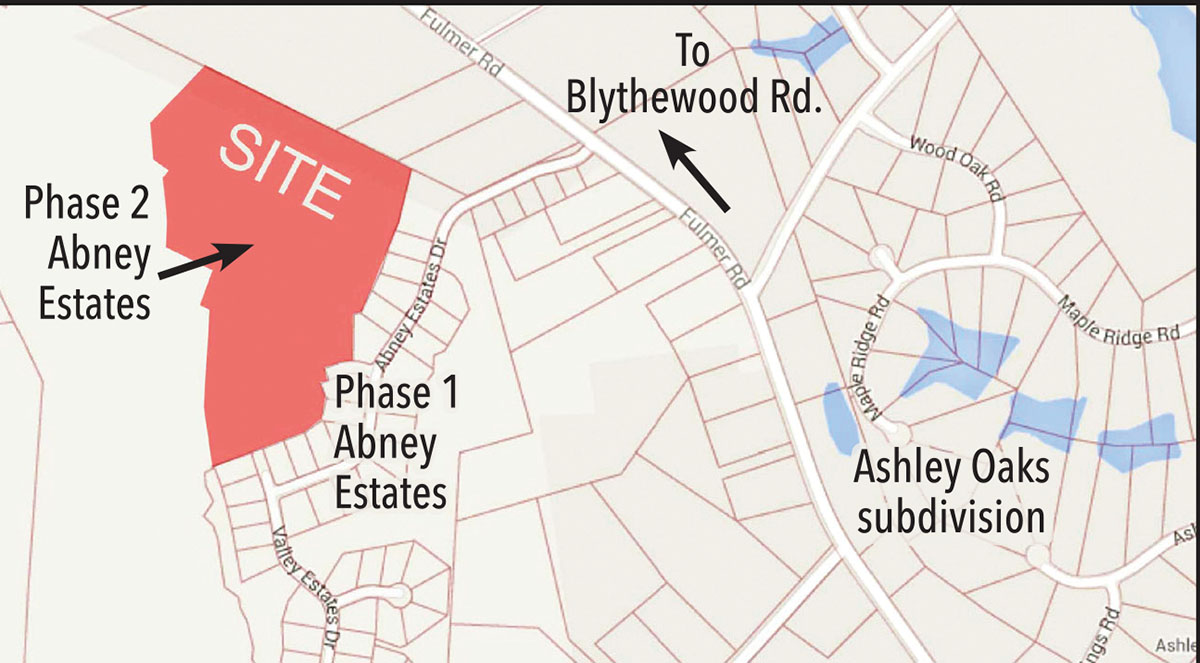
    Abney Hill map conv copyBLYTHEWOOD (May 5, 2016) – After Town Administrator Gary Parker gave administrative approval to Essex Homes earlier this month for a proposed sketch plan for Phase 2 of the Abney Hill Estates subdivision, the Town’s Planning Commission on Monday evening voted unanimously to delegate authority to Parker to issue a preliminary approval letter for the plat, but with conditions.

    The vote to approve also included a variance from the Town’s land development regulations that will allow Essex to disturb (grade) more than a third of the 90,000 square feet of designated buffered land along a stream that runs through the property. The average width of the buffer zone is 50 feet. The variance specifies, however, that the land disturbance must not intrude upon the 20 feet of land next to the stream, Parker wrote in a memo to Essex Home’s management.

    While Town Planner Michael Criss said the developer would be required to revegetate (according to submitted plans) the land area disturbed by the grading, Parker said it would take the Town’s employees time and resources to inspect and monitor the revegetated stream buffer area for erosion control now and over time.

    Town Planner Michael Criss told the Commission that while the variance will not set legal precedent for buffer land disturbance, it will set design precedent for other developers.

    “Why can you not leave the buffer undisturbed?” Commissioner Marcus Taylor asked John Champoux, Vice President of Sustainable Design Consultants, representing the developer.

    “We would lose a variable amount of land and (housing) units,” Champoux answered.

    In referencing Essex’s storm water management for the development, Criss pointed out that the 25-acre development will be the first low-impact development in the Town and could be a pilot for future developments.

    The following conditions were imposed by the Commission on the plat approval:

    • Ownership of the property being developed must be resolved to the Town’s satisfaction (presentation of a deed).
    • The plat must be reviewed by the Town’s consulting engineer and by Richland County Public Works.
    • Parker must be allowed to review the response from the S.C. Department of Transportation (DOT) to a traffic impact memo issued by the developer’s engineering firm that indicates certain intersections near the Phase 2 development (Fulmer Road at Blythewood Road, Abney Estates Drive at Fulmer Road and Mt. Valley Road at Fulmer Road) will not be significantly impacted by increased traffic from the development. Further, any improvements mandated by the DOT would be incorporated into the subsequent bond plat or final plat and not hold up construction.
    • The Town must receive the National Pollutant Discharge Elimination System permit from the S.C. Department of Health and Environmental Control. The disturbed stream buffer area must be revegetated.
    • The developer must submit confirmation of the calculations for the minimum required replacement of trees.

    Champoux told the Commissioners that the project is on schedule to begin construction in 2017.

     

  • Council Targets Big Rigs

    BLYTHEWOOD (May 5, 2016) – Many of Blythewood’s former Town Councils have fought the perception that the town is little more than a truck stop on the interstate. Monday night, Mayor J. Michael Ross decided to do something about that perception by offering an ordinance that would limit or eliminate tractor-trailer parking in the downtown area.

    “I’ve asked our attorney, Mr. (Jim) Meggs, to construct an ordinance (that will address) our primary concern in the downtown area behind Carolina Wings,” Ross said. “We’re having tractor trailers park there overnight for two and three nights. They park on the (McNulty) road, everywhere. It’s a traffic hazard and a public safety issue. And the aesthetics of the Town of Blythewood are affected by being blocked by 18-wheelers.”

    Earlier in the meeting, Mike Switzer, Executive Director of the Blythewood Chamber of Commerce, offered that Chamber members were in support of such an ordinance.

    Meggs said the ordinance would address several different aspects of tractor-trailer parking to include where and how long tractor-trailers can park in the town.

    According to the proposed ordinance, “It shall be unlawful for any person to park a truck tractor, semi-trailer having more than two axles or a trailer having more than two axles on any public street, road, right of way or as otherwise prohibited by the Town of Blythewood Code of Ordinances.”

    The ordinance also addresses unlicensed and inoperable tractor-trailers and requires that, if parked in the town limits, they “must be kept in a closed garage or under protective cover not visible from adjacent parcels or public rights of way.”

    The ordinance would require that tractor-trailers parked in the town limits between 9 p.m. and 6 a.m. be parked in areas zoned Rural (RU) and industrial (LIRP, LI, LI-2 and BI).

    Councilman Eddie Baughman made a motion to table the ordinance, “until our work session on May 12 so we can hash this out a little more. We need to look at regulations that go along with this,” Baughman said.

    Councilman Tom Utroska agreed, seconding the motion, “until we have some time to discuss all the wherefores and wherewiths. I don’t want trucks parking on the streets day in and day out. But I want to have a plan that we can go forward with,” Utroska said.

    Councilman Malcolm Gordge also agreed, saying, “There are lots of issues with this we need to clarify.”

    Asked by Ross who would enforce the ordinance once it is passed, Meggs said, “I think we’d have to have a discussion with the Sheriff as to how far he would be willing to go to enforce such an ordinance.”

    Council voted 5-0 to table the ordinance until after discussing it at the May 12 work session that will begin at 9 a.m. at The Manor.


  • Jeep Delivers –

    Jeep_Rogers_YMCA_IMG_0208 copy

    Mayor J. Michael Ross presented a check during the Monday evening Council meeting for $1,000 to Blythewood’s Jeep Rogers YMCA for its annual fundraising campaign. Accepting the donation are representatives of the YMCA, from left, Tiffani Moore, Brad Lewis (manager of the Blythewood office of Mid Carolina Credit Union) and Katie Litton.


  • Water Rate Hike Could Hit Blythewood

    BLYTHEWOOD (May 5, 2016) – A proposed increase in Columbia water and sewer rates could impact as many as 800 residential and commercial customers in the Blythewood area.

    Columbia City Council is currently considering a 4.3 percent increase in rates, which would take effect July 1. The rate hike could add between $2.26 and $12.77 to monthly bills of Blythewood customers. Although Blythewood is served by the Town of Winnsboro, the water passing through Winnsboro’s meters in Blythewood is purchased by Winnsboro from Columbia.

    “Whatever cost we incur (from Columbia) would have to be passed on to Blythewood customers,” Lorraine Abel, Winnsboro’s Assistant Town Manager, said Tuesday.

    But with the first vote on the proposed budget, which includes the rate increases, not scheduled until June 7, Abel added that it was too early to say specifically what those costs would be. Two votes are needed to pass the budget.

    If the 4.3 percent increase is approved, residential water customers outside Columbia’s city limits would pay an average of $3.80 more per month, or a little more than $93 per monthly.

    Commercial customers outside Columbia’s city limits would see an increase of $12.77 per month, which would send their monthly bill to just over $313.

    Customers inside the city limits would feel somewhat less pain, with residential customers paying an average of $2.26 more per month and commercial customers paying an average of $7.49 more per month. The average residential bill inside the city limits would increase to about $54.75 per month, while the average commercial bill would be about $184 per month.

    The 4.3 percent increase could generate more than $5 million in additional revenue for the City, all of which would go toward improvements to the water and sewer systems. The additional revenue would also reduce the amount the City will have to borrow in order to invest a planned $140 million into upkeep of and upgrades to the systems.

    City Council will meet again on May 10 to discuss the proposed rate increases. A public hearing is slated for June 7, prior to the first vote on the budget.


  • Committee OK’s Drawdy Park Fixes

    WINNSBORO (April 29, 2016) – Fairfield County Council’s Administration and Finance Committee voted Monday evening to recommend to full Council the winning bid for the repair of drainage lines at Drawdy Park. The Committee also recommended the outsourcing of printing duties to a private vendor.

    The Committee, chaired by Carolyn Robinson (District 2) and consisting of Marion Robinson (District 5) and District 6 Councilwoman Mary Lynn Kinley (who made it to the meeting after the voting was done), gave the OK to a bid of $27,000 from Martin & Son Contracting, Inc. for the Drawdy Park work.

    Martin & Son, of Spartanburg, beat out bids of $28,000 by the Ridgeway firm M.C. Rowe Construction Company, Inc., and $36,771 from J.P. Smith Builders, LLC, of Camden.

    The project will consist of digging an existing ditch to a depth where it can tie in with an 18-inch crossline pipe; replacing existing crossline pipe with 18-inch CPP tie-in to the catch basin; removing all existing concrete pipe and replacing it with 18-inch corrugated plastic pipe; removing the fence and filling in the existing catch basin; installing 18-inch plastic pipe on the baseball field side to tie in with existing concrete pipe; running an 18-inch plastic pipe to catch basin 2 and an 18-inch plastic pipe from the basin to the woods; and installing two junction boxes on the back side of the baseball field. In all, approximately 800-feet of pipe will be installed.

    Printing

    The Committee agreed to recommend to Council the outsourcing of printing and printer needs to Sharp Business Systems of Columbia, removing those duties from the County’s IT Department.

    According to Interim County Administrator Milton Pope’s recommendation documents, the outsourcing will save the County a little more than $17,629 a year.

    “We are currently not paying the least amount for daily printing and not properly utilizing the power of IT by way of in-house management of ink/toner stock,” Pope’s recommendation states. “I’m recommending a change that will reduce the IT budget by (more than) 7 percent and will also save Fairfield County over $1,700 annually. Further, IT will be better able to serve the County’s technical issues quicker.”

    Both recommendations will go before full Council on May 9.


  • Liaison Cut from Budget

    WINNSBORO (April 29, 2016) – Prior to second reading Monday night of an ordinance to establish the 2016-2017 budget, County Council voted to adopt a block of changes that shifted money between departments, while also effectively killing the County’s Workforce Liaison Department.

    The recommended changes, Interim County Administrator Milton Pope said before the vote, came from Council’s instructions to administration during the April 12 budget work session.

    “Except for the last item in the total changes in revenue, the last item there with the Workforce Liaison Department, all of the others we have accomplished . . . within the recommended budget as presented by the County Administrator,” Pope told Council. “In short, what I am saying is, it did not change the budget dollars. Depending on what action, or if you take an action on the last item, then that would be a further reduction to the numbers that you have.”

    Council voted to adopt all the changes as a whole, which included cutting $57,996 from the Workforce Liaison Department. If that change holds on third and final reading, that department will disappear.

    The position of Liaison is currently held by Jackie Workman. The department has been responsible for disseminating employment and employment training opportunities to Fairfield County residents.

    The changes also include reducing by $30,000 funding for the Clemson Extension, as well as removing $6,000 from the Tax Assessor’s software maintenance agreement, and moving both figures into Administration to fund a performance audit. Landscaping for the Walter Brown Industrial Park, for $26,400, was moved into the Economic Development Department.

    The changes also take into account an expected $20,000 windfall in recyclable revenues, which will go to help fund the $26,785 necessary to open recycling centers on Wednesdays.

    Council adopted the changes 6-0. Councilman Kamau Marcharia (District 4) was absent from Monday’s meeting.

    Council will hold its next work session on the budget on May 3. Third and final reading of the budget ordinance is slated for May 9.


  • Council Alters Board Selection Methods

    BLYTHEWOOD (April 28, 2016) – While Council appointed new members Monday evening to the Town’s Planning Commission and Board of Architecture Review, they broke new ground in how they selected and appointed the Planning Commission member.

    Mayor J. Michael Ross told Council that prior to the meeting he and Councilman Tom Utroska had jointly interviewed two applicants for the Commission. Those candidates turned out to be Cynthia Schull of Oakhurst subdivision and Michelle Kiedrowski of Cobblestone Park. Neither Ross nor Utroska named Schull. Ross said he and Utroska had made the decision to present only Kiedrowski to Council for appointment Monday evening.

    After introducing Kiedrowski, Ross and Utroska commented on her qualifications, both noting that she had run for Town Council last year.

    Utroska also commented that Kiedrowski, who moved to Blythewood about a year ago, “wanted to be part of this community and wanted to give back to this community. I like the fact that she has a willingness to give back to the community and that’s what we’re looking for.”

    After both Utroska and Ross praised the other candidate as well, still without naming her, Ross invited Council members to ask questions of Kiedrowski. In response, Council members welcomed and praised her for seeking the volunteer position and voted unanimously to appoint her to the Planning Commission. Schull was not voted on.

    Traditionally, applicants for the Town’s boards and commissions each appear before the whole Council at the public meeting, explain their qualifications and answer Council members’ questions followed by the vote.

    When asked about the new appointment procedure following the meeting, Utroska defended it, saying he saw nothing wrong with it.

    Council next voted unanimously to appoint longtime Blythewood resident John Miles, an engineer, to the Board of Architectural Review.

    Both Kiedrowski and Miles were appointed to fill partial terms.


  • School for Troubled Teens Slated for Greenbrier

    WINNSBORO (April 22, 2016) – When the director of a new alternative school for troubled teens presented County Council with his plans during Council’s March 28 meeting, one Councilman encouraged the director to make a similar presentation to the community before opening for business.

    Cameron Tea, director of Cambio Academy, told Council his Utah-based company was already renovating a building at 1403 Greenbrier Mossydale Road in Winnsboro, and hopes to have the facility open by August.

    Cambio is a high-end, private academy, Tea said, that has partnered with S.C. Whitmore, a virtual charter school headquartered in Chapin. Cambio offers wilderness therapy, equine therapy and experiential learning therapy in a group-care environment.

    “A lot of these kids come from very affluent families (and they) need to kind of grow up a little bit and realize the world isn’t just handed to you; you have to work for it,” Tea told Council. “They’ve never pulled weeds from a garden, they’ve never had to be responsible to take care of an animal.”

    Some of them, Tea said, may even have to learn something as basic as “how to clean their room every single morning.”

    The academy recruits clients from across the U.S. as well as internationally, Tea said, and they typically come recommended by private education consultants. He estimated that Cambio would house between 48 and 72 teens who would stay at the academy for a period of eight to 14 months. The academy will have a staff to student ratio of 1:6, he said, with supervision provided around the clock.

    Following Tea’s presentation, District 4 Councilman Kamau Marcharia urged Tea to hold a meeting in the Greenbrier community to make sure citizens there felt safe about having at-risk teens housed close by. Marcharia asked Tea if some of the teens in the academy might be potentially be suffering from mental health issues, which could be cause for concern in the community.

    “A lot of these kids do have some psychological issues,” Tea replied, adding that some of them may be taking prescribed medications for those issues. “We are clinically intensive and have a therapist on staff. We do not take kids that are super high risk. We’re not a lock-down facility. We do not take kids who are coming off drugs. We take kids who are coming off their short-term rehab centers for a boot camp experience.”

    Marcharia also asked Tea if there was a history of any of these troubled teens breaking out of the facility, something that also might be of concern to the surrounding community.

    In his 10 years on the job, Tea replied, there have been two cases of teens running away from a facility.

    “That’s less than 1 percent,” Tea said. “It’s always a potential factor, but a very limited factor. There are alarms on doors and windows, but sometimes they figure out ways; but for the most part they want to graduate, grow and get back to their home life.”

    While Tea agreed to hold a community meeting before opening the doors to Cambio Academy, Interim County Administrator Milton Pope told Council that the property at 1403 Greenbrier Mossydale Road was already properly zoned to accommodate Tea’s venture.

    “There was no way we could prevent them from offering their business and that particular location,” Pope said.

    Tea had come to administration with his proposal more than a year ago, Pope said, and had coordinated the development of the site with the County’s Planning and Zoning office.

    “They have followed through with everything they said they would,” Pope said.


  • District Budget Up, Millage Rate Flat

    WINNSBORO (April 22, 2016) – The Fairfield County School Board gave approval to first reading of the proposed fiscal year 2016-2017 District budget during its regular board meeting April 5. Kevin Robinson, Director of Finance for the District, presented the Board with a proposed budget of $38,470,384.

    The projected budget does not represent a millage increase, according to Robinson, although it is approximately $600,000 more than the current budget.

    On the revenue side, there is a projected increase in the local tax revenue base as well as increases in state reimbursement for bus driver salaries and projected transfers for teacher salaries and benefits.

    On the expenditure side, Robinson said the District plans to spend about $670,000 more next year than the current year. This is because of a proposed 2 percent state-mandated increase in the teacher salary scale, which will cost $510,530, plus increases in benefits, retirement costs and normal salary step increases. The District also plans to hire six new instructional positions.

    Robinson also budgeted for an increase in purchased services of $491,425. Purchased services are those items and services the District buys from outside vendors, ranging from energy costs to books, and also include substitute teachers that were previously accounted for under salaries and benefits. This projected increase is balanced by an anticipated reduction of about $100,000 in the legal services line, which has long been targeted by Board members Annie McDaniel (District 4) and Paula Hartman (District 2) as being artificially inflated to fund school trips and other miscellaneous expenses.

    Robinson also estimated a reduction of more than $300,000 in transfers from the general fund for food services, which he said is now projected to be self-sustaining. It was explained during the District’s audit last fall that this positive food service balance is primarily because of the District qualifying for and receiving $400,000 in enhanced U.S. Department of Agriculture (USDA) funding for school lunches.

    Hartman wanted to know how District salaries for teachers compared to those in the surrounding areas. Dr. J.R. Green, Superintendent, responded that the most recent salary study presented to the Board showed that the District is very competitive, especially for teachers who have been in the District for two or three years.

    Board member Henry Miller (District 3) wanted to know about the money the District transfers to Chester County for students living in the Mitford area. This payment is projected to be somewhat reduced because of fewer Fairfield County students attending those schools. Miller wanted to know why that was included in the District’s budget, making it seem higher than it was, when the students were not counted in the District.

    Board chairwoman Beth Reid (District 7) interjected that the District was not receiving state or federal funds for those students but was also not incurring any costs on their behalf. However, “the court ruling was that our local dollars follow those children to the (Chester) schools,” she said. Green pointed out that the number of students attending the Chester schools has been steadily dropping; in 2011-2012 there were about 190 students. In FY 2016-2017, the District plans to send Chester County $511,000 for about 127 students.

    The Board has scheduled a budget workshop on April 26, when it will go over the figures in more detail. The first reading of the budget passed 6-0-1.

    Also during the meeting, the Board heard from Dr. Claudia Edwards, Deputy Superintendent of Academics, on the proposed 2016-2017 Academic Calendar. The first day of the 2016-2017 school year will be August 15; spring break will be April 10 – 14, 2017, and mid-year exams will take place before winter break.


  • County Faces Shrinking LOST Fund

    WINNSBORO (April 22, 2016) – In spite of speculation last February by a member of the state’s Board of Economic Advisors that the loss of Walmart tax revenues could trigger a property tax increase, Interim County Administrator Milton Pope presented Council last week with a recommended 2016-2017 budget based on last year’s millage rates.

    “Based upon our budget recommendation, we’re using the existing revenues that we have,” Pope told Council during the April 12 work session. “We’re not requesting you to consider increasing the millage.”

    However, Pope said, there would be some fallout from the January closing of the county’s largest contributor to the Local Option Sales Tax (LOST).

    With the absence of Walmart’s contribution, Pope said the fund was expected to shrink by $497,444 – from $1,889,236 in 2015-2016 to $1,391,792 in 2016-2017 – a drop of around 30 percent.

    Robert Martin, who serves on the Board that governs the S.C. Revenue and Fiscal Affairs Office, told The Voice in February that it was unlikely that Fairfield County could maintain its then-current level of property tax relief without Walmart.

    Moreover, he added, “I don’t see how County Council is going to get around increasing property taxes somewhat next year.”

    But last week Pope told Council that while the allowable millage increase by law was 0.15 percent, the 2016-2017 budget was sticking with last year’s millage rate of 181.8. And while property tax relief is expected to diminish somewhat, Pope also said the fact that Fairfield County is a receiver county of LOST funds may help offset the budgeted 30 percent drop.

    “There could be – could be – some possible cushion in those numbers,” Pope told Council. “We’ve gotten some preliminary numbers on this, but keep in mind at the end of the fiscal year, because we are a receiving county in the Local Option Sales Tax, if all of the counties statewide are doing well, we receive monies based upon the Robin Hood provision that’s in the Local Option Sales Tax law.”

    How much cushion won’t be known until July or August, Pope said, when the 5 percent pool from donor counties is distributed.

    General Fund Expenditures

    Pope said general fund expenditures were up by more than $335,000 from last year – from $27,000,370 to $27,333,621. The biggest decreases in departmental spending come in the Fire Board’s general operations fund, down $102,446, and the Planning, Building and Zoning Department, down $63,687.

    Other decreases come in the County Attorney’s budget (down $18,882); Human Resources (down $5,191); Purchasing Department (down $10,524); Tax Assessor (down $5,959); Vehicle Maintenance (down $4,422); Solid Waste (down $19,949); Veterans Affairs (down $9,830); Recreation (down $8,381); and the County’s Summer Youth Program (down $5,000).

    The greatest increases come in the EMS Department, up $276,677; the Detention Center, up $214,541; and the Sheriff’s Office, up $118,392.

    Other increases come in the Finance Department (up $23,709); Data Processing (up $47,332); Economic Development (up $66,819); Animal Control (up $25,257); the Treasurer’s Office (up $25,233); Magistrate’s budget (up $45,745); Voter Registration (up $38,976); and Emergency Management (up $50,038.

    Overall, the budget is down a little more than 4 percent, with a decrease in special revenue funds and capital projects from $7,766,810 last year to $6,001,796 this coming year, for a total County budget that drops from $34,769,880 in 2015-2016 to $33,335,417 in 2016-2017.

    Budget documents can be found on the County’s website at www.Fairfieldsc.com.