Category: Government

  • Races on the Line in Primary

    WINNSBORO (June 9, 2016) – Polls open at 7 a.m. Tuesday in the statewide primaries and Fairfield County voters could effectively decide a number of November races on the Democratic dominated ballot.

    The District 5 seat in the U.S. House of Representatives will be the only Republican contest on the ballot as incumbent Mick Mulvaney of Indian Land faces a challenge from Ray Craig of Lake Wylie.

    State Senate

    In the Democratic race for the District 17 seat in the State Senate, incumbent Creighton Coleman faces a challenge on two fronts – from Michael Fanning of Great Falls and from Morgan Bruce Reeves of Winnsboro.

    “It is imperative that District 17 continues on its path of job creation without tax increases,” Coleman, a Winnsboro native and local attorney, told The Voice this week. “As you well know, this district encompasses Fairfield and Chester county and southern York County. Some parts of the district are doing better than others, but I am determined to move the district forward by creating the environment that will allow all of South Carolina to prosper.”

    Coleman, 60, has served in the State Senate for eight years, and previously served eight years in the State House of Representatives. Among his accomplishments, Coleman cited the creation of the I-77 Alliance, which initially included Fairfield, Chester and York counties and later added Richland and Lancaster counties. Coleman also secured money to bring the Department of Parks, Recreation and Tourism and the Department of Natural Resources into a revitalization project in Great Falls that is tied in with the relicensing of Duke Energy dams along the Catawba River.

    Coleman also helped save Fairfield Memorial Hospital “tens of thousands of dollars,” he said, by working with the Department of Revenue to waive penalties and interest on money the hospital owed in back taxes. He has also prompted the Department of Transportation to review and improve dangerous intersections, such as Salem Crossroads and the Highway 213-Jackson Creek Road junction, he said.

    “I want to continue with good common sense legislation such as the Abandoned Building Bill, which creates incentives for developers to rehab abandoned buildings by creating tax incentives,” Coleman said. “My job is to help people navigate the state government and help our laws be more people-friendly.”

    Reeves, 57, operates a clearing and grading company in Winnsboro. Reeves said his primary goal is to eliminate real estate property taxes and replace that revenue through an increase in the sales tax.

    “I want to do away with real estate property tax,” Reeves said. “I want to put that on a referendum.”

    Reeves was unclear on how much the sales tax would increase in order to make up for the property tax revenue.

    “It’s whatever the numbers would be,” he said. “I’ll talk about that later.”

    Reeves said in Fairfield County “we live like a Third World country.” To remedy that, he promises to build a new hospital, more libraries and a YMCA. He also vowed to build a new medical center and a YMCA in Great Falls, and a new hospital in Chester County. The revenue for these projects, he said, would be generated by the sales tax.

    Attempts to reach Fanning before press time were unsuccessful.

    Fanning is the Executive Director of the Olde English Consortium, a 501(c)3 non-profit that, according to its website, is an “educational collaborative seeking to promote excellence in education through collaboration.” The OEC holds professional development seminars at all levels for member districts, facilitates the Academic Challenge student competition and hosts Junior Scholar Days. It also aids in professional networking for a range of fields, from Fine Arts to Finance Directors.

    Paid membership of the OEC include the school districts of Chester, Clover, Lancaster, Chesterfield, Fairfield, Rock Hill, York, Cherokee County and Fort Mill, as well as Winthrop University and USC-Lancaster.

    According to records available on the ProPublica.org website, the OED in 2014 collected $132,265 in revenue in the form of “contributions.” Fanning drew 67.9 percent of that revenue – $83,053 – as “executive compensation.” In 2013, contributions totaled $112,890, of which 72.1 percent, or $91,615, went to Fanning’s salary. In 2012, the OEC brought in $104,626 in contributions and $20,080 in “other revenue,” for a total of $124,716. Fanning’s salary in 2012 represented 64.6 percent, or $100,306.

    While noting there was nothing illegal about how the OEC’s pay scale is structured, Sen. Coleman questioned the ethics of profiting from taxpayer dollars.

    “This is certainly not how taxpayer money should be used,” Coleman said. “It should be spent on teacher pay raises, classroom costs, etc.”

    Sheriff’s Race

    Incumbent Sheriff Will Montgomery faces a primary challenge from Marvin Willis.

    Montgomery said that during his two years in office drug arrests are up and the crime rate has dropped. More training is now available to employees, he said, and more deputies are on patrol in communities. The Sheriff’s Office is in the process of creating a K-9 unit, Montgomery said, and all deputies have been issued body cameras.

    “These are just a few of the changes that we’ve made,” Montgomery said, “and I look forward to continuing our progress in the right direction for the future of our County.”

    Willis, 45, is an officer with the City of Columbia Police Department, where he has served for the last five years. Prior to that, he was a Richland County Sheriff’s deputy for nearly 10 years. He has lived on Cook Road in Ridgeway for the last five months, but has called Fairfield County home for nearly two years, he said.

    “I want to transform the Sheriff’s Office into a transparent, modern, 21st century law enforcement agency, where all the input matters,” Willis said. “I want to improve the quality of life of all the employees at the Sheriff’s Office and for all citizens of Fairfield County.”

    Clerk of Court

    Betty Jo Beckham is retiring at the end of the year, opening the field to Judy Bonds, 61, of Winnsboro, and Dorothy Belton, 51, of Ridgeway. Bonds has worked in the Clerk of Court’s office for 30 years, spending the last 15 of those years as Deputy Clerk of Court.

    “I know how to run the job,” Bonds said. “I’ll be ready to go from day one. I won’t have to be trained. We’re also the register of deeds, so we have to know a lot in our office. It’s a lot to know, and I know it.

    “We have a reputation for being one of the best Clerk of Court offices in the state,” Bonds said. “I’m proud of that, and I want to keep that reputation.”

    Belton is a contract paralegal who works with law firms throughout the U.S. She has 20 years of experience in the legal field, she said, and 18 years of running a law office. Her primary objective, she said, is to implement an electronic court filing system in Fairfield County.

    “I understand the value of people working together,” Belton said. “I want to bring the Clerk of Court’s office into the 21st century.”

    Coroner

    Barkley Ramsey, 52, is seeking his third term as County Coroner and he faces opposition from Chris Hill, 42, a Fairfield County Sheriff’s deputy.

    Ramsey was a deputy coroner for nine years before taking the top spot after Joe Silvia retired in 2009. He has also been Chief of the Lebanon Fire Department since 1984 and of the Rescue Squad for nearly 10 years. Among his accomplishments, Ramsey noted the opening of the new Coroner’s Office on S. Congress Street, the new morgue and a new evidence room. Ramsey has four deputies, and during his tenure all four now receive a monthly stipend, he said.

    “I have a great working relationship with the Highway Patrol, other law enforcement agencies, other county coroners and EMS,” Ramsey said. “I require all my deputies to have their certified hours of training, plus their first responder certification.”

    Hill has been with the Sheriff’s Office for 16 years and is currently the Warrant Supervisor. He is a certified interior structure firefighter, formerly served on the Rescue Squad, and has been in the funeral service for 20 years. He is currently working on his apprenticeship as an embalmer.

    “I want to make a difference at the Coroner’s Office,” Hill said. “I feel like Fairfield County can get better than what it’s getting. I’m a young guy and I’ve got some new ideas.”

    Among those new ideas, he said, are the Care Program, where volunteers can assist at death scenes, and an outreach program that would partner with other agencies to demonstrate the consequences of drinking and driving or texting and driving at local schools.

    State House

    Also on the Democratic Primary ballot is the District 41 State House seat. MaryGail Douglas, the incumbent, is running unopposed.

     

  • More Delays, Rising Costs at Nuclear Plant

    JENKINSVILLE (June 9, 2016) – South Carolina Electric & Gas (SCE&G), primary owner of the V.C. Summer Nuclear Station, has filed a petition with the Public Service Commission of S.C. seeking an order approving an updated completion and cost schedule for two new nuclear reactors currently under construction at the Jenkinsville plant.

    The requested rescheduling would push the completion date for Unit 2 back to Aug. 31, 2019 and would push Unit 3 back to Aug. 31, 2020. It would also add approximately $807 million to SCE&G’s cost for the project, taking the estimated total cost for SCE&G up to $6.8 billion in 2007 dollars and $7.7 billion with escalation.

    When initially approved by the Commission in March 2009, SCE&G’s total estimated cost was expected to be $4.5 billion in 2007 dollars and $6.3 billion with escalation.

    SCE&G is a 55 percent owner of the project, with Santee Cooper owning the other 45 percent. Overall estimated cost for the project now stands at around $14 billion.

    According to SCE&G’s notice of filing, the new cost schedules “reflect additional costs associated with the Amendment and with certain change orders outside the Amendments. It also reflects additional Owner’s costs principally associated with the Amendment and the change in the guaranteed substantial completion dates, and additional costs to upgrade certain project-based transmission equipment.”

    A public hearing on the amendments has been scheduled for Oct. 5-7 at 10:30 a.m. at 101 Executive Center Drive, Saluda Building, Columbia, 29210.

    “The request for a cost of overrun of this magnitude will hit consumers hard and the PSC should for once side with residential and business customers and require for SCE&G and its shareholders to bear a major portion of the cost increase as it is in large part due to poor project management,” said Tom Clements, director of Savannah River Site Watch. “The law under which the project is being pursued is not a blank check for endless cost overruns and schedule delays and the company must be held accountable by the PSC for the costly problems and mistakes with the project.”

    Clements said SCE&G has also informed the Commission that it would be filing for its annual nuclear cost rate increase, as allowed by the Baseload Review Act. If approved, it would be the ninth such rate increase since the project was approved.

    SCE&G customers are already paying 15.5 percent of the bill for advance payment of financing costs for the project, Clements said.

    In October 2015, SCE&G signed an Amendment to the Engineering, Procurement and Construction Agreement for the project, which, among other things, granted SCE&G a “fixed price option for the remaining work required under the construction contract,” according to the company’s notice of filing.

    “The claim that the cost is fixed is very misleading as it’s clear that there can be future cost increases, all of which would be passed on to the consumer if allowed by the PSC,” Clements said. “The cost of the project is not capped and unless the PSC acts responsibly to curb the cost the sky’s the limit on future cost overruns, so customers should be braced for yet more negative rate impacts.”

    Phone calls to SCE&G spokespersons for comment were not returned at press time.

    Anyone wishing to testify and present evidence at the hearing should, by July 15, notify, in writing, the Commission at the Office of Regulatory Staff, 1401 Main St., Suite 900, Columbia, S.C. 29201; or K. Chad Burgess, Director and Deputy Counsel, SCANA Corp., 220 Operations Way, Mail Code C222, Cayce, S.C. 29033. Refer to Docket No. 2016-223-E.


  • Attempt to Max Out Lots Fails

    COLUMBIA (June 9, 2016) – When members of Richland County Council prepared, at their May 24 meeting, to delete verbiage from the County’s zoning law designed to ensure that developers do not stuff new projects with more houses than the community can sustain, LongCreek Plantation resident Sam Brick, a retired attorney and government watchdog, took note and then took on Goliath.

    To Brick’s credit, and to his surprise, he won the battle.

    “Council advertised the proposed deletion of critical protective language in the zoning law as ‘clarifying,” but they were not clarifying anything. They were going to change the law by taking out the phrase: ‘but in no case shall it (the individual lot) be less than…’

    “That phrase is specific to each zoning district and is included in the zoning regulations of every zoning code to specify the minimum size allowed for lots in that particular zoning district,” Brick said.

    Within his allotted three minutes before Council, Brick passionately explained how removing that phrase would virtually emasculate zoning designations in Richland County.

    “By removing this phrase, Council would make it legal to do what they have been doing illegally for years – allowing developers to skirt the zoning laws by putting more lots in a development than the law allows. “

    This illegal reduction of lots crept in, Brick said, through the Green Code provision (later called Open Spaces provision), passed several years ago by Council to allow developers the benefit of reducing the sizes of their lots on certain conditions, one of which was that the developer would set aside a certain amount of green space for parks, walking trails and other amenities in addition to the space already required for roads, buffers, rights-of-way, etc.

    Brick said he first become concerned about the reduction of lot sizes a couple of years ago when, under the guise of the Green Code provision, developers in his own neighborhood were granted more dense zoning designations by County Council than were allowed by the County’s zoning law.

    “It was a developer’s dream come true. They were turning areas designated for medium density into high density without having to ask for a zoning change,” Brick said.

    “Without that phrase, developers would be free to reduce lots and, in effect, change the zoning of a development without having to apply for rezoning,” Brick told Council members.

    Prior to appearing on the County Council agenda, the proposed amendment first appeared the month before on the Planning Commission’s agenda. Brick emailed residents in his neighborhood encouraging them to attend the Commission meeting and to speak out against removing the critical phrase.

    “I am not optimistic in my chances,” Brick wrote to his neighbors, “but someone needs to attempt to uphold the integrity of our zoning laws and, at least, in the few minutes allotted, explain the effects of what the Commission is being asked to do.”
    The only visible support Brick received at the meeting came from neighbor and friend Bernie Randolph.The task before Brick was daunting.
    In spite of Brick’s plea to save the phrase, the Commission voted unanimously to recommend that Council ‘clarify’ the zoning code by removing the phrase.

    Addressing Council on May 24, Brick explained how the County’s Planning Department has been ignoring the target phrase for some time, allowing a developer, under the Open Spaces provision, to put in as many houses as the developed area could fit by dividing the entire area by the stated minimum lot size for the relevant zone without first deducting the space needed for roads, easements, wetlands, etc.

    “This resulted in approximately 20 percent of new residential developments having lots substantially smaller than the zoning allows in spite of the legal requirement for minimum lot sizes,” Brick said.

    Brick told Council that while each zoning district gives a specific exemption for valid Open Space developments, the Open Spaces provision has a formula that must be adhered to entirely if the developer is to take advantage of the reduced lot portion of the provision, Brick said.
    After Brick’s three minutes ended, Councilwoman Joyce Dickerson, who represents much of Blythewood, moved that the proposed zoning amendment (deleting the ‘but in no case’ phrase) be adopted.

    After a long pause and no second, Chairman Torrey Rush announced that the proposed amendment had failed.

    Brick said he was happy with the vote, but was especially encouraged that, in discussions following the vote, that several Council members confirmed, verbally, that the amendment was not needed and that the Open Spaces provision should be re-examined.

    “I’m very happy with the outcome,” he said. “But the fight is far from over.”


  • Finding Common Ground

    New Administrator Has Record of Uniting County, Town

    WINNSBORO (June 2, 2016) – When County Council officially voted last week on their new County Administrator, they selected Jason C. Taylor from a list of five candidates from across the state.

    Taylor has been the Town Administrator for Ridgeland since 2002, where he has overseen a staff of 52 employees and a budget of $8 million. During his tenure, Taylor told The Voice last week, he has worked closely with the Jasper County government – a spirit of unity he said he hopes to bring with him to Fairfield County, which has a history of divisiveness between County and municipality.

    “It was the same way here for a long time, too,” Taylor said. “It’s just a matter of reaching out and finding common goals and knowing what is good for Winnsboro is also good for the County.

    “I’ve worked closely with Jasper County,” Taylor said. “We have a great group of elected officials at the County and the Town, and they’ve all been great. We’ve worked hand-in-hand with our County.”

    Taylor’s resume, obtained by The Voice from the County through a Freedom of Information Act request, includes a long list of accomplishments over his 14 years in Ridgeland, not the least of which is partnering with Jasper County for the renovation of the 15,000-square-foot Jasper County Farmers Market building, the renovation of Town Hall and the construction of Tuten Park. The latter, a walking trail project, won the 2010 Municipal Association Award for Economic Development.

    Taylor, who earned his Master’s Degree in Public Administration from the University of South Carolina, served as the Executive Director of the Saluda County Economic Development and Planning Office from 1998-2002, and worked for the Lexington County Department of Social Services from 1990 – 1998.

    Taylor and his family have lived in Beaufort for the last 14 years, but he is originally from the Lexington area and his parents still live in the Prosperity area.

    “It will be like coming home,” Taylor said.

    According to additional documents obtained by The Voice through a Freedom of Information Act request, Taylor was picked over the current Director of Administrative Services and Special Assistant to the Mayor for the Town of Summerville, the Darlington County Administrator, Darlington’s City Manager and the Assistant to the County Administrator of Greenville County.

    “We had an interesting group – on paper,” County Council Chairwoman Carolyn Robinson said. “He (Taylor) did an excellent job with his interview.”

    Taylor singed a three-year deal with Fairfield County worth $120,000 a year. He begins his term on June 6.


  • Council OK’s Amphitheater Naming Rights

    BLYTHEWOOD (June 2, 2016) – Town Council gave the OK Tuesday morning to an agreement with the Doko Meadows Park Foundation and Palmetto Citizens Federal Credit Union to construct an amphitheater in Doko Meadows Park and naming it the Palmetto Citizens Amphitheater.

    The nearly $400,000 project is being funded with a grant and pledges from across the community, including $125,000 from the credit union for naming rights.

    “It’s exciting that we have that commitment from our new credit union that’s coming to town,” Mayor J. Michael Ross said.

    Ross said the venue will not include formal seating, but will be open and will include a stage, lighting and sound equipment. Capacity, Ross estimated, could be between 2,000 and 3,000 people. The project has not yet been put out for bid, Ross said.

    “As a community chartered credit union, we’re happy to be able to support great projects that better the communities we serve, like the Doko Meadows Park amphitheater,” Nick Wodagaza, president of Palmetto Citizens, said. “We’re excited for this opportunity to further show our support for Blythewood and look forward to opening our new office her later this year.”

    In addition to the credit union, several community members and companies have made pledges or contributions to the Foundation for the amphitheater. Those contributors will be announced later, the Foundation said.

    “We are excited about the amount of progress the foundation has made in a relatively short time in raising funds to build this new addition to Doko Meadows Park,” Jim McLean, Foundation president, said. “Our approach was to contact companies and individuals who have a presence in the community and the responses have been great. We strongly believe this new venue will further enhance our community charm for our citizens and visitors alike.”

    Construction is expected to begin soon, with the goal of opening the amphitheater early next year.


  • Stewart Resigns

    District 3 up for Grabs in November

    Walter Stewart
    Walter Stewart

    WINNSBORO (June 2, 2016) – Walter Larry Stewart, who successfully appealed the November 2014 election results and unseated incumbent Mikel Trapp in a new election in March 2015, has officially resigned his District 3 County Council seat.

    In a letter dated May 24, Stewart informed the Fairfield County Board of Elections that he was resigning effective June 30. Stewart cited an unspecified health issue as the reason for his resignation.

    Stewart in his letter said he would “continue to serve until an election is called or someone is designated to fill the position.” Debbie Stidham, Director of Fairfield County Elections and Voter Registration, said that since Stewart’s resignation was less than 180 days before the Nov. 8 general election, no special election would be called. Instead, she said, the District 3 County Council seat would be included on the ballot this November.

    Stidham said she forwarded Stewart’s resignation to Gov. Nikki Haley’s office, which has the option to appoint someone to serve District 3 until a newly elected member can be sworn in in January. There was no word at press time if such an appointment would be made.

    Candidates interested in filling the two years remaining on Stewart’s term must file by petition by July 15 at the Voter Registration and Elections Office at 315 S. Congress St., Winnsboro.

    Trapp edged out Stewart 489-484 in the November 2014 race, with the less than 1 percent margin triggering an automatic recount. The recount the following Friday unearthed one additional vote for Stewart and enough irregularities for Stewart to file an official protest of the results.

    Debra Matthews, a Winnsboro attorney who represented the Stewart campaign in 2014, said after the recount that some absentee ballots did not conform to the state statute and three voters were given the incorrect ballot style at their polling place.

    Stewart’s camp prevailed in the protest hearing before the Fairfield County Election Commission, which ordered a new election. Trapp filed an appeal with the State Election Commission, which upheld the County Commission’s decision in a hearing in early December 2014.

    Gov. Haley set the new election date for March 3, 2015, at which time Stewart handily dispatched Trapp 429-380.

    Efforts to reach Stewart for comment before press time were unsuccessful. Trapp, meanwhile, told The Voice that he had “no interest” at this time in running for his old seat again.


  • Winnsboro Budget Clears First Reading

    WINNSBORO (May 26, 2016) – Town Council on May 17 passed first reading on their 2016-2017 general fund and utilities budgets, both of which grew by more than $1 million.

    The general fund weighs in at $5,539,335 for the coming fiscal year, up from $4,284,921 last year. The utilities budget for 2016-2017 comes in at $16,806,976, up from $15,534,364 last year. The utilities budget also includes an increase of 1.4 percent, or .065 cents, in the wholesale water rate. Effective July 1, wholesale water sold to the Town of Ridgeway and Mid-County Water will go for $4.683 per 1,000 gallons.

    The general fund budget also includes a 2.3 percent cost of living pay increase for Town employees, Council said during their May 10 work session. And, as Council ponders the fate of the Mt. Zion Institute school buildings, they have budgeted an additional $200,000 on top of the $100,000 already in the pipeline for the potential demolition of the structure.

    Council had to cope with approximately $200,000 less in Local Option Sales Tax (LOST) funds after the closing in January of Walmart, the fund’s largest contributor. However, Town Manager Don Wood said during the May 10 work session that the Town’s remaining share of the fund was still greater than their millage rate and property owners would still receive tax relief.

    The Town’s millage rate of 38.46, Wood said, amounts to approximately $331,000, while the Town’s share of the LOST fund is around $351,000.

    Expenditures

    Expenditures for Council’s 2016-2017 budget are down slightly from last year to $231,730 from $237,918. The Town Manager’s budget edged up to $315,463 from $309,224. Vehicle repair (up $150), equipment service contracts (up $1,000) and professional services (up $5,850) account for the largest shifts in the Town manager’s budget.

    Municipal Court expenditures are up slightly to $156,666 from $152,950, while expenditures for the Municipal Building rose to $33,981 from $32,100. Maintenance Shop expenditures fell from $95,041 last year to $73,632 in the coming fiscal year, while the budget for the swimming pool is also down somewhat from $44,108 to $44,077.

    Public Safety expenditures are up somewhat to $1,597,730 from $1,586,710, while Streets and Sanitation expenditures are down to $622,885 from $672,165. Building, Zoning and Planning expenditures are also down to $73,920 from $82,140.

    Utilities

    Natural gas revenues are projected to rise in the coming fiscal year from $4,395,849 to $4,505,901, while revenues from the sale of electricity are projected to rise from $6,950,947 to $7,248,092.

    Water revenues are also expected to rise from $2,986,922 to $3,726,922. Sewer revenues are also on the rise, from $1,200,646 to $1,326,061.

    Natural gas expenditures are down in 2016-2017, from $3,905,220 to $3,470,762. Expenditures for the Electric Department are also down, from $6,653,483 to $6,623,857. Water expenditures are on the uptick, from $2,110,327 to $2,382,196.

    Expenditures at the water plant are up from $744,759 to $773,864, while sewer expenditures are up from $656,663 to $705,352. Total sewer plant expenditures are up from $505,551 to $584,447.

    Council will hold second reading at their June 7 meeting.


  • A-Tax Committee Holds Band Tourney Funds

    BLYTHEWOOD (May 26, 2016) –  Confusion about whether an abstention counts as a “yes” in a tie vote meant that an expelled student’s fate was left dangling until the very end of the Fairfield County School Board of Trustees meeting on Tuesday night.
    Expulsion proceedings were initiated against two of three students involved in a fight on the school campus March 7. The expulsions were later upheld by the District Hearing Officer David Corley. Parents of one of those students subsequently requested an appeal hearing before the Board Tuesday night. During the meeting Superintendent Dr. J. R. Green made a recommendation that the Board deny the request for an appeal.
    “The recommended action is that the Board accept the superintendent’s recommendation and not hear that appeal,” Chairwoman Beth Reid (District 7) told the Board, asking for a motion. Board Vice Chair Rev. Carl Jackson, Jr., (District 5) put forward the motion, which, after a long silence, was seconded by Henry Miller (District 3).
    Reid immediately called for a vote without any discussion since this was a student issue. After the 3-3-1 vote, Board member Annie McDaniel (District 4) asked that Reid call the vote again.
    “The vote was three for the superintendent’s recommendation, three opposed and one abstention,” Reid said.
    Approving the recommendation were Reid, Jackson, and Miller; opposed were Board members William Frick (District 6), Paula Hartman (District 2) and McDaniel. Sylvia Harrison (District 1) abstained.
    “So the Board will not hear the appeal of the student,” Reid concluded.
    What happens when it is 3, 3, and 1?” Hartman asked.
    Reid responded that abstentions count as a ‘yes’ according to Roberts Rules of Order.
    “That’s not accurate,” McDaniel objected. “Not for purposes of carrying the order.”
    Reid repeated that abstentions count


  • Council Re-Votes on Administrator Hire

    Attorney: May 12 Vote Illegal

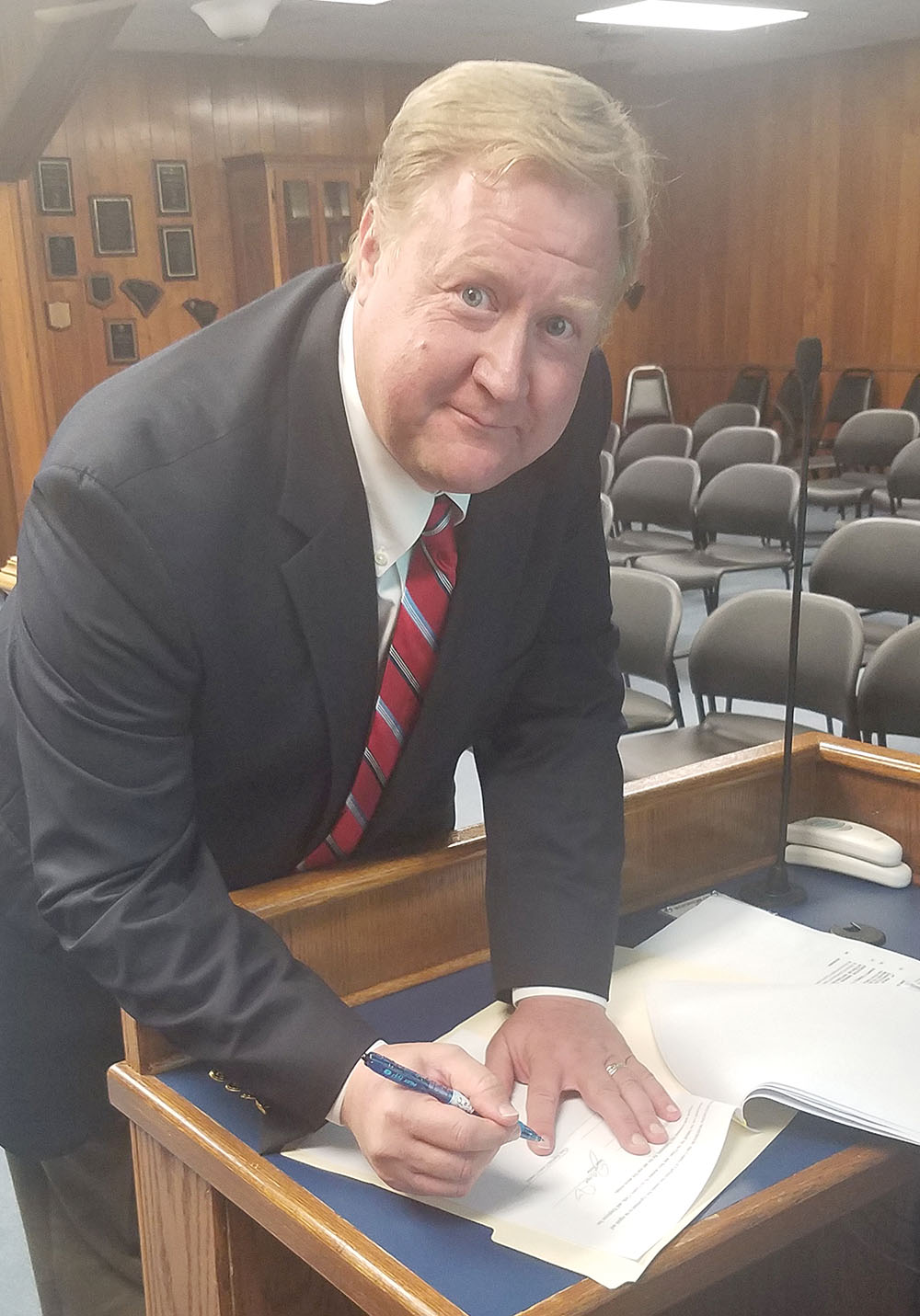
    Newly hired Fairfield County Administrator Jason Taylor signs his contract with the County Monday evening following a County Council executive session. Council voted unanimously to extend to Taylor a three-year contract. (Photo/Fairfield County)
    Newly hired Fairfield County Administrator Jason Taylor signs his contract with the County Monday evening following a County Council executive session. Council voted unanimously to extend to Taylor a three-year contract. (Photo/Fairfield County)

    WINNSBORO (May 26, 2016) – Fairfield County Council opened its May 23 meeting with a statement of apology for failing to vote in accordance with the S.C. Freedom of Information Act (FOIA) when it approved a new county administrator’s contract during a special called May 12 meeting without giving the public prior notification that they were going to vote.

    The apology also stated that Council members was not aware that an FOIA request had been sent by The Voice to County Administration on April 1 requesting the release of the names and resumes of the final candidates for the administrator’s position.

    Interim County Administration Milton Pope did not forward the FOIA request to County Council and also did not respond to The Voice’s FOIA until after the Council’s May 12 vote to offer a contract to the new administrator.

    Council Chairwoman Carolyn Robinson (District 2) told The Voice that, upon learning about the FOIA request on May 19, she asked the Administration to release the names to The Voice the next day. Other Council members reached by The Voice said they did not receive the written request and were not aware that it had been sent to the Administration until after their May 12 vote.

    According to Jay Bender, First Amendment attorney with the SC Press Association, in an article posted on the Press Association’s website, “there is no requirement that a public body (Council) announce its ‘finalists.’ What the law does require is that upon a written request, the public body must make available for inspection and copying all material gathered in a search to fill a position for those persons in the group from which the final selection is made. That group may not be fewer than three applicants.”

    Also at issue is that, during the May 12 meeting, Council came out of executive session and voted to approve a contract with Jason Taylor to be the new County Administrator. Contrary to a new ruling of the S.C. Supreme Court, there was no mention on the agenda that Council would take action, i.e., vote, on the matter discussed in executive session.

    Bender told The Voice that the vote was illegal as there was nothing on the agenda indicating an action (vote) would be taken.

    Bill Rogers, Executive Director of the S.C. Press Association, told The Voice that: “Not listing the selection on the agenda is clearly illegal and is a slap in the face to the public who might want to be there for the vote. It also casts a legal pall over the whole selection.”

    When asked in an email on Monday why The Voice’s FOIA request for the information was not passed on to Council members, Pope responded that he would have to research it and get back to The Voice as to why that happened.

    After learning of the FOIA request last Friday, Councilman William “Billy” Smith Jr. (District 7) told The Voice: “After looking at the statute (SC 30-4-40(A-13) and some interpretation material I found online about this subject, I think I understand the law’s intentions; and if anything was indeed handled improperly by the County, I sincerely apologize. I can tell you that, throughout the selection process, Council made a genuine effort to find and hire a good administrator for Fairfield County, which I believe we have done; and I hope nothing clouds that truth.”

    The May 12 vote was a mistake, Smith said. “It’s our mistake.”

    County Council completed the do-over after it came out of executive session Monday and publicly voted to enter into a “contract of employment agreement with Jason Taylor for the position of County Administrator, beginning June 6, 2016.”

    Taylor’s contract is for $120,000 each year for a three-year term.

    To rectify what turned out to be an illegal vote by Council
    on May 12, Councilwoman Mary Lynn Kinley (District 6) read the following statement at Monday’s meetng:

    The May 12 meeting was the first meeting we had after this instruction from the court and after we had added the provision to our bylaws, and the language was not on the May 12 agenda.
    That said, we sincerely apologize for these errors, any errors; we can honestly say they were unintentional.
    On Saturday, one day after this was brought to our attention, we released the names and resumes of the candidates to The Voice newspaper, and after our executive session this evening we will vote to approve acceptance of the contract with Mr. Taylor.
    It is always our goal to be as transparent as possible and to follow the letter of the law in all situations. I would like to make a statement on behalf of various other members of Council and myself regarding the executive session item on tonight’s agenda about the county administrator’s contract. This is something that needs to be addressed immediately.
    We as a council made a couple of errors in the process of hiring a new county administrator. We have learned that an FOIA request for the names and resumes of the finalists in the candidate pool for our next administrator was made by The Voice newspaper to county staff in early April. We were never served this FOIA request; no members of council received that. Nor were we advised as to what information needed to be released.
    At our May 9 meeting, we amended our bylaws in accordance with the State Supreme Court ruling that instructed public bodies to add the following language to their agendas when executive session items exist, and quote ‘Subsequent to executive session, council may take action on matters discussed in executive session.’
    Again, we apologize for these errors and are now doing what we can to correct them as quickly as possible.
    Thank you.

  • Water, Sewer Rates Rise in Ridgeway Budget

    RIDGEWAY (May 20, 2016) – Town Council during their May 12 meeting passed first reading of their 2016-2017 budget that includes a rate increase for water and sewer service. The increase, Councilman Doug Porter said, was being passed along to Ridgeway customers from the Town of Winnsboro, Ridgeway’s supplier of wholesale water.

    While the Winnsboro Town Council has not yet officially OK’d rate increases, Ridgeway is preparing for rates to go up .065 cents per 1,000 gallons, according to documents provided by the Town.

    According to last week’s proposal, in-town residential water rates would go from $15.10 to $15.25 for the first 1,000 gallons, and from $5.17 to $5.25 for overage costs. Out of town residential rates would go from $20.10 to $20.50 for the first 1,000 gallons, and from $6.42 to $6.50 for overage costs.

    In-town commercial rates would go from $18.10 to $18.50 for the first 1,000 gallons, and from $5.17 to $5.25 for overage. Out of town commercial rates would go from $23.10 to $23.50 for the first 1,000 gallons, and from $6.42 to $6.50 for overage.

    In-town residential sewer rates would go from $12.10 to $12.25 for the first 1,000 gallons, and from $4.52 to $4.75 for overage. Out of town residential sewer rates would increase from $13.10 to $13.50 for the first 1,000 gallons, and from $5.67 to $5.75 for overage.

    In-town commercial sewer rates would rise from $16.10 to $16.25 for the first 1,000 gallons, and from $4.67 to $4.75 for overage. Out of town commercial sewer rates would increase from $19.10 to $19.25 for the first 1,000 gallons, and from $5.67 to $5.75 for overage.

    Tap fees for in-town and out of town water would remain at $500 for non-bore three-quarter-inch taps and $900 for out of town non-bore 1-inch taps. Bore taps come at cost plus 10 percent. Sewer taps will be provided at cost.