Category: Government

  • Blythewood Feeling Growth Spurt

    BLYTHEWOOD (Aug. 11, 2016) – The latest housing boom is on. In Blythewood, at least, where Town officials say building permits for single-family homes are at a five year high.

    “The whole calendar year is higher than in prior years,” Town Administrator Gary Parker told The Voice last week. “The economy has improved. We’ve finally gotten over the real estate crash. And this particular town and this particular area is attractive to people. A lot of people are interested in relocating to a community that is right outside a major metropolitan area.”

    And, Parker added, the school system doesn’t hurt either.

    So, how fast is Blythewood growing?

    “Per capita, Blythewood is growing at a faster rate than Fort Mill,” Kirk Wilson, Director of Permits and Licenses for the Town of Blythewood, said. “We’re one of the fastest, if not the fastest, growing municipalities in the state.”

    The numbers tell the tale.

    Just six years ago, in 2010, Blythewood issued a modest 19 building permits for single-family homes. Since then, the growth has been steady and largely consistent. In 2011, the Town issued 34 building permits. A year later, that figure nearly doubled, to 58 permits. In 2013, permits more than doubled, with Blythewood stamping 123 for approval. There was a small dip in 2014, as the number of building permits decreased to 120. But last year, they were up again, to 175.

    Through July of this year, the Town has already issued 93 permits.

    “It’s not going to be slowing down anytime soon,” Wilson said.

    The growth is mainly west of I-77, Parker said, with the expansion of Cobblestone Park and the Oakhurst subdivisions. Ashley Oaks, phases 8 and 9, and Abney Hills, phase 2, are also likely to add to the number of building permits before the year’s end, Wilson said.

    But while growth is a promising sign for the economy, it can also put a strain on services, particularly in a small town like Blythewood.

    “We’re experiencing that,” Parker said. “We’ve taken a couple of steps to meet the demands. We’ve added additional personnel to our Town staff, and that will only increase if it continues to grow.”

    The first area to feel the strain of increased growth, Parker said, is in parks and recreation.

    “When you have more children, there’s a greater need for parks and recreational programs,” Parker said. “We have to think about it (growth) coming here and think about developing services, particularly in parks and recreation.”

    The local streets and roads, Parker said, will also feel the first symptoms of rapid growth.

    While proposed streetscaping projects will certainly make Blythewood’s roadways more attractive, to keep the traffic moving more practical and ambitious projects are going to have to get under way. The planned widening of Blythewood Road, Parker said, as well as the installation of traffic circles – particularly near the entrance to the Food Lion shopping center – should help alleviate some of the traffic headaches that often come hand-in-hand with rapid residential growth.

    “The Master and Comprehensive plans address some aspects of growth, foremost of which is traffic,” Parker said. “We’re working with the County and working with the Penny Tax folks to address that.”


  • County Council Races to Put Sunday Alcohol Sales on Ballot

    WINNSBORO (Aug. 11, 2016) – If County Council passes by Sept. 9 an ordinance allowing the Sunday sale of alcoholic beverages in Fairfield County, that will put it on the Nov. 8 ballot as a referendum for the people to decide if they want Sunday alcohol sales, County Administrator Jason Taylor told members of the Public Affairs and Policy Committee Monday evening.

    And with that, the Committee fast-tracked Ordinance 672, sending it to Council where members passed first reading by title only at their regular meeting less than an hour later.

    For the ordinance to be passed by Sept. 9, Taylor said Council would have to call some special meetings. Second reading is scheduled for Aug. 22, a Public Hearing on Aug. 25 and third and final reading on Aug. 29.

    The issue came to Council’s attention last month when Lake Wateree resident David Waters brought before Council a petition with about 1,000 signatures calling for Sunday alcohol sales in Fairfield County.

    The petition outlined the following reasons for Sunday sales – that Fairfield County businesses are losing sales to neighboring counties and that the increased sales tax would lower property taxes and provide funds for road paving in the County. But Committee member Carolyn Robinson said the sales tax from alcoholic beverages does not go to property tax or road repairs and that neighboring Kershaw and Lancaster counties do not have Sunday alcohol sales. She said only Newberry County currently has Sunday sales and that Chester County will have it on the Nov. 8 ballot.

    “I would also like to make it clear that this ordinance is only going to apply to the unincorporated areas in the County, not the towns like Ridgeway and Winnsboro,” Committee Chairwoman Mary Lynn Kinley told the Committee. She said the towns would have to pass similar ordinances if they want Sunday sales.

    “I’m not concerned with what folks around us are doing,” Committee member Billy Smith said. “As far as Council is concerned, we’re just offering citizens the opportunity to choose. It’s not about us (Council) choosing when it’s a referendum.”

    Taylor noted that the ordinance, as it reads currently, is a model ordinance that will need some tweaking for clarification before second reading.

    The ordinance also provides for the issuance of temporary permits for the Sunday sale of alcoholic beverages for non-profit events and for on-premises consumption, as well as beer and wine at permitted off-premises locations.

    Smith said the particulars of the ordinance will be spelled out in the posted referendum.


  • A-Tax Committee Reverses Course on Band, Chamber

    BLYTHEWOOD (Aug. 11, 2016) – The Town’s A-Tax Committee was publicly chided by Mayor J. Michael Ross at a special called meeting of the Committee on Aug. 3 for tabling last month a $10,000 funding request from Band Director James Barnes for Blythewood High School’s Band Tournament and for voting against recommending $3,000 for what the A-Tax meeting minutes referred to as salaries for the staff (Executive Director Mike Switzer and his assistant Kitty Kelly) of the Blythewood Chamber of Commerce for their work with the upcoming Big Grab yard sale.

    At its July 6 meeting, the A-Tax Committee took into consideration several reasons for tabling the Tournament’s request – the $31,000 profit from last year’s event, that half of the $31,000 goes to Ridge View High School, which is outside the Blythewood community and that the profits went to fund operations in the school’s band program to pay for such things as private lessons for students rather than being plowed back into the event.

    As for the vote against recommending the Chamber’s $3,000 funding request, the Committee questioned whether it should be funding salaries at all.

    In his remarks, the Mayor pressed the Committee to disregard profits when making recommendations. He also offered revised information, that the $3,000 for the Chamber would go to outside advertising for the Big Grab, not salaries for Switzer and Kelly. Following Ross’s remarks, Barnes and Switzer again made pleas to the Committee for funds.

    This time, the Committee, without discussion, voted to reverse both votes, recommending the full funding requested by the two applicants.

    Immediately following adjournment of the meeting, long-time Committee member George Sensor announced his resignation from the Committee.

    “It’s a long drive over here for me,” Sensor told the Committee and Town officials.

    The A-Tax Committee is only a recommending body and Town Council makes the final decision on awarding A-Tax funds. Council is not required to vote in favor of the A-Tax Committee’s recommendations. But instead of Council voting on the two issues at its regular meeting on July 25, Council asked the applicants, Switzer and Barnes, to resubmit their requests to the A-Tax Committee.

    “I think we need the A-Tax Committee to understand they need to reconvene and look at what is being resubmitted,” Ross said at the July 25 meeting.

    Opening that special called A-Tax Committee meeting on Aug. 3, Events and Conference Center Director Steve Hasterok, who facilitates the A-Tax Committee meetings, announced that there would be changes to the Committee’s meeting format, specifically that the meetings should be open to the public. While the meetings were never closed to the public, applicants frequently waited outside in a hallway while the Committee discussed and voted on funding. Hasterok was more specific in an interview with The Voice, saying that all applicants should know they are allowed to stay in the meetings throughout the Committee’s decision-making process.

    In a related issue, The Country Chronicle newspaper in a recent article appeared to take issue with the Committee addressing questions to a representative of The Voice who was sitting in the room during the July 10 meeting. However, Hasterok told The Voice that the Committee is welcome to direct questions to anyone in the audience, but said he would like for the person answering the questions to do so from the podium.

    At the Aug. 3 meeting, Ross emphasized his objection to the A-Tax Committee basing funding on whether an event made large profits or if it was used to pay salaries.

    “We have guidelines,” Ross told the Committee. “The Architectural Review Board, the Planning Commission all work under guidelines from ordinances, regulations and standards. Looking at the last (A-Tax Committee) minutes, I see there’s a lot of discussion revolving around profits an event might make, and a concern that if they make $31,000, why do they need our money.”

    While Ross later insisted that, “I’m not here to tell you what to do,” he added, “I just want to warn you that I don’t think anywhere in our guidelines – and it’s never been a concern of Council – what the profit margin might be. If the event brings people to eat at our restaurants, puts heads on pillows and buys gas at Larry Sharpe’s stations, then that’s what we want. But I don’t want to not have a function or event that might have been beneficial to not come because they made a profit, because they did real good, because they have other means or used their money. They still might need the seed money to have that event and be successful,” Ross said, warning the Committee a second time about funding an event based on its profit margin.

    At the July 25 Council meeting Ross said he didn’t care how much profit the rodeo makes if those people have a good time and spend money in the town.

    While there are no guidelines in the state statute to suggest the Committee should consider profits or salaries, there are also no guidelines to suggest that they should not.

    In later comments to the Committee, Town Administrator Gary Parker said, “There’s nothing in the state statute that requires (the Committee) to consider profit of an event they are asked to fund,” but he also allowed that consideration of profit, “could be a factor that the Committee wants to consider.”

    Parker said the statute basically just outlines the fact that when the community receives a certain level of funds from accommodation and hospitality tax revenues, that a committee be formed to represent the hospitality industry – hotels and restaurants. But Parker said the statute does not address terms. He said if the Committee wants to have bylaws, policies and procedures to follow, he would be happy to have the town attorney review them and send them to Council for approval.

    Supporting the notion that there are few guidelines to tell the Committee specifically what it should and should not consider when making decisions regarding funding, Damita Jeter, Director of the Tourism Expenditure Review Committee (TERC) at the S.C. Department of Revenue, wrote in an email to The Voice that, “Until funds are spent and reported to TERC we have no authority to comment on these expenditures. Our role is simply oversight; therefore, (until) funds are spent and the report is remitted to us (October of each fiscal year) and the public has (raised) questions/complaints regarding the expenditures, we cannot really say whether or not certain applications should (or should not) be considered.”

    Switzer has, since his original funding request, said both publicly and in an email to The Voice that the $3,000 the Chamber staff receives for salaries for their work on the Big Grab will be covered by the sale of $50 sponsorships, not A-Tax funds. An email storm subsequently erupted between Switzer and some business owners who said they oppose selling sponsorships to pay salaries to Switzer and Kelly who are the only two members of the Big Grab committee in Blythewood, Ridgeway and Winnsboro who receive salaries for their work.

    In an email to Big Grab Committee members that was provided to The Voice, Switzer said, “The Blythewood Chamber is a professional business support organization whose revenues (from all sources) go to cover the costs of the organization which understandably includes staff.”

    In addition to funds raised through sponsorships, the Blythewood Chamber is collecting revenue from Big Grab vendor rentals at the Blythewood Community Center where it is renting 10×10-foot indoor spaces for $80.12 and 15×30-foot outdoor spaces for $43.19.
     

  • County Puts EMS Station Contractor on Notice

    WINNSBORO (Aug. 11, 2016) – County Administrator Jason Taylor informed the Administration and Finance Committee last month of significant problems with a contract signed recently with Ken Simmons and Associates for two county projects – the EMS stations at Jenkinsville and Ridgeway.

    On Monday evening, Council voted 6-0 to rectify the problems and asked County attorney Jack James to write a letter notifying Ken Simmons and Associates that the company will be held responsible for any cost overages relating to the problems.

    “We have three issues,” Taylor told Council members. “The first has to do with a change order the County requested for $45,984 to change out the asphalt for concrete on the apron in the front and back of each fire station.”

    Taylor said the change is necessary because of the way the tires of the heavy fire trucks turn coming in and out of the driveway of the stations.

    “The asphalt would have had a life span of about 10 years while concrete will have about a 25-year life,” Taylor explained.

    “Second, there was a discrepancy between how the engineer designed the project and how it was bid out,” Taylor told Council. “The engineer designed the project with a certain amount of asphalt, but he bid it out for a lesser amount of asphalt. The cost difference between what was designed and what was bid is approximately $39,000. The Committee recommends that Ken Simmons and Associates be made responsible for covering that overage.”

    Taylor said the discrepancy was caught by Fire Chief Tony Hill.

    Third, Taylor told the Committee last month, the engineer delayed requesting S.C. Department of Transportation (DOT) encroachment permits for the project, and that delay caused the project to be shut down by the DOT.

    Taylor told the Committee last month that the County had been told by the engineer that all encroachment permits needed from the DOT had been applied for and that they would be getting the permits that week.

    “But we verified with S.C. DOT that the applications for the permits had not even been submitted, so there could be a delay of up to 30 days, which could be costly to the County,” Taylor said. “I am proposing to have our attorney send a letter to Ken Simmons and Associates saying, ‘If there is any cost associated with these delays, we expect you to cover them.’”


  • Board Awards Stipends

    WINNSBORO (Aug. 4, 2016) – The Fairfield County School Board voted 6-1 during their July 19 meeting to award stipends district wide for certified, classified, athletic and band staff. Paula Hartman (District 2) was the dissenting vote and explained that she voted against the stipends because she had asked Superintendent J.R. Green a year ago for a job description of the Board’s clerk who receives a stipend of $7,000 for  assisting the Board. Hartman said her request was never answered.

    At the District level, the Board approved $3,500 stipends for an Induction Coordinator, $2,500 for mentor teachers and $7,000 for the Board’s Administrative Clerk. In the Student Services Department, the Board approved $3,500 for the Data Manager/Medicaid Supervisor and $2,500 for the Lead Social Worker.

    Academic Supplements

    • Fairfield Central High School stipends: $2,000 each for department heads in English, Mathematics, Science, Social Studies, World Language, Electives, ROTC and Business; $1,500 for an Academic Challenge Team Lead; $1,000 each for a Beta Club Advisor and a Student Government Advisor; $2,500 for a STEM Lead Teacher; $2,000 for Yearbook; $750 for Junior Class Sponsor/Prom; $375 each for Sophomore and Freshman Class Sponsors.

    • Fairfield Middle School: $1,150 each for department heads in ELA, Science, Math and Social Studies; $1,050 each for Special Services and Related Arts; $1,155 each for six Academic Team Leaders; $900 for an Academic Team Coach; $2,500 for STEM Early College Academy Lead Teacher and $1,050 for a PBIS Coordinator.

    • Fairfield Elementary: $3,750 each for Curriculum Chairs for grades K-3, 4-6, Related Arts and Special Services.

    • Magnet School: $2,500 each for Curriculum Chairs, grades K-3 and 4-6.

    • Geiger and McCrorey-Liston: $2,500 each for Grade Level Chairs, grades CD-2 and 3-6.

    • Kelly Miller: $2,500 each for two Curriculum Chairs.

    • Career Center: $2,500 each for two Department Chairs; $1,500 for a Robotics Team Leader.

    Athletics Supplements

    The Board approved $15,000 for the Athletic Director and $3,750 each for two assistant A.D.s.; $8,000 for the Recruiting Coordinator; $5,500 for the Head Strength Coach.

    • Football: $8,000 each for the Offensive and Defensive coordinators; $6,500 for the Special Teams Coordinator; $5,500 each for four assistant varsity coaches; $6,000 for the head JV coach; $4,500 each for four assistant JV coaches; $5,000 for the head middle school coach; $2,500 each for three assistant middle school coaches; and $2,000 each for two filming coordinators.

    • Tennis: $3,000 each for the head boys’ and girls’ tennis coaches. Volleyball: $3,000 for the head varsity coach; $1,500 for the assistant varsity coach; $1,500 for the head JV coach; and $2,000 for the head middle school coach. Golf: $3,000 for the head coach.

    • Basketball: $8,500 each for the head boys’ and head girls’ varsity coaches; $3,000 each for assistant varsity girls, assistant varsity boys, head JV girls and head JV boys coaches; $2,000 each for the B-team boys’ and girls’ coaches; $1,500 each for the middle school boys’ and girls’ coaches; and $800 each for the assistant middle school boys’ and girls’ coaches.

    • Wrestling: $3,000 for the head coach; $1,500 for the assistant coach. Track: $3,500 each for the head girls’ and boys’ coaches; $1,500 each for assistant boys’ and girls’ coaches. Cross Country: $3,500 for the head coach.

    • Softball: $3,500 for the head varsity coach; $2,000 for the assistant varsity and the head JV coaches. Baseball: $3,500 for the head varsity coach; $2,000 for the assistant varsity and the head JV coaches; $1,500 for the assistant JV coach. Soccer: $3,000 each for the head boys’ and girls’ coaches; $2,000 for head JV boys’ and girls’ coaches.

    Academic coaches: $3,000 each for two positions. Band: $10,000 for the Band Director; $4,000 each for the Percussion Instructor and the Auxiliary Coordinator; and $2,000 each for the Woodwind Instructor. Cheerleading: $5,000 for the head varsity cheerleading coach; $2,500 for the head JV coach and $2,000 for the head middle school coach.


  • Council Reviews Utilities Bond

    WINNSBORO (Aug. 4, 2016) – Town Council reviewed Tuesday night a draft of an ordinance that will allow the Town to borrow up to $6 million to improve their utility system.

    “This is just a draft of the ordinance,” Mayor Roger Gaddy told Council. “We want to give everybody a chance to review it and see if there are any additions or deletions or anything they don’t understand about it so at the next meeting we can bring it back for the first reading.”

    According to the draft ordinance, the funds will provide for the rehabilitation of Winnsboro’s wastewater treatment plant and related sewer improvements; construction, replacement and rehabilitation of electric distribution lines and substation breakers; and construction and extension of natural gas lines and “cathodic improvements.”

    Town Manager Don Wood said after the meeting that “cathodic improvements” essentially means the grounding of natural gas lines to prevent electrical discharges into the lines. The replacement of some of the Town’s power lines, Wood said, was on the to-do list because some of those lines are undersized.

    “They were OK when we put them (the lines) in,” Wood said, “but we have more people on the system now and people use more electricity now.”

    The infrastructure improvements come as the Town is also acquiring the last of the necessary rights of way to run a raw water line from the Broad River to the reservoir. The approximately $13 million project is expected to bring anywhere between 8 and 10 million gallons of water a day into Winnsboro’s system.

    “Most small towns our size, their infrastructure – water, sewer – most of the stuff under the ground has been there for quite some time, for years we’ve been doing a lot of patchwork,” Gaddy told colleagues at last June’s intergovernmental meeting. “Hopefully (with the bond) we can do larger stretches of infrastructure and get it to where it’s up to snuff and we don’t have as much problems with it – not that we’re always putting out fires, but as everything else, including me, its aging and wearing out.”

    Council will hold first reading of the bond ordinance during their Aug. 16 meeting.


  • County OK’s Deal for Mega Industrial Site

    County Council’s latest venture – a mega industrial park site to attract the heavy hitters.
    County Council’s latest venture – a mega industrial park site to attract the heavy hitters.

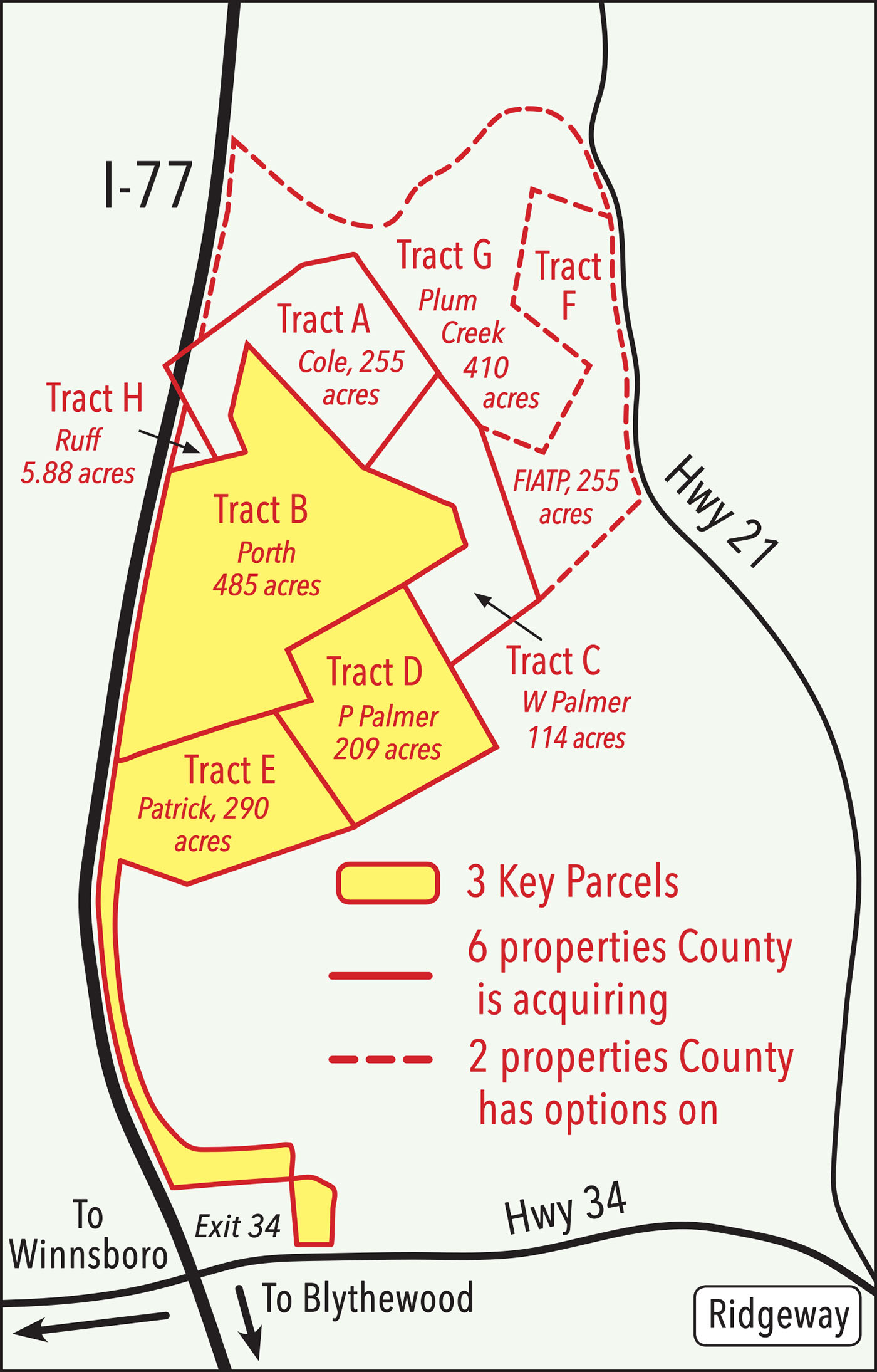
    WINNSBORO (Aug. 4, 2016) – Fairfield County Council officially embarked on a major economic development project last week, giving final authorization to an agreement between the County and the S.C. Department of Commerce to acquire more than 1,000 acres of land in Fairfield County that is located on the east side of I-77 and to the north of Highway 34. Another 800 adjoining acres are under option.

    The anticipated purchase price of the land is $8,583,669. The County will contribute $3 million with the Commerce Department raising the remaining $5.5 million. Once the properties are acquired, the County will hold the titles and will transfer the titles to the Commerce Department when it is certified that an economic development prospect intends to make a qualifying commitment on one or more of the parcels.

    “Council’s goal is to develop a mega site on this land to attract significant economic development prospects,” Ty Davenport, Fairfield County Economic Development Director, told The Voice. “This is a tremendously positive step for the County and for South Carolina. Mega projects can be transformative for communities. Our proximity to the Port of Charleston, the Charlotte International Airport, USC, Midlands Tech and to a large existing labor pool makes this site very attractive.”

    The ordinance specifies that the Commerce Department and the County will lease or buy six contiguous parcels of land that make up the site. Three of the parcels, designated as “key” parcels, meaning they are integral to the development of the mega site, comprise 984 acres and are described as the Porth Tract, the P. Palmer Tract and the Patrick Tract.

    Three other parcels are described as option parcels and include a 5.88 acre tract owned by the Ruff family. Councilman Dan Ruff (District 1) recused himself from the second reading and was not present at the special called meeting for the third reading. In total, the key and option parcels amount to just under 2,000 acres.

    Davenport said utilities and infrastructure can be extended to the site.

    “In the event that a large qualified user becomes interested in the property, funds to cover the costs of infrastructure would come mostly from the state’s resources. The commitment of these funds would be based on several criteria such as job creation, total investment, wage level, environmental compliance and other economic factors,” Davenport said. “No funds will be expended until a mega user has committed.”

    Davenport said the Commerce Department committed to actively recruiting and pursuing large economic development projects to locate on the parcels and to work with third parties in order to fund any site development costs.

    “This will not happen overnight,” Davenport said. “But I am confident that, ultimately, we will see success. Council took a very positive step in the effort to provide future jobs and long-term opportunities for Fairfield County citizens. The opportunity to partner with the State of South Carolina and the S.C. Department of Commerce as well as the I-77 Alliance and the Central Carolina Alliance is very important. Fairfield County will be marketed to significant companies around the globe.”


  • R2 Picks New Superintendent

    Dr. Baron Davis
    Dr. Baron Davis

    COLUMBIA (July 28, 2016) — At a Special Called Board Meeting on July 25, the Richland Two Board of Trustees voted to authorize Board Chairman James Manning to execute two contracts between the Board of Trustees and Dr. Baron R. Davis. Under the first contract, Dr. Davis will serve as superintendent elect from July 25 – June 30, 2017.

    “While the board has accepted Dr. (Debbie) Hamm’s retirement at the end of the 2016–2017 school year, she remains the district’s superintendent until July 1, 2017,” Manning said. “We are committed to working together to make the 2016-2017 school year a success and to ensure a smooth and seamless transition to the new superintendent. Therefore, the Board decided that it was in the best interest of the district to select Dr. Davis as superintendent elect.”

    Chairman Manning was also authorized to execute a separate three-year contract that names Dr. Davis superintendent beginning July 1, 2017.

    “I am very proud to know the district will be in great hands with Dr. Davis,” Hamm said. “He is an outstanding leader and a talented educator and truly has the best interests of students at heart. I look forward to working with him during my final year as Richland Two prepares for our next great chapter.”

    An educator for almost 20 years, Davis currently serves as one of the district’s assistant superintendents who support overall educational excellence in the schools by providing leadership, administrative direction, supervision and technical support.

    “I am beyond honored that the Richland Two Board of Trustees has entrusted me to follow Dr. Hamm as superintendent of our outstanding district,” Davis said. “Dr. Hamm and I both recognize the ultimate reasons for our success come from our extraordinary coworkers, administrators, teachers, parents, students, retirees and community members. We all share a sense of urgency when it comes to providing all learners with meaningful, challenging and engaging learning experiences. Together we will continue our focus on learning, community, character and joy as we help students maximize their gifts and talents, enabling each to chart and navigate a personal pathway towards a purposeful and productive future.”

    Davis earned a Bachelor of Science degree in sociology from Francis Marion University. From the University of South Carolina, he earned master’s degrees in school counseling and educational administration, and Educational Specialist and Doctor of Philosophy degrees in educational counseling. He holds superintendent, school counseling, secondary principal and secondary supervision certifications. In addition to his formal educational training, Davis has participated and completed numerous educational leadership programs offered through the South Carolina Department of Education including the Tapping Executive Educators Program, the School Leadership Executive Institute and the South Carolina Education Policy Fellowship Program.

    During his educational career, Davis has served as a successful school leader in rural, urban and suburban school systems where his schools were recognized for closing the achievement gap, increasing graduation rates and increasing Advanced Placement participation rates. While he was principal of Spring Valley, the school was recognized by the Washington Post as one of America’s Most Challenging High Schools and by Newsweek as one of America’s Top High Schools.

    Davis’s support of education and his community extends beyond Richland Two. Currently, he serves on the Francis Marion University Alumni Board, the University of South Carolina Trio Programs Advisory Board, the South Carolina Male Achievement Conference Planning Committee, Rotary International (Spring Valley Club, Columbia), national and state associations of school administrators, and Omega Psi Phi Fraternity Inc. He participates in the City of Columbia’s “My Brother’s Keeper” initiative. Davis was inducted into the Columbia Housing Authority’s Wall of Fame in 2015 and in past years has given service to the University of South Carolina’s Department of Counselor Education Advisory Council and the SCASA Institute of Innovation Planning Committee.

    Since assuming the role of assistant superintendent, Davis has helped to establish the Richland Two Assistant Principal Academy, the Administrators Development Series, the Training Administrators Program and the Administrators Mentoring Program. He has led the district in the implementation of a principal for a day program and the Richland Two Ready to Read book drive. Under his guidance, all five of the district’s high schools were accepted to TransformSC’s network of innovative schools in May 2016. He developed and assisted in the implementation of Richland Two’s district-wide mentoring program standards that now serves as the common framework for all current and future mentoring programs. In addition, Davis provides leadership and general oversight of the academic and programmatic development of the Richland Two Institute of Innovation, which will open in August.

    A native of Columbia, Davis is a member of the Brookland Baptist Church. He and his wife, Pam, are the proud parents of three beautiful daughters.


  • Green proposes building patio homes for teachers

    WINNSBORO (July 28, 2016) – A proposal by Superintendent Dr. J.R. Green that the Fairfield County School District construct patio homes and rent them out to teachers received mixed reactions at the July 19 regular school board meeting.

    “I’ve been working on an initiative for the last several months that would develop some housing for current and prospective teachers in the District,” Green told the Board. “We hope this will increase our ability to recruit and retain certified staff. We’ve had some conversation with experts in the field as to how we’re going to pursue maybe developing some two- and three-bedroom patio homes that would be financed through conventional financing, how we can fund traditional school district capital projects.”

    While Green did not identify the “experts” he had consulted, he said he thought the project would help teachers who work in Fairfield County and who are unable to buy housing to find a way of eventually moving here, which, he said, presents more stability and would help the entire community by spurring an economic venture. Green said he was “very optimistic about our ability to pull something like this off.”

    “So by next month I will hopefully bring forward the opportunity to make a proposal that we go out and put that project out for bid to see if we could get some firm figures on what it would cost to really pursue such an initiative,” Green said.

    William Frick, District 6, raised some questions about Green’s proposal.

    “So that we won’t run into something we ran into on a previous project, when you say, ‘put out for bid,’ could you tell us specifically what you’re talking about?” Frick asked.

    “OK, probably what I’m going to recommend, is that we pursue a design/build contract and ask firms interested in pursuing the project to give us some proposals and some firm figures on what it would cost to deliver houses that we’ve identified,” Green said. “So the design/build can encompass the architectural design and construction all under one contract. So all I’m saying is if you (contractor) have the capacity to deliver such a project, let us know what you would do it for, what would such a project cost.”

    Frick also asked Green if he had any examples to give the Board an idea what he (Green) is proposing.

    While Green did not have any models for the Board to look at, he said, “Some districts and cities have pursued such projects – Baltimore, San Francisco. One thing that initiates such a move in these cities is that teachers could not find affordable housing because the cost of living is so high. The issue in Fairfield County is not the high cost of housing, but access. There is not an abundance (of homes) available so teachers can’t find houses they are comfortable with to move in to.”

    Board member Rev. Carl Jackson (District 5) asked Green if he was proposing to build the patio homes on property the District already owned.

    “We are exploring other options,” Green said, “but, ideally, we’d like to locate them on District property.”

    Board Member Paula Hartman (District 2) said she preferred spending the District’s money on students’ education rather than building homes for teachers.

    “Let the people who build (homes) do this, not the school district,” Hartman said. “We need to stick to educating our students.”

    Hartman asked Green who would cover the cost of building and maintaining the patio homes.

    After explaining that the school district will pay for the construction of the homes, Green added that, “I will plan this so all the debt will be encompassed in the rent payments, just like a regular apartment complex. While it will cost the District money to construct the facility, my hope is that we will pursue conventional financing and then what would happen is, as we collect (rent) from the tenants, we will pay back the construction loan.”

    Green said the construction, financing, maintenance and upkeep would all be covered by the rental revenue.

    “I just don’t think the business of the school is to construct and rent out homes,” Hartman said.

    Green told the Board that he has talked to some individual County Council members about the proposal and that they told him they would be interested in partnering on such an initiative. But he said that while he is interested in partnering with the County, “I don’t want us to lose our momentum in terms of making this happen.”

    “Sometimes,” Green said, “a lot of people want to talk and evaluate. My concern about involving too many people . . . is that I just want to maintain our momentum as we move forward.”

    Board member Annie McDaniel (District 4) said she liked Green’s proposal, but asked him to keep the Board members in the loop via email so they would know where the District stands on the project and be able to answer the public’s questions about it. Green said he would.


  • Chamber Revises Funds Request

    BLYTHEWOOD (July 28, 2016) – After the Blythewood Chamber of Commerce did not receive a recommendation from the Accommodation Tax Committee last month for a request for $3,000 for salaries for Mike Switzer, the group’s Executive Director, and his assistant to coordinate the upcoming Big Grab event for Blythewood, Switzer and Chamber member Ed Parler brought a revised request for the $3,000 to Mayor J. Michael Ross.

    Chamber Board member Ashley Michie subsequently presented the revised request to the full Council Monday evening. That request called for approval of $2,000 the A-Tax Committee had already approved for security and portable restrooms for the event plus the $3,000 that the Committee had rejected for salaries. Michie told Council the Chamber is no longer going to use the $3,000 for salaries, but for social media and other outside advertising for the event.

    Ross told Council that Switzer and Parler did submit a revised request to him recently during a round table meeting in his office.

    “It was a different version (of the original request) and there would be no salaries,” Ross told Council members.

    But in an email to The Voice, Switzer said there would be salaries, but that they would be handled by the Chamber, also indicating that the $3,000 would be used for outside advertising. Switzer did not say what the source of revenue would be for the salaries.

    During her presentation, Michie read a statement from Denise Jones, founder of the Big Grab, pointing out that the event brings in more people and more money than any other event during the year. In the past, the A-Tax Committee has approved from $1,000 to $2,000 in funding for the annual event. Michie said the Chamber needs the additional $3,000 this year to assure that the Big Grab has as big a turnout as in past years.

    “This is the first year the Chamber has been involved with the Big Grab, and we just want to be sure we do it right this year,” Michie said.

    “The Big Grab has been a very successful event year after year and it is something we should support the best we can,” Councilman Malcolm Gordge said.

    Councilman Tom Utroska agreed, but said, “It just sounds odd to say, ‘We wanted $3,000 for this but if we can’t have it for this, we want it for that.’ If it quacks like a duck and walks like a duck, then it’s probably a duck.”

    Council voted unanimously to approve $2,000 for the Chamber as recommended by the A-Tax Committee, but sent the $3,000 request back to the Committee for further review. Council also approved $1,000 for the Westwood High School Redhawk Invitational, a marching band exhibition to be held Sept. 24, and $2,000 for the All-Star Baseball Tournament that was hosted by the Blythewood Baseball League June 25-30. A request for $10,000 from the Blythewood High School Band Tournament representative was tabled by the A-Tax Committee until it could review the request further.

    Decorative Banners and Poles

    The Christmas Committee presented a request to Council for the purchase of decorative banners and poles to be displayed year-round in the Town. The Committee provided pricing information for both 10 and 20 banners and also for poles with and without lighting. Council voted unanimously to approve the purchase of 20 banners for $4,500 and 10 decorative poles without lights for $5,950 for a total of $10,450.

    Fairfield Electric Company has agreed to install the poles and Town Administrator Gary Parker suggested the funds for the cost of the poles and banners could come from revenue budgeted for Community Promotions.

    “I think this will be welcoming and will give a good image to our community,” Ross said.

    Butterfly Festival Date Change

    Council voted 5-0 to approve changing the date of the Butterfly Festival. Representing Camp Discovery where the festival will be held, Board member Mary Douglas Smith asked permission to move the date of the festival from Labor Day, as planned, to May 20, 2017.

    A main reason for moving the date, Smith said, is that the May date would offer a more humane environment for the butterflies to be released.

    “Our research has shown that most butterfly releases are held in the spring,” Smith said. “That’s when they will have a better chance to survive the release. Labor Day is not a great time for a release. The butterflies won’t all migrate so they might only live a couple of weeks. Given the heat,” she added, “and their limited flight range, their food sources would be sketchy at best and we want them to survive. We don’t want to set them up for failure.”

    Palmetto Citizens Granted License

    Council passed unanimously an ordinance granting a license to Palmetto Citizens Federal Credit Union to display its corporate logo on an amphitheater and covered band shell to be constructed at Doko Park.